The Quest for Joshua Burnett Ross

by Bonnie Ross Meador.

Joshua Burnett Ross, named for his maternal grandfather, was born in Jackson Township, Clermont County, Ohio, in 1842. He was the first of eleven children born to Osmore L. and Jerusha Loveland Burnett Ross, who had been married in Jackson Township on April 14, 1839.

In the 1850s Osmore Ross moved his family to Clark County, Illinois, where he had purchased farm acreage at auction for $200. (Total interest on the mortgage was $20.) The Rosses lived on the outskirts of Casey and Crooked Creek, not far from Hazel Dell. According to the 1860 Illinois census, Joshua Ross, then 17, was a chair maker.

We have come to realize, however, that family history is much more than merely extracting a few facts from official records. Our passion for it grew out of reading The Red Badge of Courage as children and wanting to make a connection to our past through the War Between the States. It was this hope that led us on our quest.

The bits and pieces collected through family anecdotes, newspaper stories, and photographs were elusive to trace, since the family has roots in Massachusetts, New Jersey, New York, Ohio, Kentucky, Tennessee, Oklahoma, Minnesota, Utah, Oregon, California, Washington, North Carolina, and Texas. We could find nothing on Joshua beyond the 1860 census. Then I remembered The Red Badge of Courage, and a new adventure unfolded. With notebook, camera, and filing cabinet in tow, we traveled to Clark County, Illinois, to get a more authentic feeling for the family by walking in their footsteps, touching their gravestones, and walking around the old homestead. But there was still no Joshua . . ..

With the help of a librarian from Greenup, Illinois, and after days of internet research, Joshua began to emerge from the shadows. Records showed that the young chair maker had joined the Federals and become a Union soldier: on June 28, 1861, he mustered into the 21st Illinois Infantry, Company H, in Mattoon, Illinois, a few miles from his home.

Joshua’s first commanding officer was Colonel Ulysses S. Grant; when Grant received his promotion from the President, he was replaced by Colonel John W. S. Alexander. The 21st fought valiantly at Perryville, Kentucky, and at Stones River, near Murfreesboro, Tennessee, where the regiment was assigned to General Rosecrans. We were amazed to find that on their march to Stones River, the 21st had camped on Dumont Hill in Scottsville, Kentucky, the town where we presently reside.

The National Archives forwarded the information that Joshua had been wounded in the upper left chest area during the Battle of Stones River, December 1862. He was transferred to U.S. General Hospital #19, in the Morris and Stratton Building on Market Street– now 2nd Avenue–in Nashville, where he died of his injuries on February 22, 1863. Joshua Burnett Ross was buried in grave 3634 in a temporary cemetery located near the hospital. His remains were later moved to Section E, Grave 0730, in the Nashville National Cemetery.
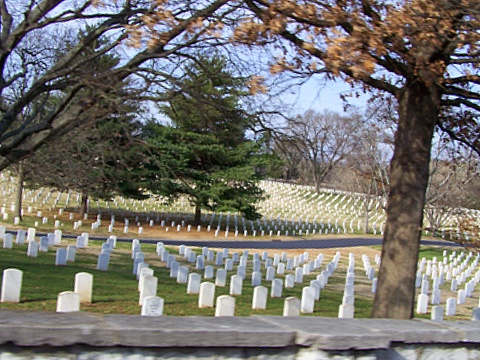
Scene in the Nashville National Cemetery

Jerusha Ross filed for her son’s pension on June 30, 1880, seventeen and one-half years after his death. Joshua’s brother, Silas L. Ross, named one of his sons after him: that child, Joshua Burnett Ross, was my grandfather.

Engraved on a brass plate near the arched marble gateway of the National Cemetery are the words of Abraham Lincoln’s “Gettysburg Address,” a fitting tribute to my great-great-uncle and all who lie beside him. On July 4, 2004, a hot Sunday afternoon, armed with advice from the Nashville Historical Newsletter and its readers, we were able to walk directly to Joshua’s grave. Knowing he was from a poor farm family who lived far away, we had little doubt that we were the first family members to stand at his gravesite. Our visit to the National Cemetery, the close of a great adventure, brought us a step closer to knowing where we came from. Our lives are made richer by the knowledge that my great-great-uncle gave up his life for us and for the hope of an America undivided.
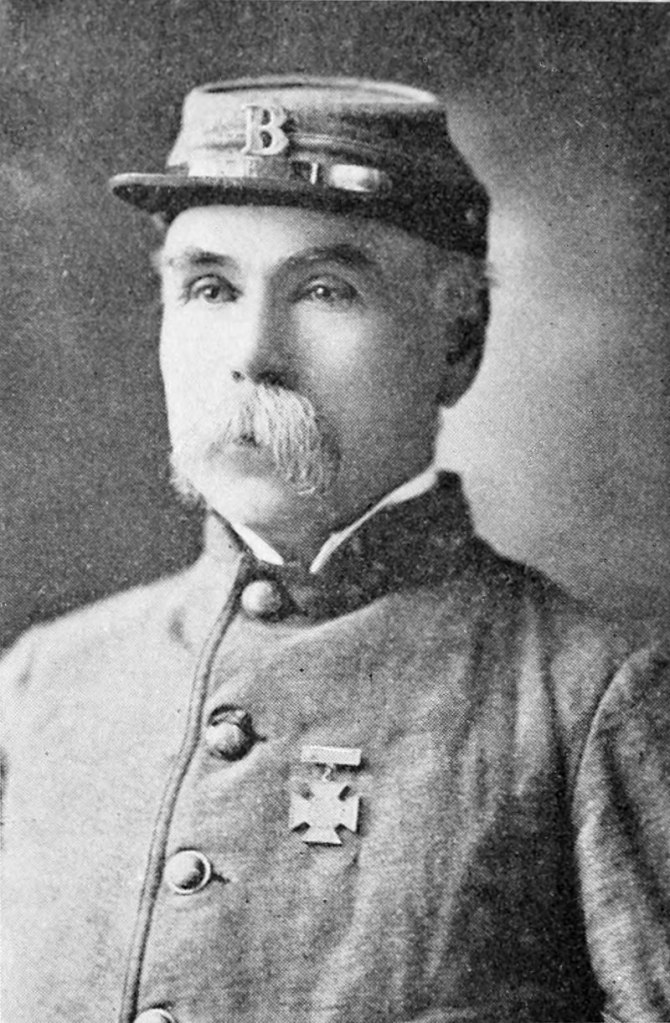
Marcus B. Toney (1840-1929)

by Kathy B. Lauder.

Born near Lynchburg, Virginia, on August 19, 1840, Marcus Breckenridge Toney came to Tennessee with his family when he was two years old.1 His father, a millwright, had intended to settle in St. Louis, but Mrs. Toney became too ill to travel beyond Nashville.2  She never recovered her health and died when Marcus was six. None of Toney’s siblings survived childhood and, when his father died early in 1852, the eleven-year-old found himself alone in the world.3 Relatives took him back to Virginia, where he attended college, but by 1860 he had returned to Nashville.4

Marcus B. Toney, about 1905

When war broke out, Toney enlisted in the First Regiment of the Tennessee Infantry (Feild’s), Company B, known as the Rock City Guards.5  The regiment was sent to Virginia, where they fought beside Lee at Cheat Mountain and Stonewall Jackson at the Potomac River before returning to guard the Cumberland Gap.6 In 1862 they took part in Bragg’s invasion of Kentucky and fought at Stones River in December.7  Toney was transferred in February 1864 to the Forty-Fourth Virginia Regiment, which participated in the Battle of the Wilderness in May.8 Captured with 1100 other Confederate soldiers, he was sent to the prison camp at Point Lookout, Maryland,9 and then transferred to Elmira, New York,10 where he spent the remainder of the war. His experiences as a prisoner make up a significant part of his memoir, The Privations of a Private*, published in 1906.

Returning to Nashville, Toney became involved for a short time with the Ku Klux Klan, perceiving the group as “conservators of law and order”11 during the chaotic years following the war.  On December 4, 1868, Toney was on board the steamer United States when it crashed into the steamer America in the Ohio River.12 He escaped by swimming to shore in his nightclothes. Many other passengers who jumped into the river to escape the burning ship died as flaming oil spread across the water.13

In 1872 Toney married Miss Sally Hill Claiborne, who would bear him two children. The same year he became Nashville commercial agent for the New York Central Railroad, holding that position more than forty years.14 He wrote many articles for newspapers and other publications, particularly the Confederate Veteran, edited by his friend Sumner Cunningham. Toney was a witty and amusing raconteur and was frequently invited to speak about his wartime experiences.  

During the mid-1880s Marcus Toney and Dr. William Bumpus became interested in establishing a residence for the widows of members of the Masonic brotherhood. The two men traveled throughout Tennessee seeking financial support for the project, and their board acquired a charter of corporation in August 1886.15 The Masonic Widows’ and Orphans’ Home was constructed near Nashville on 220 acres donated by Col. Jere Baxter.16 Funded by the Grand Lodge and personal donations, the home and its associated dairy farm opened in 1892 and operated successfully until the 1930s.

Marcus Toney died of “old age” 17 in Nashville on November 1, 1929, and was buried in Mt. Olivet Cemetery. (2014)


*A paperback edition of Privations of a Private, edited by Dr. Robert E. Hunt of MTSU, was published by Fire Ant Books in 2005. That and other editions of the book are available from most booksellers.


SOURCES:

1  Hale, Will Thomas, and Dixon Lanier Merritt. A History of Tennessee and Tennesseans: The Leaders and Representative Men in Commerce, Industry and Modern Activities, Volume V.  Lewis Publishing Company, 1913, 1507.

2  Hale and Merritt, 1508.

3  Toney, Marcus B. The Privations of a Private. Edited by Robert E. Hunt. Tuscaloosa: University of Alabama Press, 2005, xi-xii.

4  Hale and Merritt, 1508.

5  “Soldier Details,” U. S. National Park Service: The Civil War. http://www.nps.gov/civilwar/search-soldiers-detail.htm?soldier_id=788cd8d9-dc7a-df11-bf36-b8ac6f5d926a  Website accessed April 26, 2014.

 “Regimental Organisation.” First Regiment, Tennessee Infantry (Maney’s) Co. E. http://first-tennessee.co.uk/organisation.htm  Website accessed April 26, 2014.

 “Regimental Organisation.”

8  Toney, 64-70.

9  Toney, 76-83.

10  Southern Historical Society Papers, Volume XXIX. Edited by Robert Alonzo Brock. Richmond, VA: Southern Historical Society, 1901, Chapter 1-19.

11   Toney, 118.

12  “Ohio River Tragedy.” Northern Kentucky Views. http://www.nkyviews.com/gallatin/gallatin_river_disasters.htm  Website accessed April 10, 2014.

13  Toney, 120-121.

14  Hale and Merritt, 1508.

15  “The Masonic Widows and Orphans Fund of Tennessee.” The Grand Lodge of Tennessee, Free and Accepted Masons.  http://www.grandlodge-tn.org/?chapters=Y&page=WO Website accessed April 20, 2014.

16  “Masonic Widows’ and Children’s Home.” Historic Nashville. http://historicnashville.wordpress.com/2009/03/05/masonic-widows-childrens-home/ Website accessed April 20, 2014.

17  Tennessee Death Records, 1908-1959, Roll #11.  Nashville: Tennessee State Library and Archives.