Jonathan Jennings’ Will

Primary Source Document, transcribed by Debie Cox, author of Nashville History blog.

Editor’s Note: Historian Debie Cox discovered the Jennings will in the Metro Archives in 2001. Jennings’ tragic death soon after he drew it up gives unusual poignancy to the document. The will is historically significant because it is likely the oldest surviving document from Nashville, other than the Cumberland Compact itself.

Jonathan Jennings and his family were among the group of pioneers who journeyed with the John Donelson flotilla to the Cumberland Settlements. Donelson recorded in his journal on March 8, 1780, that Indians had attacked the flotilla, and that the Jennings family had been left behind as the settlers in the other boats made their escape.

The Jennings boat had indeed survived, but not without casualties. Jennings’ daughter Elizabeth, wife of Ephraim Peyton, had given birth the day before the attack. In the confusion of the fighting, her baby was killed. Jonathan Jennings Jr., son of the elder Jennings, had jumped from the boat along with two other men. Although young Jennings, who was probably in his early teens, and one of the others made it to shore, the third man drowned. Jennings Jr. and his companion were quickly captured by the Indians, who scalped Jennings and killed the other man. Young Jennings, who had survived his injuries, was eventually rescued by a trader who agreed to pay his ransom, and he was later able to reunite with his family in the Cumberland Settlements. After the attack, the remaining members of the Jennings family had continued on their journey, arriving at Fort Nashborough on April 24, 1780.
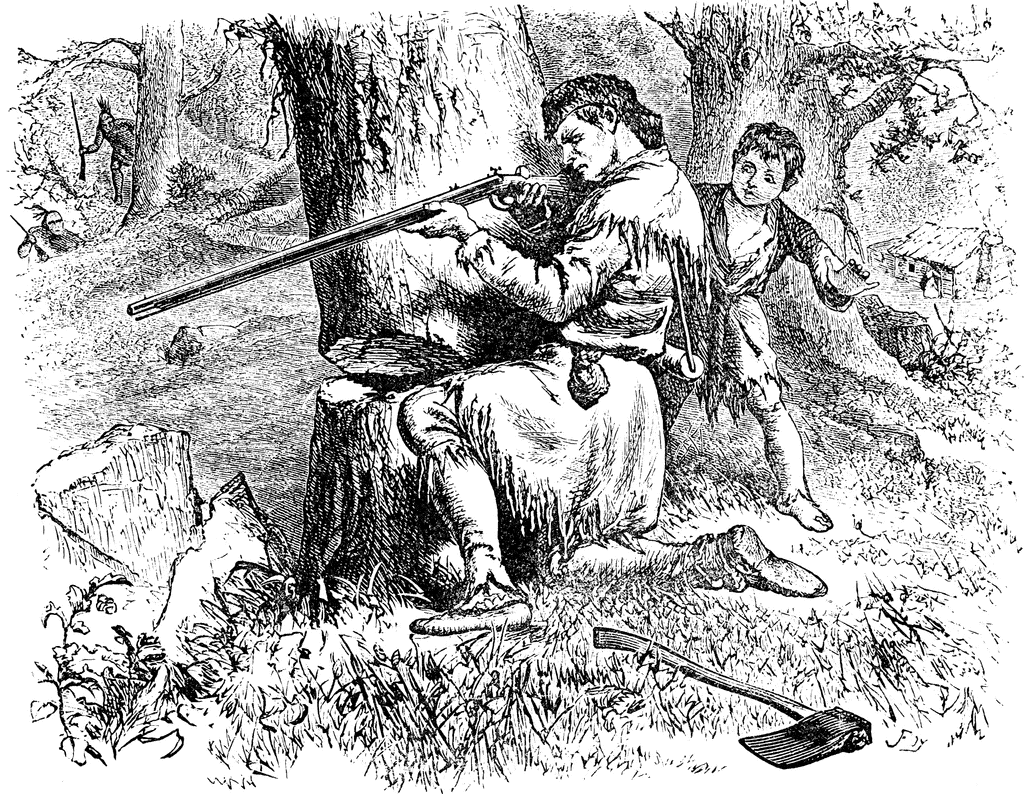
According to J. G. M. Ramsey in his Annals of Tennessee, Jonathan Jennings Sr., was himself killed by Indians three or four months later, in July or August 1780. He left an undated will, which was presented to the Davidson County court in July 1784 and proven on the oaths of James Robertson and William Fletcher. The will had also been witnessed by Zachariah White, who had died at the Battle of the Bluffs near Fort Nashborough in April 1781. The signatures of Jennings, Robertson, and White can be verified through comparison with their signatures on the Cumberland Compact, which all three men had signed in May of 1780. The will reads as follows:

In the name of God Amen I Jonathan Jennings of North Carolina on Cumberland River having this day Received several wounds from the Indians and calling to mind the mortality of my Body do make and Ordain this to be my last will & Testament And first of all I give and recommend my soul to God that gave it and my body to be disposed of at the Discretion of my executors And as touching my Worldly affairs I dispose of them in manner following Viz

Item I give and bequeath to my    It is my Desire that my Estate be Equally divided between my Wife my sons William, Edmond, Elizabeth Haranor Mary Aggy Anne & Susannah all but such a part as shall be hereafter disposed of

Item I give and bequeath to my son Jonathan who was Scalped by Indians and rendered incapable of getting his living a Negrow girl Milla & her increase who is to remain with my beloved wife till my son comes of age Also a Choice Rifle Gun & a Horse and Saddle Item I give my beloved wife Four Choice Cows and Caves The Wards Milla and her increase and the Ward Jonathan being interlined I devise that my Loveing Wife and my son Edmond be Executrix & Executor of this my last Will & Testament
Signed Sealed & Published in Presents
of Jonathan Jenings
Zach White
Js. Robertson
William Fletcher
Robert “Black Bob” Renfro: from Slave to Entrepreneur

by Larry Michael Ellis.

Robert “Black Bob” Renfro is mentioned in at least 25 records that date from 1792 to 1816. Members of John Donelson’s epic river voyage, his group left the Donelson party on April 12, 1780, at the Red River near present-day Clarksville. His master, Joseph Renfro, was a kinsman of the group’s leader Moses Renfro. Indian attacks, probably in 1780, drove them from what had become Renfro Station. Accounts differ as to the sequence of events which followed, but we do know that Joseph Renfro was killed near present-day Coopertown at what came to be known as the Battle Creek Massacre. Folk legend says that Black Bob saved his mistress and her children. Other historical accounts state that only a Mrs. Jones escaped. Nevertheless, Bob’s mistress, Olive Renfro, did arrive at Fort Nashborough where she petitioned for and was granted “letters of administration” for the estate of Joseph Renfro.

Bob does not appear in an official record until August 8, 1792, when he was sold by Olive Renfro (now Shaw) in what appears to be a three-party transaction. Bob became the property of Josiah Love, whose financial troubles involved him in several lawsuits, with Andrew Jackson serving as his lawyer. One foreclosure document lists Bob as Josiah Love’s only asset. Around the same time, Love entered into another complicated transaction in which two people claimed ownership of Bob: Robert Searcy, a prominent lawyer, and Elijah Robertson agreed to let the courts determine the true owner. In November 1795 the Court ruled Searcy was the rightful owner.

In the meantime, on January 16, 1794, the Davidson County Court agreed that “a certain Negro called Bobb [sic] in the town of Nashville be permitted to sell Liquor and Victuals.” This was the origin of what came to be known as Black Bob’s Tavern. A 1797 record lists an assault occurring at the “house of Black Bob.” This establishment was probably located on what is now Third Avenue, south of the Public Square.

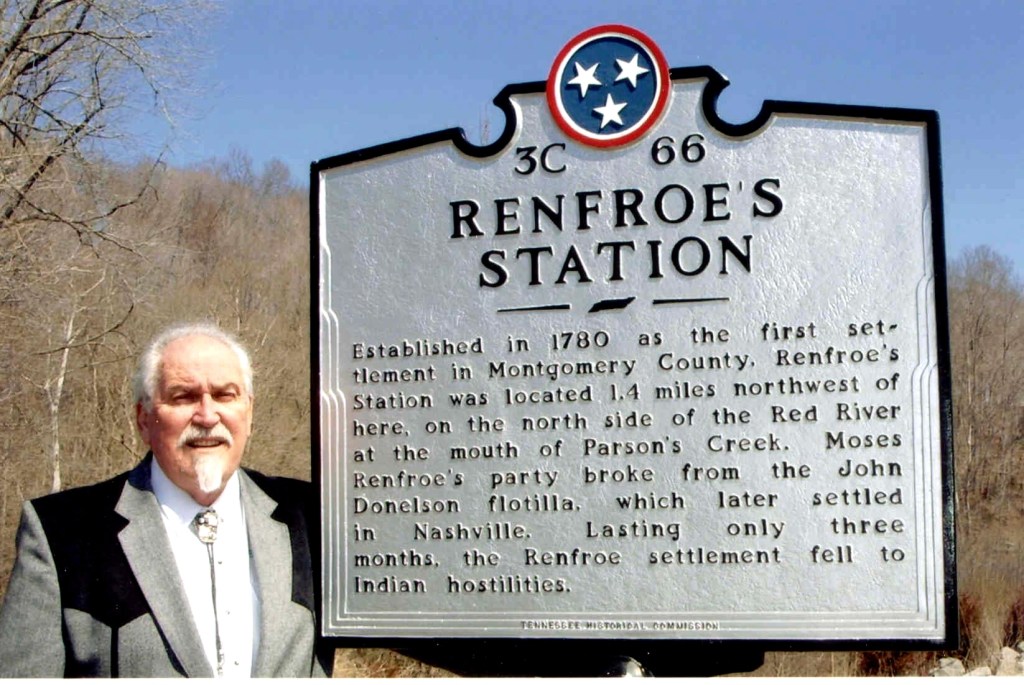
Author Mike Ellis with historical marker commemorating the establishment of Renfroe’s Station in Montgomery County, Tennessee. (Photo courtesy of the author)

An unusual event occurred in April 1800 when schoolmaster Anderson Lavender assaulted Bob. Lavender was indicted by the Davidson County Grand Jury. When he agreed to pay court costs, the case was dissolved. This was a significant moment in legal history: a white man was indicted for assaulting a slave, and the case was not simply dismissed. Andrew Jackson, Archibald Roane (future governor), and David Campbell were judges at the time the suit was heard before the Superior Court.

Robert Searcy maintained ownership of Bob until 1801, five years after Tennessee became a state. Searcy believed that Bob had more than paid back his investment and agreed to free him. However, freedom and emancipation are not synonymous terms. Fifty-three of Nashville’s most prominent and influential citizens, one of whom may have been a woman, signed a petition to the General Assembly requesting that Bob be emancipated, “giving him all the privileges that is usual to persons in a similar situation.” On November 10, 1801, the Fourth General Assembly of the State of Tennessee granted the request and further stated that he “shall in the future be known as Robert Renfro.”

The emancipated Robert Renfro opened a new “House of Entertainment” in 1802 that was located on Main Street (present-day Second Avenue). Robert then purchased a life estate in Lot #25 from Robert Searcy on Main Street where he built and operated his business until a fire destroyed the establishment in 1814. He then rented and operated the “stone tavern on the public square, near the courthouse.”

Robert Renfro continued to be involved in court cases, prevailing in at least three cases before white juries. In an 1805 breach-of-contract case he sued Charles Dickinson (who would be killed the following year in a duel with Andrew Jackson), and the appeals process established several Tennessee legal precedents. Renfro’s name is listed on militia and tax rolls, as well as in the records of several other legal transactions.

The last record mentioning Robert Renfro dates from 1816. Although no record has been found of his death, his name does not appear in the 1820 U.S. Census of Nashville.