Primary Source Document from Nashville’s Post Five Legionnaire, July 1956, p. 6.
PRIEST ASKS CONGRESS TO APPROVE FLAG AT DRIVER’S GRAVE
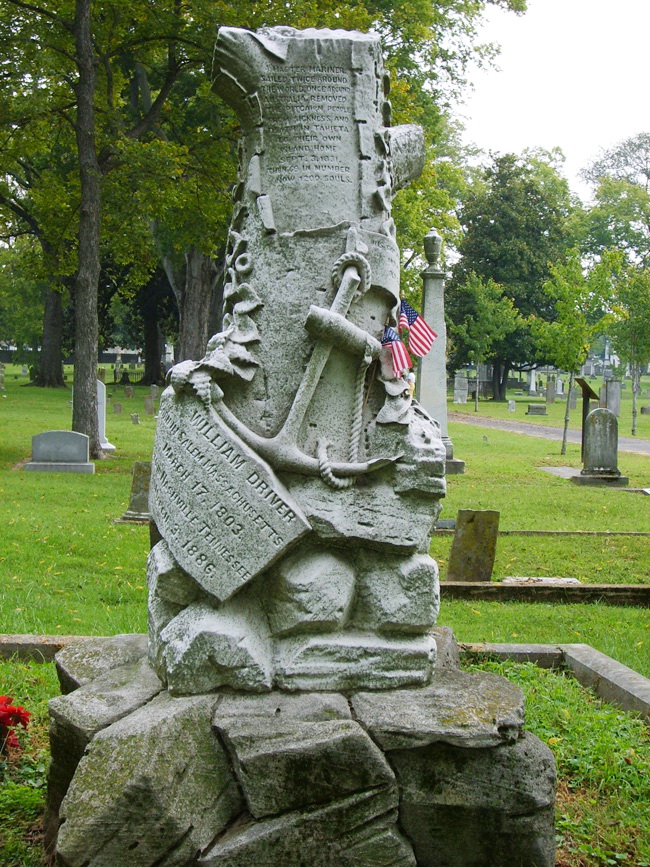
U.S. Rep. J. Percy Priest has introduced a bill in the House of Representatives to permit an American flag to fly 24 hours daily over the grave of Captain William Driver in City Cemetery at Nashville.
The bill was introduced at the request of the Post 5 Committee for the erection of a shrine to Captain Driver, who named the American flag “Old Glory.”
William Driver’s monument in Nashville City Cemetery (NHN photo)
Burr Cullom, Chairman of the Post 5 committee appointed by Commander Lannom, introduced the original resolution last year at a Post meeting and forwarded the Post’s request to Congressman Priest recently.
Congressman Priest’s H.R. 12092, introduced on July 3, 1956, and referred to the Committee on the Judiciary, follows:
A BILL
“To permit the flying of the flag of the United States for twenty-four hours of each day over the grave of Captain William Driver in City Cemetery, Nashville, Tennessee.
“Be it enacted by the Senate and House of Representatives of the United States of America in Congress assembled, That notwithstanding any rule or custom pertaining to the display of the flag of the United States of America as set forth in the joint resolution entitled “Joint resolution to codify and emphasize existing rules and customs pertaining to the display and use of the flag of the United States of America,” approved June 22, 1942, as amended, authority is hereby conferred on the appropriate officer of the State of Tennessee to permit the flying of the flag of the United States for twenty-four hours of each day over the grave of Captain William Driver in City Cemetery, Nashville, Tennessee.”
Previously published in Monuments & Milestones, the Nashville City Cemetery newsletter.
Five decades ago, on October 12, 1956, U. S. Representative J. Percy Priest died in Nashville, Tennessee. Doctors had performed an emergency repair of a duodenal ulcer, and the congressman had seemed to be recovering. But then a massive hemorrhage unexpectedly took his life. Earlier in the year his doctor in Washington had warned him not to delay the surgery, but Priest, knowing that recovery would take three to four months, had replied, “Later, I have too much to do right now.” Since 1956 was an election year, he returned instead to his home in Nashville (at 417 Fairfax Avenue), campaigned as an incumbent in the August primary for Tennessee’s Fifth Congressional District in Davidson County, and steamrolled to an easy victory. Rather than take care of himself, he then persisted with his hectic schedule – speeches, parades, and running the statewide campaign for the Stevenson-Kefauver Democratic ticket. He was also looking forward to leading the singing at Union Station before Billy Graham’s special train left Nashville for Louisville in October. Unfortunately, however, in late September, after speaking to a men’s group, Rep. Priest collapsed and was rushed to the hospital.
U.S. Representative J. Percy Priest
Priest’s renown was assured as early as January of 1941 when he took his oath of office. “It must be divine Providence,” House Majority Leader John McCormack declared, “that . . . crisis sends men like Lincoln, Wilson, and Roosevelt to the White House, and men like Percy Priest to the legislative branch.” Although he was a freshman congressman, Priest “threw himself totally into the maelstrom and helped with every ounce of his individual strength and . . . leadership to give legislative lucidity, order, and direction” during World War II. That is the way Priest worked for the next sixteen years.
Children at Percy Priest Lake, named in honor of the congressman. (from NHN photo collection)
Percy Priest was a visionary, predicting that in fifty years (dating from 1946) mental illness would be one of the biggest health concerns in our country. With TVA, he visualized the program’s ultimate goal: recovery, restoration, and utilization of the land of the Tennessee Valley, an area covering seven southeastern states. His legislation improved and advanced public health, education, and scientific research.
Priest was deeply admired and respected by his contemporaries. Several friends commented that he tried to “live as much like Jesus” as anyone they had ever known. In the House he was the most beloved man on either side of the aisle. His family knew that if he had to get to the top by walking on people he would rather not go. His constituents felt free to stop by his office in Washington unannounced, and he always obliged them. Someone once even asked if he could send the Coast Guard to find a set of false teeth that had fallen overboard in the Gulf of Mexico! (He couldn’t.) After Priest’s unexpected death, thousands flooded Nashville’s Park Avenue Baptist Church where his service was held, spilling onto the steps and sidewalks outside the building. Throngs stood in mournful lines as the hearse drove slowly through the city streets.
In the half century since his death, Percy Priest has gained a measure of immortality through various memorials to his name: a school because he was an educator; a county road because he was born nearby; a dam, reservoir, and enormous recreation area because he supported TVA. Yet few Tennesseans truly understand the extent of his character and statesmanship. Although he was not a perfect man, he exemplified the virtuous and courageous life. He believed his duty in Washington was like that of a soldier, heeding the admonition of Robert E. Lee, a man Priest admired: “Let danger never turn you aside from the pursuit of honor or the service of your country. Know that death is inevitable and the fame of virtue is immortal.” The more intangible monuments of his legacy – his progressive, humane, and farsighted legislation – continue to benefit the citizens of the United States.



 Nashville Historical Newsletter