From Curiosity to Hope: The Work of Local Historians

by Kathy B. Lauder.

Idle curiosity? There is no such thing. Curiosity, whether innocent, prying, or professional, drives historical research. Every chronicler of noteworthy events must ask the who-what-where-when-why-how questions that produce accurate records, but a good historian is also an artist. In classical Greece, history even had its own muse, Kleio, “Granter of Glory,” since an orderly account of the chaotic events of a battle or an era is as much a work of art as a poem or a drama. Curiosity unfurls the sails of imagination, and imagination is the flagship for our journey toward understanding.

Photo by George Gamble

We are all potential historians, but we will never be truly effective until we wade into the river of history to experience it with a child’s attentiveness.  Children learn about the world by breathing it into their souls (the Latin root of inspiration means “breath”) and by asking endless questions.  Behind every doorway in our neighborhood, a story unfolds; on every street in our town, epic events occur; in the heart of every city, life, with all its complexities, waits for an enlightened historian to discover it.

Herman Hesse’s Siddhartha achieved enlightenment only after realizing “that secret from the river, that there is no such thing as time . . . that the river is everywhere at the same time, at the source and at the mouth, at the waterfall, at the ferry, at the current, in the ocean and in the mountains, everywhere, and that the present only exists for it, not the shadow of the past nor the shadow of the future.

Anyone who has visited a Civil War battlefield understands how effortlessly the line blurs between past and present: the tragic events that happened there can still make us weep. Anne Frank’s spirit lives on in a dark attic in Amsterdam. Emerson’s frayed straw hat still hangs on a peg in the hallway of his house in Concord; a visitor imagines that the great writer himself might stride past at any moment and slap the hat onto his head. History surrounds us, and we can drift serenely in it if we open our hearts to wonder.

Be warned: a well-developed sense of curiosity may not make us popular – it is, in fact, commonly considered humanity’s first negative trait. Eve and Pandora are both reviled as examples of feminine imperfection. Giving ourselves over too freely to curiosity puts us at risk of being deemed “prying” or “meddlesome.” Curiosity, after all, killed the cat.

Photo by Michael DeHart

On the other hand, the rewards of perseverance can be great. Most of those punished for curiosity eventually receive compensation for their suffering. Although Eden was glorious, Eve discovered the satisfaction of personal accomplishment only after leaving Paradise. Pandora released evil into the world by opening The Box; however, the lovely, fragile creature who remained with her afterwards was hope, that same spiritual longing with which historians guide the past forward into the present. (2002)

Our Story . . .

A Nashville native, Mike Slate (1947-2021) attended Metro public schools and held degrees from Lipscomb University, Harding School of Theology, and Peabody College. Concerned by Nashville’s lack of a publication dedicated to “saving and conveying the local historical knowledge of its citizens,” Mike founded the Nashville Historical Newsletter (NHN) in January 1997 as a “medium for historical sharing.”

Mike Slate (photo by Tim Slate)

Mike was also one of the presenters in the WNPT production of “Memories of Downtown Nashville,” which still appears frequently during station fundraisers. (Here is a segment of that program dealing with the history of Union Station: https://www.youtube.com/watch?v=dBWgti8iLvk). After many requests for the NHN collection in book form, Mike and his wife Kathy Lauder published The Confederate Twenty-Dollar Irony and Other Essays from the Nashville Historical Newsletter, a compilation of selected essays, in 2004. A second book, From Knickers to Body Stockings and Other Essays from the Nashville Historical Newsletter, followed in 2006. In recent years, Mike had become a zealous advocate for Buchanan’s Station, helping to organize the Friends of Buchanan’s Station Cemetery, a group formed in 2012 to raise awareness of the site and to provide needed funding for its protection, preservation, and ongoing maintenance. After a kick-off event commemorating the 220th Anniversary of the Battle of Buchanan’s Station in September 2012, the group collected more than $10,000 in donations to construct a metal fence around the cemetery, marking and protecting the site. In addition to organizing cleanup days, members have also raised funds for repairs and an archaeological assessment of the property. Their efforts ultimately encouraged the owner of Pinnacle Business Products, who owned the 1.46-acre site, to donate it to Metro Nashville Government in 2015. The Metro Parks and Recreation Department now manages the property, which is located on a proposed future expansion of the Mill Creek Greenway system.

Kathy Lauder, current NHN administrator, moved to Nashville from Maine in 2003. She taught high school English and theatre for 30 years in Maine and Maryland and was an employee of the Tennessee State Library and Archives (TSLA) from 2003 until her retirement in late 2013.

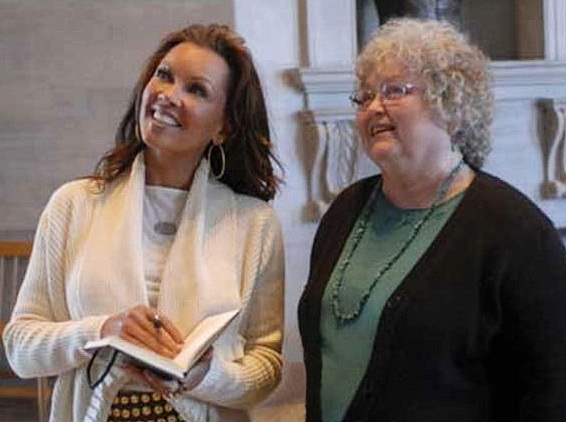
Kathy Lauder (r) with Vanessa Williams in a still from “Who Do You Think You Are?” 2011

As part of her work with TSLA, Kathy completed the research and writing for the award-winning online exhibit “‘This Honorable Body’: African American Legislators in 19th Century Tennessee”, which was featured in the Nashville Public Television documentary, First Black Statesmen: Tennessee’s Self-Made Men. She also appeared in the NBC television series Who Do You Think You Are, providing historical background for the 2011 episode featuring Vanessa Williams. Kathy joined the NHN staff as editor in 2002, shortly after the newsletter’s transition from printed to online publication. As a board member of the Nashville City Cemetery Association, she edited that organization’s newsletter Monuments and Milestones for several years. Currently engaged in a project to locate and restore missing names of people buried in Mt. Ararat and Greenwood cemeteries, she publishes a short biography of one of those individuals every Friday on the Greenwood Project Facebook page. A published poet, she is also an occasional contributor to The Tennessee Conservationist magazine. (Oct 2021)