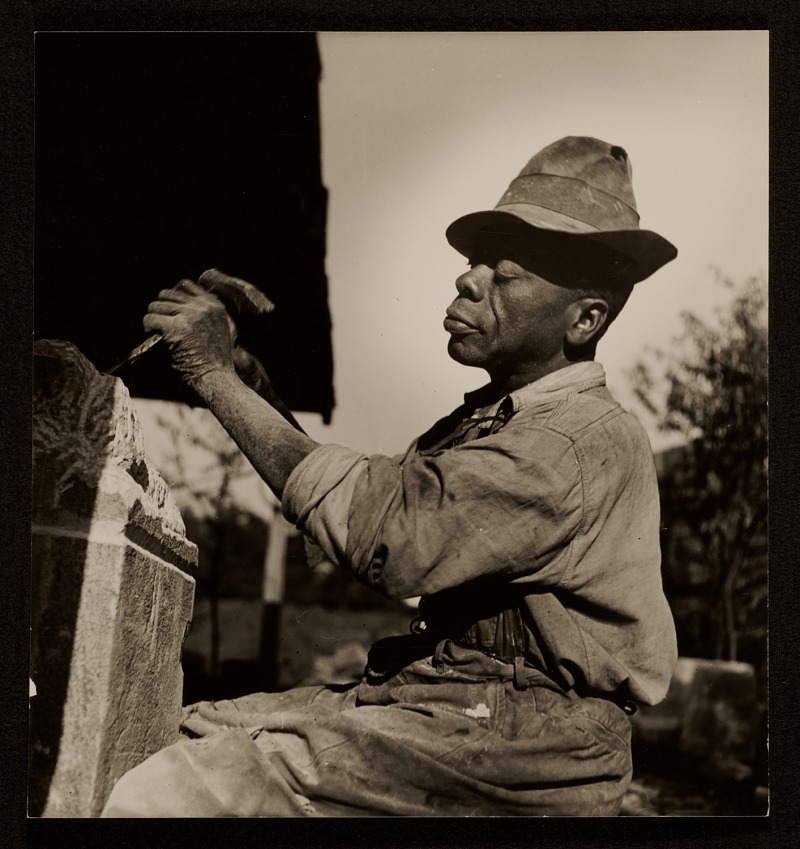
William Edmondson was one of six children born to Orange and Jane Edmondson, newly emancipated slaves. A handyman, he worked in Nashville railroad shops and at odd jobs until he heard God’s voice directing him to develop his gift for sculpture. Although nearly 60 by then, Edmondson collected bits of limestone (broken curbstones and bulldozed foundation stones collected by friends from wrecking companies) and began to carve – first tombstones, and then birds, animals, and religious figures. He worked outdoors in his yard on 14th Avenue South in Edgehill, where Murrell Elementary was later built. Within five years art critics had discovered his lyrical work, labeling it “modern primitive” and demanding more. His sculpture began to appear in exhibits around the country, and he was the first African American to have a one-man show at the Museum of Modern Art (1937). His work is now in the permanent collections of the San Francisco Museum of Art, the Hirshhorn, and the Smithsonian.
William Edmondson at work on a sculpture on his Edgehill property, 1937. (Elizabeth McCausland papers, 1838-1995. Archives of American Art, Smithsonian Institution. Photo is in public domain.)
____________________
The Greenwood Project is a series of 160-word biographies of individuals who lie at rest in Mt. Ararat and Greenwood cemeteries, two historic African American burial grounds in Nashville, Tennessee. The project, which began in September 2014 (and is still available on Facebook, at https://www.facebook.com/profile.php?id=100064806156276), shares the stories of more than 300 consequential individuals, primarily African American, who changed the course of city, state, and national history through their words and deeds. (All biographies were written by Kathy Lauder unless otherwise noted.)
In the summer of 2002 Alan LeQuire and Lou Reed supervised the gilding of Nashville’s Athena, the tallest indoor statue in the Western world. The statue, unveiled in the Centennial Park Parthenon in 1990, stood large (41′ 10″ tall), white, and incomplete for 12 years. The mission of Nashville’s full-scale replica of the Parthenon is to provide modern visitors a glimpse into the Athenian Parthenon of 438 B.C. Today the gilding project is complete and we are closer to our goal. Remarkably, the project (including gilding and painting) took just over three months, from June 3 – September 5, 2002.
The statue is a re-creation of Athena Parthenos that once stood in the Parthenon in Athens. The Athenian sculptor Pheidias constructed the massive statue from gold and ivory. The statue disappeared around 400 A.D. and little evidence remains to explain what happened to it. However, a number of ancient writings describe the statue before its loss. Sculptor Alan LeQuire studied these writings and relied on historians and his instincts to re-create Athena.
Archaeologists could spend hours discussing the minutiae of LeQuire’s decisions. It is impossible to reproduce the statue to the last detail. No one can duplicate the bridge of her nose; no one can cast a mold of her ancient sandals. She is gone. However, new scholarship circulates and new research stirs lively academic debate.
Kenneth Lapatin, of the Getty Museum, spoke in Nashville on chryselephantine (gold and ivory) statuary on September 23, 2002. His lecture provided listeners the opportunity to learn about the historic precedent of the gilding project. When Lapatin came to Nashville five years ago and saw the ungilded statue, he was politely impressed but expressed relief when he learned that we would not leave the statue white, absent of her gold decor.
The gilded Athena (photo by Gary Layda)
In his lecture Lapatin did not offer a head-to-toe comparison of the two figures. Rather, he explained the extravagance, expense, and purpose of the original compared to our own. For example, the gold plates on the Athena statue in ancient times weighed approximately 1,500 pounds and were one-eighth to one-sixteenth of an inch thick. The 23.75-karat gold leaf on Nashville’s Athena weighs about 8.5 pounds and is three times thinner than tissue paper. Our extravagance pales in comparison to the lavish spending of the Greeks.
Lapatin is especially fascinated with the work of ancient ivory craftsmen. Athena’s exposed skin, mainly that of her face and arms, was mysteriously carved or molded from sheets of ivory. Lapatin has even attempted to duplicate ivory casting on a small scale, but we still may never know the ancient techniques. To create a statue exactly as Pheidias did would be economically impractical today. The craftsmen of Nashville’s Athena painted her skin an ivory color to give the impression of delicately carved bone.
The Greeks’ dedication to Athena motivated them to spend and overspend on her monument. The Parthenon in Nashville is a tribute to the art of the 5th century B.C. Our Athena provides us the opportunity to understand the skill and devotion of the ancient Greeks. Lapatin called her “otherworldly” and, to anyone who sees Nashville’s Athena, the archaeological particulars do indeed seem less important. Like the building in which she resides, Athena is impressive…and as accurate as scholarship allows.
List of Artists (Gilders and Painters) Alan LeQuire Lou Reed Allison Byrd Amy Calzadilla Micki Cavanah Smith Coleman Patricia H. Coots Carol Lynn Driver Jenny Gill Susan Jane Hall Susan Harris Charlotte A. Hester Shana H. Keckley Margaret A. Krakowiak Dennis C. Lake Patrick J. Paine Andrew Rozario Jean B. Spencer Luke C. Tidwell


 Nashville Historical Newsletter