A scene in the Forehand compound in Woodlawn Memorial Park (photo from NHN collection)
Woodlawn Memorial Park, a cemetery established in the 1930s and acquired in 1993 by Houston-based Roesch-Patton Corporation, occupies a piece of ground rich in local history. The property, which eventually became known as Melrose, was part of John Topp’s Revolutionary War Grant #461 of November 25, 1788. The original 960 acres were reduced by a sale to Michael Deadrick, first president of the old Nashville Bank. The remaining 205 acres were purchased in 1836 by a United States Senator from Louisiana, who built a mansion there. In December 1865, the property was the site of a field hospital during the Battle of Nashville. Even today a group of log cabins, a spring house, and a man-made pond can be found near the site where the Melrose mansion once stood. Present-day Woodlawn cemetery is part of the 205-acre site that once ran from what is now the Melrose shopping area on Franklin Road to Melrose Avenue between Bransford Avenue and Nolensville Road.
Melrose Mansion, built in 1836 by Louisiana planter Alexander Barrow II, was sold six years later to John W. Saunders, who died shortly after taking possession of the property. In 1845 Saunders’ widow married Aaron V. Brown, just after his inauguration as the thirteenth governor of Tennessee. Brown, a law partner of James K. Polk (who was elected President the same year Brown became governor), had over a 24-year period served in both the Tennessee State Legislature and the U.S. House of Representatives. He later served as President Buchanan’s Postmaster from 1857 until Brown’s death in 1859.
The widow Brown suffered severe financial losses as a result of the Civil War. After her death in 1892, the property, by then only 130 acres, was sold at auction to Godfrey M. Fogg. The house would later pass into the hands of first the Sinclair and then the Bransford families. In time it became the Melrose House Restaurant, which operated in the building until the mid-1970s. Eventually two fires, in 1975 and 1979, destroyed the old mansion.
A few years earlier, in 1966, the Forehand area of the property took its name, when George and Lillian Forehand leased the stone spring house where the Melrose Mansion’s owners kept milk, butter, and other perishables. They attached their own home to the spring house, which became the Forehands’ living room, with its three-foot thick walls and cork floor.
A plaque beside the spring points out that the Confederate works ran 200 yards south of the Melrose residence; a second marker explains that a Confederate cannon used in the Battle of Nashville was borrowed from the home of Spencer McGavock. The cannon, featured in a photograph taken at the dedication of the memorial in 1969, no longer guards the plaque. The gun’s current location is a mystery.
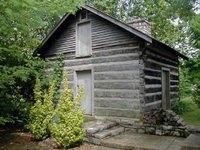
One of the two log cabins on the Forehand property. (photo from NHN collection)
As the Forehand house was under construction, the family acquired two more historic structures: log cabins that had once stood on ground now covered by Percy Priest Lake. Numbered before being dismantled, the logs were transported to their present location, where they were carefully reassembled. In front of one of the cabins is a placard identifying it as “one of the oldest remaining houses from the early American era.”
The cabins’ original owner, Tennessee pioneer Alexander Carper, came to Davidson County from Virginia and settled in the Cane Ridge community of Antioch. He married in 1825 and built his log home near Mill Creek. Descendant William Washington “Wash” Carper and his family dedicated the buildings in 1969 to Woodlawn Memorial Park for historical preservation.
The Forehand enclave nestles among sheltering trees on a bend of the road behind the Woodlawn funeral home. The couple created an idealistic pioneer setting there, ornamented with flowering shrubs and plants blooming in pots and hanging baskets. Cats napped on the porches, ducks swam in the lily pond, and the flag soared proudly above a colorful garden.
Eventually graves began to encroach upon the Forehand property. After George’s death in 2001, Lillian lived there alone, surrounded by the cemetery. Armed with pistol and shotgun, and under the watchful eyes of the Berry Hill police, she kept the vandals away. Eventually Lillian, too, moved from the house.
Memorials are created to be visited, contemplated, appreciated, and enjoyed. Today the Forehand compound features the spring and spring house of Melrose Mansion, the two Carper cabins, plaques to remind us of our Civil War past, and a tribute to Governor Aaron V. Brown. Sadly, few Nashvillians and no newcomers are aware of the existence of this historic oasis within the well-known cemetery.
Five decades ago, on October 12, 1956, U. S. Representative J. Percy Priest died in Nashville, Tennessee. Doctors had performed an emergency repair of a duodenal ulcer, and the congressman had seemed to be recovering. But then a massive hemorrhage unexpectedly took his life. Earlier in the year his doctor in Washington had warned him not to delay the surgery, but Priest, knowing that recovery would take three to four months, had replied, “Later, I have too much to do right now.” Since 1956 was an election year, he returned instead to his home in Nashville (at 417 Fairfax Avenue), campaigned as an incumbent in the August primary for Tennessee’s Fifth Congressional District in Davidson County, and steamrolled to an easy victory. Rather than take care of himself, he then persisted with his hectic schedule – speeches, parades, and running the statewide campaign for the Stevenson-Kefauver Democratic ticket. He was also looking forward to leading the singing at Union Station before Billy Graham’s special train left Nashville for Louisville in October. Unfortunately, however, in late September, after speaking to a men’s group, Rep. Priest collapsed and was rushed to the hospital.
U.S. Representative J. Percy Priest
Priest’s renown was assured as early as January of 1941 when he took his oath of office. “It must be divine Providence,” House Majority Leader John McCormack declared, “that . . . crisis sends men like Lincoln, Wilson, and Roosevelt to the White House, and men like Percy Priest to the legislative branch.” Although he was a freshman congressman, Priest “threw himself totally into the maelstrom and helped with every ounce of his individual strength and . . . leadership to give legislative lucidity, order, and direction” during World War II. That is the way Priest worked for the next sixteen years.
Children at Percy Priest Lake, named in honor of the congressman. (from NHN photo collection)
Percy Priest was a visionary, predicting that in fifty years (dating from 1946) mental illness would be one of the biggest health concerns in our country. With TVA, he visualized the program’s ultimate goal: recovery, restoration, and utilization of the land of the Tennessee Valley, an area covering seven southeastern states. His legislation improved and advanced public health, education, and scientific research.
Priest was deeply admired and respected by his contemporaries. Several friends commented that he tried to “live as much like Jesus” as anyone they had ever known. In the House he was the most beloved man on either side of the aisle. His family knew that if he had to get to the top by walking on people he would rather not go. His constituents felt free to stop by his office in Washington unannounced, and he always obliged them. Someone once even asked if he could send the Coast Guard to find a set of false teeth that had fallen overboard in the Gulf of Mexico! (He couldn’t.) After Priest’s unexpected death, thousands flooded Nashville’s Park Avenue Baptist Church where his service was held, spilling onto the steps and sidewalks outside the building. Throngs stood in mournful lines as the hearse drove slowly through the city streets.
In the half century since his death, Percy Priest has gained a measure of immortality through various memorials to his name: a school because he was an educator; a county road because he was born nearby; a dam, reservoir, and enormous recreation area because he supported TVA. Yet few Tennesseans truly understand the extent of his character and statesmanship. Although he was not a perfect man, he exemplified the virtuous and courageous life. He believed his duty in Washington was like that of a soldier, heeding the admonition of Robert E. Lee, a man Priest admired: “Let danger never turn you aside from the pursuit of honor or the service of your country. Know that death is inevitable and the fame of virtue is immortal.” The more intangible monuments of his legacy – his progressive, humane, and farsighted legislation – continue to benefit the citizens of the United States.
Has our country ever engendered a more merciless single act of racism than that known as the Trail of Tears, the 1838-1839 government-enforced removal of the Cherokees from their eastern homelands? Of the approximately 16,000 expelled Indians, as many as 4,000 died in the process of being interned and then relocated – by foot, wagon, horse, and river – to Indian Territory in today’s Oklahoma.
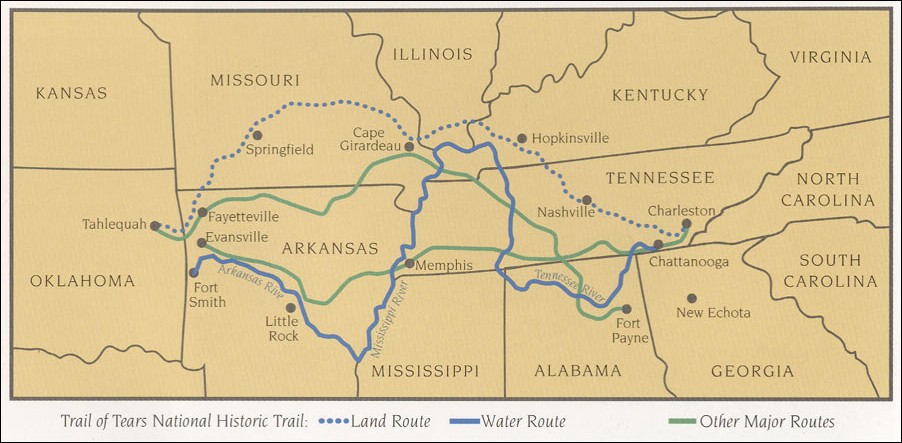
Trail of Tears map, courtesy of the National Park Service.
The primary artery of exodus, called the Northern Route, included passage through Nashville. During the fall of 1838 the group was composed of about nine different contingents of Cherokees. Surprisingly, very little is known about their exact route through the area, the events that transpired as they passed, or the reactions of Nashvillians to the emigrants.
Richard Taylor led one of the Northern route detachments, which included several hundred Native Americans as well as an intrepid white Christian missionary couple, Rev. Daniel S. Butrick and his wife. Fortunately, Butrick kept a journal of events along the way, the Nashville-related section of which (pages 46-47) is quoted verbatim below by permission of the Oklahoma Chapter of the Trail of Tears Association, publishers of the journal. (Note: Journal entries are in italics. The brackets within the entries are not mine; they are transcribed exactly as found in the published journal.)
My comments that follow various entries are often informed by the views of Benjamin Nance from the Tennessee Division of Archaeology and by the Division’s 2001 report titled The Trail of Tears in Tennessee: A Study of the Routes Used During the Cherokee Removal of 1838, cited below as TTOT. Bound volumes of both the report and the journal can be found in the Tennessee State Library and Archives. I am also indebted to Deborah Rodriguez of the Tennessee Trail of Tears Association for sharing her research with me. My hope is that this presentation of Butrick’s journal combined with my questions, guesses, and musings will encourage others to continue researching the Nashville portion of the Trail of Tears.
Monday. [November 19th] The detachment started early and proceeded through Murphy’s borough, on the road towards Nashville 20 miles. Some of the ox teams did not get up till after dark.
Although some of the groups appear to have bypassed Murfreesboro – by going through the old town of Jefferson, now flooded by Percy Priest Lake – others, apparently including Taylor’s, approached Nashville through Murfreesboro and out what is now called Old Nashville Pike (see TTOT, pp. 30-31). For most of the 1980s I lived near Old Nashville Pike in Rutherford County without realizing that my home was not far from the Trail of Tears. We are often slow to recognize that history is right under our feet.
Tuesday. [November 20th] We travelled ten miles and camped within four miles of Nashville. Our tent stood on the side of a Cedar hill, “The Cedars of Lebanon bow at his feet”, “And the air is perfumed with his breath”, often passed in my mind.
Only a few 1838 Nashville newspaper articles reference the route of the Trail of Tears through Nashville. One article, published by the Nashville Whig on Monday, October 15, includes these alarming details: “The second detachment of the emigrating Cherokees passed through Nashville Monday on their way to the ‘Far West.’ They lay encamped near Foster’s mill on the Murfreesboro’ [sic] Turnpike for several days, and while there were visited by many of our citizens. We had no opportunity of seeing this miserable remnant of a warlike race, in camp; but a worthy subscriber residing in the country, writes that he was present several times, and regrets to say that many of the Indians appeared extremely needy in apparel. Barefooted and badly clad, they cannot all hope to withstand the fatigues of travel and the inclemency of the season. Disease and perhaps death must be the portion of scores of their number before they reach the Western frontier. Indeed, four or five were buried near town, and not less than 50 were on the sick list when they passed through on Monday.”
Another newspaper report, from the November 30 edition of the Nashville Union, informed its readers that “the last detachment of the emigrating Cherokees, numbering 1,700 or 1,800 persons, is now at Mill Creek, about four miles from this city.” Although the writer is probably referring to Peter Hildebrand’s group, which followed Taylor’s, this report gives us a lead as to where Taylor may have camped, since various contingents of the exodus seemed to have bivouacked at the same locations along the way and both Hildebrand’s and Taylor’s groups stopped about four miles from Nashville. We will guess that the camping location referred to by Butrick is where Mill Creek crosses Murfreesboro Pike, a location about the right distance from Nashville. Additional support for this location is the Whig‘s reference to Foster’s mill, which was situated also at Mill Creek and Murfreesboro Pike (see Clayton, History of Davidson County, Tennessee, p. 72).
About two-tenths of a mile toward Nashville from Mill Creek, at Murfreesboro Pike and Foothill Drive, the Vultee Church of Christ sits atop a hill. Could this be the cedar hill of which Butrick speaks?
Keep in mind also that a little farther down Mill Creek, on an old pioneer road now called Elm Hill Pike (which runs roughly parallel with Murfreesboro Pike), was Buchanan Station, an original Cumberland settlement. Some of the Cherokee contingents, particularly those who came by way of Jefferson instead of Murfreesboro, could have camped there.
Wednesday. [November 21st] Early in the morning a gentleman by the name of Bryant, his wife & two other ladies called at the camps, and enquired for us. They had visited other detachments, & been informed of our coming. They now invited us to take lodgings at their house while the detachment might remain in this place. We were thankful for this expression of kindness, though as our tent was pitched, we concluded to remain with our dear Cherokee friends.
Mrs. Bryant and the other ladies had brought clothing to give to the needy Cherokees, though they said they found none needy in this detachment, compared with other companies that had gone on. We agreed to visit this kind family on Friday.
As next Sabbath is the regular time for the holy communion in Brainard church, I proposed holding a sacramental meeting in this place if we could obtain ministerial assistance from Nashville. Mr. Bryant therefore agreed to accompany me to Nashville tomorrow.
A careful study of census and deeds records might reveal who the Bryants were and where they lived. Foster’s 1871 map of Davidson County shows an L. Bryant living on McCrory’s Creek, a few miles farther out of Nashville than the location we have posited above. Perhaps there was some kinship between the 1838 Bryants and those of 1871.
Thursday. [November 22nd] Rode 5 miles to Mr. Bryant’s. Here I saw the effects of true religion. This family appears as we might expect true christians to appear towards the suffering Cherokees, and missionaries accompanying. I partook with them of a kind repast, and then accompanied Mr. Bryant to Nashville, 3 1/2 miles.
This is a beautiful city. I have seen no such place in my view since I left Boston. Here are iron works, a college, penitentiary, female academy, court house and several very handsome meeting houses, and many very elegant buildings.
But what especially adds a beauty to the prospect is the cedars which grow naturally in all part of the coven.
But my object was to find a minister to assist me at the contemplated sacramental meeting.
I was first introduced to a young Methodist minister. But his city dress and appearance, together with his having both hands full of other business, discouraged me at once, & I relinquished the idea of obtaining aid, & said to Mr. Bryant that I would seek for no other minister in the city, but return to the camps.
Just as we were preparing to leave, however, a very dear minister, by the name of Lapsley, passed that way. His health was poor, yet he expressed a strong desire to be with us on the Holy Sabbath. I accordingly appointed the meeting for Brainard & Hawels churches, at the camps, & returned.
Again, careful study of old records could help map out the triangulation of campsite, five miles to Bryant’s house, and then three and a half miles to Nashville. It is interesting that from Murfreesboro Pike at Mill Creek to L. Bryant’s, mentioned above, might be reasonably close to a distance of five miles, but then Nashville would be considerable farther away from there than three and a half miles. Of course, we are assuming that Butrick’s mileage statements are at least approximately accurate.
Butrick’s description of 1838 Nashville is heartening to all who take pride in Nashville, and it confirms the sophistication of our city even before it was designated as Tennessee’s permanent capital.
Dr. R. A. Lapsley was a principal of the Nashville Female Academy (see Wooldridge, History of Nashville, Tennessee, p. 404). Perhaps he is the Lapsley of whom Butrick speaks.
Friday. [November 23rd] My dear wife and two Cherokee girls accompanied me to the house of our dear friend Bryant, where we spent the day delightfully with that dear family.
Saturday. [November 24th] Our dear Cherokee brethren prepared seats on one side of the camp ground, where we held a meeting in the afternoon. Our dear brethren Lapsley & Greene preached.
The weather was cold, & rather uncomfortable as we were out doors. At candlelight we held a prayer meeting in our tents.
Sabbath. [November 25th] While we were contemplating the unpleasantness of holding meeting in the cold open air, an aged man, whose head had blossomed for the grave [turned his thoughts and deeds towards the after-life.], called at our tent and offered us the use of his meeting house, about half a mile distant.
He was a Baptist elder, and said he was a missionary in spirit. We gladly accepted his offer, and found a large brick house, well finished, and furnished with two stoves.
Our dear br. Lapsley preached, and Mr. Taylor interpreted, and our dear br. Stringfield assisted in administering the Holy Supper. The whole was delightful, & will not soon be forgotten by us.
O how kind was our Heavenly Father in providing for us such a meeting house, & such kind friends, just at the time they were so much needed.
The large brick Baptist church building is the most consequential landmark mentioned in this section of Butrick’s journal. The church that comes immediately to mind is the historic Mill Creek Baptist Church, which met in a brick building thought to have been erected in 1810. If this is the correct church building, it increases the likelihood that the campground was near Mill Creek and Murfreesboro Pike, since the Mill Creek Church was only a short distance upstream from the pike. The church building no longer exists, but the Mill Creek Church cemetery is situated along today’s Old Glenrose Avenue.
Another possible candidate might be the McCrory Creek Baptist Church building, located, we assume, in the vicinity of L. Bryant. But this researcher has been able to determine neither the exact location of the old church building nor whether it was of brick.
Monday. [November 26th] The detachment being supplied with tents etc., proceeded on their journey. Mrs. B. & myself dined with our kind friend Mr. Lapsley. We traveled but about four miles from Nashville & camped.
As the fires began to be kindled, an aged Cherokee, who had been sick all the way, lay down by the fire, when his clothes caught fire, and he sprang up, but before he could be relieved, was burnt nearly to death.
Here Mrs. Butrick received from our kind friend Mr. Lapsley a valuable cloak, bonnet, shawl, and a pair of shoes, send on by a waggon which passed through Nashville after we left.
Apparently, Taylor’s contingent camped four miles short of Nashville for a total of five full days, arriving on the 20th and departing on the 26th. They then proceeded through Nashville, and the Butricks stopped at Lapsley’s for dinner.
By what route did the Cherokees pass through Nashville? The Tennessee Division of Archaeology report suggests they probably proceeded up Market Street (today’s Second Avenue), crossed the Cumberland bridge (the original covered bridge) at the Square, and then north via White’s Creek Pike and through today’s Joelton area (see TTOT, pp. 31-32). The theoretical Market Street route, though logical, is as yet undocumented. We do know for certain, however, that some Cherokees lingered at the Square. An account in the November 14 edition of the Nashville Whig includes this sentence: “While traveling through or loitering about the public square, the Indians have exhibited the utmost quiet and good order, and not half a score we venture to say, of the thousands who have passed on to the west, gave evidence of intoxication while here.”
Groups of Native Americans trudging through the city would have been quite a spectacle for the Nashville population (then about 6,000 persons), providing fascinating fodder for news reporters. Why did the local newspapers fail to report this news thoroughly, and why are details about the Trail of Tears through Nashville virtually non-existent in local history books? Much more research needs to be done, not only in 1838 Nashville newspapers but also in personal diaries and other records.
On this day the Taylor group made their way through Nashville and four miles farther north, probably stopping somewhere near where White’s Creek intersects with Highway 431. It was here that the old Cherokee man was tragically burned in a campground accident. The White’s Creek at 431 camping location is supported by the fact that an earlier contingent held up there, as reported by the Nashville Union on November 5: “Another detachment of the emigrating Cherokees, twelve or thirteen hundred strong, passed through this city yesterday afternoon, and encamped at White’s Creek.”
Saturday Dec. 1. Camped on a branch of Red River, in Kentucky, having travelled during the week about 60 miles.
The poor old man who was burnt, was left at a house to be taken care of, but died in a few days.
On Wednesday night of this week, sister Ooskoone gave birth to a son, and on Thursday two children, one a daughter of our dear sister Ashhopper, were called into eternity. They had been long sick.
No doubt excruciating pain accompanied the burn victim into Kentucky where death finally relieved him of his agonies. In addition to a birth, Butrick reports the deaths of two children, tragedies that were all too common among the very young and the very old on the approximately 1,200-mile Trail of Tears, an unnecessary tribulation born of political impatience.




 Nashville Historical Newsletter