Thuss, Koellein, and Giers

by Dave Price.

The collecting of old Nashville memorabilia is an inevitable result of studying its history. Eventually every student of the discipline accumulates a few old Cartes de Visite and cabinet photographs by local artists. Among the most prolific studios of 19th century Nashville was that of Thuss, Koellein & Giers. To tell its story we must begin with Carl Giers, who founded the firm that eventually took this name.

Carl Casper (or Cooper according to one source) Giers was born April 28, 1828, in Bonn, Prussia. Family tradition has him coming to America in 1845 and to Nashville in 1852 as a conductor on the N&C RR. He may be the Mr. Geers [sic] listed in the 1853-54 Nashville General Commercial Directory as among those living “south of Broad Street, west of High.” Campbell’s 1855-56 Nashville Business Directory lists him with J.W. Northern in the firm of Giers & Northern, Daguerreotypists, at Deaderick Street and the Public Square (note: the studio was on the southwest corner of Deaderick and College; I would like to say it was located at the National Stores site of my youth but by my day Deaderick was much wider than in Giers’ and the site of the studio had long been paved over.)

Photograph of a young woman, from the photographic studio of Thuss, Koellein, and Giers (from NHN collection)

Campbell’s 1857 edition lists Giers and A.S. Byington (“formerly of Hughes Bros”) with their firm Giers & Byington, Daguerreotypists, at the same address as above. By 1859 Giers’ Southern Photographic Temple of Fine Arts is listed at the old stand with Theodore M. Schleier and Andrew Bulot on the staff. The 1860-61 Directory calls him “Charles C. Giers.”

In December 1862, Giers purchased the former Hughes Gallery at the northwest corner of College and Union (upstairs) from Frederick N. Hughes with his brother Cyril C. acting as his attorney. In October 1863, Giers sold this studio to Thomas F. Saltsman (sometimes “Saltzman”) and leased the former Saltsman gallery a half block farther up Union Street at #42-44 for himself (upstairs on the north side just west of the alley). It is interesting that he discarded the “Southern” part of his business title and used the name “National Portrait Gallery” during the occupation.

King’s 1867 Nashville City Directory tells us that many of Nashville’s streets had been renumbered since the 1866 edition. Giers’ rooms became 43-45 Union.

Carl Giers was very active in community affairs and was elected to the Tennessee House of Representatives in 1874. He passed from this life May 24, 1877. Shortly thereafter William Evermond Armstrong (b 1832) bought the studio. During his tenure the streets were again renumbered with the studio’s address becoming 139 Union. Armstrong operated it until early 1883, when he leased it to Emil Koellein (1847-1893) and James S. Patterson. The Koellein and Patterson partnership was not successful. Young Otto Burchartz Giers (1858-1940) was brought in, but the firm was destined to fail without additional capital.

Within three months of Armstrong’s lease to Koellein and Patterson, he released them from their contract because they were unable to comply with its terms. The studio was at once sold to the new firm of Thuss, Koellein & Giers, with fresh money coming from new partner W.G. Thuss.

William Gustav Thuss (1854-1943) had come to Nashville by 1875 and had been in business since that time at the former Hughes (Giers, Saltsman) address at Union and College. He had been in several partnerships, including one with Charles Paret in 1878 and another with Emil Koellein in 1880.

Backmark of previous photo (from NHN collection)

Thuss, Koellein & Giers lasted from 1883 until 1889, when Thuss and his younger brother Andrew Joseph (1866-1956) left to take over the former Theodore M. Schleier studio in the McGavock Block on Cherry. Giers & Koellein continued at the old stand (renumbered 318 in 1888) through 1892. In 1893 Emil Koellein was briefly in partnership with A.F. Weidenbacker until his own death on July 28 of that year. Otto Giers moved to 415 Church Street, where he remained until 1906. In 1911 he became City Clerk.

W.G. and A.J. Thuss prospered, won many awards, and photographed many dignitaries. In 1897 they operated a studio at the Tennessee Centennial Exposition and took souvenir photographs for fair visitors, as well as the official portraits used on Season Passes. In 1916 William Ferdinand Koellein (1873-1919), the eldest child of Emil, operated the Thuss brothers’ original studio on Cherry Street, by then 4th Avenue, while the brothers opened a second location at 217 5th Avenue North.

In 1917 the brothers split up, with W.G. taking the 5th Avenue studio and A.J. the one on 4th. Ads of the period show that each brother claimed to be operating the original Thuss studio.

In 1927 A.J. moved from 4th Avenue to a Spanish-style building on West End, where he operated what was recognized as one of the city’s premier photographic studios until 1945, when he retired. Palmer Plaza occupies the site today.

In the mid-1930s, late in his career, W.G. and William L. Patterson operated a studio (Patterson and his wife Alice roomed in East Nashville briefly; we have been unable to determine any kinship with the James Patterson mentioned earlier). Shortly before his death in 1943, W.G. was working with Nora M. Witzel of Clarksville.

Charles Paret, mentioned above, came here from New York in 1866 to work for Carl Giers. He and Miss Sarah Catlin (another former Giers employee) were in business with W.G. Thuss in 1878.

James Patterson (also formerly with Giers) seems to have left Nashville after the breakup of Koellein & Patterson, but he reappeared in 1890 and for a short time operated his own studio on Church Street. Since Otto Giers was still active, Patterson advertised himself as being of the “Old” Giers Gallery. Patterson later had studios in Pulaski, Lewisburg, and Cornersville.

W.G. and A.J. Thuss, although they saw each other from time to time (they both served as pallbearers for William F. Koellein in 1919), never spoke after their breakup. When W.G. lay on his deathbed in 1943, his daughter Bessie went to her uncle A.J. and begged him to go see her father. He refused but did attend the funeral, where in the words of one witness, “he cried bitter tears, but it was too late.”

A.J. lived until 1956, just one hundred years after Carl Giers had taken his first daguerreotype at Deaderick and the Public Square. (1999)

Arranging the Light: The Story of Calvert Photography

by Amber Barfield Gilmer.

The Calvert family came from Yorkshire, England, where Ebenezer and Peter Ross Calvert studied at the famed South Kensington Art School. In 1873, following the death of his mother, Ebenezer immigrated to Wilson County, Tennessee, upon the advice of a dentist he had met in England. Two years later Peter Ross and Rhoda Calvert, Ebenezer’s siblings, also made the transition and soon persuaded Ebenezer to move to Nashville.

The brothers became involved in Nashville’s art community, and in 1889 they appeared in the city directory as “Calvert Brothers: Portrait Painters, Draughtsmen, and Teachers of Art.” In 1896 they, along with S. A. Taylor, purchased Rodney Poole’s well-known photographic studio. During his ownership (1870-1896), Poole had advertised the studio as “of a superior quality . . . the best artists employed. Elegant rooms, and the finest arrangement of light in the South.”

Calvert Brothers & Taylor, located at the corner of Cherry and Union Streets, continued their partnership until the Calverts purchased Taylor’s interest in 1900. The studio then operated as Calvert Brothers until Peter Ross died in 1931, seven years after Ebenezer’s death.

During their era, the Calvert brothers helped shape the way many Nashvillians would remember their children, their weddings, their homes, and their friends. In addition, the Calverts were often commissioned to copy pre-existing photographs, and many of the resulting copy negatives are today among the most historically valuable negatives at the Tennessee State Library and Archives. These include the earliest known image of the Public Square, images of the wharf and Front Street, the Polk home, the State Capitol, and numerous local scenes. These images document the layout of the city, its growth and its values, and typify what the citizens of Nashville thought worth showing to future generations.

Though art was important, religion came first with Ebenezer, Peter Ross, and Rhoda Calvert. Once the brothers canceled a contract with Vanderbilt when the school asked them to work on Sundays, a thought unfathomable to them. The Calverts established ties to Nashville’s Baptist community, and they were instrumental in forming the Immanuel Baptist Church. In A History of Immanuel Baptist Church, 1887-1986, author Dr. Gaye L. McGlothlen quotes one church member who described Peter Ross as “the saintliest man in the world.” Both the Nashville Banner and The Nashville Tennessean placed Peter Ross’s obituary on the front page of their January 12, 1931, edition, each commenting on his Christian character and his role in the community. The Nashville Tennessean noted that the photographer “won for himself a place in the hearts of thousands of Nashville people.”

After the Calvert brothers’ deaths, control of the family studio passed to Ebenezer’s daughters—Bertha, Zillah, and Mary. The daughters ran the business with few changes, but concentrated on children’s photographs. Zillah’s obituary explains that ” ‘Miss Zillah’ was noted for her winning way with children as they were being photographed.” According to Bob White, who was employed by the sisters as a photographer, he would photograph the children while one of the sisters, usually Zillah, would pose and entertain them.

Five-year-old Florence Puryear Sims, 1899. (from the photo collection of the Nashville Historical Newsletter)

When the sisters retired in 1964, White purchased the studio and continued to run it under the Calvert name. Still a family business, Calvert Photography is located in Burns, Tennessee, and is now operated by Bob’s son and daughter-in-law, Bill and Scotty White. (1999)

Our Story . . .

A Nashville native, Mike Slate (1947-2021) attended Metro public schools and held degrees from Lipscomb University, Harding School of Theology, and Peabody College. Concerned by Nashville’s lack of a publication dedicated to “saving and conveying the local historical knowledge of its citizens,” Mike founded the Nashville Historical Newsletter (NHN) in January 1997 as a “medium for historical sharing.”

Mike Slate (photo by Tim Slate)

Mike was also one of the presenters in the WNPT production of “Memories of Downtown Nashville,” which still appears frequently during station fundraisers. (Here is a segment of that program dealing with the history of Union Station: https://www.youtube.com/watch?v=dBWgti8iLvk). After many requests for the NHN collection in book form, Mike and his wife Kathy Lauder published The Confederate Twenty-Dollar Irony and Other Essays from the Nashville Historical Newsletter, a compilation of selected essays, in 2004. A second book, From Knickers to Body Stockings and Other Essays from the Nashville Historical Newsletter, followed in 2006. In recent years, Mike had become a zealous advocate for Buchanan’s Station, helping to organize the Friends of Buchanan’s Station Cemetery, a group formed in 2012 to raise awareness of the site and to provide needed funding for its protection, preservation, and ongoing maintenance. After a kick-off event commemorating the 220th Anniversary of the Battle of Buchanan’s Station in September 2012, the group collected more than $10,000 in donations to construct a metal fence around the cemetery, marking and protecting the site. In addition to organizing cleanup days, members have also raised funds for repairs and an archaeological assessment of the property. Their efforts ultimately encouraged the owner of Pinnacle Business Products, who owned the 1.46-acre site, to donate it to Metro Nashville Government in 2015. The Metro Parks and Recreation Department now manages the property, which is located on a proposed future expansion of the Mill Creek Greenway system.

Kathy Lauder, current NHN administrator, moved to Nashville from Maine in 2003. She taught high school English and theatre for 30 years in Maine and Maryland and was an employee of the Tennessee State Library and Archives (TSLA) from 2003 until her retirement in late 2013.

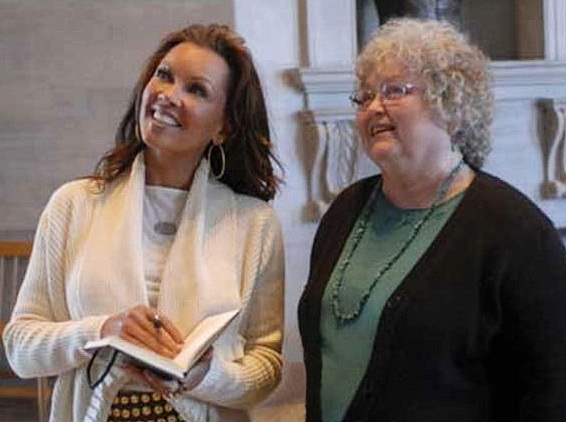
Kathy Lauder (r) with Vanessa Williams in a still from “Who Do You Think You Are?” 2011

As part of her work with TSLA, Kathy completed the research and writing for the award-winning online exhibit “‘This Honorable Body’: African American Legislators in 19th Century Tennessee”, which was featured in the Nashville Public Television documentary, First Black Statesmen: Tennessee’s Self-Made Men. She also appeared in the NBC television series Who Do You Think You Are, providing historical background for the 2011 episode featuring Vanessa Williams. Kathy joined the NHN staff as editor in 2002, shortly after the newsletter’s transition from printed to online publication. As a board member of the Nashville City Cemetery Association, she edited that organization’s newsletter Monuments and Milestones for several years. Currently engaged in a project to locate and restore missing names of people buried in Mt. Ararat and Greenwood cemeteries, she publishes a short biography of one of those individuals every Friday on the Greenwood Project Facebook page. A published poet, she is also an occasional contributor to The Tennessee Conservationist magazine. (Oct 2021)