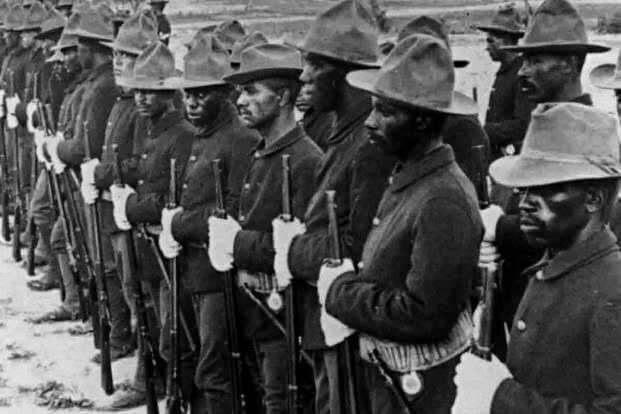
W.L. Irvin’s name appeared frequently in post-Civil War newspapers. A barber by trade, he and other elite leaders posted letters to Gov. John C. Brown and Gen. W.B. Bate in 1874, urging them to take stronger action against lynching. Irvin was a board member of the House Building and Loan Association during the 1890s. He served in the U.S. Army for several years and later led the Langston Rifles, one of Nashville’s five “colored” military companies. During the Spanish American War (1898), he became a lieutenant in an “immune regiment” (military authorities erroneously believed African American troops were naturally immune to tropical diseases and sent many into combat in the tropics), serving until the regiment mustered out. An alternate delegate to the state Republican Convention in 1900, Irvin was active in the [Frederick] Douglass Club and was a featured speaker at their 1903 meeting. He was buried with honors by the Masonic Order, of which he was a longtime member.
All existing African American military units were called up for service in the Spanish American War. (Photo from the Library of Congress)
____________________
The Greenwood Project is a series of 160-word biographies of individuals who lie at rest in Mt. Ararat and Greenwood cemeteries, two historic African American burial grounds in Nashville, Tennessee. The project, which began in September 2014 (and is still available on Facebook, at https://www.facebook.com/profile.php?id=100064806156276), shares the stories of more than 300 consequential individuals, primarily African American, who changed the course of city, state, and national history through their words and deeds. (All biographies were written by Kathy Lauder unless otherwise noted.)
The following summary has been gathered from a variety of U.S. government releases and media clippings.
Five ships bearing the name Nashville have plowed the world’s waters. The first, the Confederate steamer Nashville, originally a brig-rigged passenger steamer, was seized at Charleston after the fall of Fort Sumter and fitted out as a cruiser. With a length of 215 feet and a beam of 34 feet 6 inches, she was armed with two 12-pounders and carried a complement of 40. The Nashville ran the Union blockade on October 21, 1861 and was the first warship to fly the Confederate flag in European waters. She returned to Beaufort, North Carolina on February 28, 1862, having captured two prizes valued at $66,000.
Confederate steamer Nashville, 1861 (All photos on this page are in the public domain.)
TheNashville was then turned over to Frazer, Trenholm and Company to whom she had been sold prior to her return. After use as a blockade runner, she was refitted as a Confederate privateer and commissioned on November 5, 1862 asRattlesnake. The Federals destroyed her in the Ogeechee River, Georgia on February 28, 1863.
Confederate ironclad ram Nashville, 1864
The Confederate ironclad ram, Nashville, was built at Montgomery, Alabama in 1864. She had a length of 271 feet and a beam of 62 feet 6 inches and was armed with three 7-inch rifles and one 24-pound smoothbore. Although never completed, Nashville had been heavily armored with steel plating and, when surrendered to the U.S. Navy, was believed unable to carry her weight of armor. At the close of the Civil War, she was stripped of her armor and sold at auction in New Orleans.
USS Nashville (PG7), commissioned 19 August 1897
USS Nashville (PG7), a gunboat built at Newport News, was launched on October 19, 1895. Sponsored by Maria Guild of Nashville, she was commissioned on August 19, 1897, Washburn Maynard commanding. With a length of 233 feet 8 inches and a beam of 38 feet 1 inch, she was armed with eight .40 caliber guns, two 6-pounders, two 3-pounders, and two 1-pounders.
This famous warship fired the first shot in the Spanish-American War and played a major part in naval operations in the Cuban area. She also helped put down the Philippine Insurrection and the Boxer Rebellion in China. During World War I, USS Nashville escorted convoys in the Mediterranean to and from Europe and North Africa. At the close of the war, she was decommissioned and sold for scrap.
USS Nashville (CL-43), commissioned 6 June 1938
USS Nashville (CL-43), a light cruiser that served with distinction in World War II, was commissioned on June 6, 1938, sponsored by Ann and Mildred Stahlman of Nashville. Her length was 608 feet 4 inches and her beam measured 61 feet 8 inches. She was part of the task force that pulled off the spectacular Doolittle raid on Tokyo in early 1942. She was chosen as the flagship to transport General of the Armies Douglas MacArthur on his famous, triumphant return to the Philippines. The Nashville was hit by a suicide bomber in the Sulu Sea and suffered grave damage and many casualties. At the end of the war, she was decommissioned and sold to the Chilean Navy.
USS Nashville (LPD 13) commissioned 14 February 1970 (2006 photo)
The final ship to bear our city’s name isUSS Nashville (LPD-13), one of a class of ships designated Amphibious Transport Dock. Commissioned at Puget Sound Shipyard on February 14, 1970, she is the thirteenth ship of her class. On September 9, 1970 Nashville Mayor Beverly Briley participated in “Mayor Briley Day” aboard the Nashville in Norfolk, Virginia. She is 576 feet 4 3/8 inches in length, with a beam of 84 feet 1/2 inch. Her various assignments have included four Caribbean Amphibious Ready Groups, seven Mediterranean Groups, a Mine Countermeasure Group, and NATO North Atlantic Operations. The Nashville is still in commission and involved in operations contributing to the defense of the United States. (1998)



 Nashville Historical Newsletter