
(ca. 1870 – February 7, 1951)
from The Greenwood Project
William Edmondson was one of six children born to Orange and Jane Edmondson, newly emancipated slaves. A handyman, he worked in Nashville railroad shops and at odd jobs until he heard God’s voice directing him to develop his gift for sculpture. Although nearly 60 by then, Edmondson collected bits of limestone (broken curbstones and bulldozed foundation stones collected by friends from wrecking companies) and began to carve – first tombstones, and then birds, animals, and religious figures. He worked outdoors in his yard on 14th Avenue South in Edgehill, where Murrell Elementary was later built. Within five years art critics had discovered his lyrical work, labeling it “modern primitive” and demanding more. His sculpture began to appear in exhibits around the country, and he was the first African American to have a one-man show at the Museum of Modern Art (1937). His work is now in the permanent collections of the San Francisco Museum of Art, the Hirshhorn, and the Smithsonian.
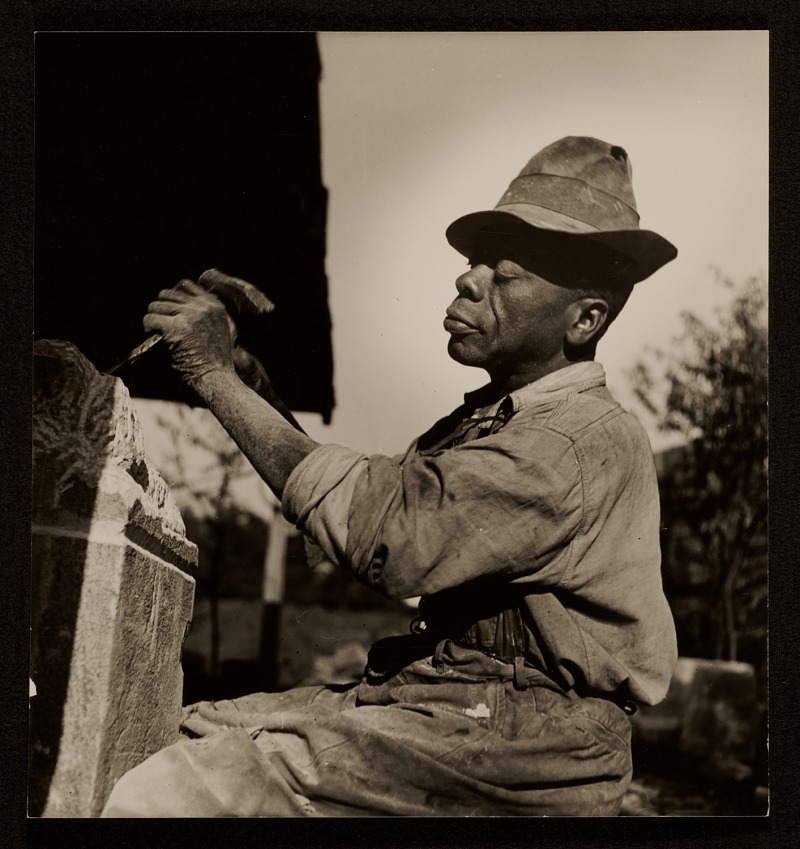
William Edmondson at work on a sculpture on his Edgehill property, 1937. (Elizabeth McCausland papers, 1838-1995. Archives of American Art, Smithsonian Institution. Photo is in public domain.)
____________________
The Greenwood Project is a series of 160-word biographies of individuals who lie at rest in Mt. Ararat and Greenwood cemeteries, two historic African American burial grounds in Nashville, Tennessee. The project, which began in September 2014 (and is still available on Facebook, at https://www.facebook.com/profile.php?id=100064806156276), shares the stories of more than 300 consequential individuals, primarily African American, who changed the course of city, state, and national history through their words and deeds. (All biographies were written by Kathy Lauder unless otherwise noted.)

 Nashville Historical Newsletter