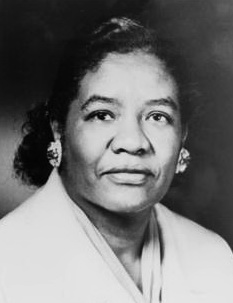
Although abandoned by her mother and raised in foster homes, Dorothy Brown became valedictorian of her high school graduating class. However, she could not afford college until a Methodist women’s group for whom she worked as a housekeeper paid her tuition at Bennett College. She graduated with honors, then worked in a defense plant to earn money for medical school, entering Meharry in 1944. After the Harlem hospital where she interned denied her a surgical residency, she convinced Meharry surgical chief Matthew Walker to allow her a residency in Nashville. In 1954 Brown became the first African American female surgeon in the South when she was named attending surgeon at Hubbard Hospital, chief of surgery at Riverside, and professor of surgery at Meharry. In 1956 she became the first single woman in Tennessee to adopt a child, and in 1966 she won a seat in the Tennessee House, becoming the first African American woman to serve in the state legislature.
Dr. Dorothy L. Brown, M.D. (Department of Interior photo, public domain)
____________________
The Greenwood Project is a series of 160-word biographies of individuals who lie at rest in Mt. Ararat and Greenwood cemeteries, two historic African American burial grounds in Nashville, Tennessee. The project, which began in September 2014 (and is still available on Facebook, at https://www.facebook.com/profile.php?id=100064806156276), shares the stories of more than 300 consequential individuals, primarily African American, who changed the course of city, state, and national history through their words and deeds. (All biographies were written by Kathy Lauder unless otherwise noted.)
Samuel Allen McElwee was born a slave in Haywood County, Tennessee, on June 26, 1859. After emancipation he attended Freedmen’s Bureau schools1 and by 16 was teaching in a local school himself.2
Rep. Samuel A. McElwee, Esq.
In 1875 he entered Oberlin College for a year, taking odd jobs to pay his tuition.3 Returning to Tennessee, he walked ten miles each day after work to study Latin, German, and algebra with a white Vanderbilt student.4 He entered Fisk University in 1878, earning a Peabody Scholarship5 to pay his way.
While still enrolled at Fisk, McElwee won a seat in the 43rd Tennessee General Assembly (1882), representing Haywood County.6 He graduated the following May, just as his first House term ended.7 In 1884, at age 25, he became secretary of the Tennessee Convention, a state-wide gathering of black leaders,8 and served as a state delegate to the Republican National Convention.9
McElwee entered Nashville’s Central Tennessee College during his second legislative term, earning a law degree in 1885.10 He became the focus of a historic vote after former U.S. Senator Roderick Butler nominated him for House Speaker. Although unable to surmount a large Democratic majority, the 26-year-old former slave received 32 of the 93 votes cast.11
The first black Tennessean elected to a third legislative term (1887), McElwee pleaded for stronger legal powers over lynch mobs: “Great God, when will this Nation treat the Negro as an American citizen?”12 Despite his highly publicized speech, the House tabled the bill 41-36.13 Later that year McElwee spoke at Tuskegee Institute’s graduation14 and presided over the Colored World’s Fair Association.15
In 1888 Samuel McElwee married the “handsome and cultured” Georgia Shelton.16 Their wedding party included many prominent Nashvillians, black and white. Fisk President E. M. Cravath officiated; guests included Charles Nelson, Granville P. Lipscomb, Dr. H. T. Noel, Dr. R. F. Boyd, Major E. B. Stahlman, and former Confederate General George Maney.17
The State Republican Party elected McElwee delegate-at-large to the 1888 Republican National Convention,18 where he was a member of the committee on credentials.19 McElwee’s eloquent words about the potential role of African Americans in national politics helped persuade Benjamin Harrison to nominate former slave Frederick Douglass as ambassador to Haiti and to endorse bills prohibiting Southern states from obstructing African American suffrage.20
At home McElwee faced powerful political challenges to his campaign for an unprecedented fourth legislative term: Haywood County officials employed “disgraceful election methods”21 to ensure his defeat,22 and white separatists drove him from the county. During the following term (1889) the all-white General Assembly approved legislation that would disfranchise black voters for decades.23
McElwee and his wife spent the next twelve years in Nashville, where he established a thriving law office.24 Both Samuel and Georgia were active in civic organizations, and their names regularly appeared in the social pages of the newspapers. In 1901 McElwee moved his wife and daughters to Chicago,25 where his legal practice flourished for over a decade. He won many important cases, including a multi-million-dollar lawsuit against the City Railway Company.26 He died in Chicago October 21, 1914, at the age of 56. 27 (2014)
SOURCES:
1 “Brave Tennessean Forgotten by History,” Nashville Tennessean, February 13, 1971.
2 “A Remarkable Negro,” Nashville Daily American, June 9, 1888.
3 “Brave Tennessean Forgotten by History.”
4 “The Death of Atty. Samuel A. McElwee,” Chicago Broad Axe, October 24, 1914.
5 Tennessee State Board of Education Minute Book, Volume 55, page 131.
6 McBride, Robert M., and Dan M. Robinson. Biographical Directory, TennesseeGeneral Assembly, Volume II (1861-1901). Nashville: Tennessee State Library and Archives, and Tennessee Historical Commission, 1979.
7 Simmons, William J. Men of Mark: Eminent, Progressive and Rising. Cleveland: G. M. Rewell & Co., 1887, 500.
8 “The Tennessee Convention: Colored Men in Council at Nashville—Vital Questions Ably Discussed—Resolutions setting forth the Grievances and Needs of the Race,” New York Globe, March 15, 1884.
9 Johnson, Charles W. Republican Party (U.S.:1854-), 227. Official Proceedings of theRepublican National Convention, Chicago, June 3, 4, 5 and 6, 1884, 21.
10 Simmons, William J. Men of Mark: Eminent, Progressive and Rising. Cleveland: G. M. Rewell & Co., 1887, 500.
11 Tennessee General Assembly. Journal of the House of Representatives of the State ofTennessee. Nashville: Tavel & Howe, 1885.
12 Nashville Union, February 23, 1887.
13 Tennessee General Assembly. Journal of the House of Representatives of the State ofTennessee. Nashville: Tavel & Howe, 1886.
14 “Tuskegee Normal School: Celebrating Its Sixth Anniversary—An Exhibit of Industries—Commencement Exercises,” New York Freeman, June 4, 1887.
16 “McElwee. A Southern Lawyer, the Brilliant Orator and Barrister,” Freeman, March 2, 1889.
17 “Hon. S. A. McElwee Married,” Nashville Daily American, June 7, 1888.
18 “A Remarkable Negro.”
19 Johnson, Charles W. Republican Party (U.S.:1854-), 227. Official Proceedings of theRepublican National Convention, Chicago, June 3, 4, 5 and 6, 1884, 24.
20 Calhoun, Charles W. Benjamin Harrison: The American Presidents Series: The 23rdPresident, 1889-1893. New York: Times Books, 2013,
21 “McElwee. A Southern Lawyer, the Brilliant Orator and Barrister.”
22 Granberry, Dorothy. “When the Rabbit Foot Was Worked and Republican Votes Became Democratic Votes: Black Disfranchisement in Haywood County, Tennessee.” Tennessee Historical Quarterly, Vol. LXIII, No. 1, Spring 2004.
23 Lester, Connie L. “Disfranchising Laws.” Tennessee Encyclopedia, Online edition. Knoxville: University of Tennessee Press, 2002-2014.
24 “An Eloquent Lawyer’s Great Effort Highly Complimented by Leading Whites,” Freeman, June 20, 1891. Also “Professional Success,” Freeman, July 11, 1891.
25 “Chips,” Broad Axe, August 12, 1901.
26 “Chips,” Broad Axe, February 8, 1902
27 “Death Claims Samuel A. McElwee: Well Known Attorney Was Native of Brownsville, Tenn.—Was Member of Tennessee Legislature.” The ChicagoDefender, October 24, 1914.
SUGGESTED READING:
Cartwright, Joseph H. The Triumph of Jim Crow: Tennessee Race Relations in the1880s. Knoxville: UT Press, 1976.
Couto, Richard A. Lifting the Veil: A Political History of the Struggles for Emancipation. Knoxville: UT Press, 1993.
Granberry, Dorothy. “When the Rabbit Foot Was Worked and Republican Votes Became Democratic Votes: Black Disfranchisement in Haywood County, Tennessee.” Tennessee Historical Quarterly, Vol. LXIII, No. 1, Spring 2004.


 Nashville Historical Newsletter