Marcus B. Toney (1840-1929)

by Kathy B. Lauder.

Born near Lynchburg, Virginia, on August 19, 1840, Marcus Breckenridge Toney came to Tennessee with his family when he was two years old.1 His father, a millwright, had intended to settle in St. Louis, but Mrs. Toney became too ill to travel beyond Nashville.2  She never recovered her health and died when Marcus was six. None of Toney’s siblings survived childhood and, when his father died early in 1852, the eleven-year-old found himself alone in the world.3 Relatives took him back to Virginia, where he attended college, but by 1860 he had returned to Nashville.4
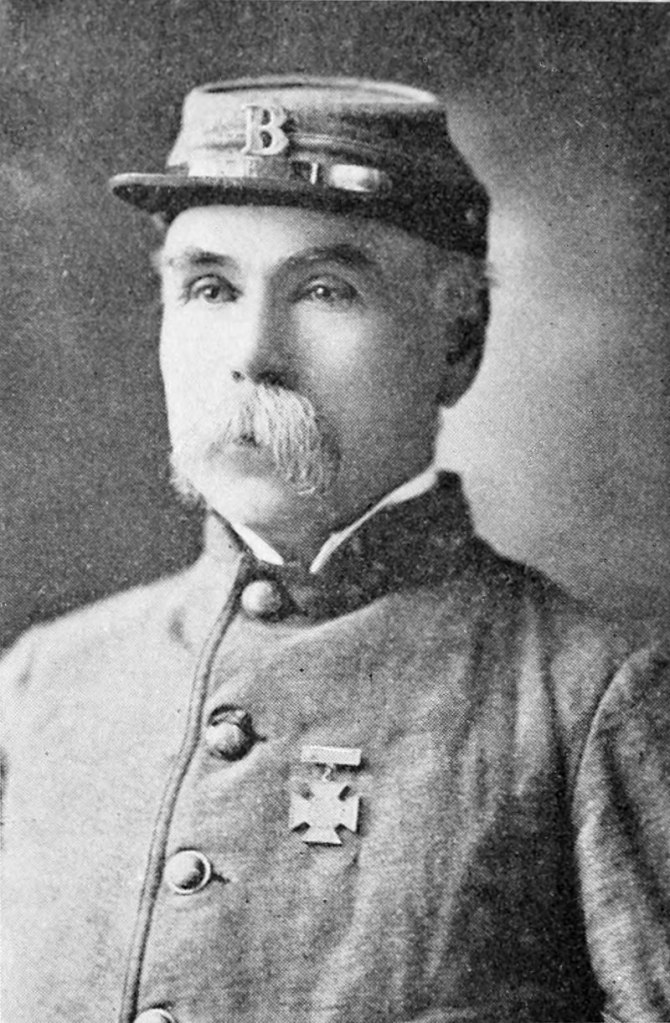
Marcus B. Toney, about 1905

When war broke out, Toney enlisted in the First Regiment of the Tennessee Infantry (Feild’s), Company B, known as the Rock City Guards.5  The regiment was sent to Virginia, where they fought beside Lee at Cheat Mountain and Stonewall Jackson at the Potomac River before returning to guard the Cumberland Gap.6 In 1862 they took part in Bragg’s invasion of Kentucky and fought at Stones River in December.7  Toney was transferred in February 1864 to the Forty-Fourth Virginia Regiment, which participated in the Battle of the Wilderness in May.8 Captured with 1100 other Confederate soldiers, he was sent to the prison camp at Point Lookout, Maryland,9 and then transferred to Elmira, New York,10 where he spent the remainder of the war. His experiences as a prisoner make up a significant part of his memoir, The Privations of a Private*, published in 1906.

Returning to Nashville, Toney became involved for a short time with the Ku Klux Klan, perceiving the group as “conservators of law and order”11 during the chaotic years following the war.  On December 4, 1868, Toney was on board the steamer United States when it crashed into the steamer America in the Ohio River.12 He escaped by swimming to shore in his nightclothes. Many other passengers who jumped into the river to escape the burning ship died as flaming oil spread across the water.13

In 1872 Toney married Miss Sally Hill Claiborne, who would bear him two children. The same year he became Nashville commercial agent for the New York Central Railroad, holding that position more than forty years.14 He wrote many articles for newspapers and other publications, particularly the Confederate Veteran, edited by his friend Sumner Cunningham. Toney was a witty and amusing raconteur and was frequently invited to speak about his wartime experiences.  

During the mid-1880s Marcus Toney and Dr. William Bumpus became interested in establishing a residence for the widows of members of the Masonic brotherhood. The two men traveled throughout Tennessee seeking financial support for the project, and their board acquired a charter of corporation in August 1886.15 The Masonic Widows’ and Orphans’ Home was constructed near Nashville on 220 acres donated by Col. Jere Baxter.16 Funded by the Grand Lodge and personal donations, the home and its associated dairy farm opened in 1892 and operated successfully until the 1930s.

Marcus Toney died of “old age” 17 in Nashville on November 1, 1929, and was buried in Mt. Olivet Cemetery. (2014)


*A paperback edition of Privations of a Private, edited by Dr. Robert E. Hunt of MTSU, was published by Fire Ant Books in 2005. That and other editions of the book are available from most booksellers.


SOURCES:

1  Hale, Will Thomas, and Dixon Lanier Merritt. A History of Tennessee and Tennesseans: The Leaders and Representative Men in Commerce, Industry and Modern Activities, Volume V.  Lewis Publishing Company, 1913, 1507.

2  Hale and Merritt, 1508.

3  Toney, Marcus B. The Privations of a Private. Edited by Robert E. Hunt. Tuscaloosa: University of Alabama Press, 2005, xi-xii.

4  Hale and Merritt, 1508.

5  “Soldier Details,” U. S. National Park Service: The Civil War. http://www.nps.gov/civilwar/search-soldiers-detail.htm?soldier_id=788cd8d9-dc7a-df11-bf36-b8ac6f5d926a  Website accessed April 26, 2014.

 “Regimental Organisation.” First Regiment, Tennessee Infantry (Maney’s) Co. E. http://first-tennessee.co.uk/organisation.htm  Website accessed April 26, 2014.

 “Regimental Organisation.”

8  Toney, 64-70.

9  Toney, 76-83.

10  Southern Historical Society Papers, Volume XXIX. Edited by Robert Alonzo Brock. Richmond, VA: Southern Historical Society, 1901, Chapter 1-19.

11   Toney, 118.

12  “Ohio River Tragedy.” Northern Kentucky Views. http://www.nkyviews.com/gallatin/gallatin_river_disasters.htm  Website accessed April 10, 2014.

13  Toney, 120-121.

14  Hale and Merritt, 1508.

15  “The Masonic Widows and Orphans Fund of Tennessee.” The Grand Lodge of Tennessee, Free and Accepted Masons.  http://www.grandlodge-tn.org/?chapters=Y&page=WO Website accessed April 20, 2014.

16  “Masonic Widows’ and Children’s Home.” Historic Nashville. http://historicnashville.wordpress.com/2009/03/05/masonic-widows-childrens-home/ Website accessed April 20, 2014.

17  Tennessee Death Records, 1908-1959, Roll #11.  Nashville: Tennessee State Library and Archives.

“Strength and Beauty”: Buford College of Nashville, 1901-1920

by Terry Baker.  

On February 15, 1862, E.G. “Eb” Buford of Giles County, Tennessee, received what later generations of soldiers would call “a million-dollar wound.” Not serious enough to kill or badly disfigure him, it nonetheless earned him a permanent discharge from the Army of Tennessee. While thousands of men from the captured garrison at Fort Donelson were being sent north to POW camps, Eb was sent to the rear. He had been shot through the left lung, the one-ounce lead ball reportedly taking part of his ramrod* with it as it exited his body.

In 1869 Eb married Belinda D. Miller in Williamson County; their only child, a son named John, was born the following July. Belinda died in 1874 at age 30, and Eb remained single for ten years. The 1880 Giles County census lists him as a widower, engaged in the hardware business and living on his mother’s farm.

On Christmas Day 1884 Eb married 35-year-old Mary Elizabeth Burgess, a prominent educator who already had quite an impressive resume. Although her tombstone lists her birth year as 1857 and says she started teaching at 16, she was in fact born in 1849, as the 1850 and 1860 census enumerations clearly show.

Her academic career, including a year at Dr. Price’s Nashville College for Young Ladies, culminated in her 1886 founding of the earliest Buford College at Clarksville. Meanwhile, Eb continued in the hardware trade, in a Clarksville firm called Buford and Bowling. For reasons the college publications do not explain, the campus was relocated to Nashville in 1901. School brochures tell us far more about Mrs. Buford, known as Elizabeth, than Eb, whose title at Buford College was Regent.

Buford College, about 1910 (postcard from NHN collection)

Contemporary photos show the Bufords as a dignified couple in their 60s. Confederate Veteran Magazine ran ads for the college and even published one of Elizabeth’s poems in 1910. As President of Buford College, she no doubt wrote the advertising copy, as well as yearbooks and other college publications.

In addition to being an ardent devotee of Shakespeare, Elizabeth was also fond of mottoes, which abounded at Buford, often called “Beaufort” in the literature. This Norman spelling of her husband’s name allowed her to convey the twin virtues of the school: Beauty and Strength. It is no surprise that many of her favorite mottoes and Bible verses found their way onto her impressive tombstone.

While Eb was certainly aware of his lineage, Elizabeth was very much the genealogy buff. She traced her Burgess line back to the Mayflower and was fond of saying that she and her staff were “to the manner born.” She seemed to believe that any post-Civil War Southern aristocracy should be based on literacy. Her ad for the Clarksville campus in an 1894 issue of Confederate Veteran stressed that she was the wife of a Confederate veteran.

Today nothing remains of Buford College except the name. West of Franklin Road, near the intersection of Caldwell Lane and General Bate Drive, is a short street named Buford Place. Although the last of the college buildings were torn down in 1946, surviving photos and a drive through the Buford Place vicinity can provide a good mental picture of the campus, which was situated just beyond the popular Glendale Park. The college yearbooks were a bit hazy as to how far from downtown the campus was, one saying it was a mere twenty minutes away by trolley, another saying thirty-five. The line ended at the campus, in an area that became known as Buford Station.

The 1903 Nashville City Directory showed Elizabeth Buford living at Buford Station. Eb, not listed, could still have been in Clarksville taking care of business. College publications are almost totally silent on his role as Regent, which might have been a figurehead title, although he may in fact have been the school liaison to the Nashville business community. It is revealing that his pension application described the school as a business.

The yearbooks describe the campus as “a magnificent highland park of 25 acres, surrounded by an 85-acre woodland, with springs, wells, and a cistern, upon a fine electric car line.” Croquet and tennis courts were set among the magnolias, while gardens, a dairy, and a hennery provided a healthy diet for campus residents.

The land was originally donated by wealthy businessman O. F. Noel, who also constructed the buildings. However, this partnership would last only during Noel’s lifetime and placed the college on precarious financial footing from the outset. College publications included some rather shrill pleas for assistance, and, although “Beaufort” had an impressive list of benefactors, it was not able to survive the deaths of Noel and the Bufords.

The enrollment at Buford, which was referred to as “select,” was limited to 100 girls between the ages of 16 and 20. The school offered the standard four-year college course, modified somewhat by Elizabeth’s (and perhaps Eb’s) personal tastes. The curriculum included English, Latin, the Bible, painting, music, and even business and journalism. Annoyed by literary portrayals of “frail Southern womanhood,” Elizabeth also stressed health and exercise.

The modern reader may scoff at the unabashedly Victorian ideals promoted at Buford, although graduates looked back on their college days with a fond nostalgia we can only envy. The presence of chaperones was a salient feature of all social outings and field trips taken by the girls, dressed in their forty-dollar gray uniforms. However, this is not to say that men were a forbidden item at Buford. Eligible young men were welcome as visitors at the college after they sent a letter of introduction to Elizabeth – only a certain gentility would do at Buford. More than one of the college yearbooks boasted that there had been no “elopement, death or casualty” in the history of the school, including the Clarksville years.

In contrast to the 19th century values and ideals taught at Buford, Elizabeth tenaciously prepared her charges for the 20th century. For example, she saw journalism as a way for women to find careers outside the home, allowing them to compete with men for jobs. Others, inspired by Elizabeth’s love of the English language, became teachers who inspired a generation of students to disdain slang and trendy speech in keeping with lofty Buford ideals.

The 1914 death of O. F. Noel, Buford’s principal benefactor, generated a flood of changes in the life of Buford College. In 1915 the Glendale campus welcomed its last class before the land devolved to Noel’s heirs. The girls who made the transition lamented that it was the last year of the “real Buford,” the idyllic picture-postcard school surrounded by oaks and magnolias.

How Eb fared in those lean years we have only a hint. In 1917 he was forced to file a Confederate pension claim, stating that he and his wife had been “engaged in School business at Nashville” the previous year, “but have been deprived of this, and are now without means,” and unable “to make any provision for the future.”

The year 1916 had seen the college relocate, according to their ad in Confederate Veteran, to the area between 21st and 22nd avenues, near the corner of 22nd and Church, in what was the old Sam Murphy Place. By 1918, the year before Eb died, it had again moved: near Gallatin Pike, on N 12th and Eastland, the Bransford Mansion was Buford’s final location.

Elizabeth would not long survive Eb. The strain of running the college and worrying over finances proved too much for the aging administrator. At 71 she suffered a breakdown from which she would not recover. She died on February 12th, 1920, and was buried next to her husband on Valentine’s Day. Looking at their grand tombstone at Mount Olivet – covered with mottos, Bible verses, a timeline of her career, the love showered on her by her girls – one realizes that, even in death, she remains the president of Buford College.


*According to the author, what actually went through Eb’s lung was not part of his ramrod, but what was known as a musket pick. A Civil War reenactor has explained that this item was a wire brush used to clean the outer parts of the gun lock, such as the percussion cap nipple.

Additional author’s note: A book recently located at TSLA “showed what Eb was doing after he married Mary Elizabeth Burgess. He was a traveling salesman for a Clarksville hardware firm. That might explain why his name is missing from the 1903 City Directory mentioned in the essay.”