Two Brothers-in-Law at City Cemetery

by Carter G. Baker.

Buried near each other in the same lot on Oak Avenue are brothers-in-law John Patton Erwin (1795-1857) and Thomas Lanier Williams (1786-1856). Their relationship was not always so peaceful. Erwin, two-time mayor of Nashville (1821 and 1834), was married to Thomas’s sister, Frances (Fannie) Lanier Williams (1796-1872).  Fannie is buried at Mt. Olivet with her daughters who lived to adulthood.  Four other children who died young are presumed to be buried at City Cemetery with their father.

John Patton Erwin’s grave at Nashville City Cemetery

Both Erwin and Williams left significant marks on Tennessee history. John Patton Erwin was a newspaper editor, lawyer, banker, justice of the peace, and postmaster of Nashville. He was also the secretary of the Robertson Association, which was deeply involved in the American settlement of Texas while that region was still part of Mexico. His sister Jane’s first husband was wealthy Nashville banker, Thomas Yeatman, under whom Erwin served for a time as cashier. (Their son, Thomas Yeatman Jr., was a powerful supporter of the Confederate cause.) After Yeatman’s death Jane married the Hon. John Bell, Speaker of the House of Representatives, U.S. Senator, and Union Party candidate for president in 1860.

Erwin’s brother married one of Henry Clay’s daughters, while his cousin, also named Jane Erwin, was married to Charles Dickinson, who died in a famous duel with Andrew Jackson. Dickinson’s remains, recently discovered, were moved from a long-unmarked grave near Whitland Avenue to Nashville City Cemetery on June 25, 2010. 

Thomas Lanier Williams was a lawyer, state representative and senator, and a justice on the State Supreme Court.  His most lasting contribution to Tennessee was his long period of service as Chancellor of Tennessee, during which he became known as the father of equity law in the state.  Less well known is the role he played many years earlier in the historic victory of the Tennessee Volunteers at the Battle of Horseshoe Bend in the War of 1812.  He and his wife’s uncle, Hugh Lawson White (an 1836 candidate for president), convinced his brother Col. John Williams (later a U. S. senator) to lead the 39th U. S. Infantry Regiment in bringing desperately-needed supplies and manpower to Col. Andrew Jackson.  Jackson would give Williams and his soldiers great credit for their pivotal role in defeating the British-allied Creek Nation at the Horseshoe. This important battle set the stage for Jackson’s success in the Battle of New Orleans and insured that Britain would never control the lower Mississippi River or the valuable ports of Mobile and Pensacola.

Horseshoe Bend from the air (courtesy of Alabama Backroads website)

Unfortunately, John Williams and Jackson later became political enemies, while Sam Houston, who had carried the regimental flag (designed by Thomas’s wife, Polly McClung Williams) in the successful charge at Horseshoe Bend, remained close to Jackson.  Houston wrote a vitriolic letter to President John Quincy Adams urging him not to appoint John Patton Erwin as postmaster.  Adams did make the appointment, but Erwin challenged Houston to a duel over the matter. Although the duel never actually took place, Houston wounded Erwin’s second.

Sometime in the 1820s John Patton Erwin declared bankruptcy, perhaps because of unsuccessful land speculation. Col. Joseph Williams, Fannie Erwin’s father, dispatched his son, Thomas Lanier Williams, to Nashville to protect his daughter’s interests and to make certain that Fannie’s future inheritance was specifically shielded from her husband.  Although this decision caused some animosity at the time, matters were eventually smoothed over. 

The Erwins’ home from 1831-1860 was named “Buena Vista.” The house was located on the hill near Rosa Parks Avenue and I-65, where the St. Cecilia motherhouse now stands. Thomas Lanier Williams stayed with the Erwins on many of his trips between his Knoxville residence and Nashville, and he eventually died in their home.

John Patton Erwin’s grave in City Cemetery is marked with a Nashville Mayors’ gravestone, while Thomas Lanier Williams is honored with a V.A. marker reflecting his military service in the War of 1812.

Thomas Lanier Williams’ grave at Nashville City Cemetery

Thomas Lanier Williams was the namesake of four other men named Thomas Lanier Williams.  The most famous of these was playwright “Tennessee” Williams, a several-times-great-nephew of Thomas I and a great-great grandson of Colonel John Williams.

The flag of the 39th, still owned by a descendant of Colonel Williams, is on temporary display this spring at the Tennessee State Museum’s War of 1812 “Tennessee Volunteers” exhibit. (2012)


Previously published in Monuments & Milestones, the Nashville City Cemetery Newsletter.
“To Live in Hearts We Leave Behind Is Not to Die”

by Carol Kaplan.

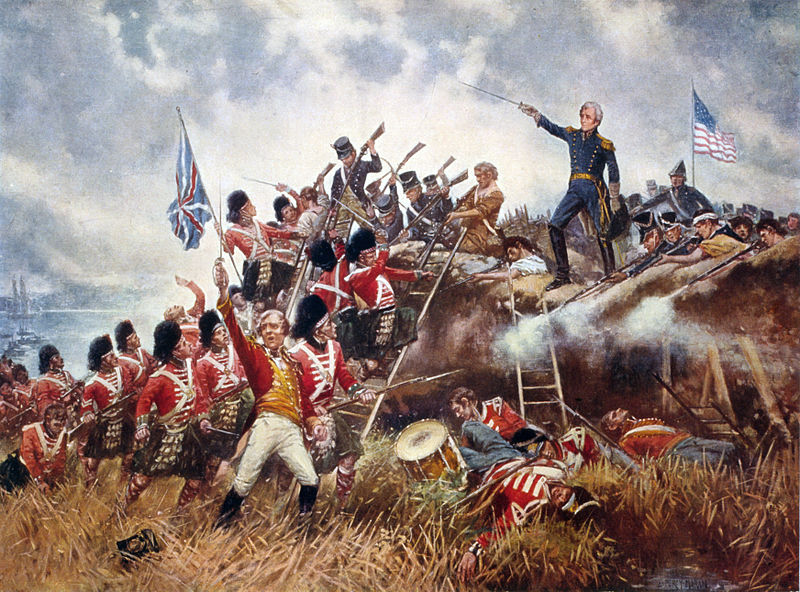
Jeffrey Lockelier was a black man, born free in North Carolina in 1788.  A young fellow with a taste for adventure, he came to Nashville in 1807.  Because the idea of soldiering appealed to him, he joined the militia, serving under Andrew Jackson during the War of 1812.  He distinguished himself in the Indian Wars at Enitachopco and Emuckfau Creeks and in the deadly Battle of Horseshoe Bend, which finally crushed the Creek Nation, forcing them to turn over 23 million acres to the U.S. Government.   Lockelier served with distinction in every conflict: his obituary stated that “none could boast of a heart more devoted to his country’s cause,” for “his military services terminated only when his country ceased to have enemies.” After the 1815 Battle of New Orleans, Jeffrey Lockelier, now known as “Major Jeffrey,” returned to Middle Tennessee, where he met and married a woman named Sabina, a slave of the Sumner family in Williamson County.  He soon purchased his wife from Thomas Sumner and petitioned the court to grant her freedom in July of 1817.  The census taker spelled their entry as “Major Locklun.”

Painting of the Battle of New Orleans by Edward Percy Moran (Library of Congress at http://hdl.loc.gov/loc.pnp/cph.3f03796)

Struggling with a heart ailment in his early 40s, Major Jeffrey “endured a long confinement,” during which he was visited by his old commanders, President Andrew Jackson and General John Coffee.  He “enjoyed, to a high degree their good opinion and friendship.”  Lockelier’s death occurred September 22, 1830, at the age of 42.  His obituary appeared in newspapers across the country, including the New York Evening Post, which marveled: “Though a very humble member of society, still it may be truly said, but few enjoyed the esteem and good will of the community to a greater extent than he did. His universal benevolence was a distinguished trait in his character; and it seemed to be the business and the pleasure of his life to serve others without even the expectation of reward.”

The admiring obituary that appeared in the National Banner & Nashville Whig 27 September 1830, ends like this: “One should not be forgotten who bestowed his best days to the service of his country; who lived a life of active benevolence, and died praising the goodness and mercy of his God.”  (2009)

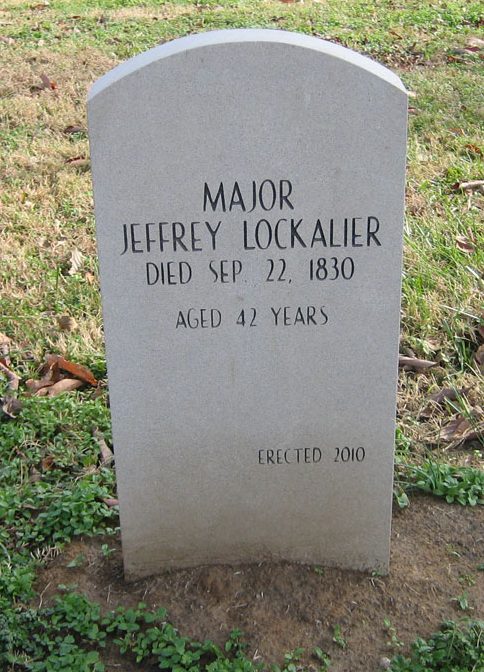
Jeffrey Lockelier’s grave at Nashville City Cemetery

Jeffrey Lockelier (whose name was spelled a variety of ways in different sources) was not forgotten by the city planners who named Nashville’s Locklayer St., near the Bicentennial Mall, in his honor.  Unfortunately, the original stone that marked his grave in Nashville’s historic City Cemetery disappeared long ago, but it was replaced in 2010 as part of the cemetery’s tombstone restoration project, which had previously replaced missing stones on the graves of Sally Thomas and Angeline Brady. 


The title of this essay comes from the poem “Hallowed Ground” by Thomas Campbell (1777-1844).


Previously published in Monuments and Milestones, the Nashville City Cemetery Newsletter.
A Lovely Sunday for the Cemetery

by Carter G. Baker.

On a beautiful early spring Sunday afternoon, about twenty descendants and relatives of Private Robert Bradfute (1794-1861), a veteran of the War of 1812, gathered in City Cemetery for a dedication of his recently installed military marker. The ceremonies were arranged by Ruth (Bradfute) Heizer of Knoxville, a great-granddaughter of Private Bradfute’s brother, and were conducted by the United States Daughters of 1812.

British Burning Washington during War of 1812 (illustration from Paul M. Rapin de Thoyras, The History of England, from the Earliest Periods, Vol. 1, 1816)

Robert Bradfute was a Virginian, and sometime after 1821, following his war service with the Virginia Militia, he and his wife, née Lucy Ann Vasser, came to Nashville, where he worked as a brick mason. One of the many buildings he worked on was the old insane asylum, which was torn down in 1999 for the new Dell campus on Murfreesboro Road.

In addition to the Veterans Administration headstone for Robert, Mrs. Heizer and her husband Jim purchased monuments for six other relatives buried in the Bradfute lot. The family placed another marker for Lucy Ann, who died in 1826 while still a young mother of three or four children. Lucy Ann is buried about 50 yards from the Bradfute lot on Oak Street.

After the death of Lucy Ann, Robert married Sarah Holman Snead and fathered four more children. Sarah is buried next to her husband, along with one of her children. Robert’s brother Hamilton, his wife Nancy Robinson Bradfute, and their daughter Blanche, are also buried in the Bradfute lot.

William R. Bradfute, the second child and oldest son of Robert and Lucy Ann, served as a captain in the Mexican War and a colonel in the Confederate Army. In 1853 William’s first wife, Ann Bennett Bradfute, only 22 years old, died in Nashville and was buried in City Cemetery, although her grave is not now marked. Colonel Bradfute later moved to Texas, along with other family members. After his death, he was buried in the National Cemetery in Austin, Texas.

A number of Bradfute descendants had come from Texas to attend the dedication ceremony. One of them, Roland Bradfute Jr., Robert’s fourth great-grandson, sang the National Anthem a cappella. He sang beautifully, and everyone present found it especially inspiring to hear the words written during Private Bradfute’s war sung in the shadow of the two flags displayed at the ceremony: the current U.S. flag and the 15-star flag that had been the national flag during the War of 1812.  (2014)


Previously published in Monuments & Milestones, the Nashville City Cemetery newsletter.