From Farm to Factory

by Ilene Jones Cornwell.

“I got my first job when I was thirteen years old, working from six in the morning ‘til six at night . . . six days a week, making fifty cents a day,” recalled Josie Coleman (1901-1986), during an oral history interview in 1972. She was referring to the summer of 1914, when she left her family’s double-log home in Spring Hill, Tennessee, to work in Nashville. Her father Jessie, a farmer supporting ten children younger than Josephine, drove the girl and her shawl-wrapped belongings the thirty-five miles to the city in a mule-drawn wagon.

Tennessee farm children, ca. 1918 (photo from NHN collection)

The previous few years had been unfortunate ones for the Colemans and other Tennessee farmers. Texas fever, a disease caused by micro-organisms transmitted by tick bites, had invaded the state and killed or quarantined most livestock. That calamity, compounded by the summer drought of 1914 and Maury County’s epidemic of hog cholera that affected the crops and hogs raised by the Colemans, had brought the farm to a standstill. Thus, when Josie’s uncle, preacher Joshua Nellums, reported in glowing terms on the ready market for labor in industrialized Nashville, first-born Josie decided that Nashville was the place to be. She could lodge with her aunt and uncle on Tenth Avenue North after she secured a job at one of the many factories and mills in the city.

At that time, Nashville already was established as a thriving commercial center. Flour had been the city’s chief product since 1899, when Royal Flour Mill was established. Royal adopted the innovative marketing practice of Ford Flour Company, offering five- and ten-cent sacks of flour to consumers instead of the usual barrel quantities. Homemakers immediately embraced the practice and established Royal Flour (later Martha White) as the area leader in flour sales. The brisk lumber trade had made Nashville the leading hardwood center of the South, and numerous factories—including Warioto Cotton Mills, Jamison Spring and Mattress Company, Tennessee Manufacturing Company, May Hosiery Mill, and Hartsford Hosiery Mill—offered steady employment to anyone willing to work.

Josie Coleman was more than willing to work; she was eager. Her first job was at Hartsford Hosiery Mill on Twelfth Avenue North at Harrison Street. She and “lots of other young girls” and women worked for fifty cents a day, six days a week, feeding the machinery that turned out long-length ribbed stockings for boys and girls. She threaded loops of cotton and wool on the large needles of a pre-set pattern or form; the needles created “everything . . . the toe, ribbing, and ends.” Then she had to transfer the stocking to a footer for finishing. The stockings of white yarn were later dyed black, a hue obtained by sulphuric dyes. This process was performed away from the processing factory, since the dye was extremely toxic. “And that dye really did smell,” Josie laughed. “It was a combination like rotten eggs and spoiled food. . .I don’t see how those folks stirring the dye vats stood that job!”

Josie remained at Hartsford for four years. “I paid fifty cents board to my Uncle Josh, kept a precious fifty cents for streetcar fare during the week, carried a tin pail with my lunch each day, and sent two dollars to my folks in Spring Hill,” she said, adding with a chuckle, “I felt I was making big money!” During that time, her father sold the Spring Hill farm and brought the family to Nashville, buying a residence in the 1700 block of Fourth Avenue North. Josie moved in with the family and obtained a job with the H. G. Hill Flour Mill on Van Buren Street. At the seasoned age of sixteen, she acquired a “better paying job” with the Tennessee Manufacturing Company on Eighth Avenue North. She began by sewing sacks of starched calico cotton used for packaging flour and meal. “Ladies really loved those sacks,” she laughed. “When they were empty, the sacks were washed and the stitches cut out so that curtains and clothes could be made from them. I’ve wondered if the ‘free’ fabric ladies got when they bought flour wasn’t more important than the product!”

During the ten years Josie Coleman worked for Tennessee Manufacturing / Werthan Bag, she married and had her first child. Motherhood prompted her to leave the work force in 1928. Looking back on those years, she observed philosophically, “Maybe the years have made me forget a lot of the hurtful things, but fifty cents a day was good money in 1914, especially for a kid right off a Spring Hill farm. I was paid hard cash for my work, and it bought a lot for the whole family. Getting paid money to work gave me a good feeling, and I liked it . . . I have no regrets.”

The Werthan Bag Company building on Eighth Avenue North is the largest surviving nineteenth-century factory in the Middle Tennessee area. The first of the buildings was constructed in 1871 by the Tennessee Manufacturing Company, and the mill began operation early in 1872, according to W. W. Clayton’s History of Davidson County, Tennessee (p.222). Plant additions were made in the 1880s. Werthan Bag Corporation bought the plant in the early 1900s and continued to offer steady employment for the flood of workers forced off rural farms by drought and livestock diseases. (photograph courtesy of the Tennessee State Library & Archives.) 

Letter from Mary

Primary Source Document, transcribed by Gordon MacDonald.

Note: Mr. MacDonald purchased this delightful letter at a community garage sale in Detroit, Michigan. It was written by a teenage girl in Nashville to her best friend in Ringgold, Tennessee. It consists of two sheets, each with a different date, but mailed together. Unfortunately, the letter is undated but, since it mentions a daguerreotype, was probably written after 1840. Mary, the young writer, seems to come from a prominent Nashville family and she mentions several names which might be traceable genealogically. The envelope is very small (4 ¼” x 2 ½”) and is written on florally-embossed stationery in a beautiful calligraphic hand. We would love to learn the identities of those mentioned herein, especially of the young author, Mary.

Miss Sallie FauntleRoy
Ringgold, Tennessee

At Home Dec 3rd

Best loved Friend, While Lou is reading over her lesson, I will employ my time in answering your more than welcome letter. The young lady I speak of is Miss Lou Craddock of Virginia. She is studying with me. Winter has just begun with we Nashvillians, and we feel it very sensibly, after so much pleasant weather, and would you believe it, after suffering all the Fall, with a severe cough, Dec. finds me wearing cotton Hoes [sic] and kid slippers. Sallie what do you think I have done to make me look more like a grown lady; why, I bought a pair of high heeled Gaiters. I know you would laugh to see me walking. You ask an invitation to my wedding. You know I have often told you that you were to be my first-Bridesmaid, and so you shall be, should such a circumstance ever occur in the annals of my history, providing you are unmarried yourself. I believe you spoke of stepping off yourself soon, now if you will invite me to be present on the interesting occasion, I will present you with my love of a Tea Set, to commence Housekeeping. Oh, it is so cold I can scarcely write, adieu 2 o’clock.

Sallie I have such a nice beau, Mr. Sweet; really he is the handsomest – did I say handsomest, I meant to say, with one exception (perhaps you are aware whom) he was the handsomest gentleman I ever saw, and is not his name “Sweet.” Tell Dr. Dabney when you see him, I had a most interesting dream about him the other night and it were so sweet, I fain would dream it o’er again. I wish you knew it Sallie, but indeed I can’t relate it on paper. Guess who I have fallen in love with, “Mr. Graves,” but don’t you tell Sister ever. I like to have broken my neck last night at church, peeping under the “Chandelier” at him, he was down stairs and I was up in the Choir and the Chandelier was between us. I am going to primp my best tonight to see him at church, ha! ha! ha!

Guess whose daguerrotype I saw at the Hotel the other evening, but I know you can’t. Miss Margaret and Susie Dabney’s and they were quite like the originals. Now if it had been Edmond’s, I would have stolen it. Mrs. Scott never would have dreamed I took it. I have a cousin from Murfreesboro studying with me now, Jennie : She sends love to you. My compliments to your Ma and Pa. Love to all others. They had me married last Thursday night, and I went up town Friday and received lots of congratulations and I wish you much joy, of course I was obliged to them. Sunday, they looked for me as a bride, but when I came in with a blue bonnet, it was all explained, but adieu.
Mary

[Written around upper border of page]

And a kiss for every day, till we meet and a sweet goodbye, Mary

[Second page]

Dec 4th. After all my primping, Mr. Graves was not at church last night. Now wasn’t that provoking. To night Amzi is coming to see me; and I believe Cousin Jennie expects two beaux; but I have nothing to do with entertaining them. Jennie does not like Lewis Freeman, He sent word to know if he could go to church with her Sunday evening and she would not go with him. she is quite a Coquette. I think of going to Murfreesboro soon, Sister is going home with T Saturday. I do wish to see you all but I fear many long months will come and go ere I can behold your loved faces again but I will never cease to remember the many happy hours I have spent in “Montgomery.” Sallie dear I have a very interesting book, a new work, and if your Ma reads at all now, write me and I will send it down. it is well worth a careful perusal. You may read it if you can collect your thoughts long enough from a certain person, to do so. I am going to send your Ma some very nice crackers made according to Dr. Jenning’s directions, especially for the sick; they are very nice indeed. Excuse writing (but I am not in the habit of making this excuse) and write very soon.

With the most devoted love,

Mary

[Written on inside flap of envelope]

Ellen I know you will write soon. Compliments to John, Rannie sends love to Miss Sallie & Ellen. Love to Cousin Mat & the girls. Tell Millie to write me about what Sam H. told her.

[Written on outside flap of envelope]

Here is a kiss for you.

Ten Important Dates in Nashville History

by Mike Slate.

A short list of important dates in Nashville history must necessarily exclude many defining events. Nevertheless, we believe the effort to narrow our history into an easily memorized list is worthwhile. The listed items provide an overview of the whole and serve as guideposts between which additional events can be viewed with some perspective. Perhaps it is also motivating to realize that memorizing a list of ten important Nashville dates will result in your suddenly knowing more Nashville history than probably eighty or ninety percent of all Nashvillians!

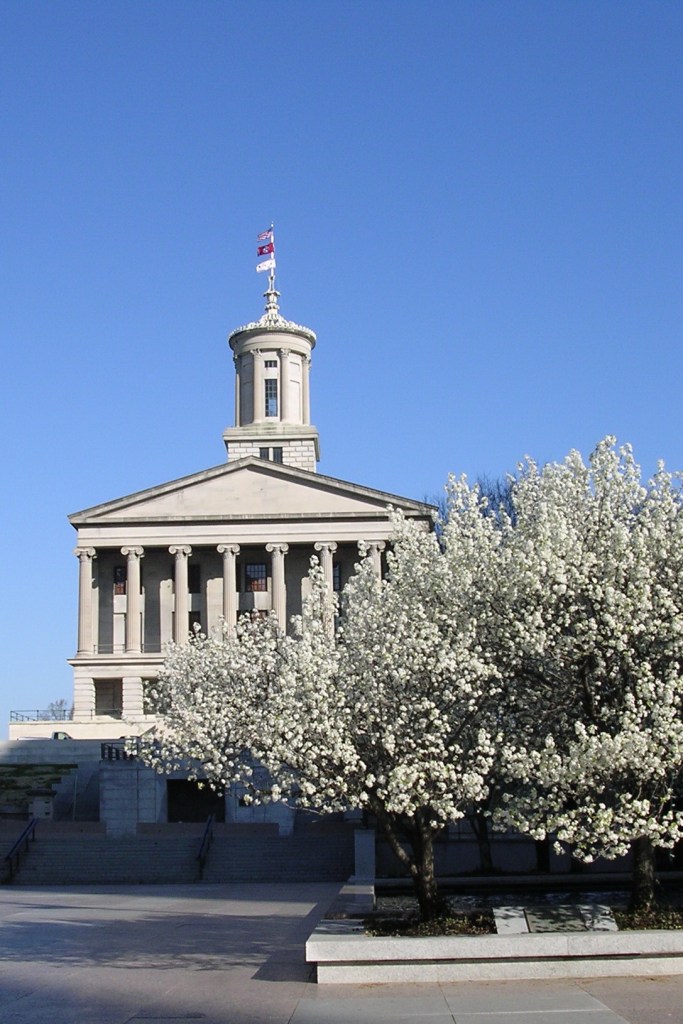
Photo of Tennessee State Capitol from NHN collection

Regrettably, in addition to Native American history, our list of dates omits Nashville’s heroic pre-settlement period, including the exploits of Timothy Demonbreun and the founding journeys to the Cumberland region led by James Robertson and John Donelson. Also omitted is the date of the formation of Davidson County (1783) as well as the dates on which Nashville was officially named (1784) and incorporated (1806). The Union occupation of Nashville (beginning February 1862) is another significant event not specified here. Several important twentieth century dates, including the rise of the huge DuPont Powder Plant complex during World War I, are not included. Finally, the modern development of Nashville, with its high-rise buildings and its various sports and entertainment venues, has been left for some future list.

No entry on the list should necessarily be construed as carrying the same historical weight as any other item on the list. For example, the 1925 beginning of the Grand Ole Opry would probably not carry the same weight as, say, the 1864 Battle of Nashville.

Expansive timelines of Nashville history can be found in other sources, including such excellent books as Henry McRaven’s Nashville: “Athens of the South.”

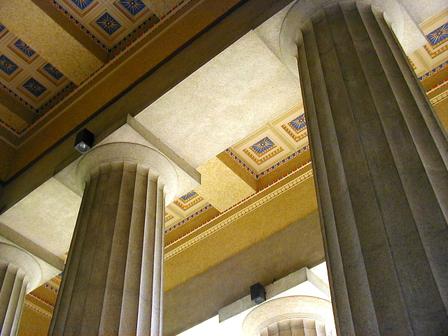
Photo of Parthenon from NHN collection

1. 1780 The signing of the Cumberland Compact.

2. 1824 The arrival of Philip Lindsley and the rise of the University of Nashville.

3. 1828 The election of Andrew Jackson as President of the United States.

4. 1843 The designation of Nashville as the capital of Tennessee.

5. 1864 The Battle of Nashville.

6. 1873 The founding of Vanderbilt University.

7. 1880 The Nashville Centennial Celebration.

8. 1897 The Tennessee Centennial Exposition.

9. 1925 The beginning of the Grand Ole Opry.

10. 1963 The formation of Metropolitan Nashville Government.

(article published in 2001)

School Desegregation in Nashville

by James Summerville.

The 1896 Supreme Court, in Plessy v. Ferguson, upheld the constitutionality of social segregation, ruling that state laws which required the separation of the races did not imply the inferiority of either. Yet separate was not equal in Tennessee. A 1930 study of Nashville schools called attention to dilapidated buildings, unsanitary outhouses, and inadequate lighting. Twenty years later, some black students still had to walk half a mile for a drink of water.

On May 17, 1954, the Supreme Court reversed Plessy, which had been used by many states to justify public segregation. Brown v. Board of Education held that “separate educational facilities” were “inherently unequal” because segregation denied black students equal protection under the law, a violation of the Fourteenth Amendment. A year later, the high court issued its implementation order, directing district federal courts to bring about compliance with the Brown decision. This was to be accomplished “with all deliberate speed,” an oxymoron which suggested that lower courts could show flexibility.

Nashville’s Board of Education appointed a committee to consider its options. Matters would have lingered in committee forever except for the lawsuit filed by Alfred Z. Kelley, an East Nashville barber. Kelley could not see why his son Robert had to commute across town to Pearl High School when the family lived within walking distance of East High School. The simple answer was that East was all white, and the Kelleys were black.

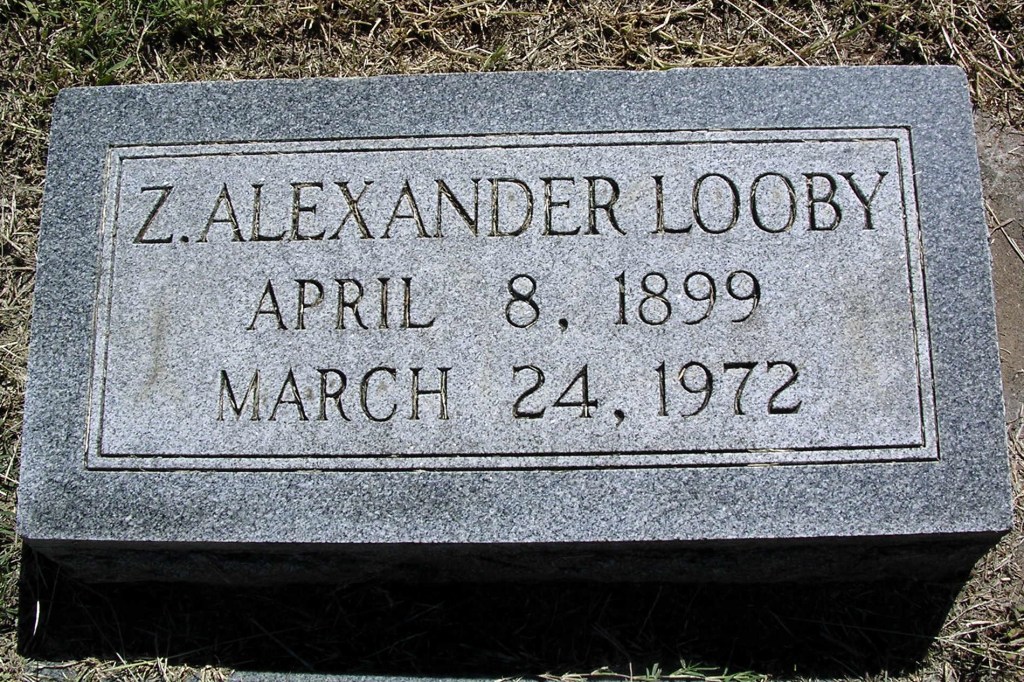
Lawyer Z. Alexander Looby and his partner Avon Williams Jr. carried Kelley v. Board of Education into federal district court. In time, Judge William E. Miller found for the plaintiff and directed the school board to prepare a plan for desegregation and submit it to the court by January 1957.

Z. A. Looby’s grave in Greenwood Cemetery

The educators stressed “deliberate” rather than “speed” and proposed that one grade per year be integrated, beginning with the first grade that next fall. At the same time, their plan allowed parents of either race to transfer a child out of a school where the other race predominated. In their final act, the board redrew the bounds of school zones so that only about 115 black first-graders, out of 1,500 eligible, could enter all-white schools come September.

Despite its novel evasions, the school board had acceded to the Brown decision. Diehards were left with unpalatable choices: resistance in public protests or keeping their children out of school.

Some black parents, worried about segregationists’ threats, took advantage of the school board’s transfer privilege. In the end, the burden of bringing down Jim Crow in public education in Nashville fell on 19 boys and girls. Twelve of them and their parents arrived at six elementary schools on the morning of September 9, 1957. So did knots of jeering white adults and teenagers. Police escorted the youngsters safely inside, but the day passed uneasily.

A few minutes after midnight, a bomb demolished a wing of East Nashville’s Hattie Cotton School. The police cracked down on persons carrying weapons, and jailed an agitator, John Kaspar, who had come to town to promote resistance to school desegregation.

Photo of schoolchildren from NHN collection

The handful of black youngsters who brought down the “walls of Jericho” adapted well, as did their white peers. Ironically, militants like Kaspar led the city to declare itself a peaceful, law-abiding community. Although support for the idea of racial equality was equivocal, the issue was now public order, for which there was universal support. The number of black students in formerly all-white schools grew from a few in 1957 to more than 700 by 1963. This was hardly a social revolution, but it did preface the gradual acceptance by Nashville parents, black and white, that the old days of separate and unequal schools were finished.

Samuel A. McElwee, 1859-1914

by Kathy B. Lauder.

Samuel Allen McElwee was born a slave in Haywood County, Tennessee, on June 26, 1859.  After emancipation he attended Freedmen’s Bureau schools1 and by 16 was teaching in a local school himself.2

Rep. Samuel A. McElwee, Esq.

In 1875 he entered Oberlin College for a year, taking odd jobs to pay his tuition.3 Returning to Tennessee, he walked ten miles each day after work to study Latin, German, and algebra with a white Vanderbilt student.4 He entered Fisk University in 1878, earning a Peabody Scholarship5 to pay his way.

While still enrolled at Fisk, McElwee won a seat in the 43rd Tennessee General Assembly (1882), representing Haywood County.6 He graduated the following May, just as his first House term ended.7 In 1884, at age 25, he became secretary of the Tennessee Convention, a state-wide gathering of black leaders,8 and served as a state delegate to the Republican National Convention.9

McElwee entered Nashville’s Central Tennessee College during his second legislative term, earning a law degree in 1885.10 He became the focus of a historic vote after former U.S. Senator Roderick Butler nominated him for House Speaker. Although unable to surmount a large Democratic majority, the 26-year-old former slave received 32 of the 93 votes cast.11

The first black Tennessean elected to a third legislative term (1887), McElwee pleaded for stronger legal powers over lynch mobs: “Great God, when will this Nation treat the Negro as an American citizen?”12 Despite his highly publicized speech, the House tabled the bill 41-36.13 Later that year McElwee spoke at Tuskegee Institute’s graduation14 and presided over the Colored World’s Fair Association.15 

In 1888 Samuel McElwee married the “handsome and cultured” Georgia Shelton.16 Their wedding party included many prominent Nashvillians, black and white. Fisk President E. M. Cravath officiated; guests included Charles Nelson, Granville P. Lipscomb, Dr. H. T. Noel, Dr. R. F. Boyd, Major E. B. Stahlman, and former Confederate General George Maney.17  

The State Republican Party elected McElwee delegate-at-large to the 1888 Republican National Convention,18 where he was a member of the committee on credentials.19 McElwee’s eloquent words about the potential role of African Americans in national politics helped persuade Benjamin Harrison to nominate former slave Frederick Douglass as ambassador to Haiti and to endorse bills prohibiting Southern states from obstructing African American suffrage.20

At home McElwee faced powerful political challenges to his campaign for an unprecedented fourth legislative term: Haywood County officials employed “disgraceful election methods”21 to ensure his defeat,22 and white separatists drove him from the county.  During the following term (1889) the all-white General Assembly approved legislation that would disfranchise black voters for decades.23

McElwee and his wife spent the next twelve years in Nashville, where he established a thriving law office.24 Both Samuel and Georgia were active in civic organizations, and their names regularly appeared in the social pages of the newspapers. In 1901 McElwee moved his wife and daughters to Chicago,25 where his legal practice flourished for over a decade. He won many important cases, including a multi-million-dollar lawsuit against the City Railway Company.26 He died in Chicago October 21, 1914, at the age of 56. 27 (2014)


SOURCES:

1 “Brave Tennessean Forgotten by History,” Nashville Tennessean, February 13, 1971.

2 “A Remarkable Negro,” Nashville Daily American, June 9, 1888.

3 “Brave Tennessean Forgotten by History.”

4 “The Death of Atty. Samuel A. McElwee,” Chicago Broad Axe, October 24, 1914.

5 Tennessee State Board of Education Minute Book, Volume 55, page 131.

6 McBride, Robert M., and Dan M. Robinson. Biographical Directory, Tennessee General Assembly, Volume II (1861-1901). Nashville: Tennessee State Library and Archives, and Tennessee Historical Commission, 1979.

7 Simmons, William J.  Men of Mark: Eminent, Progressive and Rising. Cleveland: G. M. Rewell & Co., 1887, 500.

8 “The Tennessee Convention: Colored Men in Council at Nashville—Vital Questions Ably Discussed—Resolutions setting forth the Grievances and Needs of the Race,” New York Globe, March 15, 1884.    

9 Johnson, Charles W. Republican Party (U.S.:1854-), 227. Official Proceedings of the Republican National Convention, Chicago, June 3, 4, 5 and 6, 1884, 21.

10 Simmons, William J.  Men of Mark: Eminent, Progressive and Rising. Cleveland: G. M. Rewell & Co., 1887, 500.

11 Tennessee General Assembly. Journal of the House of Representatives of the State of Tennessee. Nashville: Tavel & Howe, 1885.

12 Nashville Union, February 23, 1887.

13 Tennessee General Assembly. Journal of the House of Representatives of the State of Tennessee. Nashville: Tavel & Howe, 1886.

14 “Tuskegee Normal School: Celebrating Its Sixth Anniversary—An Exhibit of  Industries—Commencement Exercises,” New York Freeman, June 4, 1887.

15 “General Announcement. Colored World’s Exposition, 1887-’88,” Weekly Pelican, January 29, 1887.

16 “McElwee. A Southern Lawyer, the Brilliant Orator and Barrister,” Freeman, March 2, 1889.

17 “Hon. S. A. McElwee Married,” Nashville Daily American, June 7, 1888.

18 “A Remarkable Negro.”

19 Johnson, Charles W. Republican Party (U.S.:1854-), 227. Official Proceedings of the Republican National Convention, Chicago, June 3, 4, 5 and 6, 1884, 24.

20 Calhoun, Charles W. Benjamin Harrison: The American Presidents Series: The 23rd President, 1889-1893. New York: Times Books, 2013,

21 “McElwee. A Southern Lawyer, the Brilliant Orator and Barrister.”

22 Granberry, Dorothy. “When the Rabbit Foot Was Worked and Republican Votes Became Democratic Votes: Black Disfranchisement in Haywood County, Tennessee.”  Tennessee Historical Quarterly, Vol. LXIII, No. 1, Spring 2004.

23 Lester, Connie L. “Disfranchising Laws.” Tennessee Encyclopedia, Online edition. Knoxville: University of Tennessee Press, 2002-2014.

24 “An Eloquent Lawyer’s Great Effort Highly Complimented by Leading Whites,” Freeman, June 20, 1891.  Also “Professional Success,” Freeman, July 11, 1891.

25 “Chips,” Broad Axe, August 12, 1901.

26 “Chips,” Broad Axe, February 8, 1902

27 “Death Claims Samuel A. McElwee: Well Known Attorney Was Native of Brownsville, Tenn.—Was Member of Tennessee Legislature.” The Chicago Defender, October 24, 1914.

SUGGESTED READING:

Cartwright, Joseph H.  The Triumph of Jim Crow: Tennessee Race Relations in the 1880s.  Knoxville: UT Press, 1976.

Couto, Richard A. Lifting the Veil: A Political History of the Struggles for Emancipation. Knoxville: UT Press, 1993.

Granberry, Dorothy. “When the Rabbit Foot Was Worked and Republican Votes Became Democratic Votes: Black Disfranchisement in Haywood County, Tennessee.”  Tennessee Historical Quarterly, Vol. LXIII, No. 1, Spring 2004.

“This Honorable Body: African American Legislators in 19th Century Tennessee.” Exhibits, Tennessee State Library and Archives.  https://sharetngov.tnsosfiles.com/tsla/exhibits/blackhistory/index.htm

Biography of Charles Henry Ryman (1809-1879)

by Jeanne M. Johnson.*

Charles H. Ryman was the eldest of the four Ryman brothers of Nashville, Tennessee. The others were William (ca. 1814 – bef. 1872), John (1819-1864), and Francis “Frank” (ca. 1824-1866). The well-known steamboat captain Thomas G. Ryman (1841-1904), owner/operator of the largest Cumberland River steamboat company, was Charles’s nephew, the fourth of his brother John’s six children. The Ryman Auditorium (former home of the “Grand Ole Opry”) was named in recognition of Tom’s civic contributions to the city of Nashville.

The Ryman Auditorium (postcard image from NHN collection)

The exact birthplace of the Ryman brothers is unknown, but census records do establish their origins in the state of Tennessee. The brothers spent their entire adult lives in Nashville, raising families and running businesses for many decades. No one knows exactly when the Ryman family first came to the River City. The 1830 Federal census for Davidson County includes the name of the possible patriarch of the family, Frederick Reinman. An earlier Sumner County census (1820) includes a possible variation of Frederick’s name, Ferdinand Rhyneman, suggesting that the family may have lived in neighboring Sumner County before moving to Nashville. Many variations of the Ryman surname can be found in Davidson County records, including “Rimon” and “Rineman.” The fact that Charles could not write may have contributed to the various spellings that county officials used in recording his surname.

The earliest official Davidson County document to name Charles Ryman was the record of his marriage to Prudence Mary V. Reddick (1818-1874) on June 22, 1834, in Nashville. Five years later Charles was listed in the 1839 Davidson County tax lists. One year after that, his name appeared as “C. Rineman” in the 1840 Federal census of Ward 6.

Several members of the Ryman family worked as riverboat captains (photo from NHN collection)

Charles Ryman’s occupation in 1850 and 1860 Federal census records of Nashville was listed as “steamboat captain.” According to biographies of Thomas G. Ryman, Tom’s Uncle Charlie helped pilot 26-year-old Tom’s first steamboat to Nashville in 1867 after its purchase in New Orleans. Although Tom did not have a pilot’s license at that time, his uncle did. Charles’s occupation according to every Nashville city directory from 1855-1868 was “steamboat captain,” “river captain,” or “steamboatman.” Then, from 1870 until his death in 1879, his occupation was listed as “grocer” or “grocery.” The year after Charles’s death, his widow continued to be listed in the 1880 census as “grocer.” It appears that Charles retired from his physically demanding work on the river to become the proprietor of a grocery store. The grocery store may well have been an ongoing family business: younger brother Frank, who was living with Charles, according to the 1855-1857 Nashville city directories, was also listed as a “grocer.” Failed attempts to locate the possible parents of the Ryman brothers after the 1830 census make it likely that Charles raised and supported Frank and continued to play a parental role throughout his youngest brother’s life. Matrimonial records named Charles as Frank’s bondsman in his marriage to Matilda Akin in 1844.

Charles and his first wife Prudence were childless throughout their 40-year marriage. When Prudence died on December 31, 1874, at the age of 56, the 65-year-old Charles wasted no time in marrying the much younger Kate Dailey/Daly (b. 1843 in England) seventeen weeks later on May 6, 1875. Kate and Charles were united for four years before Charles’s death from “exhaustion,” as listed in the Tennessee mortality schedule. Even so, Charles still managed to outlive his three younger brothers.

The widow Kate’s son, John Dailey/Daly (b. 1864), was living with her at the time of the 1880 Federal census, indicating that her surname when she married Charles was likely from a former marriage. In her will, dated December 10, 1874, Charles’s first wife Prudence M. V. Ryman left all her personal and real property to “my husband Charles H. RIMON.” Charles later deeded to Kate several pieces of real estate that may first have belonged to Prudence – but with the stipulation that, if their marriage ended in divorce or her death, the deeds would revert to Charles. Charles’s will left all his properties to Kate with no conditions attached. She sold the real estate to her son John E. Daly and held the mortgage herself. On February 20, 1893, she recorded the release of the mortgage in the margin of the deed and signed it as “Mrs. Kate Caulfield née Kate Ryman.” [This was technically incorrect – “née” means “born as,” and Ryman was, of course, Kate’s married name, not her maiden name.] However, the new surname led this researcher to find an 1890 Davidson County marriage record for Mike Caulfield and Kate Ryman.


*From the historical research of Jeanne M. Johnson and Ella Ryman Hauser.

University of Nashville in the DAB

by Mike Slate.

The Dictionary of American Biography, an esteemed multi-volume reference work, contains essays on individuals who died before 1981. One portion of its master index lists the subjects of the biographies by the college or university they attended. Under “University of Nashville” are seventeen names: William Barksdale, John Bell, Jacob McGavock Dickinson, Andrew Jackson Donelson, Tolbert Fanning, Ephraim Hubbard Foster, Henry Hitchcock, Cave Johnson, John Berrien Lindsley, George Earle Maney, Robert Paine, Gideon Johnson Pillow, James Davis Porter, Wickliffe Rose, William Walker, John Anthony Winston, and William Yerger.

Lindsley Hall, the main classroom building of the University of Nashville, still stands near the Howard Municipal Office Building at 2nd and Lindsley.

Of these seventeen, ten are also featured in The Tennessee Encyclopedia of History & Culture, and we refer the reader to that volume for their biographies. Here we offer introductions to the remaining seven, not only to highlight their lives but also to illustrate the extensive influence of the University of Nashville.

William Barksdale (1821-1863), born in Rutherford County, Tennessee, attended the University of Nashville and studied law in Columbus, Mississippi. He became editor of the Columbus Democrat before serving in the U.S. Congress from 1853-1861. An advocate of slavery, Barksdale rose to the rank of brigadier-general during the Civil War. He died of wounds received at the Battle of Gettysburg.

Jacob McGavock Dickinson (1851-1928) was born in Columbus, Mississippi, but moved to Nashville and became one of the city’s most accomplished citizens. From the University of Nashville he received the A.B. degree in 1871 and the A.M. the following year. A well-known lawyer and judge, Dickinson served as president of the American Bar Association from 1907-1908. His appointment as Secretary of War under long-time friend William Taft is another of his many achievements. An interesting fact not mentioned in the DAB (but noted by Margaret Lindsley Warden in Nashville: A Family Town) is that at various times Dickinson was the owner of three of Nashville’s historic estates: Ensworth, Polk Place, and Belle Meade.

Henry Hitchcock (1829-1902), an Alabama native, graduated from the University of Nashville in 1846 and from Yale in 1848. He was pro-Union and served under Sherman during that General’s march to the sea. A scholarly jurist and able speaker, Hitchcock organized the law school of Washington University in St. Louis and was its first dean. Like Dickinson, he served as president of the American Bar Association (1889-1890).

Born in Franklin, Tennessee, George Earl Maney (1826-1901) graduated from the University of Nashville a year before Hitchcock but, as a Confederate brigadier-general, fought against Sherman in the Atlanta Campaign. After the War, Maney became president of the Tennessee & Pacific Railroad and was elected to the state legislature. From 1881 to 1894 he served as a diplomat in South America.

In 1814 Robert Paine (1799-1882) moved from North Carolina to Giles County, Tennessee. The DAB reports that he was “ready to enter the sophomore class of Cumberland College [a forerunner of the University of Nashville]” when a religious experience moved him to preach. In 1846, after serving for sixteen years as president of LaGrange College in Alabama, he was elected Bishop of the Methodist Episcopal Church, South, and moved to Aberdeen, Mississippi. He is the author of Life and Times of William McKendree.

John Anthony Winston (1812-1871), born in Madison County, Alabama, “spent some time at Cumberland College” in Nashville and became a successful planter, owning plantations in four Southern states. He was governor of Alabama (1853-1857), and, after the Civil War, was elected to the U.S. Senate. An ardent Confederate, he was denied his Senate seat after refusing to take the oath of allegiance to the United States.

William Yerger (1816-1872), born in Lebanon, Tennessee, graduated from the University of Nashville in 1833. He moved to Jackson, Mississippi, where he developed one of the largest law practices in the state. Although he opposed secession, Yerger was elected to the state legislature and remained in that office throughout the War. At war’s end, he was instrumental in bringing Mississippi back into the Union.

The seventeen DAB articles on men who attended the University of Nashville reinforce the importance of that institution in our city’s history. In addition, Nashville-related entries in standard reference works remind us that our history often ceases to be only “local” and becomes national or even international in significance.

The USS Tennessee at Pearl Harbor

by Kenneth Fieth, Metropolitan Nashville Archivist (includes primary source transcription by the author).

“There were so many of them flying together that they looked like one. They came through the valley very close to the ground and I could clearly see the rising sun on the end of each wing. Not a few minutes later, the rumbling sounds of multiple explosions rolled through the pineapple field.” The missionary’s son whose jet-black hair is now gray waved his hand in a dive as he recalled the first time he ever saw a Japanese warplane . . . on Sunday morning, December 7th, 1941.

The men of the USS Tennessee, moored on Battleship Row in Pearl Harbor, had a far more harrowing experience. The following excerpt is from the official after-action report filed by the Commanding Officer of the Tennessee on December 11, 1941.

The USS Nashville (CL-43) in 1943 (U.S. Navy photo)

“On Sunday, December 7, 1941, the USS Tennessee was moored starboard side to quay Fox 6 [in Naval terms, that is a berth for the ship lettered as “F 6”] with two hausers and seven manila lines. The USS Virginia was moored alongside to port. Boiler #1 was steaming for auxilliary purposes . . .. This ship was the flagship of Commander Battleship Division Two . . .; the USS Arizona was moored about 75 yards ahead and astern of the Tennessee.

“At about 7:55, planes, observed to be Japanese by their markings, were seen dropping bombs on Ford Island. [Ford Island is in the center of Pearl Harbor and was used for mooring the ships of “Battleship Row”]. This ship [Tennessee] went to general quarters . . .. Immediately, after the bombing of Ford Island, planes began torpedoing and bombing the battleships and other ships in the Harbor. This ship opened fire with .50 caliber and 5″ caliber guns about five minutes after the attack.

“Orders for sortie were received [orders to get underway and steam out of the harbor] but later cancelled for battleships . . .. The Oklahoma listed over and in about 10 minutes capsized. The West Virginia listed heavily but was righted by counter-flooding. The Arizona received several large bomb hits, at least one of which apparently penetrated the magazines [ammunition storage areas]. There was a large explosion forward. [Other accounts of the destruction of the Arizona indicate that the ship, over 30,000 tons, was actually lifted out of the water by the force of the explosion.]

“The foremast fell forward and burning powder, oil, and debris was thrown on the quarterdeck of the Tennessee. The Arizona settled rapidly by the bow. The Nevada got underway but was struck by bombs and torpedoes and grounded in the channel. Large fires were raging around the Arizona and West Virginia. The Arizona was moored to quays about 75 feet astern of the Tennessee, and the West Virginia was moored to the Tennessee. The burning powder, oil, and debris from the Arizona explosion plus the intense heat from the fires started [fires] in the stern and port quarter of this ship.

“These fires and subsequent wetting caused considerable damage to the wardroom and officers quarters in this vicinity. The fires were brought under control about 1030. The captain returned aboard and resumed command about 1000. During the engagement the Tennessee received two bomb hits, one on turret III, and one on the catapult and penetrated the roof of the turret. The bomb broke into large pieces but did not explode. The explosive charge spilled into the turret and burned. Fragments of the bomb strongly indicate that it was a converted 15″ armor piercing shell and weighed about 1500 to 2000 pounds. The training gear and rammers were damaged. The range finder was completely wrecked. Several casualties occurred as a result of this hit . . .. The hit on turret II split the hoop on the center gun, rendering it inoperative. Fragments from this hit caused casualties on the machine gun stations. The active fighting was over by about 1000; although small numbers of planes were observed and fired at throughout the day, no more bombs or torpedoes were observed.

“When fires started in and around the West Virginia and Arizona this ship let out all fire hoses and fought fires in the former ships and the oil fires on the water that endangered this ship. This fire fighting continued throughout the day and night. About 1030 it was decided to try and move the ship away from the badly burning Arizona . . .; the West Virginia as a result of her torpedo hits, had wedged the Tennessee so close to the quays that she could not move.

“The engines were kept running at 5 to 10 knots all day and night in order that the screws would wash the burning oil away from the ship. When the fires started, magazines [ammunition storage areas] number 306, 310 and 312 were flooded . . ..

“The following ammunition was expended during the battle: 760 rounds of 5 inch caliber, 180 rounds of 3 inch caliber, and 4000 rounds of .50 caliber. [Caliber is a measurement of diameter of a projectile: 5 inch means 5 inches in diameter.]

“The ship had been fueled on December 3rd. Fuel on hand was 1,380,000 gallons, 94% of capacity . . .. The conduct of the officers and crew of the Tennessee was uniformly in accordance with the highest traditions of the Service. Not only did they fight the battle with calmness and deliberation but for the next 24 hours they fought oil fires on the Arizona and West Virginia . . .; the crew carried out their gunnery and damage control duties as if on drill.”

This is the official historical account of the actions of the USS Tennessee on that fateful day in 1941, sixty years ago this December. [This article was published in 2001] The USS Tennessee would go on to participate in the last battleship-to-battleship engagement the world would ever see in the Surigao Straight, helping to sink the Japanese Battleship Yamashiro and surviving Kamikaze attacks. Unfortunately, this Tennessee namesake was decommissioned in 1947 and sold as scrap in 1959. 

A Woman Challenged: The Life of Granny White

by Doris Boyce.

Born in 1743, Lucinda Wilson became the second wife of Zachariah White about 1760 and helped raise his children, along with a brood of her own. Zachariah wanted land badly enough to risk his scalp. He joined James Robertson and headed overland to North Carolina’s Cumberland territory to help establish the settlement of French Lick, where the city of Nashville now stands.

Granny White Grave Marker (from The Historical Marker Database; photo by Michael Manning)

Zachariah was a militiaman, a farmer, and a part-time teacher. He opened the first school at French Lick in the spring of 1781, but he was killed at the Battle of the Bluffs later that year, leaving Lucinda, called Lucy, and his heirs so poor they could not afford the surveyor’s fee required for eligibility to receive the 640-acre grant North Carolina awarded to families of men killed defending the settlement.

Seventeen years later, in 1801, 58-year-old Lucy was informed by the courts of Surrey County in the Tidewater district of North Carolina that she was too old and too poor to take on the responsibility of her two orphaned grandsons, Thomas and Willis, ages 8 and 9. The judge, who would not have granted custody to a woman in any case, ruled that the boys must be bound over to a tradesman in order to keep them out of the poorhouse.

But Lucy would not be told “No” again, certainly not by North Carolina! She loaded her spinning wheel and household goods onto an oxcart pulled by a yellow longhorn steer and left in the middle of the night, along with Thomas, Willis, and an elderly slave called Uncle Zachary. Traveling only about three miles a day, they walked 800-900 miles through Indian territory and the rugged Carolina mountains, leading the oxcart toward the Cumberland settlements where Lucy had three adult children and a number of step-children. Along the way they made several stopovers, staying long enough in each place to make a little money and become more self-sufficient. In Roane County, Tennessee, at a place called Meredith, she put up a ginger cake stand where she sold baked goods to travelers.

The small, white-haired Lucy was 60 years old when she arrived in Nashville in 1803. She set up another ginger cake stand, along with a tar pit or kiln for greasing wagon axles. With the money she made from her various enterprises, she purchased 50 acres that consisted of the facing slopes of a pair of adjoining hills. Her land was located along an old buffalo path that had been the first road built going south from Nashville to Franklin. One of Lucy’s hillsides had to be dug away to create space to build a log house. The other hill was planted in grapevines, fruit trees, and vegetable gardens. The land was so steep that apples rolled downhill into the fence and pumpkins had to be staked to the hillside.

By 1812 Lucy had opened an inn that attracted travelers from the Natchez Trace, four miles to the west. She soon became known for her excellent cooking and the whiskey that she made herself. Guests of the inn praised her for the finest brandy and applejack, the best pancakes, and the cleanest beds. She charged 12 1/2 cents a night for a room and 50 cents a night to board horses. Lucy was innkeeper, housekeeper, and cook, and somehow found time to weave the bed linens and the family’s wearing apparel. When more guest rooms became necessary, she added new wings, a room at a time.

Lucy’s grandsons called her “Granny,” and soon the customers did, too. Still remembered today as Granny White, she was 73 years old when she died in 1816, possessed of considerable wealth, along with slaves, horses, and cattle. Grandson Thomas had died in an accident as a youth, so Willis inherited the property, but the tavern was not open to paying guests after Granny’s death. Willis and his wife Winifred moved to Nashville so their ten children could go to school, but the couple returned to the inn in their old age, after the children were gone.

The inn was half-rotted by late 1864, when the Battle of Nashville took place all around it. Everett Beasley acquired the lands in 1930 and in 1942 replicated the log tavern at the same location with logs from a frontier inn in Dickson County. After 30 years, however, the old logs began to sag just as Granny’s originals had. In 1983 Robert Neil and Vander Linder conveyed the logs to Cheatham County, where they constructed a log house that still stands today.

One hundred sixty-five years after Granny’s death the property was developed into 43 residences called The Inns of Granny White. Her fenced gravesite is near the entrance. To get there from Nashville, you will take the same route the buffalo did, along the street toward Franklin, now named Granny White Pike.

Granny did not accept the social wisdom of her day. She did not let being a woman, being old, or being poor defeat her. After an apparently hopeless beginning, she became a self-reliant individual, an entrepreneur. She ignored the hurdles in her path by flaunting the law, engaging in commerce, making and selling liquor, and taking strangers into her home. She accepted the challenge of frontier life and did what she had to do.

Reverend Charles Spencer Smith (1852-1922)

by Jean Roseman.

As Nashville’s attention turns to the revamped Public Square, we should take note of a fascinating but little-known story about that area. It is the story of the Reverend Charles Spencer Smith, an African American man of extraordinary accomplishments.

Photograph from The Centennial Encyclopædia of the African Methodist Episcopal Church; Philadelphia, 1916; Richard R. Wright Jr., ed.

Smith was born into humble circumstances in Colborne, Canada, in 1852. Said to be able to read before the age of five, the boy loved books so much that the first money he ever spent was for a book. Attending school irregularly until he was ten, the youngster then struck out on his own. He first learned the trade of furniture refinishing and later worked at various other jobs: as a general utility boy in a boarding house, as a deck hand on the Great Lakes, as a cook, and as a waiter, continually working his way southward on the waterways.

Passionately fond of reading, especially newspapers, he educated himself successfully enough to become a teacher in Kentucky. When the Ku Klux Klan broke up the school, Smith moved on to Mississippi. There he was licensed to preach in the African Methodist Episcopal Church at Jackson, Mississippi, and also began to take an active role in politics.

Smith next settled in Mobile, Alabama, where he was ordained as a minister. Under the political changes initiated during Reconstruction, he was elected by a large majority to the 1874 Alabama House of Representatives. Widely respected for his prodigious knowledge and his impressive speaking skills, Smith gained a reputation as “the orator of the House.” However, the signing of the Amnesty Act, a period of economic depression, and a series of violent acts by white supremacists heralded a return to Democratic control of politics in the South, and many newly elected black politicians lost their seats in the 1874 and 1876 elections.

When his term ended in 1876, Smith came to Nashville. Still very active in the church, he attended Central Tennessee College (Meharry), receiving a full medical degree in 1880.

Two years later Smith founded a publishing house, the Sunday School Union of the A. M. E. Church, at 206 Public Square. He purchased the property for $9,000 from Maria Louisa Elliston Yandell, who had inherited it from her father, William Elliston. Much earlier it had been the site of the Nashville Inn in 1804.

The Sunday School Union was the first and only steam printing establishment in America to be owned and managed by an African American. From that location, Smith generated an enormous amount of printed religious material circulated not only in the United States but also abroad. Despite Charles Spencer Smith’s international renown, however, it was seven years before the Nashville City Directory (1889) mentioned him or his publishing house.

Not only did Smith successfully supervise the Nashville publishing operation, but he also became a bishop of the A. M. E. church in 1900, traveling widely throughout Africa, the Caribbean, South America, and Europe. In 1911 he was distinguished as the first black recipient of the degree of Doctor of Divinity from Victoria College, Toronto. Before his death in 1922, Smith completed a continuation volume of the history of the A. M. E. church.

In Smith’s time 206 Public Square was a four-story building only 20 feet wide and 120 feet deep. Inscribed on the stone façade was the legend, “Founded A.D. 1882 by C. S. Smith.” At some point after 1918 the top two floors were blown off in a storm.

The building was purchased in 1918 by shoe businessman Sam Levy, who sold it in 1943 to the Katz family for their men’s furnishings wholesale house. In the mid-1960s, when the building was facing demolition, Katz descendant Dorothy Katz Mintz allied herself with others interested in preserving the building, hoping to convert it into a museum to commemorate Smith for his service to church and society. To this day, she still laments, “Now, why did they have to build a jailhouse on that property?” Some Nashvillians may still remember that, just prior to the demolition, the building housed the “Judge’s Chambers,” a restaurant on the Square.

Because of the efforts of the Reverend Charles Spencer Smith and others, 206 Public Square North has had a unique and unlikely history – one that should not be forgotten as a remodeled courthouse casts new shadows on the old Public Square.