John Berrien Lindsley, 1822-1897

by Kathy B. Lauder.

Born October 24, 1822, John Berrien Lindsley came to Nashville in 1824, when his father, Philip, became president of the University of Nashville. Young Lindsley was educated at home by his parents and a neighbor, Septima Sexta Rutledge.1 At 14 he entered the University of Nashville, earning a B.A. at 17 and an M.A. two years later.2 In 1842 he entered the University of Pennsylvania Medical School, receiving his M.D. in March 1843.3 Here Lindsley began a lifelong friendship with adventurer William Walker.4

Dr. John Berrien Lindsley

Lindsley’s next pursuit was theology: in December 1843 the Nashville Presbytery accepted him as a candidate for the ministry.5 He was licensed to preach in April 1845,6 shortly before attending to Andrew Jackson at his deathbed.7 Lindsley ministered to churches at the Hermitage and in Smyrna and, beginning in 1847, preached to slaves and the poor.8 An 1849 cholera epidemic9 kindled his interest in public health.

When Philip Lindsley left the University of Nashville in 1850, his son John Berrien became Chancellor. He proposed to rescue the faltering university by merging with the Western Military Institute of Georgetown, Kentucky,10 and by establishing the long-awaited medical school. Though apprehensive, Board members permitted the merger.  Lindsley spearheaded the development of the medical school in 1851, became its first dean, and taught there until 1873.11 [Note: the following year the University of Nashville Medical School was incorporated into Vanderbilt University, which had been founded in 1873 by virtue of a grant from Commodore Cornelius Vanderbilt. From that point on, it would be known as the Vanderbilt University School of Medicine.]

In 1857 Lindsley married Felix Grundy’s granddaughter Sarah “Sallie” McGavock, with whom he had six children. He served on the Nashville Board of Education and was secretary of the State Board of Education, administering the Peabody Education Fund and overseeing the transition of the University of Nashville into Peabody College.12 Having received a Doctorate of Sacred Theology from Princeton (1858), he lectured in the Cumberland University Theological Department in Lebanon.13

Following the capture of Fort Donelson (February 1862), Lindsley became post surgeon of Nashville hospitals. His valiant efforts to protect university property during federal occupation saved the library, laboratory equipment, and the valuable Troost mineral collection.14 

After the war, Lindsley served on the Nashville Board of Education and was superintendent of Nashville public schools. He helped establish Montgomery Bell Academy (1867) and the Tennessee College of Pharmacy (1870),15 and in 1875 presided over the State Teachers Association. Having promoted the passage of an 1877 law establishing the State Board of Health, he served as its first executive secretary.16 As Nashville Public Health Officer from 1876-1880, he supervised all health efforts in Tennessee during the 1878 yellow fever epidemic.17 He taught Sanitary Science and Preventative Medicine at the University of Tennessee from 1880-1897.18

Dr. John Berrien Lindsley in later life.

Distressed by wartime divisions within the Presbyterian Church, Lindsley became a minister in the Cumberland Presbyterian Church in 1874.19 He authored History of the Law School of Cumberland University at Lebanon, Confederate Military Annals of Tennessee, and many works on medicine and public health. He was an early member of the Tennessee Historical Society and a fellow of the American Academy of Medicine.20 His many talents led Alfred Leland Crabb to call him the “Benjamin Franklin of Nashville.”21           

John Berrien Lindsley died December 7, 1897, in Nashville. He is buried in Mt. Olivet Cemetery. (2014)


SOURCES:

1 Windrow, John Edwin. John Berrien Lindsley, Educator, Physician, Social Philosopher. Chapel Hill: University of North Carolina Press, 1938, 8.

2 Lindsley, John Berrien. Diary, Volume 4, 1849-1856.  Lindsley Family Papers, ca. 1812 – [1840-1940] – 1953, Box 1, Folder 21.  Tennessee State Library and Archives.

3 Windrow, 11.

4 Lindsley, John Berrien. Letter to Adrian Van Sinderen Lindsley, April 8, 1843. Lindsley Family Papers, ca. 1812 – [1840-1940] – 1953. Oversize folder (49). Tennessee State Library and Archives.

5 Lindsley, John Berrien. Diary, Volume 4, 1849-1856.

6 Windrow, 12.

7 Lindsley, Philip. Journal. Lindsley Family Papers, ca. 1812 – [1840-1940] – 1953, Box 2, Folder 33. Tennessee State Library and Archives.

8 Lindsley, John Berrien. Diary, Volume 4, 1849-1856. 

9 Pyle, G. F. “The Diffusion of Cholera in the United States in the Nineteenth Century,” Wiley Online Library, accessed 1-4-2014.  http://onlinelibrary.wiley.com/doi/10.1111/j.1538-4632.1969.tb00605.x/pdf

10 Conkin, Paul K. Peabody College: From a Frontier Academy to the Frontiers of Teaching and Learning. Nashville: Vanderbilt University Press, 2002, 83.

11 John Berrien Lindsley Papers, Collection No. 41. Vanderbilt University Medical Center. The Annette & Irwin Eskind Biomedical Library, Special Collections: Accessed 1-5-2014.  http://www.mc.vanderbilt.edu/diglib/sc_diglib/biopages/jlindsley.html

12 State Board of Education Records, 1815-1958. Record Group 91, Volume 55, 1875-1885. Tennessee State Library and Archives.

13 John Berrien Lindsley Papers, Vanderbilt University.

14 Crabb, Alfred Leland. The Historical Background of Peabody College. Nashville: George Peabody College for Teachers, 1941, 20-21.

15 John Berrien Lindsley Papers, Vanderbilt University.

16 Lindsley, John Berrien. Diary, Volume 5, October 6, 1856 – January 1, 1866. Lindsley Family Papers, ca. 1812 – [1840-1940] – 1953, Box 1, Folder 23. Tennessee State Library and Archives.

17 Windrow, 140-141.

18 Windrow, 159-160.

19 DeWitt, Rev. M. B. Letter, March 11, 1898, quoted in Windrow, 13-14.

20 John Berrien Lindsley Papers, Vanderbilt University.

21 Crabb, Alfred Leland. Nashville: Personality of a City. Indianapolis: Bobbs-Merrill, 1960, 95.

SUGGESTED READING:

Conkin, Paul K. Peabody College: From a Frontier Academy to the Frontiers of Teaching and Learning. Nashville: Vanderbilt University Press, 2002.

Crabb, Alfred Leland. The Historical Background of Peabody College. Nashville: George Peabody College for Teachers, 1941.

Windrow, John Edwin. John Berrien Lindsley, Educator, Physician, Social Philosopher. Chapel Hill: University of North Carolina Press, 1938.

Nashville Movie Theaters

by John Coursey.

The local cinema is much more than a dark, cavernous hall in which moving images are projected onto a bright screen. It is a point of personal reference for romance, imagination, memories, and passage. Researcher John Coursey has compiled a comprehensive list of Nashville cinemas (excluding drive-ins), past and present. The listing below, which is not yet definitive, is the outcome of his research into current and archive media, including newspapers, industry periodicals, and city directories. Note: this article was written several years ago. If you have more recent information about movie theaters, past or present, feel free to leave us a note below, and we will be glad to make corrections.

Ace – 1123 Charlotte Ave., Nashville TN 37203; Dates on File: 1940-1964; Status: Demolished; Screens: 1; Seating: 431.

Alhambra – 216 5th Ave. N, Nashville TN 37219; Dates on File: 1909-1927; Status: Demolished; Screens: 1; Seating: Unknown.

Belcourt (AKA Hillsboro) – 2102 Belcourt Ave., Nashville TN 37212; Dates on File: 1925-Present; Status: Live Performance & Film Exhibition; Screens: 3, Seating: 700.

Bell Forge Cinema 10 – 5400 Bell Forge Lane, Antioch TN 37013; Dates on File: 1983-Present; Status: Movies-1st Run; Screens: 10; Seating: 2668.

Bell Road Cinema 8 – 901 Bell Rd., Antioch TN 37013; Dates on File: 1996-Present; Status: Movies-1st Run; Screens: 8, Seating: 1318.

Belle Meade (AKA Belle Meade Cinerama) – 4305 Harding Rd., Nashville TN 37205; Dates on File: 1940-1990; Status: Mixed Commercial; Screens: 1; Seating: 800-1100.

Bellevue Cinema 12 – 7741 Highway 70 S, Nashville TN 37221; Dates on File: 1995-Present; Status: Movies-1st Run; Screens: 12; Seating: 2300.

Bellevue Cinema 8 – 120 Belle Forest Circle, Nashville TN 37221; Dates on File: 1981-Present; Status: Movies-1st Run; Screens: 8; Seating: 1200.

Belmont – 1700 21st Ave. S, Nashville TN 37212; Dates on File: 1921-1961; Status: Demolished; Screens: 1; Seating: 1350.

Bijou – 423 4th Ave. N, Nashville TN 37219; Dates on File: 1916-1955; Status: Demolished; Screens: 1; Seating: Unknown.

Capitol – 531 Church St., Nashville TN 37219; Dates on File: 1928-1930; Status: Demolished; Screens: 1; Seating: Unknown.

Capitol – 835 2nd Ave. S, Nashville TN 37210; Dates on File: 1930-1957; Status: Demolished; Screens: 1; Seating: 800.

Capri – 4050 Nolensville Rd., Nashville TN 37211; Dates on File: 1969-1989; Status: Demolished; Screens: 2; Seating: 680.

Center – 305 Thompson Ln., Nashville TN 37211; Dates on File: 1947-1955; Status: Demolished; Screens: 1; Seating: Unknown.

Central – 813 Monroe St., Nashville TN 37208; Dates on File: 1920-1930; Status: Closed; Screens: 1; Seating: Unknown.

Cinema North (AKA Cinema Four) – 703 Rivergate Pkwy., Goodlettsville TN 37072; Dates on File: 1976-2000; Status: Church; Screens: 6; Seating: 1480-1650.

Cinema South – 3760 Nolensville Rd., Nashville TN 37013; Dates on File: 1976-1998; Status: Demolished; Screens: 4; Seating: 1150.

Colonial – 837 2nd Ave. S, Nashville TN 37210; Dates on File: 1920-1925; Status: Demolished; Screens: 1; Seating: Unknown.

Courtyard Cinema 8 – 3445 Lebanon Rd., Hermitage TN 37076, Dates on File: 1988-2001; Status: Closed; Screens: 8, Seating: 1790. (now Full Moon Cineplex)

Crescent – 217 5th Ave. N, Nashville TN 37219; Dates on File: 1921-Unknown; Status: Demolished; Screens: 1; Seating: Unknown.

Crystal – 233-236 5th Ave. N, Nashville TN 37219; Dates on File: 1920-1928; Status: Demolished; Screens: 1; Seating: Unknown.

Dixie — 224 Church St., Nashville TN 37201; Dates on File: 1907-1964; Status: Closed/Demolished; Screens: 1; Seating: 980

Donelson – 2815 Lebanon Rd., Nashville TN 37214; Dates on File: 1950-1975; Status: Mixed Commercial; Screens: 1; Seating: Unknown.

Eclair – 722 4th Ave. S, Nashville TN 37210; Dates on File: 1921-1925; Status: Demolished; Screens: 1; Seating: Unknown.

Elite – 837 2nd Ave. S, Nashville TN 37210; Dates on File: 1920-1928; Status: Demolished; Screens: 1; Seating: Unknown.

Elite – 239 4th Ave. N, Nashville TN 37210; Dates on File: 1926-1930; Status: Demolished; Screens: 1; Seating: Unknown.

Elite – 233 5th Ave. N, Nashville TN 37219; Dates on File: 1890-1930; Status: Retail; Screens: 1; Seating: Unknown.

Elite – 4710 Charlotte Ave., Nashville TN 37209; Dates on File: 1927-1955; Status: Demolished; Screens: 1; Seating: 824.

Elite – 813 Monroe St., Nashville TN 37208; Dates on File: 1928-1930; Status: Closed; Screens: 1; Seating: Unknown.

Fifth Avenue – 218 5th Ave. N, Nashville TN 37219; Dates on File: 1909-1960; Status: Retail; Screens: 1; Seating: 741-1206.

Fountain Square Cinema 14 – 2298 Metrocenter Blvd., Nashville TN 37228; Dates on File: 1987-1999; Status: School; Screens: 14; Seating: 3152.

Full Moon Cineplex (formerly Courtyard) – 3445 Lebanon Rd., Hermitage TN 37076; Dates on File, 2016-present; Status: horror films Fri./Sat.; Screens: 2; Seating: Unknown.

Gem – 1003 1st Ave. S, Nashville TN 37210; Dates on File: 1945-1955; Status: Retail; Screens: 1; Seating: Unknown.

Green Hills – 4005 Hillsboro Rd., Nashville TN 37215; Dates on File: 1951-1978; Status: Demolished; Screens: 1; Seating: 840.

Green Hills Cinema 16 – 3815 Greenhills Village Dr., Nashville TN 37215; Dates on File: 1998-Present; Status: Movies-1st Run; Screens: 16; Seating: 3500.

Harding Place Cinema 6 (AKA El Cine/Barnabas Cinema) – 4030 Nolensville Rd., Nashville TN 37211; Dates on File: 1990-2003; Status: Demolished; Screens: 6, Seating: 1140.

Hermitage Cinema 4 – 4426 Lebanon Rd., Hermitage TN 37076, Dates on File: 1977-2002, Status: Demolished, Screens: 4, Seating: 1376.

Hickory Cinema 8 – 901 Bell Rd., Antioch TN 37013; Dates on File: 1996-Present; Status: Movies-1st Run; Screens: 8; Seating: 1318.

Hickory Hollow Cinema 3 – 5252 Hickory Hollow Pkwy., Antioch TN 37013; Dates on file: 1978-1996; Status: Demolished; Screens: 3; Seating, 926.

Hollywood Cinema 27 – 719 Thompson Ln., Nashville TN 37204; Dates on File: 1998-Present; Status: Movies-1st Run; Screens: 27, Seating: 5000.

IMAX (part of Opry Mills Cinema 20) – 570 Opry Mills Dr., Nashville TN 37214; Dates on File: 2000-Present; Status: Movies-1st Run; Screens: 1; Seating: Unknown.

Inglewood – 3407 Gallatin Rd., Nashville TN 37216; Dates on File: 1950-1978; Status: Demolished; Screens: 1; Seating: 1000.

Knickerbocker – 205-219 Capitol Blvd., Nashville TN 37219; Dates on File: 1916-1961; Status: Demolished; Screens: 1; Seating: 1100.

Liberty – 417 5th Ave. S, Nashville TN 37203; Dates on File: 1920-1930; Status: Demolished; Screens: 1; Seating: Unknown.

Lincoln – 1013 12th Ave. S, Nashville TN 37203; Dates on File: 1935-1950; Status: Demolished; Screens: 1; Seating: Unknown.

Lincoln – 424 Cedar Dr., Nashville TN 37211; Dates on File: 1928-Unknown; Status: Demolished; Screens: 1; Seating: Unknown.

Lions Head Cinema 5 – 90 White Bridge Rd., Nashville TN 37205; Dates on File: 1980-1998; Status: Demolished; Screens: 5; Seating: 1425.

Madison – 403 Gallatin Rd. S, Madison TN 37115; Dates on File: 1938-1950; Status: Art Gallery; Screens: 1; Seating: Unknown.

Madison – 729 Gallatin Rd. (Rear), Madison TN 37115; Dates on File: 1969-1993; Status: Closed; Screens: 1; Seating: Unknown.

Martin – 719 Thompson Ln., Nashville TN 37204; Dates on File: 1966-1989; Status: Demolished; Screens: 2; Seating: Unknown.

Melrose – 2600 Franklin Rd., Nashville TN 37204; Dates on File: 1942-1983; Status: Mixed Commercial (now the Sinema Restaurant); Screens: 1; Seating: 1000.

Nipper Corners Cinema 10 – 15534 Old Hickory Blvd., Nashville TN 37211; Dates on File: 1992-2001; Status: Demolished; Screens: 10; Seating: 1775.

Old Hickory Cinema 16 – 109 Gallatin Rd. N, Madison TN 37115; Dates on File: 1994-2000; Status: Demolished; Screens: 16; Seating: 3430.

Opry Mills Cinema 20, Plus IMAX – 570 Opry Mills Dr., Nashville TN 37214; Dates on File: 2000-Present; Status: Movies-1st Run; Screens: 20; Seating: Unknown.

Orpheum – 210 7th Ave. N, Nashville TN 37219; Dates on File: 1928-Unknown; Status: Demolished; Screens: 1; Seating: Unknown.

Paramount – 727 Church St., Nashville TN 37203; Dates on File: 1930-1978; Status: Demolished; Screens: 1; Seating: 2000.

Peafowl – 1120 4th Ave. N, Nashville TN 37208; Dates on File: 1915-1929; Status: Commercial; Screens: 1; Seating: 368.

Plaza (AKA Hillwood Plaza Cinema) – 6622 Charlotte Ave., Nashville TN 37209; Dates on File: 1971-1997; Status: Demolished; Screens: 1; Seating: 682.

Princess (AKA Cinerama, Crescent) – 415 Church St., Nashville TN 37219; Dates on File: 1949-1982; Status: Demolished; Screens: 1; Seating: 1602.

Princess – 511 Church St., Nashville TN 37219; Dates on File: 1917-1944; Status: Demolished; Screens: 1; Seating: 1500.

Rainbow – 307 Wilburn St., Nashville TN 37207; Dates on File: 1928-Unknown; Status: Demolished; Screens: 1; Seating: Unknown.

Rex – 214 5th Ave. N, Nashville TN 37219; Dates on File: 1920-1950; Status: Demolished; Screens: 1; Seating: 400.

Rialto – 233-236 5th Ave. N, Nashville TN 37219; Dates on File: 1908-1920; Status: Demolished; Screens: 1; Seating: Unknown.

Ritz – 1714 Jefferson St., Nashville TN 37208; Dates on File: 1929-1999; Status: Demolished; Screens: 1; Seating: 644.

Rivergate 800 – Rivergate Pkwy., Goodlettsville TN 37072; Dates on File: 1972-Present; Status: Movies-1st Run; Screens: 8; Seating: 2224.

Rivergate 3 & 4 (AKA Rivergate 9 & 10) – 840 Rivergate Pkwy., Goodlettsville TN 37072; Dates on File: 1973-1991; Status: Retail; Screens: 2; Seating: 526.

Roxy – 302 Wilburn St., Nashville TN 37207; Dates on File: 1940-1955; Status: Studio Audio/Visual; Screens: 1; Seating: 250.

Star – 314 Cedar Dr., Nashville TN 37211; Dates on File: 1920-1930; Status: Demolished; Screens: 1; Seating: Unknown.

State – 803 Monroe St., Nashville TN 37208; Dates on File: 1940-1955; Status: Closed; Screens: 1; Seating: Unknown.

Strand – 235 5th Ave. N, Nashville TN 37219; Dates on File: 1920-1930; Status: Demolished; Screens: 1; Seating: Unknown.

Tennessee – 527-539 Church St., Nashville TN 37219; Dates on File: 1952-1979; Status: Demolished; Screens: 1; Seating: 2028.

Vendome – 615 Church St., Nashville TN 37219; Dates on File: 1887-1968; Status: Demolished; Screens: 1; Seating: 1200.

Welede – 4914 Charlotte Ave., Nashville TN 37209; Dates on File: 1900-1915; Status: Demolished; Screens: 1; Seating: Unknown.

Woodbine – 827 Meridian St., Nashville TN 37207; Dates on File: 1950-1960; Status: Studio Audio/Visual; Screens: 1; Seating: 250.

Woodbine – 2511 Nolensville Rd., Nashville TN 37211; Dates on File: 1941-1955; Status: Demolished; Screens: 1; Seating: 740.

Woodland – 1011 Woodland St., Nashville TN 37206; Dates on File: 1924-1955; Status: Studio Audio/Visual; Screens: 1; Seating: 500.

Wynnsong Cinema 10 – 721 Myatt Dr., Madison TN 37115; Dates on File: 1996-Present; Status: Movies-1st Run; Screens: 10; Seating: 1610.

Where is the Buchanan Station Sword?

by Mike Slate.

The earlier of Nashville’s two most famous Indian onslaughts occurred on April 2, 1781. It was probably Charlotte Robertson – stalwart wife of Nashville co-founder James Robertson – who sicced the Fort Nashborough dogs on the attacking Indians, a storied deed that helped foil a clever Indian subterfuge. Another hero of that fateful day was John Buchanan Sr., who darted from the fort and rescued Edward Swanson, who had been clubbed by one of the marauders. These heroics notwithstanding, several pioneers died at the “Battle of the Bluff,” including Alexander Buchanan, thought to be John’s son.

The second of our legendary Indian battles took place on September 30, 1792, at Buchanan’s Station, which had been established about 1784 by Major John Buchanan, another son of the elder John. In his 1853 Annals of Tennessee, J.G.M. Ramsey described the Battle of Buchanan’s Station as “a feat of bravery which has scarcely been surpassed in all the annals of border warfare.” In that nighttime attack as many as 900 Creeks, Cherokees, Chickamaugans, and others were repulsed by about 20 settlers inside the station. Again the hero of the day was a woman: Sarah (called “Sally” or “Sallie”) Buchanan, wife of Major John. The heavily pregnant Sally cheered on the defenders, molded bullets, and perhaps even served up distilled beverages while the men fired away through blockhouse portholes.

Photo of Buchanan’s Station cemetery by Esther Victory.

Although the battle could have become Tennessee’s Alamo, the besieged pioneers did not suffer a single casualty. However, among the noteworthy Indians killed that night was Kiachatalee (or Chiachattalla), a dauntless warrior who attempted to set the fort ablaze. The Indians intent was to assault Fort Nashborough after destroying Buchanan’s Station, but the plucky stationers confounded the natives’ ambitions.

At first light an inspection of the premises produced numerous articles left by the retreating attackers. Several swords were found, including “a fine Spanish blade . . . richly mounted in the Spanish fashion.” Some historians have conjectured that the sword may have been traded to the Indians in exchange for scalps of slain settlers (certainly the Spanish stirred up such trouble for the westward-advancing Americans). Such a sword would have been quite a prize for the victorious stationers, plunder that would not have been treated carelessly. We can easily imagine that they presented it to Sally Buchanan as a tribute to her uncommon spunk.

So what has happened to this splendid Spanish sword? Does a Buchanan family member treasure it today? Does it survive in some museum, under the auspices of curators who have no knowledge of its history? Maybe it awaits us in a dark, cobwebbed attic; or perhaps all that separates us from this luxurious booty is a nondescript floorboard in some old house. Unfortunately, we may never set our eyes on this symbol of pioneer resilience, but all is not lost. In fact, we have something far more precious than a mere sword: we have the Buchanan Station Cemetery, where Major John and Sarah Buchanan are buried, along with other pioneers.

If the Buchanan Station sword were in a display case at the Tennessee State Museum, tens of thousands of admirers would have by now filed past it. But only a handful of Nashvillians have made the pilgrimage to the little cemetery to pay respects to our earliest settlers, upon whose sturdy shoulders rests our local civilization. If you are moved to visit the cemetery, you will find it along Mill Creek near the corner of Elm Hill Pike and Massman Drive. If you turn on Massman into the industrial park, you will find the cemetery on your left just after the first set of buildings. Parking for a few cars is available on the left side of the cemetery, which is now marked by a black fence and informative signage. We think you will agree that the Buchanan Station Cemetery is one of the most fascinating features of Nashville history.

Big Harpeth River

by Ilene Jones Cornwell.

Middle Tennessee’s Big Harpeth River drains a basin of 895 square miles. With headwaters in southwestern Rutherford County, the river meanders in a generally northwest direction through the counties of Williamson, Davidson, and Cheatham. The tree-lined waterway is fed by several tributaries–West Harpeth, Little Harpeth, and South Harpeth–as well as Trace, Brush, Turnbull, and Jones creeks. The river flows in loops and lazy curves about 118 miles before its confluence with the Cumberland River near Ashland City.

Harpeth River

The earliest recorded descriptions of the river we know as Big Harpeth mention its abundance of fish and the fertility of the soil along its course. Surveyor Thomas Hutchins labeled the river in 1768 as Fish Creek, apparently an appropriately descriptive name. Traveler John Lipscomb noted in his journal of 1784 that the wild cane along the river was “so thick a man could scarcely ride”; a profusion of wild cane indicated fertile soil, since cane grew in the most productive earth.

The name Fish Creek remained with the river until the 1780s, when the stream was shown on maps as the Harpath. The name continued to be spelled H-a-r-p-a-t-h as late as 1796, when the Map of the Tennessee Government, Formerly Part of North Carolina was published in Philadelphia. By the early 1800s, however, the name’s spelling had changed to Harpeth and that spelling appeared on nineteenth-century maps and in publications and correspondence. Pioneer surveyor John Davis, who had claimed a land grant “about twelve miles southwest of Nashville” and settled on Big Harpeth after the Revolutionary War, gave as his address in 1851 that of “Harpeth, Davidson County, Tennessee.”

Whether Harpath or Harpeth, what does the word mean and why was it applied to this beautiful stream in Middle Tennessee? Several theories have been offered, but the conjecture that seems to be most plausible is that the river was named by early Tennessee settlers for a mythical stream in English literature. Edward D. Hicks IV, a descendant of pioneer John Davis, read a paper entitled “Origin of the Name Harpeth” in 1892 to members of the Tennessee Historical Society in Nashville. He referred to an “Oriental legend” published by editor Joseph Addison in the August 23, 1714, issue of The Spectator, a popular London periodical. “Among our early settlers were some, if not many, scholarly men,” said Hicks. “Books were not so abundant then as now, but to these gentlemen the classics were as familiar as household words, and The Spectator was an English classic.”

In the legend there were two brothers, Harpath and Shalum, who lived in China and became rivals for the affection of a beautiful woman named Hilpa. After Harpath won the hand of lovely Hilpa, Shalum cursed him and prayed for a mountain to fall upon his brother. Harpath fearfully avoided the mountains, hoping to prevent such harm to himself, but he eventually drowned in a river issuing from the mountains and the river was forever called Harpath.

However the Harpeth River acquired its name, the winding waterway served as a magnet for the earliest settlers of southwestern Davidson County and is both a mythical and tangible part of the heritage of Middle Tennessee. The Harpeth by any other name would be just as scenic and historic.

Across the Harpeth Valley from the Davis-Hicks home stood the circa 1845 tollhouse beside Richland Turnpike (now Old Harding Road), west of the Harpeth River bridge.  The general route of the Richland Creek and Wharton Road was in existence in 1809, but it wasn’t until 1843 that the Richland Turnpike Company was chartered to extend the road to the “west bank of Harpeth and bridge the same.” The tollhouse gatekeeper collected the appointed (by turnpike charter) tolls and raised the long wooden tollgate to allow passage for those traveling to and from Nashville through the Harpeth Valley. The log structure stood until 1971, when it was demolished. (Photograph (c) 1967 by Ilene Jones Cornwell.)
 

1930: Caldwell & Company Fails

by Carter G. Baker.

In the 1920s Nashville’s Union Street was called the “Wall Street of the South” because of the many banks and brokerage houses had located there. The most famous of these was Caldwell & Company, founded by Rogers Clark Caldwell in 1917 to help Southern municipalities sell bonds. By the time of the Great Crash in 1929, Caldwell & Company was a regional investment banking powerhouse doing $100,000,000 a year in securities sales alone.

Soon Caldwell was involved in investment banking, hotel and newspaper ownership, and the sale of municipal bonds. With the end of World War I the Federal government ceased monopolizing the bond market and the states were able to move in to the market. The South, meanwhile, enjoyed a boom not seen since before the Civil War. Agricultural prices increased every year from 1920 to 1927 and infrastructure that had been untouched for sixty years could now be improved. In short, for most of the “Roaring Twenties” Caldwell & Company enjoyed ideal conditions for profitable expansion. By 1925 most buyers of Southern bonds knew the House of Caldwell and its slogan, “We Bank on the South.”

The next expansion of Caldwell was into bank and industrial ownership. Two Nashville banks, the American National and the First and Fourth National, came under his control. Other banks in Knoxville, Little Rock, Memphis, and various small towns in Tennessee also came under the aegis of Caldwell.

Soon the House of Caldwell controlled department stores, manufacturing and mining companies, and a Nashville baseball team, among many other businesses. Two newspapers, The Commercial Appeal in Memphis and the Knoxville Journal, were under his ownership and an unsuccessful attempt was underway to gain control of the Atlanta Constitution.

The Nashville Tennessean was owned by Colonel Luke Lea, Caldwell’s partner in many of these deals. Lea was a colorful character who had been a U.S. Senator and a World War I colonel who had led an unauthorized attempt to capture Kaiser Wilhelm of Germany, who was in exile in The Netherlands. He was instrumental in donating the land for Percy Warner Park, which is named for his father-in-law. In the 1930s Lea and his son were both jailed for fraud in connection with the failure of Caldwell & Co.

Long before the company’s collapse, there were many signs that all was not well. In 1925 the loosely managed accounting department was in trouble.  Customers were complaining of not receiving bonds and payments, and a trial balance hadn’t been made in years. Timothy Donovan was hired to sort out the mess and by the time of its bankruptcy the Caldwell & Co. books were straight, but the business wasn’t.

In a short article, it is impossible to describe all the interlocking directorates and movement of money that went on. Thanks to Luke Lea and the demand for bond sales, the company had excellent political connections. In fact, when the failure came, the State of Tennessee lost about 50% of the money it had deposited in various Caldwell banks. Municipalities all over the South lost deposits and individual depositors faced serious losses in those days before the Federal Deposit Insurance Corporation.

A good example of the chicanery that went on was the series of road contracts given to the Kentucky Rock Asphalt Company, known as Kyrock. Pressure was put on the state road commissioner to award the company contracts outside of the bidding process. When the commissioner refused, Lea was able to influence the governor to replace him with someone more amenable to seeing things Lea and Caldwell’s way. After that, Kyrock received many contracts for road construction without having to go through the inconvenience of bidding.

After the failure, reported in two Time magazine articles in November 1930, there were many cries for the impeachment of Governor Henry Horton (which did not happen) and jail time for Lea and Caldwell. As mentioned, Luke Lea did go to jail in North Carolina, but he was fully pardoned in 1937.

Caldwell had built a house called Brentwood Stables in 1928. Designed to look like The Hermitage, the building was owned by one of his companies. The State of Tennessee went to court to gain title to the house in partial payment for money Rogers Caldwell owed the state. The process took years of litigation, and it was not until 1945 that Caldwell finally relinquished his home. The State had intended to sell it, but, since the title was not clear, chose to keep it. The property is now the 207-acre Ellington Agricultural Center on Edmondson Pike.

Sorting out the various body parts of Caldwell & Co. and its related company, The Bank of Tennessee, was a long process not completed for nearly 20 years. Many of the related firms were salvaged and continue to exist today, though often as subsidiaries of other corporations. Caldwell & Co. was Tennessee’s first major financial bankruptcy, but it was certainly not to be its last.

Bibliography

McFerrin, John Berry. Caldwell and Company: A Southern Financial Empire. (Nashville: Vanderbilt University Press), 1969.

Time magazine: “More Aftermath,” November 17, 1930, and “Caldwell Crash,” November 24, 1930. From www.time.com

“Luke Lea (1879-1945). Wikipedia. 

My personal recollections of conversations with John Donovan, Vice-President of First American National Bank in the 1970s.  John, the son of Timothy Donovan, mentioned in the article, was also my boss at First American.

Two novels also touch on the Caldwell story. These are At Heaven’s Gate by Robert Penn Warren and A Summons to Memphis by Peter Taylor. I read both for background on this article. Peter Taylor’s father was Hillsman Taylor, an executive at Caldwell & Co.

Civil Rights and the Nashville Room

by Sue Loper.

Four decades ago, during a time of sweeping social change throughout our nation, a determined group of Nashville students began a nonviolent revolution in this city that changed history. On February 13, 1960, after months of workshops centered on the methods of nonviolent protest, a group of African-American students from local universities sat down at a lunch counter and refused to move until they were served.

This was the start of the sit-in movement in Nashville, inaugurating what Martin Luther King, Jr., deemed the best-organized movement in the South. It was not an easy process: response to the group’s activities was sometimes violent. Nevertheless, the movement grew, as individuals and groups raised bail money or represented the students in court. One of those advocates was lawyer Z. Alexander Looby. In retaliation for Looby’s support of the protestors, his home was bombed on April 19, 1960. Later that day the students gathered for a spontaneous march to the courthouse to confront Nashville’s mayor. Diane Nash, spokesperson for the group, asked Mayor Ben West whether he thought it morally right for a restaurant to deny an individual a meal because of the color of his skin. Mayor West agreed the practice was wrong.

That moment sparked important changes in the city — within three weeks, Nashville lunch counters began serving black customers — but it was not the end of the student movement. Many went on to join the Freedom Riders and to work faithfully in voter registration efforts all over the South.

Years later David Halberstam described the experiences of those students in his book The Children. Nashvillian Bill King was so moved by the author’s description of the fortitude, persistence, and faith of the young protestors, he believed the events in Nashville and the work of “the children” should be memorialized.

In 2001 Mr. King and his wife Robin, friends of the Nashville Public Library, set up an endowment enabling the library to create a civil rights collection focusing on the Nashville sit-in movement. The collection includes print materials, an oral history project, an audio-visual library, microfilm research materials, and a collection of dissertations.

A library space was redesigned to intensify the focus of the collection. The new area opened on December 6, 2003, and is now a mainstay of the Nashville Public Library Special Collections Division: The Nashville Room. The setting includes a symbolic lunch counter and stools: glass “placemats” on the countertop list the ten rules sit-in participants were required to follow, and a timeline of national, state, and local civil rights events adorns the backsplash of the counter. Large photographs around the room depict highlights of the movement. A media room and a classroom/lecture space offer screens and touchpads for individual and group viewing. On a glass wall are the words of Martin Luther King, Jr.: “I come to Nashville not to bring inspiration, but to gain inspiration from the great movement that has taken place in this community.” Over the doorway is a quote by John Lewis, one of the 1961 students, later to become a U. S. Representative from Georgia: “If not us, then who; if not now, then when?”

At the dedication of the room, February 14-15, 2004, John Lewis, moved to tears by seeing his quotation over the doorway, stood in the civil rights room as the leader of the “Faith and Politics Tour,” which travels annually, with invited U.S. legislators, to significant civil rights locations. Lewis’s co-chair for this trip was Senate Majority Leader Bill Frist. The library’s Saturday civil rights workshops drew 800 people; 1300 came to hear the panel speak on Sunday. This powerful discussion, moderated by John Seigenthaler, featured Reverend C. T. Vivian, Reverend James Lawson, Diane Nash, Congressman John Lewis (Georgia), Reverend James Bevel, and Reverend Bernard Lafayette, speaking to the overflow crowd. Other program participants included Nashville Library Director Donna Nicely, Nashville Mayor Bill Purcell and Vice-Mayor Howard Gentry, U.S. Congressman Jim Cooper and Senator Bill Frist, and Tennessee Governor Phil Bredesen. The program concluded with the singing of “We Shall Overcome,” led by Guy and Candie Carawan, folk singers whose songs have long inspired the civil rights movement. No one wanted the program to end: the library, scheduled to close at 5:00, remained open until after 7:00.

The program and reception were funded in part by the First Baptist Church Capitol Hill, a gathering place for sixties protestors and a training site for nonviolent protest activity. Other supporters included The First Amendment Center and The William Winter Center for Racial Justice, with primary support for the event coming from Robin and Bill King.

Additional contributions included a photographic exhibit of the civil rights movement by Harold Lowe; a film provided by Nashville Public Television, from their production entitled Nashville Memories; and a film of the event made by Metro Channel 3, which continues to make it available. Nashville Public Television filmed segments of the program for their popular series, Tennessee Crossroads.

The heroes of the Civil Rights movement lead the singing of “We Shall Overcome” at a Nashville Public Library ceremony, February 2004 (image above from PowerPoint presentation, “Resources in African American History and Civil Rights,” created by Kathy B. Lauder; original photograph by Gary Layda)

Today the civil rights room is an active place. Cumberland Valley Girl Scouts use its resources as they work on civil rights badges. Schools, churches, and civic groups come for tours; colleges and universities use the Lowe Photograph Collection. Staff members are working with Fisk University to prepare a traveling exhibit about the women of the civil rights movement. The Civil Rights Oral History Collection continues to grow as the words of participants are captured for future generations. Recently a correspondent from the Azerbaijani newspaper Baku Sun asked to copy the photograph of the silent march to the courthouse. The photograph will accompany the Sun’s interview with USAID Country Coordinator William McKinney, who was a participant in the Nashville sit-ins. The seeds planted by Nashville’s nonviolent revolution continue to produce fruit.


Follow this link to a transcription of the dialogue between Civil Rights activist Diane Nash and Nashville Mayor Ben West on the steps of City Hall April 19, 1960. https://teva.contentdm.oclc.org/digital/collection/p15138coll18/id/960/

Thuss, Koellein, and Giers

by Dave Price.

The collecting of old Nashville memorabilia is an inevitable result of studying its history. Eventually every student of the discipline accumulates a few old Cartes de Visite and cabinet photographs by local artists. Among the most prolific studios of 19th century Nashville was that of Thuss, Koellein & Giers. To tell its story we must begin with Carl Giers, who founded the firm that eventually took this name.

Carl Casper (or Cooper according to one source) Giers was born April 28, 1828, in Bonn, Prussia. Family tradition has him coming to America in 1845 and to Nashville in 1852 as a conductor on the N&C RR. He may be the Mr. Geers [sic] listed in the 1853-54 Nashville General Commercial Directory as among those living “south of Broad Street, west of High.” Campbell’s 1855-56 Nashville Business Directory lists him with J.W. Northern in the firm of Giers & Northern, Daguerreotypists, at Deaderick Street and the Public Square (note: the studio was on the southwest corner of Deaderick and College; I would like to say it was located at the National Stores site of my youth but by my day Deaderick was much wider than in Giers’ and the site of the studio had long been paved over.)

Photograph of a young woman, from the photographic studio of Thuss, Koellein, and Giers (from NHN collection)

Campbell’s 1857 edition lists Giers and A.S. Byington (“formerly of Hughes Bros”) with their firm Giers & Byington, Daguerreotypists, at the same address as above. By 1859 Giers’ Southern Photographic Temple of Fine Arts is listed at the old stand with Theodore M. Schleier and Andrew Bulot on the staff. The 1860-61 Directory calls him “Charles C. Giers.”

In December 1862, Giers purchased the former Hughes Gallery at the northwest corner of College and Union (upstairs) from Frederick N. Hughes with his brother Cyril C. acting as his attorney. In October 1863, Giers sold this studio to Thomas F. Saltsman (sometimes “Saltzman”) and leased the former Saltsman gallery a half block farther up Union Street at #42-44 for himself (upstairs on the north side just west of the alley). It is interesting that he discarded the “Southern” part of his business title and used the name “National Portrait Gallery” during the occupation.

King’s 1867 Nashville City Directory tells us that many of Nashville’s streets had been renumbered since the 1866 edition. Giers’ rooms became 43-45 Union.

Carl Giers was very active in community affairs and was elected to the Tennessee House of Representatives in 1874. He passed from this life May 24, 1877. Shortly thereafter William Evermond Armstrong (b 1832) bought the studio. During his tenure the streets were again renumbered with the studio’s address becoming 139 Union. Armstrong operated it until early 1883, when he leased it to Emil Koellein (1847-1893) and James S. Patterson. The Koellein and Patterson partnership was not successful. Young Otto Burchartz Giers (1858-1940) was brought in, but the firm was destined to fail without additional capital.

Within three months of Armstrong’s lease to Koellein and Patterson, he released them from their contract because they were unable to comply with its terms. The studio was at once sold to the new firm of Thuss, Koellein & Giers, with fresh money coming from new partner W.G. Thuss.

William Gustav Thuss (1854-1943) had come to Nashville by 1875 and had been in business since that time at the former Hughes (Giers, Saltsman) address at Union and College. He had been in several partnerships, including one with Charles Paret in 1878 and another with Emil Koellein in 1880.

Backmark of previous photo (from NHN collection)

Thuss, Koellein & Giers lasted from 1883 until 1889, when Thuss and his younger brother Andrew Joseph (1866-1956) left to take over the former Theodore M. Schleier studio in the McGavock Block on Cherry. Giers & Koellein continued at the old stand (renumbered 318 in 1888) through 1892. In 1893 Emil Koellein was briefly in partnership with A.F. Weidenbacker until his own death on July 28 of that year. Otto Giers moved to 415 Church Street, where he remained until 1906. In 1911 he became City Clerk.

W.G. and A.J. Thuss prospered, won many awards, and photographed many dignitaries. In 1897 they operated a studio at the Tennessee Centennial Exposition and took souvenir photographs for fair visitors, as well as the official portraits used on Season Passes. In 1916 William Ferdinand Koellein (1873-1919), the eldest child of Emil, operated the Thuss brothers’ original studio on Cherry Street, by then 4th Avenue, while the brothers opened a second location at 217 5th Avenue North.

In 1917 the brothers split up, with W.G. taking the 5th Avenue studio and A.J. the one on 4th. Ads of the period show that each brother claimed to be operating the original Thuss studio.

In 1927 A.J. moved from 4th Avenue to a Spanish-style building on West End, where he operated what was recognized as one of the city’s premier photographic studios until 1945, when he retired. Palmer Plaza occupies the site today.

In the mid-1930s, late in his career, W.G. and William L. Patterson operated a studio (Patterson and his wife Alice roomed in East Nashville briefly; we have been unable to determine any kinship with the James Patterson mentioned earlier). Shortly before his death in 1943, W.G. was working with Nora M. Witzel of Clarksville.

Charles Paret, mentioned above, came here from New York in 1866 to work for Carl Giers. He and Miss Sarah Catlin (another former Giers employee) were in business with W.G. Thuss in 1878.

James Patterson (also formerly with Giers) seems to have left Nashville after the breakup of Koellein & Patterson, but he reappeared in 1890 and for a short time operated his own studio on Church Street. Since Otto Giers was still active, Patterson advertised himself as being of the “Old” Giers Gallery. Patterson later had studios in Pulaski, Lewisburg, and Cornersville.

W.G. and A.J. Thuss, although they saw each other from time to time (they both served as pallbearers for William F. Koellein in 1919), never spoke after their breakup. When W.G. lay on his deathbed in 1943, his daughter Bessie went to her uncle A.J. and begged him to go see her father. He refused but did attend the funeral, where in the words of one witness, “he cried bitter tears, but it was too late.”

A.J. lived until 1956, just one hundred years after Carl Giers had taken his first daguerreotype at Deaderick and the Public Square. (1999)

“With the Sun behind Him”: Capt. Edward Buford Jr., Nashville’s World War I Ace

by Terry Baker.

The World War I aviator is a pop-culture icon, a champion of single-combat heroism that evokes images of the boy David slinging stones at Goliath. In 1918, high above France, the German Goliath was everywhere. One of the Allied pilots who would daily rise to the challenge of single combat with giants in the skies was Nashville’s own Captain Ed Buford Jr. The young Tennessean experienced a brief moment of fame and then, with the sun behind him, was all but lost to history.

Captain Edward “Eddie” Buford Jr., World War I fighter pilot (photo courtesy of the author)

The Germans invented the eight rules of air combat in World War I, one of which was to “keep the sun behind you,” the best way to avoid being seen by foes. Captain Buford still seems to be hiding against the sun when one tries to find information about him, but there are a few undeniable facts on record. He was born in Nashville in 1891, attended Vanderbilt from 1909 to 1911 (without graduating), and in 1917 volunteered to go to war.

While on patrol over France on May 22, 1918, Buford single-handedly attacked five German biplanes, shooting down one and scattering the rest.  For that act of heroism his country would award him its second highest honor, the Distinguished Service Cross. France would also honor him with her two highest military decorations, the Croix de Guerre and the Legion of Honor, for his actions over Chateau Thierry and the Toul sector.

Eddie Rickenbacker‘s 94th Aero Squadron shared the same aerodrome as Buford’s own 95th. Rickenbacker knew Buford, but his assessment of the Nashvillian was not complimentary: his book downplays Buford’s skills, gossiping about his disdain of maps and his habit of getting lost.

Buford’s sun, though now eclipsed by Rickenbacker’s, was still blazing high and white-hot when he talked to reporters on his return home on March 17, 1919. If the reporter for the Banner can be believed, Ed never wanted to fly again. He refused to answer any questions about his air combat, leading the Banner to imply that their man had merely eavesdropped on a private family conversation.

Perhaps because the reporter for the morning American interviewed him at the family home at 2300 Elliston, Ed came across in their story as a truly genial host. One incident he described could have come right out of a Hollywood script. Ed and his fellow officers had been taking tea with some French girls at the aerodrome when someone suggested they go up on a hunt for the enemy. The lads took to the skies, and Ed bagged a German plane, one of his official kills.

Whether he shot down three planes, as reported in the Banner, or only two as the American stated, the number falls short of the five required to be officially called an ace. Both papers agreed, though, that he had another five unofficial kills. Ace or not, Captain Buford was still a hero.

The hero’s welcome Ed received on his return to Nashville gave no hint of impending tragedy. After spending five weeks in a Red Cross hospital in Paris where he battled both pneumonia and the infamous 1918 flu, the worst seemed to be behind him. However, three days after his arrival, his mother became ill, dying one week later of pneumonia. Lizinka Elliston Buford may well have picked up the flu when she met her son’s train at the crowded Union Station.

The details of Captain Buford’s post-war career are sketchy. After his father’s death in 1928, the war hero seems to have lost interest in the company his father had founded in 1889, Buford Brothers Wholesale Hardware. He married Clara Payne around 1930 and, by 1932, was living in Florida and working in the auto parts business. According to the archivist for Special Collections at Vanderbilt University, Buford retired around 1952 and died at age 71 on May 9, 1962, in Tampa. Ed Jr. may have been so lost in the sun without a map to the future, that we may never know whether he had any second thoughts about leaving it all behind.


Author’s notes:

1. Captain Buford actually went by “Eddie,” and I’ve learned one or two other important details since writing this piece. Eddie actually did fly under the famous Eddie Rickenbacker for a time, so it would be better to say that Rickenbacker not only knew him but was his commanding officer.

2. A check of Lizinka Elliston Buford’s death certificate at TSLA shows that, while pneumonia was the cause of her death, influenza was a contributing factor. Given the date of 1919, that almost certainly makes it the same Spanish flu that Eddie had suffered with in Paris prior to his return home.

3. Eddie’s marriage to Clara Payne took place in Escambia County, Florida, in 1928, and there is some evidence that it was his second marriage. His first wife was evidently named Margaret.

“Washed and Dryed after Being Executed”: Historical Humor from the Metro Archives

by Ken Fieth, Metropolitan Nashville Archivist.

Working in an Archives is akin to teaching school: over the years you accumulate favorites. The Archives staff has discovered records displaying both deliberate and unintended humor. Several of the items presented here have proven to be the favorites of many a staff member and visitor.

Some of our earliest records are tavern licenses. These were issued to individuals who had been granted permission to run a tavern or “Ordinary” in Davidson County. Apparently, many such licenses were granted since a form was created and printed for use.

The 1780s language is quite specific as to the business requirements for the budding entrepreneur. In order to run an establishment in Nashville, one must “. . . conftantly find and provide in his or her faid Ordinary good wholefome, and cleanly lodging and diet for travellers . . . nor on the Sabbath day suffer or permit any perfon to drink any more than necessary.” [sic]

We’re still working on what, exactly, that means.

The following handwritten entry appears on the City of Nashville Arrest Blotter, December 31, 1930. “If every body that broke the law was locked up, they would be no body left to carry water. W. A. Gibbons, Lieutenant.” It must have been a long New Year’s Eve. Did the Lieutenant ever get his water?

Moving to the gentler side of things leads us to the honorable estate of marriage. The Court Clerk, William Barrow, sometimes felt duty-bound to inform future generations about his opinion of the happy couple before him. Many marriage licenses bear his often-caustic opinions.

Clerk Barrow wrote on an 1825 license: “. . . solemnized the rights of matrimony between the within parties, the groom’s first wife had been dead for at least five weeks.” Another gives a glimpse through the window of time onto Nashville’s energetic if not entirely wholesome 1820s waterfront district: “I married the within named person and his wife at the upper ferry at Nashville—no person present but a drunk stonemason whose name I do not know.”

A witness is a witness, inebriated or not.

It has been said that a last will and testament is just that. Human nature being what it is, these can make for fascinating reading. Take, for instance, the great aunt from Memphis who was concerned about the wisdom of her nephew’s choices. Her 1920 will granted him a generous portion of her estate provided “he marries no one from Jackson, Tennessee.” It was a large estate – did the prospective bride ever move to Memphis?

It is mostly ordinary people who make up the history of our city, and ordinary people haven’t really changed much in the last 216 years. History can be as dull or as lively as you wish; it just takes a little looking to find the lighter side.

By the way, the title was taken from a (literally) mangled 1830 marriage license. Leaving things in the pockets of clothes to be washed is not a new problem! But we never know what might provide a bit of amusement for later generations.

Jacob McGavock Dickinson Sr.

A Reminiscence by Peggy Dickinson Fleming.

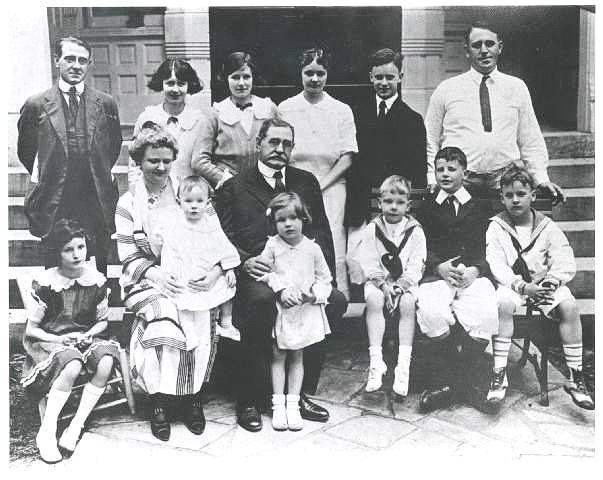
Throughout my life I have been a very lucky person. I am thinking of the luck that brought me to be one of the grandchildren of Jacob McGavock Dickinson Sr. Specifically, this meant that I was the heiress to all sorts of good things connected with him: namely, the many great names that brought about the cities of Nashville, Memphis, and other places in Tennessee. Perhaps I inherited a small portion of his greatness and love of life.

Jacob McGavock Dickinson (front row, center) with family, 1923 (photo courtesy of the author)

When I was born, my father, Captain Jacob McGavock Dickinson Jr., was fighting in the trenches in France, specifically in the Battle of Champagne during World War I. When he received the news of my arrival, he had the chaplain of his regiment christen me in absentia with a small vial of holy water that he had saved for the purpose, using his helmet for the basin. When the 42nd Rainbow Division was reactivated in 1943, he took his family with him to Tulsa, Oklahoma, the site of the reactivation. Upon hearing the news of my “activation” in the Rainbow, the General of the Regiment, Colonel Harry J. Collins, officially designated me “The Rainbow Girl.” I have attended many reunions of the 42nd Division since that time, basking in the recognition and praise for “The Rainbow Girl.”

After the death of my grandfather, my father and mother moved our family back to Nashville. This was in the late 1920s. They purchased my father’s ancestral home, Travellers Rest, where his mother, Martha Maxwell Overton, had been born and raised. I spent many happy years at Travellers Rest as well as at Antrim in Columbia, where I moved after my marriage to Stuart Swope Fleming.

My life has indeed been a happy one, and I like to think that perhaps some of that happiness is due to my close association with and love of my grandfather, Jacob McGavock Dickinson, Sr.

Travellers Rest, Nashville, Tennessee (photo from NHN collection)

Grandfather loved his family very much. He bought Belle Meade with the idea of using it both as a place to entertain and as a retreat. When business called him elsewhere, his eldest son, Overton, and family lived there. After a very unfortunate tragedy occurred — both Overton and his wife died from complications of influenza — Grandfather sold Belle Meade, and, as far as I know, never went there again. Overton’s two little girls were entrusted to the care of his sister-in-law, but Grandfather was very attentive to their education and took them on many wonderful trips.

All of this occurred before I was born. Grandfather moved to Chicago to serve as counsel for the Illinois Central Railroad. After he established law offices there, my father, mother, and family moved to Chicago, also, settling in Winnetka, Illinois. Grandfather was a most loving grandfather. He came out on the train on Sundays for lunch, armed always with Hershey chocolates that I, being of a saving nature, squirreled away in my closet. I remember sitting on his lap, when he would run his finger up my spine and admonish me always to hold my back straight.

Grandfather was very fond of my mother. When he sometimes invited her to have lunch with him, he would order only the best. On one memorable occasion, “the best” included raw oysters. Mother was dismayed but gamely resolved to eat them. When he glanced across the table and discovered her actually trying to cut them up, Grandfather sternly admonished her to “Stop murdering those oysters!”

When Grandfather was Secretary of War under President Taft, who was a great friend of his, he was in great demand as a dinner guest. However, I don’t think he was particularly interested in the constant dinner parties. One persistent hostess kept after him, starting with an invitation for Monday night, which he declined. She progressed through the week, day by day, and when she reached the weekend, Grandfather replied, “Dammit, madam, I’ll just come Monday!”

We went into Chicago on occasion to have lunch with him in his apartment. The chairs for the dining table were upholstered in a very dark green horsehair, a very scratchy material at best. He had an elegant bedroom set consisting of bed, armoire, dresser, and night stand. I am fortunate enough to have that now here in my house. When he was taken ill, he of course was propped up in that big bed. I can see him now.

After his death, we all traveled to Nashville on the train to accompany his body, which lay in state in the Tennessee State Capitol.