The Old Nashville Market House, 1828-1937

by Dave Price.

Our original market house was completed during 1802 and can be seen in the well-known map of 1804 Nashville, which appeared in Clayton’s History of Davidson County, Tennessee. Its replacement was begun in April 1828 and was occupied in January 1829. This structure, shown on the 1831 J.P. Ayres (Doolittle & Munson) map, consisted of a long market shed running north and south with a two-story building at each end.

Photograph of the Public Square courtesy of Debie Oeser Cox, https://nashvillehistory.blogspot.com/

The Ayres map was surrounded by a number of drawings of local buildings and scenes, so we know what the southerly building looked like. It was the “Tennessee Lottery Office,” the image of which has been reproduced, although I am unable to cite such a copy in one of the standard histories. Interesting features of this Lottery Office are a recessed arch shape in the brick on the west side of the building and round windows in the upper corners of the south end.

A “salt print” (dated ca. 1856) of the west side of Nashville’s Public Square attracted a good deal of attention a few years ago when the State Museum purchased the rare item at a Sotheby’s auction. (We old Nashville buffs had been aware of a copy negative in the state archives for years.) The print reveals the same features mentioned above in the northwest corner of the northerly building, indicating that the matching original end buildings of the market house were still in place with some modifications: single story wings added to the south (and we presume north) sides of the end buildings and a cupola added to the roof of the south building (and probably to the north one as well, although it cannot be seen in the print).

A familiar photo taken from Capitol Hill a few years later shows that the end buildings had either been extensively remodeled or replaced with much larger three-story structures having two square towers on each end building. This image is reproduced in Adams-Christian, p. 53. Since the old Methodist Publishing House is shown, the picture must date from before 1873. The southerly building at some point became the City Hall, and Creighton tells us that the Supreme Court met in one of the buildings for a time and that 100 stalls existed in the market section or long connecting shed.

A good view of the southerly building can be seen in James Patrick’s Architecture in Tennessee, 1768-1897, where it is suggested that Adolphus Heiman may have remodeled the buildings “about 1855.” Despite the estimated dates, the “ca. 1856” image was obviously made prior to the “about 1855” remodeling. Incidentally, this building is shown in Max Hochstetler’s great Opryland Hotel mural, which can be seen on the cover of the Summer 1990 Tennessee Historical Quarterly. A view that shows both end buildings and the connecting market building is seen in Jack Norman’s The Nashville I Knew, p. 125.

Although not mentioned by any of the histories that I consulted, the southerly building was consumed by the Burns Block fire on the square during the night of January 2, 1897. The fire company stopped at the site of an old cistern between the Court House and the Market House but found it had been Macadamed over. During the delay in finding a new water source, the old dilapidated City Hall was engulfed in flame and the crowd shouted, “Let it burn!” which is exactly what happened.

This fire was responsible for the replacement of the City Hall with the large 1898 building that older readers will recall (Norman has a good view of this on p. 122 and an unusual architectural drawing is found in the photo section of Fedora Small Frank’s Beginnings on Market Street).

In the meantime the northerly building still had at least one of its towers in an 1892 photo but had lost both towers by 1910. This building contained the office of the Market Master and such city offices as those of the Meat and Dairy Inspectors and was generally called simply, “the north end.” The new City Hall remained much the same, although much of its one large tower was gone by the time of its 1936-37 demolition. The March 14, 1933, East Nashville Tornado caused some damage on the square and this may have been when the tower was shortened.

Aerial photographs taken during the construction of the present (Woolwine) Court House show that, while the market house section and the northerly building were razed along with the Strickland Court House (since they lay in the path of construction), the City Hall was actually a few feet south of the new building and was the last part to fall. It is also obvious from these photos that the market section had been widened considerably over the years; it contained 114 or more stalls by the time of its demise.

The later (1937-1955) Market House stands today behind the present court house and is still in use as the Ben West Building, or more commonly the “Traffic Court Building.” The once-familiar wagons are gone, and the farm trucks that once surrounded the Court House moved north of the Capitol to the new Farmer’s Market in 1955. That market has now been replaced and will no doubt be recalled by a later generation as “the old Farmers’ Market.” (1998)
Louise Grundy Lindsley, 1858-1944

by Kathy B. Lauder.

Louise Grundy Lindsley was born March 11, 1858, in Nashville, Tennessee.1 She was the eldest child of Dr. John Berrien Lindsley (1822-1897) and Sarah “Sallie” McGavock Lindsley (1830-1903), and the great-granddaughter of U. S. Senator and jurist Felix Grundy (1777-1840).2  Miss Lindsley, a debutante (1898)3 and a college graduate,4 remained unmarried, devoting her life to worthy causes. She was active in Nashville chapters of the Daughters of the American Revolution, the Daughters of 1812, and the Centennial Club.5 When the Tennessee Historical Society opened its membership to women in 1915, she was one of its first female members.6

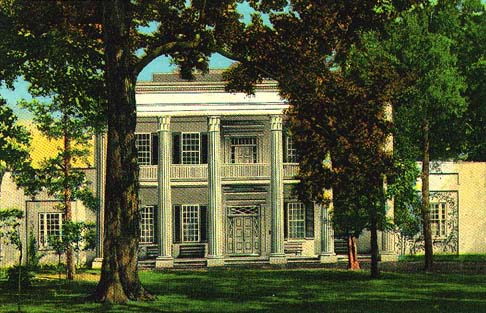
Postcard photo of The Hermitage from NHN collection

            Louise Lindsley was one of five women who signed the charter of incorporation of the Ladies’ Hermitage Association (LHA), later serving as director and regent for many years.7 In 1889 the LHA gained possession of the 25 acres that included the house and tomb.8  After the Confederate Soldiers’ Home closed in the 1930s, the State awarded the hard-working Association the remaining Hermitage land.9 A 1910 newspaper reporter observed Regent10 Louise Lindsley tending to the Hermitage hydrangeas “planted as tiny shrubs by her mother, the late Mrs. Berrien Lindsley, during her term of Regency.”11

            In 1912 Louise Lindsley described the work of the LHA to the Southern Commercial Congress,12 a group of representatives from the Southern states who worked to promote regional economic growth.  At the request of the group’s president, Miss Lindsley organized the Tennessee Women’s Auxiliary to the Congress, soon becoming the Auxiliary’s national president.13  The group took a great interest in the economic possibilities of the new Panama Canal, and Lindsley herself traveled to Panama.14 The Auxiliary also worked to bring together women – particularly rural women – in an effort to encourage them to become involved in such local issues as roads, community health, and vocational education.15

John Berrien Lindsley’s handwritten will, dated July 19, 1892, left his interest in the Nashville Medical College to his daughters Louise G. and Annie D. Lindsley.16 When Sallie Lindsley died in 1898, she left a hand-written deed of gift, giving all her “furniture silver and pictures and other household effects” to Louise, “all of my other children being married and provided for.”17 After Annie’s marriage failed, she, her daughter Margaret, and Louise shared a residence for the remainder of their lives. In February 1922, although Annie was still living, Louise petitioned to adopt Margaret so her niece would become her legal heir.18 

Louise Lindsley was an active participant in the Tennessee Equal Suffrage Association for many years.19 When World War I broke out, she was appointed to chair the Woman’s Committee of the Council of National Defense.20 She became a Southern representative to the National Bureau of Speakers and was involved locally in efforts to encourage housewives to support the war effort through resourcefulness and efficiency.21

            Louise G. Lindsley’s will, dated December 11, 1939, left half her estate to her niece, Margaret Lindsley Warden, and half to her sister Annie.22 Louise died of colon cancer on July 18, 1944, at the age of 86.23 (2014)


SOURCES:

1    Lindsley, John Berrien. Diary, Volume 5, October 6, 1856 – January 1, 1866. Lindsley Family Papers, ca. 1812 – [1840-1940] – 1953, Box 1, Folder 23. Tennessee State Library and Archives.

2   Lindly, John M. The History of the Lindley-Lindsley-Linsley Families in America, 1639-1924, Vol. II.  Winfield, Iowa: Self-published, 1924, 19.

3   Nashville American, October 27, 1898, 3.

4  Bucy, Carole Stanford. “Quiet Revolutionaries: The Grundy Women and the Beginnings of Women’s Volunteer Associations in Tennessee,” Tennessee Historical Quarterly, Vol.LIV, No. 1, Spring 1995, 47.

5  Bucy, Carole Stanford. “Louise Grundy Lindsley,” Tennessee Encyclopedia, Online edition. Knoxville: University of Tennessee Press, 2002-2014.

6   Toplovich, Ann. “The Tennessee Historical Society at 150: Tennessee History ‘Just and True.’” Tennessee Historical Quarterly, Fall 1999, Vol. LVIII, Number 3, 205.

7  Dorris, Mary C. Currey. Preservation of the Hermitage, 1889-1915: Annals, History, and Stories. Smith & Lamar, 1915, 97.

8   Bucy, Carole Stanford. “Quiet Revolutionaries,” 46.

9    “Preservation,” The Hermitage website, accessed June 28, 2014.   http://www.thehermitage.com/mansion-grounds/mansion/preservation

10   Dorris, 97.

11   Nashville American, August 7, 1910, 14.

12   Bucy, Carole Stanford. “Quiet Revolutionaries,” 47-48.

13   Bucy, Carole Stanford. “Quiet Revolutionaries,” 48.

14  “Miss Lindsley’s Visit to Panama,” Nashville Tennessean and the Nashville American, November 21, 1913, p. 4.

15   Bucy, Carole Stanford. “Quiet Revolutionaries,” 49.

16   Handwritten will of John Berrien Lindsley, witnessed by Leon Trousdale Jr. and Jos. B. Babb. (original) July 19, 1893.  Lindsley Family Papers, ca. 1812 – [1812-1940] – 1953, Box 2, Folder 47, Tennessee State Library and Archives.

17   Handwritten Deed of Gift from Sallie McGavock Lindsley (original), July 5, 1898. Lindsley Family Papers, ca. 1812 – [1812-1940] – 1953, Box 1, Folder 20, Tennessee State Library and Archives.

18    Court Records-Petition for Adoption, February 1922.  Lindsley Family Papers, ca. 1812 – [1812-1940] – 1953, Box 1, Folder 19, Tennessee State Library and Archives.

19    The Tennessean, August 30, 1914.

20   “Louise Grundy Lindsley,” Tennessee Encyclopedia of History & Culture.

21   “Louise Grundy Lindsley,” Tennessee Encyclopedia of History & Culture.

22   Hand-written will of Louise G. Lindsley, December 11, 1939.  Lindsley Family Papers, ca. 1812 – [1812-1940] – 1953, Box 2, Folder 48, Tennessee State Library and Archives.

23   Death certificate: Lindsley, Louise G. Tennessee Death Records, 1908-1958. Nashville: Tennessee State Library and Archives.

SUGGESTED READING:

Bucy, Carole Stanford. “Quiet Revolutionaries: The Grundy Women and the Beginnings of Women’s Volunteer Associations in Tennessee,” Tennessee Historical Quarterly, Vol.LIV, No. 1, Spring 1995, 40-53.

Dorris, Mary C. Currey. Preservation of the Hermitage, 1889-1915: Annals, History, and Stories. Nashville: Smith & Lamar, 1915.

1814 Nashville Fire

Primary Source Document, transcribed by Larry Michael Ellis.


DREADFUL FIRE!

Under the dispensations of divine providence, we have again to record the destructive effects of of [sic] this ungovernable element. – On Friday night last, about 10 o’clock, the citizens of this town were alarmed with the cry of fire! It proceeded from the hay-loft of Wm. W. Cooke, Esq. near Mr. Woods [sic] warehouse; it had gained such an ascendency [sic] & the buildings were so combustible, that the utmost exertions of the citizens could not save the large adjoining warehouse, filled with consignments to Joseph Woods esq commission merchant, the bindery, dwelling house and bookstore of Mr. Duncan Robertson, the tavern house of Robert Renfroe, the frame house of John Anderson esq, the house occupied by Mr. Ernest Benoit, baker, the shop of Messrs. E. and G. Hewlett saddlers above; the dwelling house of Wm. W. Cooke esq, the dwelling house occupied by Mr. S. V. Stout, the warehouse of Messrs. Read and Washington, army contractors, and their office, the shop & dwelling house of Mr. D. C. Snow, tin plate worker, below; the dwelling house of Joseph T. Elliston, and his silversmith shop, the dwelling house of the editor of the Clarion, & his printing office, the house lately occupied by Wm. M. Wallace, as a shoemaker’s shop and the house occupied be Joseph Sumner, the property of Mr. John Young, the office of the Nashville Whig, and the hatter’s shop of Mr. Joshua Pilcher, and the brick store-house occupied by W. Tannehill, esq. above on the east of Market street, & all the frame buildings on the same side opposite to bank alley, making in the whole the most destructive fire ever experienced in the western country. No language can paint the distress of many of the sufferers, who were left without bread, meat, dishes or plates, or a covering except the heavens. In the whole range of the fire we are however gratified that no lives were lost, and we hope that in a few years a majority of the sufferers will be able to replace the property they have thus lost.

In some few cases we are, however, sorry to learn the individuals are ruined. It is impossible at present to form any estimate of the immense loss sustained – nearly one half the buildings that were in the town are in ashes; much furniture and other valuable property was lost in the flames. Among the sufferers, the Editor of this Paper finds it necessary to repeat that he was one – his Printing Office contained many printed books and pamphlets, the most of which were lost, and he is sorry to state, in that situation is the Journal of the proceedings of the last Gener- Assembly [sic], which was nearly entirely lost. Of the Journal of the house of Representatives, it is believed a copy can be made out; but of the Senate, there is not the least hope of ever recovering one, for the printing and manuscript shared the same fate. Of the heavy editions of law books, &c. &c in the house, it is believed scarcely a copy remains; and of the printing apparatus, a considerable part was lost; but one press and nearly all the type was saved. For the satisfaction of the members of the last General Assembly, he is thus particular, that the loss of the public Journals may be rightly understood.

The fire was communicated, we have little doubt, by some incendiary – who is not yet ascertained.

Adolphus Heiman’s Cemetery Stone Work

by John S. Lancaster.

At the height of his career in Nashville, 1837 to 1861, Adolphus Heiman designed over 30 structures, ranging from churches and public buildings to residences, forts, and even a bridge. By the mid-1850s his architectural skills and achievements had received so much recognition he was referred to as “Nashville’s Architect.”

Until recently, Heiman’s efforts in designing and creating tombstones and vaults had not been investigated, but three newly identified examples of his work show another side to the talents of this Prussian immigrant.

Located within the Old City Cemetery on Fourth Avenue South are two very different markers. The simpler of the two tombstones was made for Benjamin Sharpe in 1848. It has experienced such severe weathering that the acroteria on the four corners and much of the inscription have eroded away. Chancery Court records of a lawsuit between F. Scott, Adm., vs. Heirs of Benjamin Sharpe provide clear documentation that this stone is a Heiman creation.

Benjamin Sharpe’s tombstone in the City Cemetery. (photo courtesy of the Nashville City Cemetery Association)

As part of the docket evidence now preserved at the Nashville Metropolitan Archives, an entry on an itemized ledger page shows that A. Heiman was paid for a tombstone on September 8, 1848. Also included is a note written in Heiman’s own hand confirming payment from Mrs. Ann Sharpe for the “forty-seven dollars on account of a tomb for Benj. Sharpe deceased.” Heiman seems to have been a friend of the family: his name also appears on the Sharpes’ wedding bond and as an executor of Mrs. Sharpe’s will.

As further documentation is discovered, other tombstones in the Old City Cemetery may also be attributable to Heiman . One such record was recently discovered in the Chancery Court case of J. W. Birdwell & wife vs. William H. Harris: a payment receipt for William Harris’s monument lists the payees as Heiman and Stevenson. (Stevenson was a popular stonecutter in Nashville and signed his name to the Mexican War Memorial in Gallatin, Tennessee.) Although we know Mr. Harris was buried in Old City Cemetery, his stone has yet to be located.

The other Heiman tombstone in City Cemetery marks the grave of Nancy Maynor. The wife of Pleasant Maynor, Nancy passed away on the 28th of May in 1836. Pleasant Maynor remarried on February 21, 1837 to Jane M. Iredale. Of interest is the fact that Heiman is believed not to have arrived in Nashville until 1837. While there is sufficient space to carve another name on the opposite side, only Nancy’s information appears on the monument. This stone also bears the signature “A. Heiman” near the base.

Nancy Maynor’s tombstone in City Cemetery. (photo courtesy of Nashville City Cemetery Association)

Carvers and designers rarely signed tombstones unless the work was unique. The Maynor monument is an above-ground stone box topped with a shaft-like pedestal surmounted by an urn. Two notable details of this piece are the carved butterfly on the pedestal and the anthemion designs on the four corners of the tombstone. In memorial art a butterfly represents the soul and/or resurrection; the anthemion is purely decorative. The use of an above-ground stone vault was common in the Nashville area, but the bodies were buried in the ground beneath rather than inside the vault.

The third and most elaborate example of Heiman’s known stonework was the Franklin Vault in Sumner County, Tennessee. Located on the property of Fairview Farm, the vault was built for the wealthy slave trader Isaac Franklin and his family. Only seven years after marrying the much younger Nashvillian, Adelicia Hayes Acklen, Mr. Franklin died suddenly in Louisiana in 1846 at the age of 57. His wishes were to be returned to Tennessee for burial, and his remains were shipped in a lead-lined casket filled with alcohol. His body was placed in a temporary brick structure until a permanent vault could be constructed. Tragedy struck the Franklin household again only seven weeks after Mr. Franklin’s death when his two oldest daughters, Victoria and Adelicia, succumbed to croup and bronchitis only two days apart.

The loss of her husband and children devastated the young widow, who soon moved back to Nashville. Her father, Oliver Bliss Hayes, was appointed to handle her affairs. It is not clear who hired Heiman to create the Franklin Vault, but he designed it along with an octagonal cast iron fence for $2,500.00. By 1850 the mausoleum still had not been finished. The local builder hired to do the job had subcontracted the work. When the builder died in 1849, the subcontractor, who had not been paid, tried unsuccessfully to sue the trustees of the Franklin estate for monies still owed him.

The Sumner County Chancery Court case of Henley vs. Armfield specifies that the material for the vault was to be solid stone masonry except for the brick interior arches for the ceiling. The dimensions were twenty-eight feet square and fourteen feet high, excluding an obelisk. The walls were to be two feet thick with the outside rubbed and with four interior pillars, two feet square, to assist in the support of the superstructure. Four partition walls would create an eight-foot-wide central passage giving access to six apartments on each side, and two sets of stone shelves that were to be no less than six inches thick. The floor was to be made of “chiseled flagging of stone diamonding with stone of different colors” and the arched brick ceiling was to be “plastered with hydraulic cement.” The outward door was to be made of iron and the inner door of cedar. A window with an iron grate would provide ventilation. The roof was to be made of stone slabs five to six inches thick laid in such a way as to prevent leaks. As cost was not a prohibiting factor, the finest materials available were to be used.

It was specifically noted that Heiman himself was expected to erect the monument on top of the vault and to create the design on the two frontispieces. Some of the details appear never to have been finished, but the design of the frontispiece was completed as an Egyptian motif — an orb flanked by winged serpents. Almost certainly the largest vault Heiman ever designed, it had a style more readily found in the St. Louis Cemetery of New Orleans than on a Sumner County farm in Tennessee. A 1911 picture of the Franklin Vault has been published in Margaret Lindsley Warden’s booklet, The Saga of Fairvue, 1832-1977, p. 10.

In 1912 the vault was struck by a tornado and collapsed. Fortunately, the remains of Franklin and his children had been removed to Mt. Olivet Cemetery in Nashville years earlier. For years the Egyptian-styled lintel remained, lying in the tall grass. Today, with the fence long since removed, the ruins of the vault are threatened by development.

Although not common knowledge, many prominent architects of the early 19th century, including Robert Mills, Gideon Shyrock, and William Strickland, accepted commissions to design tombstones or monuments, in addition to their buildings. Even after the completion of his First Baptist Church project, Heiman continued to rely on stonemasonry as a primary form of income until after his return as a hero from the Mexican War in 1847. Thenceforth, his enhanced status thrust him into the spotlight of Nashville society and he began to be offered commissions for all types of building projects.

Confederate Monument, Mt. Olivet Cemetery (photo from NHN collection)

It is ironic that the favorite architect of ante-bellum Nashville would fade into obscurity. Most of Heiman’s work has now been destroyed, including the majority of his public buildings and private residences. Even his final resting place is uncertain. Adolphus Heiman lies in an unmarked grave beneath the forty-five-foot granite monument in Mt. Olivet Cemetery’s Confederate Circle. (2000)

Chapter 130 of the Acts of Tennessee, 1875: Tennessee’s First Jim Crow Law

by Kathy B. Lauder.

Tennessee is often credited with passage of the first “Jim Crow” law (1881), which required racial segregation in train cars. However, the state had actually passed a comparable law, Chapter 130 of the Acts of Tennessee, in 1875, soon after Sampson Keeble’s legislative term ended. Chapter 130 permitted discrimination in public places – not merely trains and streetcars, but also hotels, restaurants, theaters, circuses, museums, and steamboats.1

The last Confederate state to secede from the Union and the first to return, Tennessee had revised the state constitution to prohibit slavery and quickly ratified both the 13th and 14th Amendments to the U.S. Constitution.  Passage of the Civil Rights Act of 1866 gave African Americans the right to make contracts, to inherit property, to sue, and to enjoy equal benefits and protections under the laws . . . but not the right to vote.  However, two seemingly unrelated events were aligning to produce significant changes.

First, Nashville’s influential black leaders (Sampson Keeble, Nelson G. Merry, and others) hosted the second State Colored Men’s Convention in Nashville in August 1866 and organized daily demonstrations at the Capitol urging the passage of legislation to grant voting rights to black citizens. At the same time, Governor William Gannaway “Parson” Brownlow, a man with many enemies, realized African American votes could greatly improve his chances for reelection. He shepherded a law through the Tennessee General Assembly in February 1867 that granted African American men the right to vote and to hold political office2 – three full years before the ratification of the 15th Amendment (which, incidentally, Tennessee lawmakers failed to approve until 1997).3 

Within a year Nashville voters had elected an African American to its city council; by 1868 six of the twenty members were black.4 Memphis and Chattanooga quickly followed suit.  In 1872 the first African American legislator, Nashville barber Sampson W. Keeble, was elected to the Tennessee House. The apprehension of white voters about the number of blacks suddenly occupying positions of authority set the stage for Tennessee’s first Jim Crow law.

During the 1875 Session of the General Assembly, Democrat R. P. Cole (Carroll, Gibson, Henry, and Weakley) introduced House Bill 527, which passed to the Judiciary Committee for approval. The committee modified the bill’s blatantly racist language to ensure passage, and both houses approved it – Tennessee had passed a law discriminating against one-fourth of its own citizens.

Using terminology shocking to modern sensibilities, Cole’s bill approved the exclusion of persons “whose hair has a spiral curvature, not greater than one fourth of one inch radius,” “whose ancestors were canibals [sic], or were guilty of the practice of voodoism,” or whose physical characteristics corresponded to certain racial stereotypes, all “without regard to race color or previous condition of servitude.”  Judiciary Committee members agreed they “fully approve of the principles embodied therein,” but muted the provocative language to avoid a legal battle with the federal government. Although several of the 19th century black legislators introduced bills to overturn Chapter 130, none succeeded. (2015)


A transcription of the bill, including committee notes, can be viewed here:  https://sharetngov.tnsosfiles.com/tsla/exhibits/blackhistory/pdfs/chapter130.pdf


SOURCES:

1 HB 527 (1875), Record Group 60, Tennessee State Library and Archives, Nashville, TN.

2 Cartwright, Joseph H. The Triumph of Jim Crow: Tennessee Race Relations in the 1880s. Knoxville: University of Tennessee Press, 1976, 9-11.

Brown, Representative Tommie F. (Tennessee House District #28, Hamilton County). Interview by Kathy B. Lauder. Nashville, Tennessee, June 10, 2008.  (Original tape is housed at the Tennessee State Library and Archives, Nashville, TN.)

4 Rabinowitz, Howard N. Race Relations in the Urban South, 1865-1890, 2nd ed. Athens, Georgia: University of Georgia Press, 1996, 265.

SEE ALSO:

“This Honorable Body: African American Legislators in 19th Century Tennessee.” Tennessee State Library and Archives website.   https://sharetngov.tnsosfiles.com/tsla/exhibits/blackhistory/index.htm


A slightly different version of this article appeared in the Middle Tennessee Journal of Genealogy and History, vol. XXIV, no. 2. https://sharetngov.tnsosfiles.com/tsla/exhibits/blackhistory/pdfs/Jim%20Crow%20MTGS.pdf

Angels in the Midst of Richland’s Rampage

by Ilene Jones Cornwell.

Trembling and panting with exertion, I leaned against the front door of my 1955 cottage on Richland Creek; it was 9:15 a.m. on Sunday, May 2, 2010. This was the second day of Richland’s flooding rampage. Saturday’s flood had been a “normal” backyard event for this riparian landowner – aware that the additional water and waterborne algae enrich the soil supporting trees, shrubs, and plants in my bird garden – and the water had crested at 5:10 p.m., then receded into the usually peaceful creek. Now, however, our water-saturated earth and unremitting deluge of rain were ominous harbingers of a disastrous second flood. Thus, I had begun an hour earlier to hastily gather essentials I would need after my exodus from the cottage, and I presently resembled an overloaded pack mule. Both my arms were laden with bulging plastic sacks containing essential vitamins/medicine/toiletries, my address book with listings of family/friends, my pocketbook with billfold/identification/credit cards, and the vital red-metal lockbox protecting family documents for myself and two grown sons. As survival instinct frantically pumped adrenalin throughout my five-foot body, my inner voice urged, “Brace yourself, woman, and GET OUT!”

This photograph of the author’s house was a gift to her from Tamara Magee, one of her “angels.”

With my right hand on the doorknob, I reluctantly took one last look at my long-treasured collection of Tennessee and Southern books arranged in the six bookcases lining the walls of the living room. “Pleeease don’t take my beloved books, ” I desperately prayed aloud, hoping sympathetic guardian angels lurked nearby to perform a miracle of epic proportions, but that ludicrous prayer evaporated when I pulled open the heavy wooden door. Torrential rain, near-gale-force wind, and a rapidly rising surge of foul yellow-brown flood water assaulted my senses and body, pushing me several steps backward. Given access to the cottage’s interior, roiling water rushed over the doorway’s threshold and across the gleaming oak flooring. I instantly realized there would be no coming back to save any other possessions. In fact, I would be extremely blessed if I managed to save myself.

Clutching an umbrella to shield my head, I hesitantly stepped onto the front porch, feeling the shock of cold water as my feet, ankles, and calves disappeared into it. My left hand grabbed the wrought-iron railing as my loafer-clad feet gingerly groped for the two steps down to the sidewalk. Once on that flat surface, I blindly pushed myself forward through the water and heavy rainfall. My exploring feet “recognized” familiar objects beneath the water: stepping stones, stones outlining the English cottage garden, and — ouch! — sharp shards of my smashed pottery planter.

I had progressed five or six feet into the yard, determined to reach my car, when the turbulent current threatened to throw me off my feet. I summoned extra strength and leaned forward into the wind and current to keep moving, as I squinted through the surrounding monsoon to see my maroon Saturn parked near the mailbox at the road. Eureka! But water had already risen to the bottom of the car’s windows — my Lizzie VI was doomed and could not offer escape. Muttering several X-rated curse words, I shifted my bobbing cargo as I struggled to keep my footing and turned toward the indiscernible road. I was now in the center of the swift, white-capped current and losing momentum to move forward.

“Hey, can I help you?” yelled a male voice through the hammering rain.

Startled by the sound, I peered from under the umbrella and saw a young man plunging into the current toward me with outstretched hand.

“Yes! Yes!” I yelped, flapping my encumbered right arm toward his hand. “Hurry, please hurry!”

After an eternity of a few minutes, the young man reached me and caught my right arm to drag me from the savage current, which was apparently intent upon sweeping me to the dead-end of the road and down over Richland Creek’s banks (where two persons would be drowned later that day). As my rescuer and I struggled onto the road’s pavement, he pulled the sacks off my right arm and took the red-metal lockbox to ease my load, then somehow he propelled us through the rib-high flood water to the hillside on the west side of Meadowcrest Lane. As we doggedly slogged up the water-logged hillock, young neighbor Greg Chapman met us and helped me to his cottage, where we collapsed into drenched heaps on his front-porch steps. We sat coughing, sputtering, and gasping for air as we silently surveyed the carnage around us.

As I began to shiver in my sodden clothing, I said breathlessly to my rescuer, “I’ve seen you many times coming to and going from your cottage at the end of the street, but I don’t know your name. Who are you?”

The dark-haired, bearded fellow grinned, “Your neighbor. I’m Stephen Selby.”

I gratefully returned his smile and introduced myself, then shook his strong right hand. “Thank you, Stephen Selby, for saving my life! Both my sons were water-blocked and couldn’t get here to help me out of my cottage . . . you certainly are my guardian angel this morning.”

He modestly declined any praise as he returned to the storm to join other volunteer rescuers. Greg Chapman helped me up the rain-slick steps into his home, where several other drenched neighbors had taken refuge. One of his roommates gave me dry sweat-pants and shirt to replace my soaked slacks and shirt. When I returned to the living room, a group of young men stood by the porch steps in the rain talking to Greg and Stephen; they were dividing into pairs to check the other four homes on lower Meadowcrest and rescue anyone trapped inside. I stood on the porch, watching the men struggle through the murky water. Biting my lower lip to hold back tears, I whispered, “How brave and caring they are.”

As the men moved down the submerged road, another group of fellows came from the upper end of Meadowcrest, wading through the rain and flood water toward me. One tall young man offered haven in his cottage on the high ground of Oakmont Circle to everyone in our group of refugees, and I eagerly accepted. The higher I could position myself, the sooner one of my sons could get to me. Thus my second guardian angel, Jeff Recker, and I gathered my plastic sacks, umbrella, and red-metal lockbox to push ourselves uphill ahead of the pursuing flood to his parked truck. As we traveled the two blocks south to his cottage, he chuckled, “You don’t remember me, but I came to your door and tried to buy your house a few years ago.  Now I’m glad you wouldn’t sell it to me!”

I was astonished and laughed as I exclaimed, “That was YOU?!  Well, I’m glad you decided to buy another cottage in Richland Meadows . . . otherwise, you wouldn’t have been here this morning.”

Upon reaching Jeff’s cottage, we were met at the door by his roommate, Brett Bergstrom, a young guitarist recently transplanted to Nashville. For the second time, I was offered dry sweat-pants and shirt to replace my wet clothing. After I was dry and warm, Brett whipped up a late breakfast of fried bologna, buttered toast, and scrambled eggs — absolutely the most delicious, most appreciated meal I have ever eaten!

After breakfast, Jeff attached his outboard motor boat to his truck and left us to continue his volunteer efforts for flood victims, while Brett answered the telephone and relayed messages to fellow volunteers. During the long afternoon, while hard rainfall relentlessly drummed on the roof, Brett strummed his guitar while composing music and lyrics to commemorate the Great Flood of 2010: “Ilene’s Song.” I was deeply moved by his sensitive compassion for this flood refugee and very honored by his plaintive song of survival.

When my younger son came to retrieve me around 4:00 p.m., we drove to my Meadowcrest cottage to take post-flood photographs. Later, traveling the two miles west to his home, we were silently absorbed in our own thoughts. I was sated with profound gratitude for my neighbors’ kindnesses as I mulled over the day’s benevolent events. And I repeatedly chastised myself: How could I have worried selfishly about losing books this morning when such a massive catastrophe as Richland Creek’s rampage was overwhelming all the lower creek-side neighbors?

The sought-after answer suddenly flashed through my brain: Life-saving assistance from my previously unknown neighbors was the appropriate response of any lurking-nearby guardian angels to my prayer for a miracle of epic proportions. They had, indeed, been there — ready and willing to help — but I had lost focus on what I needed most. Thank goodness, guardian angels never lose focus and provide what’s best for us, not what we think we want.


This personal story of survival on May 2 is but one of the myriad miracles affecting the lives of thousands upon thousands of uprooted victims of the Great Flood of 2010 in Nashville and environs.


A look back at the Flood of 2010 – WKRN video: https://www.wkrn.com/special-reports/ten-years-ago-a-look-back-at-the-nashville-flood-of-2010/

Vanderbilt University and Southern Methodism

by Frank Gulley.

In the latter half of the nineteenth century some of the Methodist leadership in the South came to believe that the future prosperity of their church, the Methodist Episcopal Church, South (MECS), was tied in important ways to higher education and especially to an educated ministry. Methodists ran numerous small, financially-struggling liberal arts colleges in every state of the Confederacy, but no university, no institution that could begin to compare to the prestigious universities of the North. They determined to remedy that situation.

Vanderbilt University 1889

In 1871 the Methodists of the Tennessee Annual Conference approved a resolution asking the bishops of the MECS to appoint a committee that would explore the possibility of founding a university. In January 1872 that committee convened in Memphis. By the time it adjourned, members had produced a plan to raise one million dollars, with $500,000 of that sum to be in hand before the university could be opened. Months later only $30,000 was committed, and much of that amount was needed simply to cover the fund-raising efforts. The project seemed hopeless; Southern Methodists at the time were too poor to support such an effort.

However, Methodist bishop Holland McTyeire had family connections with one of the wealthiest men in America — Cornelius Vanderbilt. In 1873 an unusual set of circumstances led McTyeire to New York and conversations with Vanderbilt. Within days Vanderbilt promised “no less” than $500,000 (In time his gift would approach $1,000,000.) for the project, but there were stipulations: the university was to be located near Nashville; McTyeire was to chair the board of trustees for life and hold virtual veto authority over board actions; and all endowment funds were to remain inviolate.

The MECS committee accepted Vanderbilt’s conditions and chose to name the university after its generous benefactor. Within days McTyeire was given authority to take the necessary steps to establish the institution. Vanderbilt University opened on October 3, 1875.

From the beginning the legal relationship between the MECS and Vanderbilt University was not clearly defined. Methodist leaders “assumed” the University was “theirs” and thus “assumed” that it would conform to Methodist understandings and sensibilities in every way. Prominent Southern Methodists, including all the bishops, were appointed to the Board of Trust, and careful attention was given by the University’s officers, who themselves were prominent in the denomination, to nurturing Methodist ties. But considerable suspicion persisted. Several incidents in the University between 1875 and 1905 led some Methodist leaders to believe that the University was not “thoroughly loyal” to the Methodist tradition. One of those issues was the appointment of several non-Methodists to the faculty. Misgivings reached a climax in 1905 when the Board of Trust voted to seek a new charter for the University, permitting only five bishops membership on the Board and clearly establishing the autonomy of the Board vis-à-vis the Church.

Bishop Elijah Hoss, a former faculty member, was furious. He led the group claiming that the University belonged to the Church and thus that the Church had final jurisdiction over all University matters, including the Board of Trust. The Board, of course, took the opposite position. The matter came to a crisis in 1910 when the General Conference of the MECS elected three new members to the Board of Trust whom the Board, in turn, refused to seat. To resolve the matter, the Church filed suit in Davidson County Chancery Court to establish its authority over the University. In 1913 that Court ruled in favor of the Church’s position. Vanderbilt immediately appealed. On March 21, 1914, the Supreme Court of Tennessee reversed the lower court’s decision, declaring that the founder of the University was Cornelius Vanderbilt, that the Board of Trust had authority to name its own trustees, and that the Church did not have veto authority over Board actions.

The leadership of the University and cooler heads in the Church hoped that, with the legal situation clarified, the two institutions could continue in the same relationship as before the crisis leading to the lawsuit, but that outcome was not to be. The General Conference of 1914 voted 151 to 140 to sever all ties with Vanderbilt and to establish two new universities. In time the MECS founded Emory University in Atlanta and Southern Methodist University in Dallas to compensate for the loss of Vanderbilt.


Frank Gulley is Professor of Church History Emeritus of the Divinity School at Vanderbilt University.

The Hodge House in Percy Warner Park

by Gale Wilkes Ford.

Hundreds of motorists rush past the intersection of Old Hickory Boulevard and Chickering Road every day without realizing they have just glimpsed a bit of early Tennessee history. Nearby, on the property of Percy Warner Park, stands an old two-story log house with white siding, its three limestone chimneys now cold.

The Hodge House early in its period of renovation (photo from NHN collection)

This is the Hodge House, built circa 1795 by Francis Hodge, an early pioneer settler who signed the 1780 Cumberland Compact and later received a land preemption of 640 acres. As Indian attacks diminished, many of the settlers ventured out from Fort Nashborough to settle on their own land. In the area of today’s Carden Road, Francis Hodge and his family built a log house which they called Hodge’s Station. It became a gathering place where many early Tennesseans, including James and Charlotte Robertson, came to study Methodism. Hodge later sold that tract of land to Joseph Ewing and built a cabin three or four miles south, on the plot where it now stands — land that had previously belonged to James Robertson.

This second Hodge house, originally a single pen log cabin (as has been determined by Metropolitan Historical Commission staff), stands today in the southeastern corner of Percy Warner Park. Francis Hodge and his two oldest sons, James and George, constructed the two-story dwelling of white ash logs. Over the years, the family added several more rooms, white clapboard siding, and a tin roof. To accommodate the family slaves, they built additional cabins, one of which survived into the late 1950s.

Within a few years the property was purchased by Mary and Samuel Northern, James Hodge’s daughter and son-in-law. The Northerns, whose descendants would live on this land for nearly one hundred years, dedicated an acre northeast of the house for use as a family cemetery. When James Hodge died in 1817, he was the first of the family to be buried in this graveyard, near what is now the Harpeth Hills Golf Course.

Pioneer Francis Hodge died in 1828. His will, written in his own hand, shows the excellent penmanship characteristic of an educated man. The will identifies his sons as John, James, Robert, and George; and his daughters as Elizabeth (Betsy) Armstrong, Sarah Slaughter, and Priscilla Carruthers. No surviving record indicates where Francis is buried. His son George died in 1833, willing the land, the house, and fourteen slaves to his wife Elizabeth. George’s 1829 will also stipulated that after Elizabeth’s death several nieces and nephews should inherit the property. One of the nephews named was Francis Hodge Asbury Slaughter, who, with Sterling Clack Robertson, was part of the first Texas colony.

Members of the Hodge family married into other local families whose names are still well known in the area: Betts, Becton, Harding, Northern, Osborne, Page, Reams, Sawyer, Slaughter, and Wilkes. The old house saw the Civil War come and go, with both Union and Confederate soldiers marching past on the historic Indian trail in front of the property. Hodge descendants occupied the home until its sale in 1895. In 1927 the property became part of the Warner Parks and is now listed on and protected by the National Register of Historic Places. According to the Warner Parks website, it is the “only early rural farmhouse of its type under public ownership in the county.”

The house served for many years as a residence for Parks Department employees and their families. In the early 1990s it was boarded up because of its deteriorated condition and was left vacant until a group of Hodge descendants began lobbying for protection and restoration of the property. Renewed interest in the site led to a survey of the old Hodge-Northern cemetery, during which sixteen unmarked graves, including several burial sites of children, were discovered. Moreover, as part of this year’s [2002] celebration of the 75th anniversary of the Warner Parks, the Hodge House has been designated for renovation, in order to make it a more valuable, hands-on local history resource. The Friends of the Warner Parks (FWP) has been working side-by-side with the Nashville Metropolitan Board of Parks and Recreation to acquire funding for the project. Their first objective is to restore the original white ash log cabin. FWP Director Eleanor Willis, who has spearheaded the project, describes the logs now visible in the attic area as “beautifully preserved.” Work on the foundation and the limestone chimneys is already underway. Visitors will soon be able to view the historic Hodge House as it appeared two centuries ago to the early settlers of Middle Tennessee. (2002)

Post-renovation photograph of Hodge House

S. H. Kress in Nashville: An Art Deco Parthenon

by Kevin Chastine.

The vision of Samuel Henry Kress (1863-1955), a Pennsylvania multi-millionaire and philanthropist, has enhanced many urban areas in Tennessee. In 1887, after seven years as a teacher, Samuel Kress had established a stationery and novelty shop in Harrisburg, Pennsylvania. When this venture prospered, Kress brought the concept of a 5&10-cent store to Tennessee, opening his first 5&10 in Memphis in 1896. One year later he opened his second 5&10 at 420 Union Street in Nashville. In 1900 Kress moved the store to 219 North Summer Street (which would become Fifth Avenue North five years later). In 1913 he opened a second store at 317 Third Avenue North. The Kress Company operated these two stores, two streets apart, until 1968.

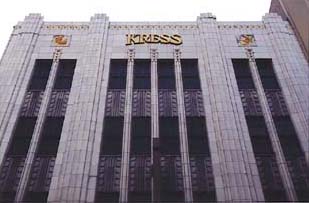
Kress Building, 5th Avenue, Nashville. (photo courtesy of the author)

In its first few years in Nashville the Kress Company leased space in older buildings, unlike their previous policy in Memphis, Knoxville, and other Tennessee cities that had received architect-designed, one-of-a-kind Kress buildings. However, in 1936 the S.H. Kress Company constructed a new store in Nashville to replace the former building at 237-239 Fifth Avenue North. The new Kress Fifth Avenue building was hailed as “the finest type of mercantile building known to modern engineering.” According to a company advertisement, the store was Kress’s way of showing his gratitude to the citizens of the Tennessee Valley “for their enthusiastic acceptance of his merchandising principles.”

During the 1930s Kress stores were designed in the popular Art Deco style. Many of these modern stores also featured locally or regionally influenced ornamental details, the concept of Edward F. Sibbert, Kress’s supervising architect from 1929 until 1952. In the 1970s Sibbert stated that his architectural influences were “anything but classical,” a comment that increases the significance of the Fifth Avenue Kress building, because it is possible that architectural details of the Kress building were borrowed from the Parthenon in Centennial Park. Architectural historian Bernice Thomas first proposed this theory in her book, America’s 5 & 10 Cent Stores: The Kress Legacy. Although there are no design records or corporate documents to confirm Thomas’s theory, details of the Kress building illustrate several similarities between the two structures.

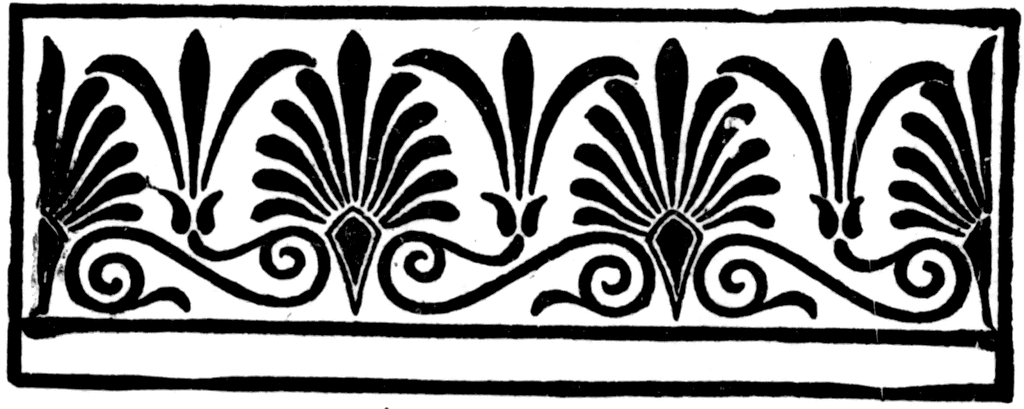
The likenesses begin with the four large fluted pilasters that extend upward from the marquee through the roofline. These pilasters may relate to the large fluted Doric columns that encircle the Parthenon. A second similarity is the stylized Greek key motif that extends in a continuous row across the building façade, just below the roofline. These Greek key motifs may relate to the anthemion pattern that lines the roof of the Parthenon. The final and most interesting details of the Kress store are the Greek-inspired panels located to either side of the Kress logo. The left panel illustrates a female figure; the right, a male figure. These decorative panels seem to mirror the painted metopes within the entablature of the Parthenon.

Anthemion, a stylized flower pattern found in Greek art and architecture

The female panel shows a woman holding a pole topped by a winged hat or helmet. The hat can be interpreted two ways: as the helmet of Hermes, the Greek god of commerce, an appropriate symbol for a 5&10-cent store; or as a woman’s hat that one might purchase in Kress’s millinery department. The background of the female panel is filled with modern skyscrapers, perhaps an image of the growth Samuel Kress foresaw in Nashville’s future. The male panel portrays an aproned man holding a stylized hammer. Its handle is in the traditional shape at the base but transmutes along its length into layered, gear-like disks. The background of the male panel is a scene of smokestacks which, along with the hammer and gears, serves to illustrate Nashville’s industrial past. The 1936 S.H. Kress building exemplifies the pride that Samuel Kress had in his company, as well as his respect for the cities where he located his stores. Unfortunately, the concept of civic responsibility is rarely a consideration of national chain stores today, thereby increasing our own obligation to preserve the distinctive buildings that are such an important part of Nashville’s heritage

Nashville’s City Hotel

by Debie Oeser Cox, author of Nashville History blog.

The first hotel on the east side of the Public Square was Talbot’s Hotel and Tavern, established about 1800. Although a deed was not filed until 1804, a subsequent document filed in Davidson County deed book F indicates that Talbot actually purchased the property in 1800.

In the 1820s Talbot sold his hotel property to the Nashville Bank. The first proprietor of the new City Hotel was James Edmondson, notice of which appeared in the National Banner and Nashville Whig, Saturday, January 12, 1828:

City Hotel, Nashville — The subscriber has the pleasure of informing his friends and the public, that he has taken that splendid Tavern lately built by the Nashville Bank. This house being planned and erected for the express purpose of a Tavern comprises advantages rarely found in such establishments . . .. Surrounding the back front [sic] are spacious balconies communicating and on a level with each story, forming airy, sheltered and delightful promenades, the whole three stories high. The private part of the house, intended for families, is entirely separated from the public establishment and ladies therefore can be free from observation and as secluded as in any private house.

The City Hotel was offered for sale in an advertisement that appeared in the National Banner and Nashville Whig, Saturday, February 2, 1828:

The Nashville Bank offers for sale, that large and commodious building on the Public Square in the town of Nashville, known by the name of the City Hotel. As any person inclining to purchase would wish to examine the premises, a minute description is unnecessary. I suffer it to say, that the whole establishment is of brick, and entirely new, having been erected during the last year. The building is three stories high; it fronts on the public square one hundred feet, with one wing extending back one hundred and thirty feet, and another about seventy feet. In the principal wing, on the first floor is a spacious dining room, 70 by 30 feet, but which can be extended as occasion may require, by means of folding doors, the whole length of the wing, or 130 feet. On the second floor is a ball room of the same dimensions. The building is so constructed as that exclusive of numerous bed chambers, a convenient portion of it may be set apart for the convenience of families, or private parties. The whole of the building on the back front, which commands a fine view of the Cumberland river, and the adjacent country, is surrounded with spacious piazzas, communicating with each story. Attached to it are all the necessary buildings for a tavern.

The City Hotel Company purchased the property from the Nashville Bank for a sum of $20,000. The deed described the property as being parts of lots 171 and 172, which had been conveyed to the Nashville Bank by Thomas Talbot in two parcels, one in 1821 and the other in 1828.

Miss Jane Thomas wrote of Edmondson and the City Hotel in her book, Old Days In Nashville. Miss Jane said that in 1837 Edmondson was managing the hotel.

In the spring of 1845 Joseph Marshall and Samuel M. Scott entered a contract to manage the City Hotel as a hotel and tavern. Joseph Marshall died soon after. As a consequence of a suit filed in Chancery Court concerning Mr. Marshall’s estate, an inventory of the contents of the City Hotel was made and filed with the court. This inventory detailed the furnishings of fifty-seven guest rooms and a garret room. Most of the guest rooms were furnished with one or two bedsteads and feather beds, mattresses and bedding, a washstand, pitcher and bowl. Many of the rooms had a table, several chairs, a looking glass, and fireplace accessories.

Other rooms included in the inventory were north and south parlors, two dining rooms, a kitchen, a pantry room, and a bar room. The south parlor had two sofas, a side board, a dozen cane-back chairs, and a pier glass (a tall, narrow mirror fitted between two windows). There were four pictures and frames, a carpet, a mantel ornament, and a brass fender for the fireplace. The north parlor featured one sofa, a pair of side tables, ten hair-seat chairs (mahogany), and one rocking chair. Other furnishings included a mantle clock, two mantle ornaments, one pair of convex reflectors, one large pier glass, one astral lamp, one center table with cover, one carpet, and one brass fender. There were both public and private dining rooms. The public room had nineteen tables and eighty-eight Windsor chairs, three side boards, a coffee urn, and a tea urn. There were eleven dozen white dinner plates and six dozen sets of knives, forks and teaspoons. Glassware included forty-four tumblers and twenty-four wine glasses. There were nearly five dozen cups and saucers, along with salt stands, celery stands, sugar tongs, ladles, tureens, molasses jugs, and a gong. The private dining room was similarly furnished but on a smaller scale, with only nine tables and thirty chairs listed.

In the kitchen was a cook stove, a coffee boiler, a tea boiler, four small boilers, a large iron grill for the fireplace, twenty-three pans, eight steamers, and three sinks. In the pantry room were kettles, cake pans, and shape pans. The bar room had a sideboard, some writing desks, an iron chest, eleven chairs, and four settees, along with a map of the world, two lamps, a looking glass, and nine decanters.

In 1859 Enoch Ensley became the principal owner of the City Hotel. From Memucan H. Howard, the largest shareholder, he acquired 135 shares. He bought 119 shares from Lizinka Brown and, from several others, smaller amounts of stock. In October of 1859, Ensley owned 313 shares of stock with 79 shares remaining in other hands.

James R. Winbourn and his mother Mary B. Winbourn leased the City Hotel in December of 1861 from Enoch Ensley. In February of 1866 the Winbourns sold their interests in the City Hotel to Hare and Roberts. During their proprietorship at the City Hotel, Mary Winbourn managed the hotel while her son James took care of a farm the Winbourns had purchased in order to supply vegetables and milk for the hotel.

Enoch Ensley died in 1866 and the property was bequeathed to his son Enoch Ensley, Jr. Sometime in the 1870s the City Hotel was torn down. Enoch Ensley, Jr., sold the former City Hotel property in 1879 for the sum of $82,500 to William Watkins of Todd County, KY. Today that site is between the Woodland Street and Victory Memorial Bridges, east of the present courthouse, overlooking the Gay Street Connector and the Cumberland River.