The two-story Victorian house that is now 3212 Freno Lane in Lincoya subdivision was the residence of Governor A. H. Roberts and his family from 1928 until shortly after his death in 1946. Roberts (1868-1946) is best remembered as being the chief executive of the State of Tennessee when, in 1920, the Tennessee legislature approved the 19th amendment, which granted voting rights to women.
Former home of Governor A. H. Roberts and family in Donelson, Tennessee.
The old house, located on the western slope of Todd’s Knob, was built in 1880 by Alex and Anna Perry. Perry’s house and large farm, called Nutwood, was across McGavock Lane from Spence McGavock’s Two Rivers farm1. Alex Perry died in 1927, and Roberts purchased 150 acres from Perry’s heirs on July 8, 19272. This was only a portion of the Perry tract.
There were eight Perry children, several of whom owned tracts of land carved from their parents’ property. Roberts continued to purchase property from these heirs from time to time. A granddaughter of Governor Roberts has written that his farm eventually comprised 600 acres, including all of Todd’s Knob, and was bounded by Stone’s River3.
Gov. Albert H. Roberts
Roberts had returned to his law practice in Nashville when his two-year term as governor expired in 1921. By 1927 he was 59 years old and probably thinking of retiring when he purchased his farm. It is also possible that he was anxious to have sufficient property for his adult children to be able to live near him. During the 1930s three of his four children owned houses on the farm.
Maurice M. and Hattie Smith Roberts built Stone Cottage, an English cottage-style house, at 3214 McGavock Lane. Sadie Roberts Capps and her husband Paul bought the shingle cottage at 3238 McGavock Lane from Boyd Perry4. Nan Isbell and A. H. Roberts, Jr. built a stone house near the summit of Todd’s Knob. This house was named Fort Houston in honor of Gov. Roberts’ ancestor, Sam Houston. It was designed by McKissack Brothers, Architects5. Helen Roberts, who married Dr. Horace Gayden, lived in Nashville on the southeast corner of Hillsboro Road and Woodmont Boulevard.
After living in Donelson for only four years, Governor Roberts’ first wife, Nora Deane Bowden Roberts, died in 1932. On October 3, 1934, Roberts married Irene Arnstein, who had previously resided on Lauderdale Road in Cherokee Park where she owned a home dry-cleaning machine. On March 7, 1935, as Irene was dry cleaning some clothes in her former home, the machine exploded. Gravely injured, she died the following day at St. Thomas Hospital6. Governor Roberts married a third time, to Mary Edwards, but this union ended in divorce in 1944.
Gov. Roberts died in 1946 and was buried in Livingston, Tennessee7. After his death his children sold the Victorian house and the property to Criswell, Freeman, and Nokes, who developed the Lincoya subdivision on the farmland.
According to Gov. Roberts’ granddaughter, Betty Capps Uffelman, who remained in the Donelson area, there was another house built on the Roberts farm at 3210 McGavock Lane. This was the residence of Maj. Claude Daughtry and his family. Maj. Daughtry was a good friend of A. H. Roberts and had been on his staff when he was governor. This house, on the site of the Donelson Free Will Baptist Church, was razed in the 1990s. (2000)
1 Smith, Elizabeth M. “A Nashvillian Tells Her Story.” Unpublished manuscript. Nashville Room, Ben West Public Library. 2Davidson County Deed Book No. 777, p. 213. 3The Nashville Tennessean, September 6, 1972. 4 Author’s interview with Mrs. Betty Capps Uffelman, April 3, 2000. 5Aiken, Leona T.Donelson, Tennessee: Its History and Landmarks, pp. 222-224. 6The Nashville Tennessean, March 7, 1935. 7 Braden, Kenneth S. “The Wizard of Overton: Governor A. H. Roberts of Tennessee.” Unpublished thesis at University of Memphis (also at TSLA), 1983.
John Crowe Ransom, future Agrarian and Fugitive poet, entered Vanderbilt University in the fall of 1903. Only fifteen, he had graduated earlier that year from Nashville’s Bowen School, 1309 Broadway, which headmaster A. G. Bowen proudly advertised in the city directory as a “high-grade preparatory school for boys.” *
Ransom was born in Pulaski, Tennessee, in 1888 to Methodist minister John James Ransom and Sara Ella Crowe. Typical of ministers’ families, the Ransoms had lived in several Tennessee communities before moving to Nashville when the elder Ransom accepted the position of minister at North High Street (6th Ave.) Methodist Church. (In 1906 the congregation moved to its new building on Monroe Street.) Young John was educated at home, along with his three siblings, until he entered public school at the age of ten. He was enrolled at the Bowen School in 1899.
1903 Senior Class of the Bowen School. John Crowe Ransom is 4th from the left.
Ransom graduated at the top of his class of five at Bowen. His classmates were Ernest William Goodpasture, Frank S. Jones, Robert Edwin Blake, and Daniel Hillman Scales. He was literary editor of the school paper, The Bowen Blade, and a member of the debate club. His senior photograph in the 1903 yearbook, The Olio, shows a very youthful face wearing a very serious expression.
It fell to Ransom to write the class prophecy. Along with pieces written for the school newspaper, this may be one of Ransom’s first published writings. Entitled “As Seen from 1930,” he describes a dream in which he saw himself in retirement reflecting on the various careers and life-turns of his classmates.
I am not naturally a dreamer; I modestly acknowledge that I am rather a wide-awake realist than a dreamy, sleepy-headed sentimentalist. I can hardly now remember one of the dreams of my childhood. But recently I had a real dream. It was more than a dream;…it was a vision….[I]t was none of your common, everyday dreams. Nor was it the natural sequence of a hearty supper;…I ate very sparingly on the eve of my vision.
Ransom continues that when he awoke, he retained “the most minute detail of events which I had foreseen…”
…not an item escaped me. I was, from the very first, sure that this vision was not an idle imagination of a sleep-befogged brain, but was a vivid, clear, accurate insight into future events; it was truth itself.
But I refused to consign the proof of the fact that I had witnessed a vision to the mere certainty of my own opinion; I am too broad-minded for that sort of thing. I would go farther. So from its place under a huge pile of books on the top of my wardrobe I took down the well-worn Bible. Closing my eyes, I opened the book at random. The very first verse I read substantiated in full my belief. The next and the next were like it. Was it a miracle? I would refer you to the verses mentioned, but I have forgotten them.
He recounted the dream to his classmates and stated that they were “ready to show fight when I told them the events which I had foreseen. I spoke as follows, just as I had witnessed and just as if it were a recent occurrence”:
About nine o’clock one morning I was sitting on the cool veranda of my beautiful summer home, which was situated on the outskirts of a small Southern city….My surroundings were ideal.
It was the summer of 1930, and I was well advancing toward a ripe middle age. The hair upon my temples was rapidly turning gray, and I was retiring to spend the remainder of my hitherto eventful life in a rest and quietude which was still accompanied by the fame which I had gained. My term of office as a great Federal official had just been completed, and the expressions of approval with which the conscientious performance of my duties had been hailed had not quite died away. Physically I was well preserved; I was a rather tall, stout man, and was still erect and unstooped of shoulder.
He describes sitting in his easy chair reading the daily paper when a small advertisement caught his eye—“D. Hillman Scales, Phrenologist, Printer, and Photographer.” He quickly copied down the given address and “had my man hitch up an automobile, and I started away.” Finding a seat in Scales’ crowded establishment, the two old classmates caught up on the fates and whereabouts of the three other members of the class of ’03. John learned that Hillman had been in partnership with Ernest Goodpasture until recently.
Ernest—or “Doc.,” as we called him—was a fine boy. He made an M. D. of himself, as he always said he would, and then came here and went into business with me….We got along fine until at last Doc. fell in love. That ruins a young fellow; and it is worse on an old one, as Doc. was, of course, five years ago. Then Doc. had an extra bad case of it, too.
The conversation turned to Bob Blake. “Surely you have heard of Blake, the pugilist, haven’t you?” asked Hillman.
That’s Bob. You remember, he was always inclined toward athletics, and he turned out just as I knew he would. He has now for a long time been the champion heavy-weight boxer of America. But he is getting just a little old, and cannot stand the pace much longer.
In Ransom’s “dream,” Hillman continued:
Then there is Jones. I always did like Jones. As soon as Jones graduated from Bowen he went on a trip up North, and married the daughter of one of the richest brewers in the country. He met the young lady in Chicago, where they became mutually attracted to each other. Jones made an impression with the father by the common sense and arithmetic knowledge he displayed, and won over the mother by his winning personality and good looks. It was easy sailing after that….
After Hillman finished, the two classmates “sat and mused [and] reviewed…our various fortunes.” Ransom concludes:
[L]astly, here was I, comfortable, well preserved, and had been President of the United States….
I arose to go, and Hillman followed me to the door. “Do you still say you don’t want those pictures?” he demanded. Perhaps, then, you want some printing done. I give you special rates, and will charge only—”
But I was gone.
John C. Ransom
The “fortunes” of Hillman Scales, Bob Blake, and Frank Jones are unknown. Ernest W. Goodpasture did in fact become a physician and in 1930 was a member of the faculty at Vanderbilt University Medical School. Ransom’s fortune lay not in politics, but in academia. By 1930 he had been a Rhodes Scholar, joined the faculty at Vanderbilt, served at the front in WW I, and published four books of poetry.
In the early 1920s Ransom and fellow faculty members, including Donald Davidson,Robert Penn Warren, and Allen Tate, began meeting to discuss their poems and manuscripts. From 1922 through 1925 the group published their literary magazine, The Fugitive, to present their writings to the public. Most of Ransom’s poems written in those years first appeared in the magazine. He wrote very little poetry after publication of the magazine ceased.
In 1926, along with Davidson and Tate, Ransom began to shift from literary to social and cultural criticism. Calling their philosophy Agrarianism, they began a movement to counter the industrial and material culture that had dominated America since the Civil War. The result was the publication in 1930 of I’ll Take My Stand: The South and the Agrarian Tradition, a collection of essays which argued for a return to Southern traditions and an agriculture-based economy. He later moved away from the agrarian tenets, seeing them as archaic and invalid in modern times.
Ransom left Vanderbilt in 1937 to become a professor of poetry at Kenyon College in Ohio. In 1939 he founded the highly respected literary journal, The Kenyon Review, and continued as its editor until his retirement in 1959. Although retired as professor and editor, Ransom continued to be engaged in—and honored by—the nation’s literary community until his death at age 86 in 1974. His ashes are buried on the campus at Kenyon College.
Throughout his academic and personal life, Ransom applied lessons learned from his early education at home and at the Bowen School. Even though a minister’s son growing up in a very religious household, he was schooled in an atmosphere of open-mindedness. Later in life, looking back at his years at Bowen, Ransom stated that Principal Angus G. Bowen had done more for his education than any other man. These early influences are keys to Ransom’s mature intellectual honesty and agility. He was always open to new ideas and, after careful examination, ever able to discard unworkable stances and beliefs.
* The Bowen School, headed by Principal Angus Gordon Bowen, was founded in 1893 as the Wharton Academic School by Arthur Dickson Wharton, former principal of the Hume and Fogg Schools. In 1898 Wharton returned to that position and Bowen became principal at Wharton’s academy. The following year the school’s name was changed to Bowen Academic School. Professor Wharton died in 1900 at the age of sixty. The Bowen School was in existence until 1919. In the early 1920s Bowen became an insurance agent and maintained an office in the Chamber of Commerce building until his death in 1948. Both Bowen and Wharton are buried at Mt. Olivet Cemetery in Nashville.
Sources:
John Crowe Ransom Papers, Vanderbilt University Special Collections Metropolitan Nashville-Davidson County Government Archives Tennessee Encyclopedia of History & Culture
Born near Lynchburg, Virginia, on August 19, 1840, Marcus Breckenridge Toney came to Tennessee with his family when he was two years old.1 His father, a millwright, had intended to settle in St. Louis, but Mrs. Toney became too ill to travel beyond Nashville.2 She never recovered her health and died when Marcus was six. None of Toney’s siblings survived childhood and, when his father died early in 1852, the eleven-year-old found himself alone in the world.3 Relatives took him back to Virginia, where he attended college, but by 1860 he had returned to Nashville.4
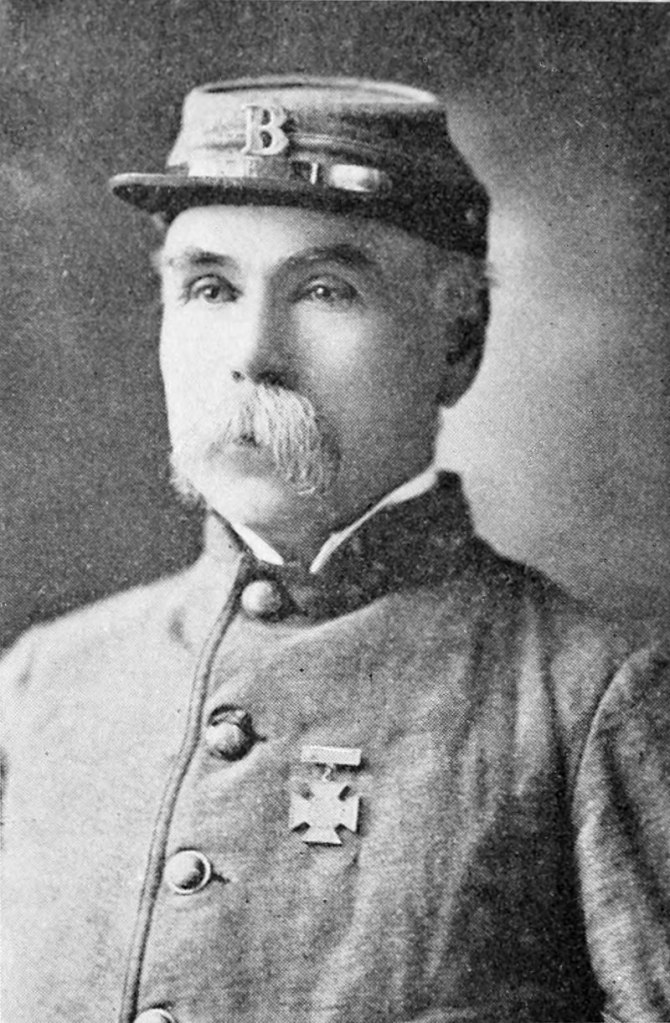
Marcus B. Toney, about 1905
When war broke out, Toney enlisted in the First Regiment of the Tennessee Infantry (Feild’s), Company B, known as the Rock City Guards.5 The regiment was sent to Virginia, where they fought beside Lee at Cheat Mountain and Stonewall Jackson at the Potomac River before returning to guard the Cumberland Gap.6 In 1862 they took part in Bragg’s invasion of Kentucky and fought at Stones River in December.7 Toney was transferred in February 1864 to the Forty-Fourth Virginia Regiment, which participated in the Battle of the Wilderness in May.8 Captured with 1100 other Confederate soldiers, he was sent to the prison camp at Point Lookout, Maryland,9 and then transferred to Elmira, New York,10 where he spent the remainder of the war. His experiences as a prisoner make up a significant part of his memoir, The Privations of a Private*, published in 1906.
Returning to Nashville, Toney became involved for a short time with the Ku Klux Klan, perceiving the group as “conservators of law and order”11 during the chaotic years following the war. On December 4, 1868, Toney was on board the steamer United States when it crashed into the steamer America in the Ohio River.12 He escaped by swimming to shore in his nightclothes. Many other passengers who jumped into the river to escape the burning ship died as flaming oil spread across the water.13
In 1872 Toney married Miss Sally Hill Claiborne, who would bear him two children. The same year he became Nashville commercial agent for the New York Central Railroad, holding that position more than forty years.14 He wrote many articles for newspapers and other publications, particularly the Confederate Veteran, edited by his friend Sumner Cunningham. Toney was a witty and amusing raconteur and was frequently invited to speak about his wartime experiences.
During the mid-1880s Marcus Toney and Dr. William Bumpus became interested in establishing a residence for the widows of members of the Masonic brotherhood. The two men traveled throughout Tennessee seeking financial support for the project, and their board acquired a charter of corporation in August 1886.15 The Masonic Widows’ and Orphans’ Home was constructed near Nashville on 220 acres donated by Col. Jere Baxter.16 Funded by the Grand Lodge and personal donations, the home and its associated dairy farm opened in 1892 and operated successfully until the 1930s.
Marcus Toney died of “old age” 17 in Nashville on November 1, 1929, and was buried in Mt. Olivet Cemetery. (2014)
*A paperback edition of Privations of a Private, edited by Dr. Robert E. Hunt of MTSU, was published by Fire Ant Books in 2005. That and other editions of the book are available from most booksellers.
SOURCES:
1 Hale, Will Thomas, and Dixon Lanier Merritt. A History of Tennessee and Tennesseans: TheLeaders and Representative Men in Commerce, Industry and Modern Activities, Volume V. Lewis Publishing Company, 1913, 1507.
2 Hale and Merritt, 1508.
3 Toney, Marcus B. The Privations of a Private. Edited by Robert E. Hunt. Tuscaloosa: University of Alabama Press, 2005, xi-xii.
15 “The Masonic Widows and Orphans Fund of Tennessee.” The Grand Lodge of Tennessee, Free and Accepted Masons. http://www.grandlodge-tn.org/?chapters=Y&page=WO Website accessed April 20, 2014.
The following summary has been gathered from a variety of U.S. government releases and media clippings.
Five ships bearing the name Nashville have plowed the world’s waters. The first, the Confederate steamer Nashville, originally a brig-rigged passenger steamer, was seized at Charleston after the fall of Fort Sumter and fitted out as a cruiser. With a length of 215 feet and a beam of 34 feet 6 inches, she was armed with two 12-pounders and carried a complement of 40. The Nashville ran the Union blockade on October 21, 1861 and was the first warship to fly the Confederate flag in European waters. She returned to Beaufort, North Carolina on February 28, 1862, having captured two prizes valued at $66,000.
Confederate steamer Nashville, 1861 (All photos on this page are in the public domain.)
TheNashville was then turned over to Frazer, Trenholm and Company to whom she had been sold prior to her return. After use as a blockade runner, she was refitted as a Confederate privateer and commissioned on November 5, 1862 asRattlesnake. The Federals destroyed her in the Ogeechee River, Georgia on February 28, 1863.
Confederate ironclad ram Nashville, 1864
The Confederate ironclad ram, Nashville, was built at Montgomery, Alabama in 1864. She had a length of 271 feet and a beam of 62 feet 6 inches and was armed with three 7-inch rifles and one 24-pound smoothbore. Although never completed, Nashville had been heavily armored with steel plating and, when surrendered to the U.S. Navy, was believed unable to carry her weight of armor. At the close of the Civil War, she was stripped of her armor and sold at auction in New Orleans.
USS Nashville (PG7), commissioned 19 August 1897
USS Nashville (PG7), a gunboat built at Newport News, was launched on October 19, 1895. Sponsored by Maria Guild of Nashville, she was commissioned on August 19, 1897, Washburn Maynard commanding. With a length of 233 feet 8 inches and a beam of 38 feet 1 inch, she was armed with eight .40 caliber guns, two 6-pounders, two 3-pounders, and two 1-pounders.
This famous warship fired the first shot in the Spanish-American War and played a major part in naval operations in the Cuban area. She also helped put down the Philippine Insurrection and the Boxer Rebellion in China. During World War I, USS Nashville escorted convoys in the Mediterranean to and from Europe and North Africa. At the close of the war, she was decommissioned and sold for scrap.
USS Nashville (CL-43), commissioned 6 June 1938
USS Nashville (CL-43), a light cruiser that served with distinction in World War II, was commissioned on June 6, 1938, sponsored by Ann and Mildred Stahlman of Nashville. Her length was 608 feet 4 inches and her beam measured 61 feet 8 inches. She was part of the task force that pulled off the spectacular Doolittle raid on Tokyo in early 1942. She was chosen as the flagship to transport General of the Armies Douglas MacArthur on his famous, triumphant return to the Philippines. The Nashville was hit by a suicide bomber in the Sulu Sea and suffered grave damage and many casualties. At the end of the war, she was decommissioned and sold to the Chilean Navy.
USS Nashville (LPD 13) commissioned 14 February 1970 (2006 photo)
The final ship to bear our city’s name isUSS Nashville (LPD-13), one of a class of ships designated Amphibious Transport Dock. Commissioned at Puget Sound Shipyard on February 14, 1970, she is the thirteenth ship of her class. On September 9, 1970 Nashville Mayor Beverly Briley participated in “Mayor Briley Day” aboard the Nashville in Norfolk, Virginia. She is 576 feet 4 3/8 inches in length, with a beam of 84 feet 1/2 inch. Her various assignments have included four Caribbean Amphibious Ready Groups, seven Mediterranean Groups, a Mine Countermeasure Group, and NATO North Atlantic Operations. The Nashville is still in commission and involved in operations contributing to the defense of the United States. (1998)
Five decades ago, on October 12, 1956, U. S. Representative J. Percy Priest died in Nashville, Tennessee. Doctors had performed an emergency repair of a duodenal ulcer, and the congressman had seemed to be recovering. But then a massive hemorrhage unexpectedly took his life. Earlier in the year his doctor in Washington had warned him not to delay the surgery, but Priest, knowing that recovery would take three to four months, had replied, “Later, I have too much to do right now.” Since 1956 was an election year, he returned instead to his home in Nashville (at 417 Fairfax Avenue), campaigned as an incumbent in the August primary for Tennessee’s Fifth Congressional District in Davidson County, and steamrolled to an easy victory. Rather than take care of himself, he then persisted with his hectic schedule – speeches, parades, and running the statewide campaign for the Stevenson-Kefauver Democratic ticket. He was also looking forward to leading the singing at Union Station before Billy Graham’s special train left Nashville for Louisville in October. Unfortunately, however, in late September, after speaking to a men’s group, Rep. Priest collapsed and was rushed to the hospital.
U.S. Representative J. Percy Priest
Priest’s renown was assured as early as January of 1941 when he took his oath of office. “It must be divine Providence,” House Majority Leader John McCormack declared, “that . . . crisis sends men like Lincoln, Wilson, and Roosevelt to the White House, and men like Percy Priest to the legislative branch.” Although he was a freshman congressman, Priest “threw himself totally into the maelstrom and helped with every ounce of his individual strength and . . . leadership to give legislative lucidity, order, and direction” during World War II. That is the way Priest worked for the next sixteen years.
Children at Percy Priest Lake, named in honor of the congressman. (from NHN photo collection)
Percy Priest was a visionary, predicting that in fifty years (dating from 1946) mental illness would be one of the biggest health concerns in our country. With TVA, he visualized the program’s ultimate goal: recovery, restoration, and utilization of the land of the Tennessee Valley, an area covering seven southeastern states. His legislation improved and advanced public health, education, and scientific research.
Priest was deeply admired and respected by his contemporaries. Several friends commented that he tried to “live as much like Jesus” as anyone they had ever known. In the House he was the most beloved man on either side of the aisle. His family knew that if he had to get to the top by walking on people he would rather not go. His constituents felt free to stop by his office in Washington unannounced, and he always obliged them. Someone once even asked if he could send the Coast Guard to find a set of false teeth that had fallen overboard in the Gulf of Mexico! (He couldn’t.) After Priest’s unexpected death, thousands flooded Nashville’s Park Avenue Baptist Church where his service was held, spilling onto the steps and sidewalks outside the building. Throngs stood in mournful lines as the hearse drove slowly through the city streets.
In the half century since his death, Percy Priest has gained a measure of immortality through various memorials to his name: a school because he was an educator; a county road because he was born nearby; a dam, reservoir, and enormous recreation area because he supported TVA. Yet few Tennesseans truly understand the extent of his character and statesmanship. Although he was not a perfect man, he exemplified the virtuous and courageous life. He believed his duty in Washington was like that of a soldier, heeding the admonition of Robert E. Lee, a man Priest admired: “Let danger never turn you aside from the pursuit of honor or the service of your country. Know that death is inevitable and the fame of virtue is immortal.” The more intangible monuments of his legacy – his progressive, humane, and farsighted legislation – continue to benefit the citizens of the United States.
The maintenance of our metropolitan humility requires us occasionally to confess and recount our sins against historic preservation. The current Nashville building spree may lull us into forgetting that during the twentieth century we destroyed probably the finest of Tennessee’s public squares (along with Francis Strickland’s courthouse), countless other downtown buildings (flirting, even, with razing Union Station and Ryman Auditorium), and several historic mansions (including two gubernatorial residences). Topping any catalog of questionable annihilations should be Polk Place, erased from our national heritage in 1901.
Postcard image of President James K. Polk from NHN collection.
Having expanded the nation’s borders to the Pacific Ocean, James K. Polk retired to Nashville a very weary man. A workaholic, he had served as a Tennessee state legislator and governor, U.S. Representative and Speaker of the House, and president of the United States from 1845-1849. In 1847 he had purchased the home of one of his mentors, the distinguished Felix Grundy, and refurbished it to his and First Lady Sarah Polk‘s desires. He lived there, however, for less than two months, dying on June 15, 1849. Sarah Polk lived on at Polk Place as the grande dame of Nashville for more than four decades, passing away in 1891.
President Polk’s will (which itself has had an incredible lost-found-lost again-found-again existence) expressed his wish that Polk Place be tendered to the State of Tennessee after Sarah’s death. Polk’s heirs wrangled and the State balked. The upshot of the imbroglio was that Polk Place was sold in a Chancery Court sale to another of Nashville’s preeminent citizens, Jacob McGavock Dickinson, Grundy’s great-grandson. In turn, Dickinson sold the columned mansion and its hallowed grounds – which until 1893 had included President and Mrs. Polk’s tomb, classically designed by William Strickland – to J.C. McLanahan, a Philadelphian. McClanahan proceeded to tear down Polk Place and build an apartment complex, the Polk Flats.
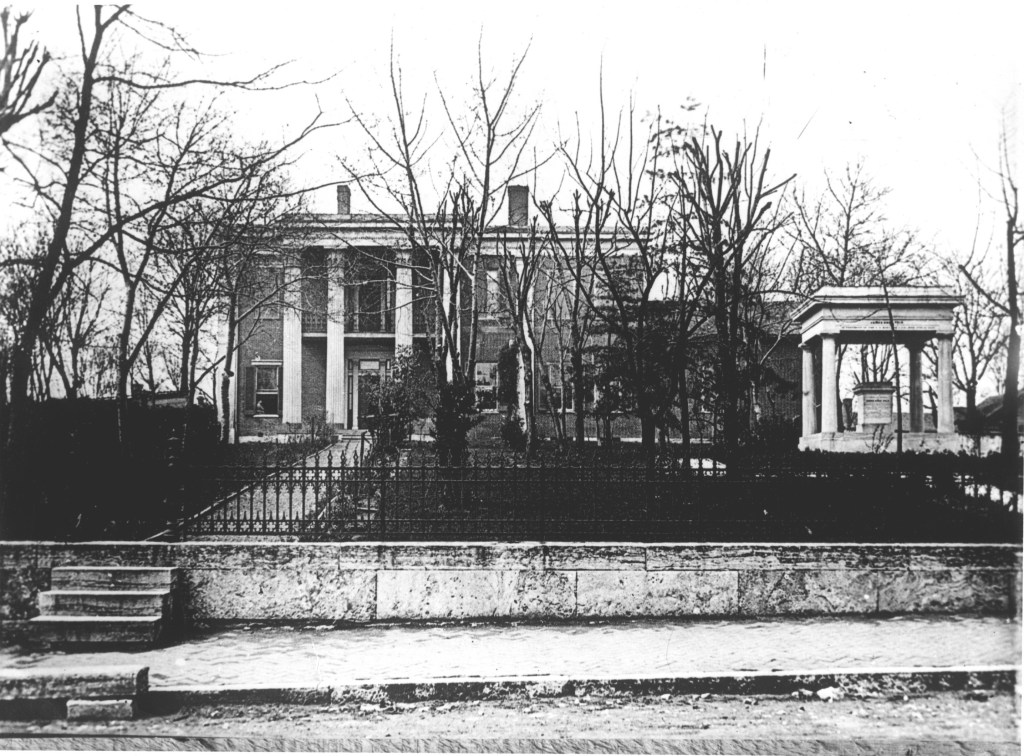
Polk Place was situated near the heart of Nashville between 7th and 8th avenues. Today’s Polk Avenue was once the lane that led from Church Street to the mansion on the rise at Union Street. The house certainly had a fortuitous location, leading us to wonder how the city fathers could have been so shortsighted as not to have seen the patriotic and economic benefits of a president’s residence in downtown Nashville. And just as the Ladies’ Hermitage Association rose up in 1889 to save Andrew Jackson’s estate, why did no such organization successfully lobby for the salvation of Polk Place? I suppose that the truism of the real estate business – that value is determined by “location, location, location” – ironically facilitated the home’s demise.
The Polk tomb (on the right above) once graced the lawn of the former president’s mansion. It was later moved to the grounds of the Tennessee State Capitol. (Photograph of the Polk home by Calvert Brothers Studio. Used by permission of the Tennessee State Library and Archives.)
What if the Polks’ retirement house were here today, surrounded by beautiful, well-kept grounds of even modest size? Literally millions of visitors would by now have toured the home, and James Knox Polk, rather than being relatively obscure in the presidential pantheon, would be far better known and interpreted. However, instead of enjoying a national landmark, we must confess to having spilled the milk of American history.
In a detailed article about Polk Place written for The Tennessean (“Learn Nashville,” 7-10-02), columnist George Zepp mentioned Mayor Richard Fulton‘s 1979 plan to acquire the original site and replicate the mansion. Evidently this magnanimous idea was not feasible at the time, but it seems worth revisiting today. At the least, an enterprising builder could duplicate the house – perhaps in an upscale development such as the Governors Club – using the elevations and floor plans published in the Tennessee Historical Quarterly in 1966 (pages 280-286). Perhaps such a replica already exists at some location.
Blessed with geographic significance, Nashville has expanded impressively over the years. We are justifiably proud of the landmark structures we have built and are building, yet we must be vigilant in remembering that the counterbalance of growth is destruction – and we have been excellent at that, too. In the twenty-first century a healthy respect for history will save us from more hard-to-swallow humble pie.
March is National Women’s History Month, a time to pause and reflect on those who have blazed the trail for us to follow. Here in Nashville it’s an easy and informative exercise, for we often hear the names of the women who have lived here and contributed to our city’s life. Yet, how much do we really know about these ladies, and how many others, just as interesting, have been forgotten?
Caroling for Fannie Battle is a Nashville tradition, but do we know that Miss Fannie, who never received a salary of more than $30 a month during her 50 years of service, was sent to prison for spying during the Civil War? Martha O’Bryan, for whom we crank ice cream, found her life’s meaning in helping others after her fiancé was executed by the Union Army. Christiana Rains, sliding her toddlers across the frozen Cumberland River to found Nashville on Christmas Day, 1779, and Stella Vaughn, the first woman staff member at Vanderbilt in 1905, are both pioneers.
Slave Sally Thomas saved her money and purchased freedom not for herself but for her little boy. Hetty McEwen flew her Union flag in Confederate Nashville. Mary Kate Patterson brought her friend Sam Davis breakfast on his last Sunday of freedom, galloping her horse so the coffee wouldn’t have time to cool.
In ante-bellum Nashville, teacher Charlotte Fall Fanning was so loved by her pupils that an extra Greek lesson was a sought-after treat. In our own time, Julia Green shocked men drivers by driving her Ford. Miss Julia was such a presence that teachers warned of her arrival by passing a green pencil so that everyone would be prepared. Hattie Cotton and Emma B. Clemons spent their lives serving Nashville’s children and were rewarded by having schools named for them. Anne Webber didn’t attend Watkins Institute, but left her large estate to help others do so.
Known primarily as founder of the UDC, Caroline Meriwether Goodlett also helped the horses of Nashville by founding the Tennessee Humane Society and placing drinking troughs on every corner. Needlework designer Anne Champe Orr provided employment for women in Appalachian Kentucky, who completed the appliqued quilts and delicate tablecloths her customers wanted to own, but not to make. Elizabeth Eakin devoted her fortune to the welfare and beautification of her city. Eakin School honors her service as the first female member of the Board of Education in 1917. When her four sons went to serve in World War I, Margaret Winston Caldwell ran their automobile dealership, the only woman dealer in the country. Her sister May Winston Caldwell, saddened by the loss of her son in that war, was the guiding spirit of the Peace or Battle of Nashville Monument. Erected in 1927 to commemorate reconciliation and the sacrifice of young men in war, the monument has recently been restored.
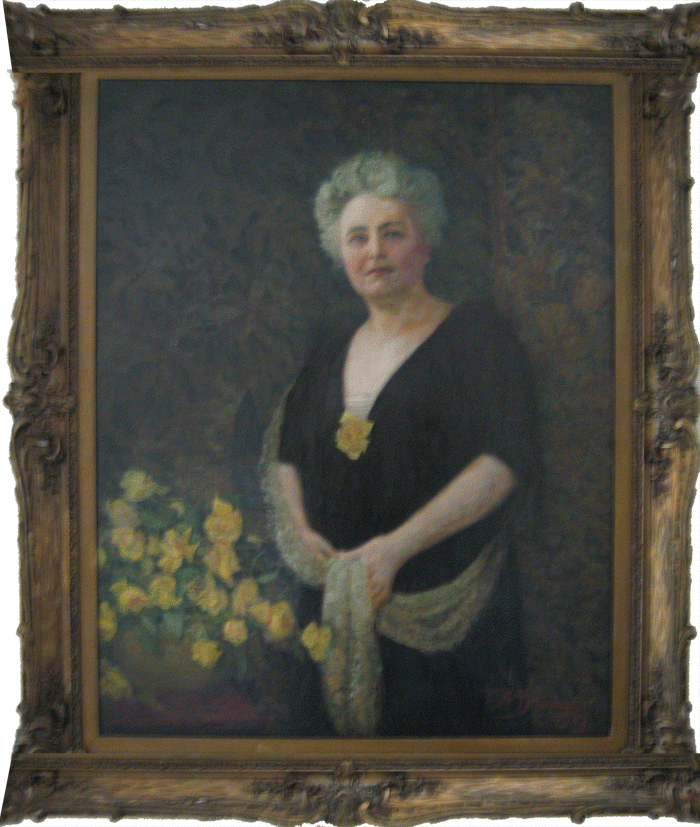
Elizabeth Eakin (Tennessee Portrait Project)
Lula Clay Naff was the manager of the Ryman Auditorium for 50 years, retiring in 1955. Rarely seeing a performance, unfazed by Barrymore, Hepburn, or Helen Hayes, Mrs. Naff always made a profit and never allowed any criticism of the facilities. Mary Dorris, Bettie Donelson, Louise Lindsley, and their friends organized the Ladies’ Hermitage Association and saved Jackson’s home from destruction. Ella Sheppard and her fellow students became the Fisk Jubilee Singers and rescued their university.
Almost all of these women lived and worked before they had the right to vote. Nashville was the battleground for the ratification of the 19th Amendment. Delia Dortch, J. Frankie Pierce, Warner family members, and countless others worked as hard as they ever had, propelled by the vision of leader Anne Dallas Dudley. “We have a vision of a time when a woman’s home will be the whole world, her children all those whose feet are bare, and her sisters all who need a helping hand; a vision of a new knighthood, a new chivalry, when men will not fight for women but for the rights of women.” Ironically, neither Anne Dudley’s nor Kate Burch Warner’s own daughters lived to adulthood to use the right for which their mothers had struggled.
Anne Dallas Dudley, 1908 (Tennessee Portrait Project)
These are just a few of the many women who have had an impact on Nashville. From Rhoda Calvert Barnard, who has a planet for a namesake, to Cornelia Clark Fort, sacrificing her young life for her country, Nashville’s daughters have lived with bravery and determination. Time and circumstances have made the challenges of each one different, but they are united in their courage and love for their city and country. We owe them respect and honor and have the obligation to keep their memory alive. (1999)
Primary Source Document, transcribed by Stewart Southard.
An act for the purpose of distroying Squirrels, Crows and Wolves
Sect. 1st Be it enacted by the General Afsembly of the state of Tennefsee, that from and after the pafsing of this act, it shall and may be lawful for each county court, in this state, at the time of laying the county tax, to lay a tax to be paid in squirrels, or crows scalps. on every person, subject to a poll tax, in their respective counties, not exceeding twenty five squirrels to each poll.
Sect. 2nd Be it enacted, that every person subject to pay a poll tax, shall deliver to the Justice of the peace, who is appointed to take in the lists of taxable property, in the district where he, or she may reside, a sufficient number of scalps to satisfy the number of polls he, she, or they may be liable to pay tax for, agreeable to the number of scalps, so laid by the court, on each poll; or one crow scalp, in lieu of two squirrels scalps; and it shall be the duty of the Justice who is appointed as aforesaid to burn the scalps so delivered; and enter the number in the tax list, in a column for that purpose.
Sect. 3rd Be it enacted that every person, who fails to deliver their number of scalps shall for every scalp so failing to deliver, pay one cent to be collected, accounted for, and applied, under the same rules, and restrictions, as other county taxes.
Sect. 4th Be it enacted, that the court of every county is hereby, authorized to lay, a rate on wolf scalps, not exceeding two dollars for each scalp, to be paid out of the county treasury, by, the trustee of the county.
Sect. 5th Be it enacted, that before any person shall be authorized to draw his pay, for the scalp of a wolf, he shall appear before some Justice of the peace of said county, wherein he killed the same, and make oath, or affirmation, that he did actually kill the wolf, in the county where said Justice resides, since the promulgation of this act, and on such qualification, it shall be the duty of said Justice, to burn the scalp, or scalps, and grant him a certificate, directed to the Trustee of the county, together with an order to pay the sum the court may appropriate for the killing of each wolf. – October 20th 1797 –
James Stuart Speaker of the House of Representatives
by Kenneth Fieth, Metropolitan Nashville Archivist.
“At long last a use has been found for those extra coat hangers that always fall to the floor,” commented Guy Redmond, Red Cross Field Director, in his plea to Nashvillians in August of 1943 to send their extra hangers to the Army Air Forces Classification Center on Thompson Lane. Some 2,500 were needed. Everything had been planned and considered: housing, hospital, mess halls, roads, sewers, and electricity. Nice new lockers, no hangers. So the call went out to wartime Nashville.
The Army Air Forces Classification Center was brand new in the summer of 1943. As early as the spring of 1942, plans had been underway to build a training center for Army Air Force cadets. The Center was an induction station where cadets were brought for preliminary training, aptitude tests, and physical examinations. They were classified according to their skills and talent and then shipped on for further training. Many became pilots, bombardiers, navigators, and gunners in the war against Germany and Japan.
Postcard of Army Air Force Classification Center(from NHN collection)
The Center eventually encompassed approximately 560 acres along Thompson Lane and Franklin Road. The close proximity of Radnor Yards and the L&N Railroad lines helped win the contract for Nashville. The City Council, in special session, passed resolutions authorizing the city to enter into contracts with the Federal Government to furnish water, electrical power, and sewer facilities for the site.
The local railroads agreed to build spur lines into the facility and Nashville Electric Service made a commitment to bring electric power into the site. To win the $5,000,000 project for Nashville, Mayor Cummings worked successfully with local contractors, businessmen, and the Federal Government. Warfield and Keeble, Foster and Creighton, and other architectural and engineering firms provided the expertise to build the complex. When completed, the complex contained hundreds of buildings, including barracks, mess halls, fire halls, warehouses, recreation halls, several theaters, and a chapel.
At its height, the Center had a staff of 200 officers and 500 enlisted personnel and was the largest of the three Army Air Force centers in operation in the United States. The Center housed, on average, 10,000 soldiers per year.
The Center operated from 1942 until 1944 as a classification center, housing WACs (Women’s Army Corps) and Army Air Corps cadets. In early 1945, the classification center was shut down and a portion of the facility served as a separation center for U.S. Navy personnel. Sailors were sent to the Center for final separation from service and were given orientation on civilian life, proper discharge papers, and transportation to their homes.
The U. S. Government continued to lease the site from the Nashville Public Housing Administration well after the war ended. Finally in 1952, the site was declared surplus and the remaining few veterans and their families were transferred to other posts.
Four local businessmen—Dewitt Carter, R. M. Crichton, A. D. Creighton, and John D. McDougall—purchased approximately 113 acres of the site for $456,000. The Nashville Chamber of Commerce led a campaign to make the site Nashville’s first planned and controlled industrial development area. Consequently, the Suburban Industrial Development Company was formed in 1953 and became known by its acronym, SIDCO. By 1954, SIDCO had plants, warehouses, and small manufacturing shops throughout the area. The buildings used during the war were razed to make way for the new development, which grew rapidly and completed its first 50-acre phase in 1959.
The Sidco area still has the plants, factories, and warehouses that were the excitement of the post-war years in Nashville. The building frenzy continued until nothing of the original Army Air Classification Center was left. Those driving by the area today will not realize that during W.W. II the region between I-65 and the Radnor railyards was home to tens of thousands of American soldiers. (2000)
This sad tale of woe involves four principal players: the victim, John W. Kirk, Superintendent of Prisons; Andrew B. Vaughn, Warden of Coal Creek Prison, who fired the fatal shot; O. B. Paxton, a prison guard, whose appointment by Kirk and dismissal by Vaughn made him the center of the controversy; and Paxton’s friend J. T. Davis, Chairman of Marshall County Democratic Executive Committee and intended target of the shooting.
Kirk, the former Warden of Coal Creek, had hired Paxton as a guard there. After Kirk’s promotion to Superintendent, Andrew Vaughn was named to succeed him. Vaughn soon removed Paxton from his position as prison guard for alleged rule violations, but Kirk reassigned Paxton to temporary work at the main prison.
Vaughn came to Nashville on Wednesday, May 29, 1895, to attend his niece’s wedding and then to transport a convict back to Coal Creek. He called on Superintendent Kirk at the Capitol to discuss the Paxton case–namely, who had authority to hire and fire prison guards.
This image of the Tennessee State Capitol was on stationery used by House members in the 1890s.
A conflict erupted when Vaughn encountered Paxton in the crowded first floor corridor and accused him of lying to Kirk. Hurling violent epithets, the two began to fight. Davis, a friend of Paxton, attempted to separate them. Vaughn lashed out with his walking stick, striking Davis twice on the head and causing a large knot over one eye. Vaughn was himself injured after Davis wrenched the stick from his grip.
The men were finally separated. Paxton and Davis were taken to the Governor’s Office, where Governor Peter Turney and his son James were having lunch. The Turneys attempted unsuccessfully to hold on to Davis, who was still in possession of Vaughn’s stick. Warden Vaughn, meanwhile, had been taken to the Treasurer’s Office to calm down but insisted that his stick be returned.
When Davis heard about Vaughn’s demand, he eluded the Governor’s grip and rushed to the Treasurer’s Office at the end of the hallway. Davis and Vaughn began cursing each other again. Senator W.P. Caldwell, who was sitting in the Treasurer’s Office, promptly fled through the nearest window. Vaughn grabbed the stick, but Davis snatched it back and struck his opponent on the head. Enraged, Vaughn pulled a gun from his pocket, firing three shots. The first barely missed Davis, causing powder burns to his face. He pushed past Deputy Insurance Commissioner Ridley Wills and raced into the corridor. Vaughn followed, firing at least two more shots in the main corridor, where Superintendent Kirk crouched near the north wall. The second or third bullet accidentally struck Kirk behind the left ear, lodging in his brain.
Warden Vaughn sidestepped Kirk’s body and continued his pursuit of Davis, who escaped by ducking into the Adjutant General’s Office. Returning to the Treasurer’s Office, Vaughn stated calmly that Superintendent Kirk was the best friend he ever had.
The shooting occurred at 2:10 p.m., shortly before the legislature was to convene in their chambers upstairs. The shots were heard throughout the busy building and out on the streets. The halls quickly filled with curious people after the news was telephoned down into the city.
Kirk was carried to State Treasurer E. B. Craig’s office, and Representative R. E. Maiden attended to him by placing a bundle of pamphlets under his head until Doctors Eve and Briggs arrived. They dressed the wound and transported Kirk to City Hospital, not expecting him to live long. No attempt was made to remove the bullet. Governor Turney telephoned Mrs. Kirk in Henderson, TN, to come at once. She sat by her husband’s bedside as he drifted in and out of consciousness, able to answer “yes” or “no” to some questions. A robust man, he lived from Wednesday afternoon until 12:24 a.m. on Saturday, June 1, 1895.
Vaughn and Davis quietly submitted to arrest when the police arrived. Taken to the station house, neither was placed behind bars. Davis returned to his home on the afternoon train; Vaughn was charged with two counts of assault and released on $5,000 bail. He was later indicted for murder. At the end of his sensational two-week murder trial ending on April 15, 1896, the jury declared Vaughn “not guilty.”
Thus concludes the nearly forgotten tale of the only person killed in the Tennessee State Capitol . . . so far.







 Nashville Historical Newsletter