A Chronology of Nashville Airports

by Georgiana T. McConnell.

Nashville’s first airfield was a two-thousand-foot strip on the E.L. Hampton farm, now along Hampton Avenue between Golf Club Lane and Woodmont Boulevard. It was used by transients and locals between 1917 and 1921.

Blackwood Field was opened in 1921 to house the newly designated 105th Observation Squadron Air Guard unit. It was on land adjacent to The Hermitage property on Shute Lane. H.O. Blackwood donated money to erect a hangar, thus the name.

When air mail was becoming important, an airport was needed closer to town, so land was purchased in West Nashville. A field at the current location of McCabe Golf Course began operation in 1927. It was named McConnell Field in honor of Brower McConnell who had been killed in Air Guard training that year. It was Nashville’s first municipal airport. McConnell Field soon became too small for the Guard and airline growth, but it stayed in operation until 1937.

Although located in Murfreesboro, the next designated Nashville airport was Sky Harbor which opened in 1929. It was located between the old Nashville Road and the railroad and was used until Berry Field opened in 1937.

Nashville’s New Municipal Airport (postcard from NHN collection)

Berry Field was built at its present location along Murfreesboro Road—although it is now greatly enlarged. It was a WPA project and was named in honor of Col. Harry S. Berry, State Administrator of the WPA. Called the Nashville International Airport since 1988, it continues to serve the growing aviation public, though mostly for corporate and airline flying.

Gillespie Airport, owned and operated by Jim Gillespie, opened in 1941. It was located at the end of 9th Avenue North on the Cumberland River (on land now part of Metro Center). It served private flying. Before it closed it was bought by the city and called Cumberland Field.

Cornelia Fort Airpark, named for a daughter of Nashville who lost her life while serving in the WAFS, opened in 1943. It is located near the old Fort farm along the Cumberland River in East Nashville.

In 1970 the Metropolitan Nashville Airport Authority acquired the airport at the old Sewart Air Force Base in Smyrna. MNAA relinquished the airport to the Smyrna/Rutherford County Airport Authority in 1991 but retains liens related to environmental issues. The Smyrna Airport serves corporate and private flying.

The John C. Tune Airport, named for a founding member of MNAA and located in the Cockrill Bend area near the prison, opened in 1986. It is owned by the Metro Airport Authority and serves corporate and private flying. (2000)
Robert “Black Bob” Renfro: from Slave to Entrepreneur

by Larry Michael Ellis.

Robert “Black Bob” Renfro is mentioned in at least 25 records that date from 1792 to 1816. Members of John Donelson’s epic river voyage, his group left the Donelson party on April 12, 1780, at the Red River near present-day Clarksville. His master, Joseph Renfro, was a kinsman of the group’s leader Moses Renfro. Indian attacks, probably in 1780, drove them from what had become Renfro Station. Accounts differ as to the sequence of events which followed, but we do know that Joseph Renfro was killed near present-day Coopertown at what came to be known as the Battle Creek Massacre. Folk legend says that Black Bob saved his mistress and her children. Other historical accounts state that only a Mrs. Jones escaped. Nevertheless, Bob’s mistress, Olive Renfro, did arrive at Fort Nashborough where she petitioned for and was granted “letters of administration” for the estate of Joseph Renfro.

Bob does not appear in an official record until August 8, 1792, when he was sold by Olive Renfro (now Shaw) in what appears to be a three-party transaction. Bob became the property of Josiah Love, whose financial troubles involved him in several lawsuits, with Andrew Jackson serving as his lawyer. One foreclosure document lists Bob as Josiah Love’s only asset. Around the same time, Love entered into another complicated transaction in which two people claimed ownership of Bob: Robert Searcy, a prominent lawyer, and Elijah Robertson agreed to let the courts determine the true owner. In November 1795 the Court ruled Searcy was the rightful owner.

In the meantime, on January 16, 1794, the Davidson County Court agreed that “a certain Negro called Bobb [sic] in the town of Nashville be permitted to sell Liquor and Victuals.” This was the origin of what came to be known as Black Bob’s Tavern. A 1797 record lists an assault occurring at the “house of Black Bob.” This establishment was probably located on what is now Third Avenue, south of the Public Square.

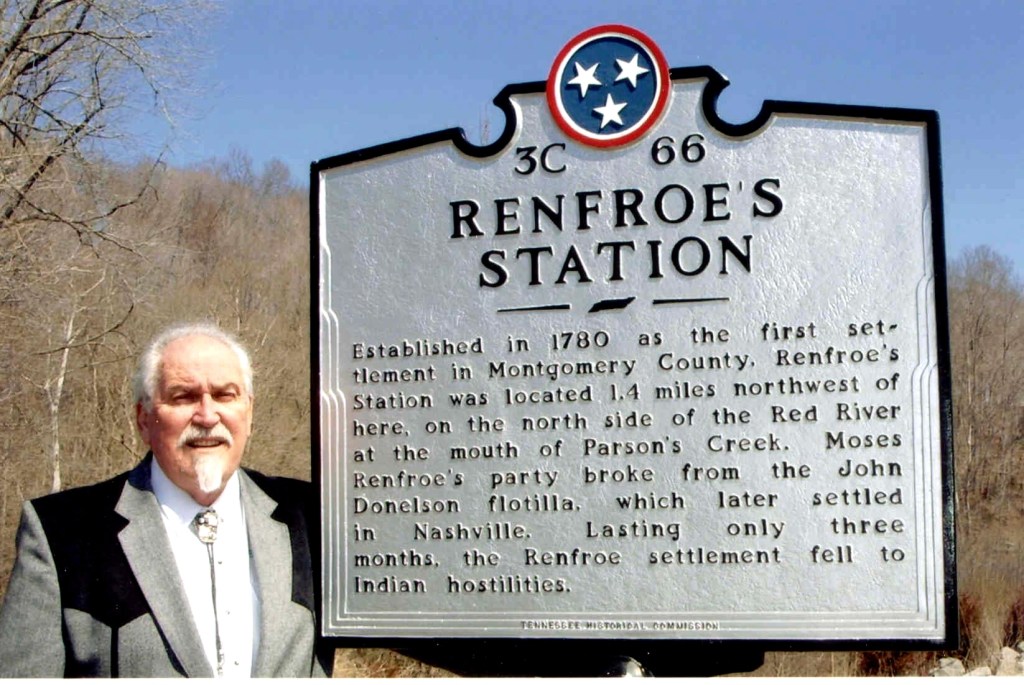
Author Mike Ellis with historical marker commemorating the establishment of Renfroe’s Station in Montgomery County, Tennessee. (Photo courtesy of the author)

An unusual event occurred in April 1800 when schoolmaster Anderson Lavender assaulted Bob. Lavender was indicted by the Davidson County Grand Jury. When he agreed to pay court costs, the case was dissolved. This was a significant moment in legal history: a white man was indicted for assaulting a slave, and the case was not simply dismissed. Andrew Jackson, Archibald Roane (future governor), and David Campbell were judges at the time the suit was heard before the Superior Court.

Robert Searcy maintained ownership of Bob until 1801, five years after Tennessee became a state. Searcy believed that Bob had more than paid back his investment and agreed to free him. However, freedom and emancipation are not synonymous terms. Fifty-three of Nashville’s most prominent and influential citizens, one of whom may have been a woman, signed a petition to the General Assembly requesting that Bob be emancipated, “giving him all the privileges that is usual to persons in a similar situation.” On November 10, 1801, the Fourth General Assembly of the State of Tennessee granted the request and further stated that he “shall in the future be known as Robert Renfro.”

The emancipated Robert Renfro opened a new “House of Entertainment” in 1802 that was located on Main Street (present-day Second Avenue). Robert then purchased a life estate in Lot #25 from Robert Searcy on Main Street where he built and operated his business until a fire destroyed the establishment in 1814. He then rented and operated the “stone tavern on the public square, near the courthouse.”

Robert Renfro continued to be involved in court cases, prevailing in at least three cases before white juries. In an 1805 breach-of-contract case he sued Charles Dickinson (who would be killed the following year in a duel with Andrew Jackson), and the appeals process established several Tennessee legal precedents. Renfro’s name is listed on militia and tax rolls, as well as in the records of several other legal transactions.

The last record mentioning Robert Renfro dates from 1816. Although no record has been found of his death, his name does not appear in the 1820 U.S. Census of Nashville.

Courthouses of Davidson County, Tennessee

by Debie Oeser Cox, author of Nashville History blog.

How many court buildings have stood on the public square in Nashville? Published sources offer conflicting information, some stating the number as four and others as five. Research in the minute books of the Davidson County Court has provided the following details.

First Courthouse

The building of the first Courthouse was authorized by the Davidson County Court at the October Term 1783: “The Court then proceeded to fix on a place for Building of a Courthouse & Prison, and agree that in the present situation of the Settlement that it be at Nashborough and Built at the Expense of the Publick. And that the size of the Courthouse be eighteen feet square in the body with a Leanto Shade of twelve feet on the one side of the length of the House. And that the house be furnished with the necessary benches, Barr, Table &c fit for the Reception of the Court.” In April of 1792 the Court “ordered that David Hay repair the Court house by Making Two Doors well fixed and Hung with three window shutters well hung; and the house Well chinked.”

Second Courthouse

Davidson County Court minutes of October 15, 1802, page 367, report as follows: “Court adjourns for five minutes, to meet in the new Courthouse. Court met according to adjournment in the New Courthouse where was present . . ..” A further search of Court minutes yields few clues as to the size or type of building. In 1804 the Court ordered the purchasing of a bell for the Courthouse and in 1806 the painting of the roof and steps. In 1822 the Court “ordered that opening at the head of the Stairs be closed, leaving a door there to which he shall have a shutter made and to have the two stoves placed one on each side of the house behind the bar with pipes extending so as to render the house comfortable for the different courts that are to set here during the winter . . ..” In October 1825 a commission was appointed to determine whether the Courthouse could be repaired to make it comfortable enough for the Court to meet in winter or whether it would be necessary to rent a building for the winter.

Third Courthouse

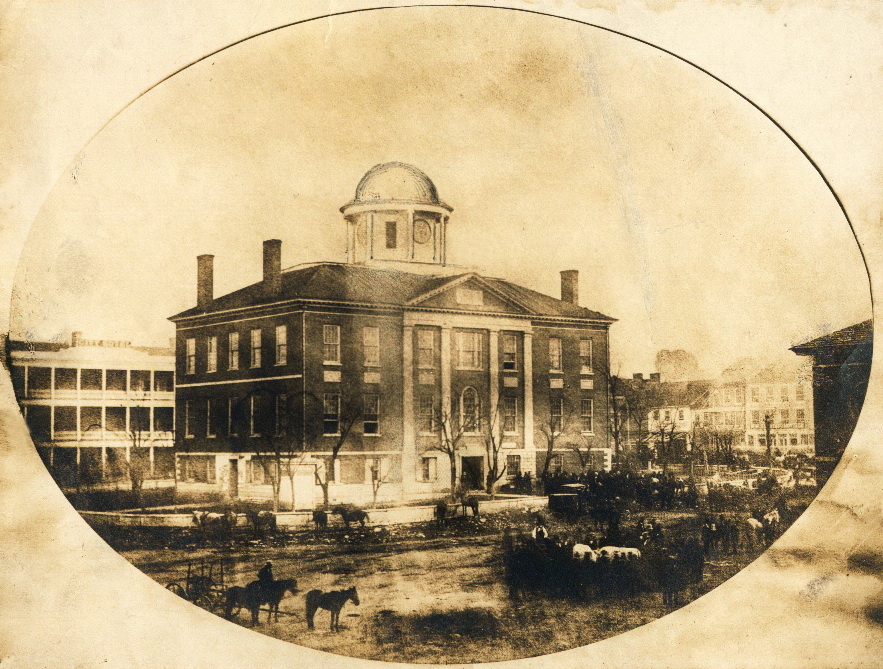
In January 1826 the acting Justices of the Court met and voted to raise, with a special tax, $15,000 over a period of three years for the purpose of building a courthouse for the county. The Courthouse was finished in late 1829 or early 1830. It is described in Eastin Morris’s Tennessee Gazetteer, 1834: “The Court House which stands on the public square, is a spacious and commodious edifice. It presents a handsome front of 105 feet and is sixty-three feet deep. The basement story contains a number of rooms, designed for public offices, and on the second and third floors there are two rooms forty by sixty feet each, two others thirty-six by forty, and two others twenty-three by forty. The basement story is eleven feet high, and the two principal ones are eighteen feet each, and the height of the whole building to the top of the dome is ninety feet. The foundation and part of the lower story is of fine hewn stone, and the remainder of brick, and the two fronts are ornamented with four white pilasters each, The dome contains a good town clock, and is supported by eight columns of Ionic order.” This Courthouse burned in 1856. The County Court minutes state: “Monday Morning April 14, 1856 Court met pursuant to adjournment at the State House in Nashville (the Court House having been burned down) . . ..”

Fourth Courthouse

Fourth Courthouse, 1906 (postcard from NHN collection)

On May 10, 1856, the Court met in the Market House: “The County Court will build a Courthouse on or near the center of the Public Square in Nashville . . ..” According to County Court minutes, architect W. Francis Strickland, son of William Strickland, designer of the Tennessee State Capitol, was “employed at a salary of one thousand dollars per annum as architect of the court house.” The design chosen by Strickland was very similar to that of the Capitol building designed by his father. The building was to have a basement and three stories above ground, and was to be 118 feet by 72 feet in size. The Court first met in the new building in January 1859. The building was remodeled in 1910 with an additional story added. In 1935 this building, along with the City Hall and Market House, was demolished to make room for a new courthouse.

Fifth Courthouse

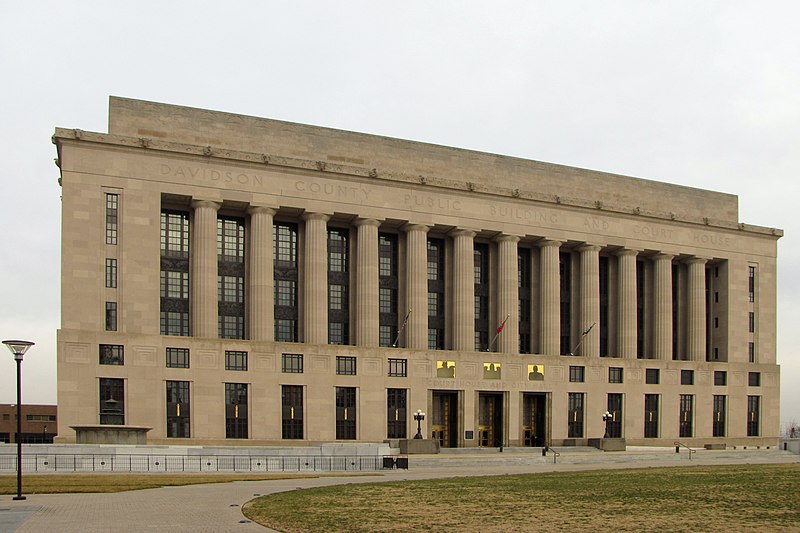
The present Courthouse was completed in 1937. The architects, Emmons H. Woolwine of Nashville and Frederic C. Hirons of New York, won an architectural competition in 1935 with their Art Deco design. The cornerstone of the building was laid August 10, 1936, and the building was dedicated on December 8, 1937. The general contractor was the J. A. Jones Construction Company. The building is eight stories high and measures 260 feet by 96 feet. The years have taken a toll – the building is in need of repair and the need for space is critical. Mayor Bill Purcell hopes to relieve the crowded conditions in the Courthouse by the construction of a General Sessions-Criminal Court complex, near the Ben West building. Plans are under way for a major renovation of the Courthouse to begin in the spring of 2003.   (Article was published in 2002)

The Confederate Twenty-Dollar Irony

by Mike Slate.

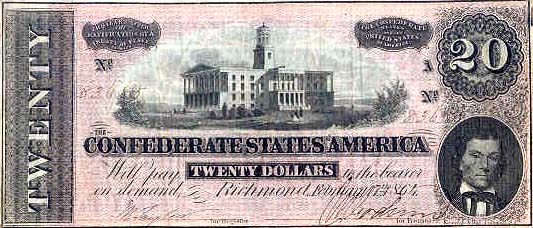
From 1862 through 1864 the Confederate States of America printed an estimated ten million twenty-dollar notes featuring an engraving of the Tennessee State Capitol. Today many of these notes survive in the hands of collectors and others, who may not be aware of the historical irony surrounding this currency.

Early Confederate twenty-dollar bills featured representations of a sailing vessel and various classical goddesses as well as a bust of CSA Vice President Alexander H. Stephens. Pursuant to the Confederate Congressional Act of October 13, 1862, the first Tennessee State Capitol notes were soon printed . . . and there the irony begins. This note’s design shows miniscule yet visibly genteel folk strolling the Capitol grounds. However, months earlier, on February 25, 1862, Nashville Mayor R. B. Cheatham had surrendered the panicked city of Nashville to Union General Don Carlos Buell. Long before October 13 Confederate currency was worthless in Nashville.

With the Federal occupation of Nashville came the immediate securing of the statehouse and the hoisting of William Driver‘s famous flag, “Old Glory,” on Capitol Hill. To be sure, no Southerners lolled around the Capitol grounds after February 25.  Iron-fisted military governor Andrew Johnson arrived in Nashville on March 12.  By the time of the October 13 Act, the Capitol was undergoing heavy fortification as Fort Andrew Johnson.                  

It seems likely that, although the “Tennessee Capitol” note was issued twice more (following the Act of March 23, 1863, and the Act of February 17, 1864), many Nashvillians did not see this currency until years after its initial printing. The bill was engraved – and presumably printed – by the firm of Keatinge & Ball in Columbia, South Carolina, a city significantly distant from occupied Nashville. There may be more of these notes in Nashville today than there ever were during the Civil War.

The Tennessee Capitol vignette was engraved probably by Edward Keatinge, who had worked for the American Bank Note Company in New York City. Recruited by the Confederacy for its treasury department, Keatinge teamed with Virginian Thomas A. Ball to form Keatinge & Ball, Bank Note Engravers, in Richmond. Soon the firm removed to Columbia, South Carolina, a strategically safer location. There they produced Confederate currency using equipment and supplies smuggled from Europe through the Federal blockade. General Sherman destroyed the firm’s facilities in February 1865.

Only two other Southern capitol buildings adorned Confederate currency: those of Columbia, South Carolina, and Richmond, Virginia. Despite the irony of its issuance, the Tennessee Capitol twenty-dollar bill is nevertheless a tribute to an architectural gem, the timeless work of Philadelphia architect William Strickland.

General James Robertson, Frontier Surgeon

by Jack Andrew Skipper.

The best known of the Middle Tennessee settlers who were scalped and lived to tell about it was David Hood, a colorful character at Fort Nashborough. He was admired for his knowledge of Bible verses and his sense of humor, which often involved wordplay. After a near-fatal Indian attack, during which he fooled his assailants by playing “possum,” he joked about “hoodwinking” his adversaries and giving up his hood but not his life, thanks to his “possuming.”

One day in the winter of 1781-1782, as Hood was coming from Freeland’s Station on his way home to Fort Nashborough, Hood encountered several unfriendly Indians, who fired their muskets at him (1). Attempting to outrun them, he concluded that his only chance of survival was to appear mortally wounded, so he fell into the weeds and snow as if dead. One account claims that he was shot with at least two musket balls (2). He was still alive, however, and somehow remained silent while they lifted his scalp. According to John Rains, another Nashborough resident, the knife they used was dull and required much work to do the deed. The Indians then walked toward Fort Nashborough in search of other victims.

Bloody and dazed, Hood struggled to his feet and started toward home, only to come face to face with the very same Indians on their return. They attacked him a second time, shooting him in the chest, and again left him for dead. The next day some of the settlers, following the trail of blood, found his still form lying in a brush pile. Believing he was dead, they carried him to an outbuilding at the fort to await burial.

Several ladies from the settlement, mourning the loss of yet another comrade, came to prepare Hood’s body for the funeral. No doubt they were saddened by the fact that this lighthearted pioneer was gone, leaving them without the cheer he had gladly provided. However, Hood began to move slightly! Astonished, they asked him if he was still alive. He whispered that he thought he could live if he were given half a chance. He was carried indoors, and James Robertson himself attended him, operating on his bare skull. In a short time Hood was walking about; by summer the beloved cooper was able to resume his trade.

In 1777, while living in the Watauga settlement, James Robertson had met a Dr. Vance from whom he learned a surgical technique for saving the lives of scalping victims. Vance, a physician visiting the Holston settlements from Augusta County, Virginia, was treating Frederick Calvit, who had been scalped in March of that year (3). Needing to attend to other settlers, the doctor taught Robertson to perform the surgery. Robertson finished what Vance had started on Calvit. The procedure allowed new skin to grow over the bare skull bone, thus preventing the skull deterioration which often took the lives of scalping victims who had survived their attacks.

Robertson utilized the Vance method on several patients, including David Hood at Fort Nashborough. Using an awl, he drilled numerous holes in Hood’s skull. Apparently, this process was relatively painless. Tissue from inside the skull (we assume not brain matter) would issue from the holes, spread over the skull, and prevent deterioration. Some of the new membrane would turn into black scales, which would be removed. The flesh would be treated regularly with ointment and a layer of lint until it cured.

David Hood lived for many years after being scalped. No doubt his deep faith and rich sense of humor assisted him in his recovery and subsequent longevity. James Robertson, in providing this service to his fellow settlers, once again proved to be invaluable to those he led into the wilderness of Middle
Tennessee (4).


Sources:

(1) A. W. Putnam, History of Middle Tennessee, pp. 153-155.
(2) “Boy Born, Man Scalped, 3 Slain in One Day,” by Ed Huddleston, Nashville Banner, April 17, 1956, p. 7.
(3) Benjamin Smith Barton, M.D., ed. “Remarks on the Management of the Scalped-Head,” by James Robertson (as communicated to the editor by Felix Robertson, M.D., April 10, 1806)The Philadelphia Medical And Physical Journal, Vol. II, 1806, pp. 27-30.
(4) “James Robertson Was Pioneer and Patriarch,” by Robert H. White, state historian, Nashville Tennessean, July 12, 1957, “Visitor’s Corner.”

From Curiosity to Hope: The Work of Local Historians

by Kathy B. Lauder.

Idle curiosity? There is no such thing. Curiosity, whether innocent, prying, or professional, drives historical research. Every chronicler of noteworthy events must ask the who-what-where-when-why-how questions that produce accurate records, but a good historian is also an artist. In classical Greece, history even had its own muse, Kleio, “Granter of Glory,” since an orderly account of the chaotic events of a battle or an era is as much a work of art as a poem or a drama. Curiosity unfurls the sails of imagination, and imagination is the flagship for our journey toward understanding.

Photo by George Gamble

We are all potential historians, but we will never be truly effective until we wade into the river of history to experience it with a child’s attentiveness.  Children learn about the world by breathing it into their souls (the Latin root of inspiration means “breath”) and by asking endless questions.  Behind every doorway in our neighborhood, a story unfolds; on every street in our town, epic events occur; in the heart of every city, life, with all its complexities, waits for an enlightened historian to discover it.

Herman Hesse’s Siddhartha achieved enlightenment only after realizing “that secret from the river, that there is no such thing as time . . . that the river is everywhere at the same time, at the source and at the mouth, at the waterfall, at the ferry, at the current, in the ocean and in the mountains, everywhere, and that the present only exists for it, not the shadow of the past nor the shadow of the future.

Anyone who has visited a Civil War battlefield understands how effortlessly the line blurs between past and present: the tragic events that happened there can still make us weep. Anne Frank’s spirit lives on in a dark attic in Amsterdam. Emerson’s frayed straw hat still hangs on a peg in the hallway of his house in Concord; a visitor imagines that the great writer himself might stride past at any moment and slap the hat onto his head. History surrounds us, and we can drift serenely in it if we open our hearts to wonder.

Be warned: a well-developed sense of curiosity may not make us popular – it is, in fact, commonly considered humanity’s first negative trait. Eve and Pandora are both reviled as examples of feminine imperfection. Giving ourselves over too freely to curiosity puts us at risk of being deemed “prying” or “meddlesome.” Curiosity, after all, killed the cat.

Photo by Michael DeHart

On the other hand, the rewards of perseverance can be great. Most of those punished for curiosity eventually receive compensation for their suffering. Although Eden was glorious, Eve discovered the satisfaction of personal accomplishment only after leaving Paradise. Pandora released evil into the world by opening The Box; however, the lovely, fragile creature who remained with her afterwards was hope, that same spiritual longing with which historians guide the past forward into the present. (2002)

Our Story . . .

A Nashville native, Mike Slate (1947-2021) attended Metro public schools and held degrees from Lipscomb University, Harding School of Theology, and Peabody College. Concerned by Nashville’s lack of a publication dedicated to “saving and conveying the local historical knowledge of its citizens,” Mike founded the Nashville Historical Newsletter (NHN) in January 1997 as a “medium for historical sharing.”

Mike Slate (photo by Tim Slate)

Mike was also one of the presenters in the WNPT production of “Memories of Downtown Nashville,” which still appears frequently during station fundraisers. (Here is a segment of that program dealing with the history of Union Station: https://www.youtube.com/watch?v=dBWgti8iLvk). After many requests for the NHN collection in book form, Mike and his wife Kathy Lauder published The Confederate Twenty-Dollar Irony and Other Essays from the Nashville Historical Newsletter, a compilation of selected essays, in 2004. A second book, From Knickers to Body Stockings and Other Essays from the Nashville Historical Newsletter, followed in 2006. In recent years, Mike had become a zealous advocate for Buchanan’s Station, helping to organize the Friends of Buchanan’s Station Cemetery, a group formed in 2012 to raise awareness of the site and to provide needed funding for its protection, preservation, and ongoing maintenance. After a kick-off event commemorating the 220th Anniversary of the Battle of Buchanan’s Station in September 2012, the group collected more than $10,000 in donations to construct a metal fence around the cemetery, marking and protecting the site. In addition to organizing cleanup days, members have also raised funds for repairs and an archaeological assessment of the property. Their efforts ultimately encouraged the owner of Pinnacle Business Products, who owned the 1.46-acre site, to donate it to Metro Nashville Government in 2015. The Metro Parks and Recreation Department now manages the property, which is located on a proposed future expansion of the Mill Creek Greenway system.

Kathy Lauder, current NHN administrator, moved to Nashville from Maine in 2003. She taught high school English and theatre for 30 years in Maine and Maryland and was an employee of the Tennessee State Library and Archives (TSLA) from 2003 until her retirement in late 2013.

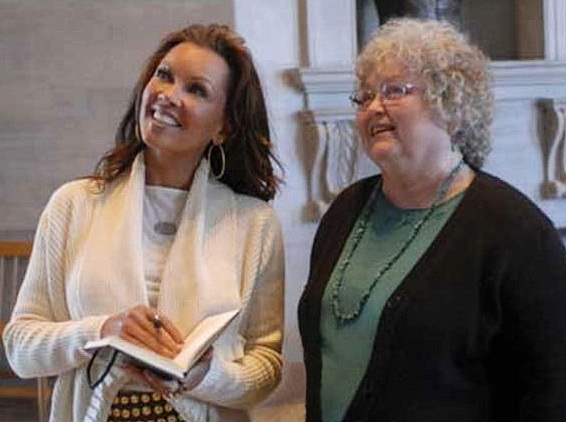
Kathy Lauder (r) with Vanessa Williams in a still from “Who Do You Think You Are?” 2011

As part of her work with TSLA, Kathy completed the research and writing for the award-winning online exhibit “‘This Honorable Body’: African American Legislators in 19th Century Tennessee”, which was featured in the Nashville Public Television documentary, First Black Statesmen: Tennessee’s Self-Made Men. She also appeared in the NBC television series Who Do You Think You Are, providing historical background for the 2011 episode featuring Vanessa Williams. Kathy joined the NHN staff as editor in 2002, shortly after the newsletter’s transition from printed to online publication. As a board member of the Nashville City Cemetery Association, she edited that organization’s newsletter Monuments and Milestones for several years. Currently engaged in a project to locate and restore missing names of people buried in Mt. Ararat and Greenwood cemeteries, she publishes a short biography of one of those individuals every Friday on the Greenwood Project Facebook page. A published poet, she is also an occasional contributor to The Tennessee Conservationist magazine. (Oct 2021)