Few musicians can claim a successful 70-year career, but Nashville native Doc Cheatham was still producing extraordinary albums at the age of 91. Cheatham began his performing career in Chicago in 1926 where he recorded (on the saxophone!) with Ma Rainey and sometimes stood in for Louis Armstrong on trumpet. In the 1930s, with the trumpet now his signature instrument, he performed in big bands led by Teddy Wilson, Benny Carter, and Cab Calloway. After World War II he played in several Latin-American groups before working with Herbie Mann and Benny Goodman, where he developed his reputation as a soloist. His expressive style involved the use of a cup mute and a stylish rough burr which intensified his elegant improvisations and what one critic called his “glorious high register.” Doc Cheatham played his last gig in 1997 at the famed Blues Alley in Washington, D.C. The next day the 92-year-old virtuoso suffered a stroke, which took his life soon afterward.
The Greenwood Project is a series of 160-word biographies of individuals who lie at rest in Mt. Ararat and Greenwood cemeteries, two historic African American burial grounds in Nashville, Tennessee. The project, which began in September 2014 (and is still available on Facebook, at https://www.facebook.com/profile.php?id=100064806156276), shares the stories of more than 300 consequential individuals, primarily African American, who changed the course of city, state, and national history through their words and deeds. (All biographies were written by Kathy Lauder unless otherwise noted.)
Daughter of Dr. Matthew Walker Sr., Maxine was a Fisk University student when she participated in non-violence training under Rev. James Lawson. A widely-published photograph showed her sitting apprehensively at a Nashville lunch counter as a mob attacked another protester, Paul Laprad, behind her. Both Maxine and LaPrad (although not their assailants) were arrested that day. A prostitute jailed with the female students taught them how to shield themselves from leering guards when using the open toilet in their cell. Maxine worked together with many of the iconic figures of the Civil Rights Movement, including John Lewis, Dr. Martin Luther King Jr., and future Supreme Court Justice Thurgood Marshall. She later earned a chemistry degree from Fisk, married Brandford Giddings, and brought up three children. After her children were grown, Mrs. Giddings earned a Master’s degree from Kent State and achieved distinction as an innovative instructor of computer technology, publisher of a civil rights veterans’ newsletter, and an election judge.
College student Maxine Walker (at right in light-colored coat) sits quietly at a Nashville lunch counter as fellow protester Paul LaPrad is pulled from his seat and violently attacked. (The Tennessean, February 28, 1960.Fair use.)
____________________
The Greenwood Project is a series of 160-word biographies of individuals who lie at rest in Mt. Ararat and Greenwood cemeteries, two historic African American burial grounds in Nashville, Tennessee. The project, which began in September 2014 (and is still available on Facebook, at https://www.facebook.com/profile.php?id=100064806156276), shares the stories of more than 300 consequential individuals, primarily African American, who changed the course of city, state, and national history through their words and deeds. (All biographies were written by Kathy Lauder unless otherwise noted.)
Born a Giles County slave, Robert Boyd came to Nashville after emancipation. He worked half-days for his meals while attending Fisk. In 1880 he enrolled in Central Tennessee (later Meharry) Medical School, graduating with honors in two years. He also graduated from Central Tennessee Dental College (1886), studied gynecology at the University of Chicago (1890), and received a Master of Arts (1891). He launched a busy medical practice, taught gynecology and clinical medicine at Meharry (1893 until his death), opened a teaching hospital (1900), and was chosen president of People’s Savings Bank and Trust (1909). He was a founder and first president of the organization that became the National Medical Association. Deeply concerned about the high mortality rate among African Americans, he wrote and lectured widely on the subject, meeting with local citizens to teach them how to avoid illness and combat tuberculosis. He was so widely beloved in Nashville that his funeral had to be held in Ryman Auditorium.
Photo of Dr. Robert Fulton Boyd published in 1902. (Photo is in the public domain)
____________________
The Greenwood Project is a series of 160-word biographies of individuals who lie at rest in Mt. Ararat and Greenwood cemeteries, two historic African American burial grounds in Nashville, Tennessee. The project, which began in September 2014 (and is still available on Facebook, at https://www.facebook.com/profile.php?id=100064806156276), shares the stories of more than 300 consequential individuals, primarily African American, who changed the course of city, state, and national history through their words and deeds. (All biographies were written by Kathy Lauder unless otherwise noted.)
When James Napier was three, his family was manumitted by the terms of their Tennessee slave-owner’s will. They moved to Ohio briefly but returned to Nashville in 1849. During the Civil War Napier attended Wilberforce University and Oberlin College in Ohio. He resigned a Freedmen’s Bureau position in 1870 in order to attend Howard University Law School. After graduation Napier opened a Nashville real estate business and served three terms on the city council (1878-1885). Active in Republican Party affairs, he sat 35 years on the state executive committee. He was a founder of the One-Cent Savings Bank (now Citizens Bank) and the TN Agricultural & Industrial School (now TSU) and served on the board of the Anna T. Jeanes Foundation. In 1911 he was named Register of the U.S. Treasury under President W.H. Taft, the highest federal post then available to an African American. In his final years he served on the Nashville Housing Authority and Board of Trade.
From An Era of Progress and Promise, 1863-1910, W. N. Hartshorn & George W. Penniman, eds., p. 415; image is in the public domain.
__________
The Greenwood Project is a series of 160-word biographies of individuals who lie at rest in Mt. Ararat and Greenwood cemeteries, two historic African American burial grounds in Nashville, Tennessee. The project, which began in September 2014 (and is still available on Facebook, at https://www.facebook.com/profile.php?id=100064806156276), shares the stories of more than 300 consequential individuals, primarily African American, who changed the course of city, state, and national history through their words and deeds. (All biographies were written by Kathy Lauder unless otherwise noted.)
African-American lawyers have practiced in Nashville at least since 1868, when Alfred Menefee, a grocer, received a license to practice before justices of the peace. Menefee thus became the first black office holder in Nashville, also being named magistrate by 1897. Nineteenth century licensing, rather informal, involved two types of licenses for attorneys. The lesser license allowed one to practice before the magistrates and could be obtained simply by gaining approval from a panel of justices and paying a fee. The “regular” license allowed a lawyer to practice in circuit and chancery courts. The approval process required an oral bar exam conducted in open court, where a panel of practicing attorneys peppered the applicant with questions. Judges freely signed licenses, even for black lawyers, but records were not carefully preserved, so the name of Nashville’s first African-American attorney is unknown.
·Gavel and court minutes at the Minnesota Judicial Center (photo by Jonathunder, 2008)
Black lawyers generally needed a white mentor in order to succeed. One of the earliest African Americans to practice in Nashville was Prince Albert Ewing, who studied law under the influential lawyer/politician Edward Baxter. Born into slavery, Ewing had eventually become a Fisk graduate. Many local historians believe that when he obtained a “regular” attorney’s license on September 15, 1871, he was likely the first African American to do so.
His twin brother, Taylor E. Ewing Sr., was the attorney for the National Baptist Publishing Board, and was almost certainly the first black lawyer to represent a corporate client.
William H. Young began practicing law in 1880. He wrested the Republican Party from white control in 1888 and actually carried Davidson County in a race for Congress.
The first African American law school in the South was established in 1879 at Central Tennessee College, later known as Walden University. In 1897 the school graduated the first black female attorney, Lutie A. Lytle, who was also its first black female law professor. The school continued to graduate two or three students each year until it closed in 1903.
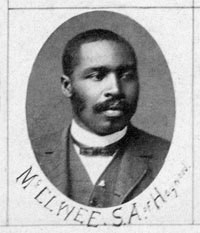
Samuel A. McElwee, from composite photograph of the 45th Tennessee General Assembly, House of Representatives, 1887-1888.
The most famous Central Tennessee alumnus was Samuel A. McElwee (1859-1914), one of the earliest black members of the Tennessee House of Representatives. He served three terms (1883-1888) and was nominated for Speaker of the House in his second term. Although he did not win the position, he did receive all the Republican votes in a Democrat-controlled General Assembly. A powerful voice for fair treatment of blacks, he delivered a nominating speech for the vice-presidential candidate (William R. Moore) at the 1888 Republican National Convention. Surprisingly, McElwee told a biographer in 1902 that his color had not been an obstacle to his law practice, and that he had received due recognition from judges and the legal fraternity in general. Another Central Tennessee alumnus, George L. Vaughn, would later convince the Supreme Court (in Shelley v. Kraemer, 1948) to declare that courts could not enforce real estate covenants that restricted the purchase or sale of property based on race.
Although Tennessee passed the first anti-Ku Klux Klan law in 1865 – a law which is still on the books – it was also one of the first states to enact a Jim Crow (segregation) law. Chapter 130 of the Acts of Tennessee (1875) permitted discrimination in public places, from hotels and theaters to trains and streetcars. Among many other constraints on African American liberties, Jim Crow law and custom militated against black professionals, including lawyers. It was soon literally impossible for blacks to study law in the state because no black law schools existed in Tennessee after 1903, and a 1901 statute forbade teaching both races in the same school, public or private. By 1910 only one or two African Americans received law licenses each year in Tennessee.
· James C. Napier, Colored American Newspaper, Washington, D.C., 2 Nov 1901, p. 1
Probably the two best-known black lawyers during that era were James C. Napier and Robert L. Mayfield, who represented widely different roles African American lawyers were likely to play in the profession. Napier (1845-1940) was a protégé of accommodationist Booker T. Washington, who promoted advancement of the race by working quietly within the system. Napier was rewarded with one of the nation’s top patronage positions available to blacks: registrar of the United States Treasury (1911-1913) under President William H. Taft. J. C. Napier was not exclusively an attorney. His business ventures included banking and street railways, and at one time he was a trustee of three black colleges. On the other hand, the legal career of Robert Mayfield (1874-1921) consisted almost entirely of litigations against Jim Crow laws and practices. Unfortunately, his work was flawed by technical errors, and he was blamed for mishandling an important 1905 suit against the L&N Railroad Company regarding racial discrimination. Quite unlike the highly principled Napier, Mayfield led a rather dissolute life and was ultimately disbarred in 1919.
· Jubilee Hall, Fisk University, Historic American Buildings Survey. Retrieved from the Library of Congress <www.loc.gov/item/tn0017/>
By the 1920s both races had come to regard African American lawyers as marginal to the legal system. Black attorneys tended to be entrepreneurs who sold insurance and real estate, and who promoted such shady public entertainments as boxing matches. Of the nine black lawyers living in Nashville in 1920, only four were practicing their profession full-time.
There were, however, exceptions. The prototypical “new” lawyer – college educated and law-school trained – was Walter W. Walker (1895-1948), who opened his Nashville practice in 1928 and soon became president of the local NAACP chapter. Among other efforts, he filed a lawsuit to equalize teacher pay, thus becoming the first actual civil rights attorney in Nashville.
Previously published in David C. Rutherford, Bench and Bar II, Nashville Bar Foundation, 1981. Used by permission of the author.
On January 25, 1866, four young men were hanged in the yard of the Tennessee State Prison, located on Nashville’s Church Street. They were known as the Hefferman (Heffernan in some sources) killers. The oldest was 20, two were 17, and the youngest, who was so small that he bragged his hanging would not succeed, was only 16.
Two officials stand on a gallows.
This is the story of public executions in Nashville. The practice was ended in 1883, for a rather surprising reason. Too many people were being injured by the crowds that attended hangings, which had turned from being solemn religious occasions to festive events that included public drinking. It was Victorian manners, rather than morals, that ended public executions in the state.
Slaves had been hanged for murder in Tennessee from the beginning, but the first white hanging in Nashville took place on December 29, 1801, when Henry Baker was hanged for horse stealing. The highest court in the state, which included Andrew Jackson, affirmed the sentences of three other horse thieves, who were hanged together on June 25, 1802, on Rutledge Hill.
Nashvillians did not see many executions. The next was a dual hanging of Jacob Pickering and Stewart Thornton, murderers, on July 13, 1811. John Lusk, also found guilty of murder, was hanged on June 26, 1820. It was more than two decades later that two more men were executed in Nashville: slaves named Jacob Bedford and Dick Dyer in 1842.
Thousands attended the October 2, 1843, triple hanging of murderers Willis Carroll, Archibald Kirby, and Zebediah Payne. By that time newspapers were widely available, and enough Middle Tennesseans could read to draw a crowd to the event. The hangings were discussed for decades because Kirby, who vigorously protested his innocence, had been convicted of killing a young woman based on circumstantial evidence. And his “innocence” was confirmed to many credulous Victorians after a young woman who witnessed the execution fell into a swoon and died two days later.
By the middle of the 19th century, execution had become a fervent religious occasion. Well-known clergy vied to preach a sermon from the gallows, and the condemned man typically made an impassioned statement exhorting the crowd to live a proper life. The lesson was meant for slaves, as well, for the March 17, 1852, execution of Alec, Jerby, and Bob (their surnames were not published) involved vigorous preaching on the evils of disobeying one’s master, as well as criminal wrongdoing.
No other executions took place in Nashville until October 21, 1865. This was the most famous trial and execution in Nashville history. Confederate guerilla Champ Ferguson boasted he had killed 100 men during the war. A military tribunal convicted him of the wanton killing of eleven. One victim was lying in a hospital bed when Ferguson entered his room and shot him in the head. Ferguson’s hanging took place in the courtyard of the Church Street prison in front of 300 people, who had been given passes to attend.
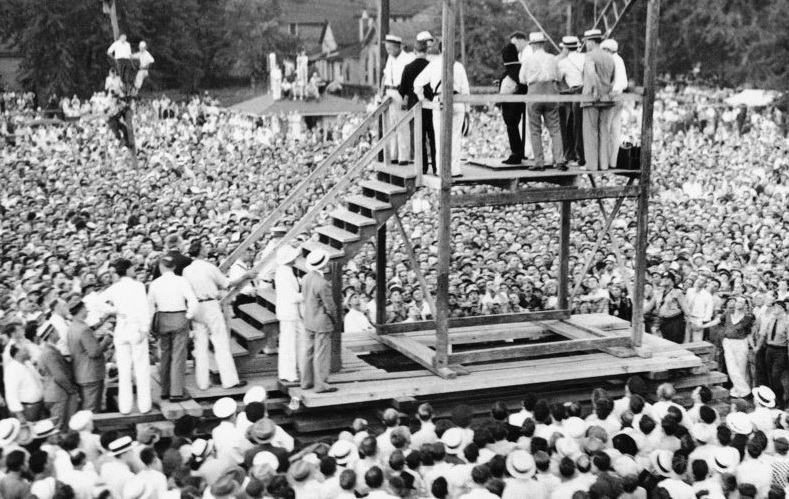
Crowd at a public hanging (AP photo)
The execution of the Hefferman killers the following year (January 25, 1866) was somewhat related to Ferguson’s. The four teenage thugs had robbed and killed an elderly and well-respected Nashville railroad contractor as he rode home one night in a carriage with his family. Because the killers were civilian employees of the Union Army, their case was decided by a military tribunal and approved by Gen. George H. Thomas, commander of U.S. forces in Tennessee. The swaggering youngsters expected to the end that they would be reprieved, but President Andrew Johnson denied their appeal, and the post-Civil War federal authorities needed to demonstrate that they could serve even-handed justice to all. Fifteen thousand people attended the execution. The military denied applications from whiskey, candy, and apple vendors to sell refreshments to the crowd.
The next public execution took place on May 9, 1874, when African American rapist Bill Kelly was hanged before a crowd of ten thousand people. The Reverend Nelson Merry, the most famous black minister of the time, delivered a homily and a prayer, after which Kelly said, “Jesus is with me. I am ready to be offered up. I am ready to die – hear me: I am prepared to die. I have religion and I don’t fear death. I’m going home.” At the moment the trap sprung, the crowd surged forward, and hundreds were injured (most not seriously), as a 50-member guard fixed bayonets and drew pistols. All of Nashville’s “fallen women,” dressed in their best and seated in lavish carriages, witnessed the execution.
The last truly public execution came on March 28, 1879, when Knox Martin, known as the Bell’s Bend Killer, was executed before a crowd of at least ten thousand, including parents who had taken their children out of school to attend. Martin had become a Catholic in the weeks before his death, and the homily was delivered in Latin before a disappointed crowd. A passing train spooked some of the horses and someone fired a pistol in the excitement. The bullet struck a young woman in the leg, causing another stampede. No one was seriously injured in the melee, although, in a similar incident in Memphis, a carriage turned over, killing a spectator.
It was clear that public executions were becoming too rowdy and dangerous. Part of the blame could be assigned to false science – Knox Martin had given doctors and medical students permission to conduct an experiment that would attempt to bring him back to life. The moment his body was taken from the scaffold, it was hurried to a nearby shed and connected to electrical batteries. The body jerked convulsively but did not come to life. Undeterred, doctors at the University of Nashville Medical School continued the experiments for some time.
Plainly stated, throngs of people were coming to public executions hoping to see both a death and a resurrection. The event had become a circus of death.
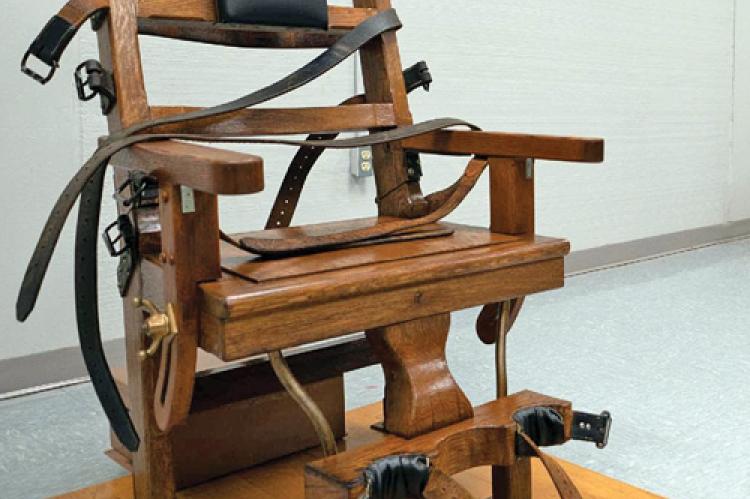
After 1883 executions in Tennessee were no longer public. New laws required them to be quasi-private, so gallows were constructed in such a way that the public was barred from seeing the actual drop. The law was amended to require the hanging to take place inside a jail or jail courtyard, viewed by only a select group of witnesses that did not include the victim’s family. Finally, in 1909, all executions were moved to the main prison in Nashville, and in 1916 the mode of execution was changed from the gallows to the electric chair.
Electric chair
Previously published in David C. Rutherford, Bench and Bar II, Nashville Bar Foundation, 1981. Used by permission of the author.
We would be remiss if we neglected to mention some of the quiet heroes who provided support to the protests with their time, money, and encouragement. Among the most generous were two Nashville couples – Dr. Charles and Mary Celeste Richardson Walker, and Dr. McDonald and Jamye Coleman Williams.
Georgia native Charles Julian Walker (1912-1997) earned his M.D. from Meharry in 1943 and opened a medical office in Nashville four years later. So devoted was he to his practice, he once agreed to see a patient when he was hospitalized himself! Deeply committed to the civil rights movement, he worked tirelessly behind the scenes, pressuring local leaders to take immediate action after the bombings of Hattie Cotton School (1957) and the Looby home (1960). He and his wife also quietly posted bail for many of the students arrested during the sit-ins. Walker served briefly in the Tennessee House after being appointed to fill a vacancy in his district, and he was a Fisk University trustee during the 1970s, encouraging the university to become more accountable to the community. According to his longtime friend, Tennessee Supreme Court Chief Justice Adolpho A. Birch, he was “fierce” and relentless in urging politicians and businessmen to invest in struggling low-income communities and to expand and diversify the work force. An outspoken champion of prison reform, he was a tireless advocate for prisoners’ rights. Although Dr. Walker was known for his energy and optimism, the loss of his beloved wife Mary in 1994 sent him into a downward spiral from which he never fully recovered.
Mary Celeste Richardson Walker (1910-1994) demonstrated a lifelong concern for social justice. Her parents divorced when she was a toddler, and she grew up in the home of her grandparents, Fire Captain Reuben B. Richardson and his wife. She attended Nashville city schools and earned bachelor’s and master’s degrees from Fisk University. When Dr. C.J. Walker met her in early 1942, he was immediately smitten. The Meharry graduate promptly proposed, and the couple married, as Walker liked to say, “five weeks after I first laid eyes on her.” That fall Mary began a 30-year career teaching English at Pearl High School, where she earned a reputation for being tough but fair, showing particular concern for disadvantaged and at-risk students. She and her husband shared a strong commitment to supporting the young civil rights demonstrators in Nashville, providing generous financial and moral support to the movement. Shortly after Mary retired from teaching, Governor Lamar Alexander appointed her to the state parole board, where her even-handed approach to the situations they faced won the profound respect of both inmates and judicial authorities. A member of Church Women United, educational advisory boards, and other civic organizations, she was a trustee of Scarritt College, as well as a lifetime member of the NAACP.
A native of Pittsburgh, Pennsylvania, McDonald Williams (1917-2019) came to Nashville with his wife Jamye Coleman Williams in 1958, he as an English professor specializing in 19th century English literature, and she as chair of the Tennessee State University Communications Department. When TSU initiated its Honors Program in 1964, Mac Williams was appointed director, serving in that position until his retirement in 1988. Together the couple edited the A.M.E. Church Review and The Negro Speaks: The Rhetoric of Contemporary Black Leaders, and they provided valuable support to Nashville’s civil rights activities. The Williamses received many awards for their service, including the Otis L. Floyd Jr. Award from Saint Bernard Academy, the Joe Kraft Humanitarian Award from the Community Foundation of Middle Tennessee, and the Human Relations Award from the National Conference of Christians and Jews. In 1995 a room in the newly remodeled Northwest YMCA building was dedicated to Dr. Williams, a longtime board member. He died in Atlanta at age 101.
Jayme Coleman Williams with husband Mac (photo courtesy of The Community Foundation of Middle Tennessee)
The daughter of a Kentucky minister, Jayme Coleman (1918-2022) earned a B.A. with honors from Wilberforce University at age 19 and an M.A. from Fisk the following year. She taught English at Wilberforce and three other HBCUs before earning a doctorate in speech communications at Ohio State University. In 1959 she began teaching at Tennessee State University, and she was named department head in 1973. She and her husband, educator McDonald Williams, were valuable organizers and supporters of the Nashville sit-in movement, later playing an active role in the development of the Community Foundation of Middle Tennessee, where their efforts earned them the Joe Kraft Humanitarian Award of the CFMT in 2002. A lifelong member of the A.M.E. Church, Jamye Williams was a member of the board of the United Council of Churches, president of the 13th District Lay Organization, and editor of the AME Church Review, the oldest African American literary journal. A member of the NAACP Executive Committee, she received the organization’s Presidential Award in 1999. She lived to be 103 years old.
You might enjoy these two short video clips of an interview with McDonald and Jamye Coleman Williams: A. and B.
The Civil Rights Movement in Nashville was led, for the most part, by college students and their instructors in the techniques of nonviolent protest. The Nashville sit-ins became a model for many other successful desegregation efforts across the nation. However, working in the background to support the protestors were some remarkably gifted individuals. Lawyers, journalists, educators, and many other local citizens donated their time and their skills to support the movement.
Z. A. Looby (from Tennessee Portrait Project)
Attorney Z. Alexander Looby (1899-1972), who became a powerful force behind the protestors, came to the U.S. from Antigua at 15. He earned degrees from Howard (A.B., 1922), Columbia (LL.B., 1925), and NYU (J.D., 1926). Following his move to Nashville, he taught economics at Fisk University, passed the Tennessee bar, and became legal director of the NAACP. In 1946, when Thurgood Marshall came to Columbia, Tennessee, to represent 25 black citizens after an outbreak of racial violence, he requested Looby’s help in mounting their defense. They successfully won acquittals for nearly all of them. After State Senator Ben West, soon to become mayor of Nashville, guided a charter reform bill through the General Assembly, which allowed voters to elect city council members from individual districts, rather than choosing all of them at large. As a result, in 1951 local black residents were able to elect the first two African American council members since 1911 – attorneys Z. A. Looby and Robert Lillard. Five years later Looby and Avon Williams were the plaintiff’s attorneys in Kelley v. Nashville Board of Education, which ultimately ended Nashville school segregation. Looby, Williams, Robert Lillard, Coyness Ennix, and Adolpho Birch led the volunteer legal team for student protesters during the 1960 Nashville sit-ins. When Looby’s house was dynamited in April 1960, nearly 3,000 demonstrators marched to the court house to confront Mayor Ben West, whose unprecedented support soon (May 10 1960) ended lunch counter segregation in Nashville. By October, Looby’s legal team managed to have all the charges “for conspiracy to disrupt trade and commerce” dismissed against 91 student protesters. Looby was a city/Metro councilman for 20 years and a founder of Kent College of Law.
Avon N. Williams Jr. (courtesy of Williams family)
Looby’s partner in many of his precedent-setting legal events was his former intern, Avon Nyanza Williams Jr. (1921-1994). A native of Knoxville, Williams earned an L.L.B. (1947) and an L.L.M. (1948) from Boston University. After interning with Looby in Nashville, he set up a law practice in Knoxville, often working closely with the NAACP Legal Defense Fund. Williams filed Tennessee’s first school desegregation case (Anderson County, 1950), and his lawsuit to admit African American students to the UT graduate school (1951) was one of seven discrimination cases he argued before the U.S. Supreme Court. In 1953 he moved to Nashville, partnered with Looby, and took an active (and mostly unpaid) role in civil rights cases ranging from lunch counter and school desegregation to housing discrimination. A founder of the Davidson County Independent Political Council and the Tennessee Voters Council, he was one of Tennessee’s first two African American state senators, serving from 1969-1990. His lawsuit to merge UT Nashville with TSU led to a landmark legal decision and the renaming of the downtown campus after him.
The attorneys in court: front row from left, Adolpho Birch, Robert Lillard, Coyness Ennix, and Avon Williams (Nashville Banner Archives, Special Collections, Nashville Public Library)
Alabama teenager Coyness Loyal Ennix Sr. (1901-1984) came to Nashville to attend Roger Williams University. Later, having graduated from Howard University Law School (1931), he returned to Nashville, where he and Z. Alexander Looby founded Kent College of Law to train other African American attorneys. Known for his flamboyant style of dress, Ennix was well known as a civic and political leader in Nashville’s black community. In the late 1940s he founded The Solid Block, a political organization which helped abolish Tennessee’s poll tax and supported African American candidates. Ennix himself ran for City Council (1951) but lost to Looby and Robert Lillard, Nashville’s first black councilmen in 40 years. Ennix was the first African American to serve on the Nashville Housing Authority and the Nashville Auditorium Commission. He was also the first black member of the Board of Education, serving during the arduous school desegregation process. One of thirteen volunteer defense attorneys for students arrested during the February 1960 Nashville Sit-ins, he was an active member of First Baptist Church, Capitol Hill, site of many Civil Rights training sessions.
Robert E. Lillard (photo courtesy of African American Registry)
Commercial college graduate Robert E. Lillard (1907-1991) worked as a garage attendant in order to take night classes at Kent College of Law, while also organizing the 15th Ward Colored Voters and Civic Club. After being admitted to the bar (1936), he opened a law practice and drove a fire truck for Engine Company No. 11. In 1951, ignoring bribes and threats, he ran for city council, joining Alexander Looby as the first black council members since Solomon Harris (1911). During his 20 years of service, Lillard never missed a regular council meeting. He assisted in desegregating the Parthenon and helped make Cameron High School the city’s second African American secondary school, and he joined other black lawyers volunteering their legal services during the 1960 sit-ins. The first African American vice mayor pro tem (1967), he was admitted to plead in the U.S. Court of Appeals, Sixth Circuit Court, and U.S. Supreme Court, and he served as judge of the First Circuit Court, Tenth Judicial District.
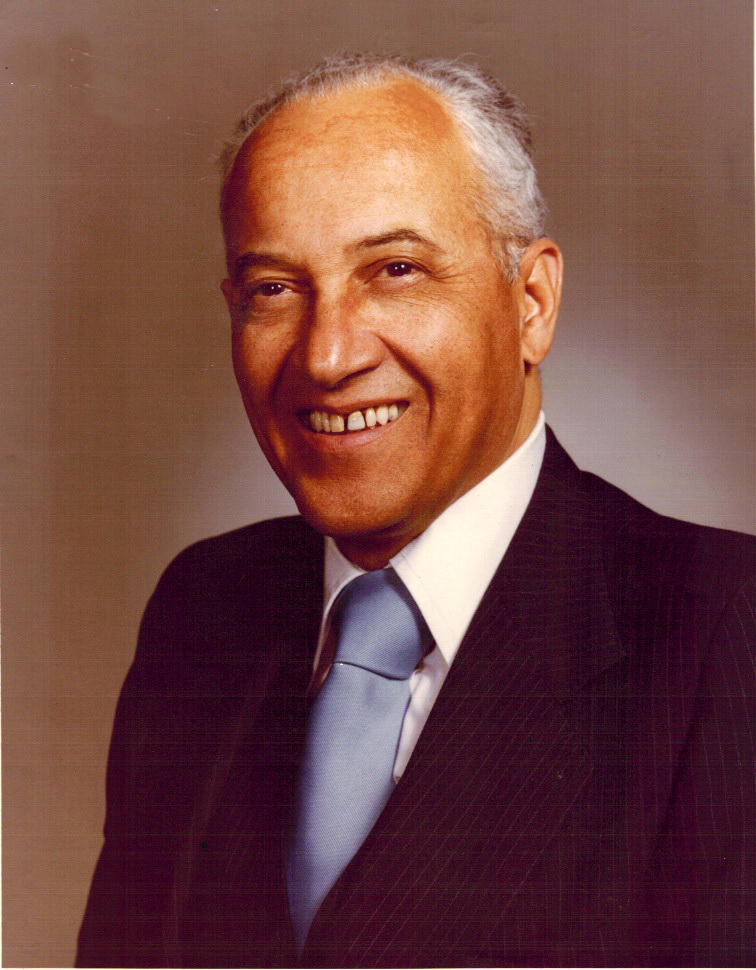
Chief Justice Adolpho A. Birch Jr.
Adolpho A. Birch (1932-2011), the son of an Episcopal priest, grew up in Washington, D.C., and earned both his B.A. and J.D. from Howard University. During his term of service in the U.S. Navy, he studied for and passed the bar exam (1957), a year before his honorable discharge. After moving to Nashville (1958), he opened a private law practice with Robert Lillard, also teaching law courses at Meharry Medical College, Fisk University, and Tennessee A&I (now Tennessee State University). He was part of the volunteer legal team who defended student protestors during the Nashville Sit-ins. He was named assistant public (1963); assistant district attorney (1966 – the first black prosecutor in Davidson County); General Sessions Court judge (1969); Criminal Court judge (1978); and first black presiding judge over the Trial Courts of Davidson County (1981, the same year he became an instructor at the Nashville School of Law). The only person, black or white, to serve in every level of the Tennessee judiciary system, he was appointed to the Court of the Judiciary (1983) and the Tennessee Court of Appeals (1987). In 1990 he became only the second African American to sit on the Tennessee Supreme Court. Four years later his fellow justices selected him as Chief Justice (October 1994-May 1996), making him the first African American to hold that position. After being confirmed for another eight-year term, he again served as Chief Justice (July 1997-August 1998 and September 1999-August 2001). He retired at the end of his second term (September 2006). He received many awards during his years of service, including a Lifetime Achievement Award from the American Civil Liberties Union of Tennessee, who called him a “beacon for equality.” He died of cancer on August 25, 2011. The Davidson County Criminal Courts now meet in the A. A. Birch Criminal Justice Building, dedicated in his honor in 2006.
Robert Churchwell Jr. (photo courtesy of Afro-American Historical & Genealogical Society)
It was not only attorneys who assisted the protestors in the Nashville civil rights movement. Newsman Robert Churchwell Sr. (1917-2009) graduated from Pearl High School (1940) before being drafted (1942) and assigned to a WWII engineering unit. Suffering terribly from misdiagnosed PTSD, he graduated from Fisk in three years by attending both Fisk and Tennessee A&I. His earliest publishing attempts were unsuccessful, but they eventually brought his talents to the attention of the Nashville Banner editor, a racial separatist who disdained African Americans but realized he needed to sell papers in the black community for economic reasons. When Churchwell reluctantly took the job writing “Negro news,” he became one of the first black journalists on any white Southern municipal newspaper. He had to carry his stories into the news office from home – he worked there for five years before he had a desk in the newsroom. He authored articles about Nashville school desegregation, interviewing both black and white educators, and he covered the 1960 sit-ins, but the Banner refused to publish stories about the protests. After Churchwell’s 1981 retirement, his pioneering efforts finally won appropriate recognition, including the establishment of Nashville’s Robert Churchwell Museum Magnet Elementary School (2010).
A significant number of the participants in the Nashville Sit-ins became nationally known as heroes in the protest movement that would ultimately bring about the Civil Rights Acts of 1964 and 1968, the Voting Rights Act of 1965, and the desegregation of schools, neighborhoods, institutions, sports teams, and businesses across the nation. Many were high school and college students at the time of the protests. Others were leaders in the local community who played significant roles either by assisting in the non-violence training of the young heroes or in volunteering to defend them in court. And still others provided quiet but valuable support behind the scenes.
A key figure in preparing young protesters for the hardships they were likely to face was Kelly Miller Smith Sr. (1920-1984). A Mississippi native, Smith studied at Tennessee A&I before transferring to Morehouse College, where he earned a degree in religion in 1942, followed by a Bachelor of Divinity from Howard University (which awarded him an honorary doctorate in 1976, as well). By 1946 he was preaching in Vicksburg, Mississippi. In 1951 he became pastor of Nashville’s First Colored Baptist Church, Capitol Hill. He was president of the local NAACP chapter and joined other local black parents in the 1955 federal lawsuit to desegregate Nashville public schools. A steadfast advocate of nonviolence, Smith founded the Nashville Christian Leadership Council and offered his church as a training center for nonviolent protest in the months leading up to the Nashville sit-ins. In 1969, in a stunning reversal of Vanderbilt University’s earlier policies regarding the desegregation movement, Kelly Miller Smith was chosen to serve as assistant dean of Vanderbilt Divinity School. Widely honored for his leadership, he was a Merrill Fellow at Harvard Divinity School, sat on the board of the Southern Christian Leadership Conference, and delivered the 1983-84 Lyman Beecher Lectures at Yale University.
Historic marker from Uniontown, Pennsylvania, James Lawson’s birthplace
Smith worked closely with other community leaders of the Civil Rights Movement, including a brilliant young divinity student, James Lawson, whom Martin Luther King Jr. had called “the leading strategist of non-violence in the world.” A native of southwestern Pennsylvania, Lawson received a Bachelor’s degree from Baldwin-Wallace College (now University) near Cleveland, Ohio; spent a year in prison for resisting the draft; and traveled to India as a Methodist missionary. In India he studied Gandhi’s use of nonviolence as a tool to achieve social and political change. Returning to the U.S. in 1956, he continued his theological studies at Oberlin College. In 1957 he met Dr. Martin Luther King Jr., who encouraged him to use his nonviolence training to instruct civil rights workers in the South. Lawson transferred his studies to Vanderbilt University and put together a series of workshops on nonviolence for community members. Student leaders at Nashville’s four black colleges used what they learned in these workshops to organize the highly disciplined lunch-counter sit-ins that began on February 13, 1960 and became the model for nonviolent protests across the country. More than 150 student demonstrators were jailed, and in March 1960 James Lawson was expelled from Vanderbilt for his involvement in desegregation activities. The Dean of Vanderbilt’s Divinity School, along with a number of other faculty members and students, resigned in protest of Lawson’s expulsion, but the university ignored their objections. Later that same year Lawson received his Bachelor of Sacred Theology degree (STB) from Boston University.
Nashville Mayor Ben West showed a greater willingness than most Southern politicians to listen to the students’ demands for change. In a highly publicized confrontation on the courthouse steps on April 19, 1960, he gave his support to the protesters, and on May 10, 1960, six Nashville stores desegregated their lunch counters.
Lawson joined the Nashville students and others in organizing the Student Nonviolent Coordinating Committee (SNCC) that April. He was co-author of the organization’s Statement of Purpose: “We affirm the philosophical or religious ideal of nonviolence as the foundation of our purpose, the presupposition of our faith, and the manner of our action. Nonviolence as it grows from Judaic-Christian traditions seeks a social order of justice permeated by love” (Lawson, 17 April 1960). He also participated in the Fellowship of Reconciliation, the Southern Christian Leadership Conference, and the 1961 Freedom Rides. He encouraged Martin Luther King Jr. to travel to Memphis to help bring national attention to the sanitation workers’ strike in that city. Dr. King mentioned Lawson by name in his “I’ve Been to the Mountaintop” speech (Memphis, 1968): “James Lawson . . . has been in this struggle for many years; he’s been to jail for struggling; but he’s still going on, fighting for the rights of his people.” The following day Dr. King was assassinated.
James Lawson was pastor of Holman United Methodist Church in Los Angeles from 1974-1999 and has continued to be active in his support of the labor movement, as well as programs supporting gay rights and reproductive choice. Not only did Vanderbilt University finally issue a long-overdue apology for his expulsion, but they invited him to return to the campus as a Distinguished University Professor. In the fall of 2021, the university opened the James Lawson Institute for the Research and Study of Nonviolent Movements, with the stated purpose of hosting “public workshops, seminars, and learning opportunities to train the next generation of community organizers equipped with the skills to make meaningful, sustainable change.”
It would probably be impossible to name all the participants in the Nashville sit-ins and other local civil rights activities. The largest number of them were students at American Baptist College, Fisk University, Meharry Medical College, or Tennessee State University (known then as Tennessee A&I), or at local high schools. Active participants in the Nashville Student Movement included Marion Barry, James Bevel, Maxine Walker Giddings, Luther Harris, Bernard Lafayette, James M. Lawson Jr., Paul LePrad, John Lewis (later a U.S. congressman from Georgia), Earl May, Diane Nash, Novella Page, Rev. Kelly Miller Smith, C. T. Vivian, Matthew Walker Jr., and Jim Zwerg.
In 1961, in the face of a Board of Regents policy, fourteen students from Tennessee Agricultural & Industrial State University were expelled from school for their participation in civil rights activities. At the time of their expulsion, the young Freedom Riders were in jail in Mississippi for riding a bus, which also carried white passengers, across state lines. Forty-seven years later, on September 18, 2008, those fourteen students were awarded honorary doctoral degrees by the school, now known as Tennessee State University. Three of them had died by the time of the ceremony and were granted their degrees posthumously.
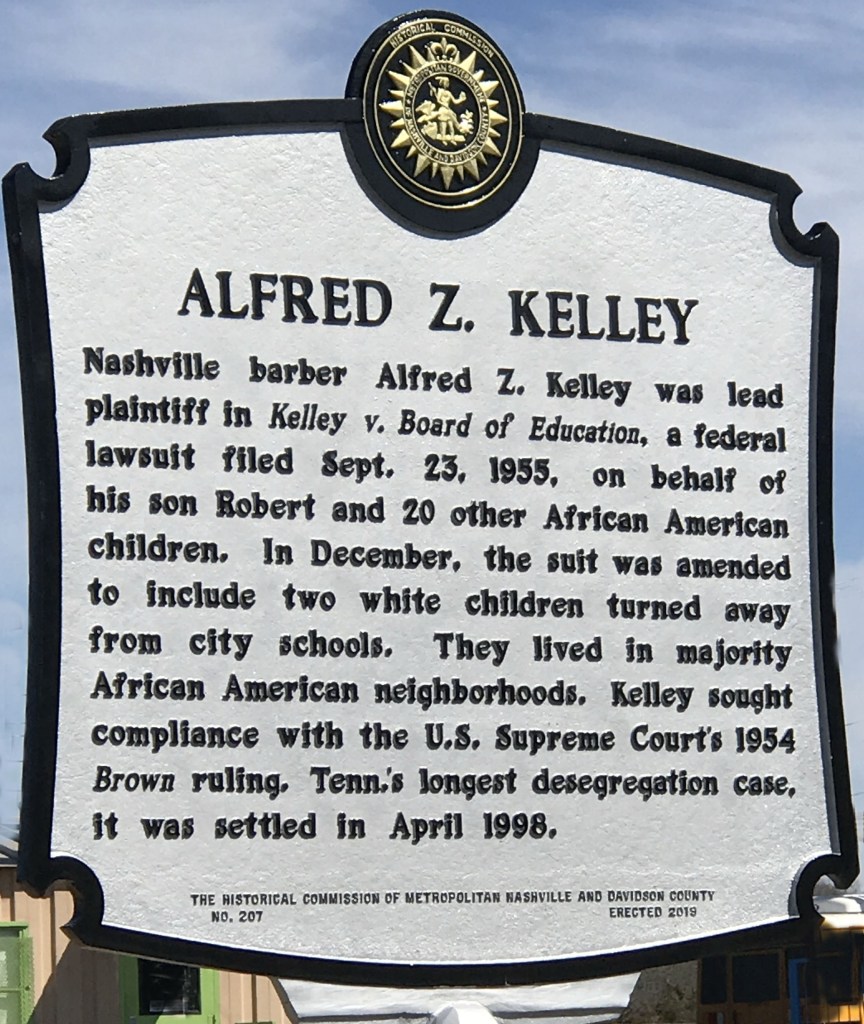
Metro Historical Commission marker for Alfred Z. Kelley, erected 2019
Another community member who quietly joined the fray was Alfred Z. Kelley (1913-1994). He returned to Nashville after service in the U.S. Navy during World War II, opened Kelley’s Barber Shop, taught a few classes at Bowman’s Barber College, sang in his church choir, and became the first black secretary of the local barbers’ union. He and his wife Robbie had four children they adored, and they were delighted when the Supreme Court ordered the schools to desegregate because they lived within walking distance of a previously segregated junior high school. But when Robert, their 14-year-old, was turned away from East Junior High and sent across town to Pearl Junior High, A. Z. Kelley agreed to become the lead plaintiff in a 1955 lawsuit, representing his son and twenty other youngsters who had been barred from attending East and other Nashville city schools. Kelley’s attorneys were Z. A. Looby and Avon N. Williams Jr., assisted by Thurgood Marshall, who would become the first African American Supreme Court Justice in October 1967. By the time Kelley v Board of Education, Tennessee’s longest-running school desegregation case, was finally settled in 1998, Kelley and all three of the attorneys had died. During the period when the case was under litigation, Kelley became even more deeply involved in political and civil rights activities: he participated in the 1963 march on Washington, held the position of president of the local NAACP chapter, and served as Sergeant-at-Arms of the Tennessee State Senate.
1966 Jan 13Robert Clifton Weaver, nominated by President Johnson to be Secretary of the Department of Housing and Urban Development, is the first African American named to a presidential cabinet.
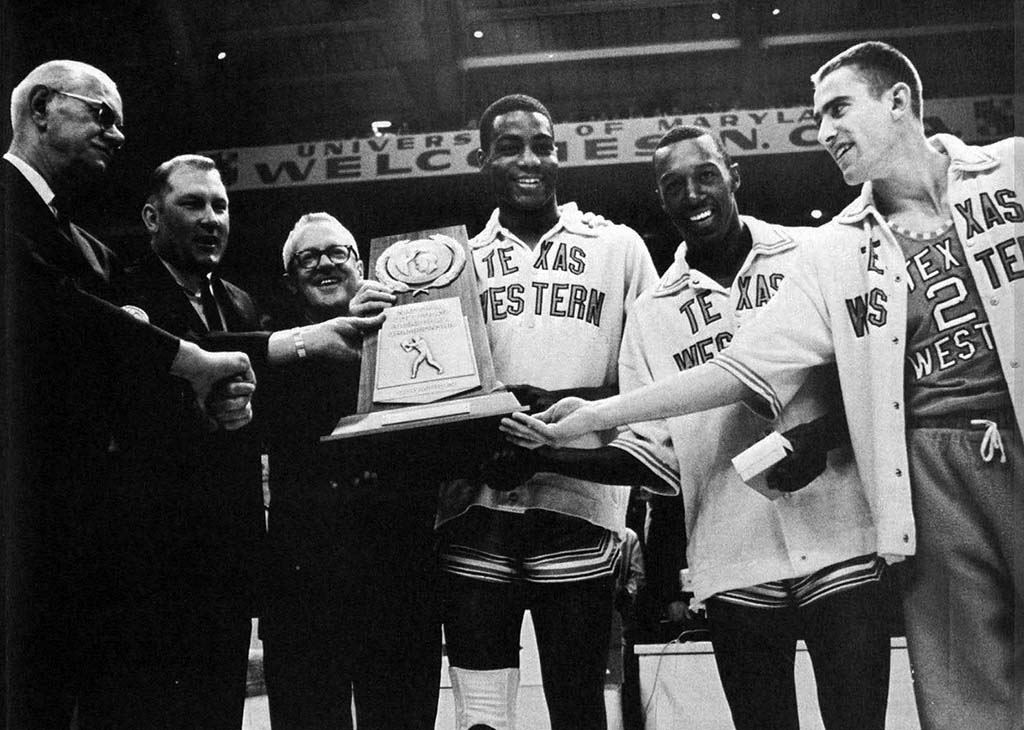
Texas Western team members with national championship trophy, 1966 (photo from UTEP yearbook)
1966 MarTexas Western College (now called University of Texas at El Paso), with its all-black starting line-up, defeats the powerful University of Kentucky team to win the NCAA championship. The game is the inspiration for the 2006 film Glory Road. The entire team is inducted into the Basketball Hall of Fame in 2007.
1966 Jun 16SNCC leader Stokely Carmichael rallies a crowd in Greenwood, Mississippi, with the cry, “We want black power!” Martin Luther King’s concerns that the phrase carries “connotations of violence and separatism” are borne out by splits in the civil rights movement between those favoring the use of nonviolent methods and those leaning more toward conventional revolutionary tactics like armed self-defense and black nationalism.
1966 Fall In college football, Jerry LeVias, a student at Southern Methodist University, is the first black scholarship athlete in the Southwest Conference. African-American athletes Greg Page and Nate Northington join the University of Kentucky football team. When Page dies after a blow to the back during practice, Northington transfers to Western Kentucky University, which integrated its classes in 1956 and has fielded black players since 1963.
1966 Fall Seven African-American students attend Vanderbilt University. Among them is Nashville native Perry Wallace, the first African-American basketball scholarship student and player in the SEC. Although Wallace would play for only three years (1968-1970), he remains the school’s second leading rebounder.
1966 Oct The militant Black Panther organization is founded in Oakland, California, by Huey Newton and Bobby Seale.
1966 Nov 8Edward W. Brooke, a Massachusetts Republican, becomes the first African American elected by popular vote to the U.S. Senate.
1967 In the worst summer of racial violence in the nation’s history, more than 40 riots and 100 other upheavals occur across the country. The most destructive take place in Newark (July 12-16) and Detroit (July 23-30).
1967 Jun 12 In Loving v. Virginia the U.S. Supreme Court unanimously declares Virginia’s anti-miscegenation law unconstitutional, thus prohibiting all legal marital restrictions based on race.
1967 Aug 30 Judge Thurgood Marshall, appointed by President Lyndon B. Johnson, is confirmed by the Senate as the 96th Supreme Court Justice. He becomes the first African American to serve on the Supreme Court.
1967 FallWilbur Hackett Jr. joins the University of Kentucky football team. He will become the first African-American team captain in the SEC two years later.
1967 NovCarl Stokes, Cleveland, Ohio, becomes the first African American to be elected mayor of a major U.S. city.
1968 Feb 12 Demanding better pay and working conditions, job equality with white workers, and city recognition of their union, 1300 black sanitation workers in Memphis walk off their jobs. Although 500 white workers march with them, they get little support from the community and ask Martin Luther King to support their cause.
1968 MarWinston-Salem State University becomes the first black college to win an NCAA basketball championship.
1968 Apr 4Martin Luther King Jr. is assassinated in Memphis. Violence breaks out in cities across America. James Earl Ray confesses to the murder, but later recants, working until the end of his life to clear his name, supported even by members of the King family who doubt his guilt. The mayor of Memphis, fearing further violence, agrees to recognize the sanitation workers’ union, permits a dues check-off, grants them a pay raise, and introduces a system of merit promotions.
1968 Apr 11 President Lyndon B. Johnson signs the Civil Rights Act of 1968, also known as the Fair Housing Act, prohibiting discrimination in the sale, rental, and financing of housing on the basis of race, religion, national origin, or sex. On the same date,
1968 Apr 11 On the same date, President Johnson also signs the Indian Civil Rights Act of 1968, granting Native American people full constitutional access. Prior to this date, the Bill of Rights has not applied to those living on tribal lands. Now, for the first time, Native Americans are guaranteed the right to trial by jury, along with freedom of religion, freedom from unlawful imprisonment, and all other privileges granted to citizens under the Bill of Rights.
1968 Jun 5 Presidential candidate Robert F. Kennedy, on the night of his victory in the California Democratic Primary, is shot to death in Los Angeles by Sirhan Sirhan, an Arab nationalist.
1968 SummerArthur Ashe wins the U.S. Open in tennis. He will go on to win the Australian Open in 1970 and the Wimbledon championship in 1975.
1968 FallLester McClain becomes the first black athlete on the University of Tennessee football team. Two years later he will be joined by African-American quarterback Condredge Holloway.
1968 Sep 17 With the premiere of Julia, Diahann Carroll becomes the first African-American woman to star in a television series in which she does not play a domestic servant. In 1962 Carroll was the first black performer to win a Tony Award, for her performance in the musical No Strings.
1968 Nov 5Shirley Chisholm, a Democrat from New York, is the first African-American woman elected to Congress. Republican Richard Nixon defeats Hubert Humphrey by a narrow margin to become President.
1969 JanAvon N. Williams Jr. (Nashville) and J. O. Patterson Jr. (Memphis) take their seats as the first two African American candidates ever popularly elected to the Tennessee State Senate.
1970 Sep 12 USC fullback Sam “Bam” Cunningham’s stellar performance against the all-white Alabama team opens the door for Alabama coach Bear Bryant to recruit black players. In fact, Wilbur Jackson, watching the game from the stands, has already been offered a scholarship to Alabama, although most fans are still unaware of his status. NCAA rules make him ineligible to play as a freshman.
1970 DecPerry Wallace, Vanderbilt basketball star, is named to the All-South-Eastern-Conference team and wins the Sportsmanship trophy after a vote by league players.
1971 Jan 12All in the Family begins its eight-year run. The number-one TV sitcom for five years, the show generates a number of other programs that deal with race relations and other controversial subjects in realistic and humorous ways.
Archie and Lionel in the blood bank episode, All in the Family, 1971
1971 Apr 20 In Swann v. Charlotte-Mecklenburg Board of Education, the Supreme Court moves to end de facto segregation in schools where segregation occurs as a consequence of neighborhood segregation and proximity to schools, even when the schools themselves have no policy requiring segregation. The solution in most cases is to reassign students and to bus them to the newly integrated schools. Although the plan is met with disfavor and sometimes violence, court-ordered busing will continue in some cities until the late 1990s.
1971 Fall The University of Alabama, one of the last schools to integrate its athletic teams, recruits John Mitchell, who will become both co-captain of the football team and an All-American the following year.
1972 Sep For the first time, all grades in the Little Rock Public Schools are integrated.
1974 Sep 3 Surprisingly, the strongest opposition to enforced busing occurs in Boston. A federal court finds that Boston school districts were originally drawn to produce racial segregation; other courts rule that racially imbalanced schools are unfair to minority students and require the racial composition of each school in a district to mirror the composition of that district as a whole. Opponents of the Civil Rights Act of 1964 had worried about using forced busing to achieve racial quotas in schools, Senator Hubert Humphrey insisting “it would be a violation [of the Constitution], because it would be handling the matter on the basis of race and we would be transporting children because of race.” When Boston schools open in 1974, police in riot gear accompany the buses. Some black children face abusive language and a storm of rocks and bottles as they enter their schools.
1975 During the late 1960s Native American activists have begun to take a more aggressive stance, leading to the occupation of Alcatraz (1969-1970), the development of the American Indian Movement (AIM, 1968), and a violent encounter at Wounded Knee, South Dakota (1973), following a series of fierce conflicts between opposing Indian factions on the Pine Ridge Reservation that have left more than 100 people dead. The shootings of two FBI agents by AIM members lead to a federal crackdown on the violence, and the organization is considerably weakened.
1977 Jan Indiana becomes the 36th and last of the 38 states required to ratify the EqualRights Amendment (ERA), which would give equal rights to women. First introduced in Congress in 1921, the amendment simply states, “Equality of rights under the law shall not be denied or abridged by the United States or by any State on account of sex.” In the face of strong opposition, led by Phyllis Schlafly and others, no other states agree to ratify, and five (Idaho, Kentucky, South Dakota, Nebraska, and Tennessee) will presently rescind their earlier ratifications.
1978 The Indian Child Welfare Act (ICWA) is enacted after the federal government becomes aware of how many Native American children are being systematically removed from their families at a much higher rate than other children – often without evidence of abuse, neglect, or other grounds for removal – and placed with non-native families. The effect, and perhaps even the intent, of these actions is to deprive the children of their native family or culture. The ICWA becomes a key component in protecting the rights and the culture of American Indian and Alaska Native families and children.
1978 Jun 26 In a controversial 5-4 decision on Regents of the University of California v.Bakke, the U.S. Supreme Court rules that racial quotas must be eliminated in education. The decision is tempered by Justice Lewis Powell’s statement (he votes with the majority but writes an opinion supporting the minority view as well): “Race can be a factor, but only one of many to achieve a balance.” Thus, affirmative action policies might continue if they are more clearly defined.
1978 Sep 29Seattle becomes the largest city in the United States to desegregate its schools without a court order. The “Seattle Plan” involves busing almost one-fourth of the school district’s students.
1979 Former governor George Wallace recants his earlier segregationist statements and apologizes to black civil rights leaders, saying, “I was wrong. Those days are over, and they ought to be over.”
1984 Jul 7 Returning from church in Bangor, Maine, Charlie Howard, a 23-year-old gay man, is beaten and kicked by three teenagers, who shout homophobic slurs before throwing him off a bridge even as he screams that he can’t swim. His body is found several hours later. He has drowned.
1989 Aug 10 General Colin Powell becomes chairman of the Joint Chiefs of Staff.
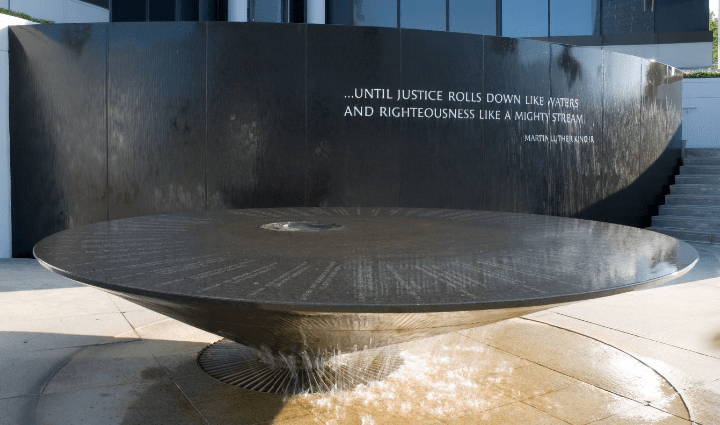
1989 Nov 5 The Civil Rights Memorial is dedicated at the Southern Poverty Law Center in Montgomery, Alabama. Designed by architect Maya Lin, it honors 41 people who died between 1954 and 1968 during the civil rights movement in the U.S.
1989 Nov 7Douglas Wilder of Virginia is elected to serve as the nation’s first African American state governor.
1991 Nov 22 President George H.W. Bush, having first threatened a veto, signs the Civil Rights Act of 1991, strengthening existing civil rights laws and providing for damages in cases of intentional job discrimination.
Screenshot from the video of LAPD officers beating Rodney King (public domain, Colorlines Screenshot)
1992 Apr 29 When a predominantly white jury acquits four LAPD officers in the beating of a black man named Rodney King, a huge riot breaks out in Los Angeles. The beating, videotaped by a bystander, combines with existing racial unrest in the city to spark five days of violence, ending only after the deployment of Federal troops. Fifty-three people die: 25 blacks, 16 Latinos, 8 whites, 2 East Asians and 2 West Asians. Approximately 3,600 fires are set, destroying 1,100 buildings. Close to 10,000 people are arrested. Stores owned by Asian immigrants are widely targeted, as are, to a lesser degree, those of whites and blacks.
1993 Oct 7 Black author Toni Morrison wins the Nobel Prize in Literature.
1994 Feb 5 In Jackson, Mississippi, thirty-one years after the 1963 shooting of Medgar Evers, Byron De La Beckwith, now 73, is finally found guilty of first-degree murder and sentenced to life in prison. In December 1997 the Mississippi Supreme Court will uphold this verdict following De La Beckwith’s appeal.
1997 Apr 2 The Tennessee General Assembly ratifies the 15th Amendment, becoming the last state in the nation to do so.
1998 Oct 7 College student Matthew Shepard, 21, is robbed, beaten, and left for dead, tied to a fence in a remote area of Wyoming by two men who have been heard plotting “to rob a gay man.” He dies on October 12 without regaining consciousness.
2000 Mar 7 In honor of the 35th anniversary of “Bloody Sunday,” Rep. John Lewis (now a U.S. Congressman from Georgia), and Hosea Williams cross the Edmund Pettus Bridge in Selma in the company of President Bill Clinton, Coretta Scott King, and several hundred others. Lewis commented, “This time when I looked there were women’s faces and there were black faces among the troopers. And this time when we faced them, they saluted.”
2000 Dec 16 President George W. Bush nominates General Colin Powell as Secretary of State. When Powell is confirmed in January, he becomes the first African American to hold that office.
2003 Jun 23 In Grutter v. Bollinger the Supreme Court rules that race can be one of many factors considered by colleges when selecting their students because it furthers “a compelling interest in obtaining the educational benefits that flow from a diverse student body.”
2005 Jan 20Condoleezza Rice succeeds Colin Powell as Secretary of State. She is the second woman and first African American woman to serve in that office.
2005 Jun 21 On the 41st anniversary of the murders of James Chaney, Michael Schwerner, and Andrew Goodman (and as the result of remarkable investigative work by a newspaper reporter and three high school girls preparing a National History Day project) Edgar Ray Killen, 80, a leader of the killings, is finally found guilty of three counts of manslaughter. Following his 2007 appeal, the Supreme Court of Mississippi upholds Killen’s sentence of 3-times-20-years in prison.
2005 Oct 24Rosa Parks dies. She is the first woman to be honored by lying in state in the U. S. Capitol Rotunda.
2007 FebEmmitt Till’s 1955 murder case, reopened by the Department of Justice in 2004, is officially closed. Both confessed murderers have died, and there is insufficient evidence to pursue further convictions.
2007 May 10James Bonard Fowler is indicted for the 1965 murder of Jimmie Lee Jackson. On November 15, 2010, Fowler pleads guilty to one count of second-degree manslaughter, insisting that he was acting in self-defense. He is sentenced to six months in prison but is released after five months because of health problems requiring surgery.
2008 Sep 18 Fourteen Freedom Riders, expelled from Tennessee State University in 1961 because of their protest activities, receive honorary Doctorates of Humane Letters (three posthumously) in an emotional ceremony.
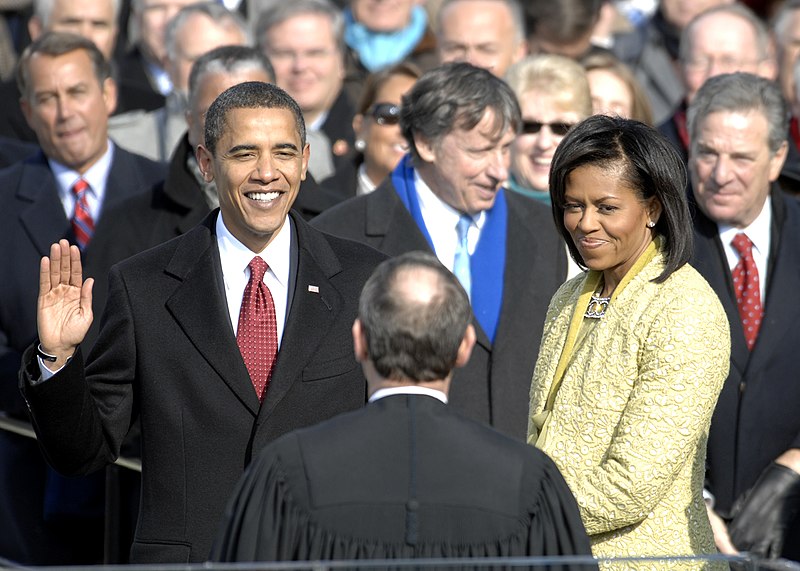
2008 Nov 4 Barack Hussein Obama, the son of a black African father and a white American mother, is elected President of the United States.
Chief Justice John Roberts administers the oath of office to President Barack Obama on January 20, 2009.
2009 May 11 During an awards ceremony at Chattanooga’s Howard High School, the Chattanooga History Center dedicates a mural honoring the students who took part in the 1960 lunch counter sit-ins, many of whom were members of Howard’s 1960 graduating class. The mural will be on permanent exhibit at the school.
2009 Jul 20 President Barack Obama signs into law the Matthew Shepard Hate CrimesPrevention Act, which specifies penalties for any crime in which someone targets a victim because of actual or perceived race, color, religion, national origin, gender, sexual orientation, gender identity, or disability.
2012 Nov 6Barack Hussein Obama becomes the first African American to win re-election to the office of President of the United States.
2021 Dec 8 One final note: There have been more than 200 unsuccessful attempts since 1900 to codify lynching as a federal crime. Rep. Bobby L. Rush (D-Ill.) introduced the Emmett Till Antilynching Act (H.R. 55) in the 115th Congress. It passed the House of Representatives on February 26, 2020, by a vote of 410-4, with overwhelming bipartisan support; however, it was blocked in the Senate by Sen. Rand Paul (R-Ky.), who objected to the language of the bill. Rush reintroduced H.R. 55 on the first day of the 117th Congress (Jan. 4, 2021), and it has moved forward with 179 bipartisan sponsors. On this date, Dec. 8, 2021, the bill passed through the House Judiciary Committee by voice vote and advanced to the House Floor. This story will be updated as the bill moves through the House and on to the Senate.
Adapted from a timeline created by Kathy B. Lauder for the TN State Library and Archives, 2013.













 Nashville Historical Newsletter