From Farm to Factory

by Ilene Jones Cornwell.

“I got my first job when I was thirteen years old, working from six in the morning ‘til six at night . . . six days a week, making fifty cents a day,” recalled Josie Coleman (1901-1986), during an oral history interview in 1972. She was referring to the summer of 1914, when she left her family’s double-log home in Spring Hill, Tennessee, to work in Nashville. Her father Jessie, a farmer supporting ten children younger than Josephine, drove the girl and her shawl-wrapped belongings the thirty-five miles to the city in a mule-drawn wagon.

Tennessee farm children, ca. 1918 (photo from NHN collection)

The previous few years had been unfortunate ones for the Colemans and other Tennessee farmers. Texas fever, a disease caused by micro-organisms transmitted by tick bites, had invaded the state and killed or quarantined most livestock. That calamity, compounded by the summer drought of 1914 and Maury County’s epidemic of hog cholera that affected the crops and hogs raised by the Colemans, had brought the farm to a standstill. Thus, when Josie’s uncle, preacher Joshua Nellums, reported in glowing terms on the ready market for labor in industrialized Nashville, first-born Josie decided that Nashville was the place to be. She could lodge with her aunt and uncle on Tenth Avenue North after she secured a job at one of the many factories and mills in the city.

At that time, Nashville already was established as a thriving commercial center. Flour had been the city’s chief product since 1899, when Royal Flour Mill was established. Royal adopted the innovative marketing practice of Ford Flour Company, offering five- and ten-cent sacks of flour to consumers instead of the usual barrel quantities. Homemakers immediately embraced the practice and established Royal Flour (later Martha White) as the area leader in flour sales. The brisk lumber trade had made Nashville the leading hardwood center of the South, and numerous factories—including Warioto Cotton Mills, Jamison Spring and Mattress Company, Tennessee Manufacturing Company, May Hosiery Mill, and Hartsford Hosiery Mill—offered steady employment to anyone willing to work.

Josie Coleman was more than willing to work; she was eager. Her first job was at Hartsford Hosiery Mill on Twelfth Avenue North at Harrison Street. She and “lots of other young girls” and women worked for fifty cents a day, six days a week, feeding the machinery that turned out long-length ribbed stockings for boys and girls. She threaded loops of cotton and wool on the large needles of a pre-set pattern or form; the needles created “everything . . . the toe, ribbing, and ends.” Then she had to transfer the stocking to a footer for finishing. The stockings of white yarn were later dyed black, a hue obtained by sulphuric dyes. This process was performed away from the processing factory, since the dye was extremely toxic. “And that dye really did smell,” Josie laughed. “It was a combination like rotten eggs and spoiled food. . .I don’t see how those folks stirring the dye vats stood that job!”

Josie remained at Hartsford for four years. “I paid fifty cents board to my Uncle Josh, kept a precious fifty cents for streetcar fare during the week, carried a tin pail with my lunch each day, and sent two dollars to my folks in Spring Hill,” she said, adding with a chuckle, “I felt I was making big money!” During that time, her father sold the Spring Hill farm and brought the family to Nashville, buying a residence in the 1700 block of Fourth Avenue North. Josie moved in with the family and obtained a job with the H. G. Hill Flour Mill on Van Buren Street. At the seasoned age of sixteen, she acquired a “better paying job” with the Tennessee Manufacturing Company on Eighth Avenue North. She began by sewing sacks of starched calico cotton used for packaging flour and meal. “Ladies really loved those sacks,” she laughed. “When they were empty, the sacks were washed and the stitches cut out so that curtains and clothes could be made from them. I’ve wondered if the ‘free’ fabric ladies got when they bought flour wasn’t more important than the product!”

During the ten years Josie Coleman worked for Tennessee Manufacturing / Werthan Bag, she married and had her first child. Motherhood prompted her to leave the work force in 1928. Looking back on those years, she observed philosophically, “Maybe the years have made me forget a lot of the hurtful things, but fifty cents a day was good money in 1914, especially for a kid right off a Spring Hill farm. I was paid hard cash for my work, and it bought a lot for the whole family. Getting paid money to work gave me a good feeling, and I liked it . . . I have no regrets.”

The Werthan Bag Company building on Eighth Avenue North is the largest surviving nineteenth-century factory in the Middle Tennessee area. The first of the buildings was constructed in 1871 by the Tennessee Manufacturing Company, and the mill began operation early in 1872, according to W. W. Clayton’s History of Davidson County, Tennessee (p.222). Plant additions were made in the 1880s. Werthan Bag Corporation bought the plant in the early 1900s and continued to offer steady employment for the flood of workers forced off rural farms by drought and livestock diseases. (photograph courtesy of the Tennessee State Library & Archives.) 

The Old Nashville Market House, 1828-1937

by Dave Price.

Our original market house was completed during 1802 and can be seen in the well-known map of 1804 Nashville, which appeared in Clayton’s History of Davidson County, Tennessee. Its replacement was begun in April 1828 and was occupied in January 1829. This structure, shown on the 1831 J.P. Ayres (Doolittle & Munson) map, consisted of a long market shed running north and south with a two-story building at each end.

Photograph of the Public Square courtesy of Debie Oeser Cox, https://nashvillehistory.blogspot.com/

The Ayres map was surrounded by a number of drawings of local buildings and scenes, so we know what the southerly building looked like. It was the “Tennessee Lottery Office,” the image of which has been reproduced, although I am unable to cite such a copy in one of the standard histories. Interesting features of this Lottery Office are a recessed arch shape in the brick on the west side of the building and round windows in the upper corners of the south end.

A “salt print” (dated ca. 1856) of the west side of Nashville’s Public Square attracted a good deal of attention a few years ago when the State Museum purchased the rare item at a Sotheby’s auction. (We old Nashville buffs had been aware of a copy negative in the state archives for years.) The print reveals the same features mentioned above in the northwest corner of the northerly building, indicating that the matching original end buildings of the market house were still in place with some modifications: single story wings added to the south (and we presume north) sides of the end buildings and a cupola added to the roof of the south building (and probably to the north one as well, although it cannot be seen in the print).

A familiar photo taken from Capitol Hill a few years later shows that the end buildings had either been extensively remodeled or replaced with much larger three-story structures having two square towers on each end building. This image is reproduced in Adams-Christian, p. 53. Since the old Methodist Publishing House is shown, the picture must date from before 1873. The southerly building at some point became the City Hall, and Creighton tells us that the Supreme Court met in one of the buildings for a time and that 100 stalls existed in the market section or long connecting shed.

A good view of the southerly building can be seen in James Patrick’s Architecture in Tennessee, 1768-1897, where it is suggested that Adolphus Heiman may have remodeled the buildings “about 1855.” Despite the estimated dates, the “ca. 1856” image was obviously made prior to the “about 1855” remodeling. Incidentally, this building is shown in Max Hochstetler’s great Opryland Hotel mural, which can be seen on the cover of the Summer 1990 Tennessee Historical Quarterly. A view that shows both end buildings and the connecting market building is seen in Jack Norman’s The Nashville I Knew, p. 125.

Although not mentioned by any of the histories that I consulted, the southerly building was consumed by the Burns Block fire on the square during the night of January 2, 1897. The fire company stopped at the site of an old cistern between the Court House and the Market House but found it had been Macadamed over. During the delay in finding a new water source, the old dilapidated City Hall was engulfed in flame and the crowd shouted, “Let it burn!” which is exactly what happened.

This fire was responsible for the replacement of the City Hall with the large 1898 building that older readers will recall (Norman has a good view of this on p. 122 and an unusual architectural drawing is found in the photo section of Fedora Small Frank’s Beginnings on Market Street).

In the meantime the northerly building still had at least one of its towers in an 1892 photo but had lost both towers by 1910. This building contained the office of the Market Master and such city offices as those of the Meat and Dairy Inspectors and was generally called simply, “the north end.” The new City Hall remained much the same, although much of its one large tower was gone by the time of its 1936-37 demolition. The March 14, 1933, East Nashville Tornado caused some damage on the square and this may have been when the tower was shortened.

Aerial photographs taken during the construction of the present (Woolwine) Court House show that, while the market house section and the northerly building were razed along with the Strickland Court House (since they lay in the path of construction), the City Hall was actually a few feet south of the new building and was the last part to fall. It is also obvious from these photos that the market section had been widened considerably over the years; it contained 114 or more stalls by the time of its demise.

The later (1937-1955) Market House stands today behind the present court house and is still in use as the Ben West Building, or more commonly the “Traffic Court Building.” The once-familiar wagons are gone, and the farm trucks that once surrounded the Court House moved north of the Capitol to the new Farmer’s Market in 1955. That market has now been replaced and will no doubt be recalled by a later generation as “the old Farmers’ Market.” (1998)

S. H. Kress in Nashville: An Art Deco Parthenon

by Kevin Chastine.

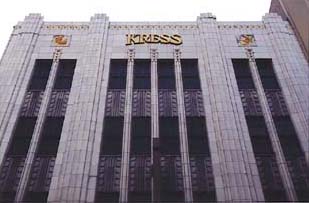
The vision of Samuel Henry Kress (1863-1955), a Pennsylvania multi-millionaire and philanthropist, has enhanced many urban areas in Tennessee. In 1887, after seven years as a teacher, Samuel Kress had established a stationery and novelty shop in Harrisburg, Pennsylvania. When this venture prospered, Kress brought the concept of a 5&10-cent store to Tennessee, opening his first 5&10 in Memphis in 1896. One year later he opened his second 5&10 at 420 Union Street in Nashville. In 1900 Kress moved the store to 219 North Summer Street (which would become Fifth Avenue North five years later). In 1913 he opened a second store at 317 Third Avenue North. The Kress Company operated these two stores, two streets apart, until 1968.

Kress Building, 5th Avenue, Nashville. (photo courtesy of the author)

In its first few years in Nashville the Kress Company leased space in older buildings, unlike their previous policy in Memphis, Knoxville, and other Tennessee cities that had received architect-designed, one-of-a-kind Kress buildings. However, in 1936 the S.H. Kress Company constructed a new store in Nashville to replace the former building at 237-239 Fifth Avenue North. The new Kress Fifth Avenue building was hailed as “the finest type of mercantile building known to modern engineering.” According to a company advertisement, the store was Kress’s way of showing his gratitude to the citizens of the Tennessee Valley “for their enthusiastic acceptance of his merchandising principles.”

During the 1930s Kress stores were designed in the popular Art Deco style. Many of these modern stores also featured locally or regionally influenced ornamental details, the concept of Edward F. Sibbert, Kress’s supervising architect from 1929 until 1952. In the 1970s Sibbert stated that his architectural influences were “anything but classical,” a comment that increases the significance of the Fifth Avenue Kress building, because it is possible that architectural details of the Kress building were borrowed from the Parthenon in Centennial Park. Architectural historian Bernice Thomas first proposed this theory in her book, America’s 5 & 10 Cent Stores: The Kress Legacy. Although there are no design records or corporate documents to confirm Thomas’s theory, details of the Kress building illustrate several similarities between the two structures.

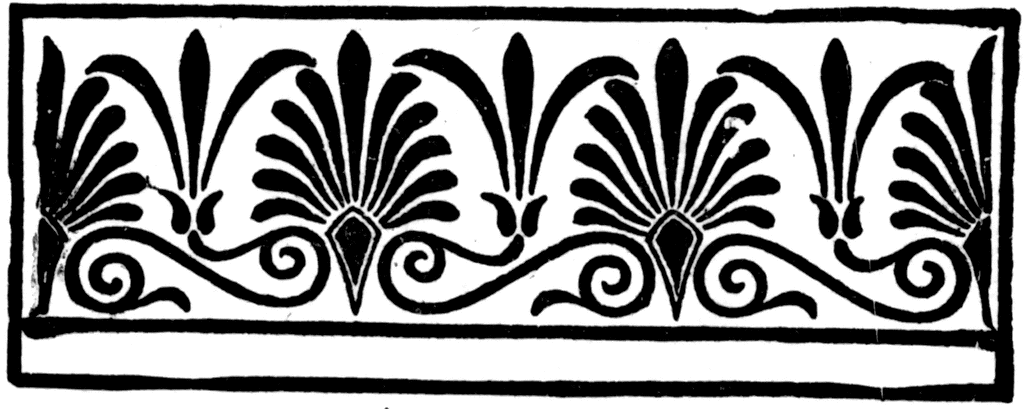
The likenesses begin with the four large fluted pilasters that extend upward from the marquee through the roofline. These pilasters may relate to the large fluted Doric columns that encircle the Parthenon. A second similarity is the stylized Greek key motif that extends in a continuous row across the building façade, just below the roofline. These Greek key motifs may relate to the anthemion pattern that lines the roof of the Parthenon. The final and most interesting details of the Kress store are the Greek-inspired panels located to either side of the Kress logo. The left panel illustrates a female figure; the right, a male figure. These decorative panels seem to mirror the painted metopes within the entablature of the Parthenon.

Anthemion, a stylized flower pattern found in Greek art and architecture

The female panel shows a woman holding a pole topped by a winged hat or helmet. The hat can be interpreted two ways: as the helmet of Hermes, the Greek god of commerce, an appropriate symbol for a 5&10-cent store; or as a woman’s hat that one might purchase in Kress’s millinery department. The background of the female panel is filled with modern skyscrapers, perhaps an image of the growth Samuel Kress foresaw in Nashville’s future. The male panel portrays an aproned man holding a stylized hammer. Its handle is in the traditional shape at the base but transmutes along its length into layered, gear-like disks. The background of the male panel is a scene of smokestacks which, along with the hammer and gears, serves to illustrate Nashville’s industrial past. The 1936 S.H. Kress building exemplifies the pride that Samuel Kress had in his company, as well as his respect for the cities where he located his stores. Unfortunately, the concept of civic responsibility is rarely a consideration of national chain stores today, thereby increasing our own obligation to preserve the distinctive buildings that are such an important part of Nashville’s heritage

From Knickers to Body Stockings

by Doris Boyce.

German-born Jacob May, 18 years old, came to America in 1879, a passenger in steerage. He arrived in this country unable to speak the language and carrying only seven dollars in his pocket. His first job was peddling dry goods from a pack on his back. When he had earned enough to purchase a horse and wagon, he peddled his wares throughout New England. He eventually married and settled in Laconia, New Hampshire, a hosiery mill town, where he opened a general store. When on buying trips for the store, he sold his suppliers hosiery from the Laconia mill.

A series of photos from November 1910 indicates that the May Company employees were primarily women and children. (Lewis Wickes Hine Photography, from Library of Congress Prints & Photo Division, reproduction number LC-DIG-nclc-01889; Call number LOT 7479, v. 2, no. 1750.)

It was an advertisement in a Boston newspaper that brought Jacob May to Nashville. He and a friend successfully bid on a Tennessee prison labor contract – 50 men at approximately 50 cents a day. May moved his family and several French-Canadian fixers (knitting machine repairmen) to Nashville and started the Rock City Hosiery Mills in the old Church Street penitentiary in 1895.

Jacob May and his partners acquired the six-and-a-half-acre Nashville property for the hosiery mill in 1908. May himself served as president and then as chairman of the board until his death, after which time his sons Mortimer and Dan operated the mill. The May company was noted for the quality of its socks. The crew of Apollo 2, which landed on the moon in 1969, wore socks made by May Hosiery under contract to NASA.

The May building in recent years

By 1908 May and his partners had opened for business on Chestnut Street. In the following years, May Mills counted as customers Marshall Field, Montgomery Ward, Spiegel, Woolworth, Kress, and the Boy and Girl Scouts, as well as Nashville wholesalers J.S. Reeves, Neely-Harwell, W.S. Riddle, and Eskind & Greenspan. In the 1930s May became one of the first licensees of Walt Disney, and his company was a prime contractor for mortar fuses during World War II.

During the years leading up World War II, Jacob and Mortimer May made five trips into Hitler’s Germany and managed to rescue more than 200 Jews before the flow of visas was cut off. Mortimer maintained an association with the network of underground movements in Europe who succeeded in saving some intellectual Jewish leaders the Nazis were eager to destroy. After the war Mortimer took part in the efforts to establish a Jewish homeland in Israel.

The family sold the mill to the Wayne-Gassard Company of Chattanooga in 1965, operating it for nearly 20 years. They sold it to the Renfro Corporation in the summer of 1983 but slow sales forced Renfro to close it soon after (1985), displacing 147 employees.

Today, the expanse of unrenovated buildings still retains the aura of the hosiery mill. It is currently the headquarters for a variety of enterprises including the Tennessee Repertory Theatre, art and photography studios, video productions, scenic design, drapery fabrication, stained glass manufacturing, food products, and more. (2000)