A Place in History: Nashville’s Historic Elliston Place

by Terry Baker.

The Nashville street that connects Church Street with West End Avenue was known as Richland or Harding Pike in 1881 when Ed Buford built a house there and called it “By Ma.” He gave the house that folksy name because it was situated next to Burlington, the estate then owned by Elizabeth Boddie Elliston, Buford’s mother-in-law and widow of W.R. Elliston. As a result of the 1904 changes in street names, Elliston Street became 23rd Avenue North, and Richland was renamed Elliston Place.

Burlington (TSLA photo)

A look at the 1889 Nashville City Atlas gives us some idea of the extent of the Elliston holdings, which included land now occupied by Vanderbilt University. At 23rd and Elliston Place the AT&T building now fronts where “By Ma” once stood. Burlington went up just to the west in two stages, first when former mayor Joseph Thorp Elliston bought the land in 1821 for just under $11,500. When he died in 1856 his youngest son, W.R. Elliston, inherited the property. William F. Strickland, the architect who designed the State Capitol, drew up a plan for the “new” Burlington, at least according to Elliston family lore. Strickland died in 1854, but a floor plan drawing he is said to have made for Burlington has survived.
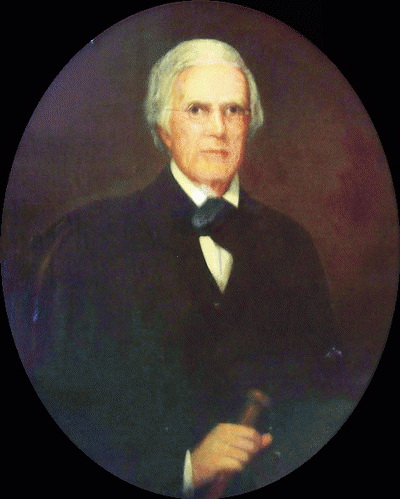
Joseph Thorp Elliston, 4th Mayor of Nashville (1814-1817); portrait by Washington B. Cooper

Though not strictly historical, family legends can augment dates and surviving maps. Stories recorded in Burlington: A Memory, published in 1958 by Josephine Elliston Farrell, make the house the scene of several interesting anecdotes of the Civil War. One of W. R. Elliston’s daughters, Louise, is the star of most of the tales, but the most poignant story concerns Willie, Elliston’s youngest son. At the age of five he was taken into custody on the almost laughable suspicion of being involved in espionage. His father was able to secure his release, but not before Willie’s shoes had been cut apart and his clothing searched.
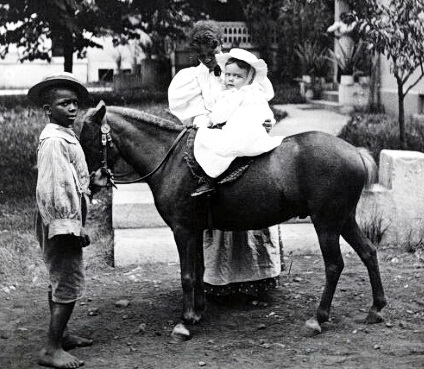
Willie (William Jackson Elliston) on a pony (TSLA photo)

Both Joseph T. Elliston and his son W.R. were slaveholders. W.R. sided with the Confederacy and is even said to have enlisted in 1861, but he was at home in 1862 when Burlington was taken over by the occupying Federals. The family legends tell us of skirmishes on the property and of a wounded Confederate spy hiding out in the house.

The names of W.R. Elliston’s daughters read like a Who’s Who of European royalty. Maria Louisa, usually called Louise, was twenty-three when she married Dr. L.P. Yandell in 1867. Research indicates that he had been a surgeon in the Confederate Army. Josephine married Norman Farrell in 1869. A freshman at Columbia University in New York when the war broke out, Farrell booked passage for Cuba, was put ashore in Florida, and eventually joined Forrest’s cavalry.

Josephine and Louise Elliston (TSLA photo)

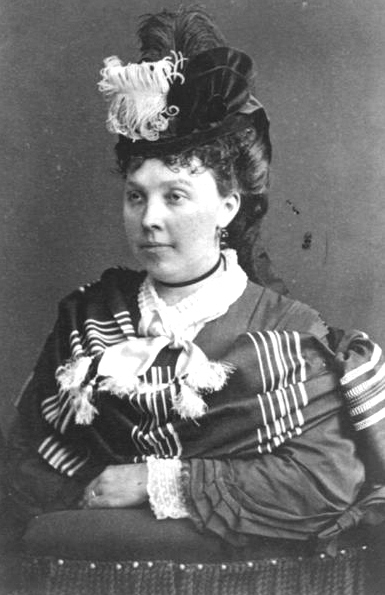
Of special interest is the youngest, Lizinka, born in 1851. Her namesake was the widow Lizinka Campbell-Brown, herself named after the Czarina of Russia. In 1875 Lizinka Elliston married Ed Buford, another Confederate veteran.

Lizinka Elliston Buford (courtesy of the author)

W.R. Elliston died in New York City on July 4, 1870. He and his wife Elizabeth had traveled there to seek a specialist’s advice on his abdominal pains. In a bureaucratic irony stemming from the rules governing the census, he was enumerated on the day of his funeral. Buried with him that same day was Medora Thayer Elliston, the eleven-month-old daughter of his son Elijah, who had married Leonora Chapman.

W. R. Elliston (Tennessee Portrait Project)

The widow Elliston left Burlington from 1870 until the 1880s. A house at 52 N High (6th Avenue) was home not only to Elizabeth but also to the Bufords and Farrells, according to the 1880 census. Elliston descendants believe that Elijah took over Burlington for his own use. It was not until 1875 that Elizabeth bought her share of the town house, while G.M. Fogg bought the other half. Norman and Josephine Farrell moved in by 1873, and the Bufords by 1876. The year 1881 would see these families back at the old Elliston lands.

Elizabeth Boddie Elliston “Ma,” 1820 (Tennessee Portrait Project)

A photo database at the Tennessee State Library and Archives contains numerous images of Burlington as well as of the Ellistons, Bufords, and Farrells. In 1901 the widow Elliston posed for a group photo with her three daughters and some of her grandchildren. Seated next to mother Lizinka Elliston Buford is ten-year-old Eddie Buford, who would go on to become Nashville’s WWI flying ace.
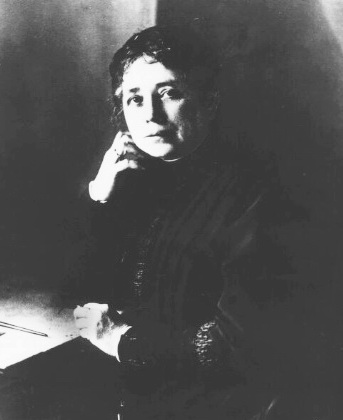
Josephine Elliston Farrell, author of Burlington: A Memory (Tennessee Portrait Project)

Burlington was not destined to see the Second World War. The mansion was torn down in 1931, and Father Ryan High School, which has since relocated, went up on the site the next year. A part of the original house was saved and reconstructed on Abbott-Martin Road by Ed Buford’s daughter Elizabeth Shepherd, who died in 1955.

Land will pass from one owner to another, buildings will be torn down and new ones constructed, names will be forgotten, and stories will be embellished over time. Through all that, the Ellistons have maintained a place in history, and the importance of that family is witnessed today by a well-known Nashville street–Elliston Place.


Author’s note: We were never positive that the paper picture used here, taken from a carte-de-visite, was really Lizinka, but based on the two known images of her at the Tennessee State Library and Archives, I’d say the odds are pretty good. This one was taken by C. C. Giers at his Union Avenue studio around 1875, the year Lizinka married Ed Buford. The address on the Giers logo on the reverse side can be shown by city directories to date to 1872-1877.
Out of the Ashes of Defeat: The Story of Confederate P.O.W. Edward L. Buford Sr., 1842-1928

by Terry Baker.

In 1865 the South lay in ruins.  Thousands of sick and wounded Confederate soldiers filled the hospitals or remained in prisons.  But out of the ashes of defeat would also come great success stories.

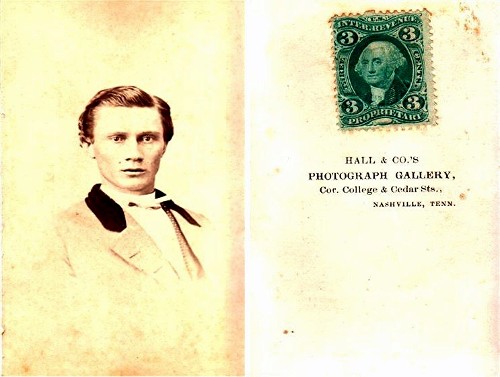
This photo of Ed Buford was taken at Hall’s Photograph Gallery on the Public Square across from the Commercial Hotel, where he boarded. In a King’s City Directory ad, Hall’s proudly stated: “HALL’S Celebrated CARTES DE VISITE Are the most Stylish Pictures made in the City.” The picture can be dated by the revenue stamp above the logo. As part of the Union effort to finance the war, photos were subject to a tax between 8-1-1864 and 8-1-1866. Ed was exchanged at City Point, Virginia, in March 1865, narrowing the date to 1865 or 1866. The original carte-de-visite has the logo and stamp on the reverse side, unlike this modern photomerge.  (from the author’s collection)

Among the ragged, half-starved men who made the long trek home that spring was 23-year-old Edward L. Buford. Born in Williamson County in 1842 to William Wirt Buford and Eleanor Pointer Buford, he was barely 19 when war broke out. The Pointers, his mother’s family, came from Virginia – Ed’s great-grandfather fought there during the Revolution. The family had spread as far west as Arkansas and Louisiana during the decades leading up to the terrible conflict that would destroy the lives and fortunes of so many.

Ed Buford joined the 3rd Tennessee Infantry in May 1861, in the company of neighbors and relatives. Within a year many of them would be among the 9,500 cold, weary, and deeply shocked Confederate prisoners shipped north by steamboat and rail after Fort Donelson fell in February 1862.

Ed’s imprisonment at Camp Douglas, Illinois, ended in September 1862, when his regiment was exchanged at Vicksburg. However, in May 1864 his luck ran out again: he was recaptured in some forgotten skirmish or unrecorded clash of picket posts. Sent to Rock Island, Illinois, he was exchanged again, at City Point, Virginia, in March 1865, and paroled in May.

Young Buford, who had been educated at Spring Hill Academy, launched his post-war career on the banks of the Cumberland River, its wharf stacked high with dry goods, cotton bales, guns, ammunition, foodstuffs, and spirits. In King’s 1866 Nashville City Directory we find him listed as a clerk at Stratton, Pointer & Co., Wholesale Grocers and Cotton Factors, at 9&11 Broad. The eponymous Pointer was Ed’s uncle, Thomas G. Pointer of Spring Hill.

Ed’s situation changed in 1867 when his uncle sold his interest in the business and moved back to his Spring Hill farm. Ed took a job as a clerk for O. Ewing & Co., Importers and Dealers in Hardware, Guns and Cutlery. By 1871 he was a salesman for Ewing, located in the old John Nichol House at 18 Public Square. He had also moved to the Maxwell House Hotel at the corner of today’s 4th and Church. If Ed had been content to remain there for the next 30 years, we might never have heard of him. The 1870 census listed as clerks many ex-Confederate officers from the wealthy land-owning clans of 1860. It was this leveling of social distinction in the post-war South that permitted Ed’s upward mobility. Although small towns and backwaters would cling to the old ways, cities like Nashville were filled with men like Ed who knew themselves to be as valuable as the officers they had obeyed in the late conflict. Moreover, in November of 1875 Ed had made a very good marriage.

William R. Elliston, the son of Joseph Thorpe Elliston, silversmith and former Nashville mayor, owned $235,000 in real estate and $58,500 in personal property, according to the 1860 census. When he died in 1870, he was even wealthier. He left his daughter Lizinka considerable property downtown, as well as the proceeds from the sale of others. When Ed married Lizinka Elliston, they moved into her mother’s house at 32 N High, today’s 6th Ave N. In 1881 Ed built a house on Elliston Street, today’s Elliston Place, where he and his family would live for the remainder of their lives.

The Baker-Brady family believes this Carl Giers photo from about 1875 to be a portrait of Lizinka Ellison Buford. (from the author’s collection)

During the 1880s and 1890s Ed became a partner in several business ventures, by 1889 operating a company known as Buford Brothers Wholesale Hardware. His brother Charles was a partner until his death, at which time Ed’s brother Brown joined the firm. Edward L. Buford, ex-Confederate POW and former dry goods clerk, had finally arrived.

Along the way Ed and Lizinka had four daughters, one of whom died in infancy, and one son, Ed Jr., who would return from France a celebrated WWI flying ace. The hero’s welcome given to young Ed in March 1919 was marred by sadness when his mother died of pneumonia soon afterwards. Lizinka’s obituary stressed her community work with the YWCA and portrayed her as cultured, sensitive, and tactful – a natural leader. She was buried at Mt. Olivet Cemetery, near her parents, her daughter Louise, and her brother Elijah. In June 1928, after a long illness and confinement, Ed Buford died at age 86 and was buried next to his beloved Lizinka.

I first visited them there one gray, damp, overcast January day. That scene needed only heavy fog or howling winds to conjure up the dim past of their saga. By my second visit a month later, I was among friends, not demigods, and felt more than welcome. We become who we are through the sacrifices, choices, and missed opportunities of the people who passed this way before us. Ed Buford could have come home in 1865 to brood about defeat and the Lost Cause. Instead, he chose the future.


Author’s Notes:

1) I would like to acknowledge the genealogical research of my distant cousins Zee Porter, Linda Pointer, Fred Rowe, and Brian Bivona, who generously shared their files with me. I would never have been able to sort out this huge family without their help. Other data comes from the US Census, Nashville City Directories, Civil War Soldiers’ Records, Widows’ Pension Claims, Mount Olivet Cemetery Records, the Will of W.R. Elliston, and the Nashville Banner.

2) The figure of 9500 prisoners from Fort Donelson may be too low. This was the estimate of Nathan Bedford Forrest’s biographers Jordan and Pryor in 1867, and I accepted it, since it was so close in time to the actual events. Modern historians estimate the number to have been between 12,500 and 13, 500 prisoners. I have also since determined that Ed Buford’s second capture took place at McKernan’s Island near Muscle Shoals, Alabama, according to an account written by Ed’s future brother-in-law Norman Farrell. Farrell wrote of a small cavalry skirmish that took place there within a few days of Ed’s capture. Ed wasn’t alone when he tried to cross the Tennessee River while on leave: with him was William Jackman of Carter’s Tennessee Cavalry, also on leave.

3) Ed Buford fell off a moving train in North Carolina after his exchange in 1865. His injuries were severe enough to delay his return home until July 7, 1865, weeks after the surrenders of Lee in Virginia and Johnston in North Carolina. His second stint as a POW probably saved his life, and his fall from the train, although painful, kept him out of the final battles in North Carolina.