Soldiers who died in the Civil War were, of necessity, almost always buried on the battlefield where they fell. After the War, however, a national movement arose to reinter them in a more honorable manner. Thus, national cemeteries were created for the Union soldiers who died so far from home. Confederate soldiers were more often buried in private burial grounds or brought home by their families. Young James Callender was one of the latter, returned to City Cemetery three years after his death in the War.
Photo by John Waggoner
James Thomas Callender, born in Nashville in 1841, was named for his grandfather, James Thomson Callender, a feisty newspaperman despised by Thomas Jefferson for printing unpleasant truths about Jefferson’s life. James’s father, Thomas, was a merchant and an alderman; his mother, Mary Sangster, had moved to Nashville from Virginia with her brother and sister. James had two sisters, Mary Catherine and Sarah, and two brothers, John Hill and William. He never knew Mary Catherine, who died in 1837 at 18 months, becoming the first of her family to be buried at City Cemetery. However, James lost his mother when he was six years old, and his father died of typhoid fever four years later. James, Sarah, and William were sent to Brentwood to live with their aunt Catherine Owen, who had no children of her own. Catherine and her wealthy husband James Owen lived at Ashlawn, a home which still stands on Franklin Road. Sarah married James Owen’s nephew, but died at 21 in 1859. She was buried with her family at City Cemetery.
Ashlawn (courtesy of Historic Nashville)
In 1859, when the Owen Chapel Church of Christ was organized, James and Catherine, along with James and William Callender, became charter members. The building was located across Franklin Road from Ashlawn. The congregation still meets there today in a brick building built just after the Civil War on land donated by James Owen.
In 1861, with fears of civil war on everyone’s mind, Christian Church ministers stood firm in their opposition to the war. Tolbert Fanning was jailed in Murfreesboro for speaking against slavery, and David Lipscomb was threatened with hanging for preaching that “Christians should not kill each other.” Philip Fall, leader of Nashville’s Christian Church (now Vine Street congregation), refused to pray for Jefferson Davis and, evoking his British citizenship, flew the Union Jack over his church, thus preserving its neutrality. However, their message had little impact on the young men who heard it. Fanning’s Franklin College closed as his students rushed to join the fight, and Philip Fall’s son Albert was killed at Fort Donelson, fighting for the Confederacy. When Confederate training camps were established on Franklin Road, James Callender, age 20, and William, three years younger, enlisted.
On June 24, 1863, at the Battle of Hoover’s Gap, James, a private in C Company, 20th Tennessee Infantry, was shot and killed. He was buried on the battlefield, and his funeral sermon was delivered at Owen Chapel on September 27, 1863. Brother William survived the war and returned home to Brentwood, where he married Mary Jane Zellner, whose sister Margaret was married to David Lipscomb. In 1869 Will and Mary Jane’s first child was born, a son they named James Thomas.
On April 27, 1866, this notice appeared in the Republican Banner: “The remains of James Thomas Callender will be conveyed from the residence of his brother, Dr. J. H. Callender, no. 26 South Summer St., to the Nashville Cemetery today at 3:30 o’clock pm. Services at the grave by Rev. Dr. Bunting.” Dr. Robert Franklin Bunting, the pastor of the First Presbyterian Church, lived next door to John Callender. James, remembered by his brothers, now rested with his parents, sisters, and Aunt Catherine Owen in the family plot in Section 8. Sadly, the only tombstones readable today are those of the parents, Thomas and Mary Callender. (2010)
In 1865 the South lay in ruins. Thousands of sick and wounded Confederate soldiers filled the hospitals or remained in prisons. But out of the ashes of defeat would also come great success stories.
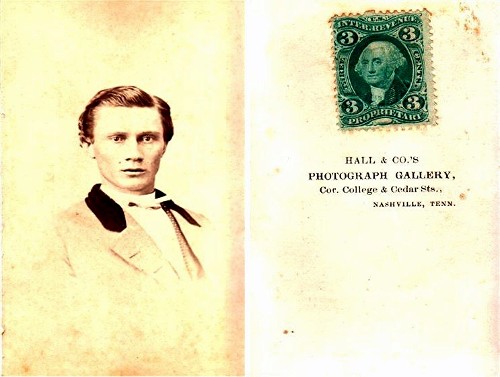
This photo of Ed Buford was taken at Hall’s Photograph Gallery on the Public Square across from the Commercial Hotel, where he boarded. In a King’s City Directory ad, Hall’s proudly stated: “HALL’S Celebrated CARTES DE VISITE Are the most Stylish Pictures made in the City.” The picture can be dated by the revenue stamp above the logo. As part of the Union effort to finance the war, photos were subject to a tax between 8-1-1864 and 8-1-1866. Ed was exchanged at City Point, Virginia, in March 1865, narrowing the date to 1865 or 1866. The original carte-de-visite has the logo and stamp on the reverse side, unlike this modern photomerge. (from the author’s collection)
Among the ragged, half-starved men who made the long trek home that spring was 23-year-old Edward L. Buford. Born in Williamson County in 1842 to William Wirt Buford and Eleanor Pointer Buford, he was barely 19 when war broke out. The Pointers, his mother’s family, came from Virginia – Ed’s great-grandfather fought there during the Revolution. The family had spread as far west as Arkansas and Louisiana during the decades leading up to the terrible conflict that would destroy the lives and fortunes of so many.
Ed Buford joined the 3rd Tennessee Infantry in May 1861, in the company of neighbors and relatives. Within a year many of them would be among the 9,500 cold, weary, and deeply shocked Confederate prisoners shipped north by steamboat and rail after Fort Donelson fell in February 1862.
Ed’s imprisonment at Camp Douglas, Illinois, ended in September 1862, when his regiment was exchanged at Vicksburg. However, in May 1864 his luck ran out again: he was recaptured in some forgotten skirmish or unrecorded clash of picket posts. Sent to Rock Island, Illinois, he was exchanged again, at City Point, Virginia, in March 1865, and paroled in May.
Young Buford, who had been educated at Spring Hill Academy, launched his post-war career on the banks of the Cumberland River, its wharf stacked high with dry goods, cotton bales, guns, ammunition, foodstuffs, and spirits. In King’s 1866Nashville City Directory we find him listed as a clerk at Stratton, Pointer & Co., Wholesale Grocers and Cotton Factors, at 9&11 Broad. The eponymous Pointer was Ed’s uncle, Thomas G. Pointer of Spring Hill.
Ed’s situation changed in 1867 when his uncle sold his interest in the business and moved back to his Spring Hill farm. Ed took a job as a clerk for O. Ewing & Co., Importers and Dealers in Hardware, Guns and Cutlery. By 1871 he was a salesman for Ewing, located in the old John Nichol House at 18 Public Square. He had also moved to the Maxwell House Hotel at the corner of today’s 4th and Church. If Ed had been content to remain there for the next 30 years, we might never have heard of him. The 1870 census listed as clerks many ex-Confederate officers from the wealthy land-owning clans of 1860. It was this leveling of social distinction in the post-war South that permitted Ed’s upward mobility. Although small towns and backwaters would cling to the old ways, cities like Nashville were filled with men like Ed who knew themselves to be as valuable as the officers they had obeyed in the late conflict. Moreover, in November of 1875 Ed had made a very good marriage.
William R. Elliston, the son of Joseph Thorpe Elliston, silversmith and former Nashville mayor, owned $235,000 in real estate and $58,500 in personal property, according to the 1860 census. When he died in 1870, he was even wealthier. He left his daughter Lizinka considerable property downtown, as well as the proceeds from the sale of others. When Ed married Lizinka Elliston, they moved into her mother’s house at 32 N High, today’s 6th Ave N. In 1881 Ed built a house on Elliston Street, today’s Elliston Place, where he and his family would live for the remainder of their lives.
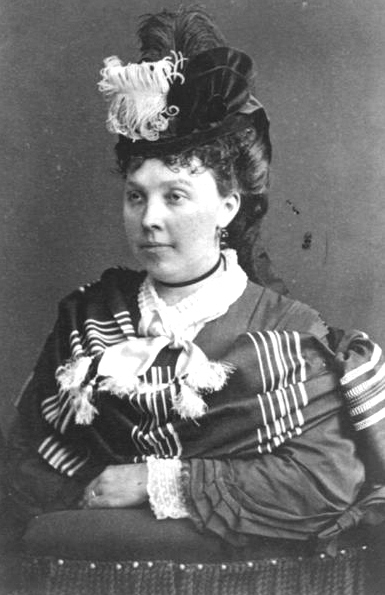
The Baker-Brady family believes this Carl Giers photo from about 1875 to be a portrait of Lizinka Ellison Buford. (from the author’s collection)
During the 1880s and 1890s Ed became a partner in several business ventures, by 1889 operating a company known as Buford Brothers Wholesale Hardware. His brother Charles was a partner until his death, at which time Ed’s brother Brown joined the firm. Edward L. Buford, ex-Confederate POW and former dry goods clerk, had finally arrived.
Along the way Ed and Lizinka had four daughters, one of whom died in infancy, and one son, Ed Jr., who would return from France a celebrated WWI flying ace. The hero’s welcome given to young Ed in March 1919 was marred by sadness when his mother died of pneumonia soon afterwards. Lizinka’s obituary stressed her community work with the YWCA and portrayed her as cultured, sensitive, and tactful – a natural leader. She was buried at Mt. Olivet Cemetery, near her parents, her daughter Louise, and her brother Elijah. In June 1928, after a long illness and confinement, Ed Buford died at age 86 and was buried next to his beloved Lizinka.
I first visited them there one gray, damp, overcast January day. That scene needed only heavy fog or howling winds to conjure up the dim past of their saga. By my second visit a month later, I was among friends, not demigods, and felt more than welcome. We become who we are through the sacrifices, choices, and missed opportunities of the people who passed this way before us. Ed Buford could have come home in 1865 to brood about defeat and the Lost Cause. Instead, he chose the future.
Author’s Notes:
1) I would like to acknowledge the genealogical research of my distant cousins Zee Porter, Linda Pointer, Fred Rowe, and Brian Bivona, who generously shared their files with me. I would never have been able to sort out this huge family without their help. Other data comes from the US Census, Nashville City Directories, Civil War Soldiers’ Records, Widows’ Pension Claims, Mount Olivet Cemetery Records, the Will of W.R. Elliston, and the Nashville Banner.
2) The figure of 9500 prisoners from Fort Donelson may be too low. This was the estimate of Nathan Bedford Forrest’s biographers Jordan and Pryor in 1867, and I accepted it, since it was so close in time to the actual events. Modern historians estimate the number to have been between 12,500 and 13, 500 prisoners. I have also since determined that Ed Buford’s second capture took place at McKernan’s Island near Muscle Shoals, Alabama, according to an account written by Ed’s future brother-in-law Norman Farrell. Farrell wrote of a small cavalry skirmish that took place there within a few days of Ed’s capture. Ed wasn’t alone when he tried to cross the Tennessee River while on leave: with him was William Jackman of Carter’s Tennessee Cavalry, also on leave.
3) Ed Buford fell off a moving train in North Carolina after his exchange in 1865. His injuries were severe enough to delay his return home until July 7, 1865, weeks after the surrenders of Lee in Virginia and Johnston in North Carolina. His second stint as a POW probably saved his life, and his fall from the train, although painful, kept him out of the final battles in North Carolina.
On February 15, 1862, E.G. “Eb” Buford of Giles County, Tennessee, received what later generations of soldiers would call “a million-dollar wound.” Not serious enough to kill or badly disfigure him, it nonetheless earned him a permanent discharge from the Army of Tennessee. While thousands of men from the captured garrison at Fort Donelson were being sent north to POW camps, Eb was sent to the rear. He had been shot through the left lung, the one-ounce lead ball reportedly taking part of his ramrod* with it as it exited his body.
In 1869 Eb married Belinda D. Miller in Williamson County; their only child, a son named John, was born the following July. Belinda died in 1874 at age 30, and Eb remained single for ten years. The 1880 Giles County census lists him as a widower, engaged in the hardware business and living on his mother’s farm.
On Christmas Day 1884 Eb married 35-year-old Mary Elizabeth Burgess, a prominent educator who already had quite an impressive resume. Although her tombstone lists her birth year as 1857 and says she started teaching at 16, she was in fact born in 1849, as the 1850 and 1860 census enumerations clearly show.
Her academic career, including a year at Dr. Price’s Nashville College for Young Ladies, culminated in her 1886 founding of the earliest Buford College at Clarksville. Meanwhile, Eb continued in the hardware trade, in a Clarksville firm called Buford and Bowling. For reasons the college publications do not explain, the campus was relocated to Nashville in 1901. School brochures tell us far more about Mrs. Buford, known as Elizabeth, than Eb, whose title at Buford College was Regent.
Buford College, about 1910 (postcard from NHN collection)
Contemporary photos show the Bufords as a dignified couple in their 60s. Confederate Veteran Magazine ran ads for the college and even published one of Elizabeth’s poems in 1910. As President of Buford College, she no doubt wrote the advertising copy, as well as yearbooks and other college publications.
In addition to being an ardent devotee of Shakespeare, Elizabeth was also fond of mottoes, which abounded at Buford, often called “Beaufort” in the literature. This Norman spelling of her husband’s name allowed her to convey the twin virtues of the school: Beauty and Strength. It is no surprise that many of her favorite mottoes and Bible verses found their way onto her impressive tombstone.
While Eb was certainly aware of his lineage, Elizabeth was very much the genealogy buff. She traced her Burgess line back to the Mayflower and was fond of saying that she and her staff were “to the manner born.” She seemed to believe that any post-Civil War Southern aristocracy should be based on literacy. Her ad for the Clarksville campus in an 1894 issue of Confederate Veteran stressed that she was the wife of a Confederate veteran.
Today nothing remains of Buford College except the name. West of Franklin Road, near the intersection of Caldwell Lane and General Bate Drive, is a short street named Buford Place. Although the last of the college buildings were torn down in 1946, surviving photos and a drive through the Buford Place vicinity can provide a good mental picture of the campus, which was situated just beyond the popular Glendale Park. The college yearbooks were a bit hazy as to how far from downtown the campus was, one saying it was a mere twenty minutes away by trolley, another saying thirty-five. The line ended at the campus, in an area that became known as Buford Station.
The 1903 Nashville City Directory showed Elizabeth Buford living at Buford Station. Eb, not listed, could still have been in Clarksville taking care of business. College publications are almost totally silent on his role as Regent, which might have been a figurehead title, although he may in fact have been the school liaison to the Nashville business community. It is revealing that his pension application described the school as a business.
The yearbooks describe the campus as “a magnificent highland park of 25 acres, surrounded by an 85-acre woodland, with springs, wells, and a cistern, upon a fine electric car line.” Croquet and tennis courts were set among the magnolias, while gardens, a dairy, and a hennery provided a healthy diet for campus residents.
The land was originally donated by wealthy businessman O. F. Noel, who also constructed the buildings. However, this partnership would last only during Noel’s lifetime and placed the college on precarious financial footing from the outset. College publications included some rather shrill pleas for assistance, and, although “Beaufort” had an impressive list of benefactors, it was not able to survive the deaths of Noel and the Bufords.
The enrollment at Buford, which was referred to as “select,” was limited to 100 girls between the ages of 16 and 20. The school offered the standard four-year college course, modified somewhat by Elizabeth’s (and perhaps Eb’s) personal tastes. The curriculum included English, Latin, the Bible, painting, music, and even business and journalism. Annoyed by literary portrayals of “frail Southern womanhood,” Elizabeth also stressed health and exercise.
The modern reader may scoff at the unabashedly Victorian ideals promoted at Buford, although graduates looked back on their college days with a fond nostalgia we can only envy. The presence of chaperones was a salient feature of all social outings and field trips taken by the girls, dressed in their forty-dollar gray uniforms. However, this is not to say that men were a forbidden item at Buford. Eligible young men were welcome as visitors at the college after they sent a letter of introduction to Elizabeth – only a certain gentility would do at Buford. More than one of the college yearbooks boasted that there had been no “elopement, death or casualty” in the history of the school, including the Clarksville years.
In contrast to the 19th century values and ideals taught at Buford, Elizabeth tenaciously prepared her charges for the 20th century. For example, she saw journalism as a way for women to find careers outside the home, allowing them to compete with men for jobs. Others, inspired by Elizabeth’s love of the English language, became teachers who inspired a generation of students to disdain slang and trendy speech in keeping with lofty Buford ideals.
The 1914 death of O. F. Noel, Buford’s principal benefactor, generated a flood of changes in the life of Buford College. In 1915 the Glendale campus welcomed its last class before the land devolved to Noel’s heirs. The girls who made the transition lamented that it was the last year of the “real Buford,” the idyllic picture-postcard school surrounded by oaks and magnolias.
How Eb fared in those lean years we have only a hint. In 1917 he was forced to file a Confederate pension claim, stating that he and his wife had been “engaged in School business at Nashville” the previous year, “but have been deprived of this, and are now without means,” and unable “to make any provision for the future.”
The year 1916 had seen the college relocate, according to their ad in Confederate Veteran, to the area between 21st and 22nd avenues, near the corner of 22nd and Church, in what was the old Sam Murphy Place. By 1918, the year before Eb died, it had again moved: near Gallatin Pike, on N 12th and Eastland, the Bransford Mansion was Buford’s final location.
Elizabeth would not long survive Eb. The strain of running the college and worrying over finances proved too much for the aging administrator. At 71 she suffered a breakdown from which she would not recover. She died on February 12th, 1920, and was buried next to her husband on Valentine’s Day. Looking at their grand tombstone at Mount Olivet – covered with mottos, Bible verses, a timeline of her career, the love showered on her by her girls – one realizes that, even in death, she remains the president of Buford College.
*According to the author, what actually went through Eb’s lung was not part of his ramrod, but what was known as a musket pick. A Civil War reenactor has explained that this item was a wire brush used to clean the outer parts of the gun lock, such as the percussion cap nipple.
Additional author’s note: A book recently located at TSLA “showed what Eb was doing after he married Mary Elizabeth Burgess. He was a traveling salesman for a Clarksville hardware firm. That might explain why his name is missing from the 1903 City Directory mentioned in the essay.”




 Nashville Historical Newsletter