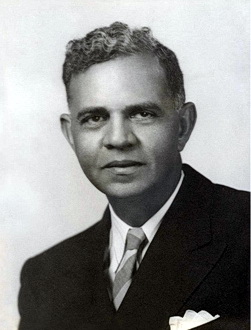
Fisk University graduate Calvin McKissack, like his older brother Moses, earned his architecture degree through a correspondence course. In 1905 the brothers founded McKissack & McKissack, now America’s oldest minority-owned architectural-engineering firm. Calvin started a satellite company in Dallas but soon returned to Nashville to teach industrial drawing at Tennessee A&I (TSU). In 1918 he was hired as director of Pearl High School’s industrial arts department. He later became executive secretary of the Tennessee State Association of Teachers in Colored Schools. When the state enacted a law requiring architects to be registered (1921), the McKissacks were nearly banned from taking the licensing examination because of their color. State authorities eventually conceded, assuming neither brother would pass, but when administrators continued to dither after both men sailed through the exam, the national media took up the story . . . and the McKissack brothers promptly received their licenses! Calvin succeeded his brother as director (1952), heading the firm until his death.
The Greenwood Project is a series of 160-word biographies of individuals who lie at rest in Mt. Ararat and Greenwood cemeteries, two historic African American burial grounds in Nashville, Tennessee. The project, which began in September 2014 (and is still available on Facebook, at https://www.facebook.com/profile.php?id=100064806156276), shares the stories of more than 300 consequential individuals, primarily African American, who changed the course of city, state, and national history through their words and deeds. (All biographies were written by Kathy Lauder unless otherwise noted.)
Our city’s most dramatic ties to Tuskegee developed shortly after the US entered World War II. In fact, it was Nashvillians who actually built the airbase where the famous Tuskegee Airmen trained. When brothers Moses and Calvin McKissack, well-known local architects, were selected to design and build the Tuskegee Airbase in 1942, they received what was then the largest federal contract ever won by an African American firm. McKissack & McKissack, now headquartered in New York City and Washington, D.C., remains the oldest minority-owned architectural engineering company in the United States.
Tuskegee Airmen 1945
The Tuskegee Airmen, whose exploits have become more familiar through a couple of recent commercial films, were actually not well known during the war, despite their extraordinary skill and courage. They were the first African American aviators to serve in the U.S. military. The “Tuskegee Airmen” title also encompasses the instructors, navigators, mechanics, and ground crew who trained and supported the pilots. According to a National Park Service article, “These men were the crème of the crop, many of whom already had bachelor’s and master’s degrees when they first began flight training in July of 1941.” And a considerable number of those remarkable men – trainers, support staff, and aviators – had ties to Middle Tennessee.
· Curtiss P-40 Warhawk – produced 1939-1944
The following local men graduated from the pilot training program on the dates listed:
2nd Lieutenant Howard L. Baugh (see story below): Single Engine Section, SE-42-J; 10 Nov 1942.
2nd Lieutenant William J. Faulkner (see story below): Single Engine Section, SE-43-D; 29 Apr 1943.
2nd Lieutenant Carroll N. Langston Jr. (see story below): Single Engine Section, SE-43-I; 1 Oct 1943.
2nd Lieutenant Thomas G. Patton: Single Engine Section, SE-44-B; 8 Feb 1944.
2nd Lieutenant Hannibal M. Cox (see story below): Single Engine Section, SE-44-D; 15 Apr 1944.
Flight Officer Robert A. Pillow: Single Engine Section, SE-44-E; 23 May 1944.
Flight Officer Robert J. Murdic: Single Engine Section, SE-44-F; 27 Jun 1944.
2nd Lieutenant Rutherford H. Adkins (see story below): Single Engine Section, SE-44-I-1; 16 Oct 1944.
Flight Officer Rutledge H. Fleming: Twin Engine Section, TE-45-A; 11 Mar 1945.
Those in the Single-Engine Cadet Pilot Class were trained to fly the Bell P-39 Airacobra, Curtiss P-40 Warhawk, Republic P-47 Thunderbolt, North American P-51 Mustang, and similar combat fighter aircraft. Those in the Twin-Engine Cadet Pilot Class were trained to fly the North American B-25 Mitchell. There was also a third cadet program, the Liaison Pilot Cadet Class, training liaison and service pilots.
The sturdy construction of the Republic P-47N Thunderbolt enabled it to absorb severe battle damage and stay in the air.
After the war, Tennessee State University developed a new program called Aeronautical and Industrial Technology, which included an aviation education component and an Air Force Reserve Officer Training Corps (ROTC). Cecil Ryan, who was head of the department of aviation, and his colleague George Turman had been instructors in the Tuskegee Airmen’s cadet program. They would instruct generations of pilots as well as aircraft design and maintenance engineers. Many of Ryan’s students went on to become pilots on both military and commercial aircraft.
Simon Gaskill, a commercial pilot for Eastern Airlines during the 1970s and ‘80s, once wore his pilot’s uniform on a tour of the TSU campus. When he ran into Cecil Ryan, he introduced himself and was startled when Ryan began to cry. “I wanted to be an airline pilot, but wasn’t allowed,” Ryan explained. “Seeing you come in here with that uniform was just too much for me.”
Carroll Napier Langston Jr. and family (photo courtesy of Kristi Farrow)
Carroll Napier Langston Jr. (1917-1944), another of the renowned Tuskegee Airmen, was the great-grandson of John Mercer Langston and great-nephew of Nashvillians James C. and Nettie Langston Napier, widely respected community leaders. Raised in Nashville and Chicago, he graduated from Oberlin College and earned an LL.B. from the University of Michigan. In 1941 he entered law practice in Chicago but, shortly after the U.S. entered World War II, he signed up for flight school at the Tuskegee Army Air Field in Alabama. By 1943 he was part of the 301st Fighter Squadron (Red Tail Angels) and was subsequently assigned to the 332nd Fighter Group. In June 1944, during a reconnaissance mission off the Italian coast, Lt. Langston’s engine lost oil pressure and he had to bail out. Tragically, his parachute failed to open, and a witness saw him clinging to the side of the plane as it went down. His body washed up on the beach several days later and was brought later to Greenwood Cemetery, where he now rests amongst his family.
William J. Faulkner Jr.
Captain William J. “Billie” Faulkner Jr. (1918-1944), a graduate of Pearl High School and Morehouse College, was the son of the Rev. and Mrs. William J. Faulkner Sr. His father was dean of the Fisk University Chapel. William Jr. enlisted August 17, 1942, graduating from the Tuskegee pilot program as a 2nd Lieutenant on April 29, 1943. An airman with the 301st Fighter Squadron, U.S. Army Air Corps, he is believed to be the first African American from Nashville to be commissioned in the Army Air Forces. In September 1944 he was awarded the first oak leaf cluster to the Air Medal for “meritorious achievement in aerial flight while participating in sustained operational activities against the enemy.” Barely two months later, November 7, 1944, with 56 combat missions to his credit, he was reported missing in action over Austria. Two days before Christmas his grieving parents finally received word that he had been killed on the day he was reported missing in November, “possibly because of mechanical failure of his P-51C.” (Other sources say he was shot down.) He was awarded the Air Medal with four oak leaf clusters. Captain Faulkner is buried in France in the Lorraine American Cemetery and Memorial, which contains the largest number of World War II American graves (10,489) in all of Europe.
Hannibal M. Cox
Colonel Hannibal M. “Killer” Cox (1923-1988) graduated from flight training at Tuskegee in April 1944 and went on to serve as a combat pilot in three wars – World War II (where he flew 64 combat missions), the Korean War (more than 100 combat missions), and Vietnam. He earned a bachelor’s degree in aeronautics from Tennessee State University (TSU), a master’s in industrial relations and personnel management from the University of Chicago, and a Ph.D. in psychology from Western Colorado University. After Vietnam one of his command duties was to serve as a professor of aerospace science at TSU, his alma mater. When he retired from the U.S. Air Force in the 1960s (with an Air Medal, five oak leaf clusters, and the Distinguished Flying Cross), he became director of ground equipment for Eastern Air Lines. Later appointed director of Eastern’s equal opportunity and community relations programs, he was instrumental in breaking down racial bias in the airline industry.
Howard Lee Baugh
Colonel Howard Lee Baugh (1920-2008) was born in Virginia; attended public schools in Virginia and Brooklyn, New York; graduated from Virginia State University; and married his college sweetheart. In March 1942 he entered the U.S. Army Air Corps and completed his pilot training at Tuskegee, Alabama, that November. Assigned to the 99th Fighter Squadron in Sicily, he flew 135 combat missions. As a pilot in the USAF, he registered 6,000 pilot hours, with a career record of 250 combat hours. Following his World War II service, Colonel Baugh, who had been trained by Cecil Ryan at the Tuskegee Institute, served for a period of time as Professor of Air Science at Tennessee State University. He retired from the United States Air Force as a Lieutenant Colonel in 1967. For his distinguished career as an aviator, Colonel Baugh was awarded the Distinguished Flying Cross, the Air Medal with three oak leaf clusters, the Air Force Commendation Medal, and the Air Force Distinguished Unit Citation, and other medals. In 2004 he was awarded the French Legion of Honor.
Rutherford H. Adkins, 1944
Dr. Rutherford H. “Lubby” Adkins (1924-1998), born in Alexandria, Virginia, developed an interest in physics while studying at Virginia Union University. He transferred to Temple University but was soon drafted into the U.S. Army. He took flight training for single-engine fighter planes at the Tuskegee Flight School, graduating as a 2nd Lieutenant in 1944. A member of the 100th Fighter Squadron of the 332nd Fighter Group – the Tuskegee Airmen – he flew 14 combat missions over Europe. Returning home, he earned a B.S. (Virginia State, 1947), an M.S. (Howard University, 1949), and a Ph.D., the first ever granted to an African American by The Catholic University in Washington, D.C. (1955). At various times he served on the faculties of Virginia State University, Tennessee State University, the U.S. Naval Academy, Fisk University, Morehouse College, and the Georgia Institute of Technology. He was president of Knoxville College from 1976 to 1981, returning to Fisk in 1993 to become division chair of Natural Sciences & Mathematics, interim president in 1996, and president in 1997, only a year before his death.
The two-story Victorian house that is now 3212 Freno Lane in Lincoya subdivision was the residence of Governor A. H. Roberts and his family from 1928 until shortly after his death in 1946. Roberts (1868-1946) is best remembered as being the chief executive of the State of Tennessee when, in 1920, the Tennessee legislature approved the 19th amendment, which granted voting rights to women.
Former home of Governor A. H. Roberts and family in Donelson, Tennessee.
The old house, located on the western slope of Todd’s Knob, was built in 1880 by Alex and Anna Perry. Perry’s house and large farm, called Nutwood, was across McGavock Lane from Spence McGavock’s Two Rivers farm1. Alex Perry died in 1927, and Roberts purchased 150 acres from Perry’s heirs on July 8, 19272. This was only a portion of the Perry tract.
There were eight Perry children, several of whom owned tracts of land carved from their parents’ property. Roberts continued to purchase property from these heirs from time to time. A granddaughter of Governor Roberts has written that his farm eventually comprised 600 acres, including all of Todd’s Knob, and was bounded by Stone’s River3.
Gov. Albert H. Roberts
Roberts had returned to his law practice in Nashville when his two-year term as governor expired in 1921. By 1927 he was 59 years old and probably thinking of retiring when he purchased his farm. It is also possible that he was anxious to have sufficient property for his adult children to be able to live near him. During the 1930s three of his four children owned houses on the farm.
Maurice M. and Hattie Smith Roberts built Stone Cottage, an English cottage-style house, at 3214 McGavock Lane. Sadie Roberts Capps and her husband Paul bought the shingle cottage at 3238 McGavock Lane from Boyd Perry4. Nan Isbell and A. H. Roberts, Jr. built a stone house near the summit of Todd’s Knob. This house was named Fort Houston in honor of Gov. Roberts’ ancestor, Sam Houston. It was designed by McKissack Brothers, Architects5. Helen Roberts, who married Dr. Horace Gayden, lived in Nashville on the southeast corner of Hillsboro Road and Woodmont Boulevard.
After living in Donelson for only four years, Governor Roberts’ first wife, Nora Deane Bowden Roberts, died in 1932. On October 3, 1934, Roberts married Irene Arnstein, who had previously resided on Lauderdale Road in Cherokee Park where she owned a home dry-cleaning machine. On March 7, 1935, as Irene was dry cleaning some clothes in her former home, the machine exploded. Gravely injured, she died the following day at St. Thomas Hospital6. Governor Roberts married a third time, to Mary Edwards, but this union ended in divorce in 1944.
Gov. Roberts died in 1946 and was buried in Livingston, Tennessee7. After his death his children sold the Victorian house and the property to Criswell, Freeman, and Nokes, who developed the Lincoya subdivision on the farmland.
According to Gov. Roberts’ granddaughter, Betty Capps Uffelman, who remained in the Donelson area, there was another house built on the Roberts farm at 3210 McGavock Lane. This was the residence of Maj. Claude Daughtry and his family. Maj. Daughtry was a good friend of A. H. Roberts and had been on his staff when he was governor. This house, on the site of the Donelson Free Will Baptist Church, was razed in the 1990s. (2000)
1 Smith, Elizabeth M. “A Nashvillian Tells Her Story.” Unpublished manuscript. Nashville Room, Ben West Public Library. 2Davidson County Deed Book No. 777, p. 213. 3The Nashville Tennessean, September 6, 1972. 4 Author’s interview with Mrs. Betty Capps Uffelman, April 3, 2000. 5Aiken, Leona T.Donelson, Tennessee: Its History and Landmarks, pp. 222-224. 6The Nashville Tennessean, March 7, 1935. 7 Braden, Kenneth S. “The Wizard of Overton: Governor A. H. Roberts of Tennessee.” Unpublished thesis at University of Memphis (also at TSLA), 1983.





 Nashville Historical Newsletter