from the files of the Nashville Historical Newsletter.
Buchanan’s Station was a fortified settlement established about 1784 during the pioneer era of Nashville, Tennessee. Located on a bluff overlooking Mill Creek in today’s Donelson suburb, the homestead was founded by Major John Buchanan who, along with his family and other settlers, lived there until the Major’s death in 1832. The station is best known as the site of the Battle of Buchanan’s Station, a famous Indian attack which occurred on September 30, 1792.
Buchanan’s Station Cemetery (photo by Tim Slate)
The fort is known to have been positioned precisely at the northwest corner of today’s Elm Hill Pike and Massman Drive, and a state historical plaque marks the spot. A large commercial building now covers the site of the original fort. Not seen from Elm Hill Pike but clearly visible from Massman Drive is the extant Buchanan’s Station Cemetery, the only remaining vestige of the original settlement and one of the oldest pioneer graveyards in Middle Tennessee. Buried here are Major John Buchanan (1759-1832) and his storied wife Sarah “Sally” Ridley Buchanan (ca.1774-1831), along with about 65 other family members, affiliated settlers, and possibly slaves. Many graves are marked only by unengraved fieldstones. Notably, historical circumstances indicate that at least five frontiersmen who were at various times killed by Indians may be buried in the cemetery: Samuel Buchanan, Cornelius Riddle, John Buchanan Sr., William Mulherrin, and John Blackburn.
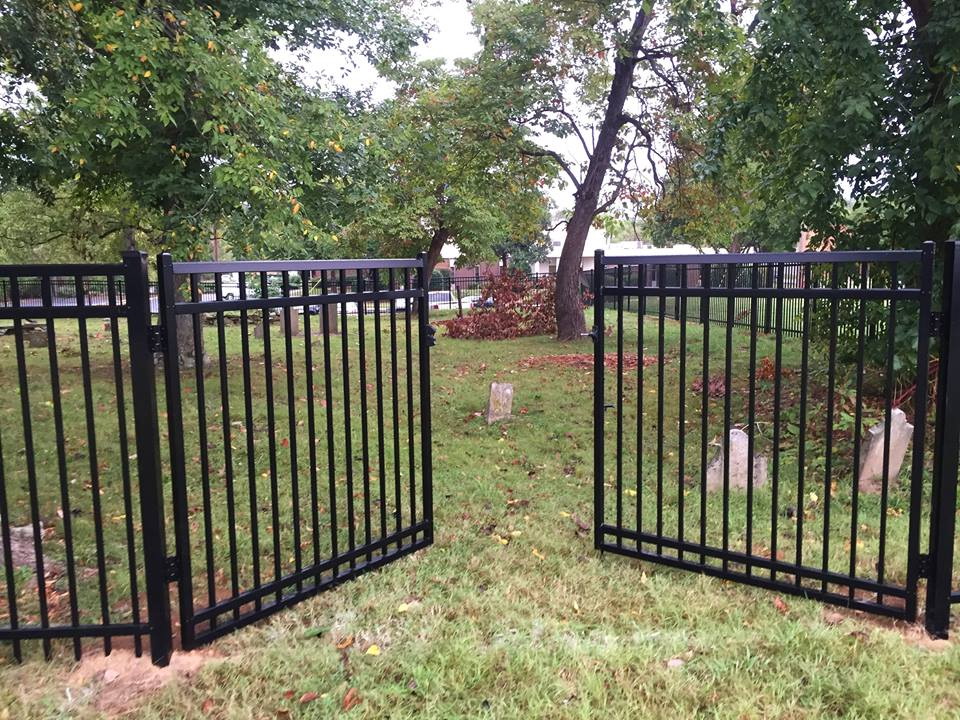
Entrance gate to Buchanan’s Station Cemetery (photo by Tim Slate)
On March 17, 2012, the Friends of Buchanan’s Station Cemetery met for the first time. Fostered primarily by the Buchanan Log House Chapter APTA, its president, Lu Whitworth, and historian Mike Slate, the grassroots group set its goals, which included effecting the transfer of the cemetery property from private ownership to Metro Nashville, fencing the unprotected graveyard, and acquiring signage for the education and inspiration of all visitors. From the beginning the Friends group worked closely with Tim Walker, executive director of the Metro Historical Commission.
On September 30, 2012, the Friends, assisted by Cumberland University and the French Lick Chapter of the DAR, held a major event at the cemetery commemorating the 220th anniversary of the Battle of Buchanan’s Station.
Lu Whitworth and Mike Slate, in period apparel, oversaw the event commemorating the 220th anniversary of the Battle of Buchanan’s Station, 9-30-2012. (NHN photo)
In 2015 businessman Scott Pope, working with group member Dick Davis, generously assigned the property to Metro Nashville. Later the same year the Friends, led by donations treasurer Joe Cathey, installed a quality fence around the historic graveyard and placed a comfortable bench inside. A grant from the Tennessee Wars Commission, facilitated by Tim Walker and David Currey, enabled some attractive interpretive signage to be added to the cemetery. (2017)
At the end of the 19th century City Cemetery was in crisis. Once a burial place for all Nashvillians, it had been supplanted by the newer and more beautiful Mt. Olivet, Mt. Ararat, and Calvary cemeteries. The Union Civil War dead had been transported to National; the Confederates, to Mt. Olivet. Neglected and ignored, City was described by the Banner on June 21, 1868, as a ruin: “robbery, murder and lust have held their horrid orgies in it and even now nightly desecrated by being the rendezvous of lascivious love.” No wonder the cemetery was promptly declared a “public nuisance” and burials were suspended the following month. A plan quickly came together within city government to remove all the graves and make the land a public park.
Sunset at Nashville City Cemetery (photo by Rebecca Sowell)
“Not so fast! Absolutely not!” Nashville’s women spoke out forcefully against such an idea. This was “sacred ground and should never be called a park,” protested Felicia Steger, a granddaughter of Felix Grundy. Women had found a new freedom of expression with the advent of the 20th century. In 1897 their Woman’s Building at the Tennessee Centennial had been a triumph. Now they found that, although not yet allowed to vote, they could nonetheless organize and engage in “civic housekeeping” with positive results. “We shall never have clean cities until the women undertake the job” was the credo of these busy ladies. Their noble efforts notwithstanding, a Banner reporter of 1900 expressed indignation that “women were boldly wearing ankle-length skirts on clear days because they were helpful in getting on and off streetcars.”
· Woman’s building at Tennessee Centennial Exposition, 1897 (Image #27163; Calvert Brothers Photography Studio; courtesy of Tennessee State Library & Archives)
Saving and caring for City Cemetery became the focus of several groups. In 1903 the Tennessee Women’s Historical Association was organized, its specific purpose to preserve the cemetery. Sumner A. Cunningham, editor of the Confederate Veteran, claimed credit for suggesting its formation. He was the only male member of an industrious group that included Louise Lindsley and Carnegie librarian Mary Hannah Johnson. Other civic and patriotic organizations were asked to join them “to assist in improving and preserving the old city cemetery, to dispel the spirit of vandalism and promote civic pride. The Ladies’ Hermitage Association, DAR, UDC, and Colonial Dames all cooperated under this umbrella. One of their successful projects was the construction of a Memorial Gate at the 5th Avenue entrance. Dedicated in 1909, the gate exists only in pictures now, having been destroyed in an automobile accident during the 1930s. Wishing to do their part, Cumberland Chapter, DAR, erected a sundial to mark the path leading to the James Robertson family plot.
Nashville City Cemetery (photo by Rebecca Sowell)
The South Nashville Federation of Women was another group that worked to care for the City Cemetery grounds. The guidebook All About Nashville reported in 1912 that “with the cooperation of 400 members, they have cleared away the rubbish, pruned trees, graveled the walks, and planted a line of memorial elms and lastly, are in the process of erecting a handsome memorial gateway to the heroes of another day.” These gateposts, on 4th Avenue, still stand. May Winston Caldwell, whose parents and siblings are buried at City, remembered the pre-Civil War days when her mother and Peter, the gardener, came to care for the family plot. Now May, as a member of the South Nashville Women, was proudly carrying on that tradition.
Sign at City Cemetery entrance gate (NHN collection)
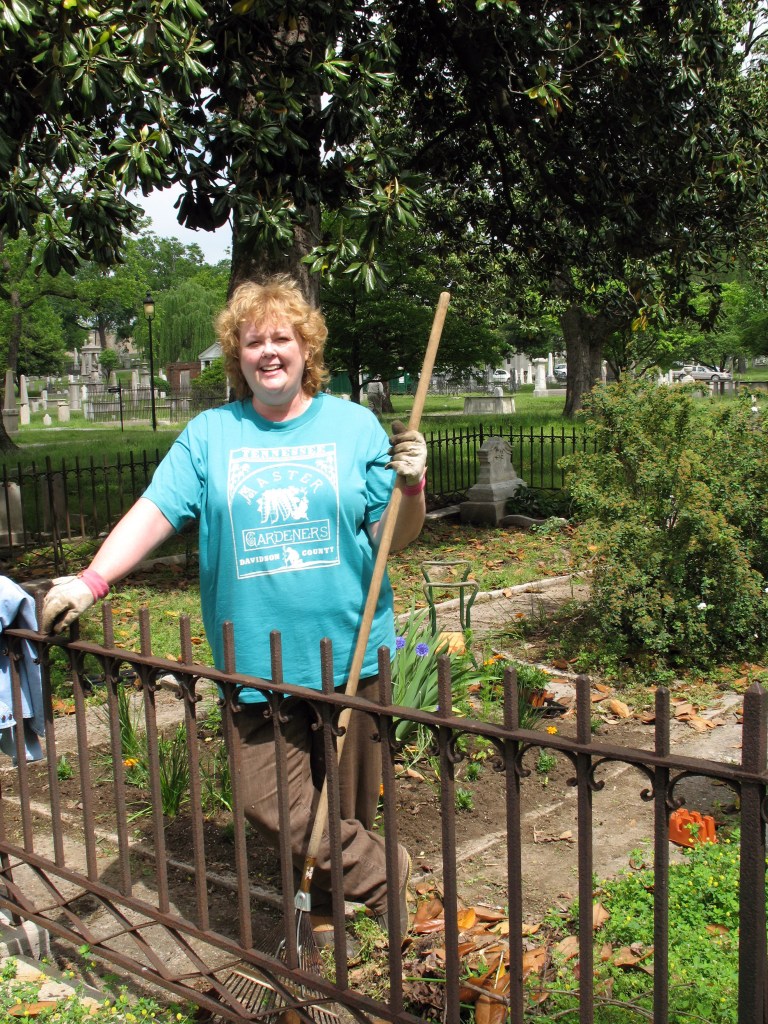
These hard-working women began a program of stewardship and restoration that has resumed in recent years after a period of neglect. Today the Nashville City Cemetery Association (composed of both men and women!) is ten* years old, making it the longest-lived and most professional volunteer organization ever to protect and renovate the grounds and markers: an endowment established at the Community Foundation will support the continuing restoration of the City Cemetery in the years to come. Thanks to the $3 million allocated by the Metro Council, and with the cooperation of the Metro Historical Commission and such citizen organizations as Master Gardeners of Davidson County, the cemetery is once again prepared to maintain its status as a historically valuable resting place of our pioneer heritage. (2008)
A volunteer from the Master Gardeners of Davidson County works in one of the family plots (NHN photo)
Previously published in Monuments and Milestones, the Nashville City Cemetery Newsletter.
* Note: This article was written in 2008. The NCCA began its work in 1998. By this time (late 2021) the organization is more than 23 years old.
by John Lawrence Connelly, Davidson County Historian.
For a large part of the twentieth century Nashville residents either ignored or did not know that an area north of Jefferson Street was once a prominent neighborhood where many of Nashville’s leading citizens lived. To a large extent, it was a German community that began flourishing heartily in the 1840s by blending its German heritage with Irish, Italian, Swiss, and Jewish neighbors, in public schools and sometimes in churches. The Catholic Church of the Assumption, founded in 1859, held many of its services in German, as did the German Methodist Church (Barth Memorial), founded in 1854 on North College Street (today’s Second Avenue North). Many prosperous merchants of the city lived in Germantown, and their names hung prominently on retail store signs downtown: Rust, Zugermann, Zickler, Ratterman, Buddeke, Thuss, Grossholz, Jensen, Jeck, and Wheling, to name a few. What’s more, the German names in the community reflected a strong Lutheran heritage.
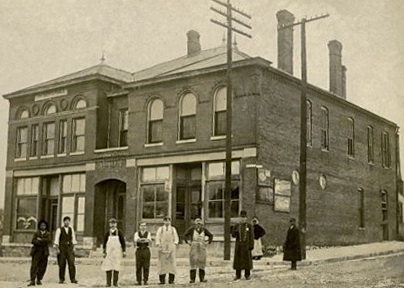
Photograph of Treibers Hall used with permission of Lois Thompson.
Within the German community many immigrants worked as butchers, a practice brought over by immigrants from Europe. These tradesmen often killed livestock and cut up the meat in their back yards or in nearby lots. Once they were able to sell their products to the Nashville Market House and other businesses, the number of people who peddled meat from door to door declined rapidly. Many residents opened their own shops or stalls. Names such as Jacobs, Dieterle, Stier, Warner, Oliver, Neuhoff, Power, Petre, Laitenberger, and White were among the best-known butchers from North Nashville. Meat suppliers from Butchertown developed the Christmas spice round, a Nashville holiday meat that would become a celebrated local tradition.
By 1915 the changes that would eventually destroy the neighborhood were beginning to take place. Just as the people who live in a community do not stay the same, old neighborhoods also undergo change. Shortly after the turn of the century, as streetcar lines expanded and motor transportation began to make advancements, Nashville saw a definite trend among the residents to move away from the “walk-to-town” areas. Moreover, the development of refrigeration led to the phasing out of many small butchering businesses. Large packing houses began to infringe upon the pleasant residential atmosphere of the neighborhood, which had often been advertised in local newspapers as a growing and fashionable community. It was World War I, however, that dealt the final blow to Germantown.
Wilbur F. Creighton’s book, Building of Nashville, provides an explanation: “In 1917 the reservoir was closed to visitors. The paper had been filled with stories of German atrocities, such as the use of poisonous gases and deliberate infection of water supplies.” Other cases of exaggerated emotional response to the war included suggestions by some that citizens should “kill their dachshunds.” Fearing for their safety, many German families instructed their older members to stop speaking German, even at home.
Changes within the Barth Memorial Church provide a good example of what was happening in Germantown. For many years sermons were delivered in German, but after World War I began, it was resolved that the church should offer only English services. Catholics and Lutherans with German backgrounds did likewise. The uniqueness of a small community with ties to the “Fatherland” was over. The neighborhood as it once was would never come back, and its steady decline continued until a handful of urban pioneers decided to attempt to create a new Germantown in the 1970s.
Germantown experienced a great deal of decay over the years as many houses were torn down and others extensively altered. Nonetheless, studies made by the Metropolitan Historical Commission in the 1970s stated: “A large percentage of structures are still intact, and it can become a viable neighborhood. The quality of architecture is exceptional, and the condition of the structures is, for the most part, quite sound.”
Today Nashville’s Germantown Historic District is one of the most architecturally heterogeneous neighborhoods in the city. The eight-block area contains a wide variety of styles and types of residences built between the 1840s and 1920s. Because of its historical and architectural significance Germantown was listed in the National Register of Historic Places in August, 1979.
For the past several years new residents have worked individually and collectively to restore Germantown. The Germantown Association has become a dynamic neighborhood group where old and new residents come together to plan for the future. A ride through the area today reveals a lively community with new and restored houses, beautiful flowers and trees, a new supermarket, a new pharmacy, and attractive brick sidewalks. Once again Nashville can take pride in this lovely neighborhood located within a few steps of the Bicentennial Mall, featuring a magnificent view of the State Capitol. Germantown has come back, with almost unlimited potential for tomorrow.
In 1980 members of the Catholic Church of the Assumption and the Monroe Street United Church (two historic churches that survived the lean years) came together to give Nashville its first Oktoberfest. This event, held on the second Saturday in October, has become one of Middle Tennessee’s most popular celebrations. The Germantown Association has sponsored a Maifest celebration for the past decade and often sells out all of its tickets. Yes, Germantown is on the map again! (2001)
Note: Although the Covid-19 pandemic has forced the cancellation of Oktoberfest for a couple of years, residents plan to bring it back soon.




 Nashville Historical Newsletter