
Primary Source Document, transcribed by Debie Cox, author of Nashville History blog.
Note: These items from the Nashville Whig newspaper were discovered by Debie Cox among the papers of Judge Litton Hickman and submitted to us. The 1823 bridge was located at the site of the present Victory Memorial Bridge. Additional information about this bridge, including other citations from the Whig, can be found in the book Building of Nashville by Wilbur Foster Creighton.
Nashville Whig – Wednesday, June 11, 1823
The bridge across the Cumberland river at this place is so far completed that horses, carriages do now pass over it.
Nashville Whig – Wednesday, July 21, 1823
Extract from the By-laws and rules adopted by the Directors of the Nashville Bridge Company…
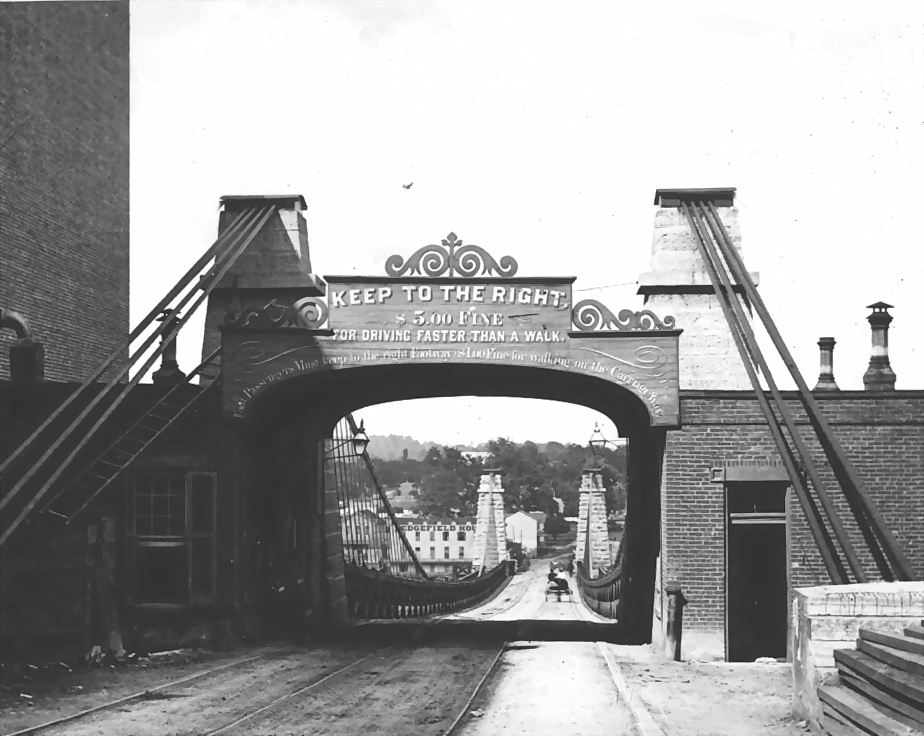
Sec. 4 Be it resolved, that the following rules, by laws and regulations shall be observed by the gate-keeper and by all persons in using, passing or being on said bridge to wit: It shall not be lawful for any person or persons, having or driving any drove of horses, mules, cattle or hogs to drive or pass on said bridge in one drove at the same time in more than the following number to wit: horses, mules or cattle, not more than ten head, of hogs not more than twenty head, and it shall not be lawful for any loaded wagon to pass on or cross said bridge within less than one hundred yards of another loaded wagon, and that it shall not be lawful for any person passing over said bridge on horseback or with a cart, wagon or carriage or with a drove of horses, mules, cattle or hogs to make any delay on said bridge except such as is unavoidable, and it shall not be lawful for any person riding on horseback or driving any cart, wagon or carriage on said bridge or driving any drove of horses, mules, cattle or hogs over same to drive faster than a walk.
It shall not be lawful for any foot passenger to travel on the road allowed for horses and carriages at the time that there is any horses or drove of horses, mules cattle or any wagon, cart or carriage passing thereon except it be such person as shall have the same charge, nor shall it be lawful for any foot passenger to molest, disturb, frighten any horse or drove of horses, mules, cattle or hogs, when passing on said bridge.
It shall not be lawful for any person to carry over or have on said bridge any coal or chunk of fire, nor to make or carry with him on said bridge any lighted segar or pipe, and if any person or persons shall willfully commit a violation of any of the rules above described he, she or they so offending shall be subject to pay the sum of five dollars for every such offence to be recovered before any tribunal having jurisdiction thereof by a warrant in the name of the Nashville Bridge Co., for the use of the said company.
It shall be the duty of all foot passengers to pass the footway on the right hand as they are going, and it shall be the duty of all passengers on horseback or driving any wagon, cart or other wheel carriage or driving any drove of horses, mules, cattle, sheep or hogs to pass over on the right hand way.
It shall not be lawful for the gate-keeper to permit any slave to pass said bridge at any time after nine o’clock at night and before day light in the morning without a written pass from his or her master or mistress expressing such permission.

 Nashville Historical Newsletter