Daniel Smith, Frontier Surveyor (1748-1818)

by Kathy B. Lauder.

Daniel Smith was born October 29, 1748, in Stafford County, Virginia. Having made up his mind to become a doctor, he studied medicine with Dr. Thomas Walker at Castle Hill, in Albemarle County, Virginia. However, he soon made an abrupt career shift and, at the age of 22, was licensed as a surveyor by the College of William and Mary (founded in 1693).

Three years after he began working as a surveyor, he married Sarah Michie and took a position as Deputy Surveyor and later sheriff of Augusta County, Virginia, where their son George was born in 1776. Smith first came to Middle Tennessee during the winter of 1779-1780, after he was hired to survey the western region of the Virginia frontier, and particularly to chart the border between Virginia and North Carolina. During the American Revolutionary War, he was commissioned a colonel in the militia, took part in a number of battles, and was appointed Assistant Deputy Surveyor for the Southern Department of the Continental Army in 1781.  Strongly attracted to Middle Tennessee, in 1784 he claimed a land grant awarded for his military service and moved his family, which now included daughter Mary Ann “Polly,” to a 3,140-acre tract in Sumner County, where he served as the county surveyor.

Rock Castle State Historic Site, home of Daniel Smith, in Sumner County, Tennessee, was completed in 1796

After reaching adulthood, both of Daniel Smith’s children wed members of the Donelson family. George married Tabitha, the daughter of Capt. John Donelson III; Polly and Rachel Jackson’s brother Samuel Donelson eloped, with the assistance of Rachel and her husband, a circumstance that caused hard feelings between Daniel Smith and Andrew Jackson for many years*.
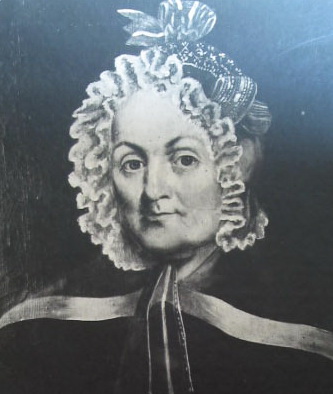
Mary “Polly” Smith Donelson (Tennessee Portrait Project)

In 1783 Daniel Smith was appointed both county surveyor and justice of the peace for Davidson County (still part of North Carolina at that time), and helped to survey the state military land-grant reservation in the Cumberland valley. One of the five trustees responsible for overseeing the establishment of the City of Nashville, he was also a charter trustee of Davidson Academy, the first institution of higher learning in Nashville. This school, founded in 1785, would over the years be transformed into Cumberland College (1806), the University of Nashville (1826), the Peabody Normal College at Nashville (1875), and finally the George Peabody College for Teachers, now part of Vanderbilt University.

When Sumner County was created in 1786, Daniel Smith, as justice of the peace, presided over the first session of the Sumner County Court. Two years later he was named Commanding General of the Mero District (Sumner, Davidson, and Tennessee counties), and in 1789 he was a member of the North Carolina convention that voted to ratify the United States Constitution. In 1790 Smith was appointed by President George Washington to become secretary of the Territory of the United States South of the River Ohio, with authority to act for the territorial governor in his absence. The first map of the region, created in large part from Smith’s own surveys, was published during his term as secretary.
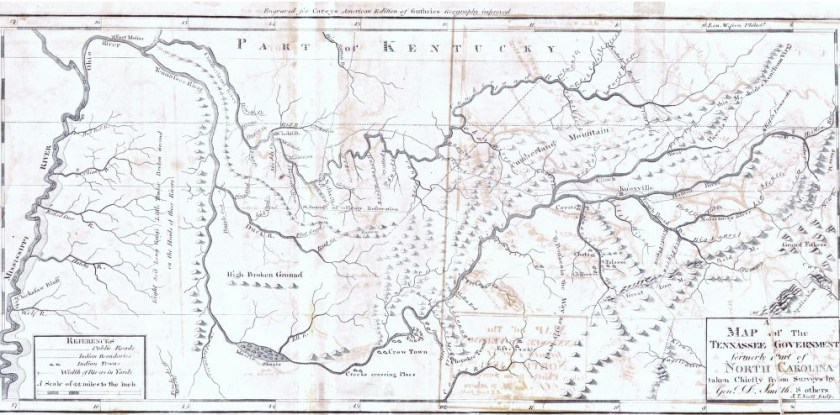
1795 Tennessee map based largely on Daniel Smith’s surveys (courtesy Alabama Department of Archives and History)

Daniel Smith held the post of territorial secretary until 1796, when the territory became the State of Tennessee. Smith was a member of the 1796 Convention and chaired the committee that wrote the young state’s first Constitution and Bill of Rights.

During the first decade of the 19th century, Smith played a key role in negotiating a series of treaties with the Cherokee. He was appointed to serve several months of Andrew Jackson’s unexpired term in the U.S. Senate (after Jackson resigned to serve on the Tennessee Supreme Court), and in 1804 was elected to his own full term in the Senate. Unfortunately, he was forced to resign from the Senate in 1809 because of ill health. He and Sarah remained at home for several more years, overseeing various farm and business interests from their Sumner County plantation house, Rock Castle, which still stands on Drake’s Creek in Hendersonville. He died there on June 16, 1818, at age 69. Both Daniel and Sarah, who died thirteen years after her husband, are buried in the family cemetery at Rock Castle. Smith County, created while Daniel was still very much alive, was named to honor his service in the Revolutionary War and his many other contributions to the development of the state of Tennessee.

Smith family cemetery at Rock Castle (Daniel and Sarah’s grave markers are the table-like platforms at upper right behind the obelisk)

* Note: This was not the only time Andrew and Rachel Jackson helped a young couple elope! See also https://nashvillehistoricalnewsletter.com/2021/11/20/til-death-do-us-part-love-and-devotion-at-city-cemetery/

Luke Lea: A Biographical Sketch

by Doris Boyce.

Luke Lea was born in Nashville in 1879. His grandmother was a descendant of Judge John Overton, law partner of Andrew Jackson. His grandfather, John McCormack Lea, was mayor of Nashville in 1849. His father, Overton Lea, was an attorney. At the time of his birth his parents owned 1,000 acres of land between Granny White and Franklin Pikes known as Lealand, part of the original acreage of Travellers Rest.

Judge John Overton, 1766-1833 (Tennessee Portrait Project)

Lea enrolled at the University of the South at Sewanee in 1896 and was awarded his master’s degree in 1900. Later that year he travelled briefly in Europe and then entered law school at Columbia University, becoming editor of the Columbia Law Review in 1903. After graduation he opened a law office in the Cole Building in downtown Nashville. In 1906 he married Mary Louise Warner, daughter of Percy Warner, and their sons were born in 1908 and 1909.

Lea organized The Tennessean Company in 1907, and by 1908 the paper was up and running efficiently enough that he was able to return to his law practice. In 1910 he chartered the Belle Meade Company for future real estate development of the 5,000-acre farm of that name, and the company presently donated 144 acres to the golf club which later became the Belle Meade Country Club.

Luke Lea was elected to the U.S. Senate in 1911, at 32 years of age, in office until 1917, at which time he took on the task of recruiting volunteers for the 114th Field Artillery. He served as their colonel until the end of the First World War.

Senator Luke Lea (1911-1917)

When Lea came home from World War I, he shifted his focus toward managing his newspapers, the Nashville Tennessean and the Evening Tennessean. Late in the 1920s he also became publisher of the Memphis Commercial Appeal and the Knoxville Journal, which he jointly owned with Rogers Caldwell.

During that same decade Lea acquired a number of properties, and he built Nashville’s first ramp-style parking garage on Seventh Avenue between Church and Commerce Streets. In 1927 he donated 868 acres for a public park that would be named for his father-in-law, Percy Warner.

In 1929 Tennessee Governor Henry H. Horton appointed Lea to the U.S. Senate to fill an unexpired term, but Lea declined, saying he could “do the greatest good and be of more service to Tennessee as a private citizen.”

Depression-era bank run on the American Union Bank, New York City. April 26, 1932.

The Great Depression brought ruin to Lea’s business affairs because of devalued assets, cash flow problems, and political maneuvering by his enemies. He was convicted of banking law violations in 1931, and his newspapers were silenced. He served two years in the North Carolina State Prison.  

Less than a month after Lea was paroled, backers approached him about running for governor of Tennessee. Still hoping to re-enter the publishing field, he turned them down.

Although Lea eventually regained his health, which had deteriorated while he was imprisoned, he never regained his wealth. When he died in 1945 at age 66, a congressional investigation was underway that might have restored the Nashville Tennessean to him once again. (1997)

Tennessee Politics 2002: A Year of Historic Change

by Pat Nolan.

Gov. Phil Bredesen

The recently concluded 2002 elections and their aftermath certainly left a historic mark on our state. The winds of change blew strongly, and much of it involved Nashvillians. We have a new governor, Phil Bredesen, a former mayor of our city and the first big city mayor to hold the state’s highest office. We have a new U.S. Senator, Lamar Alexander, who is a former governor and who has lived most of his adult life in Nashville. Finally, Bill Frist, our senior Senator, and a Nashville native, has been elevated to Majority Leader of the Senate, a position that arguably makes him one of the most powerful persons in the country, if not the world!

Dr. William H. Frist

The bruising and prolonged fight over a state income tax and a wave of state legislative retirements were also major political developments that led to change in 2002. The summer and fall elections brought the largest class of new lawmakers ever to our incoming General Assembly. But the single biggest factor in all the political change in Tennessee in 2002 came from the decision of Fred Thompson not to seek re-election to the U.S. Senate. That resulted in a fruit basket turnover of those holding office on the federal, state, and local levels. In fact, there is an almost direct link from Thompson’s decision to the election this past fall of Howard Gentry by Metro Nashville voters as the city’s first popularly elected black Vice Mayor. That’s because it was Thompson’s decision that led Bob Clement to vacate his Nashville congressional post and run (unsuccessfully) for the Senate. That, in turn, led Vice Mayor Ronnie Steine to run for Congress. During the campaign, Steine was implicated in a shoplifting scandal, which led to his resignation and the election of Gentry.

Howard Gentry Jr.

Furthermore, because of the changes on the senatorial and gubernatorial levels, there were very historic and interesting changes in our congressional delegation in Washington. For the first time in our memory, three of the four congressional districts which encompass the Greater Nashville and Middle Tennessee area (the 4th, 5th, 6th and 7th Districts) have new people now holding those seats. Yet despite all that change, some things remain the same. There has not been an incumbent Tennessee congressman defeated for re-election since 1974. That’s almost 30 years and counting!

Sen. Lamar Alexander (r) with Pres. George W. Bush

One other historic development came out of the last election about which there has been little public comment. A review of the records indicates that Lamar Alexander is the first person in the history of Tennessee to be popularly elected both Governor and U.S. Senator. Now that doesn’t mean we haven’t had people serve as both Governor and Senator. It’s happened several times. But all those occurred before the popular election of U.S. Senators. Back before 1912 and an amendment to the U.S Constitution, it was the state legislature, not the voters, who selected our Senators. Former Governor Frank Clement tried to make it to the Senate, but he was defeated by Howard Baker back in 1966.

This is not the first time Alexander has made statewide electoral history. He was also the first governor elected to two four-year terms. That was made possible again by a constitutional change (this time the Tennessee constitution). Governor Ray Blanton was the first governor to have the option to run again, but he declined.

Tennessee will have no statewide elections for almost four years (except for the 2004 Presidential election). So after a very active period of change, the election trail will be much quieter for a while. But as any student of politics, especially Tennessee politics, knows, it won’t ever be quiet politically around here for long.  (2002)


Author Pat Nolan

Editor’s note: Nashvillians know author Pat Nolan from his years of insightful election-night comments on WTVF television, where he also hosted “Inside Politics” and “Capitol View.” A graduate of Father Ryan High School and Vanderbilt University (where he was elected to the Student Media Hall of Fame for his distinguished career), Nolan later became Senior Vice President of DVL Seigenthaler Public Relations. We were extremely grateful to him for sharing this article with us after the momentous election of 2002.