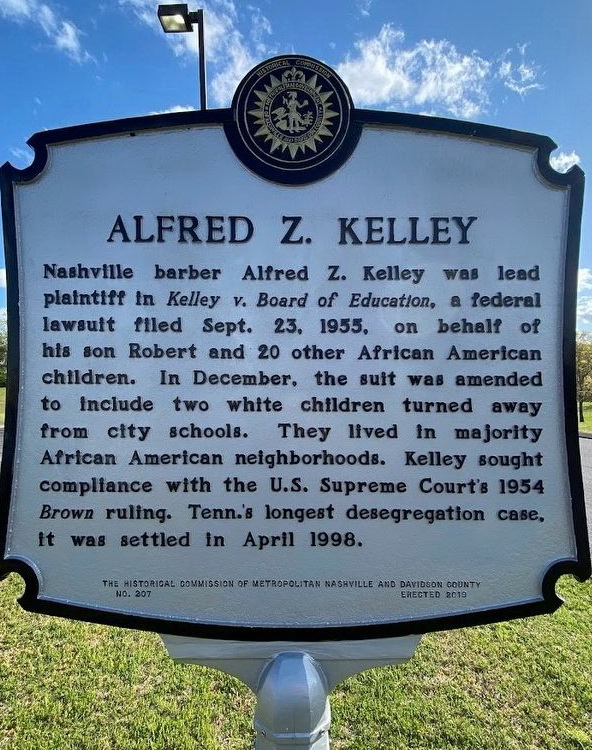
A.Z. Kelley came home from the Navy, opened Kelley’s Barber Shop, taught a few classes at Bowman’s Barber College, sang in his church choir, and became the first black secretary of the local barbers’ union. He and his wife Robbie had four beloved children, and they were delighted when the Supreme Court ordered the schools to desegregate. But when Robert, their 14-year-old, was turned away from neighboring East Junior High and sent across town to Pearl, a black school, Kelley became lead plaintiff in a lawsuit against Nashville city schools (1955). His attorneys were Z.A. Looby, Avon Williams Jr., and Thurgood Marshall (soon to become the first African American Supreme Court Justice). All four men died before Kelley v Board of Education, Tennessee’s longest-running school desegregation case, was finally settled in 1998. Meanwhile, Kelley took part in the 1963 march on Washington, served a term as president of the local NAACP chapter, and was Sergeant-at-Arms of the Tennessee State Senate.
Rev. Kelly Miller Smith, Justice Thurgood Marshall, Attorney Z. A. Looby, and Alfred Z. Kelley (Photo courtesy of Metro Nashville Public Schools)
A. Z. Kelley marker on Blairfield Dr., Antioch, Tennessee. (from Historical Marker Database, photographed by Darren Jefferson Clay)
____________________
The Greenwood Project is a series of 160-word biographies of individuals who lie at rest in Mt. Ararat and Greenwood cemeteries, two historic African American burial grounds in Nashville, Tennessee. The project, which began in September 2014 (and is still available on Facebook, at https://www.facebook.com/profile.php?id=100064806156276), shares the stories of more than 300 consequential individuals, primarily African American, who changed the course of city, state, and national history through their words and deeds. (All biographies were written by Kathy Lauder unless otherwise noted.)
On to Liberty (Theodore Kaufmann, 1867; Metropolitan Museum of Art)
Born into slavery in Charlottesville, Virginia, Sally Thomas, the slave of Charles Thomas, bore two sons to John, her owner’s brother – John, born in 1808, and Henry, born a year later. Around 1817 Sally and her children were sent over 550 miles to Thomas family land near Nashville. Here her owner allowed her to take in laundry if she gave him some of the profits. Ceding control over her, he made her a “quasi-slave,” who could rent her own house, move about freely, buy, sell, and negotiate her own business contracts. Although in time her owner even stopped requiring her to share her earnings with him, Sally was still legally considered his property.
Justice John C. Catron (portrait by Chester Harding, Tennessee Portrait Project/TSLA)
In 1827 attorney John C. Catron fathered Sally’s third son, James P. Thomas. Sally and her children lived then at the corner of Cherry (4th Avenue) and Deaderick Streets, a block from the Davidson County Courthouse. There she ran her laundry business, saving money to purchase the freedom of her children. Sally’s oldest son, John, worked for a Nashville barge captain, even taking his last name. Captain Rapier, who had taught John to read and write, saved his own money to free John, and in 1829 his executors obtained permission from the Alabama General Assembly to use estate funds to purchase John’s freedom.
In 1834 Sally learned that she, Henry, and James were being returned to Virginia to settle her owner’s estate. Fearing they would be sold separately, she urged Henry to escape. Hiding by day, avoiding farms where he might be spotted, Henry fled north to Louisville, Kentucky, only to be caught and jailed. Still chained, he miraculously escaped the first night in a stolen boat. Surviving a plunge over the Falls of The Ohio, he crossed into Indiana, where a sympathetic individual removed his chains. Henry eventually arrived in Buffalo, New York, where he worked as a barber; he later moved to Canada.
Meanwhile, to keep James from being sold away from her, Sally persuaded attorney Ephraim Hubbard Foster to help her buy the child from John Martin, the Thomas relative who owned him. Martin wanted $400 for the seven-year-old, but Sally had saved only $350. Foster agreed to lend her the other $50 and arranged the sale with Martin. Although Sally soon paid off her debt to Ephraim Foster and personally held James’s bill of sale and “free papers,” under Tennessee law James was still considered Foster’s slave. Since the 1834 state Constitution required free blacks to leave Tennessee immediately or return to slavery, James had to appear to be someone’s property in order to remain in Nashville.
Senator Ephraim H. Foster (portrait by Washington B. Cooper, Tennessee Portrait Project / Cheekwood Museum of Art)
Sally purchased her own freedom with the assistance of Godfrey M. Fogg (nephew of educator Francis B. Fogg, and law partner of Ephraim Foster), who loaned her part of the money. Deeds in the Davidson County Courthouse list Sally as the property of G. M. Fogg, and James as the property of Ephraim Foster – legally Sally and James would remain slaves until the courts ruled them free and permitted them to remain in Tennessee as free persons. Regrettably, Sally died in 1850, before such a ruling was made. James, now running a barbershop in the house Sally had rented at Deaderick and Cherry, purchased a grave site for her in City Cemetery, erecting a tombstone inscribed, “Sally Thomas 1787-1850.” On March 6, 1851, Ephraim Foster petitioned the Davidson County Court to allow him to free James. The court found in favor of the petition, Foster posted a bond, and James was free. James’s own petition to be permitted to remain in Nashville was also approved, with the posting of a good character bond. Ironically, James was the natural son of Tennessee’s Chief Justice, John C. Catron, whom Andrew Jackson had appointed to the U. S. Supreme Court during his last days in office, when the court was expanded to nine members. Thus Catron’s Dred Scott ruling that African Americans were property and had no citizenship rights applied to his own son. (2009)
Dedication ceremony for new Sally Thomas grave marker, 2009
Sally Thomas died during Nashville’s 1850 cholera epidemic. In 1908 her tombstone could still be found, but by 2005 it was no longer standing. In 2009 a replacement tombstone for Sally Thomas was dedicated in a well-attended ceremony at City Cemetery.
Previously published in Monuments & Milestones, the Nashville City Cemetery newsletter.
The story of the Thomas-Rapier family is the subject of the book In Search of the Promised Land: A Slave Family in the Old South by John Hope Franklin and Loren Schweninger (Oxford University Press, 2005).
Primary Source Document, transcribed by Mike Slate.
Yesteryear’s folding booklets of postcards sometimes included a few paragraphs about the featured state or city. The text below, which reads as though it might have been prepared by the local Chamber of Commerce, came from a booklet of postcards published by S. H. Kress & Co. and is hand-dated September 15, 1924. Ephemera like this can often provide both interesting data and thought-provoking interpretive possibilities.
NASHVILLE, TENNESSEE
Nashville is the Capital City of Tennessee, and the County Seat of Davidson County.
Four railroads serve the city. Forty-four passenger and sixty-eight freight trains arrive in Nashville daily.
The Cumberland River is navigable 210 miles down the river practically the year round and 352 miles up the river for about six months, and the work of installing new locks and dams will increase this practically to ten months each year. Nashville has seven bridges across the Cumberland River.
There are 22 parks and playgrounds, containing 468 acres. Centennial Park has the only replica of the Parthenon in the world. Shelby Park has a nine-hole municipal golf course. The Vanderbilt Stadium seats 22,000 people, and is the largest athletic field in the South. Nashville’s water supply is pure and inexhaustible, with more than 50,000,000-gallon capacity daily. The Tennessee State Fair, one of the largest expositions in the South, is held in Nashville each year. The Public Auditorium has a seating capacity of 5,000 persons.
Nashville’s Parthenon is the only full-size replica of the original building.
Vanderbilt University, with assets of $11,000,000, has entrance requirements and a curriculum equal to any university in the United States, and has drawn students from every state in the Union and from eight foreign countries. It has an endowment of $6,850,000. The medical department has an endowment of $3,500,000, and is erecting the most complete medical school in the South and one of the finest in America.
The only Y.M.C.A. College in the South is located in Nashville.
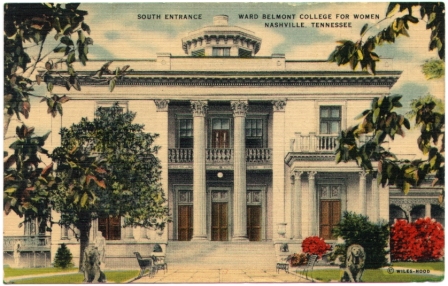
Three institutions for women, Ward-Belmont, St. Bernard Academy, and St. Cecilia, draw students from practically every state in the Union. Ward-Belmont alone has over 600 non-resident students.
Ward-Belmont School (postcard from NHN collection)
The Southeastern School of Printing has $80,000 worth of equipment, and is the only school of its kind in the South.
The Fisk Jubilee Singers have sung in every Capital and at every court in Europe.
The Fisk Jubilee Singers: from left, B. W. Thomas, Julia Jackson, Maggie Porter, Ella Sheppard, F. J. Louden, H. D. Alexander, Georgia Gordon, Jennie Jackson, America Robinson, Thomas Rutling
George Peabody College for Teachers, with an investment of $4,000,000 and 20 departments, is the only teachers’ college in the South, and the second largest in the United States. It has an endowment of $2,500,000, and in 1922-23 had an enrollment representing 36 states and 5 foreign countries.
It leads all other cities in the South in livestock, butter, poultry, grinding of wheat, eggs, and various agricultural products.
The mean annual temperature is 60 degrees; the average summer temperature is 78 degrees; and average winter temperature is 41 degrees.
The average annual rainfall is 47.2 inches, humidity moderate, and no sunstrokes are recorded.
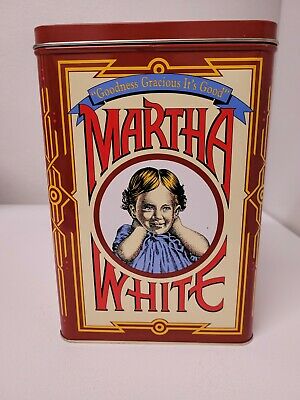
Nashville has more than 500 manufacturing enterprises, makes more self-rising flour than any city in the world (“Goodness gracious, it’s good!”), and is one of the two largest hardwood flooring markets in the world. Its annual hardwood flooring output would pave an automobile boulevard 10 feet wide from Nashville to New York. Over 35,000,000 pounds of green coffee are roasted annually.
The Hermitage, the home of Andrew Jackson, is located near Nashville, and is one of the show grounds of America.
Three Presidents of the United States, Andrew Jackson, James K. Polk, and Andrew Johnson, have lived in Nashville. Jackson is buried at the Hermitage and Polk on the grounds of the historic State Capitol.
The Battle of Nashville, one of the major engagements of the Civil War, was fought partially within the city limits on December 15 and 16, 1864.
William Driver, a New England sea captain who named the American flag “Old Glory,” is buried in the old City Cemetery.
William Driver reenactor at a recent City Cemetery Living History tour
William Walker, the “Grey-eyed Man of Destiny,” the most famous of all American filibusters, was born and reared in Nashville. Walker became president of Nicaragua and raised the blood-red five-point star of the United States of Central America, but he failed in his plans and was shot by a firing squad. (1997)







 Nashville Historical Newsletter