George Woods, 1842-1912

by Kathy B. Lauder.

Most authorities agree that George Woods and his brother Joseph were the first African American archaeological field technicians in Tennessee,1 if not the nation. George Woods (born into slavery in March 1842)2 also became the first African American to supervise important mound excavations.

When Frederic Ward Putnam (1839-1915), curator of Harvard University’s Peabody Museum of Archaeology and Ethnology for 34 years,3  came to Nashville in 1877 for  a meeting of the American Association for the Advancement of Science, he stayed on to explore several important archaeological sites in Davidson and Wilson counties.4 Before returning to Harvard, Putnam employed railroad construction contractor Edwin Curtiss5 as his foreman for the Peabody digs; Curtiss hired the laborers, including, in 1878,6  brothers George and Joe Woods, the only two workmen mentioned by name in his extensive correspondence with Putnam. The Woods brothers rapidly earned a reputation for skill and reliability. Writing from an Arkansas dig, Curtiss complained that the available field hands were “not worth feeding . . . I can get two old hands that have been with me for two years in Nashville and do more with them than I can with 5 of those here and be sure of them every day.”7

After Curtiss’s sudden death in December 1880,8 George Woods wrote to Professor Putnam about continuing Harvard’s archaeological efforts in Tennessee. His letter initiated an interesting correspondence, its principals being one of America’s most prominent scientists and a working-class black man whose nearly illegible handwriting featured his own creative spelling.9 In one letter he mentioned some artifacts remaining at the Jarman dig, explaining that he would return to pick up “thos spesmints that I laft thir in Decbur”10 in order to pack them up for shipment to the Peabody.

A Mississippian figure discovered in Humphreys County, Tennessee.

During the 1882 and 1883 seasons,11 Putnam hired Woods as foreman on the Jarman Farm site12 (sometimes called the Brentwood Library site) in Williamson County, where archaeologists have classified many outstanding examples of Mississippian culture (700 – ca.1600 A.D.),13 including pots, bowls, and both human and animal effigies. Later Putnam placed Woods in charge of the John Owen Hunt Mound dig in Williamson County while still collecting artifacts from the Jarman and Hunt excavations, as well as Dr. Oscar Noel’s farm/cemetery in Davidson County and Judge William F. Cooper’s farm, “Riverside,” in East Nashville near the McGavock Pike ferry landing.

Woods ended his association with Putnam about 1884, but continued to work at Middle Tennessee sites with “local antiquarian archaeologist”14 Gates P. Thruston from 1885-1890. In the Gates P. Thruston Collection of Vanderbilt University, now housed at the Tennessee State Museum,15 may be found several artifacts collected by George Woods,16 who, in later years, worked as a blacksmith, railroad porter, and quarryman.

George Woods, who died January 26, 1912,17 is memorialized on Tennessee Historical Commission marker #3A 217 near the entrance to Greenwood Cemetery, where he is buried.18


Note: Several sources give Woods’s death date as September 28, 1912, but both the Tennessee Death Records, 1908-1958, and the Tennessee, Deaths and Burials Index, 1874-1955, cite the January date, which is listed on his death certificate. (2015)


SOURCES:

1 Moore, Michael C., and Kevin E. Smith. “Archaeological Expeditions of the Peabody Museum in Middle Tennessee, 1877-1884.”  Nashville: TN Department of Environment & Conservation, Division of Archaeology, Research Series No. 16, (rev. 2012), 8.  https://www.tn.gov/environment/docs/arch_rs16_peabody_museum_2009.pdf

2 Moore, Michael C., Kevin E. Smith, and Stephen T. Rogers. “Middle Tennessee Archaeology and the Enigma of George Woods.” Tennessee Historical Quarterly, Vol. LXIX, Number 4 (2010), 321.

3 Tozzer, Alfred M. Biographical Memoir of Frederic Ward Putnam, 1839-1915, Vol XVI, No. 4. National Academy of Sciences: Presented to the Academy at the annual meeting, 1933, 127.

4 Moore, Michael C., et al. “Middle Tennessee Archaeology,” 320.

5 Browman, David L., and Stephen Williams. Anthropology at Harvard. Cambridge, Massachusetts: Harvard University Press, 2013, 105.

6 Browman and Williams, 105.

7 Moore and Smith. “Archaeological Expeditions,” 8.

8 Moore and Smith, “Archaeological Expeditions,” 5.

9 Moore, Michael C., et al. “Middle Tennessee Archaeology,” 323.

10 Moore, Michael C., et al. “Middle Tennessee Archaeology,” 323.

11 Browman and Williams, 106.

12  Putnam, F. W. “Abstract from the Records,” February 18, 1884. Annual Report of the Trustees of the Peabody Museum of American Archaeology and Ethnology, Volume 3. Boston, Massachusetts: John Wilson and Son, 1887, 351.

13 “Mississippian Culture: Ancient North American Culture.” Encyclopædia Britannica Online. Encyclopedia Britannica Inc., n.d.  Web.  (Accessed 10 May 2015)   http://www.britannica.com/EBchecked/topic/385694/Mississippian-culture

14 “George Woods, 1842-1912.” Tennessee Historical Commission Marker #3a 217, on north side of Elm Hill Pike between Spence Lane and entrance to Greenwood Cemetery.

15 Smith, Kevin E. “Gates P. Thruston Collection of Vanderbilt University.”  Tennessee Encyclopedia of History and Culture. Nashville: Tennessee Historical Society. Online Edition ã 2002-2015, The University of Tennessee Press, Knoxville, Tennessee.

16 Moore, Michael C., et al. “Middle Tennessee Archaeology,” 324.

17 Tennessee Death Records, 1908-1958, Roll #5. Nashville: Tennessee State Library and Archives.

18 “George Woods, 1842-1912.” Tennessee Historical Commission Marker #3a 217.

SUGGESTED READING:

Moore, Michael C. The Brentwood Library Site (A Mississippian Town on the Little Harpeth River, Williamson County, Tennessee). Tennessee Division of Archaeology Research Series (Book 15). Nashville: Tennessee Department of Environment and Conservation, 2005.

Moore, Michael C., Kevin E. Smith, and Stephen T. Rogers. “Middle Tennessee Archaeology and the Enigma of George Woods.” Tennessee Historical Quarterly, Vol. LXIX, Number 4 (2010), pp. 320-329.

Smith, Kevin E., and James V. Miller. Speaking with the Ancestors: Mississippian Stone Statuary of the Tennessee-Cumberland Region. Tuscaloosa: University of Alabama Press, 2009.
Outstanding 20th Century Tennesseans

List compiled by Dr. Edwin S. Gleaves.

In March of 2006 Dr. Edwin Gleaves, retired State Librarian and Archivist of Tennessee, sought from seven history enthusiasts their choices of twenty-five notable 20th-century Tennesseans every student of Tennessee history should know. Dr. Gleaves compiled the individual lists into a master roster of 31 names for presentation to the Tennessee history class that he was currently teaching at Lipscomb University. We were extremely grateful that he agreed to share this compilation with the NHN.

One of the seven participants was Walter T. Durham, State Historian of Tennessee from 2002-2013 and author of 24 books of local history. Mr. Durham generously agreed to allow us to publish his list separately.

The busy schedules of the list-makers no doubt forced them to make quicker decisions than they might have preferred, and, of course, limiting the size of the list means that many worthy candidates had to be omitted. Nevertheless, the following entries are extremely important, not least because they demonstrate the great diversity of accomplishment in 20th-century Tennessee.

The Compiled List

Category 1: Persons Who Received Seven Nominations

Hull, Cordell (1871-1955: lawyer; judge; U.S. Representative; U.S. Senator; U.S. Secretary of State; recipient of Nobel Peace Prize)

York, Alvin C. (1887-1964: World War I Army hero; supporter of education in the Upper Cumberland region)

Category 2: Persons Who Received Six Nominations

Crump, E. H. “Boss” (1874-1954: Mayor of Memphis; controversial but influential political figure statewide)

Gore, Albert Jr. (b. 1948: U.S. Representative; U.S. Senator; Vice President; presidential candidate; environmentalist; author; teacher)

Haley, Alex (1921-1992: novelist; biographer; author of Roots; largely responsible for popularizing genealogy in this country)

Kefauver, Estes (1903-1963: U.S. Senator; vice-presidential nominee; fought organized crime and segregation)

Category 3: Persons Who Received Five Nominations

Gore, Albert, Sr. (1907-1998: progressive U.S. Congressman and Senator; fought for civil rights legislation; known as the “Father of Medicare”)

Rudolph, Wilma (1940-1994: Olympic medalist; teacher and coach)

Category 4: Persons Who Received Four Nominations

Agee, James (1909-1955: writer and critic; author of Let Us Now Praise Famous Men and A Death in the Family)

Dudley, Ann Dallas (1876-1955: state and national leader in the women’s suffrage movement)

Horton, Myles F. (1905-1990: educator; founder and director of the Highlander Folk School and the Highlander Research and Education Center)

Presley, Elvis (1935-1977: singer, entertainer; “The King”)

Ransom, John Crowe (1888-1974: poet, professor; critic; leader of the Fugitives literary movement)

Category 5: Persons Who Received Three Nominations

Acuff, Roy (1903-1992: known as the “King of County Music” because of his long association with the Grand Ole Opry)

Cannon, Sarah Ophelia (1914-1996: Grand Ole Opry’s “Minnie Pearl”; supported and funded cancer research and treatment)

Clement, Frank G. (1920-1969: Governor, 1953-59 and 1963-67; noted speaker)

Giovanni, Nikki (b. 1943: poet; educator; activist)

Handy, W. C. (1873-1958: composer and musician; “Father of the Blues”)

Parton, Dolly (b. 1946: singer, entertainer; founder of the Imagination Library)

Smith, Bessie (1894-1937: nationally prominent blues singer)

Category 6: Persons Who Received Two Nominations

Alexander, Lamar (b. 1940: Governor, 1979-86; President, University of Tennessee; U.S. Secretary of Education; U.S. Senator)

Atkins, Chet (1924-2001: music executive; guitarist par excellence)

Baker, Howard Jr. (1925-2014: U. S. Senator, minority and majority leader; ambassador to Japan; presidential chief of staff)

Foote, Shelby (1916-2005: novelist and historian; best known for his trilogy, The Civil War)

Frist, Thomas F. Sr. (1910-1998: cardiologist and businessman; co-founder of Hospital Corporation of America)

Ingram, Martha (b. 1935: businesswoman; philanthropist; author; patron of the arts)

Lea, Luke (1879-1945: businessman; editor; military officer; financier)

McKellar, Kenneth D. (1869-1957; U.S. Senator; New Deal advocate; active supporter of the Tennessee Valley Authority)

Scopes, John T. (1900-1970: school teacher; focus of trial about teaching evolution in a Tennessee public school)

Taylor, Peter (1917-1994: novelist and short story writer; winner of Pulitzer Prize for A Summons to Memphis)

Warren, Robert Penn (1905-1989: poet; novelist; Pulitzer Prize winner; member of Fugitives group)


Walter Durham’s List

Cordell Hull (secretary of state/Nobel Peace Prize)
Al Gore, Jr. (senator/vice president)
Estes Kefauver (senator/vice-presidential candidate)
Albert Gore, Sr. (senator)
Howard Baker (senator/ambassador)
Lamar Alexander (governor/secretary of education/senator)
E. H. Crump (political boss)
Tom Frist (CEO of HCA)
Alexander Heard (education)
Ralph “Peck” Owen (Equitable/American Express)
Andrew D. Holt (TEA/NEA/UT president)
Fred Smith (founder & CEO of FedEx)
Sergeant Alvin York (war hero)
Jim Sasser (senator/ambassador)
Martha Ingram (business/performing arts)
Elvis Presley (music)
Grace Moore (music/opera)
Wilma Rudolph (Olympic athlete)
Anne Dallas Dudley (women’s voting rights amendment)
Alex Haley (Roots)
James Agee (author)
Ida B. Wells-Barnett (anti-lynching activist)
Myles Horton (educator/political activist)
Dolly Parton (music/philanthropy)

No Lighted “Segars”: Rules for Nashville’s First Bridge

Primary Source Document, transcribed by Debie Cox, author of Nashville History blog.

Note: These items from the Nashville Whig newspaper were discovered by Debie Cox among the papers of Judge Litton Hickman and submitted to us. The 1823 bridge was located at the site of the present Victory Memorial Bridge. Additional information about this bridge, including other citations from the Whig, can be found in the book Building of Nashville by Wilbur Foster Creighton.

Nashville Whig – Wednesday, June 11, 1823

The bridge across the Cumberland river at this place is so far completed that horses, carriages do now pass over it.

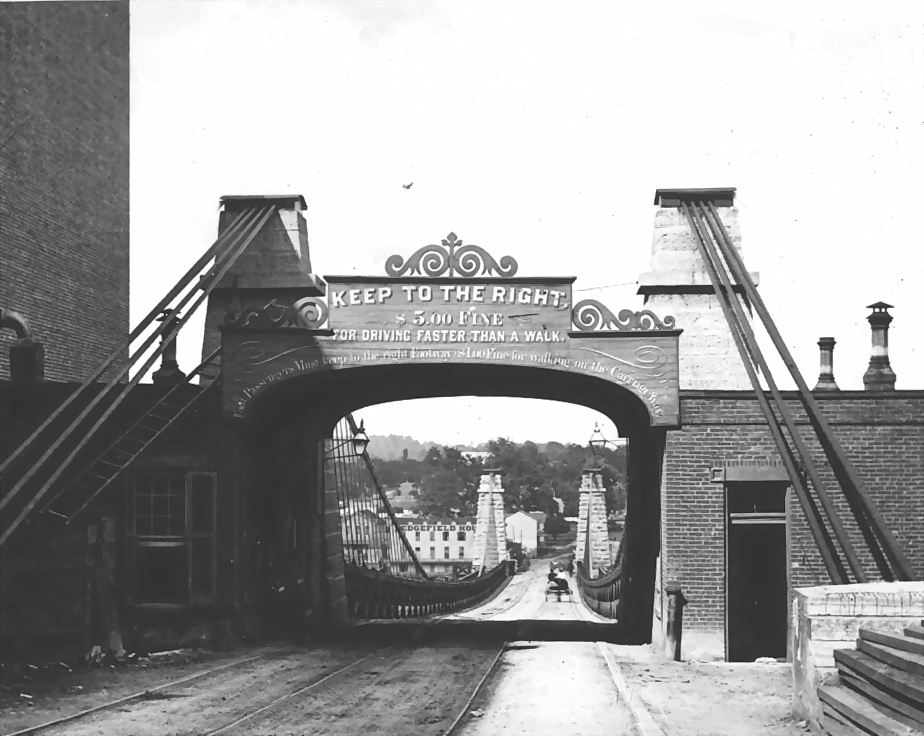
The sign on this early Nashville bridge reads, “Keep to the right. $5.00 fine for driving faster than a walk. Foot Passengers must keep to the right Footway. $1 fine for walking on the carriageway.” (photograph courtesy of Tennessee State Library and Archives)

Nashville Whig – Wednesday, July 21, 1823

Extract from the By-laws and rules adopted by the Directors of the Nashville Bridge Company…

Sec. 4 Be it resolved, that the following rules, by laws and regulations shall be observed by the gate-keeper and by all persons in using, passing or being on said bridge to wit: It shall not be lawful for any person or persons, having or driving any drove of horses, mules, cattle or hogs to drive or pass on said bridge in one drove at the same time in more than the following number to wit: horses, mules or cattle, not more than ten head, of hogs not more than twenty head, and it shall not be lawful for any loaded wagon to pass on or cross said bridge within less than one hundred yards of another loaded wagon, and that it shall not be lawful for any person passing over said bridge on horseback or with a cart, wagon or carriage or with a drove of horses, mules, cattle or hogs to make any delay on said bridge except such as is unavoidable, and it shall not be lawful for any person riding on horseback or driving any cart, wagon or carriage on said bridge or driving any drove of horses, mules, cattle or hogs over same to drive faster than a walk.

It shall not be lawful for any foot passenger to travel on the road allowed for horses and carriages at the time that there is any horses or drove of horses, mules cattle or any wagon, cart or carriage passing thereon except it be such person as shall have the same charge, nor shall it be lawful for any foot passenger to molest, disturb, frighten any horse or drove of horses, mules, cattle or hogs, when passing on said bridge.

It shall not be lawful for any person to carry over or have on said bridge any coal or chunk of fire, nor to make or carry with him on said bridge any lighted segar or pipe, and if any person or persons shall willfully commit a violation of any of the rules above described he, she or they so offending shall be subject to pay the sum of five dollars for every such offence to be recovered before any tribunal having jurisdiction thereof by a warrant in the name of the Nashville Bridge Co., for the use of the said company.

It shall be the duty of all foot passengers to pass the footway on the right hand as they are going, and it shall be the duty of all passengers on horseback or driving any wagon, cart or other wheel carriage or driving any drove of horses, mules, cattle, sheep or hogs to pass over on the right hand way.

It shall not be lawful for the gate-keeper to permit any slave to pass said bridge at any time after nine o’clock at night and before day light in the morning without a written pass from his or her master or mistress expressing such permission.

Nashville Memories: The Worried Wife of Deer Park

by Carter G. Baker.

Back in the boom years of the 1920s when Prohibition was the law of the land, it was impossible to have a real cocktail party legally.  The liquor had to be bought from a bootlegger, and there was always the chance that it might be contaminated with an additive that could cause serious problems of a neurological nature.  One possible result was called “jake leg” or “iron foot” because of the way the victim staggered along looking as if he’d had a stroke.

However, knowledgeable Nashvillians had a way to protect themselves from unintentionally poisoning their guests – or themselves – with bad whiskey.  A cheap insurance policy came in the form of an old sot who hung around on West End or Elliston Place in the Vanderbilt area.  This fellow would drink anything that had alcohol in it, and he had turned his unique talent into a source of income.  For fifty cents or a dollar, he would taste a sample of your bootleg liquor or sip from the jar of moonshine your cousin had brought in from the country.  You might hope it hadn’t been distilled through an old car radiator full of lead, but you didn’t know for sure.  The tester would take a few swallows and give you an opinion of the quality of your cocktail makings.

One memorable Saturday evening a well-known Nashville lawyer and his wife hosted a dinner party at their lovely Belle Meade home.  The food was delicious and the bar, stocked with taste-tested Bedford County moonshine, was well-attended.  These elite citizens of a much smaller Nashville, where everyone knew everyone, had a wonderful time and left in a happy mood, singing the praises of the host couple.

But the next Wednesday morning as the wife drove along West End Avenue in her big Packard automobile, she saw a most disturbing sight. The old booze tester was limping along looking for all the world as though he had a bad case of jake leg.  Mrs. Lawyer panicked, found the first pay phone she could, and called her husband to tell him that they’d given their guests bad whiskey, and that he needed to get down there right away and find out what was going on.

The husband made his excuses to the client sitting in front of him – a man who had, in fact, attended the party – and raced out toward Centennial Park looking for his quarry.  He found the old-timer sitting on the stone wall in front of the park rubbing his foot and looking rather feeble. A few questions quickly lifted the curtain of fear as the old boy said that he didn’t have the jake, but only a bad corn on the ball of his foot.  With a sigh of relief, the lawyer handed him a quarter and sent him off to buy some corn plasters.

The lawyer immediately drove to Kensington Place where his wife waited at a friend’s home, fearing the worst. He set her mind at ease with the good news and they went on their way, a much happier couple.  Still, they resolved that night never to serve corn liquor at a party again.  From that day forward, they spent a few more dollars and bought the bonded blends shipped down from Canada and sold through a reputable bootlegger. 

John Dillahunty and Baptist Origins in Nashville

by Robert Lyle Williams.

 The first Baptist church south of the Cumberland River, the Richland Creek Church, was founded by John Dillahunty, a Maryland-born Baptist preacher. His father is recognized as having been a Huguenot, but John was raised as a Catholic, in his mother’s religion. His “De La Hunte” paternal grandparents reportedly fled from France to the Netherlands in 1685 and then to Ireland in 1695. No primary-source documentation has been located regarding Dillahunty’s grandparents, their ancestry, or the definitive spelling of their surname.

After John married Quaker Hannah Neal in 1747, their respective churches excommunicated them. Around 1751 they relocated to North Carolina where John became the first sheriff of Craven County. He received a colonial land agent commission which spelled his name “Dillahunty,” a spelling he and his Tennessee descendants continued to use.

Dillahunty heard the celebrated George Whitefield preach in 1755 and was later converted by the preaching of Shubal Stearns and baptized by Philip Mulkey, both Baptists. He became a deacon and licensed preacher prior to the Revolutionary War, during which he served as a chaplain.

John led a group of families to Davidson County in 1795. The following year he founded Richland Creek Church. The church building was a log structure sited on the south bank of Richland Creek. A 1925 eyewitness account placed the location across from the Belle Meade golf course, about 300 yards west of the clubhouse.

John Dillahunty died February 8, 1816, in his 88th year. Hannah died soon thereafter, on May 5, 1816. Their 67-year marriage had produced nine children, all of whom lived into adulthood. John and Hannah were buried together in a small cemetery next to the Richland Creek Church, the stone foundation of which survived into the 20th century, along with the cemetery. A 1931 Colonial Dames survey documented seven tombstone inscriptions, including those of John and Hannah Dillahunty.

Local historian and General Harding descendant Ridley Wills II recalls playing among the Dillahunty graveyard tombstones on Nichol Lane near Richland Creek. In early 2003 the Davidson County Cemetery Survey located the likely cemetery site on Nichol Lane. In March 2003, employing a probe, Tennessee State Archaeologist Nick Fielder verified the presence of two graves at this location.

The Dillahunty tombstones were moved to a memorial chapel at Baptist Hospital sometime after World War II. The hospital has since been unable to determine their disposition; their present location is a mystery awaiting resolution.

Elder Joel Anderson succeeded John Dillahunty as pastor of Richland Creek Church. Anderson moved the church one or two miles west from its original location and changed the name to Providence Church. He was succeeded by Elder John Little, then by the Rev. Jesse Cox, who served the church for 42 years. It is no longer extant.

In his 85th year Jesse Cox wrote, “I heard Elder Dillahunty preach regularly once a month for about eight years; he was a man of small stature, and was, being old, quite feeble. He was not an orator, but sound in the faith, of unblemished character and commanded large congregations. Some of his members were among the best citizens of Nashville.”

Garner McConnico, a Virginia Baptist minister, came to Tennessee around 1798. He had personal doubts about continuing his ministry but was inspired by John Dillahunty to found, in 1800, the Harpeth Baptist Church, which he led as pastor until his death in 1833. McConnico was instrumental in the 1803 organization of the Cumberland Association; he was its first Moderator and served in that capacity until his death.

John Dillahunty was also involved with the Mill Creek Church, the second Baptist church south of the Cumberland (founded in 1797). In 1806 the Mill Creek Church met in conference and chose “Brother Dillahunty” as Moderator. Mill Creek’s first and long-time pastor, James Whitsitt, served as an executor of Dillahunty’s will.

Postcard image of First Baptist Church from NHN collection

There was no Baptist church in Nashville until James Whitsitt aided Jeremiah Vardeman in establishing the first one in 1820. Its initial membership was comprised of transfers from Mill Creek. The new church adopted the name First Baptist Church of Nashville in 1830.

The Mill Creek Valley Turnpike

by Susan Douglas Wilson.

Antioch Pike, a well-traveled road in southern Davidson County, has origins much earlier than most people realize. Before it became designated as Antioch Pike, it was known as the Mill Creek Valley Turnpike. Work began on the turnpike in the middle of the last century during a time of considerable road development in Tennessee.

An act to incorporate the Mill Creek Valley Turnpike Company was passed by the Tennessee General Assembly on January 21, 1846. E.C. Butler, Dr. Lafayette Ezell, Hinchy Petway, Clement W. Nance, Charles M. Hays, Hays Blackman, James Hamilton, Thomas Bell, Alexander Carper, John G. Briley, William H. Haynes, Nathan H. McFadden, David R. Gooch, Joel A. Battle, and William M. Battle of Davidson County, along with Joseph Kimbro, William Roulhac, John Shacklett, John C. Gooch, and Charles H. Walden of Rutherford County were named commissioners of the turnpike. The commissioners were appointed to open the books for the subscription of stock to be used in constructing a macadamized turnpike from Nolensville Road to Bowling Green in Rutherford County. The capital stock of the company was thirty thousand dollars divided into shares of twenty-five dollars each.

The turnpike was to be located near the four-mile point of the Nolensville Turnpike, running near Thompson’s Mills, up the valley of Mill Creek, crossing Mill Creek near Rains’ Mills, continuing up the valley of Mill Creek, passing Antioch meeting house, across Collier’s Creek to Bowling Green in Rutherford County. The road was to be graded twenty-five feet wide and within five degrees of level, and covered with fine-beaten stone or gravel, sixteen feet wide and nine inches deep, with ditches on both sides.

The Turnpike Company could erect a gate in order to charge and receive tolls every five miles. The tolls would be the same as those established for the Franklin Turnpike Company: ten cents for every twenty head of sheep or hogs, twenty-five cents for every head of neat or horned cattle, three cents for every horse or mule not employed in drawing a carriage, twenty-five cents for every four-wheel carriage, twelve and one-half cents for every two-wheel riding carriage, twenty-five cents for every loaded wagon and twelve and one-half cents for every empty wagon, six and one-fourth cents for every man and horse, and six and one-fourth cents for every hogshead of tobacco. The tolls were to be applied to the finishing and the completing of the turnpike. (1997)

John Montgomery’s Nashville Nap

by Mike Slate.

“Stand at Cumberland Gap and watch the procession of civilization, marching single file – the buffalo following the trail to the salt springs, the Indian, the fur-trader and hunter, the cattle-raiser, the pioneer farmer – and the frontier has passed by.”  Frederick Jackson Turner, 1893

How does someone get into a major history book by taking a nap? Whatever his reasons, iconic 19th-century historian Lyman C. Draper (1815-1891) thought an account of John Montgomery’s Nashville nap important enough to insert into his biography of Daniel Boone. Draper’s anecdote, virtually unknown except to Boone scholars, is reproduced here by permission of Stackpole Books (The Life of Daniel Boone, ed. by Ted Franklin Belue, p. 266):

“Among this band of Nimrods was John Montgomery. Having hunted awhile around Station Camp Creek and the neighboring licks, he concluded he would like to go alone and visit the French Lick region and informed his companions as he started not to be alarmed on his account should he be a week or two absent. He loitered around French Lick a day or so, and then went to what was afterwards called Robertson’s lick on Richland Creek, five miles west of the present city of Nashville. His object was not game but to view the country. Entering a thicket adjoining the lick, he lay down to take a nap and soon dreamed that if he did not take care, the Indians would kill him. So vivid was the dream that it alarmed and awakened him. While thinking of it, a gun was fired not apparently a hundred yards from him, and in a few moments a stricken deer came dashing through the bushes and fell dead almost at his feet. Knowing that Indians were close upon him, he hesitated whether to waylay the fallen deer or retreat further into the thicket; but upon a moment’s reflection he concluded that he had better quietly withdraw; for, should he wound or kill an Indian, he feared it would at least fill the minds of his hunting companions with apprehensions of retaliation, or even break up their hunting expedition with the loss of some of the party.  Acting upon this discreet conclusion, he crept carefully away and returned to the Station Camp.”

This statue of John Montgomery now stands in downtown Clarksville, Tennessee (photo from NHN collection)

While Draper’s Montgomery story may initially seem only mildly intriguing, a second look suggests some significant “firsts,” as well as a tragic irony. To my knowledge, this is the youngest age at which the future founder of Clarksville and source of Montgomery County’s name enters substantively into the historical record. According to Draper’s summary of John Montgomery’s life, which appears near the end of our story’s chapter (p. 272), Montgomery was born in 1748. Since the context of Draper’s anecdote is a 1771 group hunting and exploring expedition, Montgomery was only about 23 years old when he had his frightful dream near the natural salt licks that would, about eight years later, give rise to the new outpost of Nashborough (later Nashville).

Although there is a Station Camp Creek associated with Daniel Boone in eastern Kentucky, in our narrative Draper is no doubt referencing the one in today’s Sumner County, Tennessee. Groups of “Long Hunters,” so called because of their lengthy hunting expeditions, often established central camps in the wilderness and launched from there in smaller groups. It was from our nearby Station Camp that Montgomery began his exploration of the country around French Lick.

Draper’s reference to “Robertson’s Lick on Richland Creek” may also be a first. His 1771 context is the earliest point I know in which this salt lick and creek become elements of our written heritage. Shortly after James Robertson co-founded Fort Nashborough in 1780, he claimed land along Richland Creek that included the buffalo and deer lick and moved his family there. For a while the family lived in a log house, a replica of which stands today in H.G. Hill Park at 6710 Charlotte Pike, but Robertson soon built a comfortable brick home that, had it survived, would be located near today’s Robertson Avenue in West Nashville.

So how did John Montgomery (and later Robertson himself) manage to discover the Richland Creek/ Robertson’s Lick area? That was probably easy enough. Buffalo and deer made paths from salt lick to salt lick, with Indians stalking after the game. No doubt Montgomery simply followed the buffalo-Indian trail that ran from French Lick, the geo-historical epicenter of future Nashville, out to Robertson’s Lick, a future suburban area. Like other Nashville thoroughfares, today’s Charlotte Pike may originally have been a natural buffalo trace, and Montgomery was probably among the first white men to travel that ancient “road.”

Daniel Boone was the most famous of the Long Hunters.

Some historians malign the Long Hunters as ne’er-do-wells who escaped the drudgery of homesteading by taking to the woods, leaving wives and children to fend for themselves. While such criticism tends to counterbalance overly romantic views of the storied woodsmen, it certainly does not apply to John Montgomery. Far from lazy, he was among the busiest of American frontiersmen. After his career as a Long Hunter, he commanded troops under George Rogers Clark in the Illinois campaign of the Revolutionary War and, in concert with Col. Evan Shelby, quelled the fierce Chickamauga Indians near today’s Chattanooga, Tennessee. In 1780 he returned to the French Lick, presumably with his family, aboard the Donelson flotilla to Fort Nashborough, where he signed the Cumberland Compact. He served briefly as sheriff of the Cumberland district before co-founding Clarksville in 1784 with surveyor Martin Armstrong. Montgomery named the new city for his former colonel, George Rogers Clark.

After returning from the apocalyptic 1794 Nickajack expedition, in which he once again led troops against the Chickamaugans, Montgomery was killed and scalped by Indians while hunting near Eddyville, Kentucky, on November 27, some 23 years after his prescient dream at Robertson’s Lick. Although history’s ironies often delight us, this one compels a moment of silence. Draper, perhaps after his own quiet reflection, eulogized our fallen luminary as “brave to a fault, generous, and kind; six feet, two inches in height, with blue eyes, auburn hair, ruddy complexion, handsome features, possessing great strength and activity, and presenting altogether a real border war hero whose ‘lofty deeds and daring high’ excite our liveliest admiration” (p. 272).


Sources: Draper’s The Life of Daniel Boone; Durham’s The Great Leap Westward: A History of Sumner County, Tennessee; Haywood’s The Civil and Political History of Tennessee; Kelley’s West Nashville…Its People and Environs; Consultation with Ilene Jones Cornwell; Goodpasture’s “Colonel John Montgomery,” Tennessee Historical Magazine 5 (1919), pp. 145-150, and online.  


This article was first published in the January 2010 edition of The Nashville Retrospect.  We thank publisher Allen Forkum for his permission to republish it here.  

Sampson W. Keeble, 1833-1887

by Kathy B. Lauder.

Sampson Wesley Keeble, Tennessee’s first African American legislator, was born May 18, 1833, in Rutherford County.1 His parents were Sampson and Nancy Keeble, slaves of Walter “Blackhead” Keeble, whose 1844 inventory listed 11-year-old Sampson.2 (Walter Keeble referred to his slaves as his servants and reportedly treated them respectfully. His 1816 will specified that his slaves were to be treated kindly, to be educated, and to be freed as soon as the law allowed . . . and that any of his descendants who refused were to inherit nothing at all.) The youngster was bequeathed to newsman Horace P. Keeble, who employed him as a pressman on the Rutherford Telegraph and the Murfreesboro News.3 After the Civil War, during which Sampson probably served as Private H. P. Keeble’s cook, the newly freed slave settled in Nashville and found work as a barber. Part-time employment in a law office helped him pass the Tennessee bar.4 He quickly became a leading citizen of the black community, working with James Napier, Peter and Samuel Lowery, Henry Harding, Nelson Merry, and others to educate black voters and to improve their civic status and security.5 Popular and successful as a barber, he also managed a well-known boarding house, and was believed to be quite wealthy.6 He was a director of the Tennessee Colored Agricultural and Mechanical Association7 and served on one of the few all-black Freedman’s Bank boards in the country.

This bust of Representative Sampson W. Keeble was installed near the House Chamber in the Tennessee State Capitol in 2010. (photo used with permission of the sculptor, Roy Butler)

In 1872 Davidson County Republicans appointed Keeble to run for the Tennessee House of Representatives. Swept into office by the landslide vote for President Grant, he became the first African American to serve in the state legislature. He introduced several bills aimed at improving the condition of black citizens, but none received sufficient votes to pass into law.8 He served only a single two-year term and lost a later bid for reelection (1878).

Sampson Keeble joined other prominent Nashvillians in protesting the upper-level mismanagement and fraud that threatened to topple the Freedman’s Bank,9 but Congressional response was inadequate. When the government failed to insure the existing deposits, the Freedman’s Bank collapsed in 1874, taking with it the life savings of thousands of African American depositors.

Keeble descendants at his historical marker in downtown Nashville. (photo from NHN collection)

Keeble was elected to the Davidson County Court in 1877, serving as a magistrate until 1882.10 He was a delegate to the State Republican convention and served on a number of juries, including a federal grand jury (1881).11

After the death of his first wife,12 he married educator Rebecca Cantrell Gordon. Of the six children born to them, only a son and daughter survived to adulthood.13  At some point in the middle 1880s the family moved to Marshall, Texas, where Sampson Keeble died in June 1887.14 Rebecca brought the children back to Nashville, supporting them as a seamstress. She died in 1923 in a tragic accident at her daughter’s home in Charleston, South Carolina.15 Sampson Keeble is buried with his daughter and son-in-law in Nashville’s Greenwood Cemetery under a stone which reads, “Benjamin F. Cox (1874-1952) – His Wife, Jeannette Keeble Cox (1876-1956) – Her Father, Sampson W. Keeble (1833-1887), First Negro Representative of Tennessee Legislature.”

Keeble-Cox tombstone in Greenwood Cemetery, Nashville.

On March 29, 2010, a bust of Sampson W. Keeble, created by sculptor Roy W. Butler, was unveiled near the House chamber in the Tennessee Capitol. Its base lists all fourteen African Americans elected to the General Assembly during the 19th century. (2014)


SOURCES:

1 McBride, Robert M., and Dan M. Robinson. Biographical Directory, Tennessee General Assembly, Volume II (1861-1901) Nashville: Tennessee State Library & Archives and Tennessee Historical Commission, 1979.     

2 Rutherford County Will and Inventory Book 12, 1844, 432-434 and 558-562.

3 “Representative Keeble,” Nashville Union & American, December 6, 1872.

4 Helen Davis Mills, Keeble descendant, correspondence, 2008.

5 “In Chancery at Nashville,” Nashville Republican Banner, September 3, 1872.

6 “History of a Stolen Watch,” Nashville Republican Banner, October 18, 1871.

7 “The Colored Fair, A Satisfactory Indication of Material Progress,” Nashville Republican Banner, July 16, 1871.

8 Cartwright, Joseph H. The Triumph of Jim Crow: Tennessee Race Relations in the 1880s. Knoxville: University of Tennessee Press, 1976.9 “A Memorial to the Senate and House of Representatives of the Congress of the United States,” Congressional Record, January 15, 1875.

10 “Keeble Still Ahead,” Nashville Daily American, September 2, 1876.

11 “Federal Court Jurors,” Nashville Daily American, March 16, 1881.

12 “Died,” Nashville Republican Banner, June 17, 1870.

13 U. S. Census records.

14 “Death of Sampson W. Keeble,” Nashville Daily American, July 3, 1887.

15 Ancestry.com South Carolina, Death Records, 1821-1960 [database on-line]. Provo, UT, USA: Ancestry-com Operations Inc., 2008.

SUGGESTED READING:

Cartwright, Joseph H. The Triumph of Jim Crow: Tennessee Race Relations in the 1880s. Knoxville: University of Tennessee Press, 1976.

Lovett, Bobby L. The African-American History of Nashville, Tennessee, 1780-1930: Elites and Dilemmas. Fayetteville: University of Arkansas Press, 1999.

Rabinowitz, Howard N. Race Relations in the Urban South, 1865-1890, 2nd ed. Athens, Georgia: University of Georgia Press, 1996.

“This Honorable Body: African American Legislators in 19th Century Tennessee.” Exhibits, Tennessee State Library and Archives.  https://sharetngov.tnsosfiles.com/tsla/exhibits/blackhistory/index.htm


NOTE: Internationally acclaimed sculptor Roy W. Butler, a native Tennessean, was selected by a committee of the Tennessee Arts Commission from a nationwide artist call to create the 1.5-times-life-size bronze sculpture of Representative Keeble.  Mr. Butler is renowned for creating high-realism sculpture: Keeble has been represented with exceptional skin and hair detailing, as well as historically accurate (circa 1873) jacket lapels, vest texture, bowtie, and buttons.

Out of the Ashes of Defeat: The Story of Confederate P.O.W. Edward L. Buford Sr., 1842-1928

by Terry Baker.

In 1865 the South lay in ruins.  Thousands of sick and wounded Confederate soldiers filled the hospitals or remained in prisons.  But out of the ashes of defeat would also come great success stories.

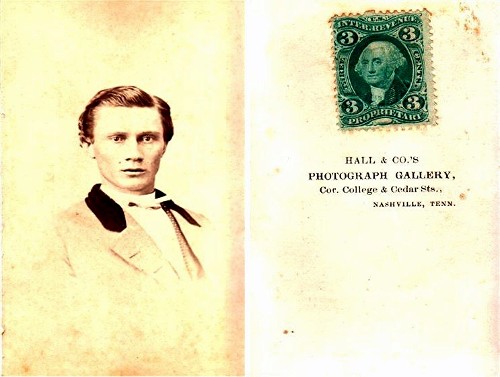
This photo of Ed Buford was taken at Hall’s Photograph Gallery on the Public Square across from the Commercial Hotel, where he boarded. In a King’s City Directory ad, Hall’s proudly stated: “HALL’S Celebrated CARTES DE VISITE Are the most Stylish Pictures made in the City.” The picture can be dated by the revenue stamp above the logo. As part of the Union effort to finance the war, photos were subject to a tax between 8-1-1864 and 8-1-1866. Ed was exchanged at City Point, Virginia, in March 1865, narrowing the date to 1865 or 1866. The original carte-de-visite has the logo and stamp on the reverse side, unlike this modern photomerge.  (from the author’s collection)

Among the ragged, half-starved men who made the long trek home that spring was 23-year-old Edward L. Buford. Born in Williamson County in 1842 to William Wirt Buford and Eleanor Pointer Buford, he was barely 19 when war broke out. The Pointers, his mother’s family, came from Virginia – Ed’s great-grandfather fought there during the Revolution. The family had spread as far west as Arkansas and Louisiana during the decades leading up to the terrible conflict that would destroy the lives and fortunes of so many.

Ed Buford joined the 3rd Tennessee Infantry in May 1861, in the company of neighbors and relatives. Within a year many of them would be among the 9,500 cold, weary, and deeply shocked Confederate prisoners shipped north by steamboat and rail after Fort Donelson fell in February 1862.

Ed’s imprisonment at Camp Douglas, Illinois, ended in September 1862, when his regiment was exchanged at Vicksburg. However, in May 1864 his luck ran out again: he was recaptured in some forgotten skirmish or unrecorded clash of picket posts. Sent to Rock Island, Illinois, he was exchanged again, at City Point, Virginia, in March 1865, and paroled in May.

Young Buford, who had been educated at Spring Hill Academy, launched his post-war career on the banks of the Cumberland River, its wharf stacked high with dry goods, cotton bales, guns, ammunition, foodstuffs, and spirits. In King’s 1866 Nashville City Directory we find him listed as a clerk at Stratton, Pointer & Co., Wholesale Grocers and Cotton Factors, at 9&11 Broad. The eponymous Pointer was Ed’s uncle, Thomas G. Pointer of Spring Hill.

Ed’s situation changed in 1867 when his uncle sold his interest in the business and moved back to his Spring Hill farm. Ed took a job as a clerk for O. Ewing & Co., Importers and Dealers in Hardware, Guns and Cutlery. By 1871 he was a salesman for Ewing, located in the old John Nichol House at 18 Public Square. He had also moved to the Maxwell House Hotel at the corner of today’s 4th and Church. If Ed had been content to remain there for the next 30 years, we might never have heard of him. The 1870 census listed as clerks many ex-Confederate officers from the wealthy land-owning clans of 1860. It was this leveling of social distinction in the post-war South that permitted Ed’s upward mobility. Although small towns and backwaters would cling to the old ways, cities like Nashville were filled with men like Ed who knew themselves to be as valuable as the officers they had obeyed in the late conflict. Moreover, in November of 1875 Ed had made a very good marriage.

William R. Elliston, the son of Joseph Thorpe Elliston, silversmith and former Nashville mayor, owned $235,000 in real estate and $58,500 in personal property, according to the 1860 census. When he died in 1870, he was even wealthier. He left his daughter Lizinka considerable property downtown, as well as the proceeds from the sale of others. When Ed married Lizinka Elliston, they moved into her mother’s house at 32 N High, today’s 6th Ave N. In 1881 Ed built a house on Elliston Street, today’s Elliston Place, where he and his family would live for the remainder of their lives.

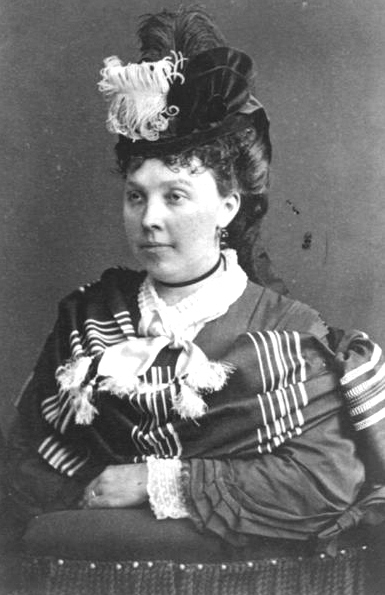
The Baker-Brady family believes this Carl Giers photo from about 1875 to be a portrait of Lizinka Ellison Buford. (from the author’s collection)

During the 1880s and 1890s Ed became a partner in several business ventures, by 1889 operating a company known as Buford Brothers Wholesale Hardware. His brother Charles was a partner until his death, at which time Ed’s brother Brown joined the firm. Edward L. Buford, ex-Confederate POW and former dry goods clerk, had finally arrived.

Along the way Ed and Lizinka had four daughters, one of whom died in infancy, and one son, Ed Jr., who would return from France a celebrated WWI flying ace. The hero’s welcome given to young Ed in March 1919 was marred by sadness when his mother died of pneumonia soon afterwards. Lizinka’s obituary stressed her community work with the YWCA and portrayed her as cultured, sensitive, and tactful – a natural leader. She was buried at Mt. Olivet Cemetery, near her parents, her daughter Louise, and her brother Elijah. In June 1928, after a long illness and confinement, Ed Buford died at age 86 and was buried next to his beloved Lizinka.

I first visited them there one gray, damp, overcast January day. That scene needed only heavy fog or howling winds to conjure up the dim past of their saga. By my second visit a month later, I was among friends, not demigods, and felt more than welcome. We become who we are through the sacrifices, choices, and missed opportunities of the people who passed this way before us. Ed Buford could have come home in 1865 to brood about defeat and the Lost Cause. Instead, he chose the future.


Author’s Notes:

1) I would like to acknowledge the genealogical research of my distant cousins Zee Porter, Linda Pointer, Fred Rowe, and Brian Bivona, who generously shared their files with me. I would never have been able to sort out this huge family without their help. Other data comes from the US Census, Nashville City Directories, Civil War Soldiers’ Records, Widows’ Pension Claims, Mount Olivet Cemetery Records, the Will of W.R. Elliston, and the Nashville Banner.

2) The figure of 9500 prisoners from Fort Donelson may be too low. This was the estimate of Nathan Bedford Forrest’s biographers Jordan and Pryor in 1867, and I accepted it, since it was so close in time to the actual events. Modern historians estimate the number to have been between 12,500 and 13, 500 prisoners. I have also since determined that Ed Buford’s second capture took place at McKernan’s Island near Muscle Shoals, Alabama, according to an account written by Ed’s future brother-in-law Norman Farrell. Farrell wrote of a small cavalry skirmish that took place there within a few days of Ed’s capture. Ed wasn’t alone when he tried to cross the Tennessee River while on leave: with him was William Jackman of Carter’s Tennessee Cavalry, also on leave.

3) Ed Buford fell off a moving train in North Carolina after his exchange in 1865. His injuries were severe enough to delay his return home until July 7, 1865, weeks after the surrenders of Lee in Virginia and Johnston in North Carolina. His second stint as a POW probably saved his life, and his fall from the train, although painful, kept him out of the final battles in North Carolina.

Woodlawn Memorial Park

by Doris Boyce.

A scene in the Forehand compound in Woodlawn Memorial Park (photo from NHN collection)

Woodlawn Memorial Park, a cemetery established in the 1930s and acquired in 1993 by Houston-based Roesch-Patton Corporation, occupies a piece of ground rich in local history. The property, which eventually became known as Melrose, was part of John Topp’s Revolutionary War Grant #461 of November 25, 1788. The original 960 acres were reduced by a sale to Michael Deadrick, first president of the old Nashville Bank. The remaining 205 acres were purchased in 1836 by a United States Senator from Louisiana, who built a mansion there. In December 1865, the property was the site of a field hospital during the Battle of Nashville. Even today a group of log cabins, a spring house, and a man-made pond can be found near the site where the Melrose mansion once stood. Present-day Woodlawn cemetery is part of the 205-acre site that once ran from what is now the Melrose shopping area on Franklin Road to Melrose Avenue between Bransford Avenue and Nolensville Road. 

Melrose Mansion, built in 1836 by Louisiana planter Alexander Barrow II, was sold six years later to John W. Saunders, who died shortly after taking possession of the property. In 1845 Saunders’ widow married Aaron V. Brown, just after his inauguration as the thirteenth governor of Tennessee. Brown, a law partner of James K. Polk (who was elected President the same year Brown became governor), had over a 24-year period served in both the Tennessee State Legislature and the U.S. House of Representatives.  He later served as President Buchanan’s Postmaster from 1857 until Brown’s death in 1859.     

The widow Brown suffered severe financial losses as a result of the Civil War. After her death in 1892, the property, by then only 130 acres, was sold at auction to Godfrey M. Fogg. The house would later pass into the hands of first the Sinclair and then the Bransford families. In time it became the Melrose House Restaurant, which operated in the building until the mid-1970s. Eventually two fires, in 1975 and 1979, destroyed the old mansion.  

A few years earlier, in 1966, the Forehand area of the property took its name, when George and Lillian Forehand leased the stone spring house where the Melrose Mansion’s owners kept milk, butter, and other perishables. They attached their own home to the spring house, which became the Forehands’ living room, with its three-foot thick walls and cork floor.

A plaque beside the spring points out that the Confederate works ran 200 yards south of the Melrose residence; a second marker explains that a Confederate cannon used in the Battle of Nashville was borrowed from the home of Spencer McGavock. The cannon, featured in a photograph taken at the dedication of the memorial in 1969, no longer guards the plaque. The gun’s current location is a mystery. 

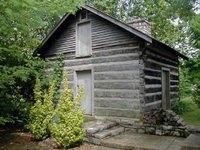
One of the two log cabins on the Forehand property. (photo from NHN collection)

As the Forehand house was under construction, the family acquired two more historic structures: log cabins that had once stood on ground now covered by Percy Priest Lake. Numbered before being dismantled, the logs were transported to their present location, where they were carefully reassembled. In front of one of the cabins is a placard identifying it as “one of the oldest remaining houses from the early American era.” 

The cabins’ original owner, Tennessee pioneer Alexander Carper, came to Davidson County from Virginia and settled in the Cane Ridge community of Antioch. He married in 1825 and built his log home near Mill Creek.  Descendant William Washington “Wash” Carper and his family dedicated the buildings in 1969 to Woodlawn Memorial Park for historical preservation. 

The Forehand enclave nestles among sheltering trees on a bend of the road behind the Woodlawn funeral home. The couple created an idealistic pioneer setting there, ornamented with flowering shrubs and plants blooming in pots and hanging baskets. Cats napped on the porches, ducks swam in the lily pond, and the flag soared proudly above a colorful garden. 

Eventually graves began to encroach upon the Forehand property. After George’s death in 2001, Lillian lived there alone, surrounded by the cemetery. Armed with pistol and shotgun, and under the watchful eyes of the Berry Hill police, she kept the vandals away. Eventually Lillian, too, moved from the house. 

Memorials are created to be visited, contemplated, appreciated, and enjoyed. Today the Forehand compound features the spring and spring house of Melrose Mansion, the two Carper cabins, plaques to remind us of our Civil War past, and a tribute to Governor Aaron V. Brown.  Sadly, few Nashvillians and no newcomers are aware of the existence of this historic oasis within the well-known cemetery.