Josephine Groves Holloway (GW014)

(March 19, 1898 – December 7, 1988)

from The Greenwood Project

Born in South Carolina, Josephine Groves Holloway was a pioneering leader in African American Girl Scouting.  A graduate of both Fisk University and Tennessee A&I, she worked at Nashville’s Bethlehem Center before marrying Guernsey Holloway (1925). Intrigued by the emerging Girl Scout program but unable to gain the local Council’s permission to form and sponsor even a segregated troop (1933), the Holloways organized an unofficial scouting program for their daughters and friends until 1943, when Josephine successfully registered her troop with the Council. That year she became the first African American Girl Scout executive in Tennessee, establishing new troops and helping locate and finance a campground. Mrs. Holloway worked with the Girl Scout Council for 20 years, retiring in 1963. The recipient of many honors and awards, she was also instrumental in integrating the scouting program in Nashville and Tennessee.  The historic special collections and gallery of the new (1991) Cumberland Valley Girl Scout Center now carry Josephine Holloway’s name.  

(Biography by Dr. Tara Mitchell Mielnik.)
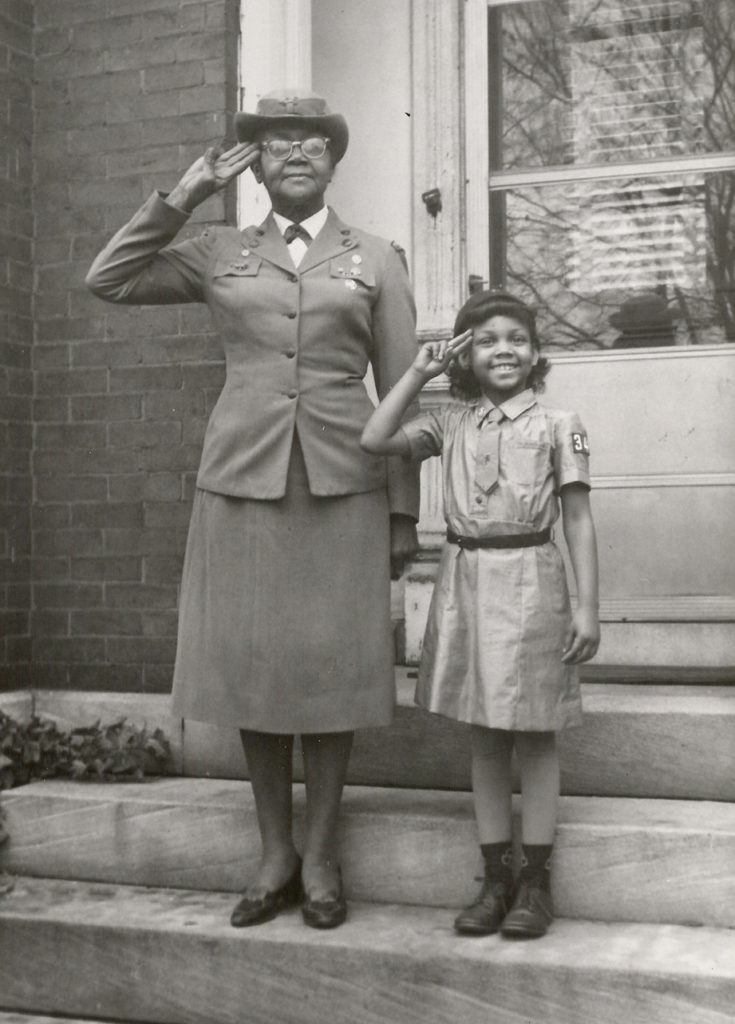
Girl Scout executive Josephine Groves Holloway and her granddaughter Nareda. (Photograph from the website of the Girl Scouts of Middle Tennessee.)

____________________

The Greenwood Project is a series of 160-word biographies of individuals who lie at rest in Mt. Ararat and Greenwood cemeteries, two historic African American burial grounds in Nashville, Tennessee. The project, which began in September 2014 (and is still available on Facebook, at https://www.facebook.com/profile.php?id=100064806156276), shares the stories of more than 300 consequential individuals, primarily African American, who changed the course of city, state, and national history through their words and deeds. (All biographies were written by Kathy Lauder unless otherwise noted.)

Marshall Keeble (GW013)

(December 7, 1878 – April 20, 1968)

from The Greenwood Project

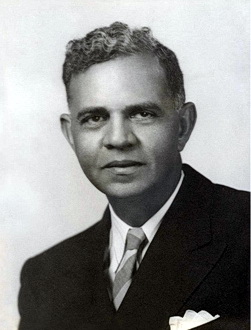
Born near Murfreesboro, Tennessee, Keeble was brought to Nashville as a toddler. He dropped out of school at 12, took factory jobs, sold produce from a wagon, and operated a grocery store, but his real love was preaching. Baptized by Preston Taylor at 17, Keeble began his own ministry within two years. He and his wife, Minnie Womack, traveled around the country, from Michigan to Florida and across Tennessee, where he preached, baptized hundreds of converts, founded schools and hospitals, and formed new churches. By 1929 his sermons were broadcast over the radio. After Minnie’s death, the popular evangelist married Laura Catherine Johnson. In 1940 he helped launch the new Nashville Christian Institute, serving as the school’s president from 1942-1958 and traveling to Canada, Nigeria, and the Holy Land. By the time of his death in 1968, having outlived his five children, he was estimated to have baptized over 40,000 converts, black and white. Hundreds of people attended his funeral.

Rev. Marshall Keeble (photo from Jackson Street Church of Christ, Nashville, Tennessee. https://www.jacksonst.org/marshall-keeble/)

____________________

The Greenwood Project is a series of 160-word biographies of individuals who lie at rest in Mt. Ararat and Greenwood cemeteries, two historic African American burial grounds in Nashville, Tennessee. The project, which began in September 2014 (and is still available on Facebook, at https://www.facebook.com/profile.php?id=100064806156276), shares the stories of more than 300 consequential individuals, primarily African American, who changed the course of city, state, and national history through their words and deeds. (All biographies were written by Kathy Lauder unless otherwise noted.)

Calvin Lunsford McKissack (GW012)

(February 23, 1890 – March 2, 1968)

from The Greenwood Project

Fisk University graduate Calvin McKissack, like his older brother Moses, earned his architecture degree through a correspondence course. In 1905 the brothers founded McKissack & McKissack, now America’s oldest minority-owned architectural-engineering firm.  Calvin started a satellite company in Dallas but soon returned to Nashville to teach industrial drawing at Tennessee A&I (TSU). In 1918 he was hired as director of Pearl High School’s industrial arts department. He later became executive secretary of the Tennessee State Association of Teachers in Colored Schools. When the state enacted a law requiring architects to be registered (1921), the McKissacks were nearly banned from taking the licensing examination because of their color. State authorities eventually conceded, assuming neither brother would pass, but when administrators continued to dither after both men sailed through the exam, the national media took up the story . . . and the McKissack brothers promptly received their licenses! Calvin succeeded his brother as director (1952), heading the firm until his death.  

Calvin L. McKissack (photo from McKissack & McKissack website: https://www.mckinc.com/)

____________________

The Greenwood Project is a series of 160-word biographies of individuals who lie at rest in Mt. Ararat and Greenwood cemeteries, two historic African American burial grounds in Nashville, Tennessee. The project, which began in September 2014 (and is still available on Facebook, at https://www.facebook.com/profile.php?id=100064806156276), shares the stories of more than 300 consequential individuals, primarily African American, who changed the course of city, state, and national history through their words and deeds. (All biographies were written by Kathy Lauder unless otherwise noted.)

Minnie Tate Hall (GW011)

(1857 – April 29, 1899)

from The Greenwood Project

Minnie Tate’s maternal grandmother was a slave in Mississippi until she and her children, including Minnie’s mother, were freed. The family traveled north on foot, carrying their possessions, until finally being welcomed into a German settlement in Tennessee, where the children received a first-rate education. Minnie, born in Nashville and educated by her mother, entered Fisk University at 14, soon becoming one of the original Jubilee Singers. She participated in the Singers’ American tour (Oct. 1871-Mar. 1872) and their journey to Great Britain and Europe (May 1872-May 1874), but the grueling journeys exacted a toll: Minnie was only 17 when they returned from Europe in 1874 but by then, sources said, “Contralto Minnie Tate had sung her voice to shreds.” There is no evidence that she ever sang publicly again. Minnie’s husband, R. A. Hall (also a former Jubilee Singer), died in 1886, leaving 29-year-old Minnie alone to raise their son Roger. Minnie herself died in 1899 at age 42.

Minnie Tate, teenage contralto with the Fisk Jubilee Singers. (Public domain.)

____________________

The Greenwood Project is a series of 160-word biographies of individuals who lie at rest in Mt. Ararat and Greenwood cemeteries, two historic African American burial grounds in Nashville, Tennessee. The project, which began in September 2014 (and is still available on Facebook, at https://www.facebook.com/profile.php?id=100064806156276), shares the stories of more than 300 consequential individuals, primarily African American, who changed the course of city, state, and national history through their words and deeds. (All biographies were written by Kathy Lauder unless otherwise noted.)
Alfred Z. Kelley (GW010)

(1913 – February 11, 1994)

from The Greenwood Project

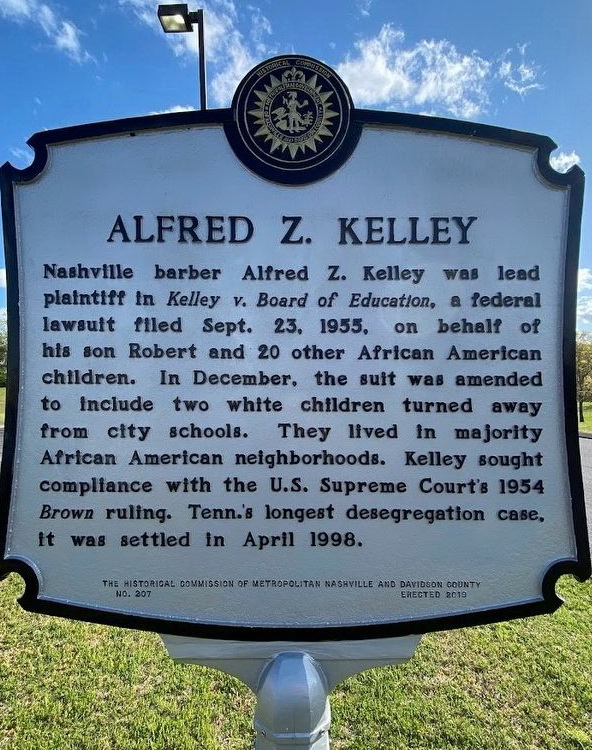
A.Z. Kelley came home from the Navy, opened Kelley’s Barber Shop, taught a few classes at Bowman’s Barber College, sang in his church choir, and became the first black secretary of the local barbers’ union. He and his wife Robbie had four beloved children, and they were delighted when the Supreme Court ordered the schools to desegregate. But when Robert, their 14-year-old, was turned away from neighboring East Junior High and sent across town to Pearl, a black school, Kelley became lead plaintiff in a lawsuit against Nashville city schools (1955). His attorneys were Z.A. Looby, Avon Williams Jr., and Thurgood Marshall (soon to become the first African American Supreme Court Justice). All four men died before Kelley v Board of Education, Tennessee’s longest-running school desegregation case, was finally settled in 1998. Meanwhile, Kelley took part in the 1963 march on Washington, served a term as president of the local NAACP chapter, and was Sergeant-at-Arms of the Tennessee State Senate.

Rev. Kelly Miller Smith, Justice Thurgood Marshall, Attorney Z. A. Looby, and Alfred Z. Kelley (Photo courtesy of Metro Nashville Public Schools)

A. Z. Kelley marker on Blairfield Dr., Antioch, Tennessee. (from Historical Marker Database, photographed by Darren Jefferson Clay)

____________________

The Greenwood Project is a series of 160-word biographies of individuals who lie at rest in Mt. Ararat and Greenwood cemeteries, two historic African American burial grounds in Nashville, Tennessee. The project, which began in September 2014 (and is still available on Facebook, at https://www.facebook.com/profile.php?id=100064806156276), shares the stories of more than 300 consequential individuals, primarily African American, who changed the course of city, state, and national history through their words and deeds. (All biographies were written by Kathy Lauder unless otherwise noted.)

Dr. Charles O. Hadley (GW009)

(March 11, 1872 – December 14, 1948)

from The Greenwood Project

Charles Hadley, a descendant of slaves from John L. Hadley’s Nashville plantation, was a graduate of Fisk University and Meharry Medical College, afterwards working at the latter as a demonstrator of anatomy, while also maintaining a successful Nashville medical practice. During the early years of the 20th century, he was president of the Tennessee chapter of the American Medical Association and secretary of the Nashville Medical and Surgical Association. By 1914 he was an official in the Star Realty & Investment Company, and in 1916 he became captain of Company G of the Tennessee National Guard, the only official Negro military organization in the entire South. As World War I approached, the company underwent additional training, guarded Memphis railroad bridges, and became Company K, 3rd Battalion, 372nd Infantry, of the U.S. Army. By April 1918 the company was in France, where they distinguished themselves in combat. Hadley practiced medicine for 48 years and taught anatomy at Meharry for 30 years.

Nashville Globe photograph of Dr. Charles O. Hadley from Debie Cox’s Nashville History blog, https://nashvillehistory.blogspot.com/2018/06/

____________________

The Greenwood Project is a series of 160-word biographies of individuals who lie at rest in Mt. Ararat and Greenwood cemeteries, two historic African American burial grounds in Nashville, Tennessee. The project, which began in September 2014 (and is still available on Facebook, at https://www.facebook.com/profile.php?id=100064806156276), shares the stories of more than 300 consequential individuals, primarily African American, who changed the course of city, state, and national history through their words and deeds. (All biographies were written by Kathy Lauder unless otherwise noted.)
William Edmondson (GW008)

(ca. 1870 – February 7, 1951)

from The Greenwood Project

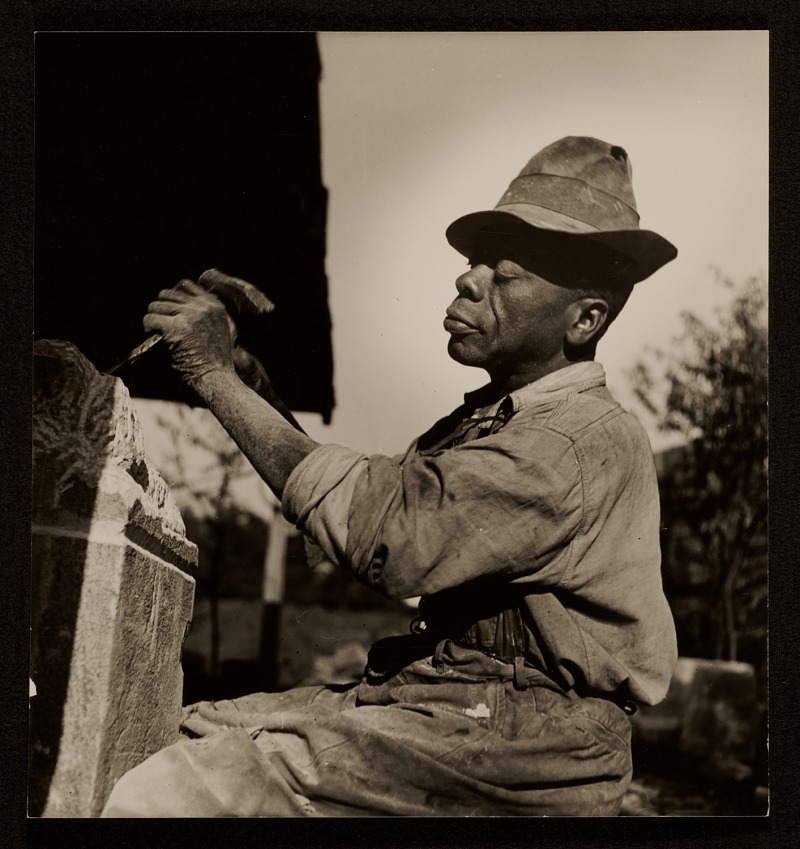
William Edmondson was one of six children born to Orange and Jane Edmondson, newly emancipated slaves. A handyman, he worked in Nashville railroad shops and at odd jobs until he heard God’s voice directing him to develop his gift for sculpture. Although nearly 60 by then, Edmondson collected bits of limestone (broken curbstones and bulldozed foundation stones collected by friends from wrecking companies) and began to carve – first tombstones, and then birds, animals, and religious figures. He worked outdoors in his yard on 14th Avenue South in Edgehill, where Murrell Elementary was later built. Within five years art critics had discovered his lyrical work, labeling it “modern primitive” and demanding more. His sculpture began to appear in exhibits around the country, and he was the first African American to have a one-man show at the Museum of Modern Art (1937). His work is now in the permanent collections of the San Francisco Museum of Art, the Hirshhorn, and the Smithsonian.

William Edmondson at work on a sculpture on his Edgehill property, 1937. (Elizabeth McCausland papers, 1838-1995. Archives of American Art, Smithsonian Institution. Photo is in public domain.)

____________________

The Greenwood Project is a series of 160-word biographies of individuals who lie at rest in Mt. Ararat and Greenwood cemeteries, two historic African American burial grounds in Nashville, Tennessee. The project, which began in September 2014 (and is still available on Facebook, at https://www.facebook.com/profile.php?id=100064806156276), shares the stories of more than 300 consequential individuals, primarily African American, who changed the course of city, state, and national history through their words and deeds. (All biographies were written by Kathy Lauder unless otherwise noted.)

Monroe Gooch (GW007)

(ca. 1844 – April 18, 1909)

from The Greenwood Project

A persistent motif of the “Lost Cause” depicts Negro combatants fighting alongside white Southern troops. In fact, the Confederacy did not approve recruitment of black soldiers until March 13, 1865, too late to train them for combat. White soldiers did, however, sometimes bring trusted slaves along to serve as personal attendants. Rutherford County slave Monroe Gooch accompanied Dr. Nat Gooch to war as his servant and soon became a cook with the 45th Tennessee Infantry. Although home on leave at the time of Hood’s raid into Tennessee, he loyally returned to the company, remaining until the surrender. After the war, Gooch faithfully attended every Confederate reunion until his health failed. His final request was for a military burial. Every Nashville newspaper carried the story of his funeral, attended by members of Company B, UCV, in full uniform. A large crowd attended the ceremony, which was highlighted by the playing of “Taps” and a parting rifle salute fired over his grave.

Photograph of Monroe Gooch appears at https://www.facebook.com/VirginiaDivisionUDC/photos/a.1658161367567634/2207735422610223/?type=3

Photo of Dr. Nat Gooch from the Find a Grave website: https://www.findagrave.com/memorial/94856339/nathaniel-gooch

____________________


The Greenwood Project is a series of 160-word biographies of individuals who lie at rest in Mt. Ararat and Greenwood cemeteries, two historic African American burial grounds in Nashville, Tennessee. The project, which began in September 2014 (and is still available on Facebook, at https://www.facebook.com/profile.php?id=100064806156276), shares the stories of more than 300 consequential individuals, primarily African American, who changed the course of city, state,
and national history through their words and deeds. (All biographies were written by Kathy Lauder unless otherwise noted.)

Clinton Hill “Butch” McCord (GW006)

November 2, 1925 – January 27, 2011

from The Greenwood Project

Nashville native Butch McCord graduated from Pearl High School and earned a football scholarship to Tennessee State University. While still in college, he signed a contract with Nashville Black Vols baseball (1947), moving on to Baltimore (1949) and Chicago (1950), where he batted .349 for the season. In 1951 he advanced to the minor leagues, playing first base with the Paris Lakers, the Denver Bears, and other teams. McCord became the first African American to play AAA ball when he joined the Richmond Virginians in 1955. Maintaining a batting average just below .400, he was the first minor league player to win the Silver Glove in two consecutive years. Unable to overcome the color barrier in major league ball, he ended his career in the minors, breaking the league’s record for fielding in his final year. During his eleven seasons McCord won two batting titles, two Silver Gloves, and three pennants, and he was voted the league’s most popular player.

Image taken from baseball card in the author’s collection.

____________________

The Greenwood Project is a series of 160-word biographies of individuals who lie at rest in Mt. Ararat and Greenwood cemeteries, two historic African American burial grounds in Nashville, Tennessee. The project, which began in September 2014 (and is still available on Facebook, at https://www.facebook.com/profile.php?id=100064806156276), shares the stories of more than 300 consequential individuals, primarily African American, who changed the course of city, state, and national history through their words and deeds. (All biographies were written by Kathy Lauder unless otherwise noted.)

Josie English Wells (GW005)

(November 28, 1878 – March 20, 1921)

from The Greenwood Project

When Josie Wells graduated from Meharry Medical College in 1904, she was both the first female graduate of Meharry and the first practicing female physician in Nashville, black or white. Previously trained as a nurse, she became superintendent of Mercy Hospital’s nurses’ training program (which later moved to Meharry), as well as general physician for Walden University. She was the first woman to teach at Meharry, also becoming the first female to hold a position of leadership there after being appointed superintendent of Hubbard Hospital (now Nashville General Hospital). A specialist in the diseases of women and children, Wells encouraged other young women to study medicine. Two afternoons a week she provided free medical treatment to patients who could not pay. During World War I she helped found the Tennessee Colored Women’s chapter of the National Council of Defense. When she died at age 42 after a brief illness, the Journal of the National Medical Association praised her many accomplishments.

Metro Nashville/Davidson County Historical Marker for Dr. Josie E. Wells on the Fisk/Meharry campus. (From the Historical Marker Database, photos by Darren Jefferson Clay, May 2022)

____________________

The Greenwood Project is a series of 160-word biographies of individuals who lie at rest in Mt. Ararat and Greenwood cemeteries, two historic African American burial grounds in Nashville, Tennessee. The project, which began in September 2014 (and is still available on Facebook, at https://www.facebook.com/profile.php?id=100064806156276), shares the stories of more than 300 consequential individuals, primarily African American, who changed the course of city, state, and national history through their words and deeds. (All biographies were written by Kathy Lauder unless otherwise noted.)