As Luke Lea and his son Luke Jr. entered the grim walls of the North Carolina State Prison at Raleigh in May 1934, they wondered how long it would be before they would pass through those gates again. Lea’s only request was granted: he and his son would share the same cell.
· Luke Lea (Library of Congress photo, LC-DIG-hec-03657, Harris & Ewing photograph collection)
At one time Luke Lea had developed policies for the state of Tennessee and had influenced decisions on the national level. Now he could no longer direct even his own affairs or those of his son, but his absolute belief in their innocence made him determined to win their freedom.
After the stock market crash in 1929, Lea had learned that his political enemies would do almost anything to get rid of him. The foundation of his political power was the newspapers he published: Lea Sr. was president of the Tennessean Publishing Company, and his son was business manager.
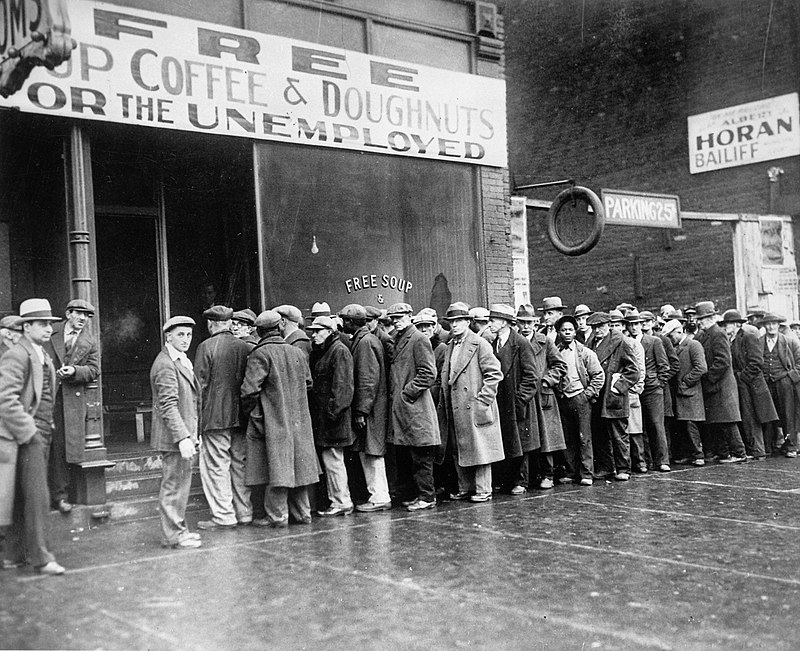
Unemployed men line up outside a depression-era soup kitchen, 1931
Luke Lea was convinced that a certain Nashville banker, in a calculated political maneuver, had set out to destroy him while also working to impeach Governor Henry Horton. With Lea’s newspapers out of the way, the banker would be able to suppress unfavorable financial news; with a governor of his choice in office, he would be able to funnel badly needed state deposits into his bank.
As charges of banking violations were brought against Lea in both Davidson County and North Carolina, his Memphis and Knoxville newspapers were put into receivership. Not having been present in North Carolina at the time of his alleged offenses, Lea could not be extradited there. However, sure of his innocence, he voluntarily traveled to Asheville to clear his name. A special term of the Buncombe County Court had been appointed to try cases growing out of bank failures. It was commonly understood by attorneys across the state that the judge appointed to hear these cases was expected to obtain convictions.
Luke Lea’s sentence was for six to ten years, His son was fined $25,000 and was to be jailed until the fine was paid, but both men understood that paying the fine would have been an admission of guilt.
Inmate showers in Old Central State Prison, Raleigh, NC, in cell block, no date (c.1950-1960s); photo courtesy Keith Acree, NC Department of Corrections. State Archives of North Carolina, Raleigh, NC.
They appealed the verdict and entered into a lengthy but unsuccessful fight for a retrial.The Nashville Tennessean was put into receivership in 1933. The Davidson County case against the Leas was dropped when they entered prison. At last, while they were still incarcerated, an independent audit proved them to be innocent of the charges for which they had been convicted.
Luke Lea Jr. was paroled in July 1934, but it wasn’t until after the mass hysteria over bank failures had died down and a new North Carolina governor had been elected that Luke Lea was paroled in April 1936 and finally pardoned in 1937. He knew he faced an uphill fight to reestablish his status and reputation, and he prayed that “the will to win” would sustain him in whatever lay ahead. Unfortunately, however, he died while legislation to allow him to regain control of the Tennessean was still incomplete. (1998)
Introduction: Although Monroe W. Gooden was not a Nashvillian, he was one of the 14 African American men elected to the Tennessee General Assembly during the 19th century. In time we hope to include all their biographies in the Nashville Historical Newsletter. For more information about these remarkable individuals and their complex historical era, see the Tennessee State Library and Archives exhibit: https://sharetngov.tnsosfiles.com/tsla/exhibits/blackhistory/index.htm
Monroe Gooden’s death certificate records his birthdate as October 26, 1852, and his death as January 19, 1915. The Biographical Directory of the Tennessee General Assembly includes the same date of death but lists Gooden’s birth date as May 10, 1848, which, since it corresponds with the age Gooden gave in census records, is probably more likely to be correct.
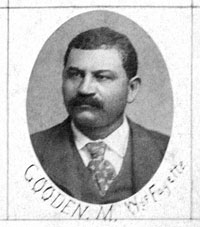
Monroe W. Gooden (from a composite photo of the 45th Tennessee General Assembly, 1887)
The death certificate also states that the future legislator was born in Fayette County, Tennessee, to Monroe Gooden Sr. and an unknown mother. The omission of the mother’s name is regrettable since it might have provided a valuable clue to the family’s history – slaves usually had the same masters (and surnames) as their mothers, at least during their youth. We do know that the neighborhood the Goodens lived in was in the north-central part of Fayette County, along the line between Districts 4 and 5, and only two or three miles from the Haywood County line. In fact, Charles G. Feild’s plantation (Feild was the slave owner of Representative John W. Boyd’s mother) was just over the county line in Haywood County, only a few miles away. Although we still do not know exactly which plantation was Monroe Gooden’s birthplace, we can identify three possible choices bordering each other in that neighborhood: the Baskerville and Tucker plantations in District 4 and the Harwell plantation in District 5. Since slaves generally took spouses from their own and adjoining plantations, a trend that continued throughout Reconstruction, it is likely that Gooden was born on one of these three plantations.
The question of where Gooden and his sister Lucinda lived during the period of slavery has not been completely answered. We are quite certain that they were Monroe Senior’s only children, and it is apparent that their mother died when they were very young. Slave schedule/census records rule out either the Tucker or Baskerville plantations. However, one clue to their childhood home may be found in Civil War enrollment records: Monroe W. evidently enrolled in the Federal army as “Monroe Harvey.” Matching this name to a late 1860s Fayette County record of a “Monroe Harwell” (who does not appear in the census), one wonders whether the young soldier’s name should have been written as “Harwell” also, and whether the children did, in fact, grow up on the Harwell plantation in District 5. Slave genealogy is a puzzle with many pieces (and documents) missing.
The Harwell plantation was owned by Dr. Frederick Harwell, a native of Brunswick County, Virginia. Several members of his family had moved to Giles County in Middle Tennessee about 1810. Twenty years later Dr. Harwell and his wife moved west to District 5 in Fayette County, where they established a sizable plantation, with more than 1,000 acres and close to 80 slaves. Several intriguing anecdotes about the family still survive. According to one story, late in the Civil War Dr. Harwell, who was quite elderly by then, took a little slave girl along to help him bury his money in order to protect it from oncoming Yankee soldiers. Several descendants of that little girl tell how, later in life, she wracked her brain trying to remember where the money was buried. Over the years many people tried to find the hidden treasure, but with no success. It was not until the 1940s that Jacob Harwell Jr., whose father was raised by a slave from the plantation, was plowing in one of the fields and dug up part of the money. Descendants of John Yarbrough, the mulatto driver [a high-ranking slave used as an overseer] on the plantation, tell of the Union soldiers who hung Yarbrough upside down from a tree to force him to reveal where the Harwells’ valuables were hidden.
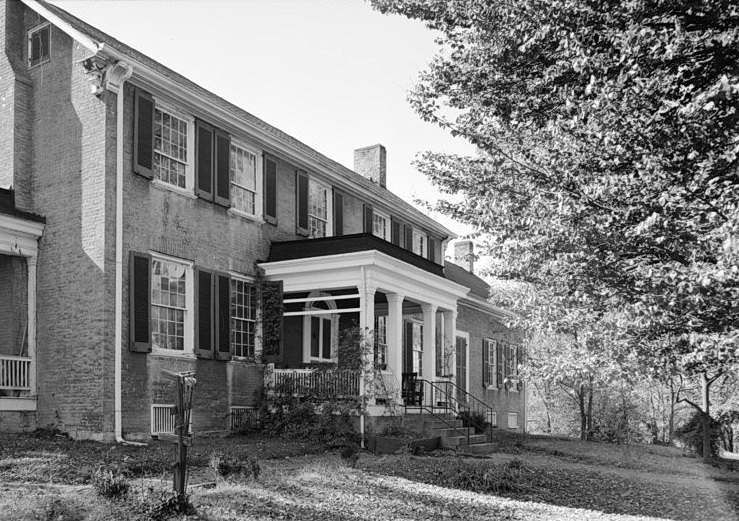
Because the Harwells had no children, when both of them died during the final year of the Civil War, they willed their property to two Giles County nephews, who continued to operate the Harwell plantation as absentee owners for another 40 years. During that period several mortgages were filed by Monroe W. Gooden for crops “grown on the Harwell place,” which was on the Somerville-to-Covington road, where the Bernard School was later located. Combining that information with the available census records, one can draw the conclusion that Monroe was renting and living in the old Harwell manor house during much of the late 1800s. Oral history suggests that Monroe was a “big operator” with many sharecroppers working under him. Whether or not he was originally a Harwell slave, it is evident that he was in time the de facto “master” of the Harwell plantation.
Photo courtesy of Fayette County Historical Society
We do know that Monroe W. Gooden’s wife Ann came from the Baskerville plantation owned by the Reverend John Tabb Baskerville, a well-known Methodist minister of the area, and a native of Mecklenburg County, Virginia, which had been home to a number of the large land-owners of southwest Tennessee. A family story relates that the white Baskervilles taught at least one of their young slaves to read, and later gave her enough money to purchase 100 acres of property.
Monroe W. Gooden and Ann Baskerville were married in Somerville on December 29, 1866, not long after Monroe Sr. married Hannah Hare, another former slave from the Baskerville plantation. It is interesting to note that Monroe Sr.’s marriage record lists his surname as “Tucker,” suggesting (since freed slaves often chose the surname of their original owner, rather than the most recent one) that he had at some point been a slave of Joseph C. C. Tucker on a plantation adjoining that of the Baskervilles.
In the 1870 census, both Monroe W. and Monroe Sr. were living in District 4. The elder Gooden was at that time 48 years old, so he would have been born about 1822, during the presidency of James Monroe. Their surname in this particular census is spelled “Goodwin,” which may provide an additional clue to their history – in the 1820s the Goodwyn family were among the largest slave-holders in Dinwiddie County, Virginia . . . which was also the original home of Joseph C. C. Tucker! It is quite possible that Monroe Sr. was born in Virginia as a Goodwyn slave, but was later brought to Fayette County by the Tuckers.
On March 2, 1872, Monroe Gooden Sr. became one of the first African Americans in Fayette County to own land, when he purchased two tracts amounting to about 250 acres from A. D. Stainback (Fayette Deed Book 2, page 57) in a transaction known as a title bond. This was an instrument of sale whereby the title passed to the new owner, but a deed was not given until payment was made in full. Six years later, after the death of Monroe Sr., the administrator of A. D. Stainback’s estate gave a deed for the property to “the heirs of Monroe Gooden,” listed as his widow Hannah Gooden and his two children, Monroe Gooden Jr. and Lucinda Gooden McNeal (Fayette Deed Book 7, page 345, 25 February 1878). Lucinda McNeal, who married Austin McNeal, owned a house and lot in the town of Mason during the early 1900s. She was known around town as “Aunt Cindy McNeal” and lived to be an old woman. Unfortunately, her death certificate provides no information as to her parentage.
Tennessee Capitol (photo courtesy of the Tennessee House of Representatives)
A deed from January 25, 1881 (Fayette Deed Book 9, page 618), provides for one-half acre to be used as the site for a school for colored children. The school directors for Civil District 5 during that period were identified as W. A. Rives, M. W. Goodwin, and James H. Cocke. Rives and Cocke were both white men. There is little doubt that by this time Monroe W. Gooden had risen to a very prominent position in the community. The only African American Democrat in the Tennessee legislature in the 19th century, he was elected to represent Fayette County in the 45th Tennessee General Assembly, 1887-1888. A legislative biography identifies him as a “farmer and ginner near Somerville, Fayette County,” and lists him as a member of the Masonic order. [African-American Freemasons groups have existed in the United States since 1775, and the number of black lodges increased significantly after the Civil War.] Gooden was also a trustee of the Williamson Chapel Missionary Baptist Church.
About the time he was elected to the legislature, Monroe W. Gooden began to acquire large tracts of land. One such purchase, recorded on November 22, 1887, was for 372 acres. He bought more land in 1890, and in 1897 he purchased still another large tract totaling over 500 acres. By the end of his life, he owned about a thousand acres, including the former Patterson plantation in the Brewer community. This property had been owned before the Civil War by General Bernard Markham Patterson (originally Patteson), another native Virginian and large-scale planter, who had also spent time in Giles County before coming to West Tennessee. At some point between 1890 and 1900 Gooden moved his large family into the old Patterson plantation house, a comfortable two-story, white frame building.
The Goodens had a large number of children: Mary, Monroe J., John, James/Jim, Lillie Bell, and Willa Ola Gooden. Ann already had one son, Dempsey (Demp) Shivers, when she married Monroe Gooden, and he is listed with the family in the 1880 census. Monroe W. had at least one other child as well, a son named Frank Gooden, whose mother was Mollie Coe.
Monroe Gooden and his wife Ann are buried in the Patterson Cemetery in Fayette County, northwest of Somerville. This section was originally a slave burial ground: most of the people buried there are descendants of slaves from the Patterson plantation. (Photo by John Marshall)
After his death, Monroe Gooden was buried in the family section he had created in the Patterson cemetery, which had originally been the slave burial ground on the Patterson plantation. Most members of his family are buried there with him. Nearly all the people buried on that site can trace their roots to the Patterson slaves. Several such cemeteries survive in District 5, all bearing the names of the original plantation owners. Although some are abandoned, several others, including the Patterson cemetery, are still in use today.
A brief obituary of Monroe Gooden appeared in the January 22, 1915, edition of the Fayette Falcon, Somerville, Tennessee:
“Fayette county lost one of her best colored citizens on last Tuesday when Monroe J. Gooden of the fifth district, died at a ripe old age. Monroe was one of the most thrifty men of his race in the county and owned several hundred acres of good land. He lived on this land and can be counted as a good citizen. He was quiet, unpretentious, and lived in peace and harmony with his white neighbors, holding their friendship and respect. He represented Fayette county in the state legislature in 1887 and was the last negro to sit in a legislature in any of the southern states during the reconstruction times. In recent years he has taken no part in politics, never even voting for years*. Many negroes could help to improve the condition and standing of their race by emulating the example of honesty and right living set by Monroe Gooden.”
* Note: There were very few African American Democrats during Reconstruction, so Gooden’s politics were quite unusual. It is likely (particularly since he seemed to withdraw completely from political attachment in his later years) that he became a Democrat during the years in which he was politically active in order to avoid friction with his white neighbors.
In August 1852, a war of words between John L. Marling (1825–1856), editor of the Nashville Union, and Gen. Felix K. Zollicoffer (1812–1862), editor of the Republican Banner, culminated in bullets and bloodshed. Marling’s paper supported New Englander Franklin Pierce (1804–1869) in the upcoming presidential election, judging (correctly) that he would side with Southern slaveholders despite his northern origins. Zollicoffer, meanwhile, bashed Pierce at every turn.
President Franklin Pierce, 1852 (Portrait by Southworth & Hawes, National Portrait Gallery)
On August 20, 1852, things got personal. Marling accused the Banner of behaving dishonorably toward Pierce: “It has tried to identify him with the abolitionism of New Hampshire, with which he had no sympathy and against which he constantly struggled,” Marling wrote. “It has even cast slurs upon his personal courage. Now, we say this is belying General Pierce. We use the word in all its length and breadth.” Zollicoffer found the editorial “personally insulting,” and he sent word that he would publicly “denounce” Marling.
That morning, the two journalists met, standing across Cherry Street (today’s 4th Avenue North) in front of the Union office. Upon being denounced, Marling fired his pistol. Zollicoffer returned fire, and the bullet struck Marling’s cheekbone, lodging behind his ear. Marling got off another shot, grazing Zollicoffer’s hand. Both editors survived the “unfortunate affray,” as the Union characterized it, while defiantly reprinting the offending article the next day. Marling went on to serve as U.S. Minister to Guatemala under the Pierce administration. Zollicoffer would die in battle as a Confederate general. Both are buried in Nashville City Cemetery.
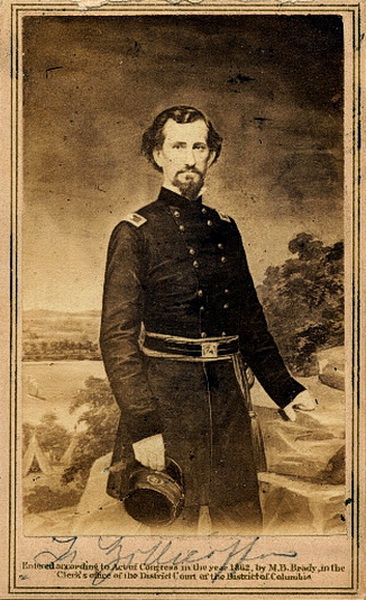
Brigadier General Felix Kirk Zollicoffer, 1812-1862 (courtesy of Tennessee State Library and Archives, ID #31585, created by Brady’s National Photographic Portrait Galleries)
Sources:
Nashville Union, August 20, 1852, “The Banner…”
Republican Banner, August 24, 1852, “On Friday morning last…”
One of Nashville’s most popular events is the annual Living History Tour each fall at City Cemetery. Visitors see the past come alive as costumed characters step forward from the gravestones to tell their stories. Although a few beloved personalities from Nashville’s history do reappear from time to time, the Nashville City Cemetery Association (NCCA) selects many new characters each year. The individuals named below were featured in the 2013 Tour. The photos of reenactors were taken during NCCA Living History Tours between 2008 and 2012.
Lipscomb Norvell, a veteran of the Revolutionary War, served under General George Washington at Brandywine, Trenton, and Monmouth. An early pioneer, he raised a large family in Kentucky before joining family members in Nashville, where he died at age 87.
Frank Parrish, a free man of color, was a Nashville entrepreneur, operating a Bathing House and Barber Shop on Deaderick Street. He died in 1867 and was buried in a family plot at City Cemetery.
Ann Robertson Cockrill, James Robertson’s sister, was a young widow with three little girls when she arrived in Nashville with the Donelson party in 1780. She later married John Cockrill, and they settled near today’s Centennial Park to raise their large family. She was the only woman among the early Cumberland settlers to receive a land grant in her own name, earned largely for her courage in defending Fort Caswell (later Fort Watauga) against Indian attack.
William Carroll Napierowned a Nashville livery stable. His son James carried Mayor Cheatham to surrender Nashville to Union forces in 1862. Later the two Napiers helped John Berrien Lindsley set up military hospitals around the city by transporting food equipment and supplies. During the Occupation, the Union Army employed Carroll as a spy, tasked with reporting Confederate troop movements in Murfreesboro and along the Harpeth River. Son James C. Napier would later become Nashville’s African American city councilor, as well as Register of the U.S. Treasury under President Taft.
George W. Campbell, one of Nashville’s most distinguished citizens, was an attorney, a U.S. Representative and Senator, one of the first two Tennessee Supreme Court Justices, U.S. Secretary of the Treasury, and U.S. Ambassador to Russia. His wife Harriet Stoddert was the daughter of the secretary of the Navy in Thomas Jefferson’s cabinet. In 1843 Campbell sold a property known as “Campbell’s Hill” to the city of Nashville, later transferred to the state as the site of the Tennessee state capitol.
Mabel Lewis Imes was raised in New England, where she received an excellent education, learned to speak French, and took voice lessons. When she auditioned for the Fisk Jubilee Singers during their Eastern tour, they immediately invited her to sing contralto with the group . . . at the age of 13!
A former Fisk Jubilee Singer portrayed Mabel Imes in the 2008 Living History event, regaling delighted visitors with beautiful music.
Thomas Crutcherserved as the State Treasurer of Tennessee for 25 years. An activist in promoting education for women, he was a founder and active trustee of the Nashville Female Academy, where the students called him “Uncle Crutcher.”
Lizzie Porterfield Elliottwas the daughter of Collins D. Elliott, president of the Nashville Female Academy, and she was perhaps the most compelling example of his belief in educating women. She taught in both public and private schools for more than 30 years and was active in educational and civic organizations. An authority on Tennessee history, she served as an officer in the Tennessee Historical Society. A bright and interesting woman, she authored the Early History of Nashville, still admired for its historical accuracy.
Before the section of the city north of the Cumberland River was known as Edgefield (and then East Nashville), it was referred to as Wetmore’s Addition. Moses Wetmore, the first person to subdivide the area into lots for homes and businesses, also donated the land for Holy Trinity Church and gave his name to two city streets.
State Representative Ben West portrayed his father, Ben West (Mayor of Nashville 1951-1963), during the 2010 Living History event.
Mayor John Patton Erwin served two terms as mayor of Nashville. He worked as a bank cashier (in those days, the equivalent of a bank manager), was editor of the Nashville Whig, and served as Postmaster, Justice of the Peace, and clerk of the Tennessee House of Representatives.
PowhatanMaxey served as a justice of the peace, an alderman for seven terms, and mayor of Nashville from 1843-1845. He negotiated the purchase of Capitol Hill from William Nichol and George W. Campbell, and then donated the land to the Tennessee General Assembly, provided they would locate the State Capitol on that site. (2013)
Ghosts in Nashville City Cemetery (photo by Lynn McDonald, 2011)
Previously published in Monuments & Milestones, the Nashville City Cemetery Newsletter.
Andrew Jackson Pageot was born a child of privilege: he was named for his godfather, the President; his mother was heir to a wealthy Nashville estate; his father was the son of a diplomat. This baby’s future was bright. How then did it come about that he lies in an unmarked grave, his burial place lost to history?
Earliest known photograph of the white House, taken c. 1846 by John Plumbe during the administration of James K. Polk.
The first (and only) Catholic wedding ceremony held in the White House took place November 29, 1832. The groom was Alphonse Pageot, secretary of the French Legation and brother-in-law of the French Minister. The bride was Nashvillian Mary Anne Lewis, daughter of Major William Berkeley Lewis, a friend and political appointee of Andrew Jackson. The Lewises’ Nashville home was called Fairfield, set on an estate not far from City Cemetery. Today’s Fairfield Avenue was originally one of the lanes leading to the residence.
Although Mary Anne and her half-siblings William Henry and Margaret Adelaide grew up in relative comfort, they all suffered early losses. William B. Lewis’s first wife (Mary Anne’s mother) was Margaret Lewis, the daughter of W. Tyrrell Lewis and owner of Fairfield. Margaret died at Fairfield in 1816, when Mary Anne was about 12. The mother of the other two children was William B. Lewis’s second wife, Mary Adelaide Stokes, daughter of U.S. Senator Montfort Stokes. Mary Adelaide died in May 1823, leaving behind “an infant son [little William Henry was not yet two] & daughter five days old.”
After their marriage, Mary Anne and Alphonse Pageot lived in Washington, D.C., in a house provided by her father, William B. Lewis, who wrote a friend, “I go to housekeeping with them.” Their son, Andrew Jackson Pageot, was born the following year and christened at the White House. The Rev. William Matthews of St. Patrick’s Catholic Church officiated, as he had for the wedding of the baby’s parents.
As a diplomatic family, the Pageots moved often between the United States and France. Major Lewis returned to Nashville, where he had to face yet another loss, that of his son, William Henry, who died August 30, 1842, “in the twentieth year of his age,” Major Lewis’s youngest child, Margaret Adelaide, who was said to be the most beautiful young woman in Tennessee, had married George Washington of Wessyngton Plantation in Robertson County that same year. She herself died at the age of 21 in November 1844, three weeks after the birth of her only son, William Lewis Washington.
When the Civil War began, William B. Lewis remained loyal to his country and active in local politics. On December 14, 1864, the night before the Battle of Nashville, as Federal troops dug entrenchments in Fairfield’s front lawn, U.S. Major T. J. Morgan stayed in the house, occupying the room that Andrew Jackson had always been given. As a loyal citizen, Lewis would eventually receive compensation from the Federal government for the damage to his property.
Two weeks after the Battle of Nashville the family suffered another tragedy. On January 11, 1865, this notice was published in the Nashville Daily Union:
“Died, on Monday morning, the 9th inst., at the residence of his Grandfather, Major William B. Lewis, Andrew Jackson Pageot, Esq., son of Hon. A. Pageot of Paris France, and Mary Ann, his wife. He died from an acute attack of the heart, after only an hour’s illness, in the 32nd year of his age. His funeral will take place this morning, at 11 o’clock, at the residence of Major Lewis. Hacks will be waiting at W. R. Cornelius’ on Church Street, at 10 o’clock this morning, to take out friends and acquaintances who desire to attend the funeral.”
Where was Pageot buried? He has an interment entry in City Cemetery records, but no location is indicated. In 1843 Major Lewis had purchased a 40×40-foot lot in section 5 for $80.00. Who, if anyone, was buried on this lot? Not Major Lewis, who died in 1866. He and others of his family, along with their tombstones, were removed to Mt. Olivet in 1890 from “the old family burying ground.” Whether this burying ground was on the Fairfield estate is yet another mystery. The property was sold at auction in 1867, and by 1890 St. Margarethe’s Hospital occupied the location.
Fairfield, during the period when it was used as St. Margarethe’s Hospital (courtesy of Debie Cox, Nashville History)
None of the removal records lists the name of Andrew J. Pageot. Was he originally interred with other Lewis family members and then, having been buried without a marker, simply forgotten? Does the partial record at City Cemetery exist because undertaker Cornelius merely assumed he would be interred there?
The old PBS series History Detectives insisted that “no secret is safe.” Is the secret of Andrew Jackson Pageot waiting to be found someday? (2010)
Dedication ceremony for new Sally Thomas grave marker, 2009
Sally Thomas died during Nashville’s 1850 cholera epidemic. In 1908 her tombstone could still be found, but by 2005 it was no longer standing. In 2009 a replacement tombstone for Sally Thomas was dedicated in a well-attended ceremony at City Cemetery.
Previously published in Monuments & Milestones, the Nashville City Cemetery newsletter.
John Buchanan was a Scots-Irish American who emigrated to the French Lick in late 1779 and helped found the town of Nashville, at that time considered part of back-country North Carolina. Born in Harrisburg, Pennsylvania, on January 12, 1759, young Buchanan and his party arrived at the Lick shortly before the James Robertson and John Rains groups, and began building cabins. Along with the Buchanans were sundry other first comers, including Daniel and Sampson Williams, James and John Mulherrin, and Thomas Thompson.
Battle of the Bluffs
Not long after the establishment of nearby Fort Nashborough on a site called “the Bluffs” overlooking the Cumberland River, John’s brother Alexander was killed in the well-known “Battle of the Bluffs” on April 2, 1781. During this same Indian attack John’s father, John Buchanan Sr., heroically saved pioneer Edward Swanson from almost certain death. The following summer, John compiled early Nashville’s first book:John Buchanan’s Book of Arithmetic, dated June 20, 1781. A kind of personal workbook likely prepared under the tutelage of teacher James Mulherrin, the fragile volume survives today at the Tennessee State Library and Archives. John used the book to learn the mathematics of land surveying, a profession he later pursued with lucrative success.
A page from John Buchanan’s Book of Arithmetic, currently stored in the Tennessee State Library and Archives.
In 1784, after the town of Nashville was officially recognized and laid out in grids, the Buchanans, apparently not wishing to live as town folk, moved a few miles southeast to Mill Creek and built their own outpost called Buchanan’s Station. Located at today’s Elm Hill Pike and Massman Drive in the Donelson area, the station and its 640-acre tract served as John’s home until his death in 1832. He also built a grist mill, well-known as Buchanan’s Mill, and one of Nashville’s earliest roads was cut from old Fort Nashborough out to the mill.
In 1786 John married Margaret Kennedy, with whom he had one child, John Buchanan III. Their descendants included Tennessee governor John Price Buchanan (1847-1939) and modern Nobel Prize winner James McGill Buchanan Jr. (1919-2013). Four years after Margaret’s untimely death in 1787, John married Sarah “Sally” Ridley, daughter of pioneer Captain George Ridley. The legendary Sally would bear thirteen more Buchanan children.
Mill wheel
Initially a lieutenant and then a captain in the local militia, by 1787 John had gained the title of major. Although he is often called “Major John” today, the circumstances that led to this rank are not known, and one speculation is that it was honorary in nature. John’s militia service reached its zenith on September 30, 1792, when Buchanan’s Station was attacked by a large confederacy of Indians from several tribes, a storied event that resulted in a dramatic victory for the Cumberland settlers.
Over the years John Buchanan served on numerous juries, surveyed countless parcels of land for other settlers, and accumulated thousands of acres for himself and his family. Having arrived on the lower Cumberland with only a few possessions on pack horses, he died a prosperous man on November 7, 1832, having realized the American pioneer’s dream.
16. Braid Electric Company (1879) – sold to Rexel, a French electrical equipment distributor, in 2004; now called Rexel-Braid Electric Co.; no website.
Note to readers: This list is nearly 25 years old, and some of the data is no longer correct. Follow the links for the updates we have located. If you have more recent information about these businesses, we’d love to have your input – you can leave any comments below.
The contractor had completed a lengthy job on the beautiful white house out on the Boulevard. Bathrooms had been remodeled, the kitchen gleamed with new appliances and tile floor, and much repair work had been done on the upstairs gables. The owner, a wealthy businessman, had paid each Friday’s weekly draw on time without any questions, so the contractor had no worries as he drove up to the house that evening to submit his final bill of fifteen hundred dollars.
Just as the chimes rang, the front door was opened by the family’s houseman, who escorted the contractor back to the owner’s private office. This sanctum sanctorum was large with dark paneled walls and an Oriental rug. Trophies, mounted critter heads, and a few books lined the walls. The upholstered furniture was all burgundy and the only illumination was a dark red shaded desk lamp centered on the huge mahogany desk.
The owner responded to the contractor’s greeting with a grunt and looked briefly at the proffered invoice. He opened a large checkbook and quickly wrote a check which he curtly handed to the contractor as he slammed shut the book. “The bill is for fifteen hundred and this check is only for one thousand,” said the contractor.
In an exasperated tone of voice, the owner quietly replied, “I told you that the bushes around this house cost five hundred dollars each – each – do you hear me? And if any of them were damaged, you would pay! So, no, there is no more money. One of your idiot clumsy workers fell off the roof and destroyed that bush. You should have supervised him better.”
The contractor took a deep breath and, looking directly at the man behind the desk, said, “There’s a reason my man fell off the roof, sir. He was looking at your wife sunbathing in the nude in your backyard – something she did every day.” He didn’t mention her frequent nude walks through the house on her way to her sunning location. All the workers enjoyed those.
The owner’s face grew a dark red; it seemed to match the upholstery in that grim room. Without a word he opened the checkbook, wrote a check for five hundred dollars, and, handing it across the desk, said, “You know the way out.”
“Thank you,” said the contractor as he turned and left. This time there was no houseman to escort him, and he only wanted to be gone quickly.
The next morning the checks were taken to the owner’s bank and turned into cashier’s checks in case the owner decided to stop payment on them. If he did now, it was too late. Sometimes the contractor wondered what was said between the owner and his young wife. But he never heard, and he never saw them again.
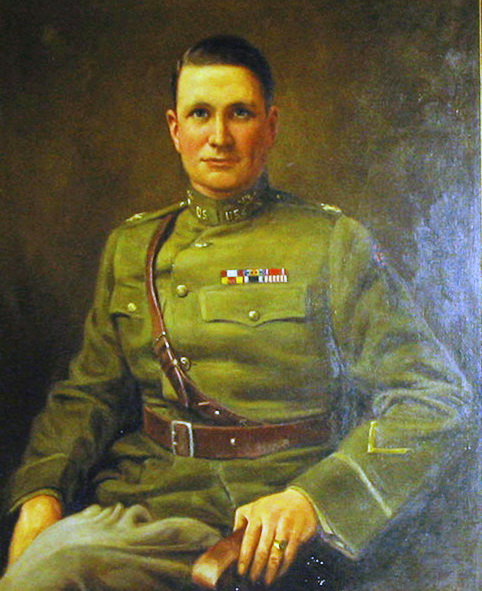
Luke Lea of Nashville, Tennessee, believed in doing the right thing. Having been elected to the U.S. Senate in 1911, at age 32, he voted to punish espionage acts and to arm merchant ships. When Congress declared war in April 1917, Lea organized a group of Tennessee volunteers to take up arms against Germany, the aggressor.
Col. Luke Lea
Within three months after completing their final training in Brittany, Colonel Lea and the 114th Field Artillery he commanded were transported to the front lines. They were in battle continuously until the cease-fire on November 11, 1918.
Following the armistice, peace talks got underway in Paris, with tensions running high and accusations rampant. Luke Lea was determined that Kaiser Wilhelm II should be held accountable for the death and destruction he had caused, even though, having lost the confidence of the German civilian government and military leaders, the Kaiser had abdicated on November 9, two days before the Armistice. Luke Lea believed that Kaiser Wilhelm should still be forced to stand trial for his war crimes, fearing that, otherwise, harsh terms levied against the German people would sow the seeds for yet another war.
Kaiser Wilhelm II
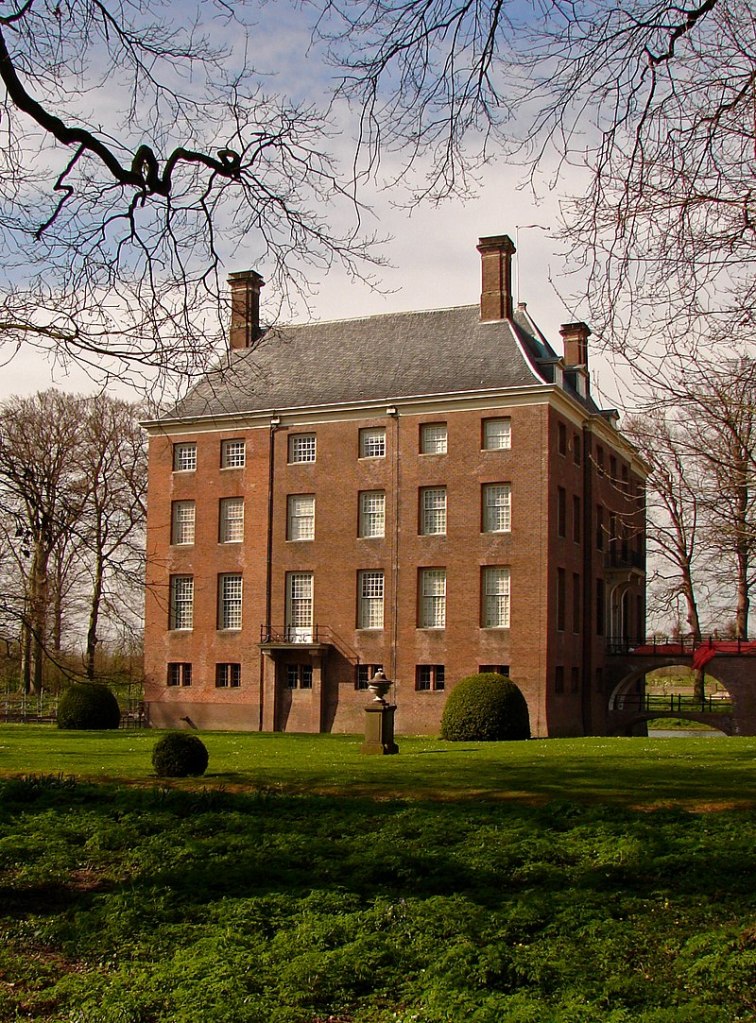
Deciding upon a course of action, Lea took a five-day leave and brought along several of his officers and men, who had no idea what he had in mind. He confided in no one as he quietly arranged passports and transportation. The group travelled in two cars, driving from Luxembourg through Belgium to Amerongen Castle in the neutral Netherlands, where the Kaiser had fled.
As the castle came within sight, Lea said, “Men, I have come to convince the Kaiser that he must come forward before the peace conference and take responsibility for his actions.”
“But,” Luke went on, “if he won’t come willingly, then we will take him unwillingly.” Cheers went up as the men agreed.
Amerongen Castle
Driving up to the castle, the men got out of their cars and knocked on the door. They were admitted and asked to state their business. Lea and his men gave their names. “We are here on a journalistic investigation and request an interview with Kaiser Wilhelm Hohenzollern,” they said. They heard their words repeated in the next room, followed by a response from a man who was almost certainly the Kaiser.
Surmising that the Kaiser was guarded and surrounded by German military personnel, Lea quickly realized that his mission would have to be aborted. There was no chance of success.
Although the visitors were treated politely and served water and cigars, the Germans reminded them that they were uninvited guests and soon asked them to leave. By this time, their cars were completely surrounded by armed Dutch civilians. Luke and his men calmly returned to their cars and drove away. The civilians fell back on either side as the Americans sped through the village.
Amerongen Castle from the air
Immediately upon returning to his regiment, Lea was faced with charges of military misconduct. He defended his actions by insisting that he had acted purely as a private citizen. “Never once,” he said, “did I state that I represented the U.S. Military.”
As a Colonel he took full responsibility and received a stern reprimand from General John J. “Black Jack” Pershing. He would have accepted further punishment, but the charges were dropped. (1997)
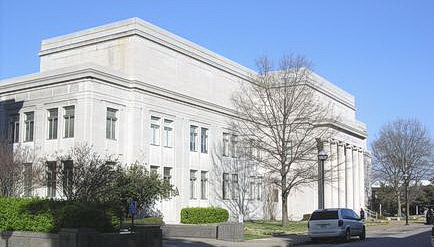
In early January 2004 Herbert Harper of the Tennessee Historical Commission announced that the Tennessee State Library and Archives building at 403 7th Avenue North “has, upon the nomination of this office, been placed in the National and Tennessee Registers of Historic Places by the National Park Service of the United States Department of the Interior on November 17, 2003.”
The 7th Avenue building was declared eligible for the National Register on two counts. The first was architecture. Designed by H. Clinton Parrent, Jr., and completed in 1953, the structure is an outstanding example of late neoclassical architecture. Introduced at the 1893 World’s Columbian Exposition in Chicago, the neoclassical style is marked by “a symmetrical façade featuring a central entrance shielded by a full-height porch with a roof supported by classical columns.” The Nashville building features the slender columns and side-gabled roofs of the later phase, along with some Art Deco touches. It was designed to complement, although not to duplicate, the neighboring Capitol and Supreme Court buildings.
The former home of the Tennessee State Library and Archives on 7th Avenue North across from the State Capitol.
The September 1953 edition of the Tennessee Historical Quarterly, reporting on the grand opening of the building, included this enthusiastic description: “With its exterior walls of white Tennessee marble, its Roman Ionic columns suggestive of the Greek Ionic columns of the Capitol and the inscriptions along the upper walls which serve as reminders of the cultural traditions out of which the building grew, it adds immeasurably to the beauty of Capitol Hill. The building is as functional as it is beautiful, with eight stack levels to accommodate [over two million volumes of] books and records . . ., a restoration laboratory for the repair and preservation of old books and records, a photographic laboratory . . ., and an auditorium.”
One of the most surprising features of the 7th Avenue facility is that it consists of two very different buildings under one roof. The handsome front section, which contained the public reading rooms and staff offices, consists of three stories and an attic storage area. A highlight is the elegant marble vestibule, featuring a terrazzo floor embellished with a geographical map of Tennessee, and military symbols reminding visitors that the building was dedicated to the Tennessee veterans of World War II. The rear of the building, functional and much less ornate, consists of eight stories of stacks and work areas.
The original Tennessee State Library was housed in the Capitol itself. Architect William Strickland personally designed the lofty and elegant room across from the Supreme Court chambers. In 1854 the legislature appropriated funds to purchase books, appointing Return Jonathan Meigs III to build the collection. Meigs, a respected scholar, was named Tennessee’s first State Librarian in 1856. By the middle of the 20th century, his successors had overseen many changes in the library collection, including the acquisition of the Tennessee Historical Society papers in 1927. As the number of resources grew, particularly under the leadership of John Trotwood Moore, who developed the collection of military and other historical records, the allotted space became cramped. It became clear that the Capitol-based Library was no longer an effective facility for research and study.
The original State Library was in this beautiful room in the Capitol, frequently used now for meetings and receptions.
For that reason, the educational value of the 7th Avenue facility – its second criterion of eligibility for the National Register – may be even more significant. The building was constructed not only to store the State Library’s growing collection, but also to preserve the state’s archival records after many decades during which they were stuffed into attics, cellars, and odd corners of the Capitol and other buildings. In the early 1890s a janitor had actually burned several cartloads of documents, saying they were “wet and nasty and smelled bad.” An 1893 request to ship 85 trunks of Civil War vouchers to Washington, D.C., led Governor Peter Turney to assign Capitol superintendent Robert Thomas Quarles to find them. Quarles became the hero of Tennessee historians forever when he focused attention on the appalling condition of stored records and began a ten-year effort to sort and preserve them. After Quarles’ death in 1914, the state legislature passed a resolution authorizing the governor to appoint a state official to continue the work of sorting and preserving. John Trotwood Moore was named the first State Librarian and Archivist in 1919, and the Library and Archives officially merged in 1921.
Construction of the 7th Avenue building was proposed at the first meeting of the Tennessee Historical Commission on December 3, 1941, by Moore’s widow and successor, Mary Daniel Moore. Unfortunately, the entry of the United States into World War II four days later forced the plans to be delayed for several years. Finally, in 1947 and 1949, under the administrations of Governors Jim Nance McCord and Gordon W. Browning, the state legislature appropriated the necessary funds to begin construction. Ground was broken in 1951; the formal opening took place on June 17, 1953.
The current home of the Tennessee State Library and Archives isthis striking facility on Bicentennial Mall near the Tennessee State Museum .
Update: Early in the 21st century, having outgrown available storage space in the 7th Avenue building, the State of Tennessee approved the development of a new facility. Construction began on December 11, 2017. Designed by Tuck-Hinton Architects, the new TSLA building stands adjacent to the Bicentennial Mall at Rep. John Lewis Way and Jefferson Street. The 165,000-square-foot facility, built at a cost of more than $120,000, includes a climate-controlled chamber for storing historic books and manuscripts within a space-saving robotic retrieval system, a blast freezer to help save water- and insect-damaged materials, and improved work spaces and meeting rooms. The ribbon-cutting and grand opening ceremony took place on April 12, 2021.
The author is grateful to Dr. Edwin Gleaves, Jeanne Sugg, Fran Schell, Greg Poole, and Ralph Sowell, who graciously shared the documents and information used in the preparation of this essay. Originally written in 2004, it was updated in 2021 to include more recent events.














 Nashville Historical Newsletter