The Suspension Bridge (1850)

by Allen Forkum.

Since settlers first arrived in 1779, there has been a need for residents to cross the Cumberland River at Nashville. Boats and ferries were the primary means until Nashville’s first bridge was completed in 1823. But within years, this covered toll bridge became an impediment to steamboat traffic, and petitions were made to the state for a second bridge.
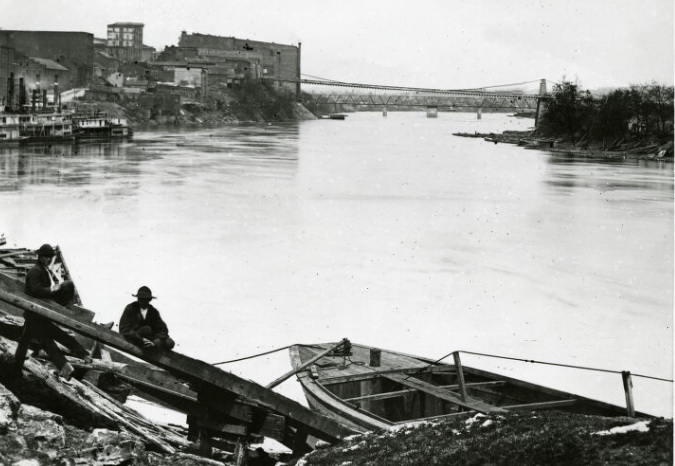
View of Cumberland River, looking north, with view of the Woodland Street suspension bridge and railroad bridge in the distance. (from TSLA photograph collection)

In December 1845 the state legislature authorized the Broad Street Bridge Company to “erect a suspension bridge, of sufficient height as to not obstruct the navigation of the Cumberland” located “at or near the junction of Broad and Water streets” (today’s Riverfront Park). The public act dictated toll rates, e.g., “Footmen free; Man and horse, 5 cents. . . ; For any four wheel two horse pleasure carriage, 25 cents,” etc. Charter company members included Felix K. Zollicoffer (1812–1862) and John Shelby (1785–1859), who owned land across the river in the community that would become known as Edgefield. After the location of the bridge was fixed (changed from Broad Street to the Public Square), contractor M.D. Field hired Nashville architect Adolphus Heiman (1809–1862) to design the bridge. Heiman’s work was lauded, but he would resign from the project over disagreements with Field about the bridge’s construction. By August 1850 the “wire suspension bridge” had “hundreds of wagons and other vehicles pass over daily.” The toll bridge officially opened on September 23. It was 663 three feet in length and 110 feet above the low-water mark. One historian said the “magnificent structure . . . gave an impetus to the growth of Edgefield, making desirable a large body of land which was not so well reached by the old bridge.” The old covered bridge was removed in 1851.

On June 16, 1855, disaster struck at the suspension bridge when a portion of the roadway collapsed, sending a carriage and several people plummeting into the river; two people were killed. Newspaper accounts attributed the accident to brittle wood being used to replace the old wood flooring.

On February 18, 1862, despite “urgent appeals” by citizens, retreating Confederate military authorities ordered that the suspension cables be cut to impede advancing Federal troops. John B. Lindsley (1822–1897) witnessed the destruction of the bridge, writing in his diary that he had never seen a “more strikingly beautiful scene . . .the Wire Bridge was a line or flooring of fire.” The railroad bridge was also burned. Federal military authorities formally took possession of the city on February 25.

The suspension bridge was rebuilt in 1866 and reopened again as a toll bridge. But by the 1870s some citizens, particularly those on the Edgefield side of the river, were expressing the desire for a free bridge. In 1882 the city and county jointly purchased the suspension bridge from the Broad Street Bridge Company and reopened it for public use without a toll. Just two years later, however, the bridge was deemed unsafe by engineers and closed. It was agreed that a new bridge would be erected, but to the chagrin of many Edgefield residents, a pay ferry and a toll pontoon bridge had to be used in the meantime. The new bridge, featuring new piers and iron truss spans with two roadways, opened in 1886. Today the Woodland Street Bridge, opened in 1966, crosses the Cumberland River at the same location as the original 1850 suspension bridge.


Sources, abridged:

Chronicles of the Cumberland Settlements (2012), by Paul Clements, page 131.

Nashville Whig, June 11, 1823, “Nashville Bridge.”

Tennessee Legislative Petitions, Record Group 62 card catalog, bridge petitions.

Tennessee Legislative Petitions, 194-1831-1A and 194-1831-1B, petition by Nashville Bridge Company against a second bridge.

Public Acts of Tennessee, 1845-46, Chapter XXVI, pages 71 to 74, authorization of the suspension bridge.

A. Heiman to John Meigs, Dec. 28, 1857, Tennessee Historical Society Miscellaneous Files (T-100) Box 7, H-62, copy of resignation letter.

A. Heiman to John Meigs, Dec. 28, 1857, Tennessee Historical Society Miscellaneous Files (T-100) Box 7, H-63, copy of report to Directors of the Suspension Bridge

Nashville Union, April 18, 1849, “Suspension Bridge.”

Daily (Centre-State) American, August 17, 1850, “The Wire Suspension Bridge…”

History of Davidson County, Tennessee (1880) by W.W. Clayton, pages 308–309, 348.

Daily American, November 13, 1851, “The work of removing the Bridge…”

Nashville Union & American, June 17, 1855, “Terrible Casualty.”

Republican Banner, June 17, 1855, “Unfortunate Accident at the Suspension Bridge.”

Republican Banner, June 19, 1855, “The Bridge Casualty.”

“The Great Panic by an Eye-witness” (1862) booklet

Lindsley, John B., diary, February 20, 1862, “By this time (3 to 4 A.M.) the suspension and railroad bridges were all in flames.”

Republican Banner, April 21, 1866, “The Suspension Bridge over the Cumberland river, connecting Nashville with the pleasant suburb of Edgefield, will be completed in a few weeks.”

Republican Banner, September 23, 1870, “To The Editor” from “Stockholders” regarding “free passage”

Daily American, January 12, 1882, “The Suspension Bridge—The Resolution Proposing Its Condemnation for a Free Bridge.”

Daily American, September 11, 1884, “The New Bridge.”

Daily American, April 18, 1886, “Crossing The River—History of Bridges Across the Cumberland at Nashville.”

Nashville Banner, October 22, 1966, “Man Survives 90-Foot Fall Off Bridge.”

“Nashville Bridges Across the Cumberland River,” by Debie Cox, online at http://nashvillehistory.blogspot.com/2008/09/nashville-bridges.html

Remembering Omohundro

by Doris Boyce.

Few people realize that Nashville is home to one of America’s oldest water pumping stations, continuously in operation since 1889. Originally named the George Reyer Pumping Station, in honor of a long-time superintendent of the Nashville Water Works, the station and the adjoining R.L. Lawrence filtration plant (in service since 1928) eventually came to be called the Omohundro Water Plant. Originally operating under steam power, the plant was converted to electricity in 1953. The Omohundro plant, which has a pumping capacity of 139,000,000 gallons of water a day, is one of the two treatment plants that provide all the water for Nashville and neighboring communities. In 1987 the Omohundro Complex was added to the National Register of Historic Places.

Even fewer people know that the names of the water plant and Pumping Station Road were changed in 1961 to honor “Squire” John Moten Omohundro Sr. The meandering Omohundro Drive, which adjoins Omohundro Place and Omohundro Court, intersects twice with Lebanon Road not far from downtown Nashville.

John Moten Sr. was often referred to in print as the “Squire,” not to be confused with John Moten Jr. or John Moten III. The senior Moten was born in Roanoke, Virginia, in 1883 and came to Tennessee’s Wilson County as a boy. He had an active political career for over fifty-six years, serving as a justice of the peace, chief of detectives, constable, inspector, magistrate, and city judge of Criminal Court. Known as the Honorable John M. Omohundro, Esquire, he was a member of the court from 1924 until his retirement in 1960. In addition, he served on the Highway Commission when construction of Old Hickory Boulevard began and when the Old Hickory bridge over the Cumberland River was built in 1927-28. His name and those of others on the Commission are carved on both stone approaches to the twin metal bridges.

This image has an empty alt attribute; its file name is old_hickory_bridge_tennessee.jpg
North entrance to the Old Hickory bridge, Old Hickory, Tennessee (Photo by Brent Moore, https://www.flickr.com/photos/brent_nashville/195132799/)

The Squire was an imposing man, over six feet tall, who always wore a white Stetson hat and sported a handkerchief in his pocket. He spoke with a husky voice through a hole in his throat after an operation in the early 1930s. He rode comfortably astride a horse, his father having been a partner in a Nashville livery stable, Jones and Omohundro. On horseback, Squire patrolled the powder plant at DuPont during World War I. He was a force within his community, known to be a man who got things done. Governor Buford Ellington and Mayor Beverly Briley were honorary pallbearers at his 1967 funeral.

In 1906 he married Sadie Poynor, who also enjoyed an admirable public career. She became Postmaster of Donelson in 1943, remaining in that position until the Donelson post office became a Nashville branch in 1954. Sadie was then named a postal superintendent, serving in that capacity until her retirement in 1957. She also had the distinction of being the first president of the Parent-Teachers Association of the old Rosemont School, which later became the Margaret Allen school.

The Squire and Sadie had two children, Alybel and John M. Jr. Alybel and her husband Bill Johnson had no children. John married Frances Nelson, and their union resulted in five children, ten grandchildren, and thirteen great-grandchildren.

Although the surname Omohundro is shrouded in folklore, we do know that the first recorded Omohundro in North America was Richard, who bought property in Virginia’s Westmoreland County in 1670. He married the daughter of the Englishman William Moxley, and all other American Omohundros have descended from them.

Before ending this tribute to the Squire, we should mention his famous uncle, “Texas Jack” Omohundro, who was a protégé of Buffalo Bill Cody. Texas Jack was a magnificent specimen of physical manhood, six feet tall and of the finest proportions. A native of Virginia, he was born in 1846, created a legendary persona, and died before our Squire Omohundro was born. Books written about the life and times of Texas Jack have influenced generations. The Texas Jack website describes him as a “cowboy, prairie scout, western hunting guide, Wild West showman, and partner of W. F. ‘Buffalo Bill’ Cody and James B. ‘Wild Bill’ Hickok.” Perhaps Squire Omohundro infused a bit of his larger-than-life uncle into our local heritage.

No Lighted “Segars”: Rules for Nashville’s First Bridge

Primary Source Document, transcribed by Debie Cox, author of Nashville History blog.

Note: These items from the Nashville Whig newspaper were discovered by Debie Cox among the papers of Judge Litton Hickman and submitted to us. The 1823 bridge was located at the site of the present Victory Memorial Bridge. Additional information about this bridge, including other citations from the Whig, can be found in the book Building of Nashville by Wilbur Foster Creighton.

Nashville Whig – Wednesday, June 11, 1823

The bridge across the Cumberland river at this place is so far completed that horses, carriages do now pass over it.

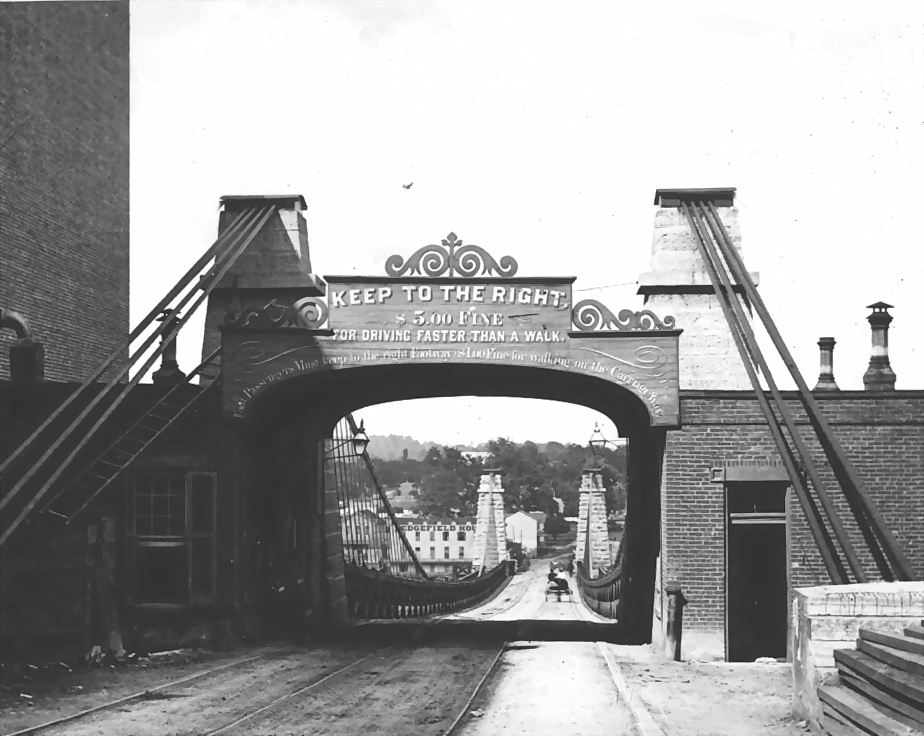
The sign on this early Nashville bridge reads, “Keep to the right. $5.00 fine for driving faster than a walk. Foot Passengers must keep to the right Footway. $1 fine for walking on the carriageway.” (photograph courtesy of Tennessee State Library and Archives)

Nashville Whig – Wednesday, July 21, 1823

Extract from the By-laws and rules adopted by the Directors of the Nashville Bridge Company…

Sec. 4 Be it resolved, that the following rules, by laws and regulations shall be observed by the gate-keeper and by all persons in using, passing or being on said bridge to wit: It shall not be lawful for any person or persons, having or driving any drove of horses, mules, cattle or hogs to drive or pass on said bridge in one drove at the same time in more than the following number to wit: horses, mules or cattle, not more than ten head, of hogs not more than twenty head, and it shall not be lawful for any loaded wagon to pass on or cross said bridge within less than one hundred yards of another loaded wagon, and that it shall not be lawful for any person passing over said bridge on horseback or with a cart, wagon or carriage or with a drove of horses, mules, cattle or hogs to make any delay on said bridge except such as is unavoidable, and it shall not be lawful for any person riding on horseback or driving any cart, wagon or carriage on said bridge or driving any drove of horses, mules, cattle or hogs over same to drive faster than a walk.

It shall not be lawful for any foot passenger to travel on the road allowed for horses and carriages at the time that there is any horses or drove of horses, mules cattle or any wagon, cart or carriage passing thereon except it be such person as shall have the same charge, nor shall it be lawful for any foot passenger to molest, disturb, frighten any horse or drove of horses, mules, cattle or hogs, when passing on said bridge.

It shall not be lawful for any person to carry over or have on said bridge any coal or chunk of fire, nor to make or carry with him on said bridge any lighted segar or pipe, and if any person or persons shall willfully commit a violation of any of the rules above described he, she or they so offending shall be subject to pay the sum of five dollars for every such offence to be recovered before any tribunal having jurisdiction thereof by a warrant in the name of the Nashville Bridge Co., for the use of the said company.

It shall be the duty of all foot passengers to pass the footway on the right hand as they are going, and it shall be the duty of all passengers on horseback or driving any wagon, cart or other wheel carriage or driving any drove of horses, mules, cattle, sheep or hogs to pass over on the right hand way.

It shall not be lawful for the gate-keeper to permit any slave to pass said bridge at any time after nine o’clock at night and before day light in the morning without a written pass from his or her master or mistress expressing such permission.