Primary Source Document, transcribed by Debie Cox, author of Nashville History blog.
Note: These items from the Nashville Whig newspaper were discovered by Debie Cox among the papers of Judge Litton Hickman and submitted to us. The 1823 bridge was located at the site of the present Victory Memorial Bridge. Additional information about this bridge, including other citations from the Whig, can be found in the book Building of Nashville by Wilbur Foster Creighton.
Nashville Whig – Wednesday, June 11, 1823
The bridge across the Cumberland river at this place is so far completed that horses, carriages do now pass over it.
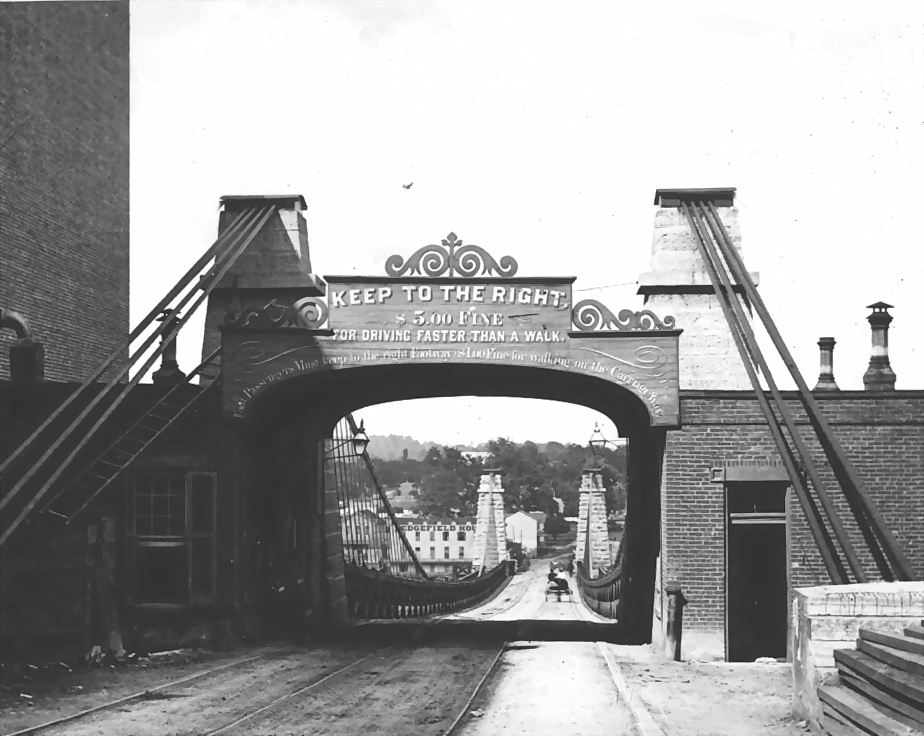
The sign on this early Nashville bridge reads, “Keep to the right. $5.00 fine for driving faster than a walk. Foot Passengers must keep to the right Footway. $1 fine for walking on the carriageway.” (photograph courtesy of Tennessee State Library and Archives)
Nashville Whig – Wednesday, July 21, 1823
Extract from the By-laws and rules adopted by the Directors of the Nashville Bridge Company…
Sec. 4 Be it resolved, that the following rules, by laws and regulations shall be observed by the gate-keeper and by all persons in using, passing or being on said bridge to wit: It shall not be lawful for any person or persons, having or driving any drove of horses, mules, cattle or hogs to drive or pass on said bridge in one drove at the same time in more than the following number to wit: horses, mules or cattle, not more than ten head, of hogs not more than twenty head, and it shall not be lawful for any loaded wagon to pass on or cross said bridge within less than one hundred yards of another loaded wagon, and that it shall not be lawful for any person passing over said bridge on horseback or with a cart, wagon or carriage or with a drove of horses, mules, cattle or hogs to make any delay on said bridge except such as is unavoidable, and it shall not be lawful for any person riding on horseback or driving any cart, wagon or carriage on said bridge or driving any drove of horses, mules, cattle or hogs over same to drive faster than a walk.
It shall not be lawful for any foot passenger to travel on the road allowed for horses and carriages at the time that there is any horses or drove of horses, mules cattle or any wagon, cart or carriage passing thereon except it be such person as shall have the same charge, nor shall it be lawful for any foot passenger to molest, disturb, frighten any horse or drove of horses, mules, cattle or hogs, when passing on said bridge.
It shall not be lawful for any person to carry over or have on said bridge any coal or chunk of fire, nor to make or carry with him on said bridge any lighted segar or pipe, and if any person or persons shall willfully commit a violation of any of the rules above described he, she or they so offending shall be subject to pay the sum of five dollars for every such offence to be recovered before any tribunal having jurisdiction thereof by a warrant in the name of the Nashville Bridge Co., for the use of the said company.
It shall be the duty of all foot passengers to pass the footway on the right hand as they are going, and it shall be the duty of all passengers on horseback or driving any wagon, cart or other wheel carriage or driving any drove of horses, mules, cattle, sheep or hogs to pass over on the right hand way.
It shall not be lawful for the gate-keeper to permit any slave to pass said bridge at any time after nine o’clock at night and before day light in the morning without a written pass from his or her master or mistress expressing such permission.
In 1865 the South lay in ruins. Thousands of sick and wounded Confederate soldiers filled the hospitals or remained in prisons. But out of the ashes of defeat would also come great success stories.
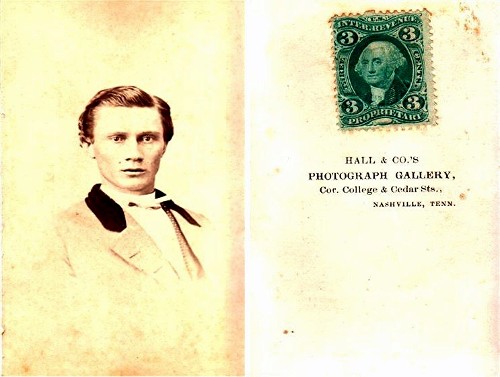
This photo of Ed Buford was taken at Hall’s Photograph Gallery on the Public Square across from the Commercial Hotel, where he boarded. In a King’s City Directory ad, Hall’s proudly stated: “HALL’S Celebrated CARTES DE VISITE Are the most Stylish Pictures made in the City.” The picture can be dated by the revenue stamp above the logo. As part of the Union effort to finance the war, photos were subject to a tax between 8-1-1864 and 8-1-1866. Ed was exchanged at City Point, Virginia, in March 1865, narrowing the date to 1865 or 1866. The original carte-de-visite has the logo and stamp on the reverse side, unlike this modern photomerge. (from the author’s collection)
Among the ragged, half-starved men who made the long trek home that spring was 23-year-old Edward L. Buford. Born in Williamson County in 1842 to William Wirt Buford and Eleanor Pointer Buford, he was barely 19 when war broke out. The Pointers, his mother’s family, came from Virginia – Ed’s great-grandfather fought there during the Revolution. The family had spread as far west as Arkansas and Louisiana during the decades leading up to the terrible conflict that would destroy the lives and fortunes of so many.
Ed Buford joined the 3rd Tennessee Infantry in May 1861, in the company of neighbors and relatives. Within a year many of them would be among the 9,500 cold, weary, and deeply shocked Confederate prisoners shipped north by steamboat and rail after Fort Donelson fell in February 1862.
Ed’s imprisonment at Camp Douglas, Illinois, ended in September 1862, when his regiment was exchanged at Vicksburg. However, in May 1864 his luck ran out again: he was recaptured in some forgotten skirmish or unrecorded clash of picket posts. Sent to Rock Island, Illinois, he was exchanged again, at City Point, Virginia, in March 1865, and paroled in May.
Young Buford, who had been educated at Spring Hill Academy, launched his post-war career on the banks of the Cumberland River, its wharf stacked high with dry goods, cotton bales, guns, ammunition, foodstuffs, and spirits. In King’s 1866Nashville City Directory we find him listed as a clerk at Stratton, Pointer & Co., Wholesale Grocers and Cotton Factors, at 9&11 Broad. The eponymous Pointer was Ed’s uncle, Thomas G. Pointer of Spring Hill.
Ed’s situation changed in 1867 when his uncle sold his interest in the business and moved back to his Spring Hill farm. Ed took a job as a clerk for O. Ewing & Co., Importers and Dealers in Hardware, Guns and Cutlery. By 1871 he was a salesman for Ewing, located in the old John Nichol House at 18 Public Square. He had also moved to the Maxwell House Hotel at the corner of today’s 4th and Church. If Ed had been content to remain there for the next 30 years, we might never have heard of him. The 1870 census listed as clerks many ex-Confederate officers from the wealthy land-owning clans of 1860. It was this leveling of social distinction in the post-war South that permitted Ed’s upward mobility. Although small towns and backwaters would cling to the old ways, cities like Nashville were filled with men like Ed who knew themselves to be as valuable as the officers they had obeyed in the late conflict. Moreover, in November of 1875 Ed had made a very good marriage.
William R. Elliston, the son of Joseph Thorpe Elliston, silversmith and former Nashville mayor, owned $235,000 in real estate and $58,500 in personal property, according to the 1860 census. When he died in 1870, he was even wealthier. He left his daughter Lizinka considerable property downtown, as well as the proceeds from the sale of others. When Ed married Lizinka Elliston, they moved into her mother’s house at 32 N High, today’s 6th Ave N. In 1881 Ed built a house on Elliston Street, today’s Elliston Place, where he and his family would live for the remainder of their lives.
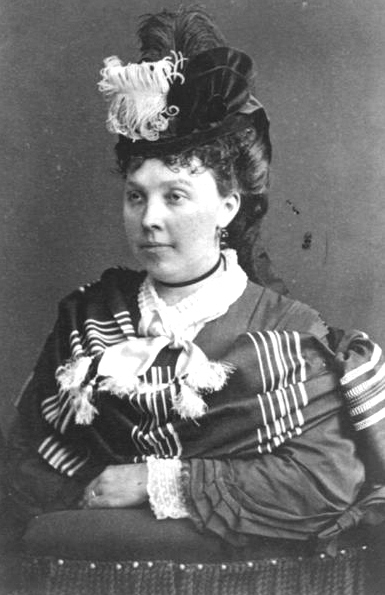
The Baker-Brady family believes this Carl Giers photo from about 1875 to be a portrait of Lizinka Ellison Buford. (from the author’s collection)
During the 1880s and 1890s Ed became a partner in several business ventures, by 1889 operating a company known as Buford Brothers Wholesale Hardware. His brother Charles was a partner until his death, at which time Ed’s brother Brown joined the firm. Edward L. Buford, ex-Confederate POW and former dry goods clerk, had finally arrived.
Along the way Ed and Lizinka had four daughters, one of whom died in infancy, and one son, Ed Jr., who would return from France a celebrated WWI flying ace. The hero’s welcome given to young Ed in March 1919 was marred by sadness when his mother died of pneumonia soon afterwards. Lizinka’s obituary stressed her community work with the YWCA and portrayed her as cultured, sensitive, and tactful – a natural leader. She was buried at Mt. Olivet Cemetery, near her parents, her daughter Louise, and her brother Elijah. In June 1928, after a long illness and confinement, Ed Buford died at age 86 and was buried next to his beloved Lizinka.
I first visited them there one gray, damp, overcast January day. That scene needed only heavy fog or howling winds to conjure up the dim past of their saga. By my second visit a month later, I was among friends, not demigods, and felt more than welcome. We become who we are through the sacrifices, choices, and missed opportunities of the people who passed this way before us. Ed Buford could have come home in 1865 to brood about defeat and the Lost Cause. Instead, he chose the future.
Author’s Notes:
1) I would like to acknowledge the genealogical research of my distant cousins Zee Porter, Linda Pointer, Fred Rowe, and Brian Bivona, who generously shared their files with me. I would never have been able to sort out this huge family without their help. Other data comes from the US Census, Nashville City Directories, Civil War Soldiers’ Records, Widows’ Pension Claims, Mount Olivet Cemetery Records, the Will of W.R. Elliston, and the Nashville Banner.
2) The figure of 9500 prisoners from Fort Donelson may be too low. This was the estimate of Nathan Bedford Forrest’s biographers Jordan and Pryor in 1867, and I accepted it, since it was so close in time to the actual events. Modern historians estimate the number to have been between 12,500 and 13, 500 prisoners. I have also since determined that Ed Buford’s second capture took place at McKernan’s Island near Muscle Shoals, Alabama, according to an account written by Ed’s future brother-in-law Norman Farrell. Farrell wrote of a small cavalry skirmish that took place there within a few days of Ed’s capture. Ed wasn’t alone when he tried to cross the Tennessee River while on leave: with him was William Jackman of Carter’s Tennessee Cavalry, also on leave.
3) Ed Buford fell off a moving train in North Carolina after his exchange in 1865. His injuries were severe enough to delay his return home until July 7, 1865, weeks after the surrenders of Lee in Virginia and Johnston in North Carolina. His second stint as a POW probably saved his life, and his fall from the train, although painful, kept him out of the final battles in North Carolina.
Once upon a time there wuz a family that lived at Gainesboro, Tennessee, Jackson County, four, three miles north of Gainesboro. So they decided to come to Nashville. An Dad come down an rented a farm that a fellar told him he’d get rich. Rented a four-hundred-acre farm. So then he come back and he told em that, oh, how much a barrel of corn would bring. It’us bringin bout three dollars at home, them time. So then, that wuz in August 1911.
So we got ready to come, we had a watermelon patch on the hill there. An Dad got some watermelon to come along with us, an . . . so me an Willie, we went up on the hill, an course we busted one open an eat it, and throwed it over in the bushes.
Dewey Richardson, the narrator of this story. Photo used by permission of the author.
So we . . . the way we’uz comin down here, me an uncle, us three boys, Willie, an myself, Carlie, Comer, Bedford, and Zinnie. We had, uh . . . four mules, five mules. Uncle Jim had three or four. We’uz gonna ride on the mules an in the wagon, an change around an drive our cows too. Gonna come thru all the way in a covered wagon. So that mornin, that . . . we had made a deal with an ole man, that’s a raft man that pilot rafts thru to Nashville, on the water, Cumberland River. So, he had made up a little raft to come to Nashville, an so we put all of our household goods on the raft, including our meat, an eggs, an flour. All things like that . . . chickens. So anyway, we got ready to move after he’d got done pulled away, why, we got ready to go, that mornin it wuz pourin the rain. An Mother an them had cooked fried chicken, an a whole basket full of teacakes. Aw, we’uz gonna have a glorious time on our way. Jus tickled to death
So Dad an em went to the store an there’s a fella that used to haul products of all kinds, an goods, from West Point, plum on to Gainesboro. An he’d pick up stuff an bring it to West Point, stuff that wuz shipped. So he had a deal, with . . . he could make a deal with the boat people. An he made a deal then, it’uz rainin and everthing. We decided to jus go on the boat then. We goes on to West Point, got there jus fore dark, put our cattle and mules up, everthing.
So, we’uz aimin to lay down in the warehouse til the boat come. It’uz sposed to come in the early part of the night sometime. So then, bout that time, why, the cows got . . . one cow got out. An so Uncle Jim an Dad went to git it, while they ‘uz gone, me an Comer, prowlin around lookin into everthing, so we saw some bananas, and so we stole some bananas. Eat them. Then we laid down . . . to go to sleep and bout that time Uncle Jim an Dad come with the cow and put em in the stall with the others.
An then, it wudn’t too long til . . . Mother an the chilern an Aunt Mattie an her chilern came. Some one brought um, I don’t know who. Someone brought um to there in a surrey.
So we wuz waitin for the boat, and finally the boat come around a curve. An . . . when it come around that curve and throwed that big bright light on the stock pin, one ole mule went plum overboard. An out he went. So Dad an Uncle Jim had to go an git em. Finally they got em, brought em back. And put em back in the stall, an they got a ropes on em. An all the men that worked on the boat, the crew, they had to put ropes around his front feet, to make em step. An then some would get behind em an push em.
So we loaded all of that stuff, an Aunt Mattie, an them commenced comin on the boat. She’s kindly shy, scared of everthing she saw. But she wudn’t too crazy bout the crew. But anyway, we went on, we pulled up the river just a little piece up there an loaded wheat bout all night. An then pulled out. We come along towards Nashville. Now then, we’d go down a piece, load up wheat, corn, cattle, hogs, sheep, anything that wuz to be shipped, why, we’d load up there. An I’d seen the time that it’d jus be pourin the rain and they’d git out there in that mud a tryin to drive cattle. Some of em they’d jus have to catch em by the tail, to keep em from runnin away. An all of that. But they had a good time when they went from one landing to another.
But we soon learnt, that how many times it blowed for a lock an how many times it blowed for a landin. Evertime it blowed for a lock, we’d go, even if it’uz in the night we’d git up. But anyway, the first lock we come to, why, we’d never seen a lock before, so we wondered what it’d look like. When you’d go in, why, you could see everthing, but then when you’d leave out, you’d have to look up to see the top of it. So we’uz way down, couldn’t even talk to people on the lock. So then one night, it blowed for a lock, an Willie heard it an he got up. Someone had sold our dog to em, to a man. He wuz fixin to get off at that lock, an he told him, says, “Hey, where you goin with my dog.” He says, “I bought this dog.” “He’s my dog anyway” says “I’m gonna have em.” So he got em, went an tied em up again. But he watched that dog all the time.
So then we come around down to Carthage, which wudn’t bout 30 miles from where we got on. An we saw a train. We’d never saw a train before. It’s jus bout daylight. So we jumps right out of the bed, jus flies out. Don’t pay no tension to what we got on. Saw that train and boy we thought that thang wuz awful. So then, we run back to bed.
Then comin on, we had bout two locks to go thru before we got to the farm that we had rented. So before we had got . . .uh . . . our journey, course they’d milk the cows an . . . uh . . . they’d churn right on the boat, right with the crowd, just like they’s at home. An I don’t know whether they put the butter on the table or milk, or what they done. But anyway, jus made theirself at home, there in the big hallway. An then we’d get ready to eat, why, they’d set the tables up right there in the middle, then everbody’d eat around.
Well, if you’uz wantin to jus get outside, why, you’d go right out on the bow there, or deck. The deck’s what it’d be. Go out there an you could sit there an watch . . . look on each side of the river as you go along an different landins. When it’d land if you’uz gonna be there several hours, why, we’d get off an walk around. We’s all over that boat, everwhere, and Olene an em, it’d jus kill em cause Mother wouldn’t let em jus go, like we did. We’d go plum to the pilot house, an everwhere. Anyway, we come on, last lock we jus got thru breakfast. They tried to, tried to put us off before breakfast. They tried to put the breakfast off, but they couldn’t do it. We got our breakfast anyway. So here we come, when they put the stage down, course we had to be the first ones off. Me and Bedford, an Comer, an Zinney, Willie, an Carlie. An Bedford, as quick as he hit the ground he reached down and says, “Boy” says “Too much sand down here”, says “I don’t like it”.
But anyway, we got all our stuff off, moved em up there to our tenant house that Uncle Oliver was supposed to move in there. The main house wudn’t empty, wouldn’t be empty first of the year. An Uncle Oliver and em wudn’t supposed to come down til first of the year, so that gave us that house to live in. An then we moved up there in the main house. Anyway we stayed there one year. But then, . . . it took bout three or four days to make the trip.
GOIN TO TOWN
So . . . uh . . . we decided, Dad an em decided, to carry us to town one day. We’d never been to Nashville. We didn’t know what it looked like. So we’uz walkin an the streetcar wuz jus goin out, out of town. Zinnie says “Look a’there at that thing”, says “What’s that thing on top?” “That big rod up there.” An that’uz the trolley ware. The one that run the thang. But we didn’t know it that time, but we knowed it fore we got back home. So it come back, an we went to town, all big eyes, you know, an lookin at everthang, countrified as it ever got.
SCHOOL
So then, later on, then school started. Well, when we’uz in Jackson County, we’d . . . uh . . . Jackson County, why, we had a big stairway to put our lunch buckets in, or dinner buckets what we called it. We didn’t know what a lunch wuz. Dinner bucket in. We’d go out at dinnertime and sit down on a rock, the whole family sit around an eat, jus like you’uz at home, only we had flat rocks to eat on, and everbody done the same. But anyway, we went an we carried our dinner bucket with us, an everthing in it, you know. So we got there an we didn’t have nowhere to put our buckets: we couldn’t find no place to put our buckets. Nobody else had no buckets, we didn’t know what to do. Finally we put em under our desk. Well then, when dinner time come we taken our buckets out there, an . . . uh . . . to sit down an eat. We didn’t have no rock to sit on. We sat out on the ground. So, anyway we spread it out there, an we wuz eatin, an noticed all the children jus comin round, standin round, lookin at us, callin us Hillbillys, an everthing else. So I guess we wuz a Hillbilly anyway. But that wound the buckets up. From then on we carried a, a little individual lunch. Jus what we wanted to eat.
Before that time, why, there’s another family moved from up there, the Cantrells. I don’t know . . . there’uz four or five of them. An went to that same school. Course they lived across the river, but they went to that school. So they, got the . . . why, when they carried their lunch, why, then the boys they didn’t have nowhere to put their buckets and they kept lookin and nobody had no buckets, but them. So he told all of em, went around to all of em, told em, said now, “We’re not gonna have no dinner today. Ain’t nobody got no buckets.” So they listened to him, but on the way home when school wuz out, they’s a little patch of woods there, and they went in them woods an eat their lunch, their dinner.
THE PICNIC
But anyway, durin that summer we had picnics there on the farm. It’uz a picnic ground there for boats to bring people up. They’d bring from one, two, three, or four, I noticed as high as four boat loads would come up there at one time. So anyway, we got the rent outa that. An that help pay on the farm. We kept it all cleaned off, with the mowers. So then, the first picnic come, why, we went down there. We didn’t have nothing to do, us six boys, Uncle Jim, an Dad. Course the fella’uz down there that told us bout the farm when we lived in Jackson, why he wuz there, eatin somethin. I said some’en to Comer, or some of em, I says, “That man must like butter.” He says, “That ain’t butter”, says “that’s ice cream.” So then, we decided to go to Uncle Jim and Dad, an get us a nickel apiece. It wudn’t but a nickel. A great big bowl full for a nickel. So we went an they gave us a nickel apiece. We begged um out of it. Course we’uz like all boys, didn’t have a penny to our name. But we got us a bowl of ice cream apiece. So we enjoyed that picnic. Evertime they’d have one, if we could go, we’d go up there. Sometimes we couldn’t go.
THE ELEVATOR
But anyway, then later on, we come to town again. So we jus alookin around an someone said something other bout some elevators. So anyway, we went to the Stahlman Buildin, which was 12 stories, the biggest building in Nashville at that time. So we went in alookin around, so we jus ride up to the top. An we looked around a little while an we’uz ready to go, all six of us. So we decided to go back, an we’uz waitin for the elevator, an happened that both of um come up there at the same time. So they said something to each other. I don’t know what they said. But we knew later on after we got down, because when he put us on, he didn’t stop. The other feller was to catch the traffic as he went down. But we didn’t know it, an we went all the way without stoppin. We didn’t know what’uz gonna take place, because seem like we’uz going back to the top, and it’uz jus settin there. So we got off, and I know they had a big laugh out of us.
April 24, 2003, marks the 223rd anniversary of the historical founding of Nashville. On that well-known date in 1780, John Donelson’s flotilla of about 30 flatboats and several pirogues completed the 1006-mile voyage via four rivers to the French Lick’s almost-completed log central station. Here the travelers joined James Robertson’s overland settlement party that had traveled into the western North Carolina frontier to cross the frozen Cumberland River on Christmas Day 1779 to establish an outpost of civilization. This two-prong settlement of Nashville was described by Theodore Roosevelt in Winning of the West as “being equal in importance to the settlement of Jamestown or the landing at Plymouth Rock.”
Not as well known is that this year also marks the 100th anniversary of the October 11, 1903, dedication of the Robertson Monument in Centennial Park. The monument’s towering 50-foot granite shaft is actually seven years older than its year of dedication, and the story of the monument’s creation in Nashville’s first public park is nearly as interesting as the Robertson pioneers it memorializes.
Photograph adapted from General James Robertson: Father of Tennessee by Thomas Edwin Matthews (Nashville: The Parthenon Press, 1934)
The monument’s existence is due to the energy, dedication, and vision of Nashville’s Major Eugene C. Lewis (1845-1917), owner of theNashville American newspaper and a consulting civil engineer. It was Lewis’ friend, local architect William C. Smith, who suggested in a late-1893 speech to Nashville’s Commercial Club that “a spectacular Tennessee Centennial be held to alleviate financial distress and to divert the attention of the people” from the long and severe depression that had engulfed America after the Panic of ’93. Before the depression, according to W. F. Creighton inBuilding of Nashville, local attorney Douglas Anderson had suggested in local newspapers that a celebration be held in Nashville to celebrate the centenary of Tennessee’s 1796 statehood. Although Anderson’s earlier suggestion had evoked favorable public response, no action was taken until Smith renewed interest in the project. The Nashville Tennessee Centennial Exposition Company was formed and by the summer of 1895 was beginning to acquire financial support for the event. John W. Thomas, president of the Nashville, Chattanooga and St. Louis Railroad, served as president of the Centennial Company and chairman of the executive committee of the Exposition, and Major E. C. Lewis was named director general. The site selected for the Exposition was the West Side Race Track and Park, located on the old fairgrounds surrounding the historic Cockrill Springs area at the end of Church Street and the terminus of the West End Avenue streetcar line. The first Tennessee State Fair had been staged on the site in 1869, with subsequent fairs held in 1873, 1879, and 1884.
The Centennial Exposition, held May 1 through October 30, 1897, was “essentially a fair on a grand scale,” wrote A. W. Crouch and H. D. Claybrook in Our Ancestors Were Engineers. Attractions included 12 large buildings featuring exhibits on the commercial, industrial, agricultural, and educational interests of the state; a “midway” including Egyptian, Cuban, and Chinese villages; a “Giant See-saw” designed by local engineer and steel fabricator Arthur J. Dyer; Venetian gondoliers on newly created Lake Watauga; a Venetian Rialto bridge designed by local architect C. A. Asmus; parades and “sham battles” by the Tennessee Militia; fireworks and other entertainment; and a 250-foot flag staff designed by E. C. Lewis. Major Lewis also had conceived the idea to create a replica of the 5th-century B. C. Athenian Parthenon to house the art exhibit, then commissioned local architect W. C. Smith to make the needed drawings. (The Parthenon, built during 1895-1897, and the city park board’s 1920 decision to have it rebuilt as a permanent structure is a story unto itself.)
Among the exhibits featured at the Exposition’s Mineral and Forestry Building was a towering, 50-foot granite shaft. The impressive monolith is attributed to the “Barry Vermont Granite Quarries” by Creighton in Building of Nashville, but Leland Johnson wrote in The Parks of Nashville that the “granite shaft was quarried at Stone Mountain, Georgia, by Venerable Brothers of Atlanta and shipped to Nashville for display during the 1897 Centennial Exposition. Oral tradition says a portion of the shaft broke off during transit to Nashville.” The shaft’s original flat-stone base remains today on the west bank of Lake Watauga and bears a metal plate commemorating the Centennial Exposition.
After the Exposition closed, all buildings except the Parthenon were torn down and removed. The success of the Exposition, as well as the progressive movement of the late 19th Century to establish public parks, planted the seed for Nashville’s park system. In 1901 Mayor James Head appointed five men, one of whom was Major E. C. Lewis, to the new Board of Park Commissioners. Negotiations were begun by the city in early 1902 with the owners of the 72-acre Centennial Park to purchase the land for a permanent city park. After months of complicated offers and counter-offers, described in The Parks of Nashville, Nashville Railway and Light Company purchased Centennial Park and its title was presented to the city park board on December 22, 1902.
On January 13, 1903, Major Lewis addressed the Tennessee Historical Society on the subject of James Robertson. He began his speech by informing the assembled members of “a fortunate circumstance that transpired only a few days ago. . . .For the first time in all its history, Nashville has park ground worthy of the Capital of Tennessee. The title to the Centennial Grounds, upon which the city has already contributed a large sum of money toward the adornment thereof, is now in the city of Nashville. The Park Commission. . .has so far determined upon but one measure, and that, the erection in Centennial Park of a monument [for] James Robertson, the founder of Nashville.” He concluded his lengthy profile of Robertson by asking, “What have we of Nashville done to honor this man’s memory? Has even the memory of all the good Robertson did been interred with his bones?. . .Are we a grateful people?”
Major Lewis had made prescient provisions to answer his own questions. When negotiations had begun to purchase the Centennial land, he purchased the 50-foot granite shaft for $200, then his fellow-commissioner Samuel A. Champion “resolved that it be erected in the park as a monument to the memory of James Robertson.” Lewis also purchased the flat-stone base for $10 in 1903 to remain beside Lake Watauga as a memorial to the Centennial Exposition. A new granite base was needed to support the heavy shaft after its relocation, but no record has yet been found of the base’s creator or its procurement. Wherever the massive base originated, Johnson described the monument’s creation in The Parks of Nashville: “With a tripod made of three large oak logs and block and tackle, Major Lewis raised the shaft into position and then constructed the foundation beneath it.” The granite shaft and its base weigh a total of 52.5 tons. Text is inscribed on a plaque on each side of the monument:
North Side Text: “James Robertson/Born in Brunswick County, Virginia, June 28, 1742. Moved to North Carolina in 1750. Came to Tennessee in 1769. Settled Nashville in 1780. Died in Tennessee Sept. 1, 1814. Reinterred in the City Cemetery at Nashville, 1825, under authority of the Tennessee Legislature.”
East Side Text: “Charlotte Reeves/Wife of James Robertson/Born in North Carolina, Jan. 2, 1751. Married to James Robertson, 1768. Died in Nashville, Jun. 11, 1843. Buried in the City Cemetery. Mother of the first male child born at Nashville. She participated in the deeds and dangers of her illustrious husband: won honors of her own and along his path of destiny cast a leading light of loyalty, intelligence, and devotion.”
South Side Text: “A worthy citizen of both Virginia and North Carolina. Pioneer, patriot, and patriarch in Tennessee. Diplomat, Indian fighter, maker of memorable history. Director of the movement of the settlers requiring that hazardous and heroic journey so successfully achieved from Watauga to the Cumberland. Founder of Nashville. Brigadier-General of the United States Army. Agent of the Government to the Chickasaw Nation. He was earnest, taciturn, self-contained, and had that quiet consciousness of power usually seen in born leaders of men. ‘He had winning ways and made no fuss.’ (Oconnostota) He had what was of value beyond price–a love of virtue, an intrepid soul, an emulous desire for honest fame. He possessed to an eminent degree the confidence, esteem, and veneration of all his contemporaries. His worth and services in peace and war are gratefully remembered. Amiable in private life, wise in council, vigilant in camp, courageous in battle, strong in adversity, generous in victory, revered in death.”
West Side Text: “James Robertson/Founder of Nashville/’We are the advance guard of civilization. Our way is across the Continent.'” Robertson—1779
The monument to James and Charlotte Reeves Robertson was presented to the city of Nashville on October 11, 1903, by Major E. C. Lewis on behalf of the Park Commission. About 100 Robertson descendants from all over the United States and one foreign country attended the ceremony in Centennial Park, according to Sarah F. Kelley in Children of Nashville. Three-year-old Dickson Wharton Robertson, descended through Dr. Peyton Robertson, was dressed in Scottish-plaid kilts and pulled the string to unveil the towering monument honoring his great-great-grandfather. Among those offering memorial tributes to Nashville’s founder were Governor James B. Frazier and Mayor James Head.
“History often repeats itself,” wrote Kelley. “On June 28, 1972, the descendants of James Robertson gathered once again in Nashville to celebrate Tennessee’s ‘James Robertson Day’ proclaimed by Governor Winfield Dunn.” Among the descendants gathered around the Robertson Monument in Centennial Park was the same Dickson Wharton Robertson who had participated in the monument’s unveiling 69 years earlier.
As the Robertson Monument approaches its centenary, the 107-year-old shaft has weathered well, as have the 100-year-old base and four bronze plaques. Attesting to the passage of a century is that the massive base appears to have sunk several feet into the earth since 1903. Without measured drawings to provide dimensions of the original base, however, a definitive conclusion cannot be made. Thus we celebrate the founding of Nashville with the hope that Centennial Park’s terra firma will continue to support the city’s monument to its founder, so that future Nashvillians may enjoy a bicentennial celebration of the Robertson Monument.
SOURCES:
Winning of the West, Volume II: From the Alleghanies to the Mississippi, 1777-1783, by Theodore Roosevelt (New York: G. P. Putnam’s Sons, 1889).
Tennessee Old and New, Sesquicentennial Edition, 1796-1946, Volumes I and II (Nashville: Tennessee Historical Commission and Tennessee Historical Society, 1946).
Seedtime on the Cumberland, by Harriette Simpson Arnow (New York: The Macmillian Company, 1960).
Building of Nashville, by Wilbur Foster Creighton; revised and enlarged by Wilbur F. Creighton, Jr., and Leland R. Johnson (Nashville: Wilbur F. Creighton, Jr., and Elizabeth Creighton Schumann, 1969).
Children of Nashville: Lineages of James Robertson, by Sarah Foster Kelley (Nashville: Blue and Gray Press, 1973).
Our Ancestors Were Engineers, by Arthur Weir Crouch and Harry Dixon Claybrook (Nashville: Nashville Section of American Society of Civil Engineers, 1976).
The Parks of Nashville: A History of the Board of Parks and Recreation, by Leland R. Johnson (Nashville: Metropolitan Nashville and Davidson County Board of Parks and Recreation, 1986).
Andrew Jackson Slept Here: A Guide to Historical Markers in Nashville and Davidson County (Nashville: Metropolitan Historical Commission of Nashville and Davidson County, 1993).



 Nashville Historical Newsletter