Nashville Founding Factors

by Mike Slate.

It’s difficult to imagine when Nashville wasn’t here—when Davidson County was a game-rich but otherwise uninhabited wilderness. Yet that’s the way it was 250 years ago. Who started all this civilization that we now take for granted and call our home? The traditional view is that Nashville was founded by pioneers James Robertson and John Donelson, who journeyed here in 1779-80 with a few hundred others, built a fort on the bluff above the Cumberland River, and persevered through much danger and hardship. The arrival of Robertson and Donelson was certainly the pinnacle of an uphill process, yet other founding factors are worthy of more emphasis than they sometimes receive.

For example, we should not forget the buffalo. The huge hump-backed beasts flourished here near the river and made paths to a salubrious spot in the vicinity of Sulphur Dell ballpark and the Bicentennial Mall. That spot was a salt lick on a creek called Lick Branch, long since smothered by modern infrastructure. So many bison and deer were here that reports from early hunters and explorers made our area attractive to adventurous colonials back east. Yes, our metropolis rides atop buffalo humps: without the bison there may never have been a Nashville, a circumstance that illustrates the interdependence of geographical, natural, and human history.

Painting from NHN collection

Despite 200 years of study the next factor remains mysterious and fraught with theory. Generally, we know that over the eons distinctly different cities were often built one on top of another. Nashville has risen upon a Mississippian-era culture commonly known as the Mound Builders, Indians so ancient that even the more modern Native Americans didn’t know where they came from or where they went. When early woodsmen arrived at our salt lick they found an old earthen mound close by, obviously man-made and apparently ceremonial in function. Ralph Earl, Andrew Jackson’s portrait artist, excavated the mound in 1821 and found the round base to be about thirty yards in diameter and the height about ten feet. Situated generally from the mound eastward to the Cumberland, an ancient burial ground held interments enough to indicate that a large population thrived here. These remains of a surprisingly sophisticated society were a few to several centuries old. In addition to Davidson County finds, other such sites were discovered in surrounding counties and across Tennessee—all a part of a nexus that extended throughout much of the Ohio River Valley and beyond. Was the existence of a previous society an encouragement to later pioneers? Did early Nashvillians assume, consciously or not, that since another culture had flourished here, so could they?

Photo by Paul Pierce

After the era of the Mound Builders, the Shawnee Indians also had villages along the Cumberland. In fact, an early name for the Cumberland River was the “Shawanoe,” an English derivative of the French “Chaouanon.”   The Shawnee were a rather nomadic tribe, but for a time they had a village near our salt lick, until driven north in about 1714 by Cherokee and Chickasaw tribes who sought to reserve Middle Tennessee for hunting only. Thus for many years before the Euro-American settlers arrived, our Middle Tennessee area was a kind of sacred game preserve. No wonder the Indians were enraged when the white man came. However, the settlers, knowing good land when they saw it, determined to have it regardless of the price they had to pay. That price was paid in blood, as Indian wars raged for the first fifteen years of white settlement. Evidently, no real estate is more desirable than that which someone else also desires!

During and after the Shawnee period, French hunters and traders headquartered at our salt lick. Around the year 1710 a young apprentice, Jean du Charleville, worked here for an old Frenchman whose name is lost to history.  Their trading post was located directly on top of our Indian mound. Arriving in the 1760s, another hunter-trader bore an auspicious name: Jacques Timothe Boucher de Montbrun. More commonly known as Timothy Demonbreun, he returned in later years to settle in Nashville, and today’s Demonbreun Street is named for him. Because of the intermittent presence of such French entrepreneurs, our locale became known as the French Lick, a name familiar to researchers of the American frontier. A remnant of French influence survives today in the word “Nashville,” the suffix -ville being French for town or village.
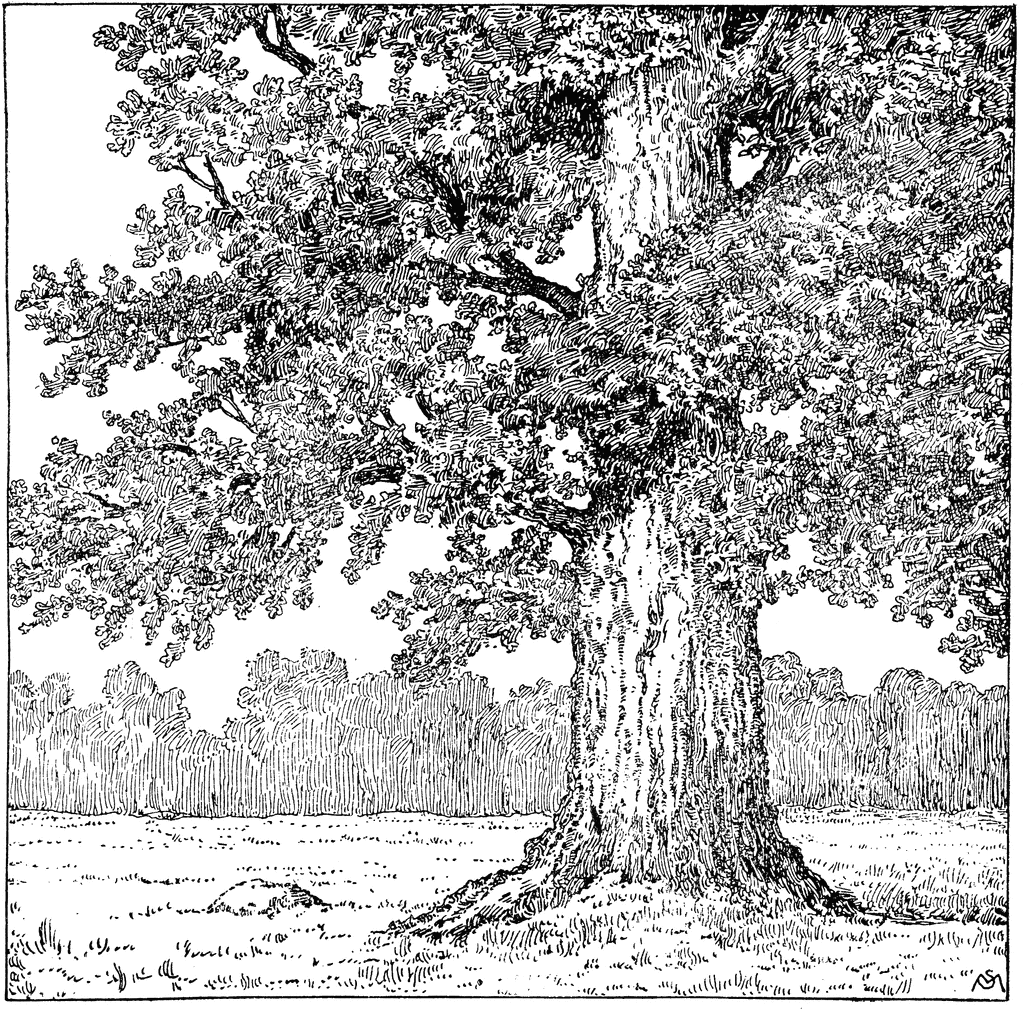
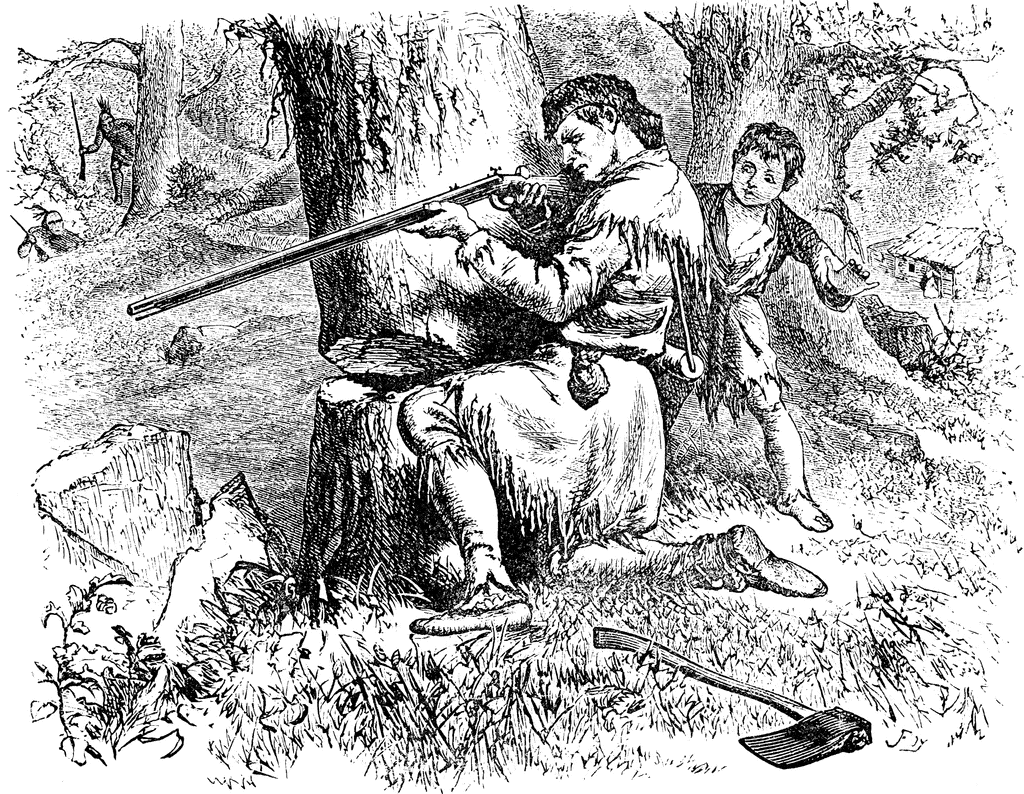
On the heels of the French traders came the Long Hunters, so called because of the lengthy time they spent in the woods. Notable hunters and explorers in our region during the 1760s and 70s include Thomas Hutchins, Henry Scaggs, Uriah Stone, Michael Stoner, Kasper Mansker, Isaac Bledsoe, Thomas “Bigfoot” Spencer, James Smith, John Rains, Daniel Boone, and John Montgomery. History knows a fair amount about these trailblazers, and their romantic era is fittingly memorialized in the name of today’s Long Hunter State Park along Percy Priest Lake. Serving as the vanguard of colonial civilization, the Long Hunters laid the foundation necessary for permanent settlement.

The Long Hunters gave rave reviews of the western wilds to a North Carolina judge, Richard Henderson, who was interested in land speculation. Together with like-minded partners, Henderson established a land company, the Transylvania Company; and in 1775 he negotiated with the powerful Cherokee Indians to gain tentative control of much of today’s Kentucky and upper Middle Tennessee territory, including the French Lick. He then organized emigrant groups to settle both the Kentucky and Cumberland regions, with Daniel Boone the head of the Kentucky contingent and James Robertson the Tennessee leader. Robertson, a North Carolinian, teamed with Virginian John Donelson and devised a plan to conduct a few hundred pioneers from northeastern Tennessee to the French Lick, Robertson by land and Donelson by river. Robertson’s group arrived here in December 1779 and built the fortification overlooking the Cumberland, and Donelson’s voyagers arrived the following April. A number of the newcomers established other stations nearby. Close behind the settlers came Henderson, who then penned our first organizational document—the famous Cumberland Compact—in which he referred to our compound as “Nashborough,” in honor of General Francis Nash who had recently died in the Revolutionary War. Some 256 men signed the Compact, and the primitive village was up and running, along with its sister stations.

But Nashborough had no real legitimacy. It was only a speck of civilization separated by hundreds of rugged miles from its territorial mother, the State of North Carolina. Finally, in 1783-84, the North Carolina legislature recognized it, upgrading the outpost to the status of a town in the new county of Davidson and changing its name to Nashville, an apparent attempt to disavow the English with whom the Revolutionary War was just ending.      

Of our Nashville founding factors—buffalo, Mound Builders, Shawnee, French hunters-traders, Long Hunters, Henderson, Robertson and Donelson, North Carolina legislature—perhaps the most under-appreciated is frontier opportunist Richard Henderson. So instrumental was his role in our beginnings that if someone were to claim him as our founding father it would be difficult to argue the point. While it is Robertson who is proudly and justifiably known as the “Father of Middle Tennessee,” Henderson was the CEO behind the initial enterprise. He didn’t do the heroic grunt work or Indian fighting necessary for our permanence, but he was our prime mover.

Like the trees that obscure the forest, hidden within the “how” of our founding is the “why.” Why did the founders come to this particular place? Nashville’s founding factors provide a fundamental answer: the colonial settlers were drawn to this location because it already had a magnetic history.


Helpful sources: Haywood’s The Natural and Aboriginal History of Tennessee, 1823; Goodspeed’s History of Tennessee, 1887; Thruston’s Antiquities of Tennessee, 1890; Williams’s Dawn of Tennessee Valley and Tennessee History, 1937; Arnow’s Seedtime on the Cumberland, 1960; Crutchfield’s Early Times in the Cumberland Valley, 1976; Satz’s Tennessee’s Indian Peoples, 1979; Hinton’s A Long Path, 1997; Finger’s Tennessee Frontiers, 2001.


This article was originally published in the September 2009 issue of The Nashville Retrospect. We thank publisher Allen Forkum for his permission to republish it here.

Jonathan Jennings’ Will

Primary Source Document, transcribed by Debie Cox, author of Nashville History blog.

Editor’s Note: Historian Debie Cox discovered the Jennings will in the Metro Archives in 2001. Jennings’ tragic death soon after he drew it up gives unusual poignancy to the document. The will is historically significant because it is likely the oldest surviving document from Nashville, other than the Cumberland Compact itself.

Jonathan Jennings and his family were among the group of pioneers who journeyed with the John Donelson flotilla to the Cumberland Settlements. Donelson recorded in his journal on March 8, 1780, that Indians had attacked the flotilla, and that the Jennings family had been left behind as the settlers in the other boats made their escape.

The Jennings boat had indeed survived, but not without casualties. Jennings’ daughter Elizabeth, wife of Ephraim Peyton, had given birth the day before the attack. In the confusion of the fighting, her baby was killed. Jonathan Jennings Jr., son of the elder Jennings, had jumped from the boat along with two other men. Although young Jennings, who was probably in his early teens, and one of the others made it to shore, the third man drowned. Jennings Jr. and his companion were quickly captured by the Indians, who scalped Jennings and killed the other man. Young Jennings, who had survived his injuries, was eventually rescued by a trader who agreed to pay his ransom, and he was later able to reunite with his family in the Cumberland Settlements. After the attack, the remaining members of the Jennings family had continued on their journey, arriving at Fort Nashborough on April 24, 1780.

According to J. G. M. Ramsey in his Annals of Tennessee, Jonathan Jennings Sr., was himself killed by Indians three or four months later, in July or August 1780. He left an undated will, which was presented to the Davidson County court in July 1784 and proven on the oaths of James Robertson and William Fletcher. The will had also been witnessed by Zachariah White, who had died at the Battle of the Bluffs near Fort Nashborough in April 1781. The signatures of Jennings, Robertson, and White can be verified through comparison with their signatures on the Cumberland Compact, which all three men had signed in May of 1780. The will reads as follows:

In the name of God Amen I Jonathan Jennings of North Carolina on Cumberland River having this day Received several wounds from the Indians and calling to mind the mortality of my Body do make and Ordain this to be my last will & Testament And first of all I give and recommend my soul to God that gave it and my body to be disposed of at the Discretion of my executors And as touching my Worldly affairs I dispose of them in manner following Viz

Item I give and bequeath to my    It is my Desire that my Estate be Equally divided between my Wife my sons William, Edmond, Elizabeth Haranor Mary Aggy Anne & Susannah all but such a part as shall be hereafter disposed of

Item I give and bequeath to my son Jonathan who was Scalped by Indians and rendered incapable of getting his living a Negrow girl Milla & her increase who is to remain with my beloved wife till my son comes of age Also a Choice Rifle Gun & a Horse and Saddle Item I give my beloved wife Four Choice Cows and Caves The Wards Milla and her increase and the Ward Jonathan being interlined I devise that my Loveing Wife and my son Edmond be Executrix & Executor of this my last Will & Testament
Signed Sealed & Published in Presents
of Jonathan Jenings
Zach White
Js. Robertson
William Fletcher

Alice Thompson Collinsworth: Intrepid Pioneer

by Gloria Newsom Huggins.

On Christmas Day 1779 James and Elizabeth Thompson arrived at French Lick on the Cumberland River. The couple had joined James Robertson’s adventurers, looking for a new life on land where they believed they would be free. However, they had no idea what a high price they would pay for land in this territory that was to become Nashville, Tennessee.

By the time John Donelson’s party arrived on April 24, 1780, the Robertson group had already built eight stations of log cabins. A week later the men in the group gathered at the Bluff and adopted the Cumberland Compact1. Within the next two weeks they agreed on additional resolutions, and on May 13, 1780, James Thompson and his son Robert joined 254 other men in signing the completed Compact.

Signature page of the Cumberland Compact

As original settlers, the Thompsons received 640 acres on Richland Creek, near today’s Belle Meade mansion. In 1790 James began building the family’s cabin there, not realizing the dangers that lay ahead. By 1791 two of the Thompsons’ sons had lost their lives in Indian attacks. More tragedy was to follow: a narrative given to The South-Western Monthly in 1852 by John Davis, an early neighbor, described the murder of James and Elizabeth Thompson and their daughter Elizabeth by a party of Indians on February 25, 1792. Thomas E. Matthews’ book General James Robertson, Father of Tennessee, adds that the marauders enslaved the Thompson’s 31-year-old daughter Alice, along with two houseguests, a Mrs. Caffrey and her young son.

Scene in Indian village

The captives were taken to a Creek village called Kialigee, where Mrs. Caffrey’s little boy was taken from her and given to another white slave to raise. It would be two years before they were freed. Indian agent John O’Riley purchased Alice from her captors for 800 weight of dressed deerskins valued at $266 (the equivalent of almost $7,000 today). In May 1794 Alice was taken to the American Agency at Rock Island, Georgia. Before she returned to Nashville, she met with Governor Blount in Knoxville to answer his questions about other captives she had seen in the Indian camps. Governor Blount recorded these facts in a letter to the Secretary of War on October 2, 1794.

Meanwhile, in 1793, Edmund Collinsworth had arrived in Nashville to join his half-brother John Cockrill, who was married to James Robertson’s sister Ann. Edmund was a veteran of the Revolutionary War, having enlisted in the First Virginia Regiment in 1777 and served until April 1780. According to family stories, it was “love at first sight” when Alice met Edmund upon her return to Nashville in late fall 1794. They were married on December 17, 1795.

The couple built their home on land that had belonged to Alice’s brother John, who had died in the 1791 Indian attack. It is believed that both Alice and Edmund were eventually buried in unmarked graves on this home place, which is located in today’s Antioch/ Mount View area southeast of Nashville.

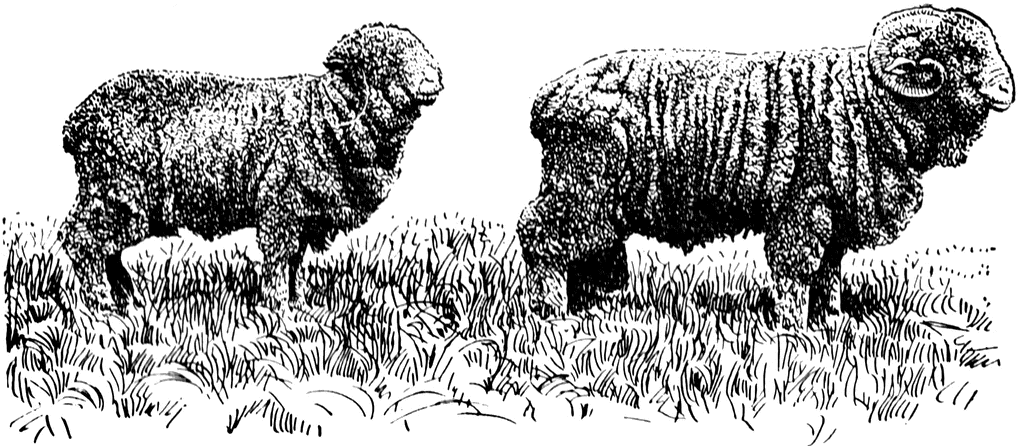
Edmund died in March of 1816, leaving Alice with seven children ranging in age from seven to eighteen. As she always seemed to do, Alice took the bad with the good and persevered, bringing up the children on her own. Her son James carried his Tennessee fortitude to the young Republic of Texas where he served as aide-de-camp to Sam Houston during the Battle of San Jacinto. He was a signer of the Texas Declaration of Independence and was Chief Justice of the Texas Supreme court at the time of his death. Another of Alice’s sons, John, graduated from the U.S. Military Academy at West Point. Daughter Susan married Mark Robertson Cockrill, who owned a 5.600-acre farm where he bred award-winning Merino sheep, their wool acclaimed as the finest in the world.

Merino sheep

Alice died in February 1828 at her home, which she shared by then with her daughter Parmelia Ann Davis and her family. The old house is long gone, but in December 1864 it was the place where Parmelia Ann had a touching encounter with a Union officer . . . but that’s another story2.


1 The Cumberland Compact, adopted in Nashville in 1780, was essentially a constitution for the frontier settlement, setting rules for governing the colony (including salaries, which were to be paid in animal skins) and for making and enforcing laws. It was signed by 256 colonists. (ed.)

2 Widowed in 1848, Parmelia watched the railroad industry change the face of middle Tennessee. During the Civil War, Nathan Bedford Forrest and others took great pride in sabotaging the tracks to impede the advance of Union troops. In early December 1864 Parmelia heard the thunderous crash of a train accident near her property and rushed toward the flaming wreckage to see what had happened. The Union officer in charge was gathering the bodies of 24 soldiers killed in the accident, planning to bury them all together in an embankment near the tracks. Parmelia intervened, insisting that the dead soldiers be buried on her plantation, each individual grave to be marked with a stone from her fields. Touched by her kind gesture, the Union officer posted a “special guard” to protect Parmelia and her land from attack for the remainder of the war. After the war the remains of the 24 Union soldiers were reportedly moved to the Stones River National Cemetery in Murfreesboro.  (ed.)

Daniel Boone in Nashville

by Mike Slate.

Legendary frontiersman Daniel Boone (1734-1820) is most often associated with blazing the Wilderness Road through the Cumberland Gap in 1775 and establishing Kentucky settlements. However, his many wide-ranging expeditions arouse our curiosity as to whether he also explored Middle Tennessee in general and the French Lick-Nashville locality in particular. Kentucky’s plucky pioneer has generated a torrent of literature, and I invite the reader to hike with me down the Nashville fork of the Boone trail. Along the way I think we’ll find that history’s subplots are both interesting and informative.

(photo by Bob Bowman)

Daniel Boone’s short “autobiography,” romantically ghostwritten by Kentucky land speculator John Filson (ca. 1753-1788) and published in 1784, launched the intrepid woodsman to national and international fame. A pertinent but inconclusive sentence therein reports that Daniel and his brother Squire Boone (1744-1815) “proceeded to Cumberland river, reconnoitring [sic] that part of the country until March 1771, and giving names to the different waters” (The Adventures of Col. Daniel Boon, Kessinger reprint, p. 56). The Life of Daniel Boone, the seminal tome of renowned archivist Lyman C. Draper (1815-1891), seems to place this exploratory event within a geographical swath ranging from near today’s Bowling Green, Kentucky, south to Castalian Springs (formerly Bledsoe’s Lick) in Sumner County, Tennessee (see p. 264 of the Stackpole Books edition, edited by Ted Franklin Belue). One contemporary writer, Robert Morgan, expands this expedition even farther south, all the way to the French Lick (Boone: A Biography, p. 121).  

Draper reports a more conclusive episode – occurring as much as two and a half years after the exploratory journey mentioned above – in this fascinating passage: “During this period, one Joe Robertson, an old weaver who had a famous pack of bear-dogs and was devoted to the chase, often accompanied Boone into the Brushy Mountain and over to the Watauga, securing loads of bear-skins, which they packed to the settlements and sold. On one of their adventurous trips, they penetrated as far as the French Lick on Cumberland and found several French hunters there” (pp. 283-284). Here we have the earliest narrative I know that places Boone squarely in the heart of Nashville. The time frame for this visit is some seven or more years before the town was founded in 1779-80 by James Robertson (1742-1814) and John Donelson (ca. 1718-1785). Incidentally, I have discovered no familial kinship between Joe Robertson and Nashville co-founder James Robertson, yet the possibility remains intriguing. Furthermore, the fact that French hunters/traders occasionally headquartered at the salt lick on the Cumberland River known as the “French Lick,” site of today’s Nashville, has always been known, the most famous of these traders being Timothy Demonbreun (1747-1826), Nashville’s “First Citizen.”

Through the years other biographers have repeated Draper’s account of Boone at the French Lick: Reuben Gold Thwaites (1853-1913), though he places Boone “sometimes with one or two companions” but not with Joe Robertson or his dogs specifically; John Bakeless (1894-1978); and more recently, historians John Mack Faragher and Michael A. Lofaro. In his acclaimed 1992 chronicle, Faragher sometimes even tags the event with seasons: “Whether with his family or alone, Boone certainly spent the fall and winter of 1771-72 hunting in what would become the state of Tennessee. With a North Carolinian named Joe Robertson, the owner of a notable pack of bear-tracking hounds, he hunted bear, pushing as far west as French Lick (later called Nashville) on the Cumberland River, where he met hunters of some of the numerous French parties that came to those licks each year to hunt buffalo” (Daniel Boone: The Life and Legend of an American Pioneer, p. 88).

Other than in biographies, I am aware of no complete reference to Draper’s Boone-at-French Lick anecdote in any other Nashville or Tennessee history. The most obvious reason is, of course, that for well over a century Draper’s Boone manuscript existed only in handwritten form and often only on hard-to-read microfilm, until Murray State University’s Ted Franklin Belue brought it to print in 1998. Several state and local historians, however, do place Boone at least in the Middle Tennessee area. A.W. Putnam (1799-1869) notes that “Boone, Rains, Mansker, and others . . . hunted and explored in 1769-70 upon the Cumberland” and reported “its marvelous herds of buffalo and deer” (History of Middle Tennessee, University of Tennessee edition, p. 619). Similarly, Samuel Cole Williams (1864-1947) comments in his discussion of 1769-70 exploratory crews that “Daniel Boone after a hunt in Kentucky joined one of the groups on the Cumberland in the Tennessee region” (Dawn of Tennessee Valley and Tennessee History, Watauga Press edition, p. 330). Harriette Simpson Arnow (1908-1986), who used Draper and many other primary sources, mentions that Boone “hunted over and explored most of the Cumberland at intervals between 1769 and 1775” (Seedtime on the Cumberland, Univ. of Nebraska edition, p. 169). And contemporary historian John R. Finger, using a Draper-like phrase, observes that in 1772 Boone “hunted as far west as French Lick” (Tennessee Frontiers: Three Regions in Transition, p. 42—which book includes, by the way, the finest bibliographic essay on frontier Tennessee sources that I know of).

Equally germane to the case for a Boone visit to Nashville are his professional and personal ties to the Lower Cumberland region. He was above all a Long Hunter extraordinaire who stayed in the woods for months or even years at a time. It strains credulity that he would not at some point come to the French Lick, heralded at least since the late 1760s for its excellent hunting. In addition, Boone was (or became) well acquainted with several Cumberland pioneers including Michael Stoner (1748-1813), Kasper Mansker (ca.1750-1820), and, most notably, Nashville co-founder James Robertson. Both Boone and Robertson worked for the prominent Transylvania Company under Richard Henderson (1734-1785), with Boone the overseer of Henderson’s Kentucky land interests and Robertson of his Tennessee holdings. Williams provides insight into the duo’s personal relationship in his report that Boone’s children, along with Robertson’s, were christened or baptized in Robertson’s Watauga home in East Tennessee, perhaps around 1772-73 (see Dawn of Tennessee Valley, p. 344). Moreover, Draper asserts that their friendship directly influenced the founding of Nashville. Upon returning to North Carolina after the famous 1778 Boonesborough siege, “Boone went by way of Watauga and was there enabled to make such representations to his old friend Capt. James Robertson as induced him the following year to visit the Cumberland country and become the pioneer father of Middle Tennessee” (The Life of Daniel Boone, p. 521).

An argument against a Boone visit to Nashville could pivot on Draper’s interviews with the pioneer’s last-born child, Nathan Boone (1781-1856), who was an intrepid frontiersman in his own right, as well as Draper’s greatest wellspring of information. Fortunately, Draper cites sources for his Boone-at-French Lick passage, with this endnote: “MS. notes of conversations with Col. Nathan Boone and the late Henry Rutherford of Tennessee. Soon after the Revolutionary War, [Joe] Robertson resided in the family of Mr. Rutherford’s father, Gen. Griffith Rutherford, of Rowan County, North Carolina, and used to speak of his hunting and exploring with Boone (The Life of Daniel Boone, p. 294). But his citation of Nathan Boone as a source for the French Lick event is problematic in view of his 1851 interviews with Nathan as presented in a 1999 book. in one interview with Nathan, Draper asked, “Did Colonel Boone ever mention hunting at the French Lick on the Cumberland River?” Nathan’s answer: “Not that I recall” (My Father, Daniel Boone, p. 45, edited by Neal O. Hammon). Throughout his Boone manuscript Draper cited Nathan often, apparently at least one time too many.

Now we come to the testimony of Henry Rutherford (1762-1847), who is ultimately Draper’s chief source for the Boone-at-French-Lick account. If Henry did not receive Robertson’s story firsthand, then he may have garnered it from his father, Gen. Griffith Rutherford (1720-1805), in honor of whom, incidentally, Rutherford County, Tennessee, was named. Recycled reminiscences are common fare for historians of the American frontier, especially when researching such mythologically infilled lives as Daniel Boone and David Crockett (1786-1836); but this one seems fairly straightforward and plausible. A relevant example, however, of the vagaries of memory is that Nathan Boone remembered Joe Robertson and his bear-hunting dogs (though not specifically with any French Lick outing), but recalled him as “John” Robertson (My Father, Daniel Boone, p. 37). Still, whether Joe or John, our Robertson hunting companion no doubt existed.

Did Daniel Boone ever visit the French Lick-Nashville area? A reasonable, one-word answer would be “probably.” If we zoom out a bit and ask whether Boone was significant to the process that led to the founding of Nashville, the consensus would be “absolutely.” Not only was Boone integral to Richard Henderson’s 1775 Transylvania Purchase, which included the French Lick area, but his Wilderness Road was the very route James Robertson and companions took to establish Nashville in late 1779. Although he died in Missouri in 1820, Daniel Boone belongs to many locations, certainly including Nashville.


Note: The author is grateful to Ted Franklin Belue, Michael A. Lofaro, and John Mack Faragher for taking time from busy university schedules to read and comment on this article. A special thanks, also, for the helpful comments of Katy Schuster-Luck.  

Ten Important Dates in Nashville History

by Mike Slate.

A short list of important dates in Nashville history must necessarily exclude many defining events. Nevertheless, we believe the effort to narrow our history into an easily memorized list is worthwhile. The listed items provide an overview of the whole and serve as guideposts between which additional events can be viewed with some perspective. Perhaps it is also motivating to realize that memorizing a list of ten important Nashville dates will result in your suddenly knowing more Nashville history than probably eighty or ninety percent of all Nashvillians!

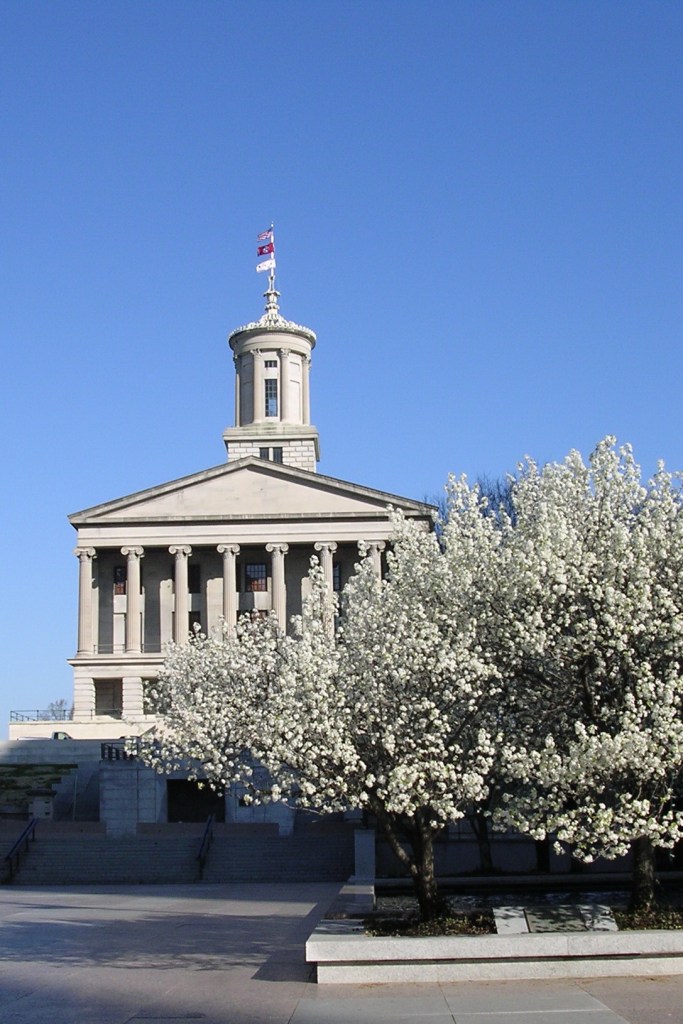
Photo of Tennessee State Capitol from NHN collection

Regrettably, in addition to Native American history, our list of dates omits Nashville’s heroic pre-settlement period, including the exploits of Timothy Demonbreun and the founding journeys to the Cumberland region led by James Robertson and John Donelson. Also omitted is the date of the formation of Davidson County (1783) as well as the dates on which Nashville was officially named (1784) and incorporated (1806). The Union occupation of Nashville (beginning February 1862) is another significant event not specified here. Several important twentieth century dates, including the rise of the huge DuPont Powder Plant complex during World War I, are not included. Finally, the modern development of Nashville, with its high-rise buildings and its various sports and entertainment venues, has been left for some future list.

No entry on the list should necessarily be construed as carrying the same historical weight as any other item on the list. For example, the 1925 beginning of the Grand Ole Opry would probably not carry the same weight as, say, the 1864 Battle of Nashville.

Expansive timelines of Nashville history can be found in other sources, including such excellent books as Henry McRaven’s Nashville: “Athens of the South.”

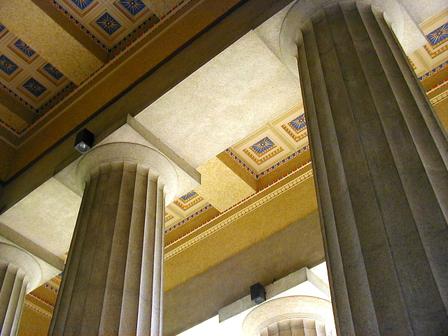
Photo of Parthenon from NHN collection

1. 1780 The signing of the Cumberland Compact.

2. 1824 The arrival of Philip Lindsley and the rise of the University of Nashville.

3. 1828 The election of Andrew Jackson as President of the United States.

4. 1843 The designation of Nashville as the capital of Tennessee.

5. 1864 The Battle of Nashville.

6. 1873 The founding of Vanderbilt University.

7. 1880 The Nashville Centennial Celebration.

8. 1897 The Tennessee Centennial Exposition.

9. 1925 The beginning of the Grand Ole Opry.

10. 1963 The formation of Metropolitan Nashville Government.

(article published in 2001)

A Woman Challenged: The Life of Granny White

by Doris Boyce.

Born in 1743, Lucinda Wilson became the second wife of Zachariah White about 1760 and helped raise his children, along with a brood of her own. Zachariah wanted land badly enough to risk his scalp. He joined James Robertson and headed overland to North Carolina’s Cumberland territory to help establish the settlement of French Lick, where the city of Nashville now stands.

Granny White Grave Marker (from The Historical Marker Database; photo by Michael Manning)

Zachariah was a militiaman, a farmer, and a part-time teacher. He opened the first school at French Lick in the spring of 1781, but he was killed at the Battle of the Bluffs later that year, leaving Lucinda, called Lucy, and his heirs so poor they could not afford the surveyor’s fee required for eligibility to receive the 640-acre grant North Carolina awarded to families of men killed defending the settlement.

Seventeen years later, in 1801, 58-year-old Lucy was informed by the courts of Surrey County in the Tidewater district of North Carolina that she was too old and too poor to take on the responsibility of her two orphaned grandsons, Thomas and Willis, ages 8 and 9. The judge, who would not have granted custody to a woman in any case, ruled that the boys must be bound over to a tradesman in order to keep them out of the poorhouse.

But Lucy would not be told “No” again, certainly not by North Carolina! She loaded her spinning wheel and household goods onto an oxcart pulled by a yellow longhorn steer and left in the middle of the night, along with Thomas, Willis, and an elderly slave called Uncle Zachary. Traveling only about three miles a day, they walked 800-900 miles through Indian territory and the rugged Carolina mountains, leading the oxcart toward the Cumberland settlements where Lucy had three adult children and a number of step-children. Along the way they made several stopovers, staying long enough in each place to make a little money and become more self-sufficient. In Roane County, Tennessee, at a place called Meredith, she put up a ginger cake stand where she sold baked goods to travelers.

The small, white-haired Lucy was 60 years old when she arrived in Nashville in 1803. She set up another ginger cake stand, along with a tar pit or kiln for greasing wagon axles. With the money she made from her various enterprises, she purchased 50 acres that consisted of the facing slopes of a pair of adjoining hills. Her land was located along an old buffalo path that had been the first road built going south from Nashville to Franklin. One of Lucy’s hillsides had to be dug away to create space to build a log house. The other hill was planted in grapevines, fruit trees, and vegetable gardens. The land was so steep that apples rolled downhill into the fence and pumpkins had to be staked to the hillside.

By 1812 Lucy had opened an inn that attracted travelers from the Natchez Trace, four miles to the west. She soon became known for her excellent cooking and the whiskey that she made herself. Guests of the inn praised her for the finest brandy and applejack, the best pancakes, and the cleanest beds. She charged 12 1/2 cents a night for a room and 50 cents a night to board horses. Lucy was innkeeper, housekeeper, and cook, and somehow found time to weave the bed linens and the family’s wearing apparel. When more guest rooms became necessary, she added new wings, a room at a time.

Lucy’s grandsons called her “Granny,” and soon the customers did, too. Still remembered today as Granny White, she was 73 years old when she died in 1816, possessed of considerable wealth, along with slaves, horses, and cattle. Grandson Thomas had died in an accident as a youth, so Willis inherited the property, but the tavern was not open to paying guests after Granny’s death. Willis and his wife Winifred moved to Nashville so their ten children could go to school, but the couple returned to the inn in their old age, after the children were gone.

The inn was half-rotted by late 1864, when the Battle of Nashville took place all around it. Everett Beasley acquired the lands in 1930 and in 1942 replicated the log tavern at the same location with logs from a frontier inn in Dickson County. After 30 years, however, the old logs began to sag just as Granny’s originals had. In 1983 Robert Neil and Vander Linder conveyed the logs to Cheatham County, where they constructed a log house that still stands today.

One hundred sixty-five years after Granny’s death the property was developed into 43 residences called The Inns of Granny White. Her fenced gravesite is near the entrance. To get there from Nashville, you will take the same route the buffalo did, along the street toward Franklin, now named Granny White Pike.

Granny did not accept the social wisdom of her day. She did not let being a woman, being old, or being poor defeat her. After an apparently hopeless beginning, she became a self-reliant individual, an entrepreneur. She ignored the hurdles in her path by flaunting the law, engaging in commerce, making and selling liquor, and taking strangers into her home. She accepted the challenge of frontier life and did what she had to do.

The Hodge House in Percy Warner Park

by Gale Wilkes Ford.

Hundreds of motorists rush past the intersection of Old Hickory Boulevard and Chickering Road every day without realizing they have just glimpsed a bit of early Tennessee history. Nearby, on the property of Percy Warner Park, stands an old two-story log house with white siding, its three limestone chimneys now cold.

The Hodge House early in its period of renovation (photo from NHN collection)

This is the Hodge House, built circa 1795 by Francis Hodge, an early pioneer settler who signed the 1780 Cumberland Compact and later received a land preemption of 640 acres. As Indian attacks diminished, many of the settlers ventured out from Fort Nashborough to settle on their own land. In the area of today’s Carden Road, Francis Hodge and his family built a log house which they called Hodge’s Station. It became a gathering place where many early Tennesseans, including James and Charlotte Robertson, came to study Methodism. Hodge later sold that tract of land to Joseph Ewing and built a cabin three or four miles south, on the plot where it now stands — land that had previously belonged to James Robertson.

This second Hodge house, originally a single pen log cabin (as has been determined by Metropolitan Historical Commission staff), stands today in the southeastern corner of Percy Warner Park. Francis Hodge and his two oldest sons, James and George, constructed the two-story dwelling of white ash logs. Over the years, the family added several more rooms, white clapboard siding, and a tin roof. To accommodate the family slaves, they built additional cabins, one of which survived into the late 1950s.

Within a few years the property was purchased by Mary and Samuel Northern, James Hodge’s daughter and son-in-law. The Northerns, whose descendants would live on this land for nearly one hundred years, dedicated an acre northeast of the house for use as a family cemetery. When James Hodge died in 1817, he was the first of the family to be buried in this graveyard, near what is now the Harpeth Hills Golf Course.

Pioneer Francis Hodge died in 1828. His will, written in his own hand, shows the excellent penmanship characteristic of an educated man. The will identifies his sons as John, James, Robert, and George; and his daughters as Elizabeth (Betsy) Armstrong, Sarah Slaughter, and Priscilla Carruthers. No surviving record indicates where Francis is buried. His son George died in 1833, willing the land, the house, and fourteen slaves to his wife Elizabeth. George’s 1829 will also stipulated that after Elizabeth’s death several nieces and nephews should inherit the property. One of the nephews named was Francis Hodge Asbury Slaughter, who, with Sterling Clack Robertson, was part of the first Texas colony.

Members of the Hodge family married into other local families whose names are still well known in the area: Betts, Becton, Harding, Northern, Osborne, Page, Reams, Sawyer, Slaughter, and Wilkes. The old house saw the Civil War come and go, with both Union and Confederate soldiers marching past on the historic Indian trail in front of the property. Hodge descendants occupied the home until its sale in 1895. In 1927 the property became part of the Warner Parks and is now listed on and protected by the National Register of Historic Places. According to the Warner Parks website, it is the “only early rural farmhouse of its type under public ownership in the county.”

The house served for many years as a residence for Parks Department employees and their families. In the early 1990s it was boarded up because of its deteriorated condition and was left vacant until a group of Hodge descendants began lobbying for protection and restoration of the property. Renewed interest in the site led to a survey of the old Hodge-Northern cemetery, during which sixteen unmarked graves, including several burial sites of children, were discovered. Moreover, as part of this year’s [2002] celebration of the 75th anniversary of the Warner Parks, the Hodge House has been designated for renovation, in order to make it a more valuable, hands-on local history resource. The Friends of the Warner Parks (FWP) has been working side-by-side with the Nashville Metropolitan Board of Parks and Recreation to acquire funding for the project. Their first objective is to restore the original white ash log cabin. FWP Director Eleanor Willis, who has spearheaded the project, describes the logs now visible in the attic area as “beautifully preserved.” Work on the foundation and the limestone chimneys is already underway. Visitors will soon be able to view the historic Hodge House as it appeared two centuries ago to the early settlers of Middle Tennessee. (2002)

Post-renovation photograph of Hodge House

Buchanan’s Station: A Stirring Reminiscence of the Olden Time

Primary Source Document, transcribed by Kathy B. Lauder.

Republican Banner, November 17, 1869

To the Editor of the Banner:

In company with the Vice-president of the Pacific Railroad, a few days since, I rode along the first six miles of the road. The work is in a forward condition, and but for two or three injunctions, the grading, masonry, etc., would be finished by the first of next January ready for track-laying.  The masonry of the bridge at Mill Creek is finished and the iron bridge will be erected when the track-laying reaches that point.  The object of this communication is to call public attention to the fact that this bridge crosses the creek at the point where was fought one of the most remarkable Indian battles that characterize the early settlements of Tennessee.

Nearly fifty years ago, the writer became familiar with the spot, and often heard from those who had participated in the battle an account of the gallant and successful defense of the fort, then called Buchanan’s Station.  The eastern abutment of the bridge rests on the bluff near the spot where stood the stockade and block-house.  It should be commemorated by some suitable tablet and inscription erected upon that end of the bridge.  This and many similar events are passing out of the memory of our people, and I am afraid that the rising generation are not at all familiar with the early history of our State.    In 1792 General Robertson, the father of Middle Tennessee, received intelligence which led him to believe the Indians would visit his neighborhood.  He sent out one of his trusty scouts, Abraham Castleman, to reconnoitre and find out what danger, if any, was impending.  Castleman made a circuit of some sixty miles, going south and returning by the place where Murfreesboro now stands.  He reported traces of the Indians at that point.  Other scouts reported that no Indians were about and none appearing.  Castleman was jeered for his report to such an extent as to cause both himself and General Robertson great mortification.  Events, however, proved the correctness of his reconnoisance [sic].  On Monday, the 30th of September, the people in the fort were awakened by the running in of the cattle and other noises which betokened a large force of Indians at hand.  Before daylight a vigorous attack was made by a large body of savages.  They attempted to fire the fort before the little garrison were in position for defense.  In the fort were fifteen gun-men and a few women, who did their full share of the fighting, running bullets, loading the guns, and firing, as the occasion required.  The heroic conduct of Mrs. Buchanan, exhibited in her coolness, bravery, and the spirit in which she animated the men, was common talk long after her death. 

Reenactors portray Sally Buchanan and a wilderness preacher at a 2012 event to commemorate the 200th anniversary of the Battle of Buchanan’s Station. (photo from NHN collection)

This station was on the old road to the Hermitage, and until the turnpike was built visitors to the Hermitage were shown this place as one pre-eminently entitled to notice.  With the people of this section, Mrs. Buchanan was as much a heroine as General Jackson was afterward a hero. 

The battle lasted an hour. The Indians, from the brisk and incessant firing kept up from the fort to their destruction, believed it was defended by a large force, and retired, leaving some of their dead on the field, but carrying off their wounded.  They left a large amount of guns, swords, tomahawks, kettles, etc., on the field.  The celebrated John Watts, a noted Cherokee Chief, was wounded.  Kiachatalee, a noted Indian warrior, was killed, as was also a hostile half-breed, known as “Tom Turnbridge’s step-son,” who was shot while attempting to fire the fort.  Thirty balls were fired through one port-hole into the roof of the fort, and were found in the area of a man’s hat.  Governor Blount, in his official account of this battle, estimated the number of assailants at three or four hundred.  Both Ramsey and Putnam, in their histories, say the Indians acknowledged their force to have been seven hundred, and that they were dispirited by the constant fire, which led them to believe that the fort was defended by a very strong force.

Not a man, woman or child in the fort received the slightest harm.  Surely such an event as this is worthy of some commemoration.  A simple tablet of iron, with a suitable inscription, could be placed by the railroad company on this bridge at a trifling cost, which they can well afford to pay, as the owners of the land neither charge damages for running the road through it, nor ask pay for the fine stone quarried from the bluff for the erection of the bridge.

(No author is listed.)

The Robertson Monument: From Exposition Capstone to Centennial Park Monolith

by Ilene Jones Cornwell.

 April 24, 2003, marks the 223rd anniversary of the historical founding of Nashville. On that well-known date in 1780, John Donelson’s flotilla of about 30 flatboats and several pirogues completed the 1006-mile voyage via four rivers to the French Lick’s almost-completed log central station. Here the travelers joined James Robertson’s overland settlement party that had traveled into the western North Carolina frontier to cross the frozen Cumberland River on Christmas Day 1779 to establish an outpost of civilization. This two-prong settlement of Nashville was described by Theodore Roosevelt in Winning of the West as “being equal in importance to the settlement of Jamestown or the landing at Plymouth Rock.”

Not as well known is that this year also marks the 100th anniversary of the October 11, 1903, dedication of the Robertson Monument in Centennial Park. The monument’s towering 50-foot granite shaft is actually seven years older than its year of dedication, and the story of the monument’s creation in Nashville’s first public park is nearly as interesting as the Robertson pioneers it memorializes.

Photograph adapted from General James Robertson: Father of Tennessee by Thomas Edwin Matthews (Nashville: The Parthenon Press, 1934)

The monument’s existence is due to the energy, dedication, and vision of Nashville’s Major Eugene C. Lewis (1845-1917), owner of the Nashville American newspaper and a consulting civil engineer. It was Lewis’ friend, local architect William C. Smith, who suggested in a late-1893 speech to Nashville’s Commercial Club that “a spectacular Tennessee Centennial be held to alleviate financial distress and to divert the attention of the people” from the long and severe depression that had engulfed America after the Panic of ’93. Before the depression, according to W. F. Creighton in Building of Nashville, local attorney Douglas Anderson had suggested in local newspapers that a celebration be held in Nashville to celebrate the centenary of Tennessee’s 1796 statehood. Although Anderson’s earlier suggestion had evoked favorable public response, no action was taken until Smith renewed interest in the project. The Nashville Tennessee Centennial Exposition Company was formed and by the summer of 1895 was beginning to acquire financial support for the event. John W. Thomas, president of the Nashville, Chattanooga and St. Louis Railroad, served as president of the Centennial Company and chairman of the executive committee of the Exposition, and Major E. C. Lewis was named director general. The site selected for the Exposition was the West Side Race Track and Park, located on the old fairgrounds surrounding the historic Cockrill Springs area at the end of Church Street and the terminus of the West End Avenue streetcar line. The first Tennessee State Fair had been staged on the site in 1869, with subsequent fairs held in 1873, 1879, and 1884.

The Centennial Exposition, held May 1 through October 30, 1897, was “essentially a fair on a grand scale,” wrote A. W. Crouch and H. D. Claybrook in Our Ancestors Were Engineers. Attractions included 12 large buildings featuring exhibits on the commercial, industrial, agricultural, and educational interests of the state; a “midway” including Egyptian, Cuban, and Chinese villages; a “Giant See-saw” designed by local engineer and steel fabricator Arthur J. Dyer; Venetian gondoliers on newly created Lake Watauga; a Venetian Rialto bridge designed by local architect C. A. Asmus; parades and “sham battles” by the Tennessee Militia; fireworks and other entertainment; and a 250-foot flag staff designed by E. C. Lewis. Major Lewis also had conceived the idea to create a replica of the 5th-century B. C. Athenian Parthenon to house the art exhibit, then commissioned local architect W. C. Smith to make the needed drawings. (The Parthenon, built during 1895-1897, and the city park board’s 1920 decision to have it rebuilt as a permanent structure is a story unto itself.)

Among the exhibits featured at the Exposition’s Mineral and Forestry Building was a towering, 50-foot granite shaft. The impressive monolith is attributed to the “Barry Vermont Granite Quarries” by Creighton in Building of Nashville, but Leland Johnson wrote in The Parks of Nashville that the “granite shaft was quarried at Stone Mountain, Georgia, by Venerable Brothers of Atlanta and shipped to Nashville for display during the 1897 Centennial Exposition. Oral tradition says a portion of the shaft broke off during transit to Nashville.” The shaft’s original flat-stone base remains today on the west bank of Lake Watauga and bears a metal plate commemorating the Centennial Exposition.

After the Exposition closed, all buildings except the Parthenon were torn down and removed. The success of the Exposition, as well as the progressive movement of the late 19th Century to establish public parks, planted the seed for Nashville’s park system. In 1901 Mayor James Head appointed five men, one of whom was Major E. C. Lewis, to the new Board of Park Commissioners. Negotiations were begun by the city in early 1902 with the owners of the 72-acre Centennial Park to purchase the land for a permanent city park. After months of complicated offers and counter-offers, described in The Parks of Nashville, Nashville Railway and Light Company purchased Centennial Park and its title was presented to the city park board on December 22, 1902.

On January 13, 1903, Major Lewis addressed the Tennessee Historical Society on the subject of James Robertson. He began his speech by informing the assembled members of “a fortunate circumstance that transpired only a few days ago. . . .For the first time in all its history, Nashville has park ground worthy of the Capital of Tennessee. The title to the Centennial Grounds, upon which the city has already contributed a large sum of money toward the adornment thereof, is now in the city of Nashville. The Park Commission. . .has so far determined upon but one measure, and that, the erection in Centennial Park of a monument [for] James Robertson, the founder of Nashville.” He concluded his lengthy profile of Robertson by asking, “What have we of Nashville done to honor this man’s memory? Has even the memory of all the good Robertson did been interred with his bones?. . .Are we a grateful people?”

Major Lewis had made prescient provisions to answer his own questions. When negotiations had begun to purchase the Centennial land, he purchased the 50-foot granite shaft for $200, then his fellow-commissioner Samuel A. Champion “resolved that it be erected in the park as a monument to the memory of James Robertson.” Lewis also purchased the flat-stone base for $10 in 1903 to remain beside Lake Watauga as a memorial to the Centennial Exposition. A new granite base was needed to support the heavy shaft after its relocation, but no record has yet been found of the base’s creator or its procurement. Wherever the massive base originated, Johnson described the monument’s creation in The Parks of Nashville: “With a tripod made of three large oak logs and block and tackle, Major Lewis raised the shaft into position and then constructed the foundation beneath it.” The granite shaft and its base weigh a total of 52.5 tons. Text is inscribed on a plaque on each side of the monument:

North Side Text:  “James Robertson/Born in Brunswick County, Virginia, June 28, 1742.  Moved to North Carolina in 1750.  Came to Tennessee in 1769.  Settled Nashville in 1780.  Died in Tennessee Sept. 1, 1814.  Reinterred in the City Cemetery at Nashville, 1825, under authority of the Tennessee Legislature.”

East Side Text:  “Charlotte Reeves/Wife of James Robertson/Born in North Carolina, Jan. 2, 1751.  Married to James Robertson, 1768.  Died in Nashville, Jun. 11, 1843.  Buried in the City Cemetery.  Mother of the first male child born at Nashville.  She participated in the deeds and dangers of her illustrious husband: won honors of her own and along his path of destiny cast a leading light of loyalty, intelligence, and devotion.”

South Side Text:  “A worthy citizen of both Virginia and North Carolina.  Pioneer, patriot, and patriarch in Tennessee.  Diplomat, Indian fighter, maker of memorable history.  Director of the movement of the settlers requiring that hazardous and heroic journey so successfully achieved from Watauga to the Cumberland.  Founder of Nashville.  Brigadier-General of the United States Army.  Agent of the Government to the Chickasaw Nation.  He was earnest, taciturn, self-contained, and had that quiet consciousness of power usually seen in born leaders of men.  ‘He had winning ways and made no fuss.’ (Oconnostota)  He had what was of value beyond price–a love of virtue, an intrepid soul, an emulous desire for honest fame.  He possessed to an eminent degree the confidence, esteem, and veneration of all his contemporaries.  His worth and services in peace and war are gratefully remembered.  Amiable in private life, wise in council, vigilant in camp, courageous in battle, strong in adversity, generous in victory, revered in death.” 

West Side Text:  “James Robertson/Founder of Nashville/’We are the advance guard of civilization.  Our way is across the Continent.'”  Robertson—1779

The monument to James and Charlotte Reeves Robertson was presented to the city of Nashville on October 11, 1903, by Major E. C. Lewis on behalf of the Park Commission.  About 100 Robertson descendants from all over the United States and one foreign country attended the ceremony in Centennial Park, according to Sarah F. Kelley in Children of Nashville.  Three-year-old Dickson Wharton Robertson, descended through Dr. Peyton Robertson, was dressed in Scottish-plaid kilts and pulled the string to unveil the towering monument honoring his great-great-grandfather.  Among those offering memorial tributes to Nashville’s founder were Governor James B. Frazier and Mayor James Head.

“History often repeats itself,” wrote Kelley.  “On June 28, 1972, the descendants of James Robertson gathered once again in Nashville to celebrate Tennessee’s ‘James Robertson Day’ proclaimed by Governor Winfield Dunn.”  Among the descendants gathered around the Robertson Monument in Centennial Park was the same Dickson Wharton Robertson who had participated in the monument’s unveiling 69 years earlier.

As the Robertson Monument approaches its centenary, the 107-year-old shaft has weathered well, as have the 100-year-old base and four bronze plaques.  Attesting to the passage of a century is that the massive base appears to have sunk several feet into the earth since 1903. Without measured drawings to provide dimensions of the original base, however, a definitive conclusion cannot be made. Thus we celebrate the founding of Nashville with the hope that Centennial Park’s terra firma will continue to support the city’s monument to its founder, so that future Nashvillians may enjoy a bicentennial celebration of the Robertson Monument.


SOURCES:

Winning of the West, Volume II: From the Alleghanies to the Mississippi, 1777-1783, by Theodore Roosevelt (New York: G. P. Putnam’s Sons, 1889).

Tennessee Old and New, Sesquicentennial Edition, 1796-1946, Volumes I and II (Nashville: Tennessee Historical Commission and Tennessee Historical Society, 1946).

Seedtime on the Cumberland, by Harriette Simpson Arnow (New York: The Macmillian Company, 1960).

Building of Nashville, by Wilbur Foster Creighton; revised and enlarged by Wilbur F. Creighton, Jr., and Leland R. Johnson (Nashville: Wilbur F. Creighton, Jr., and Elizabeth Creighton Schumann, 1969).

Children of Nashville: Lineages of James Robertson, by Sarah Foster Kelley (Nashville: Blue and Gray Press, 1973).

Our Ancestors Were Engineers, by Arthur Weir Crouch and Harry Dixon Claybrook (Nashville: Nashville Section of American Society of Civil Engineers, 1976).

The Parks of Nashville: A History of the Board of Parks and Recreation, by Leland R. Johnson (Nashville: Metropolitan Nashville and Davidson County Board of Parks and Recreation, 1986).

Andrew Jackson Slept Here: A Guide to Historical Markers in Nashville and Davidson County (Nashville: Metropolitan Historical Commission of Nashville and Davidson County, 1993).

General James Robertson, Frontier Surgeon

by Jack Andrew Skipper.

The best known of the Middle Tennessee settlers who were scalped and lived to tell about it was David Hood, a colorful character at Fort Nashborough. He was admired for his knowledge of Bible verses and his sense of humor, which often involved wordplay. After a near-fatal Indian attack, during which he fooled his assailants by playing “possum,” he joked about “hoodwinking” his adversaries and giving up his hood but not his life, thanks to his “possuming.”

One day in the winter of 1781-1782, as Hood was coming from Freeland’s Station on his way home to Fort Nashborough, Hood encountered several unfriendly Indians, who fired their muskets at him (1). Attempting to outrun them, he concluded that his only chance of survival was to appear mortally wounded, so he fell into the weeds and snow as if dead. One account claims that he was shot with at least two musket balls (2). He was still alive, however, and somehow remained silent while they lifted his scalp. According to John Rains, another Nashborough resident, the knife they used was dull and required much work to do the deed. The Indians then walked toward Fort Nashborough in search of other victims.

Bloody and dazed, Hood struggled to his feet and started toward home, only to come face to face with the very same Indians on their return. They attacked him a second time, shooting him in the chest, and again left him for dead. The next day some of the settlers, following the trail of blood, found his still form lying in a brush pile. Believing he was dead, they carried him to an outbuilding at the fort to await burial.

Several ladies from the settlement, mourning the loss of yet another comrade, came to prepare Hood’s body for the funeral. No doubt they were saddened by the fact that this lighthearted pioneer was gone, leaving them without the cheer he had gladly provided. However, Hood began to move slightly! Astonished, they asked him if he was still alive. He whispered that he thought he could live if he were given half a chance. He was carried indoors, and James Robertson himself attended him, operating on his bare skull. In a short time Hood was walking about; by summer the beloved cooper was able to resume his trade.

In 1777, while living in the Watauga settlement, James Robertson had met a Dr. Vance from whom he learned a surgical technique for saving the lives of scalping victims. Vance, a physician visiting the Holston settlements from Augusta County, Virginia, was treating Frederick Calvit, who had been scalped in March of that year (3). Needing to attend to other settlers, the doctor taught Robertson to perform the surgery. Robertson finished what Vance had started on Calvit. The procedure allowed new skin to grow over the bare skull bone, thus preventing the skull deterioration which often took the lives of scalping victims who had survived their attacks.

Robertson utilized the Vance method on several patients, including David Hood at Fort Nashborough. Using an awl, he drilled numerous holes in Hood’s skull. Apparently, this process was relatively painless. Tissue from inside the skull (we assume not brain matter) would issue from the holes, spread over the skull, and prevent deterioration. Some of the new membrane would turn into black scales, which would be removed. The flesh would be treated regularly with ointment and a layer of lint until it cured.

David Hood lived for many years after being scalped. No doubt his deep faith and rich sense of humor assisted him in his recovery and subsequent longevity. James Robertson, in providing this service to his fellow settlers, once again proved to be invaluable to those he led into the wilderness of Middle
Tennessee (4).


Sources:

(1) A. W. Putnam, History of Middle Tennessee, pp. 153-155.
(2) “Boy Born, Man Scalped, 3 Slain in One Day,” by Ed Huddleston, Nashville Banner, April 17, 1956, p. 7.
(3) Benjamin Smith Barton, M.D., ed. “Remarks on the Management of the Scalped-Head,” by James Robertson (as communicated to the editor by Felix Robertson, M.D., April 10, 1806)The Philadelphia Medical And Physical Journal, Vol. II, 1806, pp. 27-30.
(4) “James Robertson Was Pioneer and Patriarch,” by Robert H. White, state historian, Nashville Tennessean, July 12, 1957, “Visitor’s Corner.”