On Christmas Day 1779 James and Elizabeth Thompson arrived at French Lick on the Cumberland River. The couple had joined James Robertson’s adventurers, looking for a new life on land where they believed they would be free. However, they had no idea what a high price they would pay for land in this territory that was to become Nashville, Tennessee.
By the time John Donelson’s party arrived on April 24, 1780, the Robertson group had already built eight stations of log cabins. A week later the men in the group gathered at the Bluff and adopted the Cumberland Compact1. Within the next two weeks they agreed on additional resolutions, and on May 13, 1780, James Thompson and his son Robert joined 254 other men in signing the completed Compact.
Signature page of the Cumberland Compact
As original settlers, the Thompsons received 640 acres on Richland Creek, near today’s Belle Meade mansion. In 1790 James began building the family’s cabin there, not realizing the dangers that lay ahead. By 1791 two of the Thompsons’ sons had lost their lives in Indian attacks. More tragedy was to follow: a narrative given toThe South-Western Monthly in 1852 by John Davis, an early neighbor, described the murder of James and Elizabeth Thompson and their daughter Elizabeth by a party of Indians on February 25, 1792. Thomas E. Matthews’ book General James Robertson, Father of Tennessee, adds that the marauders enslaved the Thompson’s 31-year-old daughter Alice, along with two houseguests, a Mrs. Caffrey and her young son.
Scene in Indian village
The captives were taken to a Creek village called Kialigee, where Mrs. Caffrey’s little boy was taken from her and given to another white slave to raise. It would be two years before they were freed. Indian agent John O’Riley purchased Alice from her captors for 800 weight of dressed deerskins valued at $266 (the equivalent of almost $7,000 today). In May 1794 Alice was taken to the American Agency at Rock Island, Georgia. Before she returned to Nashville, she met with Governor Blount in Knoxville to answer his questions about other captives she had seen in the Indian camps. Governor Blount recorded these facts in a letter to the Secretary of War on October 2, 1794.
Meanwhile, in 1793, Edmund Collinsworth had arrived in Nashville to join his half-brother John Cockrill, who was married to James Robertson’s sister Ann. Edmund was a veteran of the Revolutionary War, having enlisted in the First Virginia Regiment in 1777 and served until April 1780. According to family stories, it was “love at first sight” when Alice met Edmund upon her return to Nashville in late fall 1794. They were married on December 17, 1795.
The couple built their home on land that had belonged to Alice’s brother John, who had died in the 1791 Indian attack. It is believed that both Alice and Edmund were eventually buried in unmarked graves on this home place, which is located in today’s Antioch/ Mount View area southeast of Nashville.
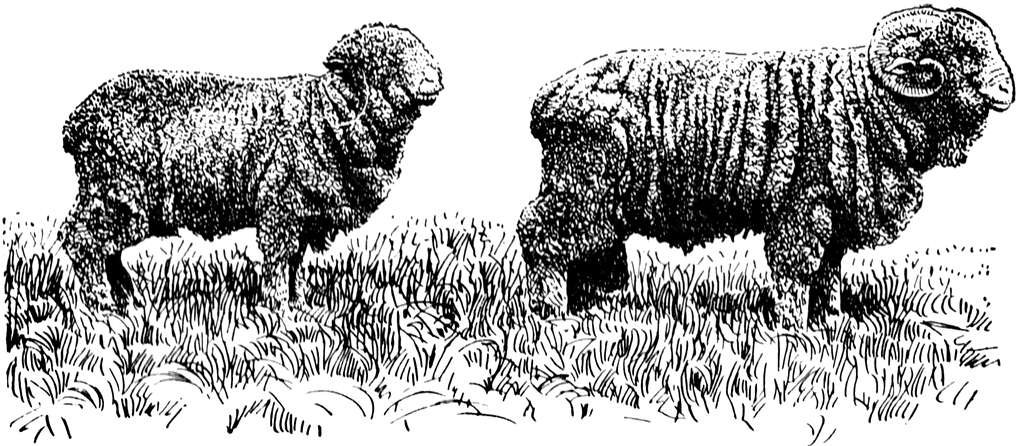
Edmund died in March of 1816, leaving Alice with seven children ranging in age from seven to eighteen. As she always seemed to do, Alice took the bad with the good and persevered, bringing up the children on her own. Her son James carried his Tennessee fortitude to the young Republic of Texas where he served as aide-de-camp to Sam Houston during the Battle of San Jacinto. He was a signer of the Texas Declaration of Independence and was Chief Justice of the Texas Supreme court at the time of his death. Another of Alice’s sons, John, graduated from the U.S. Military Academy at West Point. Daughter Susan married Mark Robertson Cockrill, who owned a 5.600-acre farm where he bred award-winning Merino sheep, their wool acclaimed as the finest in the world.
Merino sheep
Alice died in February 1828 at her home, which she shared by then with her daughter Parmelia Ann Davis and her family. The old house is long gone, but in December 1864 it was the place where Parmelia Ann had a touching encounter with a Union officer . . . but that’s another story2.
1 The Cumberland Compact, adopted in Nashville in 1780, was essentially a constitution for the frontier settlement, setting rules for governing the colony (including salaries, which were to be paid in animal skins) and for making and enforcing laws. It was signed by 256 colonists. (ed.)
2 Widowed in 1848, Parmelia watched the railroad industry change the face of middle Tennessee. During the Civil War, Nathan Bedford Forrest and others took great pride in sabotaging the tracks to impede the advance of Union troops. In early December 1864 Parmelia heard the thunderous crash of a train accident near her property and rushed toward the flaming wreckage to see what had happened. The Union officer in charge was gathering the bodies of 24 soldiers killed in the accident, planning to bury them all together in an embankment near the tracks. Parmelia intervened, insisting that the dead soldiers be buried on her plantation, each individual grave to be marked with a stone from her fields. Touched by her kind gesture, the Union officer posted a “special guard” to protect Parmelia and her land from attack for the remainder of the war. After the war the remains of the 24 Union soldiers were reportedly moved to the Stones River National Cemetery in Murfreesboro. (ed.)
The story of Thomas A. Sykes is a microcosm of African American life in the 19th century: he rose from slavery to political power in a few short years, only to disappear from view as Southern legislatures once again stripped black citizens of their freedoms.
Thomas A. Sykes represented Nashville in the 42nd Tennessee General Assembly (1881-1882)
Former North Carolina legislator, U. S. revenue official, businessman, and school superintendent Thomas Sykes represented Davidson County in the Forty-Second Tennessee General Assembly, 1881-1882.1 A former slave, Sykes had paid a white child six cents to teach him to read. After emancipation he was elected to represent Pasquotank County in the state legislature (1868-1871) and served on the state Republican executive committee.2 He came to Nashville in 1872 as a gauger, a customs official who inspects, weighs, and taxes shipping containers. The following year Sykes became assistant assessor for the Internal Revenue Service,3 and by 1878 he was a county magistrate.4
Thomas Sykes’s skills as a public speaker, which had brought him national recognition,5 quickly led him to prominence in Nashville politics. Sykes and James Carroll Napier, “Nashville’s two most important black politicians,”6 worked with others to bring down Mayor Thomas A. Kercheval’s political machine (1883). Their efforts opened up many city jobs to black workers7 and facilitated the appointment of black teachers.8
Sykes was a Republican candidate for state representative in 1880.9 One of four African Americans elected to the General Assembly that term, he introduced five important bills. His attempt to repeal Chapter 130of the Acts of 1875 was the earliest attempt to overturn this early Jim Crow law permitting discrimination in public facilities.10 The bill failed, even after all four black legislators protested Chapter 130 as “a palpable violation of the spirit, genius and letter of our system of free government.”11 Sykes’s bill recommending a penitentiary in West Tennessee was made unrecognizable by amendments. When the bill passed 41-20, Sykes, who had actually voted against it himself, pleaded unsuccessfully for its reconsideration.12 His bill to admit black students to Nashville’s School for the Blind and Knoxville’s School for the Deaf and Dumb, and to house them in separate facilities, passed 59-1, although the Civil Rights Act of 1875, still in force,13 made such segregation illegal. Two other bills, banning discrimination in jury selection and opening the University of Tennessee to black students, were tabled in committee.14
Sykes served on the State Temperance Executive Committee and made many speeches on their behalf. An 1885 newspaper article described him as “one of the most highly educated and refined colored men we know.”15 In 1887 he became Assistant Superintendent, Colored Department, of Nashville’s new Tennessee Industrial School. The school, conceived by Judge John C. Ferris after an 1873 cholera epidemic that orphaned many children, was financed by railroad tycoon Edmund W. “King” Cole.16
Thomas Sykes was placed in charge of the Colored Department of the Tennessee Industrial School in Nashville when it opened in 1887. (Sketch from Ferris, John C., and Edmund W. Cole. Homes for the Homeless, or, Fourteen Years among the Orphans. Nashville: Methodist Episcopal Church South, 1890.)
Sykes’s career after 1890 clearly illustrates the effects of Jim Crow on Southern blacks. After the Forty-Sixth General Assembly passed four disfranchising laws that effectively silenced black political voices in Tennessee, a political pundit snickered in the Nashville Daily American that former Representative Thomas A. Sykes had been demoted to elevator operator in the very Customs House where he had once held a privileged federal position.17 Sykes apparently left Nashville after a highly-publicized divorce from his schoolteacher wife, Viola Hoyt.18 His name does not appear in Nashville city directories after 1893. (2014)
SOURCES:
1 McBride, Robert M., and Dan M. Robinson. Biographical Directory, Tennessee GeneralAssembly, Volume II (1861-1901). Nashville: Tennessee State Library and Archives, and Tennessee Historical Commission, 1979.
2 “Sykes, of Nashville: Relating His North Carolina Experience to a Washington Stalwart.” Nashville Daily American, January 25, 1882. (Reprinted from the WashingtonRepublican, date unknown.)
3Nashville, Tennessee, City Directory, 1873. Ancestry.com. U.S.City Directories, 1821-1989 [database on-line], Provo, UT, USA: Ancestry.com Operations, Inc. 2011.
4Nashville, Tennessee, City Directory, 1878. Ancestry.com. U.S.City Directories, 1821-1989 [database on-line], Provo, UT, USA: Ancestry.com Operations, Inc. 2011.
5 “Sykes, of Nashville.” Nashville Daily American, January 25, 1882.
6 Rabinowitz, Howard N. Race Relations in the Urban South, 1865-1890, 2nd ed. Athens, GA: University of Georgia Press, 1996.
7 Cartwright, Joseph H. The Triumph of Jim Crow: Tennessee Race Relations in the 1880s. Knoxville: University of Tennessee Press, 1976, 132-133.
11 Tennessee General Assembly. Journal of the House of Representatives of the State ofTennessee. Nashville: Tavel & Howe, 1881.
12House Journal, 1881.
13 Lovett, Bobby L. The African-American History of Nashville, Tennessee, 1780-1930: Elitesand Dilemmas. Fayetteville: University of Arkansas Press, 1999. 221.
14House Journal, 1881.
15 “Sykes, of Nashville. A Fellow Legislator’s Handsome Compliment.” Nashville DailyAmerican, July 17, 1885. (Reprinted from Franklin Review and Journal, date unknown)
16 Tyree, Forrest H. A Centennial History of the Tennessee Preparatory School. Nashville, 1985.
17Nashville American, June 8 and 13, 1890.
18 Sykes v. Sykes, Davidson County Circuit Court, Minute Book 24, 1881, page 180.
Joshua Burnett Ross, named for his maternal grandfather, was born in Jackson Township, Clermont County, Ohio, in 1842. He was the first of eleven children born to Osmore L. and Jerusha Loveland Burnett Ross, who had been married in Jackson Township on April 14, 1839.
In the 1850s Osmore Ross moved his family to Clark County, Illinois, where he had purchased farm acreage at auction for $200. (Total interest on the mortgage was $20.) The Rosses lived on the outskirts of Casey and Crooked Creek, not far from Hazel Dell. According to the 1860 Illinois census, Joshua Ross, then 17, was a chair maker.
We have come to realize, however, that family history is much more than merely extracting a few facts from official records. Our passion for it grew out of reading The Red Badge of Courage as children and wanting to make a connection to our past through the War Between the States. It was this hope that led us on our quest.
The bits and pieces collected through family anecdotes, newspaper stories, and photographs were elusive to trace, since the family has roots in Massachusetts, New Jersey, New York, Ohio, Kentucky, Tennessee, Oklahoma, Minnesota, Utah, Oregon, California, Washington, North Carolina, and Texas. We could find nothing on Joshua beyond the 1860 census. Then I remembered The Red Badge of Courage, and a new adventure unfolded. With notebook, camera, and filing cabinet in tow, we traveled to Clark County, Illinois, to get a more authentic feeling for the family by walking in their footsteps, touching their gravestones, and walking around the old homestead. But there was still no Joshua . . ..
With the help of a librarian from Greenup, Illinois, and after days of internet research, Joshua began to emerge from the shadows. Records showed that the young chair maker had joined the Federals and become a Union soldier: on June 28, 1861, he mustered into the 21st Illinois Infantry, Company H, in Mattoon, Illinois, a few miles from his home.
Joshua’s first commanding officer was Colonel Ulysses S. Grant; when Grant received his promotion from the President, he was replaced by Colonel John W. S. Alexander. The 21st fought valiantly at Perryville, Kentucky, and at Stones River, near Murfreesboro, Tennessee, where the regiment was assigned to General Rosecrans. We were amazed to find that on their march to Stones River, the 21st had camped on Dumont Hill in Scottsville, Kentucky, the town where we presently reside.
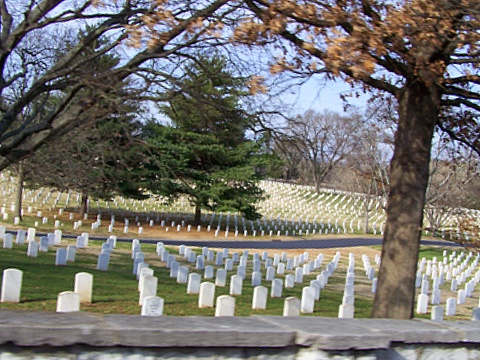
The National Archives forwarded the information that Joshua had been wounded in the upper left chest area during the Battle of Stones River, December 1862. He was transferred to U.S. General Hospital #19, in the Morris and Stratton Building on Market Street– now 2nd Avenue–in Nashville, where he died of his injuries on February 22, 1863. Joshua Burnett Ross was buried in grave 3634 in a temporary cemetery located near the hospital. His remains were later moved to Section E, Grave 0730, in the Nashville National Cemetery.
Scene in the Nashville National Cemetery
Jerusha Ross filed for her son’s pension on June 30, 1880, seventeen and one-half years after his death. Joshua’s brother, Silas L. Ross, named one of his sons after him: that child, Joshua Burnett Ross, was my grandfather.
Engraved on a brass plate near the arched marble gateway of the National Cemetery are the words of Abraham Lincoln’s “Gettysburg Address,” a fitting tribute to my great-great-uncle and all who lie beside him. On July 4, 2004, a hot Sunday afternoon, armed with advice from the Nashville Historical Newsletter and its readers, we were able to walk directly to Joshua’s grave. Knowing he was from a poor farm family who lived far away, we had little doubt that we were the first family members to stand at his gravesite. Our visit to the National Cemetery, the close of a great adventure, brought us a step closer to knowing where we came from. Our lives are made richer by the knowledge that my great-great-uncle gave up his life for us and for the hope of an America undivided.
by John Lawrence Connelly, Davidson County Historian.
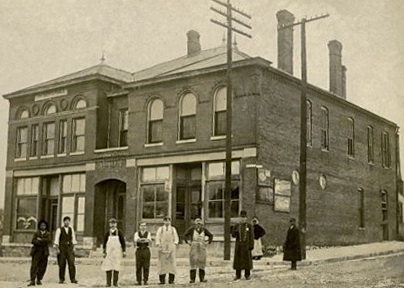
For a large part of the twentieth century Nashville residents either ignored or did not know that an area north of Jefferson Street was once a prominent neighborhood where many of Nashville’s leading citizens lived. To a large extent, it was a German community that began flourishing heartily in the 1840s by blending its German heritage with Irish, Italian, Swiss, and Jewish neighbors, in public schools and sometimes in churches. The Catholic Church of the Assumption, founded in 1859, held many of its services in German, as did the German Methodist Church (Barth Memorial), founded in 1854 on North College Street (today’s Second Avenue North). Many prosperous merchants of the city lived in Germantown, and their names hung prominently on retail store signs downtown: Rust, Zugermann, Zickler, Ratterman, Buddeke, Thuss, Grossholz, Jensen, Jeck, and Wheling, to name a few. What’s more, the German names in the community reflected a strong Lutheran heritage.
Photograph of Treibers Hall used with permission of Lois Thompson.
Within the German community many immigrants worked as butchers, a practice brought over by immigrants from Europe. These tradesmen often killed livestock and cut up the meat in their back yards or in nearby lots. Once they were able to sell their products to the Nashville Market House and other businesses, the number of people who peddled meat from door to door declined rapidly. Many residents opened their own shops or stalls. Names such as Jacobs, Dieterle, Stier, Warner, Oliver, Neuhoff, Power, Petre, Laitenberger, and White were among the best-known butchers from North Nashville. Meat suppliers from Butchertown developed the Christmas spice round, a Nashville holiday meat that would become a celebrated local tradition.
By 1915 the changes that would eventually destroy the neighborhood were beginning to take place. Just as the people who live in a community do not stay the same, old neighborhoods also undergo change. Shortly after the turn of the century, as streetcar lines expanded and motor transportation began to make advancements, Nashville saw a definite trend among the residents to move away from the “walk-to-town” areas. Moreover, the development of refrigeration led to the phasing out of many small butchering businesses. Large packing houses began to infringe upon the pleasant residential atmosphere of the neighborhood, which had often been advertised in local newspapers as a growing and fashionable community. It was World War I, however, that dealt the final blow to Germantown.
Wilbur F. Creighton’s book, Building of Nashville, provides an explanation: “In 1917 the reservoir was closed to visitors. The paper had been filled with stories of German atrocities, such as the use of poisonous gases and deliberate infection of water supplies.” Other cases of exaggerated emotional response to the war included suggestions by some that citizens should “kill their dachshunds.” Fearing for their safety, many German families instructed their older members to stop speaking German, even at home.
Changes within the Barth Memorial Church provide a good example of what was happening in Germantown. For many years sermons were delivered in German, but after World War I began, it was resolved that the church should offer only English services. Catholics and Lutherans with German backgrounds did likewise. The uniqueness of a small community with ties to the “Fatherland” was over. The neighborhood as it once was would never come back, and its steady decline continued until a handful of urban pioneers decided to attempt to create a new Germantown in the 1970s.
Germantown experienced a great deal of decay over the years as many houses were torn down and others extensively altered. Nonetheless, studies made by the Metropolitan Historical Commission in the 1970s stated: “A large percentage of structures are still intact, and it can become a viable neighborhood. The quality of architecture is exceptional, and the condition of the structures is, for the most part, quite sound.”
Today Nashville’s Germantown Historic District is one of the most architecturally heterogeneous neighborhoods in the city. The eight-block area contains a wide variety of styles and types of residences built between the 1840s and 1920s. Because of its historical and architectural significance Germantown was listed in the National Register of Historic Places in August, 1979.
For the past several years new residents have worked individually and collectively to restore Germantown. The Germantown Association has become a dynamic neighborhood group where old and new residents come together to plan for the future. A ride through the area today reveals a lively community with new and restored houses, beautiful flowers and trees, a new supermarket, a new pharmacy, and attractive brick sidewalks. Once again Nashville can take pride in this lovely neighborhood located within a few steps of the Bicentennial Mall, featuring a magnificent view of the State Capitol. Germantown has come back, with almost unlimited potential for tomorrow.
In 1980 members of the Catholic Church of the Assumption and the Monroe Street United Church (two historic churches that survived the lean years) came together to give Nashville its first Oktoberfest. This event, held on the second Saturday in October, has become one of Middle Tennessee’s most popular celebrations. The Germantown Association has sponsored a Maifest celebration for the past decade and often sells out all of its tickets. Yes, Germantown is on the map again! (2001)
Note: Although the Covid-19 pandemic has forced the cancellation of Oktoberfest for a couple of years, residents plan to bring it back soon.
Legendary frontiersman Daniel Boone (1734-1820) is most often associated with blazing the Wilderness Road through the Cumberland Gap in 1775 and establishing Kentucky settlements. However, his many wide-ranging expeditions arouse our curiosity as to whether he also explored Middle Tennessee in general and the French Lick-Nashville locality in particular. Kentucky’s plucky pioneer has generated a torrent of literature, and I invite the reader to hike with me down the Nashville fork of the Boone trail. Along the way I think we’ll find that history’s subplots are both interesting and informative.
(photo by Bob Bowman)
Daniel Boone’s short “autobiography,” romantically ghostwritten by Kentucky land speculator John Filson (ca. 1753-1788) and published in 1784, launched the intrepid woodsman to national and international fame. A pertinent but inconclusive sentence therein reports that Daniel and his brother Squire Boone (1744-1815) “proceeded to Cumberland river, reconnoitring [sic] that part of the country until March 1771, and giving names to the different waters” (The Adventures of Col. Daniel Boon, Kessinger reprint, p. 56). The Life of Daniel Boone, the seminal tome of renowned archivist Lyman C. Draper (1815-1891), seems to place this exploratory event within a geographical swath ranging from near today’s Bowling Green, Kentucky, south to Castalian Springs (formerly Bledsoe’s Lick) in Sumner County, Tennessee (see p. 264 of the Stackpole Books edition, edited by Ted Franklin Belue). One contemporary writer, Robert Morgan, expands this expedition even farther south, all the way to the French Lick (Boone: A Biography, p. 121).
Draper reports a more conclusive episode – occurring as much as two and a half years after the exploratory journey mentioned above – in this fascinating passage: “During this period, one Joe Robertson, an old weaver who had a famous pack of bear-dogs and was devoted to the chase, often accompanied Boone into the Brushy Mountain and over to the Watauga, securing loads of bear-skins, which they packed to the settlements and sold. On one of their adventurous trips, they penetrated as far as the French Lick on Cumberland and found several French hunters there” (pp. 283-284). Here we have the earliest narrative I know that places Boone squarely in the heart of Nashville. The time frame for this visit is some seven or more years before the town was founded in 1779-80 by James Robertson (1742-1814) and John Donelson (ca. 1718-1785). Incidentally, I have discovered no familial kinship between Joe Robertson and Nashville co-founder James Robertson, yet the possibility remains intriguing. Furthermore, the fact that French hunters/traders occasionally headquartered at the salt lick on the Cumberland River known as the “French Lick,” site of today’s Nashville, has always been known, the most famous of these traders being Timothy Demonbreun (1747-1826), Nashville’s “First Citizen.”
Through the years other biographers have repeated Draper’s account of Boone at the French Lick: Reuben Gold Thwaites (1853-1913), though he places Boone “sometimes with one or two companions” but not with Joe Robertson or his dogs specifically; John Bakeless (1894-1978); and more recently, historians John Mack Faragher and Michael A. Lofaro. In his acclaimed 1992 chronicle, Faragher sometimes even tags the event with seasons: “Whether with his family or alone, Boone certainly spent the fall and winter of 1771-72 hunting in what would become the state of Tennessee. With a North Carolinian named Joe Robertson, the owner of a notable pack of bear-tracking hounds, he hunted bear, pushing as far west as French Lick (later called Nashville) on the Cumberland River, where he met hunters of some of the numerous French parties that came to those licks each year to hunt buffalo” (Daniel Boone: The Life and Legend of an American Pioneer, p. 88).
Other than in biographies, I am aware of no complete reference to Draper’s Boone-at-French Lick anecdote in any other Nashville or Tennessee history. The most obvious reason is, of course, that for well over a century Draper’s Boone manuscript existed only in handwritten form and often only on hard-to-read microfilm, until Murray State University’s Ted Franklin Belue brought it to print in 1998. Several state and local historians, however, do place Boone at least in the Middle Tennessee area. A.W. Putnam (1799-1869) notes that “Boone, Rains, Mansker, and others . . . hunted and explored in 1769-70 upon the Cumberland” and reported “its marvelous herds of buffalo and deer” (History of Middle Tennessee, University of Tennessee edition, p. 619). Similarly, Samuel Cole Williams (1864-1947) comments in his discussion of 1769-70 exploratory crews that “Daniel Boone after a hunt in Kentucky joined one of the groups on the Cumberland in the Tennessee region” (Dawn of Tennessee Valley and Tennessee History, Watauga Press edition, p. 330). Harriette Simpson Arnow (1908-1986), who used Draper and many other primary sources, mentions that Boone “hunted over and explored most of the Cumberland at intervals between 1769 and 1775” (Seedtime on the Cumberland, Univ. of Nebraska edition, p. 169). And contemporary historian John R. Finger, using a Draper-like phrase, observes that in 1772 Boone “hunted as far west as French Lick” (Tennessee Frontiers: Three Regions in Transition, p. 42—which book includes, by the way, the finest bibliographic essay on frontier Tennessee sources that I know of).
Equally germane to the case for a Boone visit to Nashville are his professional and personal ties to the Lower Cumberland region. He was above all a Long Hunter extraordinaire who stayed in the woods for months or even years at a time. It strains credulity that he would not at some point come to the French Lick, heralded at least since the late 1760s for its excellent hunting. In addition, Boone was (or became) well acquainted with several Cumberland pioneers including Michael Stoner (1748-1813), Kasper Mansker (ca.1750-1820), and, most notably, Nashville co-founder James Robertson. Both Boone and Robertson worked for the prominent Transylvania Company under Richard Henderson (1734-1785), with Boone the overseer of Henderson’s Kentucky land interests and Robertson of his Tennessee holdings. Williams provides insight into the duo’s personal relationship in his report that Boone’s children, along with Robertson’s, were christened or baptized in Robertson’s Watauga home in East Tennessee, perhaps around 1772-73 (see Dawn of Tennessee Valley, p. 344). Moreover, Draper asserts that their friendship directly influenced the founding of Nashville. Upon returning to North Carolina after the famous 1778 Boonesborough siege, “Boone went by way of Watauga and was there enabled to make such representations to his old friend Capt. James Robertson as induced him the following year to visit the Cumberland country and become the pioneer father of Middle Tennessee” (The Life of Daniel Boone, p. 521).
An argument against a Boone visit to Nashville could pivot on Draper’s interviews with the pioneer’s last-born child, Nathan Boone (1781-1856), who was an intrepid frontiersman in his own right, as well as Draper’s greatest wellspring of information. Fortunately, Draper cites sources for his Boone-at-French Lick passage, with this endnote: “MS. notes of conversations with Col. Nathan Boone and the late Henry Rutherford of Tennessee. Soon after the Revolutionary War, [Joe] Robertson resided in the family of Mr. Rutherford’s father, Gen. Griffith Rutherford, of Rowan County, North Carolina, and used to speak of his hunting and exploring with Boone (The Life of Daniel Boone, p. 294). But his citation of Nathan Boone as a source for the French Lick event is problematic in view of his 1851 interviews with Nathan as presented in a 1999 book. in one interview with Nathan, Draper asked, “Did Colonel Boone ever mention hunting at the French Lick on the Cumberland River?” Nathan’s answer: “Not that I recall” (My Father, Daniel Boone, p. 45, edited by Neal O. Hammon). Throughout his Boone manuscript Draper cited Nathan often, apparently at least one time too many.
Now we come to the testimony of Henry Rutherford (1762-1847), who is ultimately Draper’s chief source for the Boone-at-French-Lick account. If Henry did not receive Robertson’s story firsthand, then he may have garnered it from his father, Gen. Griffith Rutherford (1720-1805), in honor of whom, incidentally, Rutherford County, Tennessee, was named. Recycled reminiscences are common fare for historians of the American frontier, especially when researching such mythologically infilled lives as Daniel Boone and David Crockett (1786-1836); but this one seems fairly straightforward and plausible. A relevant example, however, of the vagaries of memory is that Nathan Boone remembered Joe Robertson and his bear-hunting dogs (though not specifically with any French Lick outing), but recalled him as “John” Robertson (My Father, Daniel Boone, p. 37). Still, whether Joe or John, our Robertson hunting companion no doubt existed.
Did Daniel Boone ever visit the French Lick-Nashville area? A reasonable, one-word answer would be “probably.” If we zoom out a bit and ask whether Boone was significant to the process that led to the founding of Nashville, the consensus would be “absolutely.” Not only was Boone integral to Richard Henderson’s 1775 Transylvania Purchase, which included the French Lick area, but his Wilderness Road was the very route James Robertson and companions took to establish Nashville in late 1779. Although he died in Missouri in 1820, Daniel Boone belongs to many locations, certainly including Nashville.
Note: The author is grateful to Ted Franklin Belue, Michael A. Lofaro, and John Mack Faragher for taking time from busy university schedules to read and comment on this article. A special thanks, also, for the helpful comments of Katy Schuster-Luck.
Nashville began to attract streams of visitors almost from the moment it became a frontier trading post. As time passed, tourists and settlers came for the music and theatre and food, for history and politics and education, for the casual atmosphere and friendly people. It was educator Philip Lindsley (1785-1855) who first referred to Nashville as the “Athens of the South” (Philip actually said “Southwest”), for the city has long been a center of educational and cultural activities. And high on the list of attractions is the intriguing variety of architectural styles to be discovered here.
One’s first impression of Nashville, the downtown skyline, features the “Batman” and “R2-D2” building silhouettes, several tall hotels and banks, and the dear old L&C Tower, whose 31 floors made it, at the time of its 1957 opening, the “tallest commercial structure of its day in the Southeastern United States.”1 Church Street and Broadway feature some of our most interesting church buildings: the First Baptist Church; Christ Church Episcopal; McKendree Methodist, its earlier façades buried beneath layers of renovations; Downtown (First) Presbyterian with its rich and compelling history; and, a little farther out, the graceful Holy Trinity Episcopal Church on Sixth Avenue.
This 1880-era photograph, taken from the State Capitol looking east, shows the railroad bridge over the Cumberland River and the steeple of Second Presbyterian Church (right center), which stood on 3rd Avenue near where the Criminal Justice Center stands today. (TSLA photograph, used by permission)
Many tourists come to Nashville specifically to visit historic homes, and the city has a lovely collection of these as well: The Hermitage, fourth most-visited Presidential home in America (after the White House, Mount Vernon, and Monticello); Belmont, former home of one of the country’s richest women, and now the centerpiece of the Belmont University campus; Belle Meade and Travellers Rest, renowned for the breeding of magnificent horses; Cheekwood, with its exquisite gardens and galleries; and the wedding-cake charm of Clover Bottom and Two Rivers. Equally unforgettable are the stand-alone architectural delights of the Tennessee State Capitol, the Customs House, Union Station, Ryman Auditorium, and the splendid Parthenon, the crowning glory of Centennial Park and the only full-scale replica of the ancient Athenian temple in the world.
Yet if we could visit the Nashville of earlier days, we would be astonished, not only at the number of public buildings that have been transformed into more modern spaces, but also at the number that have disappeared forever.
Not all the stories have tragic endings, of course. Union Station was saved from impending destruction a few years ago, as was the Ryman. Moreover, the Metropolitan Historical Commission encourages preservation activities by presenting a number of awards each year to individuals and groups who have rescued and restored public or private structures throughout the city. But the very word “progress” conjures up an image of bulldozers, and Nashville, like many American cities, has seen far too many beautiful buildings destroyed to make room for, among other things, motels and parking lots!
One of the city’s loveliest lost buildings was the Second Presbyterian Church, once part of our riverfront skyline, but now only a fading image in a handful of old photos. The church stood on Third and Gay Streets, not far from the spot where the James Robertson Parkway crosses Third Avenue before swooping across Victory Memorial Bridge. Dr. John Todd Edgar and Dr. Philip Lindsley spoke at the church’s 1844 dedication.2
There are significant differences of opinion about the history of “2nd Pres,” as John Berrien Lindsley called it in his 1859 diary.3 Many Nashvillians believe that William Strickland, architect of the Capitol, designed the church. However, according to James Patrick, author of Architecture in Tennessee, 1768-1897, the architect was James M. Hughes, a man the Nashville City Directory lists as a carpenter.4 Patrick refers to a silver plate deposited in the cornerstone of the church naming Hughes as the architect. In 1844 the Nashville Whig listed the full text of the inscription:
The Second Presbyterian Church of Nashville, OLD SCHOOL. erected in the year of our lord 1844. Rev. Robert A. Lapsley, Pastor. Samuel Seay, William B. Shapard, William H Marquess, James M. Hamilton, and Adam G. Adams, Elders. Samuel Hill, Foster Williams, Abram Stevens, and John McCrea – Deacons. Organized February, 1844, with 32 Members. JOHN TYLER, President of the United States. James C. Jones, Governor of Tenn. P.W. Maxey, Mayor of Nashville. Population of Nashville, 8,000. James M. Hughes, Architect. Engraved by D. Adams.5
Adding further weight to Patrick’s assertion, Nell Savage Mahoney, a lifelong student of Strickland’s work, omits Second Presbyterian from her list of his creations.
Support for Strickland’s involvement, however, may be found in “William Strickland, Architect,” a 1986 article from the Tennessee Historical Quarterly. Author James A. Hoobler, Curator of the Capitol, compares the altar area of the Second Presbyterian Church with a Strickland drawing labeled “Second Presbyterian.” 6 The structural similarities of shape and dimension cannot be denied. (Hoobler has also discovered compelling evidence that St. Mary’s Roman Catholic Church, long attributed to William Strickland, was, in fact, built by Adolphus Heiman, but that’s a story for another day.)
Actually, a fairly strong case can be made for the possibility of a collaboration between the two men, with Strickland as teacher/adviser and Hughes as apprentice/contractor. Mahoney herself provides evidence of an earlier such alliance between Strickland and one of his students. Strickland is believed to have drawn the original elevation used by his former pupil Thomas U. Walter when the younger man was appointed to design a building for the Girard College campus in Philadelphia.7
Further evidence of a Strickland-Hughes partnership comes from Circuit Court records, January term 1857. Strickland had been engaged by H.R.W. Hill “to serve as an architect for and superintend the erection of a Methodist church [in New Orleans] . . .. William [Strickland] was put to great expense in going to and from said city during the progress of said work . . .. The church was built at the same time that the St. Charles Hotel was erected – both the St. Charles and the Methodist Church on Pozdras street were burned in February, 1850 . . .. Strickland and Hughes were here at the time, as this witness learned from Hughes, to get a contract for [re]building the St. Charles.”8
So even finding James Hughes’ name inside the cornerstone does not rule out the possibility that the original drawings for Second Presbyterian came from Strickland.
Newcomers may wonder why William Strickland’s buildings are so valuable. In fact, many people consider them national treasures – Strickland is widely considered to be one of the most influential architects of the nineteenth century. Prior to his move to Nashville, he built so many notable buildings in Philadelphia, he was sometimes called “the city architect.”9 Among his important designs there are the Second Bank of the United States (His best-known portrait places him in front of the Bank, which strongly resembles the Parthenon.); the Merchants Exchange; St. Stephen’s Church; Masonic Hall; and dozens more. In Nashville Strickland contributed to the design and re-design of many private homes, burial monuments, and a wide variety of public buildings. Best known, however, are the Downtown (First) Presbyterian Church – now widely considered America’s finest surviving example of church architecture in the Egyptian Revival style – and his masterpiece, the Tennessee State Capitol. Many of Strickland’s buildings have been designated National Historic Landmarks.
In 1902, convinced that the neighborhood was becoming too commercial, the Second Presbyterian congregation sold the building and relocated to North Nashville, moving again in 1929 to better oversee the Monroe-Harding Children’s Home in Green Hills.10 They left behind not only the classical simplicity of the building’s exterior, but also the beautiful interior, which included a painted fresco behind the altar suggesting a classical porch with a view of distant hills, and a network of intricate trompe l’oeil panels and columns adorning the ceiling and walls. For many years thereafter, the original building – described at the time of its dedication as a “new and beautiful edifice . . . an ornament to that part of the city”11 – was used by the Standard Candy Company as a warehouse.12
By the late 1970s the church building had become the property of Metro Nashville. The city’s plans to build a new Criminal Justice Center involved razing the old church and other nearby structures. Although preservation advocates from the Metropolitan Historical Commission and the Tennessee State Museum pleaded with city officials to be permitted at least to salvage significant architectural elements from the building, their requests were denied.13 In 1979 Nashville’s historic Second Presbyterian Church was bulldozed into rubble in order to provide a handful of parking spaces for the Criminal Justice Center.
Sources consulted:
1 Zepp, George. “Nashville L&C Tower once offered bird’s-eye view of Nashville,environs,” Nashville Tennessean, 16 Feb 2005.
2 Nashville Whig, April 27, 1844.
3 Lindsley Family Papers, ca. 1600-ca. 1940. Tennessee State Library and Archives.
4 Patrick, James. Architecture in Tennessee, 1768-1897. Knoxville: University of Tennessee Press, 1981.
5 Nashville Whig, April 27, 1844.
6 Hoobler, James A. “William Strickland, Architect,” Tennessee Historical Quarterly, Spring 1986.7 Mahoney, Nell Savage (1889-1986) Papers, 1825-1972. THS Acc. No. 457 & 681. Tennessee State Library and Archives.
12 Hoobler, James A. A Guide to Historic Nashville, Tennessee. Charleston, SC: The History Press, 2008.
13 Hoobler, James A. A Guide to Historic Nashville, Tennessee.
This article was first published in The Nashville Retrospect. We thank publisher Allen Forkum for his permission to republish it here. Much gratitude also to Jim Hoobler, Cathi Carmack, Lori Lockhart, and Mike Slate for helping me untangle the knotted threads of this story. KBL
Although several researchers have written parts of the story, a comprehensive history of Nashville’s theaters has not yet been written. Nor will that ponderous task be undertaken by this scribe; but as we approach the year 2000, it might be of interest to look briefly at the local theater scene as it existed a century ago, with a few comments on the later history of our turn-of-the-century theaters.
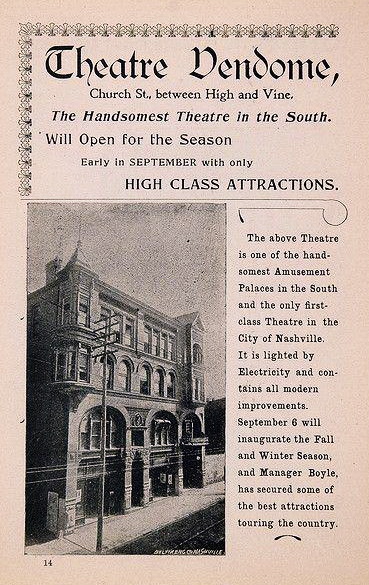
Four venues could be classified as theaters in the Nashville of 1900, two that were built as such and two others that had been adapted to serve the purpose: the Grand Opera House, the Masonic, the Vendome, and the Union Gospel Tabernacle, often simply called “the Auditorium.”
The oldest of the four would be the Grand Opera House at 431 North Cherry Street (today’s Fourth Avenue), whose entrance was not far from the present-day entrance to the former Municipal Auditorium. The Grand had opened July 1, 1850, as The Adelphi, amid much publicity, spoken of as one of the finest playhouses in the South. This theater operated under many names and managements as the Nashville, the Gaiety, May’s Grand, Milsom’s, and possibly others. By 1900 it had been occupied for six years by the Boyle stock company, Tony J. Boyle, proprietor, presenting occasional vaudeville shows.
The next in age would be the Masonic. The Old Masonic Hall at 422 Church Street – that is to say, on the north side of Church behind the Maxwell House – had been rebuilt in 1859-1860 to include a theater, which over the years had been called Jenny Wilmore’s, the Bijou, the New Masonic, and finally, toward the end of the nineteenth century, simply the Masonic. In 1900 it was under the very capable management of William A. Sheetz, who was also a long-time fixture at the Vendome. Before long, Mrs. Boyle of the Grand would take over management of the Masonic and announce that she was booking “shows that have been shut out of the syndicate,” a reference to the Vendome’s use of the attractions of Klaw and Erlanger, a New York booking and management concern with a secure grip on much of the dramatic theater business of the day.
The Vendome – facing the Capitol from the south side of Church midway between High and Vine – had opened October 2, 1887, as a truly first-class playhouse. One of the stockholders was J. Oliver Milsom, who was to manage the Vendome for a time and, as mentioned above, briefly gave his name to the Grand when he managed that theater.
These three locations primarily showed “legitimate theater,” that is to say, dramatic productions or plays. Vaudeville had had a somewhat sporadic presence locally, and moving pictures had not yet come to Nashville. (However, their arrival was not far off: the Vendome was trying out “Vitagraph Matinees” by late 1901, and in 1902 the Grand began showing “Biograph Views”)
The story of the Union Gospel Tabernacle is well known, and we shall not repeat it here. Suffice it to say that it was erected on Summer Street (now Fifth Avenue) just north of Broad by a local group under the leadership of riverboat magnate Tom Ryman after his conversion by noted evangelist Sam Jones. Not until Ryman’s death in 1904 was the building called Ryman Auditorium, but by 1900 it was being called “the Auditorium” and was advertising lyceum programs, which term may need some explanation to today’s readers. The lyceum was somewhat related to the traveling Chautauqua movement, except that it took place indoors rather than in tents. An auditorium could book a series of programs of a more-or-less educational nature which varied from temperance lecturers and choral groups to the occasional play or operatic production, or which might even include such a novelty performance as that of a very refined magician. De Long Rice, a later manager of the Auditorium, managed a bureau of lyceum attractions at the same time and frequently booked his clients at the Auditorium.
The Vendome burned in 1902. An interesting sidelight to the fire is that manager Billy Sheetz attempted to lease the Masonic, by then under Mrs. Boyle’s management, for the attractions he had booked for the Vendome, but she turned him down. The Auditorium subsequently offered to let the attractions play there . . . but only under their own management. The managers of the next few Sheetz-booked shows took the position that their contract with Sheetz was voided when his theater burned. Some then played the Masonic, and others appeared at the Auditorium on their own terms, cutting Sheetz out of the picture! Not one to overlook a snub, the scrappy Billy Sheetz reopened the Vendome before the end of 1902 with a guaranteed hit: Al G. Field’s Minstrels.
Al G. Field, born Alfred Griffin Hatfield, worked for the Sells Bros. Circus 1875-1884, organized what would become the Hagenbeck-Wallace Circus in 1884, and opened his eponymous minstrel show in 1886. When he died in 1921, leaving the show to his brother Joseph E. Hatfield, his estate was valued at $150,000 (the equivalent of $2.3 million today).
After the Grand also burned in 1902, the Boyle stock company moved to the Masonic, taking the name of the Grand along with them. The Masonic promptly began to be called the Grand (or on occasion the “Little Grand”). In 1904 a new theater, the Bijou, would be erected on the former Grand site by Jake Wells, an enterprising sort who, among other things, once managed the Birmingham Barons, a Chicago Cubs farm team.
Older readers may recall the Bijou, which in 1916 became one of the South’s leading theaters for African American audiences, and which lasted until it was demolished during the winter of 1957-1958 for the construction of the Municipal Auditorium.
The new Grand (Masonic) was vacated for theatrical purposes in 1914, and the property was sold in 1915 to Joe Fensterwald, who demolished the building and erected the steel and concrete edifice that was to house Burk and Company. The fiction that Burk’s occupied the former Masonic building has been repeated too many times (even in print!) for us to convince anyone otherwise at this late date. The Masonic lodge moved to a new location on Seventh Avenue North, where many of us recall the majestic lions guarding its portals. It stood next to the Clarkston Hotel and behind the War Memorial Building.
In 1920 the Vendome became Loew’s Vendome (or as time went by simply “Loew’s”) and presented both moving pictures and vaudeville shows. Several years later Loew’s entered into an agreement with movie king Tony Sudekum whereby his Princess Theater down the street became the only “vaude” house in town and Loew’s got the pick of the first-run movies.
Loew’s burned again in 1967 and this time was not rebuilt, a signal that the Church Street of our youth was disappearing. For years thereafter one could walk through the old Loew’s lobby to the parking garage that occupied the site of the theater auditorium. In the mid-1980s all that was wrecked for the building of Church Street Center, and you saw what happened to that!
You will read elsewhere that the Ryman was Nashville’s only playhouse after the Vendome became Loew’s, but those reports ignore the importance of the 1910 Orpheum, which booked dramatic roadshows for most of its almost thirty years. Parenthetically, we should also mention what older Nashvillians already know: namely, that during the Depression the Edward Bellamy Players went broke at the Orpheum, and Mrs. Inez Bassett Alder bought the props and wardrobe for the Hume-Fogg dramatic department. The Ryman, of course, is the only survivor of our 1900 quartet and is again presenting live stage attractions as these lines are being penned. (1999)
Eighteen-year-old Private Willis L. McWhirter of Adamsville in McNairy County was mustered into the 27th Tennessee Infantry, CSA, in September 1861. He would not survive the war. A little over three years after his enlistment he was hit by artillery fire at the Battle of Franklin. The missile caused severe damage to his right hip joint, and it is remarkable that McWhirter, by then a corporal, survived as long as he did.
The monument that graces Confederate Circle in Mt. Olivet Cemetery is a granite obelisk topped by a nine-foot statue of a Confederate soldier. Thirteen rows of graves surround the monument: buried in the first six rows are Confederate soldiers from other states; in the seventh row are unknown soldiers; and in the outer rows, the graves of Tennesseans. (photo from NHN collection)
When Hood retreated after the Battle of Nashville, McWhirter remained behind with the rest of those too seriously wounded to be moved. Taken prisoner on December 17, 1864, he was left in the care of Union Army surgeons at the U.S. Army General Hospital #1, on the hill near where Third and Lindsley now meet. McWhirter died of his wounds on January 31, 1865, and was buried the next day at Nashville City Cemetery.
According to his military records, the corporal was assigned two numbers, a hospital patient number and a grave number, the latter also appearing in Nashville mortician W. R. Cornelius‘s burial ledger. The letters “GSW” next to his name there represent the cause of death: “gunshot wound.” Cornelius had contracted with the Union military authorities to bury both the Union dead and their Confederate counterparts. His ledger contains over 15,000 entries, many of them unknown soldiers.
In 1869 a movement developed to honor fallen Confederates by re-interring them at Mount Olivet Cemetery, in existence then for nearly 15 years. Twenty years later, in 1889, the monument at Confederate Circle was dedicated in a ceremony commemorated by photos in Confederate Veteran Magazine. In the early 1970s, owing largely to the work of the Reverend Florence Redelsheimer of the Mount Olivet staff, markers provided by the United States Veterans Administration (now the Department of Veterans Affairs) were placed around the circle. Flat stones were chosen rather than the more typical vertical stones (which were pointed, allegedly to prevent disrespectful persons from sitting on them). Walking the northern face of the Circle, a visitor can see rows of markers for Alabama soldiers along with Corporal McWhirter’s, one of half a dozen Tennesseans whose markers lie on that side.
Not far from Corporal McWhirter lies the grave of one of only three women buried here. Mary Kate Patterson Davis Hill Kyle was an active member of a Confederate unit known as Coleman’s Scouts. It was this company to which Sam Davis belonged at the time of his 1863 capture. The story of Davis’s hanging by the Federals is well-known to Middle Tennesseans. Mary Kate, whose first marriage was to Sam’s brother John, died in 1931 at age 97.
In at least one case, a husband and wife were buried together in Confederate Circle: William and Catharine Palmer rest together under upright stones. We see from the inscriptions that William lived to be one hundred years old, and Catharine survived until 1952. Behind an evergreen tree in the outer rows lies J.A. Hankin, a nurse who died in 1863.
It should be noted that Corporal McWhirter is buried under the name William, rather than Willis, as his service records identify him. Many of the old records are difficult to read, particularly since styles of penmanship have changed; to complicate matters further, some of Mount Olivet’s microfilm records are almost illegible. Not so the records of Mr. W. R. Cornelius, the mortician, whose hand was quite elegant.
Missing are the pre-1875 records for Mount Olivet, later supplemented by the discovery of some interment books in a building on the cemetery grounds. Also lost was a pre-1952 map, without which it was difficult for the staff to locate the known Confederate graves. Add to that the apparent indifference to standardized name spellings during the Civil War and the high illiteracy rate among rural soldiers, and one can begin to understand why so many names on the markers are oddly spelled.
Close to 1,500 Confederate soldiers are buried in thirteen rows, the overwhelming majority of the soldiers unknown. Those who died in hospitals and prison camps left records of their names, and these can be found on the inner row markers. Unknown soldiers were buried in a trench running completely around the Circle. In the outer rows lie men who died after the war, their names etched in stone for all to read. On the left side of the 45-foot-tall monument is a touching verse, which reads in part, “The muster roll of our dauntless dead is lost and their dust dispersed on many fields.” At least a part of that muster roll has finally been recovered.
This 45-foot monument stands guard over Confederate Circle in Mt. Olivet Cemetery (photo from NHN collection)
The author would like to thank Tim Burgess, researcher into Confederate deaths and burials, who has been instrumental in having markers placed at Confederate Circle in recent years. This essay was composed using material supplied by Mr. Burgess, along with microfilm records at the Tennessee State Library and Archives.
Notes from readers:
1. Mary Kate Patterson Davis Hill Kyle had a brother, Everard Meade Patterson, who was also a Coleman Scout. He, too, is buried in Mt. Olivet Cemetery. Three other Coleman Scouts are also buried there. Everard died in 1932, being the last of the Scouts. My relative Joshua Brown was a Scout, and he, Mary Kate, and Everard are profiled in our new Civil War book, Shadow Soldiers of the Confederacy. (Talley Bailey)
2. I am named for John F. Wheless, First Tennessee Rock City Guard, who is buried in the Circle, He was a friend and business partner of my great-grandfather, Henry Wade, and godfather to my grandfather, Harry Wheless Wade Sr. (Harry Wheless Wade III, Nashville)
Few people realize that Nashville is home to one of America’s oldest water pumping stations, continuously in operation since 1889. Originally named the George Reyer Pumping Station, in honor of a long-time superintendent of the Nashville Water Works, the station and the adjoining R.L. Lawrence filtration plant (in service since 1928) eventually came to be called the Omohundro Water Plant. Originally operating under steam power, the plant was converted to electricity in 1953. The Omohundro plant, which has a pumping capacity of 139,000,000 gallons of water a day, is one of the two treatment plants that provide all the water for Nashville and neighboring communities. In 1987 the Omohundro Complex was added to the National Register of Historic Places.
Even fewer people know that the names of the water plant and Pumping Station Road were changed in 1961 to honor “Squire” John Moten Omohundro Sr. The meandering Omohundro Drive, which adjoins Omohundro Place and Omohundro Court, intersects twice with Lebanon Road not far from downtown Nashville.
John Moten Sr. was often referred to in print as the “Squire,” not to be confused with John Moten Jr. or John Moten III. The senior Moten was born in Roanoke, Virginia, in 1883 and came to Tennessee’s Wilson County as a boy. He had an active political career for over fifty-six years, serving as a justice of the peace, chief of detectives, constable, inspector, magistrate, and city judge of Criminal Court. Known as the Honorable John M. Omohundro, Esquire, he was a member of the court from 1924 until his retirement in 1960. In addition, he served on the Highway Commission when construction of Old Hickory Boulevard began and when the Old Hickory bridge over the Cumberland River was built in 1927-28. His name and those of others on the Commission are carved on both stone approaches to the twin metal bridges.
The Squire was an imposing man, over six feet tall, who always wore a white Stetson hat and sported a handkerchief in his pocket. He spoke with a husky voice through a hole in his throat after an operation in the early 1930s. He rode comfortably astride a horse, his father having been a partner in a Nashville livery stable, Jones and Omohundro. On horseback, Squire patrolled the powder plant at DuPont during World War I. He was a force within his community, known to be a man who got things done. Governor Buford Ellington and Mayor Beverly Briley were honorary pallbearers at his 1967 funeral.
In 1906 he married Sadie Poynor, who also enjoyed an admirable public career. She became Postmaster of Donelson in 1943, remaining in that position until the Donelson post office became a Nashville branch in 1954. Sadie was then named a postal superintendent, serving in that capacity until her retirement in 1957. She also had the distinction of being the first president of the Parent-Teachers Association of the old Rosemont School, which later became the Margaret Allen school.
The Squire and Sadie had two children, Alybel and John M. Jr. Alybel and her husband Bill Johnson had no children. John married Frances Nelson, and their union resulted in five children, ten grandchildren, and thirteen great-grandchildren.
Although the surname Omohundro is shrouded in folklore, we do know that the first recorded Omohundro in North America was Richard, who bought property in Virginia’s Westmoreland County in 1670. He married the daughter of the Englishman William Moxley, and all other American Omohundros have descended from them.
Before ending this tribute to the Squire, we should mention his famous uncle, “Texas Jack” Omohundro, who was a protégé of Buffalo Bill Cody. Texas Jack was a magnificent specimen of physical manhood, six feet tall and of the finest proportions. A native of Virginia, he was born in 1846, created a legendary persona, and died before our Squire Omohundro was born. Books written about the life and times of Texas Jack have influenced generations. The Texas Jack website describes him as a “cowboy, prairie scout, western hunting guide, Wild West showman, and partner of W. F. ‘Buffalo Bill’ Cody and James B. ‘Wild Bill’ Hickok.” Perhaps Squire Omohundro infused a bit of his larger-than-life uncle into our local heritage.
Renowned Tennessee newsman Elbridge Gerry Eastman was born in Bridgewater, New Hampshire, on February 27, 1813,1 to Timothy and Abigail Eastman. As a young man, he learned the printing trade,2 which would support him throughout his life.
E. G. Eastman’s gravesite in Mt. Olivet cemetery, Nashville, Tennessee.
Young Eastman moved to Boston and then, by 1838, to Washington, D. C., where he worked at the Washington Globe and became a trusted confidant of House Speaker James K. Polk.3 In 1839 Polk brought Eastman and his new wife, Lucy Ann Carr, back to Tennessee, to install the young publisher as editor of the Knoxville Argus.4 Eastman’s incisive writing helped Polk win the governorship that October, while establishing his own reputation as “the leading Democratic editor of East Tennessee”5 – quite a political shift for Eastman, who had published The Abolitionist in New Hampshire only four years earlier.6
While in Knoxville, he also encouraged and published the writings of humorist George Washington Harris, whose works would influence Twain and Faulkner. Harris dedicated Sut Lovingood, Yarns (1867) to Eastman, “the friend whose kindly voice first inspired my timid pen with hope.”7
When Polk became the eleventh U. S. President in 1845, Eastman followed him to Washington.8 However, he was quickly called back to Tennessee by Democratic party leaders, who put him in charge of the Nashville Union (1847).9 Eastman’s newspaper not only showed Polk in the best possible light but also supported other Democratic candidates, including Andrew Johnson, then facing a difficult Congressional reelection campaign. “Take high ground on the slavery question,” Johnson wrote to Eastman in 1849.10
In 1850 the Union changed its name to The Nashville American, with E. G. Eastman and Thomas Boyers as editors. In 1853, in “one of the most important newspaper mergers in the antebellum history of the state,”11 the newspaper became The Nashville Union and American. Eastman was elected clerk of Tennessee’s Democratic House (1849)12 and Senate (1853).13 When Andrew Johnson became governor in 1853, he appointed Eastman to the State Agricultural Bureau. As bureau secretary,14 Eastman instituted Tennessee’s first county, regional, and state fairs.15 Meanwhile, his firm, E. G. Eastman & Co., Public Printers, produced many of the state’s publications, including the House and Senate journals.
Base of E. G. Eastman’s gravestone in Mt. Olivet Cemetery, Nashville. (Note misspelling of “February.”)
On November 23, 1859, five days after Union and American editor George Poindexter was shot to death by rival editor Allen A. Hall of the Nashville Daily News,16 Elbridge G. Eastman died suddenly at his home from a paralyzing stroke.17 “The most influential political writer in the State,”18 he was only 56. Governor Isham Harris later wrote a friend that he believed Poindexter had been killed deliberately in an effort to break Eastman’s spirit.19 Both houses of the Tennessee General Assembly adjourned that day “in token respect to the memory of E. G. Eastman, the public printer.”20
Lucy Eastman was left with nine children, ages one to eighteen.21 She eventually sold her interest in the Union and American to Thomas S. Marr and Leon Trousdale. When the Confederates evacuated Nashville in early 1862, the operations of the paper were suspended. (2014)
SOURCES:
1 Ancestry.com. New Hampshire, Births and Christenings Index, 1714-1904 [database on-line]. Provo, UT, USA: Ancestry.com Operations, Inc., 2011. Accessed January 13, 2014.
2 Clayton, W. W. History of Davidson County, Tennessee. Philadelphia: J. W. Lewis & Co., 1880, 385.
3 Burt, Jesse C. The Most Tremendous Democrat: The Editing, Publishing & Public Service Career of Elbridge Gerry Eastman in Tennessee, 1839-1859. Bound, unpaged manuscript in Jesse C. Burt, Jr., Papers, 1920-1981, chapter 1. VI-L-1-2. Tennessee State Library and Archives.
4 Guild, Josephus Conn. Old Times in Tennessee : with Historical, Personal, and Political Scraps and Sketches. Nashville: Tavel, Eastman & Howell, 1878, 142-143.
5 Clayton, 385.
6 Moore, Jacob B. “History of Newspapers in New Hampshire,” in Edwards, B. B., and W. Cogswell, eds. The American Quarterly Register, Vol. XII. Boston: The American Education Society, 1840.
7 Harris, George Washington. High Times and Hard Times: Sketches and Tales. Nashville: Vanderbilt University Press, 1967.
8 Clayton, 385.
9 Clayton, 385.
10 Graf, LeRoy P., and Ralph W. Haskins, eds. The Papers of Andrew Johnson: Volume 1, 1822-1851. Knoxville: University of Tennessee Press, 1967.
11 Burt, Introduction.
12 House Journal (Tennessee), 1849, 8.
13 Senate Journal (Tennessee, 1853-1854, 19.
14Biennial Report of the State Agricultural Bureau of Tennessee to the Legislature of 1855-56, prepared by E. G. Eastman, Secretary of the Bureau. Nashville: G. C. Torbeit & Co, 1856.
17 Ancestry.com. U.S. Federal Census Mortality Schedules, 1850-1885 [database on-line]. Provo, UT, USA: Ancestry.com Operations, Inc., 2010. Accessed January 13, 2014.
18Second Report of the Board of Health to the Honorable City Council of the City of Nashville, for the Year ending July 4, 1877. Nashville: Tavel, Eastman & Howell, 1877.
19 Burt, Introduction.
20 House Journal (Tennessee), November 23, 1859, 280; Senate Journal (Tennessee), November 23, 1859, 170.
21 Ancestry.com 1860 United States Federal Census [database online]. Provo, UT, USA: Ancestry.com Operations, Inc., 2009. Accessed January 14, 2014.
SUGGESTED READING:
Clayton, W. W. History of Davidson County, Tennessee. Philadelphia: J. W. Lewis & Co., 1880.
Harris, George Washington. High Times and Hard Times: Sketches and Tales. Nashville: Vanderbilt University Press, 1967.








 Nashville Historical Newsletter