from the files of the Nashville Historical Newsletter.
Buchanan’s Station was a fortified settlement established about 1784 during the pioneer era of Nashville, Tennessee. Located on a bluff overlooking Mill Creek in today’s Donelson suburb, the homestead was founded by Major John Buchanan who, along with his family and other settlers, lived there until the Major’s death in 1832. The station is best known as the site of the Battle of Buchanan’s Station, a famous Indian attack which occurred on September 30, 1792.
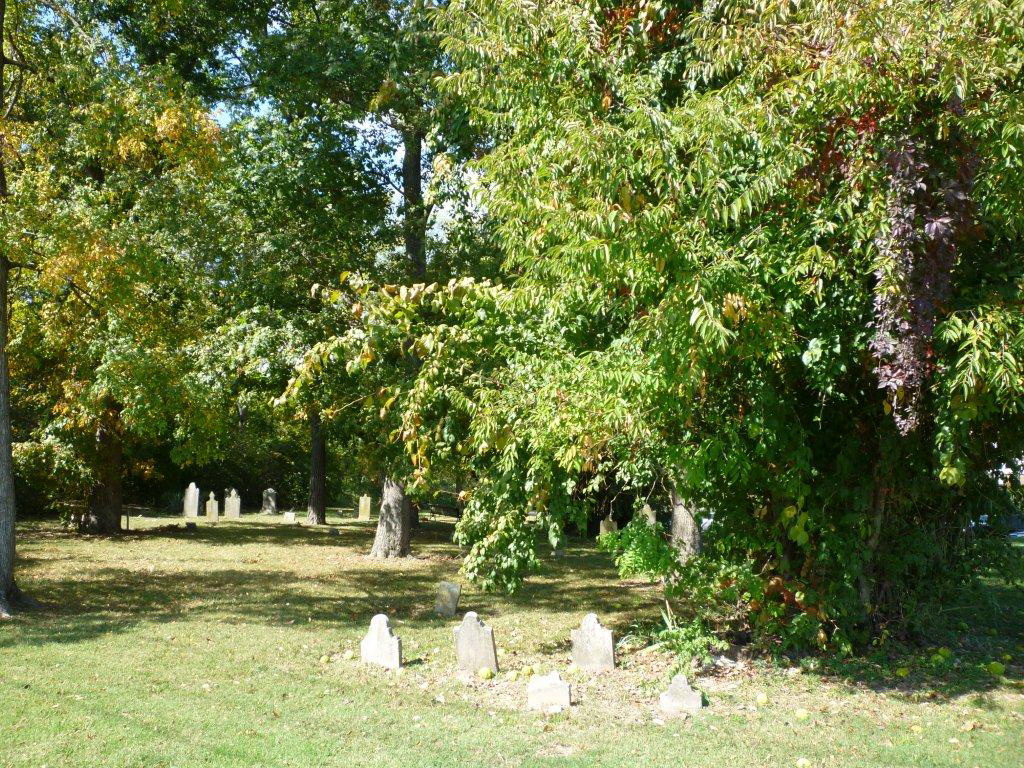
Buchanan’s Station Cemetery (photo by Tim Slate)
The fort is known to have been positioned precisely at the northwest corner of today’s Elm Hill Pike and Massman Drive, and a state historical plaque marks the spot. A large commercial building now covers the site of the original fort. Not seen from Elm Hill Pike but clearly visible from Massman Drive is the extant Buchanan’s Station Cemetery, the only remaining vestige of the original settlement and one of the oldest pioneer graveyards in Middle Tennessee. Buried here are Major John Buchanan (1759-1832) and his storied wife Sarah “Sally” Ridley Buchanan (ca.1774-1831), along with about 65 other family members, affiliated settlers, and possibly slaves. Many graves are marked only by unengraved fieldstones. Notably, historical circumstances indicate that at least five frontiersmen who were at various times killed by Indians may be buried in the cemetery: Samuel Buchanan, Cornelius Riddle, John Buchanan Sr., William Mulherrin, and John Blackburn.
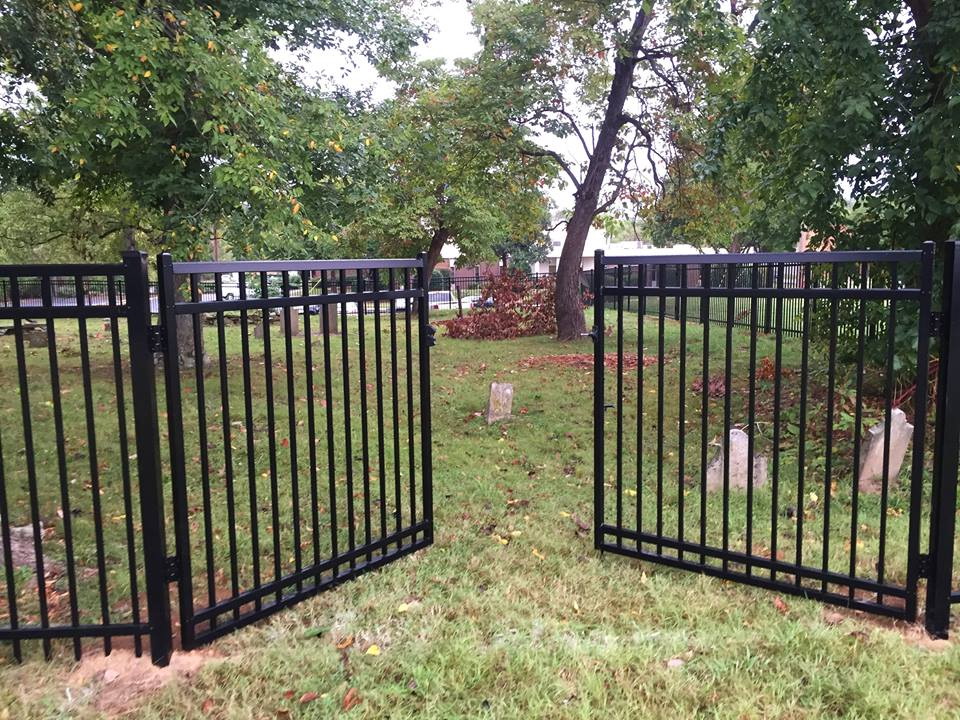
Entrance gate to Buchanan’s Station Cemetery (photo by Tim Slate)
On March 17, 2012, the Friends of Buchanan’s Station Cemetery met for the first time. Fostered primarily by the Buchanan Log House Chapter APTA, its president, Lu Whitworth, and historian Mike Slate, the grassroots group set its goals, which included effecting the transfer of the cemetery property from private ownership to Metro Nashville, fencing the unprotected graveyard, and acquiring signage for the education and inspiration of all visitors. From the beginning the Friends group worked closely with Tim Walker, executive director of the Metro Historical Commission.
On September 30, 2012, the Friends, assisted by Cumberland University and the French Lick Chapter of the DAR, held a major event at the cemetery commemorating the 220th anniversary of the Battle of Buchanan’s Station.
Lu Whitworth and Mike Slate, in period apparel, oversaw the event commemorating the 220th anniversary of the Battle of Buchanan’s Station, 9-30-2012. (NHN photo)
In 2015 businessman Scott Pope, working with group member Dick Davis, generously assigned the property to Metro Nashville. Later the same year the Friends, led by donations treasurer Joe Cathey, installed a quality fence around the historic graveyard and placed a comfortable bench inside. A grant from the Tennessee Wars Commission, facilitated by Tim Walker and David Currey, enabled some attractive interpretive signage to be added to the cemetery. (2017)
from the files of the Nashville Historical Newsletter.
This account was written by Mike Slate in 2011 as part of his campaign to save Buchanan’s Station Cemetery from being lost in a flurry of industrial development.
John Buchanan (1759-1832) and his group of settlers arrived at the French Lick (future Nashville, Tennessee) in the winter of 1779-80. In his book Tennessee during the Revolutionary War, historian Samuel Cole Williams states that “Some South Carolinians on the move to the West overtook the Robertson party; and, being smaller in number and less encumbered, reached French Lick first, crossed the Cumberland on ice, and began the building of cabins. The South Carolinians included John Buchanan and his brother, Alexander; Daniel and Sampson Williams, brothers; James and John Mulherrin, and Thomas Thompson.” If this account is accurate, John Buchanan was one of the very first pioneers to call Nashville home. Today John (often called “Major John”) lies buried at the Buchanan’s Station Cemetery.
John Buchanan was the son of John Buchanan Sr., one of Nashville’s first heroes. In the April 2, 1781, “Battle of the Bluffs” near Fort Nashborough, John Sr. famously saved Edward Swanson from being killed by a Native American attacker, but Buchanan lost his son Alexander during this battle. Several years later John Sr. was himself murdered at Buchanan’s Station by Indians; an account of this event is preserved by George W. Featherstonhaugh in his Excursion through the Slave States. Samuel Buchanan, another brother of Major John, was also killed by Indians at the station. For an evocative account of Samuel’s death see the article, “The Buchanans of Buchanan’s Station” in the Chicago Magazine, Vol. 1 No. 3, 1857. Buchanan Sr., his wife Jane, and their son Samuel are likely buried in the Buchanan’s Station Cemetery in unmarked graves. Though he lost his father and two brothers to Indian warfare, Major John, unlike many others who attempted to settle in Nashville but moved on, persevered here for the remainder of his life.
John Buchanan’s Book of Arithmetic (courtesy of the Tennessee State Library and Archives)
John Buchanan wrote Nashville’s first book. Apparently in a systematic effort to learn the mathematics of land surveying, Major John created John Buchanan’s Book of Arithmetic, and dated it June 20, 1781. He did indeed pursue land surveying, and his name is listed on many early Nashville surveys. In the course of his public career, Buchanan himself amassed many hundreds of acres, becoming quite prosperous. Today, Buchanan’s book is a Nashville and Tennessee artifact that is carefully preserved in the Tennessee State Library and Archives. Ironically, Tennessee has treasured the book but not the grave of the man who produced it.
After living approximately four years at Fort Nashborough, Buchanan and his family moved a few miles east and established Buchanan’s Station on Mill Creek, near today’s Elm Hill Pike and Massman Drive. In addition to a stockaded fort with blockhouses, Major John built a grist mill, and some authorities believe his mill is the one that gave Mill Creek its name. In about 1786 John married Margaret Kennedy, who died after giving birth to their first and only child, John Buchanan II (technically John III), born on May 15, 1787. Little is known about Margaret, who may be buried in an unmarked grave at the Buchanan’s Station Cemetery. Descendants of John Buchanan II include Tennessee Governor John Price Buchanan, Nobel Prize winner James M. Buchanan, and Nashville attorney Alexander Buchanan.
John Buchanan was the commander of the fort on the fateful night of September 30, 1792, when several hundred Indians attacked it as part of a grand plan to destroy the Cumberland settlements. In this “Battle of Buchanan’s Station,” roughly 20 riflemen in the station repulsed the horde, killing several Indian leaders, without the loss of a single settler. Historian J.G.M. Ramsey called the victory “a feat of bravery which has scarcely been surpassed in all the annals of border warfare.” James Phelan offered a similar assessment: “This is one of the most remarkable incidents in the early border warfare of the Southwest. So wonderful, indeed, that even some of the pioneers believed in the direct interposition of Providence.” Not surprisingly, the story of the Battle has been recounted in many volumes of history, including Theodore Roosevelt’s The Winning of the West.
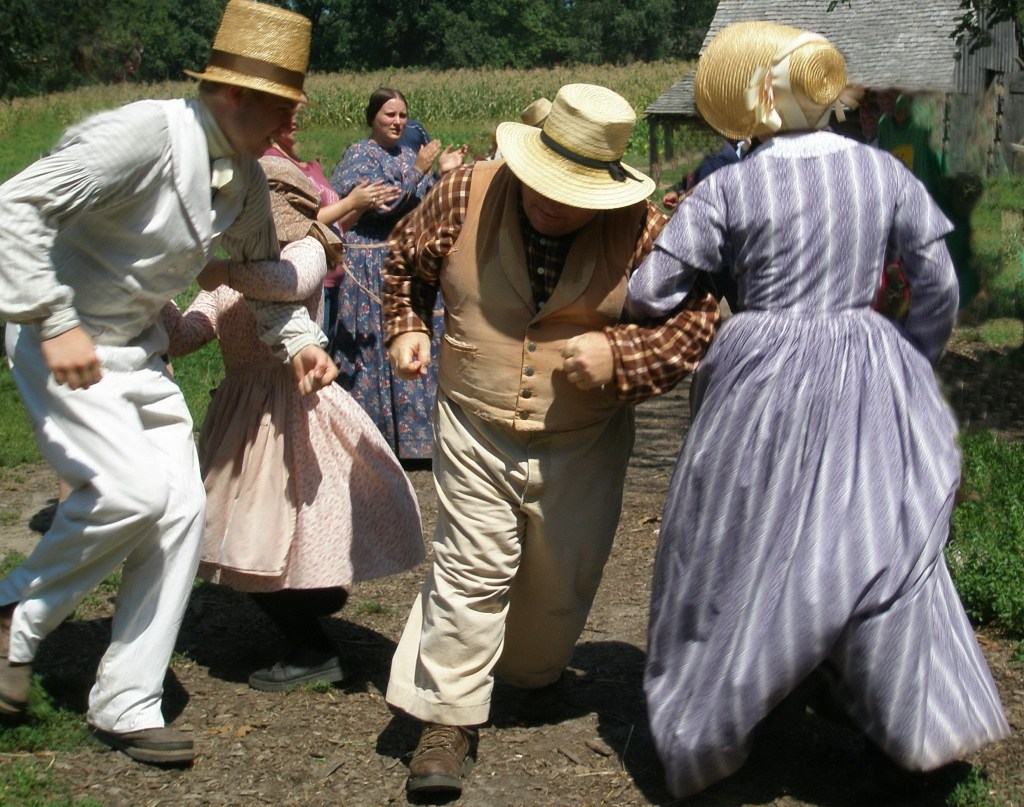
Frontier wedding (photo courtesy of Living History farms)
Perhaps the wisest decision John Buchanan ever made was to marry Sarah “Sally” Ridley (1773-1831). Sally was one of the first white females born in what would eventually become the state of Tennessee. Along with her father, Revolutionary War veteran Captain George Ridley, she arrived in the Cumberland settlements about 1790. Her family established Ridley’s Station in the area of today’s Nolensville Road and Glenrose Avenue. Sally, a large woman with a large personality, was destined to become a legend in much of the eastern half of the United States.
Throughout the Battle of Buchanan’s Station, Sally, nine months pregnant with the couple’s first child, was the heroic voice of victory. She encouraged the riflemen at every turn, molded bullets when the supply ran low (reportedly by melting her dinnerware), blocked another woman in the station from surrendering herself and her children to almost certain death, and helped fool the Indians by a “showing of hats.” Sally’s uncommon spunk was extolled by biographer Elizabeth Ellet in her 1856 volume, The Women of the American Revolution, which referred to her as “the greatest heroine of the West.” Periodicals from as far away as Boston immortalized Sarah, some fancifully, and she was listed in at least two national encyclopedias of biography (Appleton’s and Herringshaw’s).
John and Sarah Buchanan had thirteen children: George, Alexander, Elizabeth, Samuel, William, Jane T., James B., Moses R., Sarah V., Charles B., Richard G., Henry R., and Nancy M. The Buchanan children and grandchildren intermarried with members of other settlements around Buchanan’s Station, their families becoming important not only to Davidson County history but also to that of neighboring Rutherford and Williamson counties. Eventually the Buchanan descendants spread to all parts of the United States, and accounts of their accomplishments and contributions to the nation could fill volumes.
A reenactor portraying Cherokee Chief John Watts shares historical information with visitors to the Buchanan’s Station Cemetery, 2012.
Buchanan’s Station also has significant associations with local Native American history. It was a confederacy of Creeks, Cherokees, and Shawnees that attacked the Station in 1792. During the battle, Chiachattalla (also known as Kiachatalee, Tsiagatali, Kittegiska, and Tom Tunbridge’s son), an especially dauntless warrior, was shot near the fort. As he lay dying, he reportedly continued his efforts to set the structure ablaze by fanning the flames with his last breaths. Also killed in the battle were “the Shawnee Warrior” (Cheeseekau, a brother of the great Tecumseh) and White Owl’s Son, brother of Dragging Canoe. The great Chickamauga chief John Watts was shot through both thighs but was removed from the battleground in a litter and later recovered. For a partial list of Indian casualties at the Battle of Buchanan’s Station see American State Papers: Indian Affairs 4-331.
Today John and Sarah Buchanan are almost forgotten. Very few citizens know that their graves, with the original headstones, survive in Buchanan’s Station Cemetery, the last vestige of the pioneer settlement. The educational and inspirational lessons of their lives have been largely squandered, and the story of the Battle of Buchanan’s Station has been all but lost. Believing that the Buchanans are an integral part of early Nashville history – see the first chapter in Harriette Simpson Arnow’s Flowering of the Cumberland – a number of concerned Nashville-area citizens have formed the Friends of the Buchanan’s Station Cemetery, with the goals of remedying years of neglect of this historic site and of restoring one of Nashville’s founding families to its proper place in our historical consciousness. (2011)
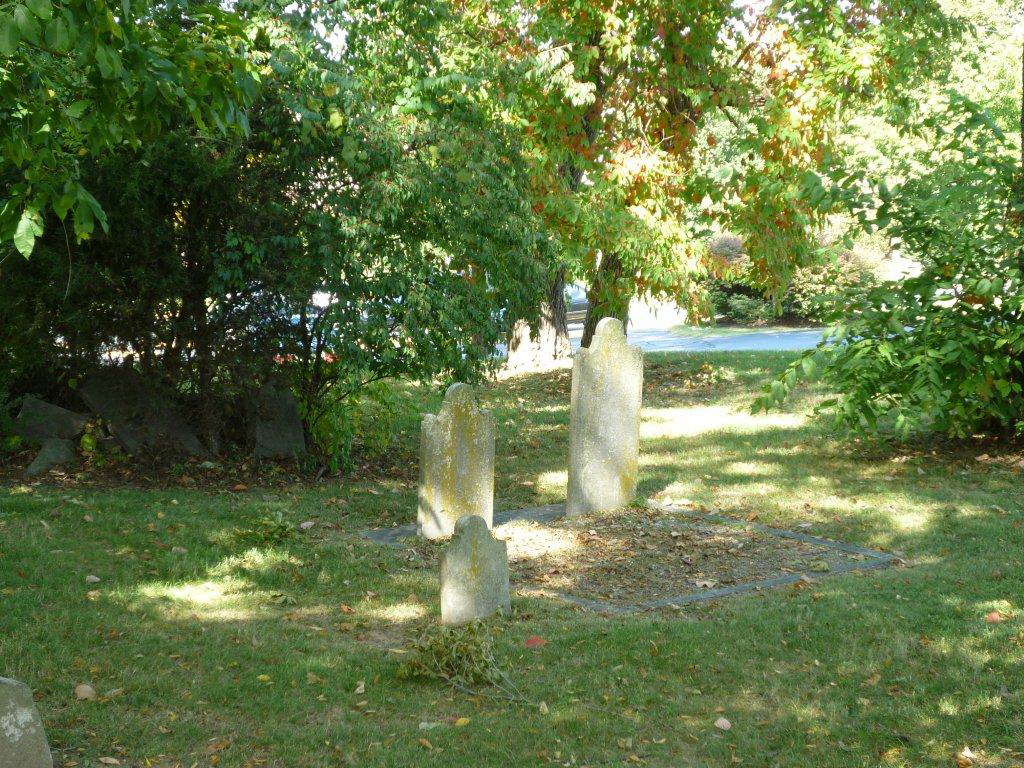
John and Sally Buchanan’s gravestones in Buchanan’s Station Cemetery
from the files of the Nashville Historical Newsletter.
Mike Slate wrote this press release in early 2012, hoping to stimulate public interest in rescuing one of early Nashville’s most important historical sites, which was about to be swallowed up by industrial development.
On a rocky bluff above a bubbling Mill Creek, under a canopy of trees that include American elm, black cherry, and sassafras, a group of pioneers – some of the architects of Nashville’s “can do” spirit – lie buried and forgotten. Two of them are especially significant.
Twenty-year-old John Buchanan (later called “Major John”) and his family arrived at the future Nashville during the unusually cold winter of 1779-1780—perhaps even ahead of James Robertson’s founding party—with nothing but a few necessities on pack horses. Unlike many other early settlers, Major John persevered here for the remainder of his life.
After losing his brother Alexander at Ft. Nashborough’s 1781 “Battle of the Bluffs” and writing Nashville’s first book, John Buchanan’s Book of Arithmetic, the young land surveyor and his extended family established Buchanan’s Station at Mill Creek, near today’s Elm Hill Pike at Massman Drive in what is now Donelson. Additional sorrows soon followed as John lost his father, John Buchanan Sr., and another brother, Samuel, in continuing Indian assaults.
The Chickamauga War reached its climax at Buchanan’s Station on September 30, 1792, when only about twenty defenders held off several hundred Native Americans whose goal was to destroy all the Cumberland settlements. Buchanan and his friends stopped them there, saving Nashville without the loss of a single stationer. Nineteenth-century historian J.G.M. Ramsey called this victory “a feat of bravery which has scarcely been surpassed in all the annals of border warfare.”
It was during this nighttime “Battle of Buchanan’s Station” that Major John’s eighteen-year-old wife, Sarah (“Sally”) Ridley Buchanan, in her ninth month of pregnancy with the first of their thirteen children, earned national fame. She encouraged the men, reassured the women and children, molded much-needed ammunition reportedly by melting down her dinnerware, and provided the voice of victory throughout the seemingly hopeless pandemonium. For her uncommon spunk, biographer Elizabeth Ellet referred to her as “the greatest heroine of the West,” and she was heralded in magazines and newspapers from as far away as Boston.
Unfortunately, the Buchanan Station story, as celebrated as it once was, has become lost to contemporary Nashville. Today the dilapidated Buchanan’s Station Cemetery, where Major John and Sarah Buchanan lie buried, is wedged anonymously into a Massman Drive industrial park, where hundreds of workers drive past twice a day, completely unaware of the graveyard’s historical import. (2011)
All photos of Buchanan Station’s Cemetery by Mike Slate, 2011.
Daniel Williams Jr., first sheriff of Davidson County, was born December 11, 1755, the fourth of thirteen children of Daniel and Hannah Echols Williams. Many sources fail to distinguish between the two Daniels, father and son: fellow settler Robert Weakley wrote, “Daniel Williams was originally from Virginia but went to South Carolina before the Revolution. There the Tories shot down two of his sons, in cold blood, at their father’s house.”1 This is a clear reference to Daniel Sr., since Daniel Jr. was 20 years old and unmarried when the American Revolution began, but their identities are not always so obligingly unambiguous. Both Daniels are documented as residing in Middle Tennessee, serving on juries, supervising road construction, and participating in civic activities.
Daniel Williams Jr., along with his brother Sampson, John Buchanan and his brother Alexander, James and John Mulherrin, and others, arrived in the Cumberland region in 1779.2 They had left their families at Clark’s Station, near Danville, Kentucky, “in comparative safety”3 and traveled ahead to establish a settlement. They faced frequent Indian attacks, and several members of the party were injured or killed.
Although Daniel Williams Jr. was the first sheriff of Davidson County, he was not the first sheriff of the district. The colonists had established the Cumberland Court on January 7, 1783, as a regional government to oversee the new settlement. The Court elected John Montgomery district sheriff in January4 and swore him in on February 5, 1783,5 but he was soon replaced by Thomas Fletcher as “Sworn Sheriff of ye Destrict of Cumberland.”6 The hapless Montgomery (almost certainly not the same man as Clarksville’s founder, Col. John Montgomery) appeared in court in January 1784, accused of “Treasonable proceedings on the Mississippi Against the Spaniards.”7 While acquitted of these charges, when Montgomery failed to appear to face subsequent civil allegations, the court seized his property.8
Davidson County, the oldest county in Middle Tennessee, was established by an act of the North Carolina legislature in April 1783 and named for General William Lee Davidson, who had died fighting Cornwallis in the Revolutionary War. At the first session of the Davidson County court, which met October 6, 1783, the justices elected Daniel Williams to a two-year term as sheriff and ordered construction of the first county courthouse and jail.9 The sheriff, paid on a fee basis, made a comfortable living: he received 8 shillings for each arrest and slightly smaller amounts for placing someone in the stocks, collecting bad debts, carrying out whippings and brandings, and so forth.10
According to Col. T. H. Williams, writing to Lyman Draper about 1843, four Williams brothers served as Davidson County Sheriff: Daniel (1755-1823), Sampson (1763-1841), Oliver (1768-1831), and Wright Williams (1776-1815). 11 A list on the website of the Davidson County Sheriff’s Department does not include Oliver Williams, but it does name Daniel Williams (elected 1783), Sampson Williams, who served two terms (1789 and 1791-1794), and Wright Williams (1799).12
Daniel Williams Jr. died in Wilkinson County, Mississippi. Sources vary as to his date of death. (2014)
Sources:
[Note: Many of the period sources quoted in this paper may be found in Paul Clements’ invaluable book, Chronicles of the Cumberland Settlements, 1779-1796. (Nashville: Self-published, 2012) References to all such quotes include not only the original published source (Draper, Haywood, Weakley, etc.), but also the page number where that and additional source material may be found in Clements’ book.]
1 Letter from Robert Weakley to Lyman Draper: Draper Papers, 32S, 519-520 (Clements 150).
2 Haywood, John. Civil and Political History of the State of Tennessee from its earliest settlement up tothe Year 1796. New York: Arno Press, 1971 [ca. 1823].
3 Arnow, Harriette Simpson. Seedtime on the Cumberland. Lincoln: University of Nebraska Press, 1960, 218.
4 “Minutes of Cumberland Court,” January 7, 1783. Three Pioneer Tennessee Documents. Nashville: Tennessee Historical Commission, 1964, 23.
5 “Minutes of Cumberland Court,” February 5, 1783, 25.
6 “Minutes of Cumberland Court,” March 15, 1783, 29.
Arnow, Harriette Simpson. Seedtime on the Cumberland. Lincoln: University of Nebraska Press, 1960.
Clements, Paul. Chronicles of the Cumberland Settlements, 1779-1796. Nashville: Clements, self-published, 2012.
Haywood, John. Civil and Political History of the State of Tennessee from its earliest settlement up to theyear 1796. New York: Arno Press, 1971 [ca. 1823].
Soldiers who died in the Civil War were, of necessity, almost always buried on the battlefield where they fell. After the War, however, a national movement arose to reinter them in a more honorable manner. Thus, national cemeteries were created for the Union soldiers who died so far from home. Confederate soldiers were more often buried in private burial grounds or brought home by their families. Young James Callender was one of the latter, returned to City Cemetery three years after his death in the War.
Photo by John Waggoner
James Thomas Callender, born in Nashville in 1841, was named for his grandfather, James Thomson Callender, a feisty newspaperman despised by Thomas Jefferson for printing unpleasant truths about Jefferson’s life. James’s father, Thomas, was a merchant and an alderman; his mother, Mary Sangster, had moved to Nashville from Virginia with her brother and sister. James had two sisters, Mary Catherine and Sarah, and two brothers, John Hill and William. He never knew Mary Catherine, who died in 1837 at 18 months, becoming the first of her family to be buried at City Cemetery. However, James lost his mother when he was six years old, and his father died of typhoid fever four years later. James, Sarah, and William were sent to Brentwood to live with their aunt Catherine Owen, who had no children of her own. Catherine and her wealthy husband James Owen lived at Ashlawn, a home which still stands on Franklin Road. Sarah married James Owen’s nephew, but died at 21 in 1859. She was buried with her family at City Cemetery.
Ashlawn (courtesy of Historic Nashville)
In 1859, when the Owen Chapel Church of Christ was organized, James and Catherine, along with James and William Callender, became charter members. The building was located across Franklin Road from Ashlawn. The congregation still meets there today in a brick building built just after the Civil War on land donated by James Owen.
In 1861, with fears of civil war on everyone’s mind, Christian Church ministers stood firm in their opposition to the war. Tolbert Fanning was jailed in Murfreesboro for speaking against slavery, and David Lipscomb was threatened with hanging for preaching that “Christians should not kill each other.” Philip Fall, leader of Nashville’s Christian Church (now Vine Street congregation), refused to pray for Jefferson Davis and, evoking his British citizenship, flew the Union Jack over his church, thus preserving its neutrality. However, their message had little impact on the young men who heard it. Fanning’s Franklin College closed as his students rushed to join the fight, and Philip Fall’s son Albert was killed at Fort Donelson, fighting for the Confederacy. When Confederate training camps were established on Franklin Road, James Callender, age 20, and William, three years younger, enlisted.
On June 24, 1863, at the Battle of Hoover’s Gap, James, a private in C Company, 20th Tennessee Infantry, was shot and killed. He was buried on the battlefield, and his funeral sermon was delivered at Owen Chapel on September 27, 1863. Brother William survived the war and returned home to Brentwood, where he married Mary Jane Zellner, whose sister Margaret was married to David Lipscomb. In 1869 Will and Mary Jane’s first child was born, a son they named James Thomas.
On April 27, 1866, this notice appeared in the Republican Banner: “The remains of James Thomas Callender will be conveyed from the residence of his brother, Dr. J. H. Callender, no. 26 South Summer St., to the Nashville Cemetery today at 3:30 o’clock pm. Services at the grave by Rev. Dr. Bunting.” Dr. Robert Franklin Bunting, the pastor of the First Presbyterian Church, lived next door to John Callender. James, remembered by his brothers, now rested with his parents, sisters, and Aunt Catherine Owen in the family plot in Section 8. Sadly, the only tombstones readable today are those of the parents, Thomas and Mary Callender. (2010)
Nashville has not yet applauded all the cast members in its founding drama. Witness this sentence: “Boone went by way of Watauga [after surviving the 1778 Indian siege of Boonesborough] and was there enabled to make such representations to his old friend Capt. James Robertson as induced him the following year to visit the Cumberland country and become the pioneer father of Middle Tennessee.” For convenience, let’s call this revelation the “Watauga Statement.”
The Watauga Statement was made by 19th-century archivist and historian Lyman C. Draper in his book The Life of Daniel Boone (p. 521), a seminal work for later Boone biographers. Draper is our most renowned source for information about America’s first western frontier, the area from the Allegheny Mountains to the Mississippi River. Not surprisingly, when Draper speaks, historians listen.
The Statement makes the legendary Daniel Boone a major catalyst for the founding of the city of Nashville. Heretofore, history has viewed Boone’s contribution to our area’s settlement as considerably more indirect – as an organizer for Richard Henderson‘s 1775 purchase of much of Kentucky and northern Middle Tennessee from the Cherokees, and as the blazer of the Wilderness Trail through Cumberland Gap, by which route James Robertson conducted Nashville’s first settlers. However, if we accept the Statement as an accurate assessment – and why shouldn’t we? – historical justice would press us toward adding Daniel Boone as the fourth in a quartet of Nashville founding fathers: James Robertson (1742-1814), John Donelson (ca. 1718-1785), Richard Henderson (1734-1785), and Daniel Boone (1734-1820).
Twentieth-century historian Samuel Cole Williams unwittingly reveals the likely progenitor for Draper’s Watauga Statement. Serious students of the Boone-Nashville connection will want to consult Williams’ book, Tennessee during the Revolutionary War (UT edition, p. 104, note 1), as well as that note’s correlative reference to Draper Manuscript #6XX50. There they will find convincing evidence that Lavinia Robertson Craighead, James Robertson’s youngest daughter, is at least one of Draper’s original sources for his Statement.
So why isn’t the Watauga Statement better known? The most obvious reason is that for well over a century Draper’s Boone manuscript existed in handwritten form only, found exclusively on microfilm, until Murray State University’s Ted Franklin Belue brought it to print in 1998 via Stackpole Books. Furthermore, any historians who have discovered the Statement may offhandedly have dismissed it for lack of complementary accounts.
Although corroborating evidence is scant, we can nevertheless make a strong circumstantial case for the Statement’s veracity. Circumstantial Fact One: Daniel Boone and James Robertson knew each other well. John Haywood, the father of Tennessee history, stresses that for a time both men lived in the Watauga area of East Tennessee (see The Civil and Political History of Tennessee, p. 53). Both also worked for land speculator Richard Henderson’s Transylvania Company, with Boone the leader for Henderson’s Kentucky land interests and Robertson, for his Tennessee holdings. In addition, Williams provides insight into the extent of the duo’s personal relationship in his report that Boone’s children, along with Robertson’s, were christened or baptized in Robertson’s Watauga home, perhaps around 1772-1773. (See Dawn of Tennessee Valley, p. 344.)
Circumstantial Fact Two: Daniel Boone had explored the lower Cumberland region – including the French Lick-Nashville area – and so was qualified to give Robertson a firsthand report about that country. Draper, also in his Boone biography (pp. 283-284), related a pertinent yet little-known anecdote:
“During this period, one Joe Robertson, an old weaver who had a famous pack of bear-dogs and was devoted to the chase, often accompanied Boone into the Brushy Mountain and over to the Watauga, securing loads of bear-skins, which they packed to the settlements and sold. On one of their adventurous trips, they penetrated as far as the French Lick [future Nashville] on Cumberland and found several French hunters there.”
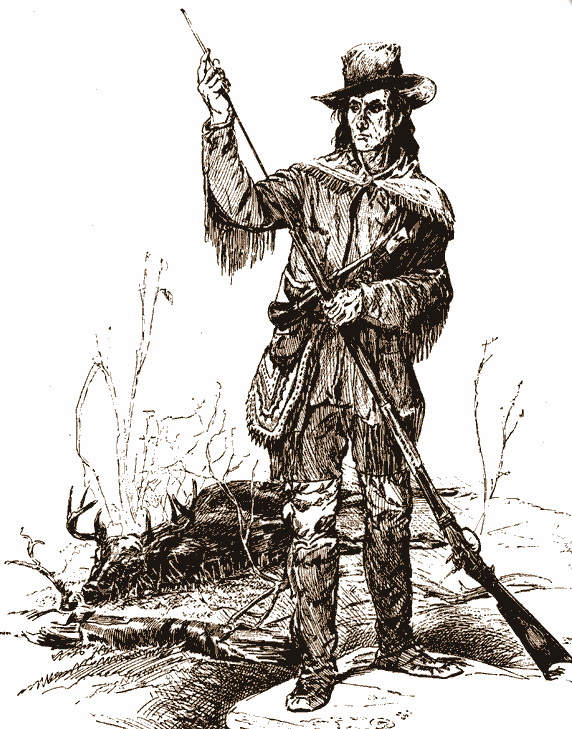
Long hunter with deer (courtesy of State Historical Society of Missouri.
Through the years, this fascinating passage has been repeated by other Boone biographers, including John Mack Faragher, who dates Boone’s French Lick exploration to the fall and winter of 1771-1772. (See Daniel Boone: the Life and Legend of an American Pioneer, p. 88.) Although Draper’s account is the only one I know that positions Boone squarely in geographical Nashville, various state historians do place him in the Middle Tennessee area. A.W. Putnam notes that “Boone, Rains, Mansker, and others…hunted and explored in 1769-70 upon the Cumberland” and reported “its marvelous herds of buffalo and deer” (History of Middle Tennessee, p. 619). Similarly, Williams comments in his discussion of 1769-1770 exploratory crews that “Daniel Boone after a hunt in Kentucky joined one of the groups on the Cumberland in the Tennessee region” (Dawn of Tennessee Valley, p. 330). Harriette Simpson Arnow mentions that Boone “hunted over and explored most of the Cumberland at intervals between1769 and 1775” (Seedtime on the Cumberland, p. 169). And John R. Finger, apparently guided by Draper, observes that in 1772 Boone “hunted as far west as French Lick” (Tennessee Frontiers: Three Regions in Transition, p. 42).
What shall we do with the Watauga Statement, circumstantially but not overwhelmingly confirmed? A lone sentence – even when supported by the testimony of James Robertson’s daughter – does not a historical certainty make; so I’m not advocating that we rush precipitously to validate Daniel Boone’s ticket as a father of Nashville. But I am suggesting that we pay more attention to Boone, keep an open mind about his role in our founding, and be prepared to give him his Nashville due.
At the least, the Statement reminds us that our city’s genesis involves more personalities than we customarily credit. While Robertson and Donelson are Nashville’s leading physical founders, the conceptual founders could include not only Richard Henderson and Daniel Boone but also others as yet unrecognized.
This article was first published in the November 2009 issue of The Nashville Retrospect newspaper. We thank publisher Allen Forkum for his permission to republish it here.
Buried near each other in the same lot on Oak Avenue are brothers-in-law John Patton Erwin (1795-1857) and Thomas Lanier Williams (1786-1856). Their relationship was not always so peaceful. Erwin, two-time mayor of Nashville (1821 and 1834), was married to Thomas’s sister, Frances (Fannie) Lanier Williams (1796-1872). Fannie is buried at Mt. Olivet with her daughters who lived to adulthood. Four other children who died young are presumed to be buried at City Cemetery with their father.
John Patton Erwin’s grave at Nashville City Cemetery
Both Erwin and Williams left significant marks on Tennessee history. John Patton Erwin was a newspaper editor, lawyer, banker, justice of the peace, and postmaster of Nashville. He was also the secretary of the Robertson Association, which was deeply involved in the American settlement of Texas while that region was still part of Mexico. His sister Jane’s first husband was wealthy Nashville banker, Thomas Yeatman, under whom Erwin served for a time as cashier. (Their son, Thomas Yeatman Jr., was a powerful supporter of the Confederate cause.) After Yeatman’s death Jane married the Hon. John Bell, Speaker of the House of Representatives, U.S. Senator, and Union Party candidate for president in 1860.
Erwin’s brother married one of Henry Clay’s daughters, while his cousin, also named Jane Erwin, was married to Charles Dickinson, who died in a famous duel with Andrew Jackson. Dickinson’s remains, recently discovered, were moved from a long-unmarked grave near Whitland Avenue to Nashville City Cemetery on June 25, 2010.
Thomas Lanier Williams was a lawyer, state representative and senator, and a justice on the State Supreme Court. His most lasting contribution to Tennessee was his long period of service as Chancellor of Tennessee, during which he became known as the father of equity law in the state. Less well known is the role he played many years earlier in the historic victory of the Tennessee Volunteers at the Battle of Horseshoe Bend in the War of 1812. He and his wife’s uncle, Hugh Lawson White (an 1836 candidate for president), convinced his brother Col. John Williams (later a U. S. senator) to lead the 39th U. S. Infantry Regiment in bringing desperately-needed supplies and manpower to Col. Andrew Jackson. Jackson would give Williams and his soldiers great credit for their pivotal role in defeating the British-allied Creek Nation at the Horseshoe. This important battle set the stage for Jackson’s success in the Battle of New Orleans and insured that Britain would never control the lower Mississippi River or the valuable ports of Mobile and Pensacola.
Horseshoe Bend from the air (courtesy of Alabama Backroads website)
Unfortunately, John Williams and Jackson later became political enemies, while Sam Houston, who had carried the regimental flag (designed by Thomas’s wife, Polly McClung Williams) in the successful charge at Horseshoe Bend, remained close to Jackson. Houston wrote a vitriolic letter to President John Quincy Adams urging him not to appoint John Patton Erwin as postmaster. Adams did make the appointment, but Erwin challenged Houston to a duel over the matter. Although the duel never actually took place, Houston wounded Erwin’s second.
Sometime in the 1820s John Patton Erwin declared bankruptcy, perhaps because of unsuccessful land speculation. Col. Joseph Williams, Fannie Erwin’s father, dispatched his son, Thomas Lanier Williams, to Nashville to protect his daughter’s interests and to make certain that Fannie’s future inheritance was specifically shielded from her husband. Although this decision caused some animosity at the time, matters were eventually smoothed over.
The Erwins’ home from 1831-1860 was named “Buena Vista.” The house was located on the hill near Rosa Parks Avenue and I-65, where the St. Cecilia motherhouse now stands. Thomas Lanier Williams stayed with the Erwins on many of his trips between his Knoxville residence and Nashville, and he eventually died in their home.
John Patton Erwin’s grave in City Cemetery is marked with a Nashville Mayors’ gravestone, while Thomas Lanier Williams is honored with a V.A. marker reflecting his military service in the War of 1812.
Thomas Lanier Williams’ grave at Nashville City Cemetery
Thomas Lanier Williams was the namesake of four other men named Thomas Lanier Williams. The most famous of these was playwright “Tennessee” Williams, a several-times-great-nephew of Thomas I and a great-great grandson of Colonel John Williams.
The flag of the 39th, still owned by a descendant of Colonel Williams, is on temporary display this spring at the Tennessee State Museum’s War of 1812 “Tennessee Volunteers” exhibit. (2012)
Previously published in Monuments & Milestones, the Nashville City Cemetery Newsletter.
Daniel Smith was born October 29, 1748, in Stafford County, Virginia. Having made up his mind to become a doctor, he studied medicine with Dr. Thomas Walker at Castle Hill, in Albemarle County, Virginia. However, he soon made an abrupt career shift and, at the age of 22, was licensed as a surveyor by the College of William and Mary (founded in 1693).
Three years after he began working as a surveyor, he married Sarah Michie and took a position as Deputy Surveyor and later sheriff of Augusta County, Virginia, where their son George was born in 1776. Smith first came to Middle Tennessee during the winter of 1779-1780, after he was hired to survey the western region of the Virginia frontier, and particularly to chart the border between Virginia and North Carolina. During the American Revolutionary War, he was commissioned a colonel in the militia, took part in a number of battles, and was appointed Assistant Deputy Surveyor for the Southern Department of the Continental Army in 1781. Strongly attracted to Middle Tennessee, in 1784 he claimed a land grant awarded for his military service and moved his family, which now included daughter Mary Ann “Polly,” to a 3,140-acre tract in Sumner County, where he served as the county surveyor.
Rock Castle State Historic Site, home of Daniel Smith, in Sumner County, Tennessee, was completed in 1796
After reaching adulthood, both of Daniel Smith’s children wed members of the Donelson family. George married Tabitha, the daughter of Capt. John Donelson III; Polly and Rachel Jackson’s brother Samuel Donelson eloped, with the assistance of Rachel and her husband, a circumstance that caused hard feelings between Daniel Smith and Andrew Jackson for many years*.
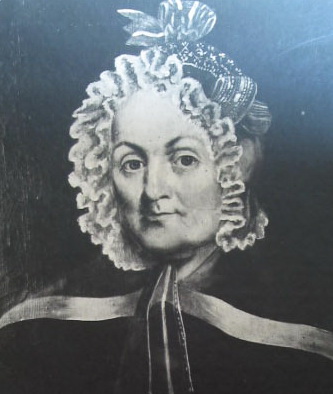
Mary “Polly” Smith Donelson (Tennessee Portrait Project)
In 1783 Daniel Smith was appointed both county surveyor and justice of the peace for Davidson County (still part of North Carolina at that time), and helped to survey the state military land-grant reservation in the Cumberland valley. One of the five trustees responsible for overseeing the establishment of the City of Nashville, he was also a charter trustee of Davidson Academy, the first institution of higher learning in Nashville. This school, founded in 1785, would over the years be transformed into Cumberland College (1806), the University of Nashville (1826), the Peabody Normal College at Nashville (1875), and finally the George Peabody College for Teachers, now part of Vanderbilt University.
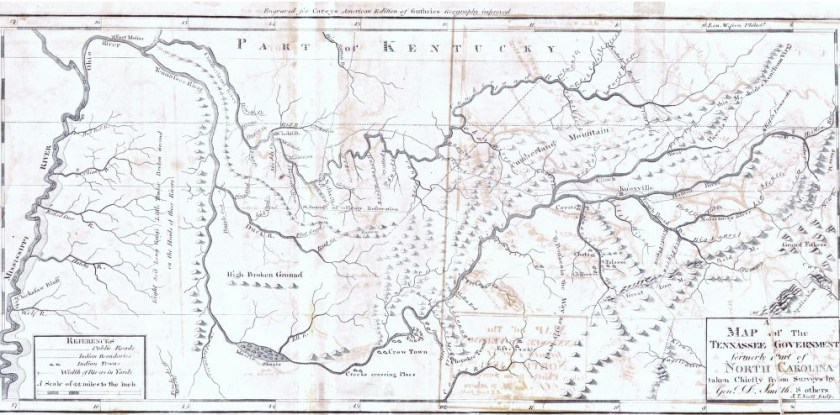
When Sumner County was created in 1786, Daniel Smith, as justice of the peace, presided over the first session of the Sumner County Court. Two years later he was named Commanding General of the Mero District (Sumner, Davidson, and Tennessee counties), and in 1789 he was a member of the North Carolina convention that voted to ratify the United States Constitution. In 1790 Smith was appointed by President George Washington to become secretary of the Territory of the United States South of the River Ohio, with authority to act for the territorial governor in his absence. The first map of the region, created in large part from Smith’s own surveys, was published during his term as secretary.
1795 Tennessee map based largely on Daniel Smith’s surveys (courtesy Alabama Department of Archives and History)
Daniel Smith held the post of territorial secretary until 1796, when the territory became the State of Tennessee. Smith was a member of the 1796 Convention and chaired the committee that wrote the young state’s first Constitution and Bill of Rights.
During the first decade of the 19th century, Smith played a key role in negotiating a series of treaties with the Cherokee. He was appointed to serve several months of Andrew Jackson’s unexpired term in the U.S. Senate (after Jackson resigned to serve on the Tennessee Supreme Court), and in 1804 was elected to his own full term in the Senate. Unfortunately, he was forced to resign from the Senate in 1809 because of ill health. He and Sarah remained at home for several more years, overseeing various farm and business interests from their Sumner County plantation house, Rock Castle, which still stands on Drake’s Creek in Hendersonville. He died there on June 16, 1818, at age 69. Both Daniel and Sarah, who died thirteen years after her husband, are buried in the family cemetery at Rock Castle. Smith County, created while Daniel was still very much alive, was named to honor his service in the Revolutionary War and his many other contributions to the development of the state of Tennessee.
Smith family cemetery at Rock Castle (Daniel and Sarah’s grave markers are the table-like platforms at upper right behind the obelisk)
At the end of the 19th century City Cemetery was in crisis. Once a burial place for all Nashvillians, it had been supplanted by the newer and more beautiful Mt. Olivet, Mt. Ararat, and Calvary cemeteries. The Union Civil War dead had been transported to National; the Confederates, to Mt. Olivet. Neglected and ignored, City was described by the Banner on June 21, 1868, as a ruin: “robbery, murder and lust have held their horrid orgies in it and even now nightly desecrated by being the rendezvous of lascivious love.” No wonder the cemetery was promptly declared a “public nuisance” and burials were suspended the following month. A plan quickly came together within city government to remove all the graves and make the land a public park.
Sunset at Nashville City Cemetery (photo by Rebecca Sowell)
“Not so fast! Absolutely not!” Nashville’s women spoke out forcefully against such an idea. This was “sacred ground and should never be called a park,” protested Felicia Steger, a granddaughter of Felix Grundy. Women had found a new freedom of expression with the advent of the 20th century. In 1897 their Woman’s Building at the Tennessee Centennial had been a triumph. Now they found that, although not yet allowed to vote, they could nonetheless organize and engage in “civic housekeeping” with positive results. “We shall never have clean cities until the women undertake the job” was the credo of these busy ladies. Their noble efforts notwithstanding, a Banner reporter of 1900 expressed indignation that “women were boldly wearing ankle-length skirts on clear days because they were helpful in getting on and off streetcars.”
· Woman’s building at Tennessee Centennial Exposition, 1897 (Image #27163; Calvert Brothers Photography Studio; courtesy of Tennessee State Library & Archives)
Saving and caring for City Cemetery became the focus of several groups. In 1903 the Tennessee Women’s Historical Association was organized, its specific purpose to preserve the cemetery. Sumner A. Cunningham, editor of the Confederate Veteran, claimed credit for suggesting its formation. He was the only male member of an industrious group that included Louise Lindsley and Carnegie librarian Mary Hannah Johnson. Other civic and patriotic organizations were asked to join them “to assist in improving and preserving the old city cemetery, to dispel the spirit of vandalism and promote civic pride. The Ladies’ Hermitage Association, DAR, UDC, and Colonial Dames all cooperated under this umbrella. One of their successful projects was the construction of a Memorial Gate at the 5th Avenue entrance. Dedicated in 1909, the gate exists only in pictures now, having been destroyed in an automobile accident during the 1930s. Wishing to do their part, Cumberland Chapter, DAR, erected a sundial to mark the path leading to the James Robertson family plot.
Nashville City Cemetery (photo by Rebecca Sowell)
The South Nashville Federation of Women was another group that worked to care for the City Cemetery grounds. The guidebook All About Nashville reported in 1912 that “with the cooperation of 400 members, they have cleared away the rubbish, pruned trees, graveled the walks, and planted a line of memorial elms and lastly, are in the process of erecting a handsome memorial gateway to the heroes of another day.” These gateposts, on 4th Avenue, still stand. May Winston Caldwell, whose parents and siblings are buried at City, remembered the pre-Civil War days when her mother and Peter, the gardener, came to care for the family plot. Now May, as a member of the South Nashville Women, was proudly carrying on that tradition.
Sign at City Cemetery entrance gate (NHN collection)
These hard-working women began a program of stewardship and restoration that has resumed in recent years after a period of neglect. Today the Nashville City Cemetery Association (composed of both men and women!) is ten* years old, making it the longest-lived and most professional volunteer organization ever to protect and renovate the grounds and markers: an endowment established at the Community Foundation will support the continuing restoration of the City Cemetery in the years to come. Thanks to the $3 million allocated by the Metro Council, and with the cooperation of the Metro Historical Commission and such citizen organizations as Master Gardeners of Davidson County, the cemetery is once again prepared to maintain its status as a historically valuable resting place of our pioneer heritage. (2008)
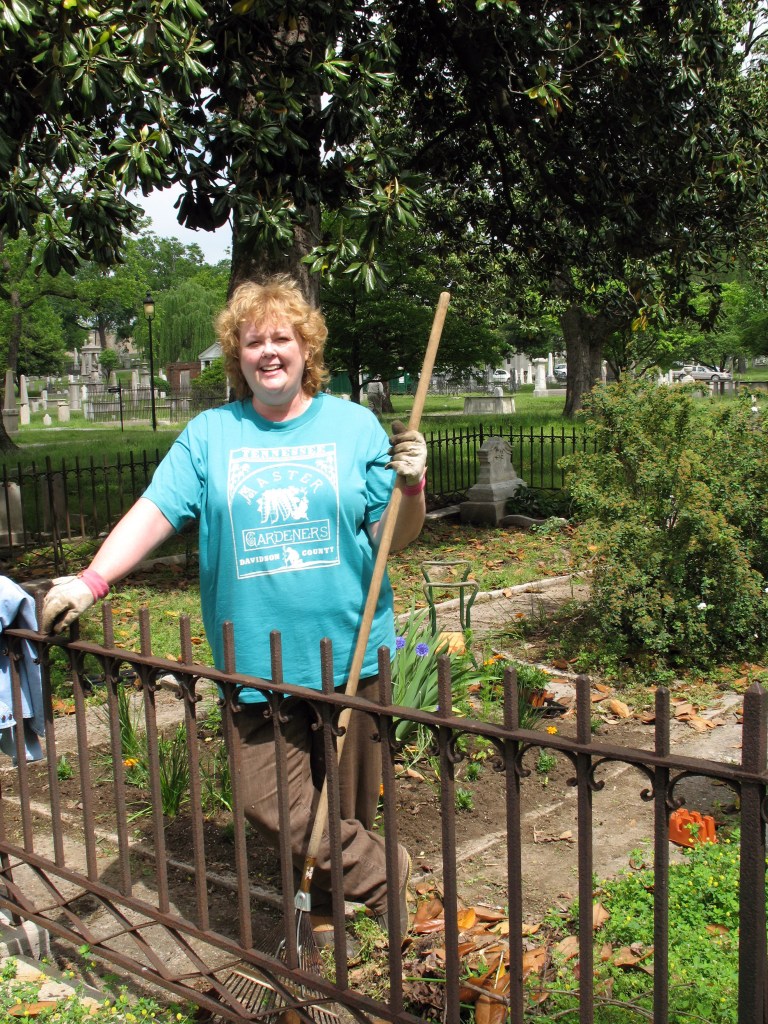
A volunteer from the Master Gardeners of Davidson County works in one of the family plots (NHN photo)
Previously published in Monuments and Milestones, the Nashville City Cemetery Newsletter.
* Note: This article was written in 2008. The NCCA began its work in 1998. By this time (late 2021) the organization is more than 23 years old.
Often called “Sally,” Sarah Ridley Buchanan was a pioneer Nashvillian described by one of her contemporaries as “large, bold, homely, rough, vulgar, industrious, neat, kind, benevolent, highly honorable, and much respected by all.”1 As her fame spread through much of the eastern United States, this woman of contrasts would become known as “the greatest heroine of the West.”2
Reenactors portray John and Sally Buchanan and a wilderness preacher in a 2012 event at Buchanan’s Station Cemetery
Probably born in 17733, Sally is said to be one of the first female children born in the eastern Tennessee territory.4 Her parents, the venerable Captain George Ridley and his first wife, Elizabeth Weatherford Ridley, moved their family to Nashville in 1790 and established Ridley’s Station near the present intersection of Nolensville Road and Glenrose Avenue.5 Early on, Sally gained a reputation as “the fast rider of Mill Creek” when she and neighbor Susan Everett fooled some lurking Indians by feigning to be crazed males and riding past them at blazing speed.6
After marrying widower John Buchanan in 17917, Sally settled in at nearby Buchanan’s Station, becoming the step-mother of young John Buchanan III, whose mother had died shortly after his birth.8 On September 30, 1792, the most historic day of her life, Sally was in the ninth month of her own pregnancy. Near midnight on that fateful Sunday, hundreds of Indians attacked the undermanned Buchanan’s Station.9 All seemed hopeless, but the undaunted Sally is said to have cheered and encouraged the gunmen as she supplied them with fresh ammunition,10 halted a stationer from surrendering herself and her children to the Indians,11 shamed a frightened man into action12, and participated in a “showing of hats” to fool the attackers into thinking the station was heavily manned.13 Her insistence on victory contributed to the withdrawal of the Indians without the loss of a single defender. Eleven days later the heroine of the Battle of Buchanan’s Station gave birth to George Buchanan, the first of her thirteen children.14
Nineteenth-century writer Elizabeth Ellet, Sally’s primary biographer, told yet another story of her audacity. According to Ellet, when two notorious horse thieves appeared at Buchanan’s Station and demanded that she produce two fine horses for them, Sally brandished a long hunting knife and threatened to cut the rascals down. The thieves, astonished, “were compelled to retire without the horses15.”
Primarily within the context of the 1792 battle, Sally’s fame spread widely. In 1892 one Boston periodical, Ballou’s Monthly Magazine, published a story featuring “Mrs. Buchanan,” titling it “The Heroine of Cumberland Valley.” The fanciful author depicts Sally engaging in a lengthy conversation with an Indian chief immediately before the battle, then parting, each having gained a measure of mutual respect.16 Such authorial embellishments highlight the difficulties historians face in trying to establish reliable details of Sally’s exploits.17
John and Sally Buchanan’s gravestones at the Buchanan’s Station Cemetery
The legendary Sarah Buchanan died in 1831 and is buried beside her husband in the Buchanan’s Station Cemetery on Nashville’s Massman Drive.
1 Pioneer William Martin 1843 letter to archivist Lyman Draper transcribed in Paul Clements, Chronicles of the Cumberland Settlements (Nashville: self-published, 2012), 366. The description is also quoted in John Buchanan, Jackson’s Way: Andrew Jackson and the People of the Western Waters (Hoboken NJ: John Wiley & Sons, 2001, reprint by Castle Books), 132.
2 Elizabeth F. Ellet, The Women of the American Revolution, Vol. III (New York: Charles Scribner, 1856), 325. Ellet’s exact words were, “The fame of this gallant defense [during the Battle of Buchanan’s Station] went abroad, and the young wife of Major Buchanan was celebrated as the greatest heroine of the West.”
3 Like that of her husband (and many other pioneers), Sally’s exact birth year is problematic. In Jeannette Tillotson Acklen, comp., Tennessee Records: Bible Records and Marriage Bonds (Baltimore: Genealogical Publishing Co., 2001, reprint of 1933 edition), 244, Sally’s birth date is recorded as November 28, 1774. Since this date was supposedly transcribed from the Buchanan family Bible, I would ordinarily default to it. However, on Sally’s headstone, in the Buchanan’s Station Cemetery, are these words: “In memory of Sarah Buchanan, died Nov. 23th, 1831, aged 57 years 11 months, and 23 days.” Doing the subtraction results in a birth date of November 30, 1773. Additionally, in Ellet, 311, Sally is said to have been born “in December, 1773.” Therefore, in this case I conclude that “ca. 1773” and “probably born in 1773” are appropriate.
4 Ellet, 311, affirms, “one of the first, if not the first-born daughter of Tennessee.” In G.T. Ridlon, History of the Ancient Ryedales (Manchester NH: published by the author, 1884), 495, the author writes, “She is said to have been the third white woman born in her State.” Ridlon also states that Sally was born on November 28, 1773.
5 G.W. Featherstonhaugh, Excursion through the Slave States, Vol. I (London: John Murray, 1844), 202. Featherstonhaugh interviewed Sally’s father, Captain George Ridley, and reports that the Ridley family emigrated from east Tennessee to Nashville in 1790. Ridlon, 494, says “about the year 1790.” Concerning the exact location of Ridley’s Station near Nashville see Clements, 688.
6 Ellet, 314-315, tells this story. The venerable Jane Thomas also recounts this story in Miss Jane H. Thomas, Old Days in Nashville, Tenn. (Nashville: Publishing House Methodist Episcopal Church, South, 1897), 110-111.
7 Among other places, the 1791 marriage date is recorded in Acklen, 244, and in Ridlon, 485.
8 Among the sources that speak of Major Buchanan’s first wife and son is Josephus Conn Guild, Old Times in Tennessee (Knoxville: Tenase Company, 1971, reprint of the 1878 original) 304, in which Guild says, “Maj. Buchanan was married twice—first, in 1786, to Miss Margaret Kennedy, who bore him one son; and the second time in 1791, to Miss Sally Ridley, daughter of Capt. George Ridley, who bore him nine sons and four daughters.” See also Acklen, 243-244.
10 Numerous anecdotal accounts have Sally distributing ammunition to the gunmen, and some accounts say that she (and other women) molded the bullets during the ongoing battle. It is even said that the fresh bullets were molded out of Sally’s pewter plates and spoons. Concerning this matter, Ellet, 324, reports that after the discovery that the men were out of bullets “Mrs. Buchanan passed around with an apronful of bullets, which she and Nancy Mulherrin, the Major’s sister, had moulded during the fight out of her plates and spoons.” At least by 1888 the “plates and spoons” became “pewter plates and spoons,” when Wilson & Fiske, eds., Appleton’s Cyclopaedia of American Biography, Vol. 1 (New York: D. Appleton and Company, 1888), 436-437, said, “When the bullets gave out, Mrs. Buchanan was at hand with an apronful moulded from pewter plates and spoons during the progress of the fight.” I am somewhat skeptical that bullets were molded during the battle itself (which James Robertson said lasted “for an hour”), and I am quite skeptical about the detail that would have the women melting plates and spoons.
11 Ellet, 322-323, tells this story. Also, in Octavia Zollicoffer Bond, Old Tells Retold (Nashville: Smith & Lamar, 1906), 165-166, Bond gives the name “Phoebe” to the would-be surrenderer.
12 Ellet, 323. In Guild, 307, the frightened man is called “Tom.” In the Draper Manuscripts, 6XX64, John Buchanan Todd reports, “There was a man in the fort so much of a coward that he could not fight. What his proper name was I do not remember, but in derision he was ever after called Jenny Glisten.” Clements, 366, also presents this Todd comment.
13 Edward Albright, Early History of Middle Tennessee (Nashville: Brandon Printing Company, 1909), 175, explains, “However, there were more portholes than gunners to man them, and the Major’s wife, Mrs. Sallie Buchanan, together with other women of the fort, displayed in this emergency great bravery. Seizing each a man’s hat they dodged about holding them from time to time in front of the vacant openings. This was called a ‘showing of hats.’ It was intended to fool the Indians as to the size of the garrison.” See also A. W. Putnam, History of Middle Tennessee (Knoxville: University of Tennessee Press, 1971, new edition of the 1859 original), 395-396.
14 Major Thomas Washington, “The Attack on Buchanan’s Station,” Annals of the Army of Tennessee and Early Western History, Vol. 1, December 1878, 426, reports, “There were a number of women in the station at the time, and among them Mrs. Sarah Buchanan, who was occupied during the attack in carrying around to the men posted in the different parts of the station ammunition and brandy, giving to each, as she supplied him, a word of encouragement. In eleven days afterward, this same Sarah Buchanan was delivered of her first child, the said George Buchanan.” Acklen, 244, verifies that George was born on October 11, 1792. George Buchanan (1792-1816) is buried, with original headstone, in the Buchanan’s Station Cemetery.
15 Ellet, 317.
16 Mrs. M.E. Robinson, “The Heroine of Cumberland Valley” Ballou’s Monthly Magazine, Vol. LXXVI, August 1892, 121-125.
17 Relevant to the difficulties in determining the true facts of the heroics attributed to Sally Buchanan, Ellet, 326, offers this: “When called upon, as she often was, to detail the part she bore in ‘the times that tried men’s souls,’ she never failed to disclaim any credit for herself, and always said that many foolish stories had been told about her by gossipping old ladies and garrulous old men, exhibiting her in a character which she never displayed.”
FUNDAMENTAL SOURCES
Ellet, Elizabeth F. The Women of the American Revolution, Vol. 3, p. 310-327; chapter on “Sarah Buchanan.” New York, Charles Scribner, 1856.
Featherstonhaugh, G.W. Excursion through the Slave States, Vol. 1, p. 199-212. London, John Murray, 1844.
Ridlon, G.T. History of the Ancient Ryedales, p. 493-497; section on “Ridley’s of Rutherford County, Tennessee.” Manchester NH, published by the author, 1884.
Clements, Paul. Chronicles of the Cumberland Settlements. Nashville, self-published, 2012.
Bond, Octavia Zollicoffer. Old Tells Retold, p. 154-167; chapter on “Night Assault on Buchanan’s Station.” Nashville, Smith & Lamar, 1906.















 Nashville Historical Newsletter