Since settlers first arrived in 1779, there has been a need for residents to cross the Cumberland River at Nashville. Boats and ferries were the primary means until Nashville’s first bridge was completed in 1823. But within years, this covered toll bridge became an impediment to steamboat traffic, and petitions were made to the state for a second bridge.
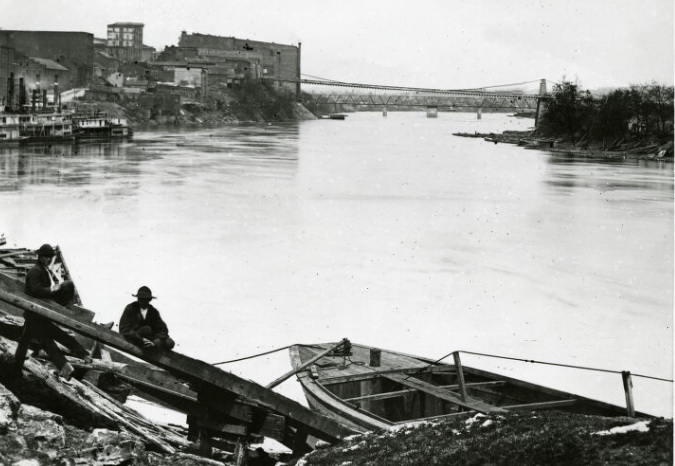
View of Cumberland River, looking north, with view of the Woodland Street suspension bridge and railroad bridge in the distance. (from TSLA photograph collection)
In December 1845 the state legislature authorized the Broad Street Bridge Company to “erect a suspension bridge, of sufficient height as to not obstruct the navigation of the Cumberland” located “at or near the junction of Broad and Water streets” (today’s Riverfront Park). The public act dictated toll rates, e.g., “Footmen free; Man and horse, 5 cents. . . ; For any four wheel two horse pleasure carriage, 25 cents,” etc. Charter company members included Felix K. Zollicoffer (1812–1862) and John Shelby (1785–1859), who owned land across the river in the community that would become known as Edgefield. After the location of the bridge was fixed (changed from Broad Street to the Public Square), contractor M.D. Field hired Nashville architect Adolphus Heiman (1809–1862) to design the bridge. Heiman’s work was lauded, but he would resign from the project over disagreements with Field about the bridge’s construction. By August 1850 the “wire suspension bridge” had “hundreds of wagons and other vehicles pass over daily.” The toll bridge officially opened on September 23. It was 663 three feet in length and 110 feet above the low-water mark. One historian said the “magnificent structure . . . gave an impetus to the growth of Edgefield, making desirable a large body of land which was not so well reached by the old bridge.” The old covered bridge was removed in 1851.
On June 16, 1855, disaster struck at the suspension bridge when a portion of the roadway collapsed, sending a carriage and several people plummeting into the river; two people were killed. Newspaper accounts attributed the accident to brittle wood being used to replace the old wood flooring.
On February 18, 1862, despite “urgent appeals” by citizens, retreating Confederate military authorities ordered that the suspension cables be cut to impede advancing Federal troops. John B. Lindsley (1822–1897) witnessed the destruction of the bridge, writing in his diary that he had never seen a “more strikingly beautiful scene . . .the Wire Bridge was a line or flooring of fire.” The railroad bridge was also burned. Federal military authorities formally took possession of the city on February 25.
The suspension bridge was rebuilt in 1866 and reopened again as a toll bridge. But by the 1870s some citizens, particularly those on the Edgefield side of the river, were expressing the desire for a free bridge. In 1882 the city and county jointly purchased the suspension bridge from the Broad Street Bridge Company and reopened it for public use without a toll. Just two years later, however, the bridge was deemed unsafe by engineers and closed. It was agreed that a new bridge would be erected, but to the chagrin of many Edgefield residents, a pay ferry and a toll pontoon bridge had to be used in the meantime. The new bridge, featuring new piers and iron truss spans with two roadways, opened in 1886. Today the Woodland Street Bridge, opened in 1966, crosses the Cumberland River at the same location as the original 1850 suspension bridge.
Sources, abridged:
Chronicles of the Cumberland Settlements (2012), by Paul Clements, page 131.
Nashville Whig, June 11, 1823, “Nashville Bridge.”
Tennessee Legislative Petitions, Record Group 62 card catalog, bridge petitions.
Tennessee Legislative Petitions, 194-1831-1A and 194-1831-1B, petition by Nashville Bridge Company against a second bridge.
Public Acts of Tennessee, 1845-46, Chapter XXVI, pages 71 to 74, authorization of the suspension bridge.
A. Heiman to John Meigs, Dec. 28, 1857, Tennessee Historical Society Miscellaneous Files (T-100) Box 7, H-62, copy of resignation letter.
A. Heiman to John Meigs, Dec. 28, 1857, Tennessee Historical Society Miscellaneous Files (T-100) Box 7, H-63, copy of report to Directors of the Suspension Bridge
Nashville Union, April 18, 1849, “Suspension Bridge.”
Daily (Centre-State) American, August 17, 1850, “The Wire Suspension Bridge…”
History of Davidson County, Tennessee (1880) by W.W. Clayton, pages 308–309, 348.
Daily American, November 13, 1851, “The work of removing the Bridge…”
Nashville Union & American, June 17, 1855, “Terrible Casualty.”
Republican Banner, June 17, 1855, “Unfortunate Accident at the Suspension Bridge.”
Republican Banner, June 19, 1855, “The Bridge Casualty.”
“The Great Panic by an Eye-witness” (1862) booklet
Lindsley, John B., diary, February 20, 1862, “By this time (3 to 4 A.M.) the suspension and railroad bridges were all in flames.”
Republican Banner, April 21, 1866, “The Suspension Bridge over the Cumberland river, connecting Nashville with the pleasant suburb of Edgefield, will be completed in a few weeks.”
Republican Banner, September 23, 1870, “To The Editor” from “Stockholders” regarding “free passage”
Daily American, January 12, 1882, “The Suspension Bridge—The Resolution Proposing Its Condemnation for a Free Bridge.”
Daily American, September 11, 1884, “The New Bridge.”
Daily American, April 18, 1886, “Crossing The River—History of Bridges Across the Cumberland at Nashville.”
Nashville Banner, October 22, 1966, “Man Survives 90-Foot Fall Off Bridge.”
Primary Source Document, transcribed by Mike Slate.
Yesteryear’s folding booklets of postcards sometimes included a few paragraphs about the featured state or city. The text below, which reads as though it might have been prepared by the local Chamber of Commerce, came from a booklet of postcards published by S. H. Kress & Co. and is hand-dated September 15, 1924. Ephemera like this can often provide both interesting data and thought-provoking interpretive possibilities.
NASHVILLE, TENNESSEE
Nashville is the Capital City of Tennessee, and the County Seat of Davidson County.
Four railroads serve the city. Forty-four passenger and sixty-eight freight trains arrive in Nashville daily.
The Cumberland River is navigable 210 miles down the river practically the year round and 352 miles up the river for about six months, and the work of installing new locks and dams will increase this practically to ten months each year. Nashville has seven bridges across the Cumberland River.
There are 22 parks and playgrounds, containing 468 acres. Centennial Park has the only replica of the Parthenon in the world. Shelby Park has a nine-hole municipal golf course. The Vanderbilt Stadium seats 22,000 people, and is the largest athletic field in the South. Nashville’s water supply is pure and inexhaustible, with more than 50,000,000-gallon capacity daily. The Tennessee State Fair, one of the largest expositions in the South, is held in Nashville each year. The Public Auditorium has a seating capacity of 5,000 persons.
Nashville’s Parthenon is the only full-size replica of the original building.
Vanderbilt University, with assets of $11,000,000, has entrance requirements and a curriculum equal to any university in the United States, and has drawn students from every state in the Union and from eight foreign countries. It has an endowment of $6,850,000. The medical department has an endowment of $3,500,000, and is erecting the most complete medical school in the South and one of the finest in America.
The only Y.M.C.A. College in the South is located in Nashville.
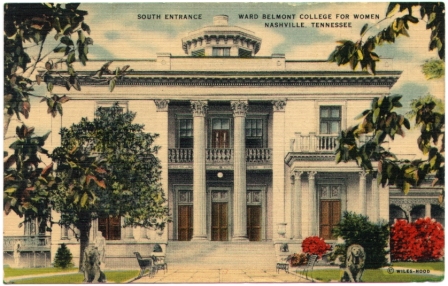
Three institutions for women, Ward-Belmont, St. Bernard Academy, and St. Cecilia, draw students from practically every state in the Union. Ward-Belmont alone has over 600 non-resident students.
Ward-Belmont School (postcard from NHN collection)
The Southeastern School of Printing has $80,000 worth of equipment, and is the only school of its kind in the South.
The Fisk Jubilee Singers have sung in every Capital and at every court in Europe.
The Fisk Jubilee Singers: from left, B. W. Thomas, Julia Jackson, Maggie Porter, Ella Sheppard, F. J. Louden, H. D. Alexander, Georgia Gordon, Jennie Jackson, America Robinson, Thomas Rutling
George Peabody College for Teachers, with an investment of $4,000,000 and 20 departments, is the only teachers’ college in the South, and the second largest in the United States. It has an endowment of $2,500,000, and in 1922-23 had an enrollment representing 36 states and 5 foreign countries.
It leads all other cities in the South in livestock, butter, poultry, grinding of wheat, eggs, and various agricultural products.
The mean annual temperature is 60 degrees; the average summer temperature is 78 degrees; and average winter temperature is 41 degrees.
The average annual rainfall is 47.2 inches, humidity moderate, and no sunstrokes are recorded.
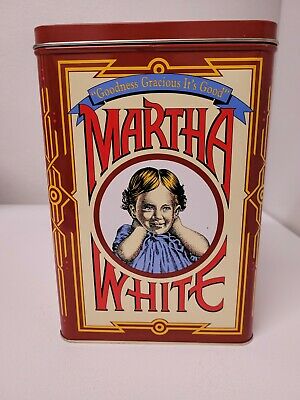
Nashville has more than 500 manufacturing enterprises, makes more self-rising flour than any city in the world (“Goodness gracious, it’s good!”), and is one of the two largest hardwood flooring markets in the world. Its annual hardwood flooring output would pave an automobile boulevard 10 feet wide from Nashville to New York. Over 35,000,000 pounds of green coffee are roasted annually.
The Hermitage, the home of Andrew Jackson, is located near Nashville, and is one of the show grounds of America.
Three Presidents of the United States, Andrew Jackson, James K. Polk, and Andrew Johnson, have lived in Nashville. Jackson is buried at the Hermitage and Polk on the grounds of the historic State Capitol.
The Battle of Nashville, one of the major engagements of the Civil War, was fought partially within the city limits on December 15 and 16, 1864.
William Driver, a New England sea captain who named the American flag “Old Glory,” is buried in the old City Cemetery.
William Driver reenactor at a recent City Cemetery Living History tour
William Walker, the “Grey-eyed Man of Destiny,” the most famous of all American filibusters, was born and reared in Nashville. Walker became president of Nicaragua and raised the blood-red five-point star of the United States of Central America, but he failed in his plans and was shot by a firing squad. (1997)
Introduction: Although John W. Boyd was not a Nashvillian, he was one of the fourteen African American men who served in the Tennessee General Assembly during the 19th century, so was certainly a significant figure in Nashville history. In time we hope to include biographies of all these men in the Nashville Historical Newsletter. For more information about these remarkable individuals and their complex historical era, visit the website of the Tennessee State Library and Archives.
John W. Boyd was born about 1852 in Tipton County, Tennessee, to Philip and Sophia Fields Boyd*. On March 13, 1879, John married Martha C. “Mattie” Doggett in Trinity Episcopal Church, Mason, Tennessee. Mattie was a member of St. Paul Episcopal Church, the local black congregation, but the couple was somehow permitted to be married in the white church, with their wedding ceremony conducted by its priest, Rev. C. F. Collins. Anecdotal references suggest that Boyd freely attended services in both churches, black and white.
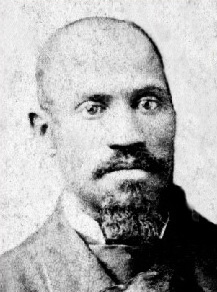
John Boyd, from a composite photo of the 42nd Tennessee General Assembly, 1881
Mattie Doggett was the daughter of Andrew Doggett, a free man of color. Andrew actually owned property before the Civil War, acquiring some 200 acres more after the war ended. John Boyd’s older brother Armistead was married to Mattie’s twin sister, Nannie Doggett. Neither couple left any children. Their sister Judy married Henderson Stevens, a member of a well-respected, land-owning family in Mason. Judy and Henderson Stevens did leave a number of descendants, one of whom provided much of the information we know about the family.
While Nannie and Mattie Doggett were Episcopalian, the Boyd brothers were originally Methodists, members of what survives today as Alexander’s Chapel United Methodist Church. This church, too, was somewhat unusual in that it was not connected with either the Christian Methodist Episcopal (CME) or African Methodist Episcopal (AME) churches, the historically black Methodist denominations.
John Boyd was a member of what is now Alexander’s Chapel United Methodist Church in Mason, Tennessee. Boyd is the bald gentleman standing in the back row on the left; his wife Mattie, wearing a dark hat, stands beside him. John’s brother Armistead Boyd, seated in front of Mattie, has a light-colored hat and a large white mustache. (Photo used by permission, Tipton County Historical Society)
John Boyd was too young to take part in the Civil War, but toward the end of the war his older brother Armistead left the Sanford place and went to Memphis to join the Federal army. His war record shows that he joined Company C of the 88th U.S. Colored Infantry on Jan. 21, 1865, at 19 years of age. He was mustered out a year later as a corporal. A story still extant in the community tells that, before his enlistment but after all the adult males had gone off to fight, Armistead, still a young teenager, armed himself with a shotgun to protect his master’s family.
Although no information has yet come to light concerning how or where John W. Boyd received his education or legal training, we do know that he was an attorney in the local courts and was highly respected among both the white and black communities. It is likely that the Boyd family had been allowed to obtain some rudimentary education even before emancipation – there is some evidence that for several generations this family of slaves had been high-achievers and had received special treatment from their masters. Perhaps this background gave them an advantage during Reconstruction and helped propel John Boyd into the profession of the law. Despite the Jim Crow laws that disfranchised African Americans during the last decade of the 19th century and removed them from positions of power, Boyd was still representing District 10 as a magistrate on the county court as late as 1900, although by that time he was the only black member remaining on the court.
John Boyd served as a Tipton County Magistrate well into the Jim Crow era. (Photo used by permission, Tipton County Historical Society)
John Boyd was elected to two terms in the Tennessee State Legislature. In the 42nd General Assembly (1881-1882) he served on the committees for Immigration, New Counties and County Lines, and Tippling Houses. In the 43rd General Assembly (1883-1884) he was named to the committee on Federal Regulations. During his period of service in Nashville, Boyd worked diligently with other African American legislators to overturn Chapter 130 of the Acts of 1875, the first of Tennessee’s Jim Crow laws, which permitted racial discrimination in public facilities. He also attempted unsuccessfully to repeal the restrictive contract labor law, which had the effect of keeping working blacks in bondage.
Republican ballot from 1884 election, when Boyd ran for the Tennessee Senate. 19th century ballots listed all candidates from a single political party. If a voter wanted to vote for everyone on the ticket, he merely dropped it into the ballot box with no alterations (i.e., he voted the straight ticket). However, he could mark through (scratch) any names he did not want to vote for. Black candidates often received many fewer votes than others on the same ticket.
In the 1884 election, John Boyd ran for the Tennessee Senate seat representing Tipton and Fayette counties. When certified winner H. L. Blackwell, a Democrat, died three days before the 44th Session was due to convene, Governor William B. Bate called for a new Democratic election to choose Blackwell’s successor. Boyd challenged the governor’s ruling, saying he was the rightful winner of the original election and had been defrauded of his seat: during the November 4 election the District 4 ballot box had “mysteriously disappeared,” along with at least 400 Republican ballots, more than enough to elect Boyd Tennessee’s first black senator. However, despite compelling evidence – depositions from the sheriff and several election officials that two Democratic election judges had taken the box with them when they left for supper, later claiming that it had been “stolen and carried off” – the Senate chose to seat Democrat J. P. Edmondson. It would be 84 years (1969) before an African American would be seated in the Tennessee State Senate.
John and Mattie Boyd’s home was in the town of Mason, just south of the railroad tracks on the east side of Main Street. John, who outlived Mattie, died on March 11, 1932, at about 80 years of age, and was buried in Magnolia Cemetery, Mason, Tennessee. The following is his obituary, found in the March 17, 1932, edition of the Covington (TN) Leader. It appeared on the newspaper’s first page:
“WELL-KNOWN NEGRO BURIED AT MASON–John W. BOYD, a well-known negro of District #10, died suddenly of heart failure Thursday, March 10th. He was buried the following Sunday. There were no immediate survivors. Well up in the eighties in age, Boyd was politically prominent in the three decades following the Civil War. A resident of a district composed largely of negroes, he was for a number of years a magistrate for the 10th District, and following a split in the Democratic ranks in the years following 1880 was elected to the Legislature from this county. He was also a member of the Covington Bar.”
* Philip and Sophia Fields Boyd were slaves to Henry Sanford and his wife Jean Murray Feild [sic] Sanford (1830-1893). Henry Sanford’s father was Col. Robert Walker Sanford (1802-1861), an early elected official of Tipton County, who had moved to Tennessee from Orange County, Virginia. Jean Feild Sanford’s father was Charles Grandison Feild (1805-1845), of Mecklenburg County, Virginia, and Haywood County, Tennessee. The death certificate of Armistead Boyd, another of Philip and Sophia’s children, indicated that both his parents were born in Virginia. Sophia Fields Boyd’s obituary lists her birthplace specifically as Mecklenburg County, Virginia, which had been home to many of Mason’s largest slaveholders – including the Feild family. [Note that the African American members of the family, after Emancipation, changed the spelling of their name from Feild to the more familiar Fields.] Another of the large slave-holding families in Mecklenburg County was the Boyd family, who were intimates and neighbors of the Feilds. It is likely that the Boyd name among the Feild slaves came from trading or intermarrying between the slaves of the two families.
As a 1956 graduate of Gallatin High School who lived in Nashville from ages two to eleven, I was raised on Krystals (I had one this afternoon!) and Krispy Kreme doughnuts sold in a shop where the Estes Kefauver Federal Building now stands. I loved the balcony dinette at the Woolworths on 5th Avenue. Their ham sandwiches on grilled toast were never excelled anywhere else.
I remember street car rides, the old car barn where the Municipal Auditorium now stands, the peddlers’ carts and horses stabled there after the street cars left. I also remember Gilbert’s Men’s Clothing Store on the square, where the money was sent via cable car to the cashiers on the mezzanine. There my dad traded for his clothes, and my parents bought my first suit with long pants. It wasn’t far from the Nashville Court House fountains, with their colored lights under the water.
Early in the morning the street peddlers loaded their carts with produce at the market that is now the Ben West Building. They spread out across town and through the residential streets where they sold ears of corn by the dozen, pole beans by the pound (weighed on a scale on the back corner of the cart), and ice-cold watermelons. They also carried bread and snacks for the kids. I can still hear the call of the drivers as they broadcast their wares.
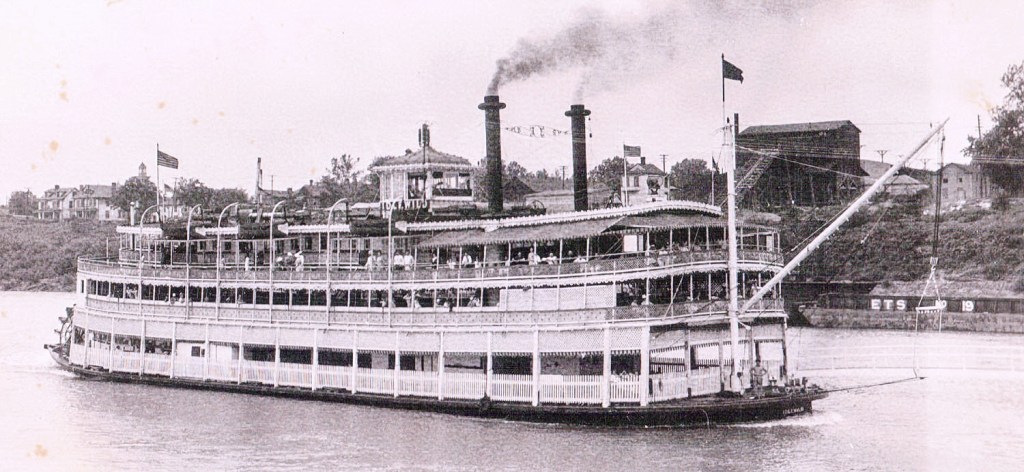
The paddlewheelerIdlewild
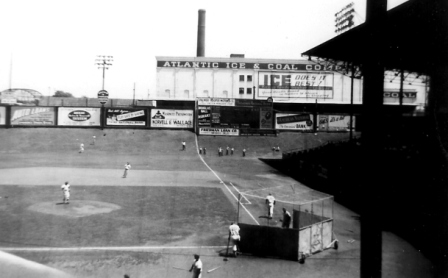
Then there was the annual thrill of driving down to Broad and First to watch the docking of the steamboat Idlewild and hear the calliope. I always wanted to ride on the paddlewheeler but never had the chance. And, of course, I loved Sulphur Dell, where ‘Bama Ray, Buster Boguski, Buckshot Tommy Brown, and Carl Sawatski thrilled us in person or through the radio voice of Larry Munson as we lay in bed on those hot summer nights with the lights out and the windows open, hoping for a breeze to calm the heat. We had an occasional opportunity to see the “Goat Man” when he came through on his endless journey. He rode on a little wagon pulled by a team of goats, trailed by a dog or two and a nanny that was his milk source. It was a true wonder of the world to a youngster.
The original Sulphur Dell (photo used by permission of Skip Nipper)
We had our movie theater, too – the Roxy in East Nashville. On Saturdays at noon, we rushed home, washed up, grabbed a sandwich, and took off on our bikes to get in line for the movies. Note the plural: there were two movies, three or more cartoons, and a serial starring Whip Wilson or Lash Larue, all for 10 cents. A nickel for popcorn and a nickel for a Coke sustained us for the afternoon until we could go home to reenact the roles of good guys and bad guys. There were no gray guys. We knew who was who and that the good guys always won.
Of course, we all made Red Cross boxes, and collected papers and tin cans, while we took our ration books to the store to buy bread, milk, and sugar. If we lost the book, or if the store was out of what we needed, it was a long week until the next supply came. I don’t know whether it is a bad thing or a good one that later generations did not experience those days, but I am glad that I did.
Notes and comments from the Nashville Historical Newsletter.
Jim Summerville, “The Battle of Nashville Monument,” NHN, March 1997
The pace is quickening at Hawkins Partners, chief contractor overseeing the relocation and restoration of the Battle of Nashville Monument. A concept plan for the new site, the southwest corner of Granny White and Battlefield Drive, is underway. By early April the firm hopes to turn over to the state architect the bid packages for all subcontracting, including the sculpting of the new 40-foot obelisk and angel that were part of the original monument. Groundbreaking may take place sometime this summer.
The restored monument in its new location (NHN photo)
The Tennessee Historical Commission, which owns the monument, selected the new site in 1992. Thanks to federal, state, and local funds, as well as numerous private contributions, this great art and history treasure will be brought back to public view and appreciation.
The driving force behind the monument’s creation was May Winston Caldwell and the Ladies’ Battlefield Association. In 1911 the group secured four acres at Franklin Road and Thompson Lane, where in 1863 Union and Confederate forces had clashed fiercely. At this place the association determined to erect a memorial to mark the last major action in the western theater, the Battle of Nashville.
World War I delayed the project, and by the time the Association commissioned sculptor Giuseppe Moretti, the idea for a solders’ memorial had taken on new significance. On the battlefields of Europe, Southern and Northern young men had fought side by side, reuniting the country under one flag. Moretti expressed this idea in two rearing horses, representing the former enemies, yoked together by a youth who stood for the young men who had served on foreign fields.
The original monument at Franklin Road & Thompson Lane (postcard from NHN collection)
Finally dedicated in 1927, the Battle of Nashville monument stood proudly for many years. Then in 1974 a tornado destroyed the obelisk and the Angel of Peace that crowned it. In the 1980s a 13-acre interchange for I-440 and I-65 pressed against the site, isolating the remaining bronze, the youth and horses, on a pinched plot of ground. For some time, acid rain has been pitting the soft marble of the base. Lately, vandals have scrawled graffiti on the stone.
This great wrong will now be righted, as the Battle of Nashville comes to its new home. In the vicinity of the new location, the Confederate line under General A. P. Stewart reached its farthest advance on the afternoon of December 15, 1864.
2. NHN: A Work of Art Needs Your Help, September 1997
Contractors working on the restoration of the Battle of Nashville Monument would be grateful to hear from anyone who possesses any fragments of the original sculpture. Pieces of the obelisk and angel would enable the careful replication of the work, which was hurled to the ground and smashed during a 1974 tornado. All fragments loaned for this purpose will be handled with care and returned promptly to the lender. Contact: The Association for Tennessee History.
3. NHN: History in Action, March 1998
Approximately $300,000 will be needed to complete the interpretive park that will be the new site for the refurbished Battle of Nashville Peace Monument. The park, located at Granny White Pike and Battlefield Drive, is scheduled to open this summer. Preliminary site preparation has begun, and sculptor Colley Coleman has been producing shop drawings that will determine the proper cutting of the new granite for the Monument. The Tennessee Historical Commission is welcoming donations to the park project.
4. NHN: History in Action, May-June 1999
Giuseppe Moretti’s Battle of Nashville Peace Monument is scheduled to be rededicated on Saturday, June 26, at 10:00 a.m. at the new historical park on Battlefield Drive. The monument, a tribute to those who fought and died in both the Civil War and World War I, was damaged by a 1974 tornado and neglected for years thereafter. The renewed monument is also a tribute to those organizations and individuals who refused to allow it to lie in ruin.
The park receives many visitors.
5. NHN: News & Notes, July-August 1999
The restored Battle of Nashville Peace Monument, thought to be the only Civil War monument in the United States to honor both Union and Confederate soldiers, was rededicated on June 26, 1999. The principal speaker for the occasion was venerable Nashvillian Wilbur Foster Creighton Jr., a hearty ninety-two years of age. Ward DeWitt Jr., chairman of the Tennessee Historical Commission, appropriately dedicated the Peace Monument to our city’s youth. The now-pristine monument – with its mighty granite base, its bronze sculpture, and its triangular obelisk – rises to thirty feet and is topped with an Angel of Peace. Fittingly located in a new park at Granny White Pike and Battlefield Drive, this memorial could become, we believe, one of the most frequently photographed of all Tennessee outdoor statuary.
Sarah Malvina Bass McGavock, usually called Sallie, was born July 17, 1830, in Nashville, Tennessee.1 Her father was Jacob McGavock (1790-1878), a county, circuit, and U.S. circuit court clerk for fifty years.2 Jacob had served as Andrew Jackson’s aide during the Creek War,3 and the two men remained close friends throughout their lives.4 Sallie’s mother, Louisa Grundy McGavock, was the daughter of noted jurist Felix Grundy,5 Chief Justice of the Kentucky Supreme Court, U. S. Representative and Senator from Tennessee, and U. S. Attorney General under President Martin Van Buren.6
Sallie McGavock Lindsley
On February 9, 1857, Sallie married Dr. John Berrien Lindsley (1822-1897),7 one of Nashville’s most eligible bachelors. Lindsley’s journal reports, “At 4 & 10 minutes P.M. was married by the Rev. J. T. Edgar, D.D. to Miss Sallie McGavock . . . only the immediate family and a very few friends present. All very happy.”8
Sallie Lindsley gave birth to six children: Louise Grundy Lindsley (1858-1944); Jacob McGavock Lindsley (1860-1925), nicknamed “J. Mac,” who married Kittie Kline; Mary McGavock Lindsley (b 1861), wife of R. C. Kent; Margaret Elizabeth Lawrence Lindsley (1863-1936), who married Percy Warner, and whose descendants bore the names Frazer, White, Mallison, and Lea; Anne “Annie” Dickinson Lindsley (1864-1958), who married Dr. Carl Warner; and Randal McGavock Lindsley (1870-1871),9 named for Sallie’s brother, a former Nashville mayor (1824-1825), who had died in the Civil War.
Dr. John Berrien Lindsley
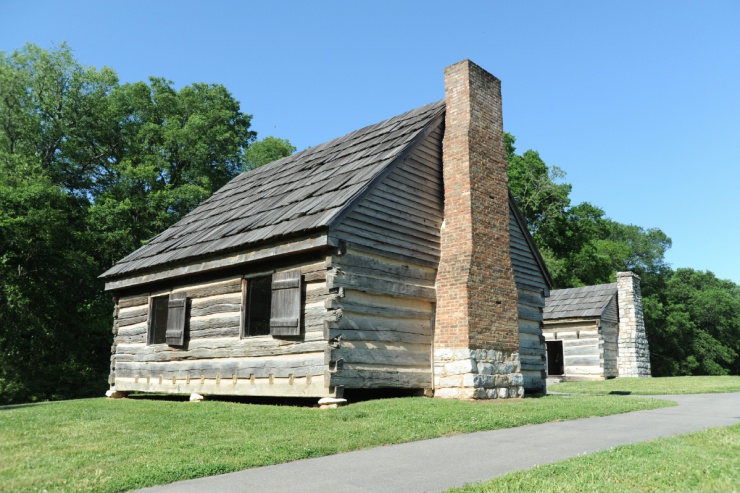
The Lindsley family remained in Nashville during the War, moving to Sallie’s parents’ home after Union troops seized the Lindsleys’ property during the Battle of Nashville.10 Sallie later became active in various charities of the First Presbyterian Church. She was a charter member of the United Daughters of the Confederacy (founded in1894) and served as the group’s first corresponding secretary.11 The work closest to Sallie Lindsley’s heart, however, was the creation of the Ladies’ Hermitage Association (LHA), organized to protect and preserve Andrew Jackson’s home, a state property scheduled to become a rest home for aged and needy Confederate soldiers.12 When attorney A. S. Colyar determined that only unmarried women (femmes soles) were eligible to sign the LHA charter of incorporation,13 the committee members selected five unmarried women, including Sallie’s daughter, Louise Grundy Lindsley,14 to sign the document. Meanwhile, John Berrien Lindsley, then Executive Secretary of the State Board of Public Health, was attempting unsuccessfully to craft a compromise between the Confederate organization and the LHA. At his urging, Sallie met with Representative John H. Savage, a former Confederate officer and the chief opponent of the amendment that would cede the women’s group 25 acres that included the house, family graveyard, and tomb.15 Sallie persuaded Savage to change his vote, the amendment passed, and the Association opened the property to the public in July 1889.16 The group’s first major undertaking, restoring Jackson’s original log home, “First Hermitage,” was Tennessee’s first historic preservation project. 17
“First Hermitage,” Hermitage, Davidson County, Tennessee
Sallie Lindsley was elected Second Vice Regent of the Ladies’ Hermitage Association (1891-1899), then served as Regent18 until her death by heart failure on July 5, 1903.19 (2014)
SOURCES:
1 Her birth and death dates are inscribed on her tombstone in Mt. Olivet Cemetery.
2 Gray, Robert. The McGavock Family: A Genealogical History of James McGavock and HisDescendants from 1760 to 1903. Richmond, VA: William Ellis Jones, Printer, 1903, 21.3 Gray, Robert, 20-21.
4 Gray, Robert, 14.
5 “Mrs. Lindsley Dead. Passes Away Quietly after Brief Illness.” The Nashville American, July 6, 1903, page 4.
6 “Felix Grundy.” United States Congress. Biographical Directory of the United StatesCongress, 1774-2005. Washington, D. C.: Government Printing Office, 2005.
7Tennessee State Marriages, 1780-2002. Nashville: Tennessee State Library and Archives.
8 Lindsley, John Berrien. Diary, Volume 5, October 6, 1856 – January 1, 1866. Lindsley Family Papers, ca. 1812 – [1840-1940] – 1953, Box 1, Folder 23. Tennessee State Library and Archives. February 9, 1857.
9 Lindly, John M. The History of the Lindley-Lindsley-Linsley Families in America, 1639-1924,Vol. II. Winfield, Iowa: Self-published, 1924, 19.
10 Lindsley, John Berrien. Diary, Volume 5, December 1-24, 1864.
11 Bucy, Carole Stanford. “Quiet Revolutionaries: The Grundy Women and the Beginnings of Women’s Volunteer Associations in Tennessee,” Tennessee Historical Quarterly, Vol.LIV, No. 1, Spring 1995, 45.
12 Bucy, Carole Stanford. “Ladies’ Hermitage Association.” Tennessee Encyclopedia Online. Knoxville: University of Tennessee Press, 2002-2014.
13 Dorris, Mary C. Currey. Preservation of the Hermitage, 1889-1915: Annals, History, andStories. Smith & Lamar, 1915, 35.
Living a lifetime in Nashville has been a storybook experience in many ways. Memories of the magnificent Hermitage Hotel have certainly played a large part in creating the desire to write my own storybook for my children, grandchildren, and great-grandchildren.
Photograph courtesy of the author
My first visits to the Hotel were by invitation when my uncle, an attorney in Louisville, Kentucky, came here frequently to visit my family. He usually stayed at the Hermitage and my brother and I, though quite young, were always included in his invitation for dinner at the Hotel. What a splendid occasion that was!
In those days of early childhood I had a vivid imagination, so on those evenings I became the beautiful princess who lived in this wonderful castle right out of the storybooks my parents had read so often to me – it was much more than a mere hotel!
My mother often went to the beauty salon that was located on the mezzanine at the Hermitage. Daddy would drive us there and, while waiting, would sometimes get a shoe shine just off the lobby, somewhere in the vicinity of the men’s restroom, as I recall. I could always be found nestled in one of the big comfortable chairs in the lobby, reading a book. Even at that young age I enjoyed pausing to enjoy my surroundings and observe the beautiful carvings that were an important part of the architectural design.
Later, as a teenager, I enjoyed the Hotel in a different fashion when I attended sorority meetings there on Saturday mornings. I felt so sophisticated as I mimicked the movie stars like Bette Davis, Joan Crawford, and Loretta Young, and smoked along with the older sorority girls. My mother and daddy would have killed me! So they wouldn’t know, I hid my cigarettes among the potted plants in the beautiful urns, ready for my next party at the Hermitage!
Sorority and fraternity dances were held in the Grand Ballroom with its exquisitely rich wood paneling. All the brass features throughout the Hotel shone with a mirror finish. I remember being a little reluctant to use the handrails as I was fearful of leaving fingerprints.
On one particular evening I was waiting for my handsome date, who was going to drive me to the Hotel for his fraternity dance. I was in a panic before leaving the house, rushing around to find Daddy’s tool chest, using any tool that I could find to pry the high heels off my new evening sandals, specially dyed to match my evening dress. Of course, to my horror, the heels came off, but the nails were left intact. I had no choice but to take them to my daddy and say sweetly, “Please do something.” He actually laughed when I explained that my date was probably about my height and those heels would make me look taller than he was. I knew my daddy was still laughing when I walked awkwardly out the front door.
When the two of us arrived at the Hotel, the doorman, dressed in his beautifully tailored clothes and top hat, was even more elegantly dressed than my date, who was probably wearing a rented tuxedo. Bellboys, doormen, every person employed by the Hotel, male or female, were all sharply dressed, with excellent posture and manners. The band was playing – I’m wondering whether it might have been Frances Craig, everybody’s favorite. The huge vases were filled with fresh flowers, and I danced away the night, never giving my damaged shoes another thought.
Beautiful evenings like this came to an abrupt end when World War II was declared. The next memorable event would be the day my handsome Army-Air Force Lieutenant and I were married at West End Methodist Church, located just a few blocks out of downtown. Our wedding dinner was held at the Hermitage Hotel, and the beautiful wedding suite with a large arrangement of fresh flowers on the table and chocolate on the pillows was ours for the night. Just as when I was a small child, I felt like a princess in my castle, which was, of course, my beloved Hermitage Hotel.
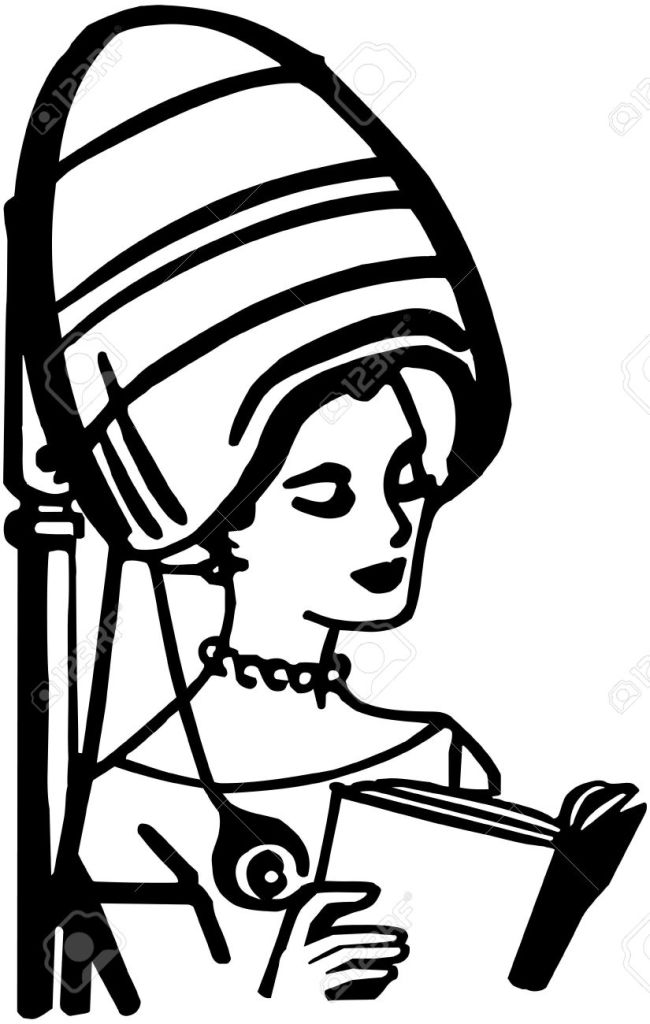
After my husband and I returned to live out our lives in Nashville, the Hermitage Hotel memories would continue. My mother was still a patron of the Hotel beauty salon when one morning, with my baby boy in tow, I found myself back in that familiar area. Wanting all the hairdressers to see my beautiful little boy, we stepped inside, where I nearly burst with pride! As we were walking to the lobby, my sweet son tugged on my coat sleeve, asking, “What were those women doing with those big buckets on their heads?” Well, those old hair dryers really did look like big buckets! On that day, sitting in the big comfortable chair with a book in my hand, reading to my child as I waited for my mother, I was overwhelmed by a wave of nostalgia. I shared with my son stories of myself as a little girl, sitting in the same beautiful Hotel lobby waiting for his grandmother all those years before.
Except for an occasional lunch with friends or a very special dinner, I did not spend a great deal of time at the Hermitage while we were raising our family of five children. Our youngest child, a daughter, would be the one to bring the Hotel back in my life when her wedding reception was held there in June 1991. The wedding took place just a few blocks down the street in the historic Downtown Presbyterian Church at Fifth and Church. Many guests walked the short distance to the Hotel, while others rode the trolley, which was not difficult to spot, with a large wedding wreath on the front, its white ribbons flowing lightly in the breeze. All the wonderful people employed by the Hotel seemed to get into the spirit of the evening, as we had become good friends during the weeks of planning. They also enjoyed my loving memories of the Hotel, which I was eager to share.
Leaving the ballroom at midnight, we watched the bride and groom being whisked away in their limousine, and I cried. I walked back inside just for a moment, glanced around the lobby, said “Good night!” to two young couples on the verandah, and then walked down the steps and out those handsome doors with an ache of sadness: an era in my life was now closed.
Just a few years ago, this same daughter’s children, my grandchildren, had become old enough to appreciate a tour of downtown Nashville. I took them to the lovely old church where their parents were married, and to the Hermitage Hotel where the family celebrated afterwards. Of all they saw and loved, they were most impressed by the Hotel.
Photograph courtesy of the author
I could see their excitement when we first walked through the doors. They didn’t know which direction they wanted to go first! We covered it all – every nook and cranny. They kept saying, “Nunny, I’ve never seen anything this beautiful.” Those children could understand how, when I was even younger than they were, I viewed it as my castle! I’m sure the Hermitage Hotel has never hosted more appreciative young visitors.
Just recently, when a group of younger friends asked where they could take me for lunch to celebrate my 85th birthday, my choice, of course, was the Hermitage Hotel. What a treat! As I stepped out of my car, that rush of nostalgia engulfed me once again, and I had to keep myself from dominating the conversation, as I yearned to share every memory. Just this morning, one of those precious young women said she hadn’t gotten to see it all on that day, so she and I will return in the near future. I can hardly wait. One more time I will have a captive audience to share the grandeur and my unforgettable memories of the Hermitage Hotel.
Primary Source Document, transcribed by Kathy B. Lauder.
Dr. William H. Payne (1836-1907), Chancellor of the University of Nashville and President of Peabody College
On November 9, 1889, members of the State Board of Education and the University of Nashville Board of Trustees met in the office of Governor Robert L. Taylor to plan a banquet in honor of the Peabody Board of Trustees. William H. Payne had been Chancellor of the University and President of the recently-named Peabody Normal College for two years. One of his frequently stated goals was for the college to become the sole recipient of Peabody funds, which would allow it, as he said, to become the major educational institution in the South.
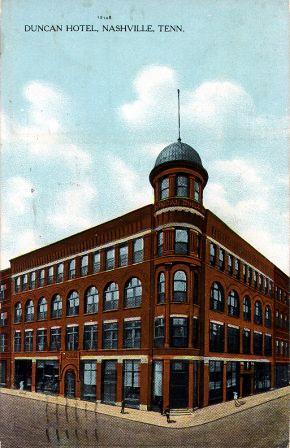
Following a recent conflict with the Tennessee Legislature over educational appropriations, Payne was also eager to secure a permanent, dependable source of funding for the school. Having hung large portraits of Peabody Board members in prominent locations in the chapel, he now persuaded the State Board of Education to produce a huge banquet for visiting Peabody Board members. The State Board rushed into action, checking on rates at both the Maxwell House and the Hotel Duncan and arranging for lodgings and carriages for the visiting Peabody representatives.
By November 12, arrangements were nearly finished. A banquet for 100 of Tennessee’s most prominent citizens would take place at the Duncan (which finessed the Maxwell House by offering the meal at $3.00 a plate), on November 21, 1889, at 8:00 p.m. Committees rushed around arranging details. It is interesting to note that, although the male faculty members of Peabody College were invited to take part in the festivities, no women, including the female faculty members, were present.
Nashville’s Duncan Hotel (postcard from NHN collection)
On November 22 the Nashville Daily American carried this comprehensive description of the evening:
Compliment Extended the Visiting Peabody Trustees. The Hotel Duncan a Scene of Brilliancy.
Who Were Present, Who Made Speeches and What They Ate – The Meeting Yesterday.
It was a most distinguished gathering of gentlemen who met at the Duncan last night at a banquet given by the trustees of the University of Nashville and the State Board of Education in honor of the committee from the Peabody Board of Trust. Nashville has known few such assemblages, and has extended the hearty hand of genuine welcome to few such visiting delegations.
The occasion illustrates, if nothing else, how dear to the heart of this city is the cause of education, and how eagerly our people grasp at every opportunity that is offered to make manifest their earnestness in the cause.
The honorees of last night were ex-President Hayes, Bishop H.B. Whipple, of Minnesota; Hon. Samuel A. Green, of Massachusetts; Hon. J.L.M. Currey, ex-Minister to Spain; Hon. James D. Porter, ex-Governor of Tennessee.
The hosts of the occasion were the members of the State Board of Education: His Excellency Robert L. Taylor, President; Frank Goodman, Secretary and Treasurer; Dr. W. P. Jones, Hon. Frank M. Smith, Hon. Thomas H. Paine, Rev. J.W. Bachman, Superintendent Charles S. Douglass.
Also the following Trustees of the University of Nashville: Hon. James D. Porter, President; Edward D. Hicks, Secretary and Treasurer; Hon. Edwin H. Ewing, LL.D., Hon. Abram Demoss, Hon. John Overton, Hon. Edward H. East, LL.D., John M. Thompson, Hon. Mark S. Cockrill, Hon. Campbell Brown, C.D. Berry, H.M. Doak, Edgar Jones, Hon. William B. Reese, Hon. W. F. Cooper, LL.D., Hon. Frank T. Reid, Hon. Robert B. Lea, Hon. Charles G. Smith, LL.D., Hon. Samuel Watson, John M. Bass, Hon. Thos. D. Craighead, and William H. Payne, LL.D., Chancellor of the University and President of the Peabody Normal College.
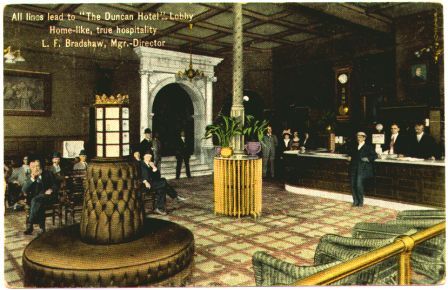
Duncan Hotel lobby (postcard from NHN collection)
The very handsome new hotel was the fitting scene for such a gathering. The parlors on the second floor were thrown wide open for the reception of the guests. They and the hallways and the dining-room were brightened by a tasteful and bounteous array of potted flowers and chrysanthemum decorations.
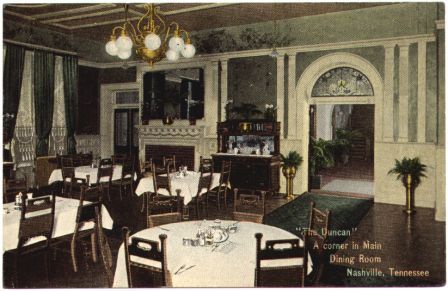
In the dining-room covers had been spread for more than 100 guests and nearly every seat was occupied.
There were two long tables and one cross table. At the head of these sat ex-President Hayes; at his left was Gov. Taylor, and on his right was Hon. J.L.M. Currey. At one foot of the table sat ex-Gov. Porter, with Hon. Mr. Green to his right; at the other foot sat Judge D.M. Key, with Bishop Whipple to his right.
The guests were all seated at 9 o’clock. From that hour until about 1 o’clock in the morning when the last toast was spoken the royal banquet proceeded. During those hours the speeches were spoken and wit and wisdom was the order.
Duncan Hotel dining room (postcard from NHN collection)
The following is a full list of the invited guests: Senator Wm. B. Bate. Hon. Benton McMillin, member Congress. Hon. J. E. Washington, member of Congress. Hon. D. M. Key, United States Federal Judge and ex-Postmaster General. Hon. Howell E. Jackson, United States Circuit Judge. Hon. H. H. Lurton, Justice of State Supreme Court. Hon. Andrew Allison, Chancellor. Hon. G. S. Ridley, Judge Criminal Court. Hon. W. K. McAlister, Judge Circuit Court. Hon. N. Baxter, Sr., Clerk Supreme Court. State Treasurer M. F. House. State Comptroller J. W. Allen. Secretary of State Charles Miller. Hon. B. M. Hord, Commissioner of Agriculture. Gen. Laps D. McCord, Adjutant General. Chas. L. Ridley, Coal Oil Inspector. Hon. John Ruhm, United States District Attorney. Maj. A. W. Wills, Postmaster. Hon. Carter B. Harrison, United States Marshall. Maj. J. W. Thomas, President Nashville, Chattanooga & St. Louis Railway. Maj. W. L. Danley, General Passenger Agent Nashville, Chattanooga & St. Louis Railway. Maj. E. B. Stahlman, Vice President Louisville & Nashville Railway. Hon. W. L. Clapp of Memphis, Speaker House of Representatives. Hon. Benj. J. Lea, of Brownsville, Speaker State Senate. Hon. J. B. Killebrew. Hon. Leon Trousdale, Sr. Gen. W. H. Jackson. H. C. Hensley, President Merchants’ Exchange. Lewis T. Baxter, President Commercial Club. Dr. J. Berrien Lindsley, Secretary State Board of Health. Col. P. P. Pickard, ex-Comptroller. Dr. Wm. Morrow. Col. A. S. Colyar. Judge John M. Lea. Wm. M. Duncan. Hon. T. O. Morris, Chairman of Legislative Educational Committee. Dr. C. D. Elliott. Geo. W. Fall. Roger Eastman. Gen. G. P. Thruston. Dr. J.P. Dake. Hon. Robert Ewing, President Board of Public Works. Col. E. W. Cole. Jos. S. Carels, Librarian Howard Library. Hon. Nathaniel Baxter, Jr. Anson Nelson, ex-City Treasurer. Col. Jeremiah George Harris, Paymaster United States Navy. Judge Jas. Whitworth. Judge Thos. J. Freeman. Hon. Jere Baxter. Gen. Jno. F. Wheless. Hon. Jno. Allison, ex-Secretary of State. Dr. J.H. Callender, Superintendent State Insane Asylum. Col. B. F. Wilson. J. W. Childress, E. W. Carmack, Walter Cain, J. D. Campbell and W. H. Peck, of THE AMERICAN. G. H. Baskett, Robt. J. G. Miller, David G. Ray and James Clark, of the Banner. Col. Duncan B. Cooper, Geo. H. Armistead, R. A. Halley and W. B. Palmer, of the Herald. Rev. O. P. Fitzgerald, of the Christian Advocate. Dr. D. M. Harris, President Art Association and editor of the Cumberland Presbyterian. Rev. David Lipscomb, of the Gospel Advocate. A.H. Landis, Jr., of the National Review. J. H. McDowell, of the Toiler. Geo. W. Armistead, of the Issue. Rev. B. J. Moody, of the Baptist and Reflector. A. E. Baird, of the Southern Lumberman. Dr. Chas. W. Dabney, Jr., President University of Tennessee, Knoxville. Chancellor L. C. Garland, of Vanderbilt University. Judge N. Green, Chancellor Cumberland University, Lebanon. Dr. W. J. Darby, General Manager Cumberland Presbyterian Publishing House. Rev. Telfair Hodgson, Vice Chancellor University of the South, Sewanee. Dr. Geo. W. Jarman, President Southwestern Baptist University, Jackson. Dr. John Braden, President Central Tennessee College. Dr. A. Owen, President Roger Williams University. Dr. E. M. Cravath, President Fisk University. Dr. J. N. Waddell, President Clarksville Presbyterian University. G. M. Fogg, President Nashville Board of Education. Z. H. Brown, Superintendent Nashville Public Schools. Capt. W. R. Garrett, Secretary National Educational Association. Rev. Geo. W. F. Price, President Nashville College for Young Ladies. Prof. J. B. Hancock, President Ward’s Seminary. Prof. S. M. D. Clark, Principal Montgomery Bell Academy. Dr. Duncan Eve, Dean Medical College, University of Tennessee. Dr. W. T. Briggs, Dean University of Nashville Medical College. Dr. Thos. Menees, Dean Vanderbilt Medical College. Dr. Wm. H. Morgan, Dean Vanderbilt Dental College. Prof. S. A. Link, Superintendent Tennessee Blind Asylum. Dr. J. S. Cain, University of Tennessee Medical College. Dr. R. E. Freeman, Vanderbilt, Dental College. Col. J. W. Barlow, United States Army. Profs. B. B. Penfield, J. L. Lampson, A. L. Purinton, E. C. Huntington, Geo. F. James, H. A. Vance, Peabody Normal College. J. L. Pearcy, Warden State Prison. Hon. T. B. Harwell, member Legislature from Giles County. Dr. T. A. Atchison. Col. J. W. Stone. Gen. H. B. Lyons, member of Congress from Kentucky. Col. J. M. Hamilton. Dr. T. L. Maddin, of the Medical Department of Vanderbilt University. Capt. John Demoville. Prof. Wharton S. Jones, Memphis.
The following was the menu:
Blue Points on Shell. Boston brown bread. Olives. Celery. Bouillon. Cutlets of chicken aux truffles. Sliced tomatoes. Baked sweet potatoes. Fillet of beef, larded, mushroom sauce. Potato croquettes. French peas. Punch, a la Cardinal. Mallard duck, currant jelly. Asparagus. Lobster salad. Plum pudding, brandy sauce. Neopolitaine ice cream. Assorted cake. Florida oranges. Grapes. Pears. Cheese. Cafe Noir.
The toasts were introduced by ex-Gov. Porter, who presided over the banquet and introduced each speaker in that happy manner characteristic of him.
James Davis Porter (1828-1912), Governor of Tennessee (1875-1879), U.S. Asst. Secretary of State (1885-1887), U.S. Minister to Chile (1893-1894).
In introducing the first speaker he extended to the visitors the hospitality of Nashville and of Tennessee in most graceful style. “Among our visitors,” said he, “is a man who has filled the most exalted place in the gift of his countryman, a man who has been distinguished in all the walks of life, as a private citizen, as a member of the bar of his State, as a Representative in Congress, as a distinguished soldier, twice the Governor of his State from which high place he was called to the highest within the gift of the people, where he signalized himself by a display of honesty of purpose, by maintaining the dignity of his high office, by furnishing a clean administration, by restoring their citizenship to the disfranchised people of Louisiana. In his retirement he has maintained the same dignity, and has attached himself to the people of Nashville and the South by his efforts in the great educational work upon which he is now engaged. I introduce the Hon. Rutherford B. Hayes.”
Mr. Hayes was roundly applauded as he arose. Addressing himself to the “Peabody Trust,” as the toast propounded, he referred to the donation of Mr. Peabody made twenty-three years ago, and repeated his grand words when he said: “I make this gift to the suffering South for the good of the whole country.”
Rutherford Birchard Hayes (1822-1893), Governor of Ohio (1868-1872, 1876-1877), President of the United States (1877-1881)
He referred in the highest terms to the President of the Board of Trustees, Hon. Robert C. Winthrop, and complimented the great work of Dr. Sears, the first agent of the fund. He alluded to the visit of the Prison Congress to Nashville and asserted that every member left Nashville with feelings of unmixed satisfaction at having been present. He said he ought to make acknowledgements for the kindness which he had received while here.
The committee of the Peabody Board had with unanimity made the largest appropriation to the Peabody Normal College in Nashville that it had ever made for such a purpose.
This could not be taken as a pledge of the action of the Trustees in disposing of the fund amounting to $2,000,000. The trust might run six or seven years and “if it shall be that this structure authorized to be built in Nashville shall turn out to become the first step towards the establishment of a final monument to Mr. Peabody by the donation of the whole sum to the institution in Nashville, I have to say that not one of the committee who are your guests will ever regret that fact.”
This declaration was received with much applause.
Judge Edwin H. Ewing, who had been announced to respond to the toast “The University of Nashville,” was absent, and Dr. J. Berrien Lindsley was called upon to supply his place.
“No one better than myself,” said Dr. Lindsley, “recognizes the difficulty of supplying the place of such a man as Judge Ewing. The University of Nashville, so far as age goes, can claim renowned antiquity. For twenty-six years its existence shone with brilliant classic light. Its graduates took high honors at Harvard, Princeton and elsewhere. In 1861 in method of work and equipment it was second to no institution in the land. Its Board of Trustees have now placed the citizens of Nashville and Tennessee under sacred obligations and raised a monument to the memory of that great man, who will always be remembered in his efforts to advance the cause of education-George H. Peabody.” [Applause].
The next speaker was Dr. W. P. Jones, who responded to the toast, “The Tennessee State Board of Education.”
“It is said that honest confession is good for the soul,” he remarked, in beginning his address. “The vitalization of the public school system of Tennessee comes, in a great degree, through the Board of Trustees of the Peabody Educational Fund. Dr. Sears, Agent of that Fund, gave the State Teachers’ Association soon after his arrival here $1,500, to obtain a man to canvass the State in the interest of public education. James Killebrew in this capacity did great good for the people, but received little thanks.”
Dr. Jones referred to a bill prepared by Superintendent S.Y. Caldwell and himself, and revised by Dr. Sears, which passed the Tennessee Legislature and led to the foundation of the State Normal School.
“This Normal College of Tennessee has outgrown the expectations of the first agent of the Peabody Board, as well as of the people. It is not now only a State school, but of right should be the Peabody College for the whole South, and the State Board of Education recognizes the idea that the Peabody Board should have supervision over the institution. Between the State and the Peabody Board there is harmony, and will likely continue so. We of the State Board may wish that the school may be developed and nourished to be worthy of that renowned philanthropist, Geo. Peabody, who, in giving $2,000,000, said, ‘This I give to the suffering South for the good of the whole country.’ He desired that the education and elevation brought about by it should have a national reflex action. He was a patriot as well as a philanthropist. I am looking in the face of one who when occupying highest position in the country, with thousands asking what can be best done for the party, said: ‘He serves his country.’ Few more important truths have ever been uttered. Twenty years ago Dr. Sears said Nashville had all the improved means of education. If that was true, then what can be said of Nashville to-day? The tented fields around Nashville have been converted into classic grounds. I hope the visitors to-morrow will view the educational advantages for colored people, nowhere surpassed in America; the female schools, then Vanderbilt, and tell their advantages to the other members of the board. The educational centre of the South should of all places be selected for the Peabody Normal College. Build upon the beautiful campus a building which shall be a monument to George Peabody, and write upon it his immortal words. ‘This is a gift to the suffering South for the good of the whole people.'” [Applause.]
In the absence of Senator W. B. Bate, Dr. J. L. M. Currey responded to the toast, the “United States.”
“It is a high honor,” said he, “which ought to be duly appreciated to be called to stand in the shoes of the Senator of Tennessee, and a still higher honor to respond to the sentiment proposed; but as the young man who was about to be married said, I hope I will have your sympathies. I am probably more of a cosmopolite than many of you. I have been in every State of the Union except three and love our country and honor it. Patriotism begins at home, and begins with the State which throws the aegis of its protection over the dearest relations of life, and I believe in an indissoluble Union of indestructible States. While one may be a patriot at home and have his affections centered upon his own State, when he goes abroad the horizon of his patriotism widens and he looks up, not to a single star, but to the stars and stripes. I have wandered through the dilapidated streets of Palos, and I must confess that I never had before in looking upon a material object such thrilling, overpowering and tearful emotions as when I looked in imagination across to the country where have been wrought out the most beneficent questions of civilization, humanity, and good government. The foundation of our government and something which is next to Christianity, the best preservative of our free institutions is universal education, for without intelligence of the masses there can be no freedom of the masses. Before the Government it was declared that freedom of institutions depended upon education, and the Government should aid the schools.”
The speaker referred in glowing terms to Mr. Peabody’s gift, and said he could not think of anything that contributed more to the establishment of friendly relations between the sections. His act was the first to bring about a reconciliation. It would be one of the justest and most magnanimous acts for the Southern States to erect in the hall of the National House of Representatives a monument more lasting than brass to their greatest benefactor. Referring to the Peabody memorial school, he inquired why should there not be in Nashville, in the centre of this great country, established the great normal school of the United States? Applause followed his remarks.
Robert Love Taylor (1850-1912), Governor of Tennessee (1887-1891), U.S. Senator from Tennessee (1907-1912)
Gov. Robert L. Taylor responded to the toast “The State of Tennessee.” “Tennessee,” said he, “lies on the happiest lines that girdle the globe, on the golden lines of God’s favor to man. I have thought that when God turned our progenitors out of the Garden of Eden, loth [sic] to destroy the beauties of Paradise he transplanted them to Tennessee. Our mountains are higher than other mountains, our valleys more fertile, our sunlight as beautiful as Mahomet’s vision of heaven. Our men are brave in battle, and our women are the sweetest that ever presided at home except the women of Virginia, and New York and Ohio and North Carolina, where I got my wife. [Laughter.] Tennessee is the richest country in the world. She has never had her proper place in public estimation. Her resources, capabilities, and possibilities have never been measured. Lying between the great cereal and cotton regions, their peculiarities are wedded on her own fertile soil where each is produced in profusion.
“The chemical forces elsewhere at war, here in harmony blend and produce results nowhere else reached. We have the happiest people in the world and the brightest atmosphere except about this time in November. Beneath the rich soil you find mines of wealth never dreamed of even here in Tennessee. More mineral wealth is found here than in any other State in the Union.
“A State of universities and good common schools-only one thing was needed to make Tennessee’s people happy. That was a great central normal college at Nashville, where teachers might be turned out to instruct the land, and live a monument to the memory of George Peabody. He did not believe the day was far distant when the visitors present and their fellow members of the board would in this great school complete the school system in Tennessee.” [Applause.]
Judge D. M. Key, of Chattanooga, was called upon and responded by saying that he thought he was on a side-track, as there was nothing on the programme set down against him. To Mr. Porter he had past obligations, but the force of the present ones he did not feel. There was a kind of honorable rivalry between Federal and State courts, and he did not think it would be kind for him to praise the Federal judiciary system in the presence of one of the State’s most honored justices who sat in silence. Like Webster “Here are the Federal officers. Behold them; they speak for themselves.”
The toast “The Schools and Colleges of Tennessee,” was responded to by Dr. G. W. F. Price, who said the gentlemen who had spoken seemed to have preempted and preoccupied the territory. He did not know what ground to stand upon unless he stretched a hawser from the Rocky Mountain peaks to the blasted projections of the moon, and performed aerial Blondin feats among the blazing stars and wheeling comets. He referred to Mr. Peabody in the highest terms and commended the Peabody Normal College as an institution of magnificent design and worthy of the most extended development.
In the enforced absence of Mr. E. A. Carmack, Mr. G. H. Baskette responded to the toast “The Press.” He said the weary, dry hours of the night had been reached and the party could, no doubt, appreciate the ingenuity of the man who tacked the Lord’s prayer over the wall and on cold nights jumped into bed, saying, “Lord, them’s my sentiments.” The press was a tremendous engine for potency and influence-one which had a great field for opportunities. It was, however, open to abuses. It was courted and feared, praised and denounced. It is the moulder of sentiment, the framer of public policy. It was a great educational power.
It has not done its whole duty in the uplifting of a Christian civilization, but is doing much for education, and with a united influence, will contribute to an educational development of the country more rapid than ever before seen. His remarks were liberally applauded.
The company dispersed at 1:30 o’clock. The following are the committees who were in charge of the banquet. Committee on Reception – Gov. Robert L. Taylor, Hon. William F. Cooper. Committee on Visitations – Hon. William B. Reese, Hon. Frank M. Smith. Committee on Invitations – John M. Bass, Frank Goodman.
To all is due the very highest compliment for their success. Especial mention is tendered Prof. Frank Goodman, the very efficient Secretary of the State Board of Education and Secretary also of the local Peabody Board for his interest in the work of making the affair a success.
by Kenneth Fieth, Metropolitan Nashville Archivist.
The typed letters stand out in stark contrast to the white paper. This is only one of the thousands of documents held by the Metro Archives: most of them are routine; many are interesting; a few are significant. At first glance, this one appears to be nothing more than a standard form sent out from the office of John Koen, principal of Hillsboro High School. However, the date gives it instant significance: October 26, 1962.
In October 1962 the United States and the Soviet Union – the two great powers that had risen from the wreckage of World War II – stood nose to nose, ready to unleash the forces of the third, and arguably final, world war.
Nashville knew little of the events spiraling out of control in the White House and the Kremlin. Here life went on as usual: fifty cents would buy a ticket to see the latest James Bond movie, Dr. No, or to watch Marlon Brando’s Mutiny on the Bounty. A Westinghouse 4-speed phonograph cost $29.95, and a driver could fill the tank of his new $2,500 automobile with gasoline that cost 31 cents a gallon.
School children taking part in a duck-and-cover drill to practice what they should do in case of an nuclear attack.
From all indications, there were few preparations being made in Middle Tennessee for potential catastrophe. Nashville was not the primary target that Oak Ridge, Ft. Campbell, or Memphis would be, but the fallout from an attack on Fort Campbell would be picked up by the prevailing easterly winds. Nashville would be permeated by a mortality that could not be seen, heard, or tasted. Surprisingly, though, other papers in the Archives from the same period – those of Nashville Mayor Ben West, County Judge Beverly Briley, and other city and county officials – give no indication that anything was amiss. The major political concern of the moment seemed to be the conflict over a proposed consolidation of city and county administrations into a single metropolitan government.
But public and private change occurs in subtle ways. During the renovation of the Metro courthouse, many artifacts and records were transferred to the Metro Archives. Among those was a faded yellow sign, installed in the mid-1960s, proclaiming that this particular courthouse hallway was a fallout shelter that would hold 103 persons.
Paul Clements, a local historian and writer, remembers his father filling the car with gas every night that November. The senior Clements kept food and water in the car and developed an escape plan in the event of the unthinkable.
Former Nashville Mayor Richard Fulton also recalls those days in 1962. Newly elected to Congress, he had gone to Washington, D.C., to meet with Bobby Kennedy, Attorney General of the United States. The meeting ended abruptly when Kennedy received an urgent summons to the White House. Because it was raining, Fulton rode with the Attorney General to the White House, after which the driver delivered him to his own destination. The White House meeting, Fulton learned later, was a discussion of the withdrawal of Soviet missiles from Cuba.
President John F. Kennedy and his brother Robert in conference. (public domain)
Thus, the apparently routine form sent out by Principal John Koen was not a mere formality after all, as it asked parents to indicate what they wanted their children to do in the event of “a real emergency created by any type of attack.” This particular parent’s response specifies that the child should start walking home.
The Metro Archives is a treasure house full of these seemingly unrelated snippets in time – a faded yellow sign, a boy’s memory of his father’s anxiety, a freshman Congressman’s brush with world power, a simple typed form with a child’s name on it. Put together, these examples form a picture of a time when the lights almost went out never to come on again.
















 Nashville Historical Newsletter