In 1908 Duncan College Preparatory School for Boys was founded by Mr. Marvin T. Duncan and his wife Pauline. Located at 401 25th Avenue South in Nashville, a three-story structure served both as the school building and as a home for Mr. and Mrs. Duncan. In recent years a historical marker has been erected at the site, just south of the Vanderbilt gym.
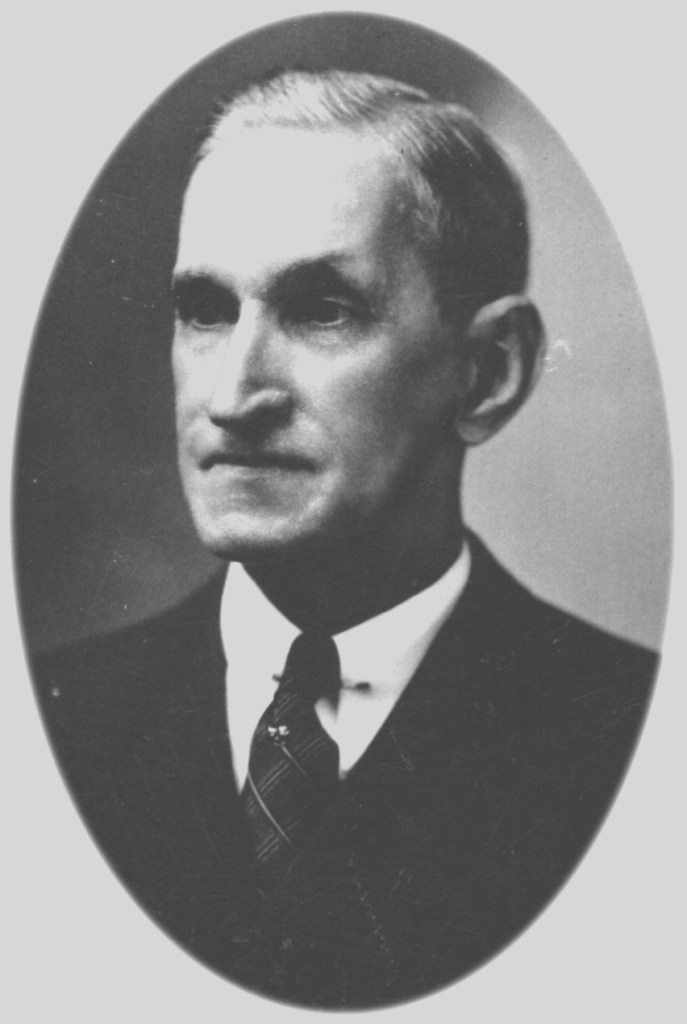
Headmaster Marvin T. Duncan (photo courtesy of the author)
Mr. Duncan, the son of a Methodist minister and a graduate of the Webb School at Bell Buckle, graduated from Vanderbilt in 1905. He established Duncan School after stints as a teacher at the old Wallace School on Broadway and as principal of schools in Lawrenceburg and Paris, Tennessee. Mrs. Duncan was a graduate of Columbia Institute and had taught at the old Tarbox School, which is now the Senior Citizens’ Center at 1801 Broad.
Mr. Duncan was a strict disciplinarian. Any student who violated school rules certainly knew the punishment he would receive. The Honor Council, elected by their fellow students, sat in judgment of all honor code violations. Some student misdemeanors were handled by an invitation to Saturday School, while more serious infractions required a visit with Mr. Duncan and his belt. Whippings were reserved for students who appeared not to benefit from one of his famous lectures.
“Trapping” was an academic exercise that rewarded those who were prepared for their daily classes. Students sat in rows on old-fashioned benches, and those who were able to answer questions from the teacher moved ahead of those unable to answer. When a student moved to the head of the class and stayed there for a full class period, he received a “headmark” for his efforts, which enhanced his final grade in that class.
Chapel was an integral part of daily life at the school. Mr. Duncan was always at his best during his “sermonettes,” and the students enjoyed these lectures since they took time away from class work. Duncan’s presentations were designed to instruct his boys in high principles of honor and scholarship, and to remind them of the importance of hard work in both life and the classroom.
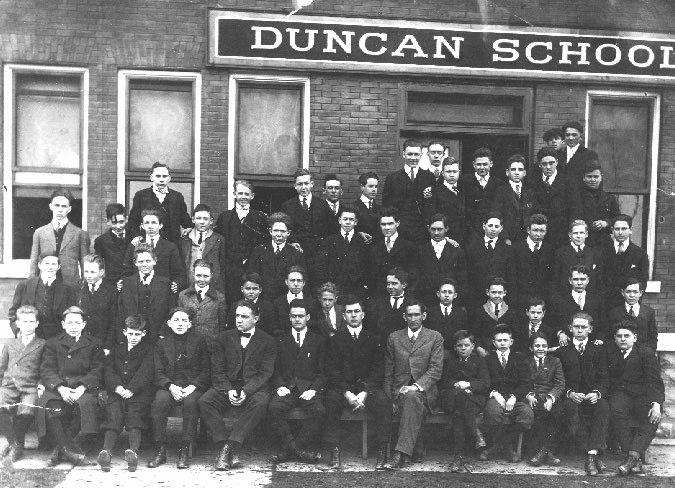
Duncan Student Body (photo courtesy of the author)
Athletics was another important part of school life. In spite of having no gym, track, or athletic field, the Duncan Longhorns fielded competitive teams in the major sports. In 1945 the baseball team won the Mid-South Association Western Division crown.
Ill health forced Headmaster Duncan to close his school after the 1951-52 academic year. After he died that fall, Vanderbilt University acquired the property. The school building was torn down in 1958.
Many leading citizens of Middle Tennessee received their education at Duncan. A Duncan diploma enabled graduates to enter many leading universities, including Vanderbilt and Sewanee, without an entrance exam. A number of Duncan alumni – some 752 men and 6 women graduated from the school – helped Brentwood Academy raise funds for their building program, and the Duncan Library at Brentwood Academy is the repository for the school’s memorabilia. (2000)
In the short lifespan of Cornelia Fort, this remarkable Nashvillian accomplished great things. She was a premier aviatrix and was privileged to play an important role in history. The first female flight instructor in Nashville, she was sent to Hawaii to teach military personnel to fly. On December 7, 1941, Fort was flying with a student pilot when their aircraft nearly collided with an invading Japanese plane. From the air she saw the smoke from the Pearl Harbor bombing.
In the fall of 1942 Cornelia Fort was selected as one of the first members of the Women’s Auxiliary Ferrying Service (WAFs). She flew a number of missions in the service of her country before she was killed in March 1943 in a flying accident in Texas.
High school photograph of Cornelia Fort used with permission of the author.
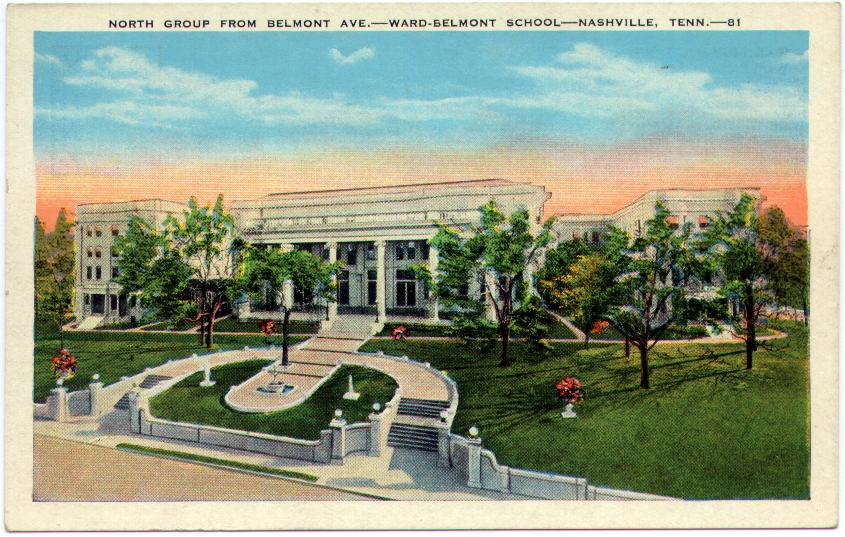
I went to high school with Cornelia at Ward-Belmont in Nashville. She was an outstanding student, even then having the “look of eagles.” As I remember, Cornelia was responsible for the early downfall of my handwriting. Miss Major, our domineering Latin teacher, demanded rather long reports and test responses. Cornelia would sail through the reports and tests with her huge, looping handwriting, covering many pages with essays and answers. This greatly impressed Miss Major. I would be crawling along with my cramped version of handwriting, perhaps getting the job done, but not using up much test paper. Cornelia looked over my work with disgust and advised me to open up and stretch my efforts! This strategy produced the desired effect of creating large bunches of work, but, as you can imagine, it did nothing constructive for my handwriting. It is still rather illegible to this day.
Postcard photo of Ward-Belmont School from NHN collection.
Cornelia lived near Shelby Park in East Nashville. She was driven to and from school by a very amiable black employee by the name of Eperson. I loved being invited to accompany her, as we traveled in style in a large black town car.
Cornelia’s house was a lovely white antebellum home, set far from the road in a grove of walnut trees. Meals there were quite impressive, eaten under the watchful eye of Eperson, who saw to it that the young Forts minded their manners. You can imagine that I ate Very Carefully.
Cornelia had three older brothers who completely awed me. They were Rufus Fort Jr., Dudley, and Garth. Rufus and Dudley became well-known Nashville businessmen, while Garth followed in his father’s footsteps, becoming an MD. Garth married one of our neighbors here in Columbia, a woman with whom my husband Swope had grown up. Of course, this was many years after Cornelia’s tragic death.
I did not see Cornelia, or “Corns,” as I was wont to call her, after our graduation from high school; however, I have always valued the memories of our friendship.
Has our country ever engendered a more merciless single act of racism than that known as the Trail of Tears, the 1838-1839 government-enforced removal of the Cherokees from their eastern homelands? Of the approximately 16,000 expelled Indians, as many as 4,000 died in the process of being interned and then relocated – by foot, wagon, horse, and river – to Indian Territory in today’s Oklahoma.
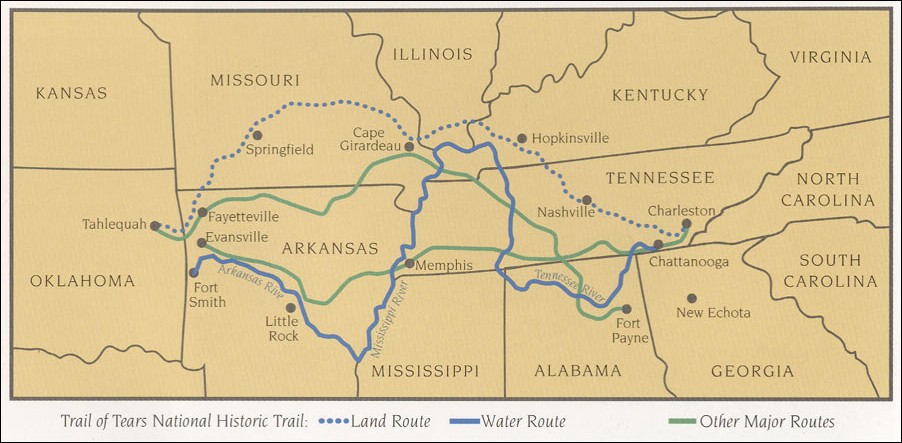
Trail of Tears map, courtesy of the National Park Service.
The primary artery of exodus, called the Northern Route, included passage through Nashville. During the fall of 1838 the group was composed of about nine different contingents of Cherokees. Surprisingly, very little is known about their exact route through the area, the events that transpired as they passed, or the reactions of Nashvillians to the emigrants.
Richard Taylor led one of the Northern route detachments, which included several hundred Native Americans as well as an intrepid white Christian missionary couple, Rev. Daniel S. Butrick and his wife. Fortunately, Butrick kept a journal of events along the way, the Nashville-related section of which (pages 46-47) is quoted verbatim below by permission of the Oklahoma Chapter of the Trail of Tears Association, publishers of the journal. (Note: Journal entries are in italics. The brackets within the entries are not mine; they are transcribed exactly as found in the published journal.)
My comments that follow various entries are often informed by the views of Benjamin Nance from the Tennessee Division of Archaeology and by the Division’s 2001 report titled The Trail of Tears in Tennessee: A Study of the Routes Used During the Cherokee Removal of 1838, cited below as TTOT. Bound volumes of both the report and the journal can be found in the Tennessee State Library and Archives. I am also indebted to Deborah Rodriguez of the Tennessee Trail of Tears Association for sharing her research with me. My hope is that this presentation of Butrick’s journal combined with my questions, guesses, and musings will encourage others to continue researching the Nashville portion of the Trail of Tears.
Monday. [November 19th] The detachment started early and proceeded through Murphy’s borough, on the road towards Nashville 20 miles. Some of the ox teams did not get up till after dark.
Although some of the groups appear to have bypassed Murfreesboro – by going through the old town of Jefferson, now flooded by Percy Priest Lake – others, apparently including Taylor’s, approached Nashville through Murfreesboro and out what is now called Old Nashville Pike (see TTOT, pp. 30-31). For most of the 1980s I lived near Old Nashville Pike in Rutherford County without realizing that my home was not far from the Trail of Tears. We are often slow to recognize that history is right under our feet.
Tuesday. [November 20th] We travelled ten miles and camped within four miles of Nashville. Our tent stood on the side of a Cedar hill, “The Cedars of Lebanon bow at his feet”, “And the air is perfumed with his breath”, often passed in my mind.
Only a few 1838 Nashville newspaper articles reference the route of the Trail of Tears through Nashville. One article, published by the Nashville Whig on Monday, October 15, includes these alarming details: “The second detachment of the emigrating Cherokees passed through Nashville Monday on their way to the ‘Far West.’ They lay encamped near Foster’s mill on the Murfreesboro’ [sic] Turnpike for several days, and while there were visited by many of our citizens. We had no opportunity of seeing this miserable remnant of a warlike race, in camp; but a worthy subscriber residing in the country, writes that he was present several times, and regrets to say that many of the Indians appeared extremely needy in apparel. Barefooted and badly clad, they cannot all hope to withstand the fatigues of travel and the inclemency of the season. Disease and perhaps death must be the portion of scores of their number before they reach the Western frontier. Indeed, four or five were buried near town, and not less than 50 were on the sick list when they passed through on Monday.”
Another newspaper report, from the November 30 edition of the Nashville Union, informed its readers that “the last detachment of the emigrating Cherokees, numbering 1,700 or 1,800 persons, is now at Mill Creek, about four miles from this city.” Although the writer is probably referring to Peter Hildebrand’s group, which followed Taylor’s, this report gives us a lead as to where Taylor may have camped, since various contingents of the exodus seemed to have bivouacked at the same locations along the way and both Hildebrand’s and Taylor’s groups stopped about four miles from Nashville. We will guess that the camping location referred to by Butrick is where Mill Creek crosses Murfreesboro Pike, a location about the right distance from Nashville. Additional support for this location is the Whig‘s reference to Foster’s mill, which was situated also at Mill Creek and Murfreesboro Pike (see Clayton, History of Davidson County, Tennessee, p. 72).
About two-tenths of a mile toward Nashville from Mill Creek, at Murfreesboro Pike and Foothill Drive, the Vultee Church of Christ sits atop a hill. Could this be the cedar hill of which Butrick speaks?
Keep in mind also that a little farther down Mill Creek, on an old pioneer road now called Elm Hill Pike (which runs roughly parallel with Murfreesboro Pike), was Buchanan Station, an original Cumberland settlement. Some of the Cherokee contingents, particularly those who came by way of Jefferson instead of Murfreesboro, could have camped there.
Wednesday. [November 21st] Early in the morning a gentleman by the name of Bryant, his wife & two other ladies called at the camps, and enquired for us. They had visited other detachments, & been informed of our coming. They now invited us to take lodgings at their house while the detachment might remain in this place. We were thankful for this expression of kindness, though as our tent was pitched, we concluded to remain with our dear Cherokee friends.
Mrs. Bryant and the other ladies had brought clothing to give to the needy Cherokees, though they said they found none needy in this detachment, compared with other companies that had gone on. We agreed to visit this kind family on Friday.
As next Sabbath is the regular time for the holy communion in Brainard church, I proposed holding a sacramental meeting in this place if we could obtain ministerial assistance from Nashville. Mr. Bryant therefore agreed to accompany me to Nashville tomorrow.
A careful study of census and deeds records might reveal who the Bryants were and where they lived. Foster’s 1871 map of Davidson County shows an L. Bryant living on McCrory’s Creek, a few miles farther out of Nashville than the location we have posited above. Perhaps there was some kinship between the 1838 Bryants and those of 1871.
Thursday. [November 22nd] Rode 5 miles to Mr. Bryant’s. Here I saw the effects of true religion. This family appears as we might expect true christians to appear towards the suffering Cherokees, and missionaries accompanying. I partook with them of a kind repast, and then accompanied Mr. Bryant to Nashville, 3 1/2 miles.
This is a beautiful city. I have seen no such place in my view since I left Boston. Here are iron works, a college, penitentiary, female academy, court house and several very handsome meeting houses, and many very elegant buildings.
But what especially adds a beauty to the prospect is the cedars which grow naturally in all part of the coven.
But my object was to find a minister to assist me at the contemplated sacramental meeting.
I was first introduced to a young Methodist minister. But his city dress and appearance, together with his having both hands full of other business, discouraged me at once, & I relinquished the idea of obtaining aid, & said to Mr. Bryant that I would seek for no other minister in the city, but return to the camps.
Just as we were preparing to leave, however, a very dear minister, by the name of Lapsley, passed that way. His health was poor, yet he expressed a strong desire to be with us on the Holy Sabbath. I accordingly appointed the meeting for Brainard & Hawels churches, at the camps, & returned.
Again, careful study of old records could help map out the triangulation of campsite, five miles to Bryant’s house, and then three and a half miles to Nashville. It is interesting that from Murfreesboro Pike at Mill Creek to L. Bryant’s, mentioned above, might be reasonably close to a distance of five miles, but then Nashville would be considerable farther away from there than three and a half miles. Of course, we are assuming that Butrick’s mileage statements are at least approximately accurate.
Butrick’s description of 1838 Nashville is heartening to all who take pride in Nashville, and it confirms the sophistication of our city even before it was designated as Tennessee’s permanent capital.
Dr. R. A. Lapsley was a principal of the Nashville Female Academy (see Wooldridge, History of Nashville, Tennessee, p. 404). Perhaps he is the Lapsley of whom Butrick speaks.
Friday. [November 23rd] My dear wife and two Cherokee girls accompanied me to the house of our dear friend Bryant, where we spent the day delightfully with that dear family.
Saturday. [November 24th] Our dear Cherokee brethren prepared seats on one side of the camp ground, where we held a meeting in the afternoon. Our dear brethren Lapsley & Greene preached.
The weather was cold, & rather uncomfortable as we were out doors. At candlelight we held a prayer meeting in our tents.
Sabbath. [November 25th] While we were contemplating the unpleasantness of holding meeting in the cold open air, an aged man, whose head had blossomed for the grave [turned his thoughts and deeds towards the after-life.], called at our tent and offered us the use of his meeting house, about half a mile distant.
He was a Baptist elder, and said he was a missionary in spirit. We gladly accepted his offer, and found a large brick house, well finished, and furnished with two stoves.
Our dear br. Lapsley preached, and Mr. Taylor interpreted, and our dear br. Stringfield assisted in administering the Holy Supper. The whole was delightful, & will not soon be forgotten by us.
O how kind was our Heavenly Father in providing for us such a meeting house, & such kind friends, just at the time they were so much needed.
The large brick Baptist church building is the most consequential landmark mentioned in this section of Butrick’s journal. The church that comes immediately to mind is the historic Mill Creek Baptist Church, which met in a brick building thought to have been erected in 1810. If this is the correct church building, it increases the likelihood that the campground was near Mill Creek and Murfreesboro Pike, since the Mill Creek Church was only a short distance upstream from the pike. The church building no longer exists, but the Mill Creek Church cemetery is situated along today’s Old Glenrose Avenue.
Another possible candidate might be the McCrory Creek Baptist Church building, located, we assume, in the vicinity of L. Bryant. But this researcher has been able to determine neither the exact location of the old church building nor whether it was of brick.
Monday. [November 26th] The detachment being supplied with tents etc., proceeded on their journey. Mrs. B. & myself dined with our kind friend Mr. Lapsley. We traveled but about four miles from Nashville & camped.
As the fires began to be kindled, an aged Cherokee, who had been sick all the way, lay down by the fire, when his clothes caught fire, and he sprang up, but before he could be relieved, was burnt nearly to death.
Here Mrs. Butrick received from our kind friend Mr. Lapsley a valuable cloak, bonnet, shawl, and a pair of shoes, send on by a waggon which passed through Nashville after we left.
Apparently, Taylor’s contingent camped four miles short of Nashville for a total of five full days, arriving on the 20th and departing on the 26th. They then proceeded through Nashville, and the Butricks stopped at Lapsley’s for dinner.
By what route did the Cherokees pass through Nashville? The Tennessee Division of Archaeology report suggests they probably proceeded up Market Street (today’s Second Avenue), crossed the Cumberland bridge (the original covered bridge) at the Square, and then north via White’s Creek Pike and through today’s Joelton area (see TTOT, pp. 31-32). The theoretical Market Street route, though logical, is as yet undocumented. We do know for certain, however, that some Cherokees lingered at the Square. An account in the November 14 edition of the Nashville Whig includes this sentence: “While traveling through or loitering about the public square, the Indians have exhibited the utmost quiet and good order, and not half a score we venture to say, of the thousands who have passed on to the west, gave evidence of intoxication while here.”
Groups of Native Americans trudging through the city would have been quite a spectacle for the Nashville population (then about 6,000 persons), providing fascinating fodder for news reporters. Why did the local newspapers fail to report this news thoroughly, and why are details about the Trail of Tears through Nashville virtually non-existent in local history books? Much more research needs to be done, not only in 1838 Nashville newspapers but also in personal diaries and other records.
On this day the Taylor group made their way through Nashville and four miles farther north, probably stopping somewhere near where White’s Creek intersects with Highway 431. It was here that the old Cherokee man was tragically burned in a campground accident. The White’s Creek at 431 camping location is supported by the fact that an earlier contingent held up there, as reported by the Nashville Union on November 5: “Another detachment of the emigrating Cherokees, twelve or thirteen hundred strong, passed through this city yesterday afternoon, and encamped at White’s Creek.”
Saturday Dec. 1. Camped on a branch of Red River, in Kentucky, having travelled during the week about 60 miles.
The poor old man who was burnt, was left at a house to be taken care of, but died in a few days.
On Wednesday night of this week, sister Ooskoone gave birth to a son, and on Thursday two children, one a daughter of our dear sister Ashhopper, were called into eternity. They had been long sick.
No doubt excruciating pain accompanied the burn victim into Kentucky where death finally relieved him of his agonies. In addition to a birth, Butrick reports the deaths of two children, tragedies that were all too common among the very young and the very old on the approximately 1,200-mile Trail of Tears, an unnecessary tribulation born of political impatience.
The Belmont Church on Music Row was organized as a Church of Christ on the then affluent 16th Avenue South after R. V. Cawthon conducted a two-week tent meeting in 1911. The original Greek Revival building, still in use as a conference center, was erected in 1915. In the early years there was no single regular minister, but several had monthly appointments including A. B. Lipscomb, nephew of David Lipscomb (founder of present-day Lipscomb University). Later illustrious ministers were Hall Calhoun, who became widely known for his daily radio program from the Central Church of Christ, and J. P. Sanders, Dean of Lipscomb.
David Lipscomb
Roots of the 20th century Churches of Christ in Nashville may be traced through the early 19th century Baptist Church of Nashville to Alexander Campbell, whose father’s famous motto “Where the Scriptures speak, we speak; and where the Scriptures are silent, we are silent” became the hallmark of a fast-growing reformation. Ironically, Barton W. Stone, a co-founder of the Restoration Movement (a 19th century effort to “restore” the 1st century apostolic church) was host and a major participant in the 1801 Kentucky Cane Ridge Revival. Stone condoned, if he did not embrace, the many manifestations of the outpouring of the Holy Spirit called “exercises” including falling, jerking, running, skipping, dancing, laughing, shouting, and barking.
It was the recognition of the major active role of the Holy Spirit in the daily lives and worship of the fellowship, the emphasis on life in the Spirit including speaking in tongues, and the exercise of other spiritual gifts—precedents set at Cane Ridge—which highlighted the “Revolution at 16th and Grand” sparked by the charismatic Don Finto in the 1970’s. The introduction of instrumental music in worship, major anathema to the orthodox Churches of Christ, was, undoubtedly, the major factor in the drive for denominational independence of Belmont Church.
Another major theme in the history of the church is its outreach to the inner city and to the nations. Koinonia Ministries began twenty-five years ago as Koinonia Bookstore and Coffee House, which served the church body and the larger community including street people. Live Saturday night performances of budding Christian artists including Amy Grant, Gary Chapman, Chris Christian, and Dogwood (Steve and Annie Chapman and Ron Elder) among others, launched their careers in contemporary Christian music while inspiring Koinonia audiences. (1997)
(Abstracted by the author from his larger work, The Cloud Moves: Belmont Church, A History.)
On February 15, 1862, E.G. “Eb” Buford of Giles County, Tennessee, received what later generations of soldiers would call “a million-dollar wound.” Not serious enough to kill or badly disfigure him, it nonetheless earned him a permanent discharge from the Army of Tennessee. While thousands of men from the captured garrison at Fort Donelson were being sent north to POW camps, Eb was sent to the rear. He had been shot through the left lung, the one-ounce lead ball reportedly taking part of his ramrod* with it as it exited his body.
In 1869 Eb married Belinda D. Miller in Williamson County; their only child, a son named John, was born the following July. Belinda died in 1874 at age 30, and Eb remained single for ten years. The 1880 Giles County census lists him as a widower, engaged in the hardware business and living on his mother’s farm.
On Christmas Day 1884 Eb married 35-year-old Mary Elizabeth Burgess, a prominent educator who already had quite an impressive resume. Although her tombstone lists her birth year as 1857 and says she started teaching at 16, she was in fact born in 1849, as the 1850 and 1860 census enumerations clearly show.
Her academic career, including a year at Dr. Price’s Nashville College for Young Ladies, culminated in her 1886 founding of the earliest Buford College at Clarksville. Meanwhile, Eb continued in the hardware trade, in a Clarksville firm called Buford and Bowling. For reasons the college publications do not explain, the campus was relocated to Nashville in 1901. School brochures tell us far more about Mrs. Buford, known as Elizabeth, than Eb, whose title at Buford College was Regent.
Buford College, about 1910 (postcard from NHN collection)
Contemporary photos show the Bufords as a dignified couple in their 60s. Confederate Veteran Magazine ran ads for the college and even published one of Elizabeth’s poems in 1910. As President of Buford College, she no doubt wrote the advertising copy, as well as yearbooks and other college publications.
In addition to being an ardent devotee of Shakespeare, Elizabeth was also fond of mottoes, which abounded at Buford, often called “Beaufort” in the literature. This Norman spelling of her husband’s name allowed her to convey the twin virtues of the school: Beauty and Strength. It is no surprise that many of her favorite mottoes and Bible verses found their way onto her impressive tombstone.
While Eb was certainly aware of his lineage, Elizabeth was very much the genealogy buff. She traced her Burgess line back to the Mayflower and was fond of saying that she and her staff were “to the manner born.” She seemed to believe that any post-Civil War Southern aristocracy should be based on literacy. Her ad for the Clarksville campus in an 1894 issue of Confederate Veteran stressed that she was the wife of a Confederate veteran.
Today nothing remains of Buford College except the name. West of Franklin Road, near the intersection of Caldwell Lane and General Bate Drive, is a short street named Buford Place. Although the last of the college buildings were torn down in 1946, surviving photos and a drive through the Buford Place vicinity can provide a good mental picture of the campus, which was situated just beyond the popular Glendale Park. The college yearbooks were a bit hazy as to how far from downtown the campus was, one saying it was a mere twenty minutes away by trolley, another saying thirty-five. The line ended at the campus, in an area that became known as Buford Station.
The 1903 Nashville City Directory showed Elizabeth Buford living at Buford Station. Eb, not listed, could still have been in Clarksville taking care of business. College publications are almost totally silent on his role as Regent, which might have been a figurehead title, although he may in fact have been the school liaison to the Nashville business community. It is revealing that his pension application described the school as a business.
The yearbooks describe the campus as “a magnificent highland park of 25 acres, surrounded by an 85-acre woodland, with springs, wells, and a cistern, upon a fine electric car line.” Croquet and tennis courts were set among the magnolias, while gardens, a dairy, and a hennery provided a healthy diet for campus residents.
The land was originally donated by wealthy businessman O. F. Noel, who also constructed the buildings. However, this partnership would last only during Noel’s lifetime and placed the college on precarious financial footing from the outset. College publications included some rather shrill pleas for assistance, and, although “Beaufort” had an impressive list of benefactors, it was not able to survive the deaths of Noel and the Bufords.
The enrollment at Buford, which was referred to as “select,” was limited to 100 girls between the ages of 16 and 20. The school offered the standard four-year college course, modified somewhat by Elizabeth’s (and perhaps Eb’s) personal tastes. The curriculum included English, Latin, the Bible, painting, music, and even business and journalism. Annoyed by literary portrayals of “frail Southern womanhood,” Elizabeth also stressed health and exercise.
The modern reader may scoff at the unabashedly Victorian ideals promoted at Buford, although graduates looked back on their college days with a fond nostalgia we can only envy. The presence of chaperones was a salient feature of all social outings and field trips taken by the girls, dressed in their forty-dollar gray uniforms. However, this is not to say that men were a forbidden item at Buford. Eligible young men were welcome as visitors at the college after they sent a letter of introduction to Elizabeth – only a certain gentility would do at Buford. More than one of the college yearbooks boasted that there had been no “elopement, death or casualty” in the history of the school, including the Clarksville years.
In contrast to the 19th century values and ideals taught at Buford, Elizabeth tenaciously prepared her charges for the 20th century. For example, she saw journalism as a way for women to find careers outside the home, allowing them to compete with men for jobs. Others, inspired by Elizabeth’s love of the English language, became teachers who inspired a generation of students to disdain slang and trendy speech in keeping with lofty Buford ideals.
The 1914 death of O. F. Noel, Buford’s principal benefactor, generated a flood of changes in the life of Buford College. In 1915 the Glendale campus welcomed its last class before the land devolved to Noel’s heirs. The girls who made the transition lamented that it was the last year of the “real Buford,” the idyllic picture-postcard school surrounded by oaks and magnolias.
How Eb fared in those lean years we have only a hint. In 1917 he was forced to file a Confederate pension claim, stating that he and his wife had been “engaged in School business at Nashville” the previous year, “but have been deprived of this, and are now without means,” and unable “to make any provision for the future.”
The year 1916 had seen the college relocate, according to their ad in Confederate Veteran, to the area between 21st and 22nd avenues, near the corner of 22nd and Church, in what was the old Sam Murphy Place. By 1918, the year before Eb died, it had again moved: near Gallatin Pike, on N 12th and Eastland, the Bransford Mansion was Buford’s final location.
Elizabeth would not long survive Eb. The strain of running the college and worrying over finances proved too much for the aging administrator. At 71 she suffered a breakdown from which she would not recover. She died on February 12th, 1920, and was buried next to her husband on Valentine’s Day. Looking at their grand tombstone at Mount Olivet – covered with mottos, Bible verses, a timeline of her career, the love showered on her by her girls – one realizes that, even in death, she remains the president of Buford College.
*According to the author, what actually went through Eb’s lung was not part of his ramrod, but what was known as a musket pick. A Civil War reenactor has explained that this item was a wire brush used to clean the outer parts of the gun lock, such as the percussion cap nipple.
Additional author’s note: A book recently located at TSLA “showed what Eb was doing after he married Mary Elizabeth Burgess. He was a traveling salesman for a Clarksville hardware firm. That might explain why his name is missing from the 1903 City Directory mentioned in the essay.”
Adapted by Kathy B. Lauder from the historical research of Nancy Helt and Josef Wilson, founding members of the Donelson-Hermitage Chapter of APTA, and Lu Whitworth, Buchanan-Whitworth researcher.
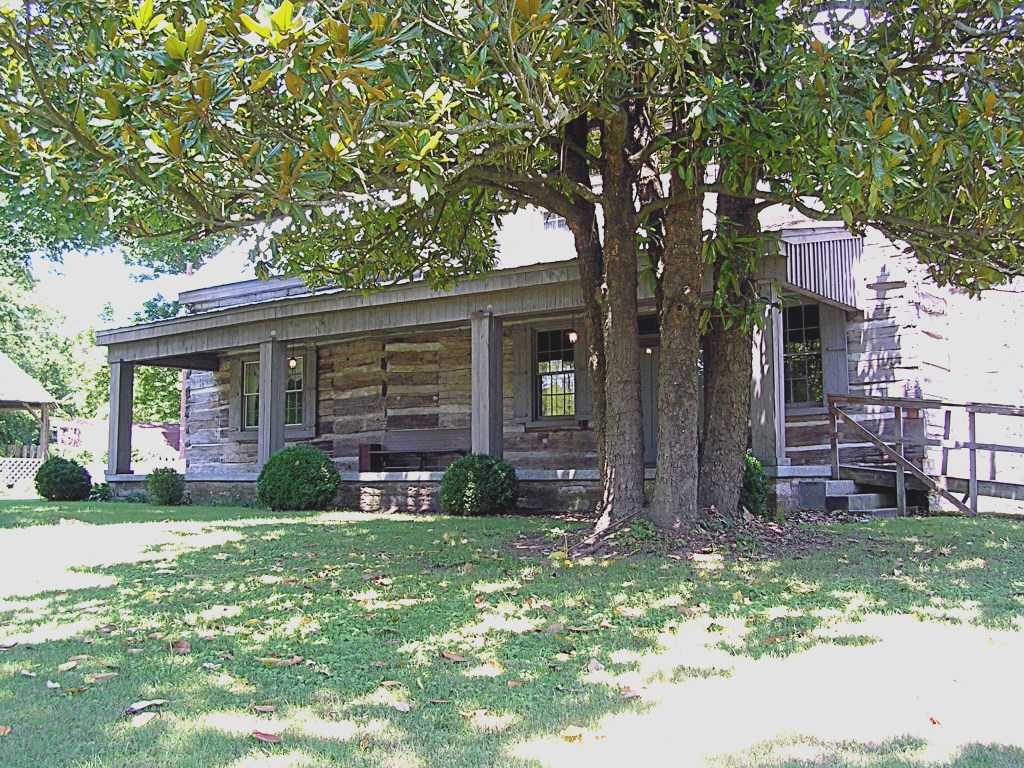
Members of the Buchanan family have been part of Nashville history from the beginning. Alexander Buchanan died in 1781 in the “Battle of the Bluff,” protecting Fort Nashborough from an Indian attack. Major John Buchanan was living in Buchanan’s Station by 1784. Archibald Buchanan moved his family to the area from Augusta County, Virginia, in 1785 to take charge of a 640-acre land grant called Clover Bottom. When Archibald died in 1806, his son James, who had spent his early years farming this land, inherited half the property (his uncle Robert Buchanan received the remainder), and purchased 310 additional acres from Thomas Gillespie’s original land grant “on Stone’s River.” This second property, which was not adjacent to Archibald’s grant, included the McCrory’s Creek area where James built what we now know as the Buchanan Log House. Eventually James Buchanan sold his share of Archibald’s property to John Hoggatt, who purchased the other half from Robert Buchanan’s heirs.
James was 46 years old when he finished the three-room log structure in 1809, about 50 years before the Two Rivers and Clover Bottom mansions were completed. A year after completing the house, James married 17-year-old Lucinda “Lucy” East and moved his young bride into the house, where the first of their sixteen children was born in 1811. Their home was one of the earliest log structures built in Middle Tennessee and is one of the few examples of two-story log construction still on its original foundation.
The original building exhibits construction techniques typical of frontier houses. Resting on solid unmortared limestone, the half-dovetail notched logs are chestnut, oak, and yellow poplar. The two-story single-pen original structure measures 18 by 26 feet, with exterior limestone gable-end chimneys flanked by double-hung sash windows. The two-room first floor has a 10-foot ceiling with exposed beaded poplar floor joists. A “ladder” stairway led to the upstairs room, which features a fireplace with an unusual arched limestone lintel marked by an incised keystone.
By 1820, after ten years of marriage, James and Lucy already had eight children. Needing more space, they constructed a one-and-a-half-story addition measuring 16 by 18 feet. This addition, with an exterior gable and a limestone chimney, created what is known as a saddlebag-type house. Even with the new section, the floor space still totaled only about 1430 square feet, into which they crowded eight more little Buchanans over the next few years. All sixteen children lived to adulthood, and many remained in the Donelson-Hermitage area, where a number of their descendants live today.
Because of the Buchanans’ land holdings and the number of slaves they held – about 15 – the family would have been considered quite wealthy for the period, falling into the upper 10% of the population.
When James Buchanan died at the age of 78 in 1841, he became the first person to be buried in the Buchanan Cemetery* across the road from the house. His tombstone carries this inscription:
Farewell my friends, as you pass by As you are now, so once was I As I am now, so you must be Prepare to die and follow me.
With the help of Addison, her fourth child, Lucy kept the farm going for another 24 years after her husband’s death. She died in 1865, at the age of 73, and was buried near her husband. Her epitaph echoes his:
As thou hast said, I follow you As all the rest must shortly do Then be not guilty of any crime So you may live in heaven sublime.
Her faithful son Addison received a 50-acre plot 1/4 mile east of the family home, where he built a two-room log house (one room downstairs, and one room up). This building has been moved to the 2910 Elm Hill Pike location, just behind the main log house. The move required “chopping” the roof so it could pass under the power lines, and taking the chimney apart, stone by stone, to be rebuilt at the new location. Renovating the Addison Buchanan house included removing the siding to expose the cedar logs and to repair or replace the chinking.
Soon after Lucy’s death, just as the Civil War ended, the property (except for the one-and-a-half-acre Buchanan cemetery) was purchased by Thomas Neal Frazier, a criminal court judge for Rutherford and Davidson counties. Frazier, a Union sympathizer, was impeached by the Tennessee General Assembly in 1866 for a conflict involving the 14th Amendment, but the impeachment was overturned in 1869. Judge Frazier’s son, James B. Frazier, who was a 10-year-old boy when the family moved into the log house, was elected governor of Tennessee in 1903. His administration is remembered primarily for advances in public education. He resigned as governor in 1905 to complete the term of U.S. Senator William B. Bate, who had died in office. Frazier was elected to three more terms in the Senate but lost to Luke Lea in 1911 and returned to his law practice in Chattanooga. Governor Frazier’s mother, Margaret McReynolds Frazier, lived on in the Log House until her death in 1910. Living with her were her daughter Sarah, with her husband John Harris, and Sarah’s brother Samuel J. Frazier, with his wife Fannie (Whitworth) and their son Neal, who later became a professor and dean at MTSU. Sarah, John, and Samuel, who lived on in the house for close to twenty years after Margaret’s death, all eventually died there. Neighbors referred to the house for years thereafter as the “Frazier place.”
Since 1927 the names on the mail box at 2910 Elm Hill Pike have included Payne, Richardson, Stark, Hudson, Keathly, Williams, and Greer, each of whom made a few changes and additions to the house. In May 1992 the property was purchased by the Metropolitan Nashville Airport Authority, who soon transferred it to the Association for the Preservation of Tennessee Antiquities (APTA), a statewide organization dedicated to the restoration and care of historic sites. Located seven miles from downtown Nashville, the Buchanan Log House is now managed by volunteers from the Donelson-Hermitage Chapter of APTA. Three of James Buchanan’s children married Whitworth siblings, and their descendants care for the Buchanan cemetery to this day.
*Note: this is not the same as the Buchanan’s Station Cemetery.
Frank Goodman, an expert accountant and one of Nashville’s hardest-working educators, was born in Cleveland, Ohio, on Christmas day 18541 to blacksmith Vincent L. Goodman and his wife, née Jane Lewis, whose Welsh Quaker ancestors had followed William Penn to Philadelphia.2 Jane died shortly after Vincent’s return from the Civil War, and young Frank worked his way through Bryant & Stratton’s Business College, where he and Platt Rogers Spencer Jr., son of the developer of Spencerian script, became lifelong friends.3
Photograph of Frank Goodman, p. 448, Official History of the Tennessee Centennial Exposition. Press of the Brandon Printing Co., 1898, Herman Justi, ed.
Around 1874 Goodman arrived in Nashville to teach penmanship4 and was soon employed by Ward’s Seminary5 and by Toney’s Nashville Business College, which then served as the business department of Cumberland University.6 In 1878 the college’s board of directors removed the Rev. Thomas Toney as principal, appointing 24-year-old Frank Goodman to reorganize the failing establishment.7 Incorporated in 1881 as Goodman’s Business College (sometimes called “Goodman & Eastman”), it was a respected Southern institution for over twenty years, with a branch college in Knoxville.8Goodman’s Book-keeping Simplified became a widely used textbook,9 and author Frank Goodman was credited with introducing bookkeeping as a course of study in the Nashville public schools.10 In the margin of his personal copy of Goodman’s Book-keeping Simplified, William Alexander Provine, renowned Cumberland Presbyterian minister and official of the Tennessee Historical Society, noted that many of the names used in the book’s exercises were those of fellow Nashvillians, including the ten-year-old boys Frank had taught in Sunday school . . . one of whom was the young Provine himself!
A member of the State Board of Education from 1880-1903, Frank Goodman replaced John Berrien Lindsley as secretary after 188711 and served on the committee which named Peabody Normal College.12 He represented an Edgefield district on the Nashville City Council from 1894-190013 and served as auditor of the 1897 Tennessee Centennial Exposition.14 Secretary-treasurer of the State Teachers Association for seventeen years,15 he also chaired the finance committee for Nashville’s first Labor Day observance in 1894.16
In July 1880 Frank Goodman married Pattie Sims,17 daughter of Edgefield insurance agent Leonard Swepson Sims. All four of their sons would eventually become successful businessmen. Active in the Masons and the Knights Templar,18 Frank was treasurer of the United Order of the Golden Cross,19 a temperance-based insurance fraternity, and taught Sunday school in the Cumberland Presbyterian Church.20
Pattie Sims Goodman with granddaughter, 1904 (from NHN collection)
By the end of the 1890s, his hearing failing, Goodman closed the college and worked as an expert accountant, appearing as a witness in court cases across the country. His testimony resulted in, among others, the conviction of the Mississippi State Treasurer for embezzling $315,000 from the state coffers.21 He audited the Tennessee State Comptroller’s and Treasurer’s records at least seven times,22 helped the city of Chattanooga reorganize its financial records,23 and reportedly audited the books of the U. S. Treasury in Washington, D.C.24
When the Reverend John B. Morris of St. Mary’s Church in Nashville was selected Bishop of Little Rock in 1906, he took Frank Goodman with him as diocesan auditor.25 Pattie, quite ill by then, received medical treatment in Hot Springs but died in 1909.26 Her body was brought back to Nashville for burial. Eight months later Frank himself died mysteriously on July 28, 1910, following an excessively hot mineral bath at Hot Springs.27 On July 30 the body of the man St. Louis Magazine had described as “the rising young businessman of the South”28 was brought home to Nashville by his young sons and laid to rest beside Pattie in Mt. Olivet Cemetery.29
Frank Goodman’s pallbearers included Tennessee Secretary of State Hallum W. Goodloe; George W. Stainback, Chairman of the Nashville Board of Public Works; Nashville City Assessor Roger Eastman, a longtime business partner; John W. Paulett, newsman and Assistant Superintendent of Public Instruction; Dr. William H. Bumpus, President of the American Local Freight Agents Association, renowned orator, and past Grand Master of the Tennessee Masons; Dr. William E. McCampbell, the Edgefield physician who had delivered the Goodman children; Marcus B. Toney, Civil War veteran and author; and Sumner Cunningham, fractious editor of theConfederate Veteran, who wrote his friend a tender eulogy in “The Last Roll,” despite the fact that, at the outbreak of the Civil War, his subject had been a seven-year-old Yankee boy! (2014)
NOTES AND SOURCES:
1 Richard, James Daniel. Tennessee Templars: A Register of Names with Biographical Sketchesof the Knights Templar of Tennessee. Nashville: Robert H. Howell & Co., 1883, 78.
2 Glenn, Thomas Allen. Merion in the Welsh Tract: With Sketches of the Townships ofHaverford and Radnor. Herald Press, 1896, 236 ff.
3 Goodman’s son Leonard owned a photograph of the Goodman and Spencer families taken during a Nashville visit in the 1890s, according to an interview with Leonard’s daughter, Kathleen Goodman Bowman about 1995.
4Catalog of Cumberland University, Lebanon, Tennessee, 1874-75. Lebanon, TN: R. L. C. White, University Printers, 1875.
5 Nashville City Directory, 1877 and 1878.
6Annual Report of the Department of the Interior, 1875, 605, footnote.
7 Clayton, W. W. History of Davidson County, Tennessee. Philadelphia: J. W. Lewis & Co., 1880, 270-271.
8 Nashville City Directory, 1883, advertisement opposite p. 568.
10 “Frank Goodman, Sr., Dead.” Nashville American, July 29, 1910.
11State Board of Education Minute Book #56, page 27, May 24, 1887. Tennessee State Library and Archives, Record Group #91, Vol. 56.
12State Board of Education Minute Book #56, page 53, February 15, 1888, and page 57, May 31, 1888.
13 Nashville City Directories.
14 Justi, Herman, ed. Official History of the Tennessee Centennial Exposition. Press of the Brandon Printing Co., 1898, 31.
15 “Tennessee Teachers: How the Association Feels About Prof. Goodman’s Resignation as Secretary.” Nashville American, August 1, 1897, 6.
16 “Prof. Frank Goodman: Labor Day Committee Thanks Him for His Efforts.” Daily American, September 7, 1894, 3.17 “The Nuptial Knot,” Daily American, July 21, 1880.
17A There were no wedding attendants (bridesmaids or best man), but the ushers were an interesting cross-section of friends:
Charles B. Glenn was listed in the 1880 Nashville City Directory as a bookkeeper for the Nashville, Chattanooga & St. Louis Railway. He lived at 357 Broadway. By 1906 he was paymaster for the NC&StL. One wonders whether he might have been a Goodman graduate.
Robert T. Creighton was a surveyor at this time, but he later became city engineer and was a partner with Wilbur F. Foster in Foster & Creighton, civil engineers and contractors, #3 Berry Block.
Robert A. Fraley Jr. was a clerk at Collier, Fraley & Co., cotton factors and commission merchants, a business owned by his father. He was later bookkeeper for the National Manufacturing Company and may also have been a Goodman student.
Henry C. Jameson, originally from Hickman, Kentucky, was listed in the 1880 Census, along with Herbert W. Grannis, as one of Frank’s housemates at #7 Summer St. (5th Ave.). [Other residents in what was apparently a men’s hotel or boarding house included the brothers George and Robert Cowan (who owned Cowan & Co., wholesale notions & white goods at 36-37 Public Square), Van Buren Dixon (a dentist, with an office at 93½ Church), Porter Rankin (William Porter Rankin, with his brother David P., owned Rankin & Co., wholesale clothing at 57 Public Square.), W. S. Duckworth (who owned WS Duckworth & Co., books, stationery, cigars, tobacco, and railroad tickets, at 4 S. Cherry and also the corner of N. Cherry and Union), Samuel N. Warren (a bookkeeper who worked at 43 N. College), and Robert Fletcher (a salesman).] Goodman, Jameson, and Grannis all listed their occupation as “teacher,” and we know from Clayton’s History of Davidson County that all three were faculty members in Goodman’s Business College. Jameson was listed in the 1876 Cumberland University catalog as a student at the Business College there. The 1878, 1879, and 1880 Nashville City Directories say he was a professor at the business college in Nashville. The 1878 book terms it “F. Goodman & Co’s College”; 1879 lists it as “Goodman’s Nashville Business College”; and in 1880 it is simply “Nashville Business College.” In 1878 he boarded at 95 Church St., and in 1879-1880, at 24 S. Summer. In 1887 the City Directory describes him as a teacher at Goodman & Eastman’s Business College, living two miles from Nashville on Chicken Pike (today’s Elm Hill Pike).
17B The Goodman-Sims wedding in the First Cumberland Presbyterian Church was somewhat unusual, in that it took place at 7:00 a.m. According to the news item in the American, many of the couple’s friends – including the youngsters in Frank’s Sunday school class, accompanied them to the train station to give them a rousing send-off as they left on their honeymoon trip to Louisville, Cincinnati, Cleveland, and Chicago.
18 Richard, James Daniel. Tennessee Templars: A Register of Names with Biographical Sketchesof the Knights Templar of Tennessee. Nashville: Robert H. Howell & Co., 1883, 78.19 Nashville City Directories.
20 “Obituary: Funeral of Prof. Frank Goodman,” Nashville American, July 31, 1910; also mentioned in July 29, 1910, story; see footnote 21.
21 “Frank Goodman, Sr., Dead.” Nashville American, July 29, 1910.
22 “Prof. Goodman’s Reappointment,” Nashville American, January 23, 1903, 1. At least two of his audit reports are reproduced in their entirety in Senate Records: Tennessee Senate Journal 1895, pages 89-100, and Tennessee Senate Journal 1903, pages 755-805.
23 “Chattanooga City Books to be Overhauled by an Expert.” Daily Journal and Journal andTribune (Knoxville), January 7, 1890.
24 “Frank Goodman, Sr., Dead.” Nashville American, July 29, 1910. This is also mentioned in Cunningham, Sumner. “Frank Goodman,” Confederate Veteran, Vol. 18: 1910, 382.25 “Former Citizen of Nashville: Prof. Frank Goodman Passes Away in Little Rock – Interment Here Saturday,” Nashville Banner, July 29, 1910.26 “Mrs. Frank Goodman Dies in Arkansas,” Nashville Banner, November 1, 1909.
27 Special dispatch to the American, July 29, 1910. This follows the article, “Frank Goodman, Sr., Dead.” Nashville American, on the same date. Similar information appears in the article “Goodman Funeral Saturday Morning,” Nashville Banner, July 29, 1910.
28 Nashville City Directory, 1883, advertisement opposite p. 568.
29 Participants in Frank’s funeral, most (if not all) of whom were fellow Masons/Knights Templar:
Rev. George W. Shelton was the pastor of the Russell Street Presbyterian Church at the time of the laying of its cornerstone in 1904. The Cumberland Presbyterian described him as “a young man of energy and enthusiasm.”
Rev. William A. Provine (1867-1935) (who as a boy had been a member of the Sunday school class taught by Frank Goodman) assisted in the funeral. He had attended Vanderbilt and earned a Bachelor of Divinity from Cumberland University, which later awarded him an honorary degree of Doctor of Divinity. A widely respected minister of the Cumberland Presbyterian Church, he served as Superintendent of the Presbyterian Board of Publication and Sabbath School Work and Treasurer of Mission Work for the Synod of Tennessee. He was for many years corresponding secretary of the Tennessee Historical Society and editor of its journal.
Sumner Cunningham (1843-1913) was a sergeant in Company B, 41st Tennessee Infantry. He was the editor and publisher of The Confederate Veteran and lived at the Maxwell House. He was instrumental in fundraising for the monument to Confederate hero Sam Davis that was unveiled near the Tennessee Capitol in June 1909.
Attorney Hallum W. Goodloe (1869-1956) was Tennessee’s Secretary of State at the time of Frank Goodman’s funeral. He was Clerk and Master of Crockett County Chancery Court (1891-1901); Chief Clerk to the TN Secretary of State (1901-1907); Secretary of State (1909-1913); Private Secretary to Gov. Tom C. Rye (1915-1918); Assistant to the Superintendent of Banks (1918-1929); Chief Clerk to State Treasurer (1929-1931); and Deputy Superintendent of State Banks (1931-1949).
George W. Stainback (1842-1918) was the chairman of the Nashville Board of Public Works and Affairs, a very powerful three-man group. Members were required to abstain from other active employment – they received a salary for their work – and were ex officio members of the City Council. They hired city laborers and department heads; oversaw streets, sewers, and public property; supervised the laying and removal of railroad tracks on city streets; and prepared an annual operating budget. Stainback was a lodge brother of Frank Goodman in the UOGC. He was honored by having a portrait of his face displayed in fireworks at the 1897 Tennessee Centennial.
Roger Eastman (1858-1938), youngest son of Elbridge Gerry Eastman and Lucy Ann Carr, was a banker, rising to the position of assistant cashier [in those days a cashier was a bank manager] with the First National Bank. He was Frank Goodman’s business partner in both the college and the accounting business. He was probably Frank’s closest friend – Frank named two children after him (Frank Eastman Goodman, 17 July 1881 – 29 December 1882, and Roger Eastman Goodman, 14 April 1895 – 29 April 1953). He served several terms as Nashville Tax Assessor, beginning in 1898. He was an active Mason (elected worshipful master of Phoenix lodge at the age of 23), a member and auditor of the Baptist Sunday-school board, treasurer of the First Baptist church, and vice-president of the Nashville Athletic Club. His biography was included in John Allison’s Notable Men of Tennessee (1905).
Dr. William E. McCampbell (1854-1924) had a medical office at 523 Woodland Street in East Nashville. He was the physician who had reported Roger Goodman’s birth in 1895 so had probably delivered him. He served on the Nashville City Board of Health for many years and was elected its chairman in 1911.
Captain Marcus Breckenridge Toney (1840-1929) was a convinced Methodist, Confederate, and slavery partisan who became an early volunteer for Confederate service. He served with the 1st Tennessee Volunteer regiment in campaigns in West Virginia and at Shiloh, Chickamauga, and the Wilderness, where he was captured. He was the author of The Privations of a Private (1905), which described his experiences as a Federal P.O.W. in the Union prison camp at Elmira, New York, as well as the war’s immediate aftermath and the growth and appeal of the Ku Klux Klan, which he had joined after the war. He was an active member of the Masonic fraternity and worked with W. H. Bumpus to found the Masonic Widows’ and Orphans’ Home, which was incorporated in 1886.
John W. Paulett, who was a Knoxville textbook salesman when he first met Frank Goodman in the early years of Goodman’s Business College, was Assistant Superintendent of Public Instruction around the turn of the century, and later worked as a newspaper correspondent. He was appointed by the governor to serve on the Board of Visitors of the University of Tennessee.
Dr. William Hill Bumpus (1843-1926) one of Frank Goodman’s closest friends, is actually buried in the Sims-Goodman plot at Mt. Olivet. Trained as a physician and a lawyer, he was the local agent for the Louisville & Nashville Railroad for 52 years, serving for a time as the president of the National Association of Local Freight Agents’ Associations. An active Mason, he was the editor and publisher of the Tennessee Mason and a sometime-writer for the Nashville American. He and Marcus Toney were the driving force behind the Masonic Widows’ and Orphans’ Home. He was elected Grand Master of the Grand Lodge of Tennessee, Free & Accepted Masons, on January 26, 1898.
[Note: Bumpus, Eastman, McCampbell, Paulett, and Stainback had also served as pall bearers for Pattie Goodman in November 1909.]
SUGGESTED READING:
Clayton, W. W. History of Davidson County, Tennessee. Philadelphia: J. W. Lewis, 1880.
Goodman, Frank. Goodman’s Book-keeping Simplified. A Work Thoroughly Explaining theTheory of Single and Double Entry. Nashville: Wheeler & Osborn, 1882. (A copy is available in the Tennessee State Library and Archives.)
The Calvert family came from Yorkshire, England, where Ebenezer and Peter Ross Calvert studied at the famed South Kensington Art School. In 1873, following the death of his mother, Ebenezer immigrated to Wilson County, Tennessee, upon the advice of a dentist he had met in England. Two years later Peter Ross and Rhoda Calvert, Ebenezer’s siblings, also made the transition and soon persuaded Ebenezer to move to Nashville.
The brothers became involved in Nashville’s art community, and in 1889 they appeared in the city directory as “Calvert Brothers: Portrait Painters, Draughtsmen, and Teachers of Art.” In 1896 they, along with S. A. Taylor, purchased Rodney Poole’s well-known photographic studio. During his ownership (1870-1896), Poole had advertised the studio as “of a superior quality . . . the best artists employed. Elegant rooms, and the finest arrangement of light in the South.”
Calvert Brothers & Taylor, located at the corner of Cherry and Union Streets, continued their partnership until the Calverts purchased Taylor’s interest in 1900. The studio then operated as Calvert Brothers until Peter Ross died in 1931, seven years after Ebenezer’s death.
During their era, the Calvert brothers helped shape the way many Nashvillians would remember their children, their weddings, their homes, and their friends. In addition, the Calverts were often commissioned to copy pre-existing photographs, and many of the resulting copy negatives are today among the most historically valuable negatives at the Tennessee State Library and Archives. These include the earliest known image of the Public Square, images of the wharf and Front Street, the Polk home, the State Capitol, and numerous local scenes. These images document the layout of the city, its growth and its values, and typify what the citizens of Nashville thought worth showing to future generations.
Though art was important, religion came first with Ebenezer, Peter Ross, and Rhoda Calvert. Once the brothers canceled a contract with Vanderbilt when the school asked them to work on Sundays, a thought unfathomable to them. The Calverts established ties to Nashville’s Baptist community, and they were instrumental in forming the Immanuel Baptist Church. In A History of Immanuel Baptist Church, 1887-1986, author Dr. Gaye L. McGlothlen quotes one church member who described Peter Ross as “the saintliest man in the world.” Both theNashville Banner and The Nashville Tennessean placed Peter Ross’s obituary on the front page of their January 12, 1931, edition, each commenting on his Christian character and his role in the community.The Nashville Tennessean noted that the photographer “won for himself a place in the hearts of thousands of Nashville people.”
After the Calvert brothers’ deaths, control of the family studio passed to Ebenezer’s daughters—Bertha, Zillah, and Mary. The daughters ran the business with few changes, but concentrated on children’s photographs. Zillah’s obituary explains that ” ‘Miss Zillah’ was noted for her winning way with children as they were being photographed.” According to Bob White, who was employed by the sisters as a photographer, he would photograph the children while one of the sisters, usually Zillah, would pose and entertain them.
Five-year-old Florence Puryear Sims, 1899. (from the photo collection of the Nashville Historical Newsletter)
When the sisters retired in 1964, White purchased the studio and continued to run it under the Calvert name. Still a family business, Calvert Photography is located in Burns, Tennessee, and is now operated by Bob’s son and daughter-in-law, Bill and Scotty White. (1999)
In 1912 at age 25, my father, Ernest A. Pickup, set out on two journeys–marriage and a profession as a commercial artist. When he told his father about his career plans, his father responded, “Son, you go with my blessing, but if you don’t succeed, don’t come back to me looking for a job.” The family had moved to Nashville in 1902 and had established G.A. Pickup & Son, a rubber stamp business that is still in existence. While working for his father, in his spare time his mother allowed him to hide in the attic of their home, where he studied a correspondence course on the basics of art.
Block print of Nashville’s Parthenon by Ernest Pickup (Courtesy of Beverly St. John)
The lessons paid off, and he became one of the first commercial artists in Nashville. He was so successful that he needed to keep an apprentice with him in his studio. The first was Herman Burns, who went on to become the Art Director at the Baptist Sunday School Board. Next came Lewis Akin, who became the Art Director for the Methodist Publishing House. Subsequent apprentices included Castner’s Department Store artist Mariah Ferris, Curtis Snell, and cartoonist Bill Wall. Even I was one of his apprentices during my high school and college days. I later worked for Mr. Burns at the BSSB until 1942.
In 1930, when the Great Depression devastated our nation, my father’s commercial work came to a halt. With time on his hands, he began honing the skills necessary to make woodblock prints, an ancient medium that he had long admired. With the encouragement of his artist friends, he submitted his work for an exhibit at the Corcoran Gallery in Washington, D.C. His career as a wood engraver took off, resulting in about 65 woodblock prints made during the 1930s and early 1940s.
One of his greatest honors came in 1937, when the Society of American Etchers chose his print Finis–a Study in Finalities as one of The Best 100 Prints of American Artists, a collection selected to go on a tour of Europe, beginning at Stockholm, Sweden. My father was a very modest man, but when he saw his name listed in the exhibit catalogue next to Thomas Nason, his woodblock hero, he was ecstatic.
His most popular prints were of Nashville landmarks: the Capitol, the Parthenon, the Hermitage, Scarritt Tower, and the Battle of Nashville Monument. He also loved making prints of trees and rural scenes. He used boxwood, a very hard wood with no grain. Woodblocks were made up of two or more pieces of wood glued together. Whenever one would break, he made miniatures out of the pieces, and these are among my favorites. When the curator of the Graphic Arts Division of the Smithsonian saw my father’s work, he asked if we would donate the collection. Because he also wanted the blocks and tools, I turned him down. Some of his work, however, is archived in the Tennessee State Museum.
For over thirty years my father’s art studio was on the 5th floor of the old Cumberland Presbyterian Building, which was located on 4th Avenue about where the AT&T Building is now. When he decided to retire in 1963 at age 76, it was as if his life had come to an end. He could not envision life without his cluttered office, the smell of ink and paint thinner, the whir of the airbrush, or the occasional knock at the door: “Mr. Pickup, I have a job for you–do you think you could do it for us today?”
Then one day the phone rang. Mr. John Ambrose of Ambrose Printing Company called to ask my father if he was willing to join the company as an art consultant “whenever you feel like it.” He “felt like it” until he turned 80, when he announced his full retirement. From then on, he had little interest in anything but sharing stories about his years as an artist, a sometime farmer, a grandfather, and a Sunday School teacher. My father left us a quiet legacy of integrity as well as a collection of woodblock prints. His mother often said of him, “He came into this world drawing pictures on any piece of paper he could get his hands on!.” The year before he died, I found these words that he had written: “Things I want for myself: to be cheerful in the face of difficulties, to merit the esteem of my friends, to be grateful for all that other folks have done for me, and to know no heartache of my own making.”
In the summer of 2002 Alan LeQuire and Lou Reed supervised the gilding of Nashville’s Athena, the tallest indoor statue in the Western world. The statue, unveiled in the Centennial Park Parthenon in 1990, stood large (41′ 10″ tall), white, and incomplete for 12 years. The mission of Nashville’s full-scale replica of the Parthenon is to provide modern visitors a glimpse into the Athenian Parthenon of 438 B.C. Today the gilding project is complete and we are closer to our goal. Remarkably, the project (including gilding and painting) took just over three months, from June 3 – September 5, 2002.
The statue is a re-creation of Athena Parthenos that once stood in the Parthenon in Athens. The Athenian sculptor Pheidias constructed the massive statue from gold and ivory. The statue disappeared around 400 A.D. and little evidence remains to explain what happened to it. However, a number of ancient writings describe the statue before its loss. Sculptor Alan LeQuire studied these writings and relied on historians and his instincts to re-create Athena.
Archaeologists could spend hours discussing the minutiae of LeQuire’s decisions. It is impossible to reproduce the statue to the last detail. No one can duplicate the bridge of her nose; no one can cast a mold of her ancient sandals. She is gone. However, new scholarship circulates and new research stirs lively academic debate.
Kenneth Lapatin, of the Getty Museum, spoke in Nashville on chryselephantine (gold and ivory) statuary on September 23, 2002. His lecture provided listeners the opportunity to learn about the historic precedent of the gilding project. When Lapatin came to Nashville five years ago and saw the ungilded statue, he was politely impressed but expressed relief when he learned that we would not leave the statue white, absent of her gold decor.
The gilded Athena (photo by Gary Layda)
In his lecture Lapatin did not offer a head-to-toe comparison of the two figures. Rather, he explained the extravagance, expense, and purpose of the original compared to our own. For example, the gold plates on the Athena statue in ancient times weighed approximately 1,500 pounds and were one-eighth to one-sixteenth of an inch thick. The 23.75-karat gold leaf on Nashville’s Athena weighs about 8.5 pounds and is three times thinner than tissue paper. Our extravagance pales in comparison to the lavish spending of the Greeks.
Lapatin is especially fascinated with the work of ancient ivory craftsmen. Athena’s exposed skin, mainly that of her face and arms, was mysteriously carved or molded from sheets of ivory. Lapatin has even attempted to duplicate ivory casting on a small scale, but we still may never know the ancient techniques. To create a statue exactly as Pheidias did would be economically impractical today. The craftsmen of Nashville’s Athena painted her skin an ivory color to give the impression of delicately carved bone.
The Greeks’ dedication to Athena motivated them to spend and overspend on her monument. The Parthenon in Nashville is a tribute to the art of the 5th century B.C. Our Athena provides us the opportunity to understand the skill and devotion of the ancient Greeks. Lapatin called her “otherworldly” and, to anyone who sees Nashville’s Athena, the archaeological particulars do indeed seem less important. Like the building in which she resides, Athena is impressive…and as accurate as scholarship allows.
List of Artists (Gilders and Painters) Alan LeQuire Lou Reed Allison Byrd Amy Calzadilla Micki Cavanah Smith Coleman Patricia H. Coots Carol Lynn Driver Jenny Gill Susan Jane Hall Susan Harris Charlotte A. Hester Shana H. Keckley Margaret A. Krakowiak Dennis C. Lake Patrick J. Paine Andrew Rozario Jean B. Spencer Luke C. Tidwell






 Nashville Historical Newsletter