The Battle of Nashville: Shy, Smith, and Hood

by Doris Boyce.

A detail in the death of a Williamson County Civil War hero was clarified after Colonel William Shy’s grave was vandalized in 1977. Before that time, it was believed that Shy had been killed by a mini-ball shot from a muzzle-loading firearm during the Battle of Nashville, December 16, 1864. When anthropologist Dr. William M. Bass (founder of the University of Tennessee’s “Body Farm”) reconstructed the wound in Shy’s skull, he found that the wound was too large to have been caused by a mini-ball. Shy’s wound was more likely the result of the bombardment that Nashville citizens had watched from Capitol Hill.

William Mabry Shy, Colonel of the 20th Tennessee, was left dead on the top of what was then Compton Hill. When his body was recovered, it had been stripped and bayoneted to a tree. His descendants are still in possession of the bayonet. General Benton Smith*, Shy’s superior officer, was taken prisoner at the bottom of the hill, where his captor cracked him over the head three or four times with a saber. He never entirely recovered and ended his life in an insane asylum.

General John Bell Hood, Confederate commander of the battle, appeared to associate valor with casualties. Hood was a none-too-stable combat veteran who had to be tied onto his horse because of a useless arm and an amputated leg. Sixteen days earlier, on November 30th, Hood had attacked the Union Army in the bloody one-day Battle of Franklin, which had resulted in 6,000 Confederate losses.

The Battle of Nashville thrust 21,000 of Hood’s ill-equipped infantry and 4,000 cavalry against General George H. Thomas’s well-equipped Union infantry, about 60,000 strong. The fighting took place in the hills near the present-day intersection of Granny White Pike and Harding Place/Battery Lane, ultimately spreading over five miles, from Franklin Road to Hillsboro Pike. The Union bombardment lasted for two days before their troops attacked with overwhelming force. Confederate survivors limped away as best they could after suffering some 4,000 casualties. After the Battle of Nashville, Hood, a West Point graduate who believed in frontal attacks with flags flying, retreated to Mississippi. In January of 1865, less than one month later, he gave up command, having all but destroyed the Army of Tennessee. Hood died in relative obscurity after ten years as a successful New Orleans businessman.

Confederate kepi

Thankfully, the valor of the Confederate dead will not be forgotten. In 1968 the Metro Historical Commission placed a plaque at the slope of Compton Hill, which has been re-named Shy’s Hill. The area can be accessed via Shy’s Hill Road or Benton Smith Road from Harding Place, two blocks west of Granny White Pike.


* Gen. Thomas Benton Smith, who had been gravely wounded at Stones River (31 Dec 1862-2 Jan 1863) and Chickamauga (18-20 Sep 1863), returned to military duty after his eventual recovery. As Smith surrendered to Union Col. William L. McMillen during the Battle of Nashville, McMillen attacked the disarmed general savagely with his own sword, causing such severe brain injuries that Smith was at first not expected to survive. Although he eventually recovered sufficiently to return to his pre-war job at the Nashville & Decatur Railroad, he was eventually confined in a Nashville insane asylum, where he lived for most of his last 47 years. He is buried in Confederate Circle at Mt. Olivet Cemetery.


Editor’s note: When this essay was published earlier on another site, a reader strenuously objected to its characterization of General John Bell Hood. We understand that other views of Hood’s tactical wisdom and effectiveness are certainly possible. Hood was a complex individual whose actions have engendered both hostility and admiration among those who have studied his military career. The points of view expressed in this essay are those of its author, but other positions may be equally valid. We encourage any reader to submit an essay detailing your own perspectives on Hood, particularly as they relate to the Battle of Nashville.   

John Berrien Lindsley, 1822-1897

by Kathy B. Lauder.

Born October 24, 1822, John Berrien Lindsley came to Nashville in 1824, when his father, Philip, became president of the University of Nashville. Young Lindsley was educated at home by his parents and a neighbor, Septima Sexta Rutledge.1 At 14 he entered the University of Nashville, earning a B.A. at 17 and an M.A. two years later.2 In 1842 he entered the University of Pennsylvania Medical School, receiving his M.D. in March 1843.3 Here Lindsley began a lifelong friendship with adventurer William Walker.4

Dr. John Berrien Lindsley

Lindsley’s next pursuit was theology: in December 1843 the Nashville Presbytery accepted him as a candidate for the ministry.5 He was licensed to preach in April 1845,6 shortly before attending to Andrew Jackson at his deathbed.7 Lindsley ministered to churches at the Hermitage and in Smyrna and, beginning in 1847, preached to slaves and the poor.8 An 1849 cholera epidemic9 kindled his interest in public health.

When Philip Lindsley left the University of Nashville in 1850, his son John Berrien became Chancellor. He proposed to rescue the faltering university by merging with the Western Military Institute of Georgetown, Kentucky,10 and by establishing the long-awaited medical school. Though apprehensive, Board members permitted the merger.  Lindsley spearheaded the development of the medical school in 1851, became its first dean, and taught there until 1873.11 [Note: the following year the University of Nashville Medical School was incorporated into Vanderbilt University, which had been founded in 1873 by virtue of a grant from Commodore Cornelius Vanderbilt. From that point on, it would be known as the Vanderbilt University School of Medicine.]

In 1857 Lindsley married Felix Grundy’s granddaughter Sarah “Sallie” McGavock, with whom he had six children. He served on the Nashville Board of Education and was secretary of the State Board of Education, administering the Peabody Education Fund and overseeing the transition of the University of Nashville into Peabody College.12 Having received a Doctorate of Sacred Theology from Princeton (1858), he lectured in the Cumberland University Theological Department in Lebanon.13

Following the capture of Fort Donelson (February 1862), Lindsley became post surgeon of Nashville hospitals. His valiant efforts to protect university property during federal occupation saved the library, laboratory equipment, and the valuable Troost mineral collection.14 

After the war, Lindsley served on the Nashville Board of Education and was superintendent of Nashville public schools. He helped establish Montgomery Bell Academy (1867) and the Tennessee College of Pharmacy (1870),15 and in 1875 presided over the State Teachers Association. Having promoted the passage of an 1877 law establishing the State Board of Health, he served as its first executive secretary.16 As Nashville Public Health Officer from 1876-1880, he supervised all health efforts in Tennessee during the 1878 yellow fever epidemic.17 He taught Sanitary Science and Preventative Medicine at the University of Tennessee from 1880-1897.18

Dr. John Berrien Lindsley in later life.

Distressed by wartime divisions within the Presbyterian Church, Lindsley became a minister in the Cumberland Presbyterian Church in 1874.19 He authored History of the Law School of Cumberland University at Lebanon, Confederate Military Annals of Tennessee, and many works on medicine and public health. He was an early member of the Tennessee Historical Society and a fellow of the American Academy of Medicine.20 His many talents led Alfred Leland Crabb to call him the “Benjamin Franklin of Nashville.”21           

John Berrien Lindsley died December 7, 1897, in Nashville. He is buried in Mt. Olivet Cemetery. (2014)


SOURCES:

1 Windrow, John Edwin. John Berrien Lindsley, Educator, Physician, Social Philosopher. Chapel Hill: University of North Carolina Press, 1938, 8.

2 Lindsley, John Berrien. Diary, Volume 4, 1849-1856.  Lindsley Family Papers, ca. 1812 – [1840-1940] – 1953, Box 1, Folder 21.  Tennessee State Library and Archives.

3 Windrow, 11.

4 Lindsley, John Berrien. Letter to Adrian Van Sinderen Lindsley, April 8, 1843. Lindsley Family Papers, ca. 1812 – [1840-1940] – 1953. Oversize folder (49). Tennessee State Library and Archives.

5 Lindsley, John Berrien. Diary, Volume 4, 1849-1856.

6 Windrow, 12.

7 Lindsley, Philip. Journal. Lindsley Family Papers, ca. 1812 – [1840-1940] – 1953, Box 2, Folder 33. Tennessee State Library and Archives.

8 Lindsley, John Berrien. Diary, Volume 4, 1849-1856. 

9 Pyle, G. F. “The Diffusion of Cholera in the United States in the Nineteenth Century,” Wiley Online Library, accessed 1-4-2014.  http://onlinelibrary.wiley.com/doi/10.1111/j.1538-4632.1969.tb00605.x/pdf

10 Conkin, Paul K. Peabody College: From a Frontier Academy to the Frontiers of Teaching and Learning. Nashville: Vanderbilt University Press, 2002, 83.

11 John Berrien Lindsley Papers, Collection No. 41. Vanderbilt University Medical Center. The Annette & Irwin Eskind Biomedical Library, Special Collections: Accessed 1-5-2014.  http://www.mc.vanderbilt.edu/diglib/sc_diglib/biopages/jlindsley.html

12 State Board of Education Records, 1815-1958. Record Group 91, Volume 55, 1875-1885. Tennessee State Library and Archives.

13 John Berrien Lindsley Papers, Vanderbilt University.

14 Crabb, Alfred Leland. The Historical Background of Peabody College. Nashville: George Peabody College for Teachers, 1941, 20-21.

15 John Berrien Lindsley Papers, Vanderbilt University.

16 Lindsley, John Berrien. Diary, Volume 5, October 6, 1856 – January 1, 1866. Lindsley Family Papers, ca. 1812 – [1840-1940] – 1953, Box 1, Folder 23. Tennessee State Library and Archives.

17 Windrow, 140-141.

18 Windrow, 159-160.

19 DeWitt, Rev. M. B. Letter, March 11, 1898, quoted in Windrow, 13-14.

20 John Berrien Lindsley Papers, Vanderbilt University.

21 Crabb, Alfred Leland. Nashville: Personality of a City. Indianapolis: Bobbs-Merrill, 1960, 95.

SUGGESTED READING:

Conkin, Paul K. Peabody College: From a Frontier Academy to the Frontiers of Teaching and Learning. Nashville: Vanderbilt University Press, 2002.

Crabb, Alfred Leland. The Historical Background of Peabody College. Nashville: George Peabody College for Teachers, 1941.

Windrow, John Edwin. John Berrien Lindsley, Educator, Physician, Social Philosopher. Chapel Hill: University of North Carolina Press, 1938.

Sampson W. Keeble, 1833-1887

by Kathy B. Lauder.

Sampson Wesley Keeble, Tennessee’s first African American legislator, was born May 18, 1833, in Rutherford County.1 His parents were Sampson and Nancy Keeble, slaves of Walter “Blackhead” Keeble, whose 1844 inventory listed 11-year-old Sampson.2 (Walter Keeble referred to his slaves as his servants and reportedly treated them respectfully. His 1816 will specified that his slaves were to be treated kindly, to be educated, and to be freed as soon as the law allowed . . . and that any of his descendants who refused were to inherit nothing at all.) The youngster was bequeathed to newsman Horace P. Keeble, who employed him as a pressman on the Rutherford Telegraph and the Murfreesboro News.3 After the Civil War, during which Sampson probably served as Private H. P. Keeble’s cook, the newly freed slave settled in Nashville and found work as a barber. Part-time employment in a law office helped him pass the Tennessee bar.4 He quickly became a leading citizen of the black community, working with James Napier, Peter and Samuel Lowery, Henry Harding, Nelson Merry, and others to educate black voters and to improve their civic status and security.5 Popular and successful as a barber, he also managed a well-known boarding house, and was believed to be quite wealthy.6 He was a director of the Tennessee Colored Agricultural and Mechanical Association7 and served on one of the few all-black Freedman’s Bank boards in the country.

This bust of Representative Sampson W. Keeble was installed near the House Chamber in the Tennessee State Capitol in 2010. (photo used with permission of the sculptor, Roy Butler)

In 1872 Davidson County Republicans appointed Keeble to run for the Tennessee House of Representatives. Swept into office by the landslide vote for President Grant, he became the first African American to serve in the state legislature. He introduced several bills aimed at improving the condition of black citizens, but none received sufficient votes to pass into law.8 He served only a single two-year term and lost a later bid for reelection (1878).

Sampson Keeble joined other prominent Nashvillians in protesting the upper-level mismanagement and fraud that threatened to topple the Freedman’s Bank,9 but Congressional response was inadequate. When the government failed to insure the existing deposits, the Freedman’s Bank collapsed in 1874, taking with it the life savings of thousands of African American depositors.

Keeble descendants at his historical marker in downtown Nashville. (photo from NHN collection)

Keeble was elected to the Davidson County Court in 1877, serving as a magistrate until 1882.10 He was a delegate to the State Republican convention and served on a number of juries, including a federal grand jury (1881).11

After the death of his first wife,12 he married educator Rebecca Cantrell Gordon. Of the six children born to them, only a son and daughter survived to adulthood.13  At some point in the middle 1880s the family moved to Marshall, Texas, where Sampson Keeble died in June 1887.14 Rebecca brought the children back to Nashville, supporting them as a seamstress. She died in 1923 in a tragic accident at her daughter’s home in Charleston, South Carolina.15 Sampson Keeble is buried with his daughter and son-in-law in Nashville’s Greenwood Cemetery under a stone which reads, “Benjamin F. Cox (1874-1952) – His Wife, Jeannette Keeble Cox (1876-1956) – Her Father, Sampson W. Keeble (1833-1887), First Negro Representative of Tennessee Legislature.”

Keeble-Cox tombstone in Greenwood Cemetery, Nashville.

On March 29, 2010, a bust of Sampson W. Keeble, created by sculptor Roy W. Butler, was unveiled near the House chamber in the Tennessee Capitol. Its base lists all fourteen African Americans elected to the General Assembly during the 19th century. (2014)


SOURCES:

1 McBride, Robert M., and Dan M. Robinson. Biographical Directory, Tennessee General Assembly, Volume II (1861-1901) Nashville: Tennessee State Library & Archives and Tennessee Historical Commission, 1979.     

2 Rutherford County Will and Inventory Book 12, 1844, 432-434 and 558-562.

3 “Representative Keeble,” Nashville Union & American, December 6, 1872.

4 Helen Davis Mills, Keeble descendant, correspondence, 2008.

5 “In Chancery at Nashville,” Nashville Republican Banner, September 3, 1872.

6 “History of a Stolen Watch,” Nashville Republican Banner, October 18, 1871.

7 “The Colored Fair, A Satisfactory Indication of Material Progress,” Nashville Republican Banner, July 16, 1871.

8 Cartwright, Joseph H. The Triumph of Jim Crow: Tennessee Race Relations in the 1880s. Knoxville: University of Tennessee Press, 1976.9 “A Memorial to the Senate and House of Representatives of the Congress of the United States,” Congressional Record, January 15, 1875.

10 “Keeble Still Ahead,” Nashville Daily American, September 2, 1876.

11 “Federal Court Jurors,” Nashville Daily American, March 16, 1881.

12 “Died,” Nashville Republican Banner, June 17, 1870.

13 U. S. Census records.

14 “Death of Sampson W. Keeble,” Nashville Daily American, July 3, 1887.

15 Ancestry.com South Carolina, Death Records, 1821-1960 [database on-line]. Provo, UT, USA: Ancestry-com Operations Inc., 2008.

SUGGESTED READING:

Cartwright, Joseph H. The Triumph of Jim Crow: Tennessee Race Relations in the 1880s. Knoxville: University of Tennessee Press, 1976.

Lovett, Bobby L. The African-American History of Nashville, Tennessee, 1780-1930: Elites and Dilemmas. Fayetteville: University of Arkansas Press, 1999.

Rabinowitz, Howard N. Race Relations in the Urban South, 1865-1890, 2nd ed. Athens, Georgia: University of Georgia Press, 1996.

“This Honorable Body: African American Legislators in 19th Century Tennessee.” Exhibits, Tennessee State Library and Archives.  https://sharetngov.tnsosfiles.com/tsla/exhibits/blackhistory/index.htm


NOTE: Internationally acclaimed sculptor Roy W. Butler, a native Tennessean, was selected by a committee of the Tennessee Arts Commission from a nationwide artist call to create the 1.5-times-life-size bronze sculpture of Representative Keeble.  Mr. Butler is renowned for creating high-realism sculpture: Keeble has been represented with exceptional skin and hair detailing, as well as historically accurate (circa 1873) jacket lapels, vest texture, bowtie, and buttons.

Out of the Ashes of Defeat: The Story of Confederate P.O.W. Edward L. Buford Sr., 1842-1928

by Terry Baker.

In 1865 the South lay in ruins.  Thousands of sick and wounded Confederate soldiers filled the hospitals or remained in prisons.  But out of the ashes of defeat would also come great success stories.

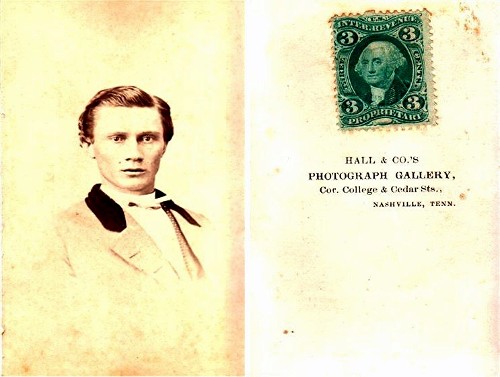
This photo of Ed Buford was taken at Hall’s Photograph Gallery on the Public Square across from the Commercial Hotel, where he boarded. In a King’s City Directory ad, Hall’s proudly stated: “HALL’S Celebrated CARTES DE VISITE Are the most Stylish Pictures made in the City.” The picture can be dated by the revenue stamp above the logo. As part of the Union effort to finance the war, photos were subject to a tax between 8-1-1864 and 8-1-1866. Ed was exchanged at City Point, Virginia, in March 1865, narrowing the date to 1865 or 1866. The original carte-de-visite has the logo and stamp on the reverse side, unlike this modern photomerge.  (from the author’s collection)

Among the ragged, half-starved men who made the long trek home that spring was 23-year-old Edward L. Buford. Born in Williamson County in 1842 to William Wirt Buford and Eleanor Pointer Buford, he was barely 19 when war broke out. The Pointers, his mother’s family, came from Virginia – Ed’s great-grandfather fought there during the Revolution. The family had spread as far west as Arkansas and Louisiana during the decades leading up to the terrible conflict that would destroy the lives and fortunes of so many.

Ed Buford joined the 3rd Tennessee Infantry in May 1861, in the company of neighbors and relatives. Within a year many of them would be among the 9,500 cold, weary, and deeply shocked Confederate prisoners shipped north by steamboat and rail after Fort Donelson fell in February 1862.

Ed’s imprisonment at Camp Douglas, Illinois, ended in September 1862, when his regiment was exchanged at Vicksburg. However, in May 1864 his luck ran out again: he was recaptured in some forgotten skirmish or unrecorded clash of picket posts. Sent to Rock Island, Illinois, he was exchanged again, at City Point, Virginia, in March 1865, and paroled in May.

Young Buford, who had been educated at Spring Hill Academy, launched his post-war career on the banks of the Cumberland River, its wharf stacked high with dry goods, cotton bales, guns, ammunition, foodstuffs, and spirits. In King’s 1866 Nashville City Directory we find him listed as a clerk at Stratton, Pointer & Co., Wholesale Grocers and Cotton Factors, at 9&11 Broad. The eponymous Pointer was Ed’s uncle, Thomas G. Pointer of Spring Hill.

Ed’s situation changed in 1867 when his uncle sold his interest in the business and moved back to his Spring Hill farm. Ed took a job as a clerk for O. Ewing & Co., Importers and Dealers in Hardware, Guns and Cutlery. By 1871 he was a salesman for Ewing, located in the old John Nichol House at 18 Public Square. He had also moved to the Maxwell House Hotel at the corner of today’s 4th and Church. If Ed had been content to remain there for the next 30 years, we might never have heard of him. The 1870 census listed as clerks many ex-Confederate officers from the wealthy land-owning clans of 1860. It was this leveling of social distinction in the post-war South that permitted Ed’s upward mobility. Although small towns and backwaters would cling to the old ways, cities like Nashville were filled with men like Ed who knew themselves to be as valuable as the officers they had obeyed in the late conflict. Moreover, in November of 1875 Ed had made a very good marriage.

William R. Elliston, the son of Joseph Thorpe Elliston, silversmith and former Nashville mayor, owned $235,000 in real estate and $58,500 in personal property, according to the 1860 census. When he died in 1870, he was even wealthier. He left his daughter Lizinka considerable property downtown, as well as the proceeds from the sale of others. When Ed married Lizinka Elliston, they moved into her mother’s house at 32 N High, today’s 6th Ave N. In 1881 Ed built a house on Elliston Street, today’s Elliston Place, where he and his family would live for the remainder of their lives.

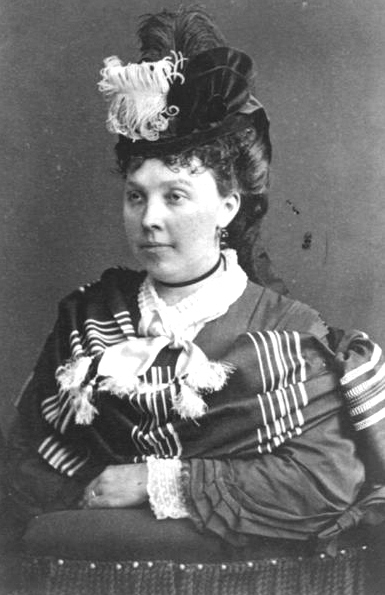
The Baker-Brady family believes this Carl Giers photo from about 1875 to be a portrait of Lizinka Ellison Buford. (from the author’s collection)

During the 1880s and 1890s Ed became a partner in several business ventures, by 1889 operating a company known as Buford Brothers Wholesale Hardware. His brother Charles was a partner until his death, at which time Ed’s brother Brown joined the firm. Edward L. Buford, ex-Confederate POW and former dry goods clerk, had finally arrived.

Along the way Ed and Lizinka had four daughters, one of whom died in infancy, and one son, Ed Jr., who would return from France a celebrated WWI flying ace. The hero’s welcome given to young Ed in March 1919 was marred by sadness when his mother died of pneumonia soon afterwards. Lizinka’s obituary stressed her community work with the YWCA and portrayed her as cultured, sensitive, and tactful – a natural leader. She was buried at Mt. Olivet Cemetery, near her parents, her daughter Louise, and her brother Elijah. In June 1928, after a long illness and confinement, Ed Buford died at age 86 and was buried next to his beloved Lizinka.

I first visited them there one gray, damp, overcast January day. That scene needed only heavy fog or howling winds to conjure up the dim past of their saga. By my second visit a month later, I was among friends, not demigods, and felt more than welcome. We become who we are through the sacrifices, choices, and missed opportunities of the people who passed this way before us. Ed Buford could have come home in 1865 to brood about defeat and the Lost Cause. Instead, he chose the future.


Author’s Notes:

1) I would like to acknowledge the genealogical research of my distant cousins Zee Porter, Linda Pointer, Fred Rowe, and Brian Bivona, who generously shared their files with me. I would never have been able to sort out this huge family without their help. Other data comes from the US Census, Nashville City Directories, Civil War Soldiers’ Records, Widows’ Pension Claims, Mount Olivet Cemetery Records, the Will of W.R. Elliston, and the Nashville Banner.

2) The figure of 9500 prisoners from Fort Donelson may be too low. This was the estimate of Nathan Bedford Forrest’s biographers Jordan and Pryor in 1867, and I accepted it, since it was so close in time to the actual events. Modern historians estimate the number to have been between 12,500 and 13, 500 prisoners. I have also since determined that Ed Buford’s second capture took place at McKernan’s Island near Muscle Shoals, Alabama, according to an account written by Ed’s future brother-in-law Norman Farrell. Farrell wrote of a small cavalry skirmish that took place there within a few days of Ed’s capture. Ed wasn’t alone when he tried to cross the Tennessee River while on leave: with him was William Jackman of Carter’s Tennessee Cavalry, also on leave.

3) Ed Buford fell off a moving train in North Carolina after his exchange in 1865. His injuries were severe enough to delay his return home until July 7, 1865, weeks after the surrenders of Lee in Virginia and Johnston in North Carolina. His second stint as a POW probably saved his life, and his fall from the train, although painful, kept him out of the final battles in North Carolina.

Woodlawn Memorial Park

by Doris Boyce.

A scene in the Forehand compound in Woodlawn Memorial Park (photo from NHN collection)

Woodlawn Memorial Park, a cemetery established in the 1930s and acquired in 1993 by Houston-based Roesch-Patton Corporation, occupies a piece of ground rich in local history. The property, which eventually became known as Melrose, was part of John Topp’s Revolutionary War Grant #461 of November 25, 1788. The original 960 acres were reduced by a sale to Michael Deadrick, first president of the old Nashville Bank. The remaining 205 acres were purchased in 1836 by a United States Senator from Louisiana, who built a mansion there. In December 1865, the property was the site of a field hospital during the Battle of Nashville. Even today a group of log cabins, a spring house, and a man-made pond can be found near the site where the Melrose mansion once stood. Present-day Woodlawn cemetery is part of the 205-acre site that once ran from what is now the Melrose shopping area on Franklin Road to Melrose Avenue between Bransford Avenue and Nolensville Road. 

Melrose Mansion, built in 1836 by Louisiana planter Alexander Barrow II, was sold six years later to John W. Saunders, who died shortly after taking possession of the property. In 1845 Saunders’ widow married Aaron V. Brown, just after his inauguration as the thirteenth governor of Tennessee. Brown, a law partner of James K. Polk (who was elected President the same year Brown became governor), had over a 24-year period served in both the Tennessee State Legislature and the U.S. House of Representatives.  He later served as President Buchanan’s Postmaster from 1857 until Brown’s death in 1859.     

The widow Brown suffered severe financial losses as a result of the Civil War. After her death in 1892, the property, by then only 130 acres, was sold at auction to Godfrey M. Fogg. The house would later pass into the hands of first the Sinclair and then the Bransford families. In time it became the Melrose House Restaurant, which operated in the building until the mid-1970s. Eventually two fires, in 1975 and 1979, destroyed the old mansion.  

A few years earlier, in 1966, the Forehand area of the property took its name, when George and Lillian Forehand leased the stone spring house where the Melrose Mansion’s owners kept milk, butter, and other perishables. They attached their own home to the spring house, which became the Forehands’ living room, with its three-foot thick walls and cork floor.

A plaque beside the spring points out that the Confederate works ran 200 yards south of the Melrose residence; a second marker explains that a Confederate cannon used in the Battle of Nashville was borrowed from the home of Spencer McGavock. The cannon, featured in a photograph taken at the dedication of the memorial in 1969, no longer guards the plaque. The gun’s current location is a mystery. 

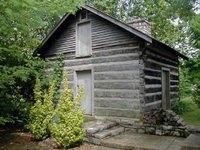
One of the two log cabins on the Forehand property. (photo from NHN collection)

As the Forehand house was under construction, the family acquired two more historic structures: log cabins that had once stood on ground now covered by Percy Priest Lake. Numbered before being dismantled, the logs were transported to their present location, where they were carefully reassembled. In front of one of the cabins is a placard identifying it as “one of the oldest remaining houses from the early American era.” 

The cabins’ original owner, Tennessee pioneer Alexander Carper, came to Davidson County from Virginia and settled in the Cane Ridge community of Antioch. He married in 1825 and built his log home near Mill Creek.  Descendant William Washington “Wash” Carper and his family dedicated the buildings in 1969 to Woodlawn Memorial Park for historical preservation. 

The Forehand enclave nestles among sheltering trees on a bend of the road behind the Woodlawn funeral home. The couple created an idealistic pioneer setting there, ornamented with flowering shrubs and plants blooming in pots and hanging baskets. Cats napped on the porches, ducks swam in the lily pond, and the flag soared proudly above a colorful garden. 

Eventually graves began to encroach upon the Forehand property. After George’s death in 2001, Lillian lived there alone, surrounded by the cemetery. Armed with pistol and shotgun, and under the watchful eyes of the Berry Hill police, she kept the vandals away. Eventually Lillian, too, moved from the house. 

Memorials are created to be visited, contemplated, appreciated, and enjoyed. Today the Forehand compound features the spring and spring house of Melrose Mansion, the two Carper cabins, plaques to remind us of our Civil War past, and a tribute to Governor Aaron V. Brown.  Sadly, few Nashvillians and no newcomers are aware of the existence of this historic oasis within the well-known cemetery.   

Nashville on the High Seas

by Billy J. Slate.

The following summary has been gathered from a variety of U.S. government releases and media clippings.

Five ships bearing the name Nashville have plowed the world’s waters. The first, the Confederate steamer Nashville, originally a brig-rigged passenger steamer, was seized at Charleston after the fall of Fort Sumter and fitted out as a cruiser. With a length of 215 feet and a beam of 34 feet 6 inches, she was armed with two 12-pounders and carried a complement of 40. The Nashville ran the Union blockade on October 21, 1861 and was the first warship to fly the Confederate flag in European waters. She returned to Beaufort, North Carolina on February 28, 1862, having captured two prizes valued at $66,000.

Confederate steamer Nashville, 1861 (All photos on this page are in the public domain.)

The Nashville was then turned over to Frazer, Trenholm and Company to whom she had been sold prior to her return. After use as a blockade runner, she was refitted as a Confederate privateer and commissioned on November 5, 1862 as Rattlesnake. The Federals destroyed her in the Ogeechee River, Georgia on February 28, 1863.

Confederate ironclad ram Nashville, 1864

The Confederate ironclad ram, Nashville, was built at Montgomery, Alabama in 1864. She had a length of 271 feet and a beam of 62 feet 6 inches and was armed with three 7-inch rifles and one 24-pound smoothbore. Although never completed, Nashville had been heavily armored with steel plating and, when surrendered to the U.S. Navy, was believed unable to carry her weight of armor. At the close of the Civil War, she was stripped of her armor and sold at auction in New Orleans.

USS Nashville (PG7), commissioned 19 August 1897

USS Nashville (PG7), a gunboat built at Newport News, was launched on October 19, 1895. Sponsored by Maria Guild of Nashville, she was commissioned on August 19, 1897, Washburn Maynard commanding. With a length of 233 feet 8 inches and a beam of 38 feet 1 inch, she was armed with eight .40 caliber guns, two 6-pounders, two 3-pounders, and two 1-pounders.

This famous warship fired the first shot in the Spanish-American War and played a major part in naval operations in the Cuban area. She also helped put down the Philippine Insurrection and the Boxer Rebellion in China. During World War I, USS Nashville escorted convoys in the Mediterranean to and from Europe and North Africa. At the close of the war, she was decommissioned and sold for scrap.

USS Nashville (CL-43), commissioned 6 June 1938

USS Nashville (CL-43), a light cruiser that served with distinction in World War II, was commissioned on June 6, 1938, sponsored by Ann and Mildred Stahlman of Nashville. Her length was 608 feet 4 inches and her beam measured 61 feet 8 inches. She was part of the task force that pulled off the spectacular Doolittle raid on Tokyo in early 1942. She was chosen as the flagship to transport General of the Armies Douglas MacArthur on his famous, triumphant return to the Philippines. The Nashville was hit by a suicide bomber in the Sulu Sea and suffered grave damage and many casualties. At the end of the war, she was decommissioned and sold to the Chilean Navy.

USS Nashville (LPD 13) commissioned 14 February 1970 (2006 photo)

The final ship to bear our city’s name is USS Nashville (LPD-13), one of a class of ships designated Amphibious Transport Dock. Commissioned at Puget Sound Shipyard on February 14, 1970, she is the thirteenth ship of her class. On September 9, 1970 Nashville Mayor Beverly Briley participated in “Mayor Briley Day” aboard the Nashville in Norfolk, Virginia. She is 576 feet 4 3/8 inches in length, with a beam of 84 feet 1/2 inch. Her various assignments have included four Caribbean Amphibious Ready Groups, seven Mediterranean Groups, a Mine Countermeasure Group, and NATO North Atlantic Operations. The Nashville is still in commission and involved in operations contributing to the defense of the United States. (1998)

Slavery at the Hermitage: Fascinating Finds

by Ashley Layhew White.

The Hermitage, Andrew Jackson’s imposing home, survives today as a memorial to American history, to the old days of Tennessee, and to true love. Still standing proud and stately, it has endured poverty, the War Between the States, and the 1998 tornado. Today, perhaps more than ever before, The Hermitage serves to inspire and instruct us.

Recent archeological work at The Hermitage has uncovered some significant details of everyday 19th century slave life. Interesting finds in and near slave cabins on the property include sewing items, toys, and bits of money. The discovery of pencils and slates in every excavated cabin, indicating that Andrew Jackson’s slaves were literate, is surprising and leads us to re-examine some of our ideas about slave life. Good luck charms found at the dig sites are also fascinating, especially the Hand of Fatima which was used to ward away evil spirits. Underground “hidey holes” have also been great sources for archeologists at The Hermitage. Items stolen from the main house or passed along from a slave on a neighboring farm were commonly hid in these secret places.

Though it has become more or less expected to find them on plantation digs, the excavation of gun parts at The Hermitage is nevertheless startling. Hammers, flints, and lead shot have been found, pointing toward gun possession among the slaves. Why would Andrew Jackson allow slaves to bear arms? One plausible explanation is that the slaves used guns to hunt game which included raccoons, squirrels, turtles, and deer. By allowing slaves to hunt, plantation owners could promote self-sufficiency in the slave community.

Archeologists at The Hermitage are optimistic about what the future will teach us about the past, and their successful work reinforces the role of the great plantation as a national treasure. The many fortunate discoveries they have made tempt us to ask: Has the Hand of Fatima had something to do with it?


Ashley Layhew White was a junior at McGavock High School in Donelson, Tennessee, when she wrote this essay for the May-June 2000 newsletter. Since that time she has become a respected historian in her own right.