John Buchanan was a Scots-Irish American who emigrated to the French Lick in late 1779 and helped found the town of Nashville, at that time considered part of back-country North Carolina. Born in Harrisburg, Pennsylvania, on January 12, 1759, young Buchanan and his party arrived at the Lick shortly before the James Robertson and John Rains groups, and began building cabins. Along with the Buchanans were sundry other first comers, including Daniel and Sampson Williams, James and John Mulherrin, and Thomas Thompson.
Battle of the Bluffs
Not long after the establishment of nearby Fort Nashborough on a site called “the Bluffs” overlooking the Cumberland River, John’s brother Alexander was killed in the well-known “Battle of the Bluffs” on April 2, 1781. During this same Indian attack John’s father, John Buchanan Sr., heroically saved pioneer Edward Swanson from almost certain death. The following summer, John compiled early Nashville’s first book:John Buchanan’s Book of Arithmetic, dated June 20, 1781. A kind of personal workbook likely prepared under the tutelage of teacher James Mulherrin, the fragile volume survives today at the Tennessee State Library and Archives. John used the book to learn the mathematics of land surveying, a profession he later pursued with lucrative success.
A page from John Buchanan’s Book of Arithmetic, currently stored in the Tennessee State Library and Archives.
In 1784, after the town of Nashville was officially recognized and laid out in grids, the Buchanans, apparently not wishing to live as town folk, moved a few miles southeast to Mill Creek and built their own outpost called Buchanan’s Station. Located at today’s Elm Hill Pike and Massman Drive in the Donelson area, the station and its 640-acre tract served as John’s home until his death in 1832. He also built a grist mill, well-known as Buchanan’s Mill, and one of Nashville’s earliest roads was cut from old Fort Nashborough out to the mill.
In 1786 John married Margaret Kennedy, with whom he had one child, John Buchanan III. Their descendants included Tennessee governor John Price Buchanan (1847-1939) and modern Nobel Prize winner James McGill Buchanan Jr. (1919-2013). Four years after Margaret’s untimely death in 1787, John married Sarah “Sally” Ridley, daughter of pioneer Captain George Ridley. The legendary Sally would bear thirteen more Buchanan children.
Mill wheel
Initially a lieutenant and then a captain in the local militia, by 1787 John had gained the title of major. Although he is often called “Major John” today, the circumstances that led to this rank are not known, and one speculation is that it was honorary in nature. John’s militia service reached its zenith on September 30, 1792, when Buchanan’s Station was attacked by a large confederacy of Indians from several tribes, a storied event that resulted in a dramatic victory for the Cumberland settlers.
Over the years John Buchanan served on numerous juries, surveyed countless parcels of land for other settlers, and accumulated thousands of acres for himself and his family. Having arrived on the lower Cumberland with only a few possessions on pack horses, he died a prosperous man on November 7, 1832, having realized the American pioneer’s dream.
Probably recounted more often than any other Indian attack in Tennessee history1, the heroic Battle of Buchanan’s Station occurred on the moonlit night of September 30, 1792. A confederacy of about 300 Creeks, Chickamauga Cherokees, and Shawnee2 surrounded Major John Buchanan’s Mill Creek stockade, intending to destroy it before advancing on Nashville and the other Cumberland settlements. A mere fifteen sharpshooters3 within the station turned back the onslaught by killing or wounding several notable Indian leaders without losing a single defender. Historian J.G.M. Ramsey called the victory “a feat of bravery which has scarcely been surpassed in all the annals of border warfare.”4
Informants Richard Finnelson and Joseph Deraque had warned the Cumberland settlers of the impending attack.5 In Knoxville territorial governor William Blount was similarly alerted by friendly Indians. Blount ordered Nashville’s James Robertson to raise militia and prepare, but he sent orders to stand down after no attack materialized. Robertson, more skeptical, remained vigilant and sent out scouts to hunt for marauders. Two of the scouts, Jonathan Gee and Seward Clayton, never returned and were later discovered to have been killed.6
Following a war conference that fueled their longstanding outrage over colonial encroachment, the Indians, armed by the Spanish government, began their campaign in Chickamauga country near today’s Chattanooga. As they approached Nashville, they quarreled about whether to attack Buchanan’s Station first. This decision set the stage for the ensuing drama.7
On guard at Buchanan’s Station, John McCrory heard the Indians approaching and fired the first shot of the battle, instantly killing Shawnee Warrior.8 The Indians fired volley after volley at the blockhouse as the little garrison inside struggled against overwhelming odds. Sarah “Sally” Ridley Buchanan, Major Buchanan’s hugely pregnant wife, became the voice of victory. Aided by other women, she reportedly molded and carried additional ammunition to the riflemen, supplied them with distilled spirits, insisted that they make every shot count, and cheered them on. For her courageous acts that night, she would become known as “the greatest heroine of the West.”9
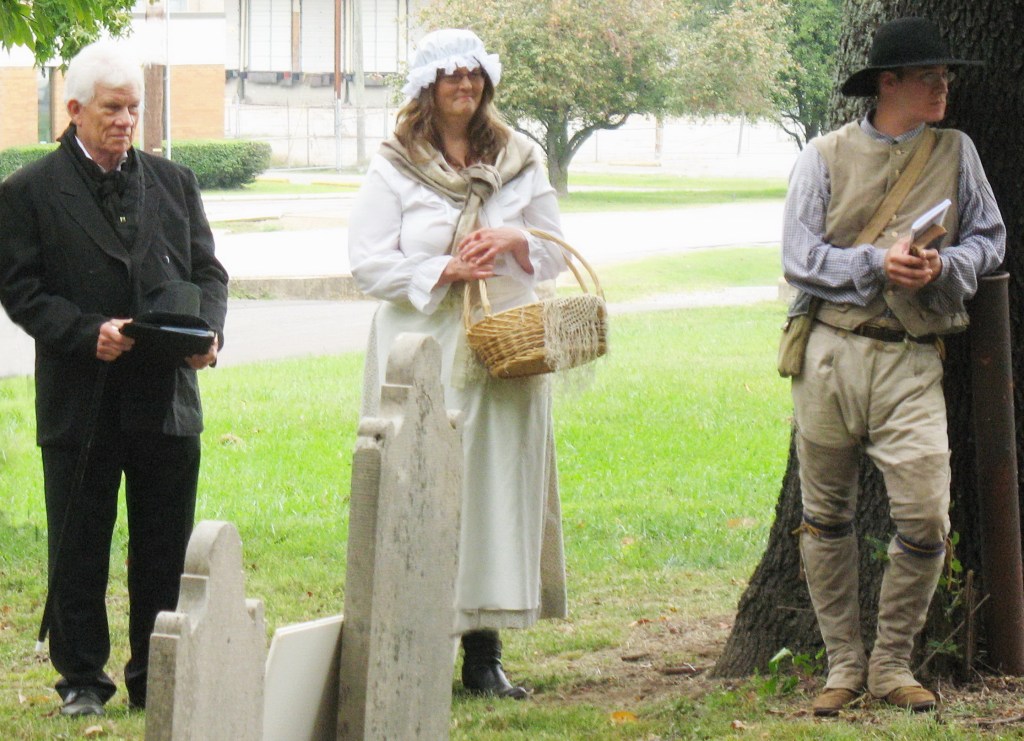
Reenactors in a 2012 event at Buchanan’s Station cemetery portray Maj. John Buchanan, Sally Buchanan, and a wilderness preacher.
The Indians also demonstrated great courage. Cherokee warrior Kiachatallee (also Chiachattalla) attempted to set the fort ablaze. Although mortally injured, he continued to kindle flames with his dying breath.10 Among other braves who died that Sunday night was White Owl’s Son, possibly the brother of Dragging Canoe.11John Watts, recently chosen chief of the Lower Cherokees (Chickamaugas), was severely wounded but later recovered.
The battle finally ended, perhaps because of the ineptitude of an inebriated Irishman in the station. Not realizing he had overloaded the Buchanans’ old blunderbuss, Jimmy O’Connor produced a stupendous boom.12 The Indians, terrified of cannon fire, withdrew.
The Battle of Buchanan’s Station has captured the attention of historians since 1792. British scholar Dr. John Sugden recently determined that the Shawnee Warrior killed by John McCrory was Cheeseekau, Tecumseh’s brother and mentor. Moreover, Sugden writes, Tecumseh himself was present at the battle and watched his brother die.13 Such valuable ongoing research will continue to deepen our understanding of this critical frontier event. (2014)
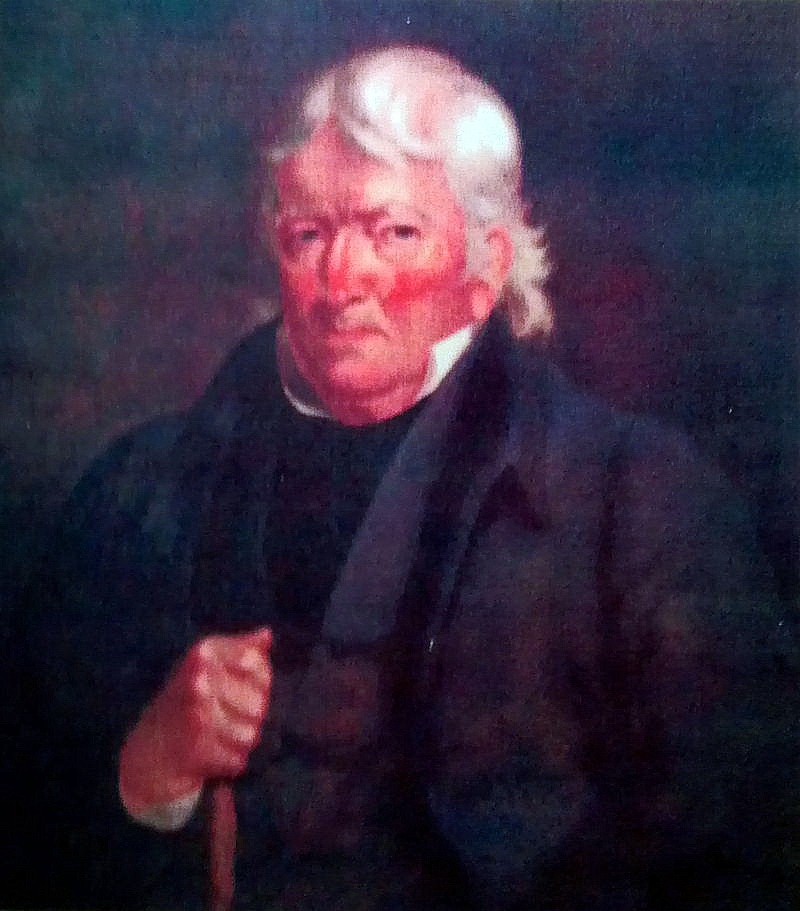
Portrait of Major John Buchanan (TN State Museum)
1 Although such matters are difficult to quantify, I know of no single conflict between colonial settlers and Native Americans in Tennessee history, not even Nashville’s “Battle of the Bluff,” that has appeared in print as often as the Battle of Buchanan’s Station (BoBS). Accounts of the BoBS are many, varied, and sometimes conflicting. Tracing and analyzing these accounts chronologically, from 1792 until the present, is a fascinating historiographical journey. The “baseline” account is a 388-word report from James Robertson to territorial governor William Blount, which arrived to Blount on October 9, 1792. That correspondence can be found in American State Papers: Indian Affairs 1: 294-295. Skipping over many other accounts to the present, three excellent modern treatments of the battle are John Buchanan [a coincidental name], Jackson’s Way: Andrew Jackson and the People of the Western Waters (Hoboken NJ: John Wiley & Sons, 2001, reprint by Castle Books), 131-136; John Sugden, Tecumseh: A Life (New York: Henry Holt and Company, paperback reprint, 1997), 70-75; and John Anthony Caruso, The Appalachian Frontier: America’s First Surge Westward (Knoxville: University of Tennessee Press, 2003, new edition of the 1959 original), 353-357.
2 The number of Indians said to have surrounded Buchanan’s Station varies from 280 to 900 or more. Robertson’s original account (in the American State Papers) says, “supposed to consist of three or four hundred.” However, a report from Blount on November 5, 1792, says, “appeared to have been, Creeks, from 400 to 500; Cherokees, 200; Shawanese, from 30-40” (See American State Papers: Indian Affairs 1: 331). The Tennessee state historical marker on the battle site says “about 300,” and most modern treatments also report “about 300.” I have chosen to use the conservative “about 300” figure.
3 The exact number of defenders, like that of the attackers, is uncertain. Robertson’s original account clearly says “fifteen gun-men,” and that is the number used by some later accounts and most modern ones. Yet it appears possible if not likely that Robertson’s report was not precisely accurate. Over the ensuing years the number increased to about twenty. A few accounts attempt to name the defenders, and a researcher can combine those accounts and arrive at well over twenty. Those accounts which attempt to name the defenders include the following: John Buchanan Todd, letter to Lyman Draper, 9 November 1854, Draper Manuscripts 6XX64; Major Thomas Washington, “The Attack on Buchanan’s Station,” Annals of the Army of Tennessee and Early Western History, Vol. 1 November (1878): 378-381; Josephus Conn Guild, Old Times in Tennessee (Knoxville: Tenase Company, 1971, reprint of the 1878 original), 300-313; Thomas Buchanan, “Buchanan Memoir,” at https://sites.google.com/site/davidsoncounty/home/people-of-interest/buchanan-history, accessed 01-25-14; and Edward Albright, Early History of Middle Tennessee (Nashville: Brandon Printing Company, 1909), 171-177. It appears that some of the pioneers named were indeed involved in the larger context of the battle but not in the actual conflict itself. I have chosen to use Robertson’s conservative “fifteen gun-men” figure.
4 J.G.M. Ramsey, The Annals of Tennessee to the End of the Eighteenth Century (Johnson City TN: The Overmountain Press, 1999 reprint of the 1853 original), 566-567.
5 For more on Finnelson and Deraque see American State Papers: Indian Affairs 1: 288-292.
6 Robertson’s original account (in the American State Papers) reports of Gee and Clayton that “it is supposed they are killed.” Later accounts substantiate this and describe the circumstances of their deaths. Little is known about Jonathan Gee. Ironically, Seward Clayton was captured by Indians when he was a boy, in an incident that involved Major John Buchanan. For that story see Lizzie P. Elliott, Early History of Nashville (Nashville: The Board of Education, 1911), 155-158. The Indians later released Clayton, who then met his death by their hands in 1792.
7 The events and circumstances leading up to the Battle of Buchanan’s Station are substantially covered by the three modern accounts listed in note #1 above. The BoBS was the climax of a much larger story that is instructive as to the political climate of the time as well as to the complicated relationships between Native Americans and Euro-American settlers.
8 “John Mc. Rory” is the only active defender that Robertson mentions by name in his original account. The specific fact that McCrory killed Shawnee Warrior is not stated by Robertson, but is taken from later accounts. Additionally, some later accounts mention Thomas McCrory rather than John. An example of such accounts is the “literary” (complete with dialogue, etc.) story by Octavia Zollicoffer Bond, Old Tells Retold (Nashville: Smith & Lamar, 1906), 154-167.
9 Elizabeth F. Ellet, The Women of the American Revolution, Vol. III (New York: Charles Scribner, 1856), 310-327. Ellet wrote an entire chapter featuring Sarah Buchanan. Concerning the designation, “the greatest heroine of the West,” Ellet’s exact words were: “The fame of this gallant defence [during the BoBS] went abroad, and the young wife of Major Buchanan was celebrated as the greatest heroine of the West.” Also see Wilson and Fiske, eds., Appleton’s Cyclopaedia of American Biography, Vol. 1 (New York: D. Appleton and Company, 1888), 436-437, in which Sarah is again called “the greatest heroine of the west.”
10 The events of the death of Kiachatalle (also known as “Tom Tunbridge’s step-son”) must have been quite dramatic. Robertson’s report says that he “ascended the roof with a torch, where he was shot, and, falling to the ground, renewed his attempts to fire the bottom logs, and was killed.” Kiachatalle’s body was identified the next morning by Joseph Brown, who knew him well from his captivity by the Indians a few years before the BoBS.
11 White Owl’s Son seems to be sometimes known as “Little Owl,” who was indeed Dragging Canoe’s brother. A Creek chief (perhaps Talotiskee) was also killed at the battle, and Unacate was injured or killed. See American State Papers: Indian Affairs 1: 331. One or two other accounts report that as many as thirty Indians were killed that night. More research needs to be done about the Indians who participated in the BoBS.
12 The priceless story of Jimmy O’Connor’s fortunate misuse of the blunderbuss has been told over and over again. Some accounts, however, say that it was the boom of the little swivel cannon at Fort Nashborough that so frightened the Indians. I am partial to John Buchanan Todd’s clever statement (in Draper, 6XX64) that, “Jemmy O’Connor blundering with his blunderbuss in all probability saved the station.”
13 It would be difficult to overestimate the importance and influence of Sugden’s determination that Cheeseekau (sometimes called “Chiksika”) died at Buchanan’s Station in the presence of his brother, the iconic Tecumseh. Fortunately, Sugden provides his well-reasoned analysis of the sources related to this matter in Sugden, 421-422 n. 1. Many scholars and Internet sources have accepted Sugden’s discovery as fact, which has placed Buchanan’s Station on the radar of many additional historians.
FUNDAMENTAL SOURCES
American State Papers: Indian Affairs 1: 294-295.
Arnow, Harriette Simpson. Flowering of the Cumberland. Lincoln, University of Nebraska Press, 1996 edition of the 1963 original.
Buchanan, John. Jackson’s Way: Andrew Jackson and the People of the Western Waters. Hoboken NJ, John Wiley & Sons, 2001, reprint by Castle Books.
Caruso, John Anthony. The Appalachian Frontier: America’s First Surge Westward. Knoxville, University of Tennessee Press, 2003, new edition of the 1959 original.
Clements, Paul. Chronicles of the Cumberland Settlements. Nashville, self-published, 2012.
Ramsey, J.G.M. The Annals of Tennessee to the End of the Eighteenth Century. Johnson City TN, The Overmountain Press, 1999 reprint of the 1853 original.
Sugden, John. Tecumseh: A Life. New York, Henry Holt and Company, 1997, paperback reprint.
ADDENDUM
James Robertson’s original account of the Battle of Buchanan’s Station as found in American State Papers: Indian Affairs 1: 294-295:
“On the 30th September, about midnight, John Buchanan’s Station, four miles south of Nashville, (at which sundry families had collected, and fifteen gun-men) was attacked by a party of Creeks and Lower Cherokees, supposed to consist of three or four hundred. Their approach was suspected by the running of cattle, that had taken fright at them, and, upon examination, they were found rapidly advancing within ten yards of the gate; from this place and distance they received the first fire from the man who discovered them, (John Mc. Rory.) They immediately returned the fire, and continued a very heavy and constant firing upon the station, (blockhouses, surrounded with a stockade) for an hour, and were repulsed with considerable loss, without injuring man, woman, or child, in the station.
“During the whole time of attack, the Indians were not more distant than ten yards from the blockhouse, and often in large numbers round the lower walls, attempting to put fire to it. One ascended the roof with a torch, where he was shot, and, falling to the ground, renewed his attempts to fire the bottom logs, and was killed. The Indians fired 30 balls through a port-hole of the overjutting, which lodged in the roof in the circumference of a hat, and those sticking in the walls, on the outside, were very numerous.
“Upon viewing the ground next morning, it appeared that the fellow who was shot from the roof, was a Cherokee half-breed of the Running Water, known by the whites by the name of Tom Tunbridge’s step-son, the son of a French woman, by an Indian, and there was much blood, and signs that many dead had been dragged off, and litters having been made to carry their wounded to their horses, which they had left a mile from the station. Near the blockhouse were found several swords, hatchets, pipes, kettles, and budgets of different Indian articles; one of the swords was a fine Spanish blade, and richly mounted in the Spanish fashion. In the morning previous to the attack, Jonathan Gee, and — Clayton were sent out as spies, and on the ground, among other articles left by the Indians, were found a handkerchief and a moccason [sic], known one to belong to Gee, and the other to Clayton, hence it is supposed they are killed.”
The earlier of Nashville’s two most famous Indian onslaughts occurred on April 2, 1781. It was probably Charlotte Robertson – stalwart wife of Nashville co-founder James Robertson – who sicced the Fort Nashborough dogs on the attacking Indians, a storied deed that helped foil a clever Indian subterfuge. Another hero of that fateful day was John Buchanan Sr., who darted from the fort and rescued Edward Swanson, who had been clubbed by one of the marauders. These heroics notwithstanding, several pioneers died at the “Battle of the Bluff,” including Alexander Buchanan, thought to be John’s son.
The second of our legendary Indian battles took place on September 30, 1792, at Buchanan’s Station, which had been established about 1784 by Major John Buchanan, another son of the elder John. In his 1853 Annals of Tennessee, J.G.M. Ramsey described the Battle of Buchanan’s Station as “a feat of bravery which has scarcely been surpassed in all the annals of border warfare.” In that nighttime attack as many as 900 Creeks, Cherokees, Chickamaugans, and others were repulsed by about 20 settlers inside the station. Again the hero of the day was a woman: Sarah (called “Sally” or “Sallie”) Buchanan, wife of Major John. The heavily pregnant Sally cheered on the defenders, molded bullets, and perhaps even served up distilled beverages while the men fired away through blockhouse portholes.
Photo of Buchanan’s Station cemetery by Esther Victory.
Although the battle could have become Tennessee’s Alamo, the besieged pioneers did not suffer a single casualty. However, among the noteworthy Indians killed that night was Kiachatalee (or Chiachattalla), a dauntless warrior who attempted to set the fort ablaze. The Indians intent was to assault Fort Nashborough after destroying Buchanan’s Station, but the plucky stationers confounded the natives’ ambitions.
At first light an inspection of the premises produced numerous articles left by the retreating attackers. Several swords were found, including “a fine Spanish blade . . . richly mounted in the Spanish fashion.” Some historians have conjectured that the sword may have been traded to the Indians in exchange for scalps of slain settlers (certainly the Spanish stirred up such trouble for the westward-advancing Americans). Such a sword would have been quite a prize for the victorious stationers, plunder that would not have been treated carelessly. We can easily imagine that they presented it to Sally Buchanan as a tribute to her uncommon spunk.
So what has happened to this splendid Spanish sword? Does a Buchanan family member treasure it today? Does it survive in some museum, under the auspices of curators who have no knowledge of its history? Maybe it awaits us in a dark, cobwebbed attic; or perhaps all that separates us from this luxurious booty is a nondescript floorboard in some old house. Unfortunately, we may never set our eyes on this symbol of pioneer resilience, but all is not lost. In fact, we have something far more precious than a mere sword: we have the Buchanan Station Cemetery, where Major John and Sarah Buchanan are buried, along with other pioneers.
If the Buchanan Station sword were in a display case at the Tennessee State Museum, tens of thousands of admirers would have by now filed past it. But only a handful of Nashvillians have made the pilgrimage to the little cemetery to pay respects to our earliest settlers, upon whose sturdy shoulders rests our local civilization. If you are moved to visit the cemetery, you will find it along Mill Creek near the corner of Elm Hill Pike and Massman Drive. If you turn on Massman into the industrial park, you will find the cemetery on your left just after the first set of buildings. Parking for a few cars is available on the left side of the cemetery, which is now marked by a black fence and informative signage. We think you will agree that the Buchanan Station Cemetery is one of the most fascinating features of Nashville history.
Primary Source Document, transcribed by Kathy B. Lauder.
Republican Banner, November 17, 1869
To the Editor of the Banner:
In company with the Vice-president of the Pacific Railroad, a few days since, I rode along the first six miles of the road. The work is in a forward condition, and but for two or three injunctions, the grading, masonry, etc., would be finished by the first of next January ready for track-laying. The masonry of the bridge at Mill Creek is finished and the iron bridge will be erected when the track-laying reaches that point. The object of this communication is to call public attention to the fact that this bridge crosses the creek at the point where was fought one of the most remarkable Indian battles that characterize the early settlements of Tennessee.
Nearly fifty years ago, the writer became familiar with the spot, and often heard from those who had participated in the battle an account of the gallant and successful defense of the fort, then called Buchanan’s Station. The eastern abutment of the bridge rests on the bluff near the spot where stood the stockade and block-house. It should be commemorated by some suitable tablet and inscription erected upon that end of the bridge. This and many similar events are passing out of the memory of our people, and I am afraid that the rising generation are not at all familiar with the early history of our State. In 1792 General Robertson, the father of Middle Tennessee, received intelligence which led him to believe the Indians would visit his neighborhood. He sent out one of his trusty scouts, Abraham Castleman, to reconnoitre and find out what danger, if any, was impending. Castleman made a circuit of some sixty miles, going south and returning by the place where Murfreesboro now stands. He reported traces of the Indians at that point. Other scouts reported that no Indians were about and none appearing. Castleman was jeered for his report to such an extent as to cause both himself and General Robertson great mortification. Events, however, proved the correctness of his reconnoisance [sic]. On Monday, the 30th of September, the people in the fort were awakened by the running in of the cattle and other noises which betokened a large force of Indians at hand. Before daylight a vigorous attack was made by a large body of savages. They attempted to fire the fort before the little garrison were in position for defense. In the fort were fifteen gun-men and a few women, who did their full share of the fighting, running bullets, loading the guns, and firing, as the occasion required. The heroic conduct of Mrs. Buchanan, exhibited in her coolness, bravery, and the spirit in which she animated the men, was common talk long after her death.
Reenactors portray Sally Buchanan and a wilderness preacher at a 2012 event to commemorate the 200th anniversary of the Battle of Buchanan’s Station. (photo from NHN collection)
This station was on the old road to the Hermitage, and until the turnpike was built visitors to the Hermitage were shown this place as one pre-eminently entitled to notice. With the people of this section, Mrs. Buchanan was as much a heroine as General Jackson was afterward a hero.
The battle lasted an hour. The Indians, from the brisk and incessant firing kept up from the fort to their destruction, believed it was defended by a large force, and retired, leaving some of their dead on the field, but carrying off their wounded. They left a large amount of guns, swords, tomahawks, kettles, etc., on the field. The celebrated John Watts, a noted Cherokee Chief, was wounded. Kiachatalee, a noted Indian warrior, was killed, as was also a hostile half-breed, known as “Tom Turnbridge’s step-son,” who was shot while attempting to fire the fort. Thirty balls were fired through one port-hole into the roof of the fort, and were found in the area of a man’s hat. Governor Blount, in his official account of this battle, estimated the number of assailants at three or four hundred. Both Ramsey and Putnam, in their histories, say the Indians acknowledged their force to have been seven hundred, and that they were dispirited by the constant fire, which led them to believe that the fort was defended by a very strong force.
Not a man, woman or child in the fort received the slightest harm. Surely such an event as this is worthy of some commemoration. A simple tablet of iron, with a suitable inscription, could be placed by the railroad company on this bridge at a trifling cost, which they can well afford to pay, as the owners of the land neither charge damages for running the road through it, nor ask pay for the fine stone quarried from the bluff for the erection of the bridge.




 Nashville Historical Newsletter