Primary Source Document, transcribed by Kathy B. Lauder.
Republican Banner, November 17, 1869
To the Editor of the Banner:
In company with the Vice-president of the Pacific Railroad, a few days since, I rode along the first six miles of the road. The work is in a forward condition, and but for two or three injunctions, the grading, masonry, etc., would be finished by the first of next January ready for track-laying. The masonry of the bridge at Mill Creek is finished and the iron bridge will be erected when the track-laying reaches that point. The object of this communication is to call public attention to the fact that this bridge crosses the creek at the point where was fought one of the most remarkable Indian battles that characterize the early settlements of Tennessee.
Nearly fifty years ago, the writer became familiar with the spot, and often heard from those who had participated in the battle an account of the gallant and successful defense of the fort, then called Buchanan’s Station. The eastern abutment of the bridge rests on the bluff near the spot where stood the stockade and block-house. It should be commemorated by some suitable tablet and inscription erected upon that end of the bridge. This and many similar events are passing out of the memory of our people, and I am afraid that the rising generation are not at all familiar with the early history of our State. In 1792 General Robertson, the father of Middle Tennessee, received intelligence which led him to believe the Indians would visit his neighborhood. He sent out one of his trusty scouts, Abraham Castleman, to reconnoitre and find out what danger, if any, was impending. Castleman made a circuit of some sixty miles, going south and returning by the place where Murfreesboro now stands. He reported traces of the Indians at that point. Other scouts reported that no Indians were about and none appearing. Castleman was jeered for his report to such an extent as to cause both himself and General Robertson great mortification. Events, however, proved the correctness of his reconnoisance [sic]. On Monday, the 30th of September, the people in the fort were awakened by the running in of the cattle and other noises which betokened a large force of Indians at hand. Before daylight a vigorous attack was made by a large body of savages. They attempted to fire the fort before the little garrison were in position for defense. In the fort were fifteen gun-men and a few women, who did their full share of the fighting, running bullets, loading the guns, and firing, as the occasion required. The heroic conduct of Mrs. Buchanan, exhibited in her coolness, bravery, and the spirit in which she animated the men, was common talk long after her death.
Reenactors portray Sally Buchanan and a wilderness preacher at a 2012 event to commemorate the 200th anniversary of the Battle of Buchanan’s Station. (photo from NHN collection)
This station was on the old road to the Hermitage, and until the turnpike was built visitors to the Hermitage were shown this place as one pre-eminently entitled to notice. With the people of this section, Mrs. Buchanan was as much a heroine as General Jackson was afterward a hero.
The battle lasted an hour. The Indians, from the brisk and incessant firing kept up from the fort to their destruction, believed it was defended by a large force, and retired, leaving some of their dead on the field, but carrying off their wounded. They left a large amount of guns, swords, tomahawks, kettles, etc., on the field. The celebrated John Watts, a noted Cherokee Chief, was wounded. Kiachatalee, a noted Indian warrior, was killed, as was also a hostile half-breed, known as “Tom Turnbridge’s step-son,” who was shot while attempting to fire the fort. Thirty balls were fired through one port-hole into the roof of the fort, and were found in the area of a man’s hat. Governor Blount, in his official account of this battle, estimated the number of assailants at three or four hundred. Both Ramsey and Putnam, in their histories, say the Indians acknowledged their force to have been seven hundred, and that they were dispirited by the constant fire, which led them to believe that the fort was defended by a very strong force.
Not a man, woman or child in the fort received the slightest harm. Surely such an event as this is worthy of some commemoration. A simple tablet of iron, with a suitable inscription, could be placed by the railroad company on this bridge at a trifling cost, which they can well afford to pay, as the owners of the land neither charge damages for running the road through it, nor ask pay for the fine stone quarried from the bluff for the erection of the bridge.
The Mud Tavern community grew out of two events in the early settlement of Middle Tennessee. First, sometime before 1784, Major John Buchanan built a “station,” or fortified home, on the east bank of Mill Creek just downstream from where Elm Hill Pike today crosses the creek. This is thought to be the first permanent dwelling in the Mud Tavern area. Buchanan lived in his “station” house until his death in 1832.
Buchanan’s Station became famous in early Middle Tennessee history when, during the Chickamauga Wars, it was attacked on the evening of September 30, 1792, by a large party of Cherokee, Shawnee, and Muskogee warriors. The attack was successfully repelled by the small band of men and women who had gathered for safety at the station amid signs that the Chickamauga group was in the area. More important for this article is that the station’s defenders included James Mulherrin and Sampson Williams – two men who had migrated with Buchanan in 1780 from South Carolina to Tennessee – as well as James Todd, Samuel McMurray, and others who had received land grants in the immediate vicinity. The presence of so many neighboring settlers suggests that Buchanan station was already the civic center for a developing community of people that would come to be known as Mud Tavern.
The second founding event is as legendary as it is historic. Sometime near the beginning of the 19th century a tavern opened on Elm Hill Pike near what is today the intersection of the Elm Hill and McGavock Pikes. It was said to have been built of mud and cedar, hence the name “Mud Tavern.” There are no records to show who first owned the inn, but Richard Smith purchased property at this site in 1810, and court decisions in 1816 in 1832 seem to suggest that it was indeed Smith who operated a tavern there. Although there are no ruins to mark its location or documents to prove its existence, stories of the old tavern persist. It is said that Andrew Jackson often stopped there on his way to and from Nashville and that he stayed there for two nights as he prepared for his fateful 1806 duel with Charles Dickinson. In the end, however, the best proof of the inn’s existence and its significance is that the surrounding community chose to call itself Mud Tavern, and so it appears on Davidson County maps into the 21st century.
In 1821 the Rev. Richard Dabbs came from Charlotte County, Virginia, to become founding pastor of the First Baptist Church of Nashville. He purchased 347 acres in the Mud Tavern community and built his home on hills overlooking the Mill Creek Valley. Rev. Dabbs died just two years after assuming leadership of First Baptist Church, but by that time his family had become well established in the area. In the years just before the Civil War, his grandsons expanded the original purchase to more than six hundred acres. The war and its aftermath reduced the fortunes of the Dabbs family, but they continued to play a role in the Mud Tavern community and beyond. John W. T. Dabbs, M.D., was a beloved physician in the Nashville area during the early part of the 20th century. His son, John W.T. Dabbs Jr., Ph. D, gained an international reputation for his work at Oak Ridge National Laboratory on the nuclear ramifications of extremely low temperatures. Descendants of the Rev. Richard Dabbs were still living on his Mud Tavern farm in 1955, when the airport authority purchased the land in order to extend runways to accommodate jet air traffic.
The expansion of southern railroads after the Civil War played a major role in the area’s recovery. The community appeared on the map in 1869 when the Tennessee and Pacific Railroad established a route called the Lebanon Junction and showed Mud Tavern as one of several flag-stop stations along the way. An 1871 Davidson County map – “from actual surveys made by order of the county court” – clearly marks Mud Tavern as a separate and distinct community with the railroad running through it.
The railroad station had a two-fold and somewhat ironic effect on Mud Tavern residents. It provided their community with a geographic center of activity: within a fairly short time the area around the station had acquired a post office, a school, and a general store run for many years by Wallace Gleaves. The railroad also gave local citizens access to jobs, schools, and services beyond the immediate community. In 1877 the T&P was purchased by the Nashville, Chattanooga, and Saint Louis Railway, to open up travel an even larger world. Sometime in the 1920s, however, the general store acquired gasoline pumps to service the automobiles and trucks that were beginning to displace the railroads. By 1934 passenger traffic on the Lebanon Junction had declined precipitously, and the NC&SL petitioned the Interstate Commerce Commission to abandon it. The last train stopped at Mud Tavern in 1935. Among those who boarded was longtime resident Will Page, who later told an interviewer, “I took the last trip on the train about two years ago on the thirteenth of July.” It was the end of an era.
From the earliest days, Mud Tavern was primarily a rural, farming community within six or seven miles of downtown Nashville. Farmers took their produce to market by wagon, train, and truck until well into the 1950s. Some of the community’s most enduring institutions supported and influenced its agricultural way of life. Early in the 20th century, Peabody College established Knapp School of Country Life on acreage that included the old Buchanan Station. Along with other practices, the school introduced alfalfa as a hay crop among local farmers. The present-day Purity Dairies had its origins in Mud Tavern on the Miles Ezell farm. For many years Oscar L. Farris, agent for the University of Tennessee Agricultural Extension Service, lived on a hill overlooking the site of the old Mud Tavern inn. Farris and his wife Mary helped farm families of the community adapt as agricultural technology began to change rapidly during the 20th century.
In 1911 the community acquired an institution that would become emblematic of its way of life. The Davidson County Board of Education deeded to Jacob Young the old Mud Tavern school, which sat a few yards west of the crossroads where the Mud Tavern inn had been located. Young in turn gave the clapboarded building and one acre of land to the Mud Tavern community to be used for “the good of the community,” and it was received by H. S. Allen, D. W. Thompson, James Hite, Leopold Strasser, Thomas Whitworth, and Thomas Page, who were elected trustees. That one-room school became the meeting place of the Elm Hill Community Club. Over the years it was the site of many ice cream socials, community fairs, a free circulation library, worship services, baseball games, 4-H club and Home Demonstration meetings . . . in short, all of the activities associated with a lively rural society.
After 1935 the urban ethos of Nashville, which was never far away, slowly but inevitably encroached upon Mud Tavern’s bucolic existence with its siren call of more lucrative jobs and public demands for new roads, commercial development, and residential subdivisions. The airport expanded in 1955, and by the early 1960s Briley Parkway and Interstate 40 had been built through the area, obliterating many of the old farms. Still, as late as 1990 the Elm Hill Community Club building could still be seen hidden in a bramble patch and surrounded by taller commercial buildings, a symbol of an earlier way of life that was gone but not forgotten. Today a group of former Mud Tavern residents meets twice a year to share stories and memories of the area.
In one of Wendell Berry’s short stories, an old man reminisces about his life on his family’s farm: “He is thinking of the membership of the fields that he has belonged to all his life, and will belong to while he breathes, and afterward. He is thinking of the living ones of that membership – at work today in the fields that the dead were at work in before them. ‘I am blessed,’ he thinks. ‘I am blessed.’” Those whose families lived in the Mud Tavern community count themselves blessed to belong to its membership.
This article was originally published in the January 2010 edition of The Nashville Retrospect. We thank publisher Allen Forkum for his permission to republish it here. Photograph of Mud Tavern historical marker from NHN collection.
George Peabody College’s Knapp Farm and its sister institution, the Seaman A. Knapp School of Country Life, began operations on Elm Hill Pike in 1915. Financed by a $250,000 philanthropic endowment and other funds raised throughout the South, the farm and its associated agricultural school was a memorial to Seaman Knapp, an agronomist and leader in farm demonstration work. Eventually the farm grew to 315 acres and became nationally known for putting modern agricultural theory into practice. Many of its pioneering practices were at first ridiculed as “college ideas” but later became accepted as standard techniques. One source of pride was the farm’s outstanding herd of registered Holstein cattle, perhaps the first to graze in the pastures of the South.
The farm was situated in a bend in the Mill Creek along the old Chicken Pike/Mud Tavern pioneer route. The farmland included the site of historic Buchanan’s Station, one of the original Cumberland settlements where a handful of settlers withstood one of the last great Indian onslaughts in Nashville’s history. Today, the Buchanan’s Station historical marker and the cemetery where Major Buchanan and his wife are buried have survived the industrialization of the area.
Buchanan’s Station Cemetery prior to its renovation. (NHN photo)
In 1923 Peabody established its Knapp Farm Club House on the exact site of the old Buchanan stockade. This stately colonial mansion was a social center for the college for about forty years, and its bucolic setting along with the hypnotic sounds of the rushing Mill Creek enchanted thousands of students, faculty, and other visitors over the years.
Despite the disapproval and counter proposals of some alumni and faculty, the Peabody Board of Trustees sold the farm and its club house for one million dollars in 1965. Today, many important commercial facilities—including those of Standard Candy Company and Gibson Guitar—are located along Massman Drive, which cuts through the heart of the once-great farm.
Since no vestige of Knapp Farm remains today, Nashvillians are generally unaware of its existence. One way to ensure the future recognition of the Knapp Farm adventure would be to erect a suitable historical marker along Elm Hill Pike or Massman Drive. (1997)
Elm Hill Pike is one of the most historic roads in Nashville. Few thoroughfares in our city contain so much history packed into so few miles. The road, which probably began as a buffalo or Indian trail, has been mentioned in several accounts of early Nashville history. Andrew Jackson was reported to be a frequent traveler on Elm Hill Pike on his journeys from downtown Nashville to the Hermitage. Mapmakers and old-timers have also referred to this road as “the chicken pike” and the Stones River Road.
As you turn off of Murfreesboro Pike onto Elm Hill Pike, the first historic site encountered is Mt. Ararat Cemetery on the north. Mount Ararat was founded in 1869 by local black leaders and became a burial ground for many of Nashville’s black pioneers. Over the years, the cemetery became a dumping ground and a target for vandals. In 1982 the management of Mt. Ararat was taken over by the Greenwood Cemetery’s board of directors, which voted to change the name from Mt. Ararat to Greenwood Cemetery West and to begin a comprehensive restoration project.
About a mile east of Mt. Ararat Cemetery is Greenwood Cemetery, established on thirty-seven acres in 1888 by Preston Taylor. Taylor, born a slave in Louisiana in 1849, was an influential black preacher, undertaker, and business leader. In addition to Taylor, illustrious Nashville citizens buried at Greenwood Cemetery include Z. Alexander Looby, the Rev. Kelly Miller Smith, Sr., DeFord Bailey, John Merritt, and J. C. Napier.
The gates of Mt. Ararat Cemetery (photograph from NHN Collection)
In 1906 Preston Taylor opened Greenwood Park on approximately forty acres adjoining Greenwood Cemetery. The park was established to serve the black community and included a baseball stadium, skating rink, swimming pool, theater, merry-go-round, bandstand, zoo, and many other attractions. A state-wide fair and a Boy Scout summer camp were also held at Greenwood Park. The admission to the park was ten cents on regular days and twenty-five cents on holidays. The Fairfield-Green streetcar stop was nearby and horse-drawn wagons would pick up patrons and deliver them to the park’s entrance at Lebanon Road and Spence Lane. Preston Taylor died in 1931 and his wife managed the park until its closing in 1949.
Buchanan’s Station was located about another mile east where Mill Creek crosses Elm Hill Pike. The station was established by John Buchanan in 1780. Twelve years later, an oft-recounted Indian battle ensued. On a moonlit night in 1792, a band of three hundred Creek and Cherokee, under the leadership of Chiachattalla, raided the station. The twenty-one settlers fought bravely and defeated their attackers, killing Chiachattalla. Major Buchanan lived at the station until his death in 1832. He is buried, along with his wife and other settlers, in the station’s cemetery.
John and Sally Buchanan’s gravestones in Buchanan Station Cemetery. (from NHN Collection)
Peabody College established the Seaman A. Knapp School of Rural Life in 1915 on one hundred fifty acres on Elm Hill Pike. More acreage, including the site of Buchanan’s Station, was acquired in 1922. The farm was the first institution in the United States devoted to the study of the problems of rural life. Peabody College officials believed that teachers should become acquainted with agricultural life since so many of them would be teaching in rural areas. The experimental farm became a showplace with award-winning dairy and beef cattle herds. Innovative techniques in irrigation, pasturage and field equipment were tested at the farm; and many crops were raised including a certified corn station and a contoured, 25-acre orchard. Knapp Farm provided Peabody College with all its meat, vegetables, and fruit until World War II. The importance of the farm declined after the 1920s because of state-supported agricultural research. Expensive to maintain, Knapp Farm was sold in 1965 to a contractor who developed it into an industrial park.
Though the exact location of Mud Tavern is disputed, most old-timers agree that it was near the intersection of Elm Hill Pike and McGavock Pike. The tavern, built during Nashville’s youth, was made of cedar logs with a mud and stick chimney. Andrew Jackson was a frequent patron and it is reported that he spent two days there planning strategy in his duel with the ill-fated Charles Dickinson. Years later a community named Mud Tavern grew up in the area and contained a railroad station, school, post office, and grocery store. The Mud Tavern school building was used for many years as a clubhouse by the Elm Hill Community Club.
On the far side of Donelson Pike, at the corner of Elm Hill Pike and Hurt Drive, is the James Buchanan house. This two-story log house was built circa 1809. James Buchanan and his wife are buried in the family graveyard near the house, which is now under the care of the Association for Preservation of Tennessee Antiquities.
At the present time, Elm Hill Pike ends at Bell Road. The eastern-most part of the road has been re-engineered several times. The course of the road itself may change, but the history of Elm Hill Pike will always remain as a significant part of Nashville’s heritage. (2000)
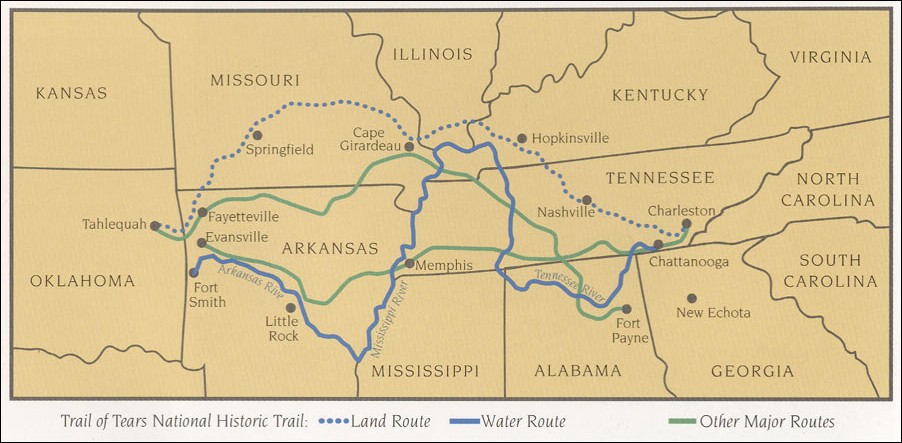
Has our country ever engendered a more merciless single act of racism than that known as the Trail of Tears, the 1838-1839 government-enforced removal of the Cherokees from their eastern homelands? Of the approximately 16,000 expelled Indians, as many as 4,000 died in the process of being interned and then relocated – by foot, wagon, horse, and river – to Indian Territory in today’s Oklahoma.
Trail of Tears map, courtesy of the National Park Service.
The primary artery of exodus, called the Northern Route, included passage through Nashville. During the fall of 1838 the group was composed of about nine different contingents of Cherokees. Surprisingly, very little is known about their exact route through the area, the events that transpired as they passed, or the reactions of Nashvillians to the emigrants.
Richard Taylor led one of the Northern route detachments, which included several hundred Native Americans as well as an intrepid white Christian missionary couple, Rev. Daniel S. Butrick and his wife. Fortunately, Butrick kept a journal of events along the way, the Nashville-related section of which (pages 46-47) is quoted verbatim below by permission of the Oklahoma Chapter of the Trail of Tears Association, publishers of the journal. (Note: Journal entries are in italics. The brackets within the entries are not mine; they are transcribed exactly as found in the published journal.)
My comments that follow various entries are often informed by the views of Benjamin Nance from the Tennessee Division of Archaeology and by the Division’s 2001 report titled The Trail of Tears in Tennessee: A Study of the Routes Used During the Cherokee Removal of 1838, cited below as TTOT. Bound volumes of both the report and the journal can be found in the Tennessee State Library and Archives. I am also indebted to Deborah Rodriguez of the Tennessee Trail of Tears Association for sharing her research with me. My hope is that this presentation of Butrick’s journal combined with my questions, guesses, and musings will encourage others to continue researching the Nashville portion of the Trail of Tears.
Monday. [November 19th] The detachment started early and proceeded through Murphy’s borough, on the road towards Nashville 20 miles. Some of the ox teams did not get up till after dark.
Although some of the groups appear to have bypassed Murfreesboro – by going through the old town of Jefferson, now flooded by Percy Priest Lake – others, apparently including Taylor’s, approached Nashville through Murfreesboro and out what is now called Old Nashville Pike (see TTOT, pp. 30-31). For most of the 1980s I lived near Old Nashville Pike in Rutherford County without realizing that my home was not far from the Trail of Tears. We are often slow to recognize that history is right under our feet.
Tuesday. [November 20th] We travelled ten miles and camped within four miles of Nashville. Our tent stood on the side of a Cedar hill, “The Cedars of Lebanon bow at his feet”, “And the air is perfumed with his breath”, often passed in my mind.
Only a few 1838 Nashville newspaper articles reference the route of the Trail of Tears through Nashville. One article, published by the Nashville Whig on Monday, October 15, includes these alarming details: “The second detachment of the emigrating Cherokees passed through Nashville Monday on their way to the ‘Far West.’ They lay encamped near Foster’s mill on the Murfreesboro’ [sic] Turnpike for several days, and while there were visited by many of our citizens. We had no opportunity of seeing this miserable remnant of a warlike race, in camp; but a worthy subscriber residing in the country, writes that he was present several times, and regrets to say that many of the Indians appeared extremely needy in apparel. Barefooted and badly clad, they cannot all hope to withstand the fatigues of travel and the inclemency of the season. Disease and perhaps death must be the portion of scores of their number before they reach the Western frontier. Indeed, four or five were buried near town, and not less than 50 were on the sick list when they passed through on Monday.”
Another newspaper report, from the November 30 edition of the Nashville Union, informed its readers that “the last detachment of the emigrating Cherokees, numbering 1,700 or 1,800 persons, is now at Mill Creek, about four miles from this city.” Although the writer is probably referring to Peter Hildebrand’s group, which followed Taylor’s, this report gives us a lead as to where Taylor may have camped, since various contingents of the exodus seemed to have bivouacked at the same locations along the way and both Hildebrand’s and Taylor’s groups stopped about four miles from Nashville. We will guess that the camping location referred to by Butrick is where Mill Creek crosses Murfreesboro Pike, a location about the right distance from Nashville. Additional support for this location is the Whig‘s reference to Foster’s mill, which was situated also at Mill Creek and Murfreesboro Pike (see Clayton, History of Davidson County, Tennessee, p. 72).
About two-tenths of a mile toward Nashville from Mill Creek, at Murfreesboro Pike and Foothill Drive, the Vultee Church of Christ sits atop a hill. Could this be the cedar hill of which Butrick speaks?
Keep in mind also that a little farther down Mill Creek, on an old pioneer road now called Elm Hill Pike (which runs roughly parallel with Murfreesboro Pike), was Buchanan Station, an original Cumberland settlement. Some of the Cherokee contingents, particularly those who came by way of Jefferson instead of Murfreesboro, could have camped there.
Wednesday. [November 21st] Early in the morning a gentleman by the name of Bryant, his wife & two other ladies called at the camps, and enquired for us. They had visited other detachments, & been informed of our coming. They now invited us to take lodgings at their house while the detachment might remain in this place. We were thankful for this expression of kindness, though as our tent was pitched, we concluded to remain with our dear Cherokee friends.
Mrs. Bryant and the other ladies had brought clothing to give to the needy Cherokees, though they said they found none needy in this detachment, compared with other companies that had gone on. We agreed to visit this kind family on Friday.
As next Sabbath is the regular time for the holy communion in Brainard church, I proposed holding a sacramental meeting in this place if we could obtain ministerial assistance from Nashville. Mr. Bryant therefore agreed to accompany me to Nashville tomorrow.
A careful study of census and deeds records might reveal who the Bryants were and where they lived. Foster’s 1871 map of Davidson County shows an L. Bryant living on McCrory’s Creek, a few miles farther out of Nashville than the location we have posited above. Perhaps there was some kinship between the 1838 Bryants and those of 1871.
Thursday. [November 22nd] Rode 5 miles to Mr. Bryant’s. Here I saw the effects of true religion. This family appears as we might expect true christians to appear towards the suffering Cherokees, and missionaries accompanying. I partook with them of a kind repast, and then accompanied Mr. Bryant to Nashville, 3 1/2 miles.
This is a beautiful city. I have seen no such place in my view since I left Boston. Here are iron works, a college, penitentiary, female academy, court house and several very handsome meeting houses, and many very elegant buildings.
But what especially adds a beauty to the prospect is the cedars which grow naturally in all part of the coven.
But my object was to find a minister to assist me at the contemplated sacramental meeting.
I was first introduced to a young Methodist minister. But his city dress and appearance, together with his having both hands full of other business, discouraged me at once, & I relinquished the idea of obtaining aid, & said to Mr. Bryant that I would seek for no other minister in the city, but return to the camps.
Just as we were preparing to leave, however, a very dear minister, by the name of Lapsley, passed that way. His health was poor, yet he expressed a strong desire to be with us on the Holy Sabbath. I accordingly appointed the meeting for Brainard & Hawels churches, at the camps, & returned.
Again, careful study of old records could help map out the triangulation of campsite, five miles to Bryant’s house, and then three and a half miles to Nashville. It is interesting that from Murfreesboro Pike at Mill Creek to L. Bryant’s, mentioned above, might be reasonably close to a distance of five miles, but then Nashville would be considerable farther away from there than three and a half miles. Of course, we are assuming that Butrick’s mileage statements are at least approximately accurate.
Butrick’s description of 1838 Nashville is heartening to all who take pride in Nashville, and it confirms the sophistication of our city even before it was designated as Tennessee’s permanent capital.
Dr. R. A. Lapsley was a principal of the Nashville Female Academy (see Wooldridge, History of Nashville, Tennessee, p. 404). Perhaps he is the Lapsley of whom Butrick speaks.
Friday. [November 23rd] My dear wife and two Cherokee girls accompanied me to the house of our dear friend Bryant, where we spent the day delightfully with that dear family.
Saturday. [November 24th] Our dear Cherokee brethren prepared seats on one side of the camp ground, where we held a meeting in the afternoon. Our dear brethren Lapsley & Greene preached.
The weather was cold, & rather uncomfortable as we were out doors. At candlelight we held a prayer meeting in our tents.
Sabbath. [November 25th] While we were contemplating the unpleasantness of holding meeting in the cold open air, an aged man, whose head had blossomed for the grave [turned his thoughts and deeds towards the after-life.], called at our tent and offered us the use of his meeting house, about half a mile distant.
He was a Baptist elder, and said he was a missionary in spirit. We gladly accepted his offer, and found a large brick house, well finished, and furnished with two stoves.
Our dear br. Lapsley preached, and Mr. Taylor interpreted, and our dear br. Stringfield assisted in administering the Holy Supper. The whole was delightful, & will not soon be forgotten by us.
O how kind was our Heavenly Father in providing for us such a meeting house, & such kind friends, just at the time they were so much needed.
The large brick Baptist church building is the most consequential landmark mentioned in this section of Butrick’s journal. The church that comes immediately to mind is the historic Mill Creek Baptist Church, which met in a brick building thought to have been erected in 1810. If this is the correct church building, it increases the likelihood that the campground was near Mill Creek and Murfreesboro Pike, since the Mill Creek Church was only a short distance upstream from the pike. The church building no longer exists, but the Mill Creek Church cemetery is situated along today’s Old Glenrose Avenue.
Another possible candidate might be the McCrory Creek Baptist Church building, located, we assume, in the vicinity of L. Bryant. But this researcher has been able to determine neither the exact location of the old church building nor whether it was of brick.
Monday. [November 26th] The detachment being supplied with tents etc., proceeded on their journey. Mrs. B. & myself dined with our kind friend Mr. Lapsley. We traveled but about four miles from Nashville & camped.
As the fires began to be kindled, an aged Cherokee, who had been sick all the way, lay down by the fire, when his clothes caught fire, and he sprang up, but before he could be relieved, was burnt nearly to death.
Here Mrs. Butrick received from our kind friend Mr. Lapsley a valuable cloak, bonnet, shawl, and a pair of shoes, send on by a waggon which passed through Nashville after we left.
Apparently, Taylor’s contingent camped four miles short of Nashville for a total of five full days, arriving on the 20th and departing on the 26th. They then proceeded through Nashville, and the Butricks stopped at Lapsley’s for dinner.
By what route did the Cherokees pass through Nashville? The Tennessee Division of Archaeology report suggests they probably proceeded up Market Street (today’s Second Avenue), crossed the Cumberland bridge (the original covered bridge) at the Square, and then north via White’s Creek Pike and through today’s Joelton area (see TTOT, pp. 31-32). The theoretical Market Street route, though logical, is as yet undocumented. We do know for certain, however, that some Cherokees lingered at the Square. An account in the November 14 edition of the Nashville Whig includes this sentence: “While traveling through or loitering about the public square, the Indians have exhibited the utmost quiet and good order, and not half a score we venture to say, of the thousands who have passed on to the west, gave evidence of intoxication while here.”
Groups of Native Americans trudging through the city would have been quite a spectacle for the Nashville population (then about 6,000 persons), providing fascinating fodder for news reporters. Why did the local newspapers fail to report this news thoroughly, and why are details about the Trail of Tears through Nashville virtually non-existent in local history books? Much more research needs to be done, not only in 1838 Nashville newspapers but also in personal diaries and other records.
On this day the Taylor group made their way through Nashville and four miles farther north, probably stopping somewhere near where White’s Creek intersects with Highway 431. It was here that the old Cherokee man was tragically burned in a campground accident. The White’s Creek at 431 camping location is supported by the fact that an earlier contingent held up there, as reported by the Nashville Union on November 5: “Another detachment of the emigrating Cherokees, twelve or thirteen hundred strong, passed through this city yesterday afternoon, and encamped at White’s Creek.”
Saturday Dec. 1. Camped on a branch of Red River, in Kentucky, having travelled during the week about 60 miles.
The poor old man who was burnt, was left at a house to be taken care of, but died in a few days.
On Wednesday night of this week, sister Ooskoone gave birth to a son, and on Thursday two children, one a daughter of our dear sister Ashhopper, were called into eternity. They had been long sick.
No doubt excruciating pain accompanied the burn victim into Kentucky where death finally relieved him of his agonies. In addition to a birth, Butrick reports the deaths of two children, tragedies that were all too common among the very young and the very old on the approximately 1,200-mile Trail of Tears, an unnecessary tribulation born of political impatience.


 Nashville Historical Newsletter