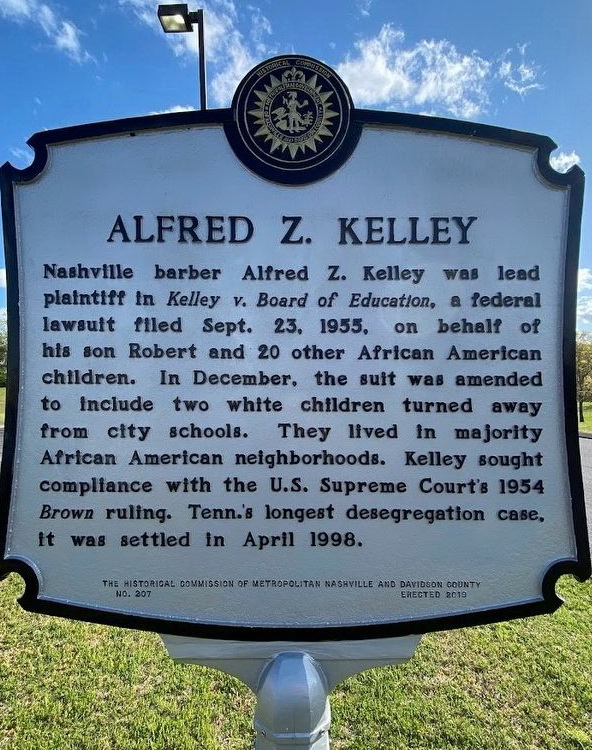
A.Z. Kelley came home from the Navy, opened Kelley’s Barber Shop, taught a few classes at Bowman’s Barber College, sang in his church choir, and became the first black secretary of the local barbers’ union. He and his wife Robbie had four beloved children, and they were delighted when the Supreme Court ordered the schools to desegregate. But when Robert, their 14-year-old, was turned away from neighboring East Junior High and sent across town to Pearl, a black school, Kelley became lead plaintiff in a lawsuit against Nashville city schools (1955). His attorneys were Z.A. Looby, Avon Williams Jr., and Thurgood Marshall (soon to become the first African American Supreme Court Justice). All four men died before Kelley v Board of Education, Tennessee’s longest-running school desegregation case, was finally settled in 1998. Meanwhile, Kelley took part in the 1963 march on Washington, served a term as president of the local NAACP chapter, and was Sergeant-at-Arms of the Tennessee State Senate.
Rev. Kelly Miller Smith, Justice Thurgood Marshall, Attorney Z. A. Looby, and Alfred Z. Kelley (Photo courtesy of Metro Nashville Public Schools)
A. Z. Kelley marker on Blairfield Dr., Antioch, Tennessee. (from Historical Marker Database, photographed by Darren Jefferson Clay)
____________________
The Greenwood Project is a series of 160-word biographies of individuals who lie at rest in Mt. Ararat and Greenwood cemeteries, two historic African American burial grounds in Nashville, Tennessee. The project, which began in September 2014 (and is still available on Facebook, at https://www.facebook.com/profile.php?id=100064806156276), shares the stories of more than 300 consequential individuals, primarily African American, who changed the course of city, state, and national history through their words and deeds. (All biographies were written by Kathy Lauder unless otherwise noted.)
Charles Hadley, a descendant of slaves from John L. Hadley’s Nashville plantation, was a graduate of Fisk University and Meharry Medical College, afterwards working at the latter as a demonstrator of anatomy, while also maintaining a successful Nashville medical practice. During the early years of the 20th century, he was president of the Tennessee chapter of the American Medical Association and secretary of the Nashville Medical and Surgical Association. By 1914 he was an official in the Star Realty & Investment Company, and in 1916 he became captain of Company G of the Tennessee National Guard, the only official Negro military organization in the entire South. As World War I approached, the company underwent additional training, guarded Memphis railroad bridges, and became Company K, 3rd Battalion, 372nd Infantry, of the U.S. Army. By April 1918 the company was in France, where they distinguished themselves in combat. Hadley practiced medicine for 48 years and taught anatomy at Meharry for 30 years.
The Greenwood Project is a series of 160-word biographies of individuals who lie at rest in Mt. Ararat and Greenwood cemeteries, two historic African American burial grounds in Nashville, Tennessee. The project, which began in September 2014 (and is still available on Facebook, at https://www.facebook.com/profile.php?id=100064806156276), shares the stories of more than 300 consequential individuals, primarily African American, who changed the course of city, state, and national history through their words and deeds. (All biographies were written by Kathy Lauder unless otherwise noted.)
Born a Giles County slave, Robert Boyd came to Nashville after emancipation. He worked half-days for his meals while attending Fisk. In 1880 he enrolled in Central Tennessee (later Meharry) Medical School, graduating with honors in two years. He also graduated from Central Tennessee Dental College (1886), studied gynecology at the University of Chicago (1890), and received a Master of Arts (1891). He launched a busy medical practice, taught gynecology and clinical medicine at Meharry (1893 until his death), opened a teaching hospital (1900), and was chosen president of People’s Savings Bank and Trust (1909). He was a founder and first president of the organization that became the National Medical Association. Deeply concerned about the high mortality rate among African Americans, he wrote and lectured widely on the subject, meeting with local citizens to teach them how to avoid illness and combat tuberculosis. He was so widely beloved in Nashville that his funeral had to be held in Ryman Auditorium.
Photo of Dr. Robert Fulton Boyd published in 1902. (Photo is in the public domain)
____________________
The Greenwood Project is a series of 160-word biographies of individuals who lie at rest in Mt. Ararat and Greenwood cemeteries, two historic African American burial grounds in Nashville, Tennessee. The project, which began in September 2014 (and is still available on Facebook, at https://www.facebook.com/profile.php?id=100064806156276), shares the stories of more than 300 consequential individuals, primarily African American, who changed the course of city, state, and national history through their words and deeds. (All biographies were written by Kathy Lauder unless otherwise noted.)
Nashville has not yet applauded all the cast members in its founding drama. Witness this sentence: “Boone went by way of Watauga [after surviving the 1778 Indian siege of Boonesborough] and was there enabled to make such representations to his old friend Capt. James Robertson as induced him the following year to visit the Cumberland country and become the pioneer father of Middle Tennessee.” For convenience, let’s call this revelation the “Watauga Statement.”
The Watauga Statement was made by 19th-century archivist and historian Lyman C. Draper in his book The Life of Daniel Boone (p. 521), a seminal work for later Boone biographers. Draper is our most renowned source for information about America’s first western frontier, the area from the Allegheny Mountains to the Mississippi River. Not surprisingly, when Draper speaks, historians listen.
The Statement makes the legendary Daniel Boone a major catalyst for the founding of the city of Nashville. Heretofore, history has viewed Boone’s contribution to our area’s settlement as considerably more indirect – as an organizer for Richard Henderson‘s 1775 purchase of much of Kentucky and northern Middle Tennessee from the Cherokees, and as the blazer of the Wilderness Trail through Cumberland Gap, by which route James Robertson conducted Nashville’s first settlers. However, if we accept the Statement as an accurate assessment – and why shouldn’t we? – historical justice would press us toward adding Daniel Boone as the fourth in a quartet of Nashville founding fathers: James Robertson (1742-1814), John Donelson (ca. 1718-1785), Richard Henderson (1734-1785), and Daniel Boone (1734-1820).
Twentieth-century historian Samuel Cole Williams unwittingly reveals the likely progenitor for Draper’s Watauga Statement. Serious students of the Boone-Nashville connection will want to consult Williams’ book, Tennessee during the Revolutionary War (UT edition, p. 104, note 1), as well as that note’s correlative reference to Draper Manuscript #6XX50. There they will find convincing evidence that Lavinia Robertson Craighead, James Robertson’s youngest daughter, is at least one of Draper’s original sources for his Statement.
So why isn’t the Watauga Statement better known? The most obvious reason is that for well over a century Draper’s Boone manuscript existed in handwritten form only, found exclusively on microfilm, until Murray State University’s Ted Franklin Belue brought it to print in 1998 via Stackpole Books. Furthermore, any historians who have discovered the Statement may offhandedly have dismissed it for lack of complementary accounts.
Although corroborating evidence is scant, we can nevertheless make a strong circumstantial case for the Statement’s veracity. Circumstantial Fact One: Daniel Boone and James Robertson knew each other well. John Haywood, the father of Tennessee history, stresses that for a time both men lived in the Watauga area of East Tennessee (see The Civil and Political History of Tennessee, p. 53). Both also worked for land speculator Richard Henderson’s Transylvania Company, with Boone the leader for Henderson’s Kentucky land interests and Robertson, for his Tennessee holdings. In addition, Williams provides insight into the extent of the duo’s personal relationship in his report that Boone’s children, along with Robertson’s, were christened or baptized in Robertson’s Watauga home, perhaps around 1772-1773. (See Dawn of Tennessee Valley, p. 344.)
Circumstantial Fact Two: Daniel Boone had explored the lower Cumberland region – including the French Lick-Nashville area – and so was qualified to give Robertson a firsthand report about that country. Draper, also in his Boone biography (pp. 283-284), related a pertinent yet little-known anecdote:
“During this period, one Joe Robertson, an old weaver who had a famous pack of bear-dogs and was devoted to the chase, often accompanied Boone into the Brushy Mountain and over to the Watauga, securing loads of bear-skins, which they packed to the settlements and sold. On one of their adventurous trips, they penetrated as far as the French Lick [future Nashville] on Cumberland and found several French hunters there.”
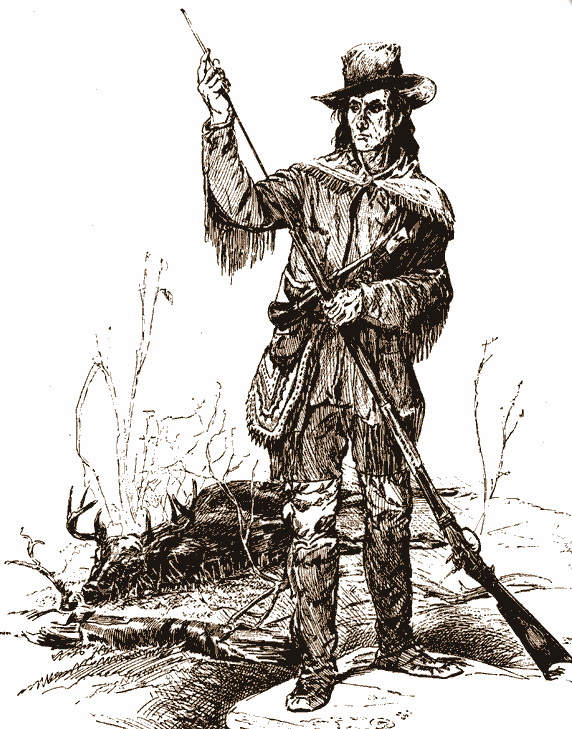
Long hunter with deer (courtesy of State Historical Society of Missouri.
Through the years, this fascinating passage has been repeated by other Boone biographers, including John Mack Faragher, who dates Boone’s French Lick exploration to the fall and winter of 1771-1772. (See Daniel Boone: the Life and Legend of an American Pioneer, p. 88.) Although Draper’s account is the only one I know that positions Boone squarely in geographical Nashville, various state historians do place him in the Middle Tennessee area. A.W. Putnam notes that “Boone, Rains, Mansker, and others…hunted and explored in 1769-70 upon the Cumberland” and reported “its marvelous herds of buffalo and deer” (History of Middle Tennessee, p. 619). Similarly, Williams comments in his discussion of 1769-1770 exploratory crews that “Daniel Boone after a hunt in Kentucky joined one of the groups on the Cumberland in the Tennessee region” (Dawn of Tennessee Valley, p. 330). Harriette Simpson Arnow mentions that Boone “hunted over and explored most of the Cumberland at intervals between1769 and 1775” (Seedtime on the Cumberland, p. 169). And John R. Finger, apparently guided by Draper, observes that in 1772 Boone “hunted as far west as French Lick” (Tennessee Frontiers: Three Regions in Transition, p. 42).
What shall we do with the Watauga Statement, circumstantially but not overwhelmingly confirmed? A lone sentence – even when supported by the testimony of James Robertson’s daughter – does not a historical certainty make; so I’m not advocating that we rush precipitously to validate Daniel Boone’s ticket as a father of Nashville. But I am suggesting that we pay more attention to Boone, keep an open mind about his role in our founding, and be prepared to give him his Nashville due.
At the least, the Statement reminds us that our city’s genesis involves more personalities than we customarily credit. While Robertson and Donelson are Nashville’s leading physical founders, the conceptual founders could include not only Richard Henderson and Daniel Boone but also others as yet unrecognized.
This article was first published in the November 2009 issue of The Nashville Retrospect newspaper. We thank publisher Allen Forkum for his permission to republish it here.
Just as in our national history, the question of personal safety has arisen many times in Nashville. For at least fifteen years after our 1780 founding, not a man, woman, or child was safe. Indians devised surprise attacks again and again on the encroaching settlers, and many lives were lost – some, like Jonathan Jennings, through horrific means.
Never has there been a Nashville panic like that of February 1862. After Fort Donelson fell on February 16, it became clear that Union troops would occupy Nashville. Many Nashville secessionists quickly scattered to the winds, while others, determined to remain, hunkered down in fearful anticipation of the arrival of the invading army.
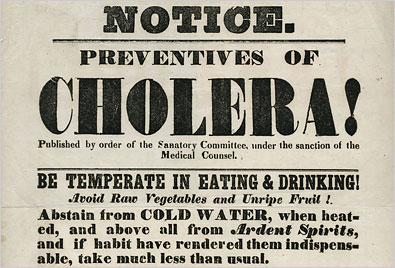
Soon afterwards, as if the Civil War had not brought enough agony, one of several vicious cholera epidemics claimed as many as 800 Nashville lives in the summer of 1866. Seven years later, in 1873, nearly 750 Nashvillians perished in another outbreak of the terrible disease.
By the end of the day on March 22, 1916, about thirty-two square blocks of East Nashville had become a wasteland. A particularly voracious fire, driven by high winds, had devoured nearly 700 buildings and homes. Not many years later, on March 14, 1933, another unwelcome guest—a savage tornado—roared through East Nashville threatening again the very foundations of the community.
Remains of a fire engine from Company #4 near Russell and Fatherland Streets after the 1916 Edgefield fire (TSLA photo)
During the 1960s Nashville was a highly visible stage for the Civil Rights Movement. At times it looked as though our city might self-destruct out of racial tension. Neither whites nor blacks felt safe as the pressures created by mandated integration resulted in legal battles, demonstrations, sit-ins, and riots.
Nashville was left largely to its own devices during the destructive flood of May 2010, when it received more than 13 inches of rain in two days. The fast-rising water displaced 10,000 residents, produced $2.3 billion in property damage, and caused a number of deaths. Receiving little help from outside, neighbors helped neighbors, and volunteers turned out by the hundreds to help with clean-up efforts.
Nashville flood 2010
Late on March 2, 2020, a category-EF3 tornado roared through Nashville and into Mt. Juliet along nearly the same path as the 1933 storm, causing five deaths, over 200 serious injuries, and $1.5 billion in property damage, including a disproportionate number of churches and school buildings. The Covid-19 pandemic had just begun to affect the health of the community as tornado clean-up got underway, and the remainder of the year was consumed by efforts to sustain schools, businesses, and healthcare facilities during a time of unprecedented illness and hardship. And then, just as new vaccines brought hope, the Christmas morning bomb blast on 2nd Avenue downtown shattered our peace once again.
Second Avenue, Nashville, after Christmas bombing 2020
Yet somehow, through these and other perilous times, Nashville has survived, and even thrived. We have always been an industrious lot, constructing landmark public buildings, universities, churches, libraries, businesses, and homes. More important, we have strengthened our collective character and have raised our children to become leaders in business, education, law, politics, medicine, and music. We have produced artists and poets, authors and publishers, factory technicians and practical nurses. We, along with our nation, have become a diversified and enriched society that must continue to mature. We have proudly earned our motto, “Nashville Strong!”
How many court buildings have stood on the public square in Nashville? Published sources offer conflicting information, some stating the number as four and others as five. Research in the minute books of the Davidson County Court has provided the following details.
First Courthouse
The building of the first Courthouse was authorized by the Davidson County Court at the October Term 1783: “The Court then proceeded to fix on a place for Building of a Courthouse & Prison, and agree that in the present situation of the Settlement that it be at Nashborough and Built at the Expense of the Publick. And that the size of the Courthouse be eighteen feet square in the body with a Leanto Shade of twelve feet on the one side of the length of the House. And that the house be furnished with the necessary benches, Barr, Table &c fit for the Reception of the Court.” In April of 1792 the Court “ordered thatDavid Hay repair the Court house by Making Two Doors well fixed and Hung with three window shutters well hung; and the house Well chinked.”
Second Courthouse
Davidson County Court minutes of October 15, 1802, page 367, report as follows: “Court adjourns for five minutes, to meet in the new Courthouse. Court met according to adjournment in the New Courthouse where was present . . ..” A further search of Court minutes yields few clues as to the size or type of building. In 1804 the Court ordered the purchasing of a bell for the Courthouse and in 1806 the painting of the roof and steps. In 1822 the Court “ordered that opening at the head of the Stairs be closed, leaving a door there to which he shall have a shutter made and to have the two stoves placed one on each side of the house behind the bar with pipes extending so as to render the house comfortable for the different courts that are to set here during the winter . . ..” In October 1825 a commission was appointed to determine whether the Courthouse could be repaired to make it comfortable enough for the Court to meet in winter or whether it would be necessary to rent a building for the winter.
Third Courthouse
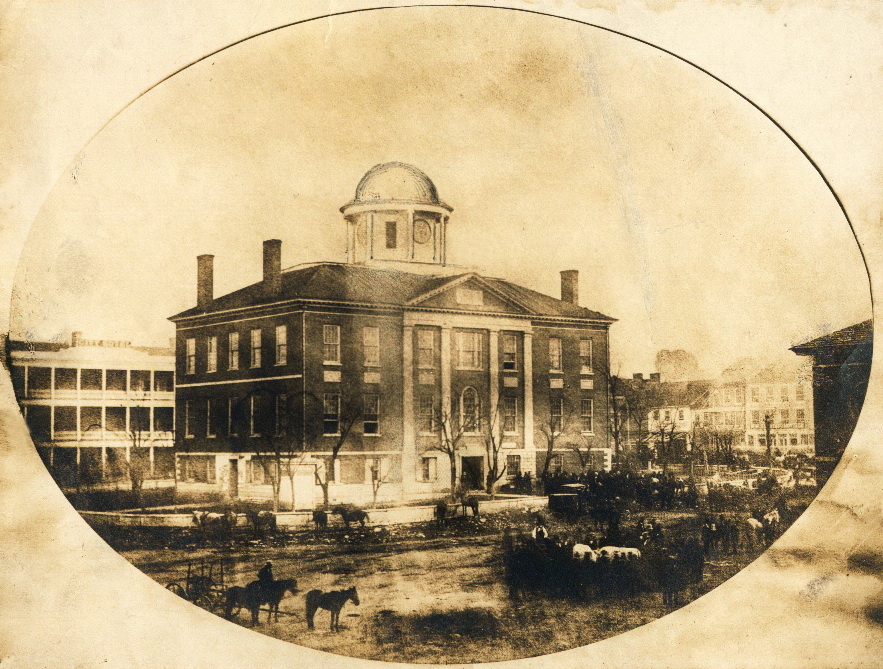
In January 1826 the acting Justices of the Court met and voted to raise, with a special tax, $15,000 over a period of three years for the purpose of building a courthouse for the county. The Courthouse was finished in late 1829 or early 1830. It is described in Eastin Morris’s Tennessee Gazetteer, 1834: “The Court House which stands on the public square, is a spacious and commodious edifice. It presents a handsome front of 105 feet and is sixty-three feet deep. The basement story contains a number of rooms, designed for public offices, and on the second and third floors there are two rooms forty by sixty feet each, two others thirty-six by forty, and two others twenty-three by forty. The basement story is eleven feet high, and the two principal ones are eighteen feet each, and the height of the whole building to the top of the dome is ninety feet. The foundation and part of the lower story is of fine hewn stone, and the remainder of brick, and the two fronts are ornamented with four white pilasters each, The dome contains a good town clock, and is supported by eight columns of Ionic order.” This Courthouse burned in 1856. The County Court minutes state: “Monday Morning April 14, 1856 Court met pursuant to adjournment at the State House in Nashville (the Court House having been burned down) . . ..”
Fourth Courthouse
Fourth Courthouse, 1906 (postcard from NHN collection)
On May 10, 1856, the Court met in the Market House: “The County Court will build a Courthouse on or near the center of the Public Square in Nashville . . ..” According to County Court minutes, architect W. Francis Strickland, son of William Strickland, designer of the Tennessee State Capitol, was “employed at a salary of one thousand dollars per annum as architect of the court house.” The design chosen by Strickland was very similar to that of the Capitol building designed by his father. The building was to have a basement and three stories above ground, and was to be 118 feet by 72 feet in size. The Court first met in the new building in January 1859. The building was remodeled in 1910 with an additional story added. In 1935 this building, along with the City Hall and Market House, was demolished to make room for a new courthouse.
Fifth Courthouse
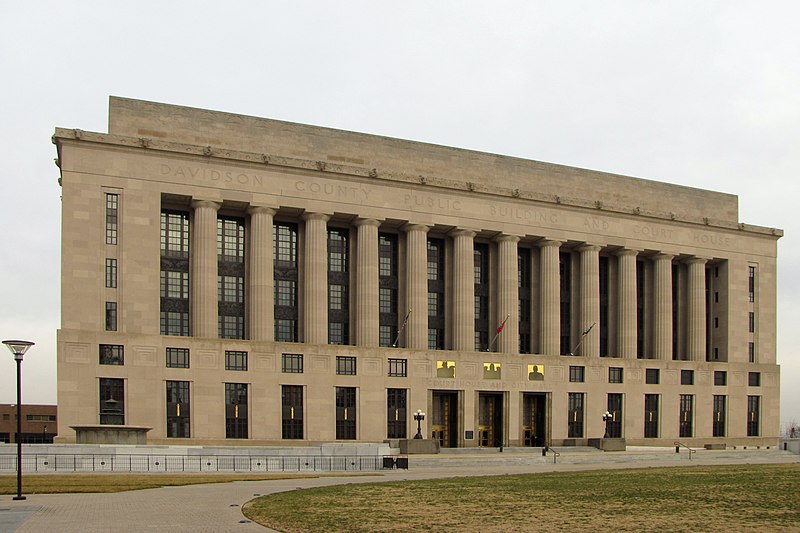
The present Courthouse was completed in 1937. The architects, Emmons H. Woolwine of Nashville and Frederic C. Hirons of New York, won an architectural competition in 1935 with their Art Deco design. The cornerstone of the building was laid August 10, 1936, and the building was dedicated on December 8, 1937. The general contractor was the J. A. Jones Construction Company. The building is eight stories high and measures 260 feet by 96 feet. The years have taken a toll – the building is in need of repair and the need for space is critical. Mayor Bill Purcell hopes to relieve the crowded conditions in the Courthouse by the construction of a General Sessions-Criminal Court complex, near the Ben West building. Plans are under way for a major renovation of the Courthouse to begin in the spring of 2003. (Article was published in 2002)









 Nashville Historical Newsletter