Jonathan Jennings’ Will

Primary Source Document, transcribed by Debie Cox, author of Nashville History blog.

Editor’s Note: Historian Debie Cox discovered the Jennings will in the Metro Archives in 2001. Jennings’ tragic death soon after he drew it up gives unusual poignancy to the document. The will is historically significant because it is likely the oldest surviving document from Nashville, other than the Cumberland Compact itself.

Jonathan Jennings and his family were among the group of pioneers who journeyed with the John Donelson flotilla to the Cumberland Settlements. Donelson recorded in his journal on March 8, 1780, that Indians had attacked the flotilla, and that the Jennings family had been left behind as the settlers in the other boats made their escape.

The Jennings boat had indeed survived, but not without casualties. Jennings’ daughter Elizabeth, wife of Ephraim Peyton, had given birth the day before the attack. In the confusion of the fighting, her baby was killed. Jonathan Jennings Jr., son of the elder Jennings, had jumped from the boat along with two other men. Although young Jennings, who was probably in his early teens, and one of the others made it to shore, the third man drowned. Jennings Jr. and his companion were quickly captured by the Indians, who scalped Jennings and killed the other man. Young Jennings, who had survived his injuries, was eventually rescued by a trader who agreed to pay his ransom, and he was later able to reunite with his family in the Cumberland Settlements. After the attack, the remaining members of the Jennings family had continued on their journey, arriving at Fort Nashborough on April 24, 1780.
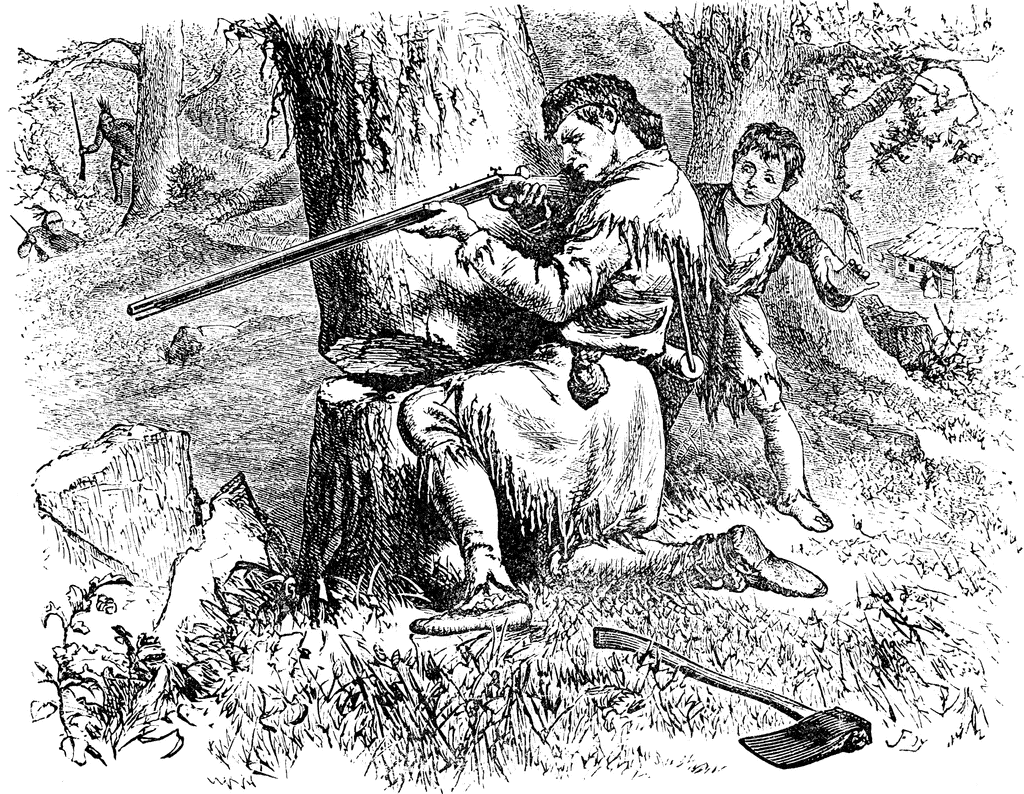
According to J. G. M. Ramsey in his Annals of Tennessee, Jonathan Jennings Sr., was himself killed by Indians three or four months later, in July or August 1780. He left an undated will, which was presented to the Davidson County court in July 1784 and proven on the oaths of James Robertson and William Fletcher. The will had also been witnessed by Zachariah White, who had died at the Battle of the Bluffs near Fort Nashborough in April 1781. The signatures of Jennings, Robertson, and White can be verified through comparison with their signatures on the Cumberland Compact, which all three men had signed in May of 1780. The will reads as follows:

In the name of God Amen I Jonathan Jennings of North Carolina on Cumberland River having this day Received several wounds from the Indians and calling to mind the mortality of my Body do make and Ordain this to be my last will & Testament And first of all I give and recommend my soul to God that gave it and my body to be disposed of at the Discretion of my executors And as touching my Worldly affairs I dispose of them in manner following Viz

Item I give and bequeath to my    It is my Desire that my Estate be Equally divided between my Wife my sons William, Edmond, Elizabeth Haranor Mary Aggy Anne & Susannah all but such a part as shall be hereafter disposed of

Item I give and bequeath to my son Jonathan who was Scalped by Indians and rendered incapable of getting his living a Negrow girl Milla & her increase who is to remain with my beloved wife till my son comes of age Also a Choice Rifle Gun & a Horse and Saddle Item I give my beloved wife Four Choice Cows and Caves The Wards Milla and her increase and the Ward Jonathan being interlined I devise that my Loveing Wife and my son Edmond be Executrix & Executor of this my last Will & Testament
Signed Sealed & Published in Presents
of Jonathan Jenings
Zach White
Js. Robertson
William Fletcher

Six Triple-Threat Town Sites

by Guy Alan Bockmon.

In his 1930 book Soil, Its Influence on the History of the United States, Archer Butler Hulbert noted that the locations of the early “ferries . . . mark the . . . points where the ancient trails descended from high ground to the fords. These were usually located on a river at the mouth of a loading tributary. The sediment of this tributary was deposited blow [sic] its mouth in the main river, making the water shallower at that point and therefore more easily forded. About such fords human habitations usually sprang up in the shape of trading cabins, villages, or forts.”

At six such sites there sprang up the first tiny villages on the Cumberland and Red Rivers in Middle Tennessee.

The village of Nashville grew up around the 1780 fort sited on a defensible bluff accessible from the river via Lick Branch. The Lick Branch shoal was augmented by that of Pond Branch, which flowed into the Cumberland from the opposite side.

A little more than a mile downstream from Nashville, and on the other side of the river, Heaton’s (or Eaton’s) Station was also established in 1780, at a location near where Well’s Mill Creek loaded into the Cumberland. The station had prospered sufficiently to be called Heatonsburg in the 1783 minutes of the Notables. Historian A. W. Putnam (1799-1869) believed the town of Waynesborough was laid out at Heaton’s Station about 1796. This new town, a rival to Nashville, was given its name in honor of General Anthony Wayne.

Clarksville, the second settlement in Middle Tennessee to survive as a town, was sited on the east bank of the Cumberland, just above the mouth of the Red River. Local historian W. P. Titus observed that Clarksville had the advantages of two rivers, good landings, and, what was then indispensable, a gushing spring of pure water.

A few miles downstream from Clarksville, Deason and Weaver Creeks had combined forces over geological time, carving a deep notch into the high limestone bluff. At that spot on the south shore, downstream from the mouth of the north shore’s Hog Branch, the village of Palmyra began to prosper in its role as the country’s international port nearest to the Gulf of Mexico. Jonathan Steele, Comptroller of the Treasury from 1796-1802, noted that the appointment of one Morgan Brown as Collector had been approved upon the information of Andrew Jackson, then a Senator from Tennessee.

About ten miles east of Clarksville, where Sulphur Fork Creek flows into the Red River, the village of Port Royal was laid out, as described by C. E. Brehm*, into 37 lots, four streets, a public square and a section of land reserved for a public warehouse.

Upstream from Nashville about six miles is the mouth of Spencer’s Spring Branch. It was later to be called, successively, Buchanan’s Spring Branch, Craighead’s Spring Branch, and Love’s Spring Branch. On its banks by 1799 was established the village of Haysborough.

Only a few fords and ferries are still in use, as are even fewer portages. The cities of Nashville and Clarksville still thrive. Palmyra still exists. The site of Port Royal is now a State Park. The historic villages of Haysborough and Waynesboro have disappeared from modern maps. The triple threat of fording place, portage, and harbor at these six sites and many others largely determined where future settlements, roads, ferries, bridges, and eventually railroads would be located. Thus did sedimentation influence settlement.


* Cloide Everett Brehm (1889-1971) was president of the University of Tennessee from 1946-1959.

The Relevance of 1850s Nashville

by Mike Slate.

The Clover Bottom Mansion, Donelson, built in 1858, is currently home to the Tennessee Historical Commission

Events of the past continue to shape our lives today, and the prosperous era of the 1850s is a case in point. In 1850 the first locomotive arrived in Nashville, sustaining and enhancing the city as a regional commercial and metropolitan hub, a standing we have never relinquished. Today’s Union Station, built at the turn of the century during the railroad boom, survives as one of our most beloved cultural landmarks.

Nashville’s Union Station opened in October 1900 as a Louisville & Nashville Railroad station.

The Medical School of the University of Nashville opened in 1851, met with immediate success, and quickly established Nashville as a medical center. Following in its wake, Shelby Medical College opened in 1858. The Nashville medical tradition continued with Vanderbilt University, which today provides one of America’s finest medical centers.

The Medical Department of the University of Nashville opened on Second Avenue South in 1851. It would become part of Vanderbilt University in 1874, forming the nucleus of what is today the Vanderbilt University School of Medicine.

In 1854 the publishing arm of the Methodist Episcopal Church South opened on the public square, securing Nashville’s future as a publishing mecca. No doubt the presence here of the Methodist Publishing House played a part in the 1870s formation of Vanderbilt University, which began as a Methodist school. Still in operation today and publishing under several imprints, the publishing house has employed thousands of Nashvillians and pumped millions of dollars into our economy.

In 1873 Cornelius Vanderbilt, known as “the Commodore,” endowed the city of Nashville with $1 million to establish and build the university that today bears his name. The old “Main Building” (pictured above) was dedicated in 1875. Nearly destroyed by fire in 1905, the structure was rebuilt in Italianate style crowned with a single tower and renamed Kirkland Hall in honor of Chancellor James Hampton Kirkland.

Nashville’s first public school was named in honor of educator Alfred Hume, who has been called “the father of Nashville public schools.” Hume School opened in 1855 with 12 teachers. From that modest beginning developed the sprawling Metro Nashville public school system with a total proposed operating budget for the 2021-2022 fiscal year of $1,017,807,500, which provides for 157 schools, 86,000 students, and 11,000 employees.

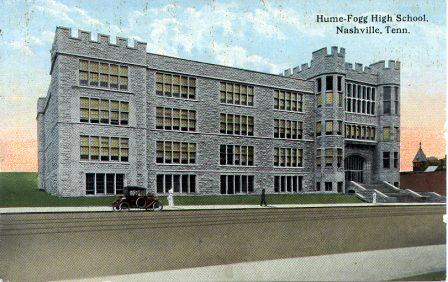
The Hume School, Nashville’s first public school, opened in 1855 for grades 1-12. In 1874 the high school students moved to the Fogg High School, newly built on an adjoining lot fronting Broad Street. In 1912 the two schools merged and moved into this Gothic Revival building designed by architects William Ittner and Robert Sharp.

The Tennessee State Capitol, completed in 1859, is the governmental temple in which our state laws are still sanctified. Other structures built in the 1850s that contribute to Nashville’s present character include Downtown Presbyterian Church (dedicated in 1851), Holy Trinity Episcopal Church (1852), Sunnyside Mansion (ca. 1852), Belmont Mansion (1853), Literary Building of the University of Nashville (1853), Church of the Assumption (completed in 1859), Clover Bottom Mansion (1859), and Two Rivers Mansion (1859).

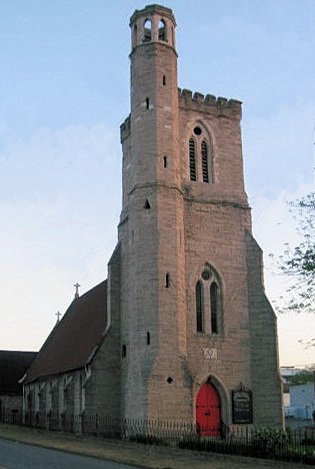
Holy Trinity Church, located on 6th Ave. S at Lafayette, became an Episcopal parish in 1851. The building was occupied by Federal troops during the Civil War and received considerable damage. Restored after the war, it has served the African American community for decades.

These and other events from 150 years ago belie any notion that history is irrelevant. The past has not only a chronological relationship with the present but also a causative one. We did not just happen upon the present: the past is the impetus for today.


All postcards and photographs used in this article are part of the NHN collection.

A Pioneer History of Stone’s River near the Clover Bottoms

by Amelia Whitsitt Edwards.

One of the most popular features of the Donelson area is a paved greenway trail system along the banks of Stone’s River from the Percy Priest Dam to the Cumberland River. The trail winds through the Clover Bottoms, an area of prime importance to the early settlers in the Nashville area.

Scene on the greenway trail (from NHN collection)

The pioneer story began in 1766 with the exploration of the Long Hunters. The river was named in honor of one of their group, Uriah Stone. These adventurers carried the story of this bountiful, uninhabited land with them when they returned to Virginia and North Carolina. It was fourteen years, however, before the first settlers arrived.

In the spring of 1780, John Donelson, having led the flotilla of settlers to Nashborough, recognized the need to plant a corn crop immediately. He again boarded the good ship Adventure with his family, poled up the Cumberland around the great bend until he found the mouth of Stone’s River. He was looking for alluvial fields that were as fertile as the Valley of the Nile and which needed no clearing in order to plant.

The Donelson Party arrived on flatboats

A short distance from the confluence of the two rivers he found what he was looking for on the west bank of Stone’s River*, an area forever after known as the Clover Bottoms. Here he docked his boat and built half-faced shelters to house his family on the opposite bluff. This was fifteen-year-old Rachel Donelson’s first home in Tennessee.

That July heavy rains inundated the corn crop. This unhappy event, plus constant harassment from the native Indians, forced the family to move to Mansker’s Fort for protection.

By fall, word reached the settlers at Mansker’s that the flood waters had subsided and that the corn had eared. John Donelson sent a request to the men at Fort Nashborough to meet him at the Clover Bottoms to help harvest the corn. Approximately ten men from each fort built wooden sleds to drag the corn from the field to the boats moored in Stone’s River. Several days were required to load the boats.

As they left the shore, the boat from Fort Nashborough was attacked by Indians; only three settlers escaped with their lives. The Donelson party was on the north bank, harvesting the cotton planted there. They abandoned their boat loaded with corn and managed to get away on foot through the woods. Donelson’s heroic slave, Somerset, swam the Cumberland River and brought help from Mansker’s Fort to the stranded group.

Meanwhile, the boat from Fort Nashborough floated downstream, eventually reaching the bluffs with its tragic cargo of corn and slain men. The settlers there rescued the corn and buried their dead.

Some years later Andrew Jackson, who had married Rachel Donelson, operated several businesses along the Stone’s River corridor. He first opened a general store near the Clover Bottoms. In order to stock his store, he went to Philadelphia and traded land preemptions for flour, sugar, piece goods, and pocket knives. The store was a two-story building near today’s Downeymead Drive.  C. Lawrence Winn, a descendant of Jackson’s adopted son, built a house on the property in 1960.

In 1805 Jackson, with two partners, formed the Clover Bottom Jockey Club. A race track and tavern were built by the river. The story of Jackson’s duel with Charles Dickinson is well known. The unfortunate quarrel that sparked the duel started at this race track.

A story that is not so well known is that of Jackson’s boat yard on Stone’s River, near its mouth. Here he constructed five flat boats and one keel boat for former Vice President Aaron Burr who was leading a group of colonists to lands he had acquired in Louisiana. In 1812 Andrew Jackson became a military officer and began his lengthy pursuit of both a military and a political career. Thereafter his business interests on Stone’s River faded away.

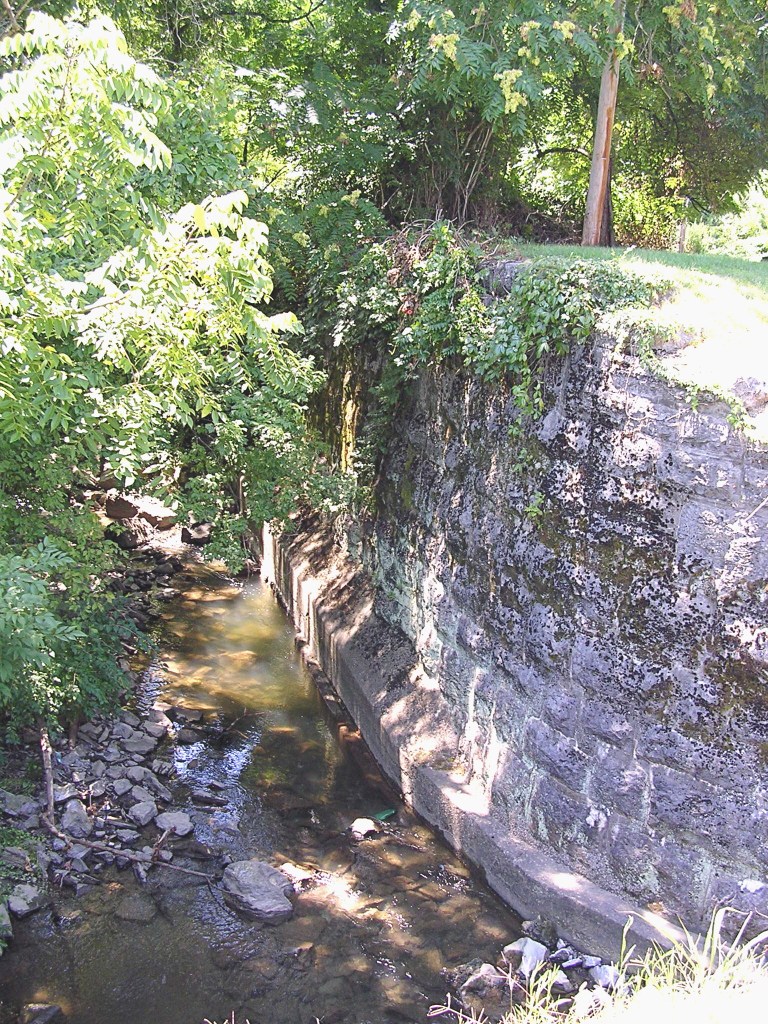
A Donelson creek (from NHN photo collection)

The large tract of land known as Clover Bottom Plantation came to be owned by Dr. James Hoggatt, who built the ante-bellum mansion on the property. The property was sold to Mr. Andrew Price in the late 19th century, and then to A.F. and R.D. Stanford in the early 20th century. After World War II it was sold to the State of Tennessee.

Although the last several years have brought considerable business development to the Clover Bottoms, much of the river bank remains untouched by man. The Greenway Project is a promise to maintain the natural beauty of this historic site and preserve it for our future generations. (2000)


* Historians surmise that John Donelson’s cornfield was located just west of the Stone’s River bridge, in the general area of today’s Jackson Downs (Target) shopping center, which was named, incidentally, for the racetrack Andrew Jackson later built slightly northeast of that location.

Jacob McGavock Dickinson: Jurist and Statesman

by Kathy B. Lauder.

Jacob McGavock Dickinson was a distinguished attorney, Tennessee Supreme Court Justice, Assistant U.S. Attorney General, and U. S. Secretary of War.  A grandson of Jacob McGavock and great-grandson of Felix Grundy, Dickinson was born January 30, 1851, in Mississippi. He enlisted at fourteen in the Confederate cavalry,1 just as the Civil War ended, and soon thereafter earned A.B. and M.A. degrees from the University of Nashville. He studied law at Columbia University and in Europe2 before being admitted to the Tennessee Bar (1874).3 He and his wife, née Martha Overton, reared three sons.4

Dickinson, an early law partner of Judge Claude Waller,5 accepted four temporary appointments to the Tennessee Supreme Court (1891-1893) 6 before becoming Assistant U.S. Attorney General (1895-1897), as well as General Attorney for the Louisville & Nashville Railroad7 and law professor at Vanderbilt University (1897-1899).8 

He moved to Chicago to serve as Solicitor General (1899-1901) and General Counsel (1901-1909) for the Illinois Central Railroad.9  One of three attorneys representing the United States before the Alaskan Boundary Tribunal (1903),10 Dickinson delivered the successful closing argument in an emotionally charged case.11  He helped organize the American Society of International Law (1906) and became president of the American Bar Association a year later.12  Between 1905 and 1909 he received honorary doctorates from Columbia,13 Yale,14 and the University of Illinois.15

President William Howard Taft, seated left; Judge Howard H. Lurton, whom Taft appointed to the Supreme Court, standing center; and Jacob McGavock Dickinson, seated right. (photo courtesy of Peggy Dickinson Fleming)

In March 1909, President William H. Taft, a long-time friend,16 appointed him Secretary of War, a post he occupied until May 1911.17 Secretary Dickinson proposed two pieces of legislation: providing an annuity retirement system for civil service employees and admitting foreign students to West Point.18 

Much in demand as a dinner guest, Dickinson preferred the company of friends and family to the Washington social scene. Once, having refused a persistent hostess’s dinner invitations for each night from Monday through the weekend, he finally growled, “Dammit, madam, I’ll just come Monday!”19

Before 1890 Dickinson owned several large estates, including the Henry Hayes mansion, Ensworth, which he sold in 1898 to the Sisters of Charity as the future site of St. Thomas Hospital.20 Around the same time, he infuriated Nashville residents with his decision to sell another historic property, Polk Place (the former residence of not only U.S. Congressman, Senator, and Attorney General Felix Grundy, but also President James K. Polk) to a developer, who razed the presidential home (1900) to build apartments.21  Dickinson bought Belle Meade in 1906 as a place to entertain guests22; his son Overton lived there year-round with his family.23 When Overton died of heart disease in 1910, a year after his wife’s death, Jacob Dickinson sold Belle Meade and never returned.24

From 1913-1917 he served as Special Assistant U.S. Attorney General in the federal prosecution of the U.S. Steel Corporation, acting also as receiver for the Rock Island Line, which he restored to solvency.25 In later years Dickinson was president of the Izaak Walton League, an early conservation group.26

After his death on December 13, 1928, his body lay in state in the Tennessee Capitol27 before being transported to Mt. Olivet Cemetery for burial.28

The Dickinson papers at the Tennessee State Library and Archives include his correspondence with, among others, William Jennings Bryan, Andrew Carnegie, Henry Ford, George W. Goethals, and presidents Cleveland, Coolidge, Hoover, Taft, Wilson, and Theodore Roosevelt.29 (2015)


SOURCES:

1 Nashville Families and Homes: Selected Paragraphs from Nashville History. Nashville:  Nashville Room, Nashville Public Library, 1983, 33.

2 Nashville, A Family Town: 1975-76 Paragraphs from Nashville History. Nashville: The Nashville Room, Nashville Public Library, 1978, 85.

3 Dickinson, Jacob McGavock (1851-1928) Family Papers, 1812-1946. Microfilm #836. Tennessee State Library and Archives (finding aid).

4 Sobel, Robert. Biographical Directory of the United States Executive Branch, 1774-1989. Santa Barbara, CA: Greenwood Publishing Group (ABC-CLIO), 1990.

5 Nashville, A Family Town, 85. Waller was the first judge appointed to the Second Circuit Court after its creation in 1895.

6 Nashville Families and Homes, 35.

7 Sobel.

8 Dickinson Family Papers (finding aid).

9 U.S. Army Center of Military History. Washington, D.C.: Office of the Administrative Assistant to the Secretary of the Army. http://www.history.army.mil/books/Sw-SA/Dickinson.htm (Accessed 3-23-2015)

10 Nashville, A Family Town, 87.

11 Dickinson Family Papers (finding aid).

12 U.S. Army Center of Military History.

13 Columbia University Quarterly, Volume 7. New York: Columbia University Press, 1905.

14 Office of the Secretary and Vice President for Student Life. New Haven: Yale University. http://secretary.yale.edu/programs-services/honorary-degrees/since-1702?field_degrees_value=All&field_year_value=All&keys=&page=13&order=title&sort=asc  (Accessed 3-24-2015)

15 Commencement at Illinois, Urbana-Champaign Campus: Honorary Degrees 1891-Present. http://commencement.illinois.edu/ceremonies/honors_awards.html (Accessed 3-24-2015)

16 Nashville Families and Homes, 37.

17 Sobel.

18 U.S. Army Center of Military History.

19 Fleming, Peggy Dickinson. “Jacob McGavock Dickinson, Sr.” Nashville Historical Newsletter, https://nashvillehistoricalnewsletter.com/2021/10/17/jacob-mcgavock-dickinson-sr/  (Accessed 3-15-2015)

20 Nashville, A Family Town, 90.

21 Nashville, A Family Town, 90.

22 Fleming, Peggy Dickinson.

23 “Later Residents of Belle Meade.” Belle Meade Plantation website. http://bellemeadeplantation.com/later-residents/  (Accessed 3-24-2015)

24 Fleming, Peggy Dickinson.

25 Nashville Families and Homes, 35.

26 U.S. Army Center of Military History.

27 Nashville Families and Homes, 44.

28 Find A Grave. http://www.findagrave.com/cgi-bin/fg.cgi?page=gr&GRid=8004817 (Accessed 3-24-2015)

29 Dickinson Family Papers (finding aid).


SUGGESTED READING:

Nashville, A Family Town: 1975-76 Paragraphs from Nashville History. Nashville: The Nashville Room, Nashville Public Library, 1978.

Nashville Families and Homes: Selected Paragraphs from Nashville History. Nashville: The Nashville Room, Nashville Public Library, 1983.

Hodgins, Thomas. The Alaska-Canada Boundary Dispute. Franklin Classics, 2018.

The Battle of Nashville: Shy, Smith, and Hood

by Doris Boyce.

A detail in the death of a Williamson County Civil War hero was clarified after Colonel William Shy’s grave was vandalized in 1977. Before that time, it was believed that Shy had been killed by a mini-ball shot from a muzzle-loading firearm during the Battle of Nashville, December 16, 1864. When anthropologist Dr. William M. Bass (founder of the University of Tennessee’s “Body Farm”) reconstructed the wound in Shy’s skull, he found that the wound was too large to have been caused by a mini-ball. Shy’s wound was more likely the result of the bombardment that Nashville citizens had watched from Capitol Hill.

William Mabry Shy, Colonel of the 20th Tennessee, was left dead on the top of what was then Compton Hill. When his body was recovered, it had been stripped and bayoneted to a tree. His descendants are still in possession of the bayonet. General Benton Smith*, Shy’s superior officer, was taken prisoner at the bottom of the hill, where his captor cracked him over the head three or four times with a saber. He never entirely recovered and ended his life in an insane asylum.

General John Bell Hood, Confederate commander of the battle, appeared to associate valor with casualties. Hood was a none-too-stable combat veteran who had to be tied onto his horse because of a useless arm and an amputated leg. Sixteen days earlier, on November 30th, Hood had attacked the Union Army in the bloody one-day Battle of Franklin, which had resulted in 6,000 Confederate losses.

The Battle of Nashville thrust 21,000 of Hood’s ill-equipped infantry and 4,000 cavalry against General George H. Thomas’s well-equipped Union infantry, about 60,000 strong. The fighting took place in the hills near the present-day intersection of Granny White Pike and Harding Place/Battery Lane, ultimately spreading over five miles, from Franklin Road to Hillsboro Pike. The Union bombardment lasted for two days before their troops attacked with overwhelming force. Confederate survivors limped away as best they could after suffering some 4,000 casualties. After the Battle of Nashville, Hood, a West Point graduate who believed in frontal attacks with flags flying, retreated to Mississippi. In January of 1865, less than one month later, he gave up command, having all but destroyed the Army of Tennessee. Hood died in relative obscurity after ten years as a successful New Orleans businessman.

Confederate kepi

Thankfully, the valor of the Confederate dead will not be forgotten. In 1968 the Metro Historical Commission placed a plaque at the slope of Compton Hill, which has been re-named Shy’s Hill. The area can be accessed via Shy’s Hill Road or Benton Smith Road from Harding Place, two blocks west of Granny White Pike.


* Gen. Thomas Benton Smith, who had been gravely wounded at Stones River (31 Dec 1862-2 Jan 1863) and Chickamauga (18-20 Sep 1863), returned to military duty after his eventual recovery. As Smith surrendered to Union Col. William L. McMillen during the Battle of Nashville, McMillen attacked the disarmed general savagely with his own sword, causing such severe brain injuries that Smith was at first not expected to survive. Although he eventually recovered sufficiently to return to his pre-war job at the Nashville & Decatur Railroad, he was eventually confined in a Nashville insane asylum, where he lived for most of his last 47 years. He is buried in Confederate Circle at Mt. Olivet Cemetery.


Editor’s note: When this essay was published earlier on another site, a reader strenuously objected to its characterization of General John Bell Hood. We understand that other views of Hood’s tactical wisdom and effectiveness are certainly possible. Hood was a complex individual whose actions have engendered both hostility and admiration among those who have studied his military career. The points of view expressed in this essay are those of its author, but other positions may be equally valid. We encourage any reader to submit an essay detailing your own perspectives on Hood, particularly as they relate to the Battle of Nashville.   

Francis Baily and the Flavor of the Tennessee Frontier

by Mike Slate.

On the evening of Monday, July 31, 1797, a 23-year-old English sojourner arrived at Nashville, an upstart town in the embryonic State of Tennessee. For our purposes, forget that this refined, yet daring young man would return to England and make a fortune as a stockbroker. Never mind that in the third stage of a charmed life he would become a world-class astronomer and have a moon crater named after him. For if Francis Baily had accomplished nothing else except to bequeath us his American travel journal, that alone would have secured him a place in the annals of history. First published posthumously in 1856, Baily’s Journal of a Tour in Unsettled Parts of North America in 1796-1797 is an invaluable primary source for interpreting an emerging nation.

After nearly starving and drowning on his way up the trail later called the Natchez Trace, sometimes with Indians as companions, Baily approached a ramshackle settlement on the fringes of Nashville. In a lengthy July 31st journal entry, he noted that “Nothing could exceed our joy upon this occasion: we jumped, halloed, and appeared as elated as if we had succeeded to the greatest estate imaginable.” The Natchez-to-Nashville leg of his American odyssey had taken about 27 days by horseback.

A mile and a half closer to Nashville, Baily and some fellow travelers arrived at the plantation of a “Mr. Joslin.” Perhaps this was the Joslin’s Station mentioned by later historians (e.g., Haywood, Civil and Political History of Tennessee, p. 427). Of this outpost and his meal there, Baily wrote:

“It has been formed about seven or eight years, and consisted of several acres of land tolerably well cultivated: some in corn, some in meadow, and others in grain, &c.  His house was formed of logs, built so as to command a view of the whole plantation, and consisted of only two rooms; one of which served for all the purposes of life, and the other to hold lumber, &c.  Our fare, when it came to be served up, was such as we might have expected in such a rough country as this: it consisted of nothing more than a large piece of boiled bacon, and a great dish full of French beans, together with some bread made of Indian meal. However, as it was quantity, not quality, which we stood most in need of, we made a very hardy meal, and devoured with great avidity the homely fare that was set before us.”

Continuing toward Nashville later that day, Baily and a companion named Bledsoe (perhaps a member of the important Bledsoe’s Lick community northeast of Nashville) “even met, within three or four miles of the town, two coaches, fitted up in all the style of Philadelphia or New York, besides other carriages, which plainly indicated that a spirit of refinement and luxury had made its way into this settlement.” Tantalizing tidbits to ponder are the identities and destinations of the passengers in these fine coaches.

Baily entered Nashville that evening and stayed for about two days. In his journal he left us a few precious paragraphs about the town, including this excerpt with its memorable “rude rabble” conclusion:

“This town contains about sixty or eighty families; the houses (which are chiefly of logs and frame) stand scattered over the whole site of the town, so that it appears larger than it actually is. The inhabitants (like all those in the new settled towns) are chiefly concerned in some way of business: a storekeeper is the general denomination for such persons, and under this head you may include every one who buys and sells. There are two or three taverns in this place, but the principal one is kept by Major Lewis [this was, in fact, William T. Lewis’s establishment, later known as the Nashville Inn]. There we met with good fare, but very poor accommodations for lodgings; three or four beds of the roughest construction in one room, which was open at all hours of the night for the reception of any rude rabble that had a mind to put up at the house; and if the other beds happened to be occupied, you might be surprised when you awoke in the morning to find a bedfellow by your side whom you had never seen before, and perhaps might never see again.”

Leaving Nashville in the afternoon of August 2, Baily proceeded across the Cumberland wilderness to Knoxville, a 15-day immersion in further adventures, privations, and scenery. At one point on this trek, he complimented Tennessee’s beauty by noting that “the agreeable diversity of hill and dale with which this state is favored, together with the delightful views of a fine romantic country, served to dissipate that ennui and wearisomeness which, perhaps, I might otherwise have experienced.”

The Nashville and Tennessee portion of Baily’s journal has been extracted in various historical works including Samuel Cole Williams’ Early Travels in the Tennessee Country and J. Wooldridge’s History of Nashville, Tenn. The newly formed state, however, was only one destination of Baily’s much larger American itinerary. Prior to his Natchez Trace expedition, he had visited such eastern cities as Philadelphia, New York, and Washington before crossing the Allegheny Mountains and voyaging down the Ohio and Mississippi rivers to New Orleans. His resulting journal of roughly 300 pages, one of our most engaging firsthand accounts of early American life, begs to be read in its entirety.


Rights to the 1856 edition of the Journal are in the public domain and, fortunately, Google Books offers the complete text online. In addition, used hardcopies of the 1969 Southern Illinois University Press edition can be purchased through such vendors as AbeBooks.com and Amazon.com.  Surprise after surprise awaits the reader of the full travelogue, including a description of Washington city under construction, details on building a flatboat (pertinent to John Donelson’s founding voyage to Nashville), and an almost-incredible account of meeting with none other than Daniel Boone.


This article was first published in the August 2009 issue of The Nashville Retrospect. We thank publisher Allen Forkum for his permission to republish it here.

Four Recent Answers from Two Old Documents

by Guy Alan Bockmon.

Published studies of the frontier in Middle Tennessee, Davidson County, Nashville and her urban and suburban areas tell little or nothing about the area which would become Madison, Tennessee. In them Fort Union may or may not be mentioned, but most of the published sources consulted agree that in the mid-1780s the Rev. Thomas Brown Craighead came to the frontier to establish the first church and school, that his Meetinghouse was erected near the southwest corner of Madison’s Spring Hill Cemetery, that its size was about 24 by 30 feet and that it was built of stone.

Image of a similar early stone church, from the South Carolina Department of Archives and History.

Four questions present themselves: 1) in that troubled time why settle so far from the protection of the fort at Nashville; 2) why build a structure so much larger than the courthouse; 3) why use stone instead of logs; and 4) who supplied the manpower to finish the construction in time for the Meetinghouse to be used by September 25, 1786?

After some “digging” I found an answer to the first question in a Tennessee Historical Society document, “The trustees of the church of Nashville and Springhill,” transcribed on pages 24-25 of Madison Station. There are the names of nearly sixty pioneers and the amounts they pledged in pounds, shillings, and pence to Craighead’s church in 1786. Many contributors lived at Nashville, but others were from stations scattered from Castalian Springs to Goodlettsville to White’s Creek to Mill Creek and to Robertson Road. Realizing that he was their only minister, Craighead evidently sought and found a site centrally located to all the stations. Spring Hill was accessible from the Cumberland up that historic creek near where in 1780 had stood Fort Union. The branch has been named successively for Spencer, Buchanan, Craighead, and Love. Spring Hill was also accessible from the “road” which became Gallatin Pike.

A document among the Draper papers, “Edmondson’s Defeat at Neely’s Bend-1787” yielded answers to the remaining questions. On page 23 of Madison Station is a facsimile revealing that some twenty families from Washington County, Virginia emigrated with Craighead to Spring Hill. So large a congregation required a large church and provided the necessary labor. The chosen material was stone because it fire-proofed the Meetinghouse-fort at “The Irish Station,” the existence of which had been forgotten until publication of Madison Station. (1998)


Guy A. Bockmon (1926-2005) was a professor of music with degrees from Murray State College in western Kentucky and the Eastman School of Music in Rochester, New York. He authored and/or edited several college textbooks in his field and served as director of music in Baptist, Congregationalist, Methodist, and Episcopal churches. He was the author of Madison Station, a history of Madison, Tennessee, published by Hillsboro Press in 1997.

“With All Deliberate Speed”: The Desegregation of Cameron High School

by Kathy B. Lauder.

Nashville’s first public high school for African American students was the Meigs School, which opened as a grammar school in 1883 and accepted secondary students for the first time the fall of 1886.  Eleven years later, in 1897, responding to rising student enrollment, the Board of Education moved all the city’s black high school students to the former Pearl Grammar School building, built in 1883 at 217 5th Ave. S (across from today’s Country Music Hall of Fame), creating Pearl High School, which remained at that location until its move to 16th Ave. N. in 1917.

The 5th Avenue building remained vacant until the fall of 1924, when it reopened as Pearl Junior High, serving grades 1-9. Four years later, on November 26, 1928, the School Board voted to change the school’s name to Cameron Junior High School, in honor of Professor H. A. Cameron.

Henry Alvin Cameron was one of eleven African American soldiers from Davidson County to die in World War I. Before enlisting at age 45, Cameron had worked as a science teacher and coach at Pearl High School, taking a leave of absence from teaching in 1917 to volunteer for service in the war. One of only twelve black soldiers from Tennessee accepted into the officer training program at Fort Des Moines, Iowa, Cameron was among the 1.2 million American soldiers who participated in the Meuse-Argonne Offensive in the autumn of 1918. He died twelve days before the end of the war at Châtel-Chéhéry, not far from where Sgt. Alvin York had earned the Medal of Honor for courage under fire three weeks earlier.

Cameron was the fourth public school in Nashville to be named for an African American. The others were Carter School (1897), named for Nashville teacher Howard Carter (and becoming the Carter-Lawrence School after a 1940 merger); Napier School (1898), named for Henry Alonzo Napier, a Nashville school principal who had studied at West Point; and Nelson Merry School (date unknown), honoring Nashville’s first African-American ordained minister.

The original Cameron school building was a two-story brick structure. It lacked indoor plumbing, heated its classrooms by means of a scattering of stoves and grates throughout the building, and was seriously overcrowded — designed for 800 students, it typically housed 1,000 and had a lengthy waiting list. Elementary classrooms were located on the first floor; grades 7-9 met on the second.

Cameron School building on First Ave. S. and Lafayette St. (photo by Andrew Jameson)

In 1940 Cameron School moved to First Ave. S., occupying a building designed by Henry Clossen Hibbs, a celebrated architect who also designed Nashville’s NES building, along with structures at Fisk, Vanderbilt, Peabody, Scarritt, Belmont, and Meharry. This four-story facility, set on a 7-acre campus, featured 23 classrooms, two office suites, a large library, three home economics rooms, two science laboratories, a clinic, a cafeteria, and a teachers’ lounge.

Under the leadership of Principal John C. Hull, Cameron became a senior high school in the fall of 1955, when its elementary grades (1-6) moved into the newly constructed Johnson Elementary School (named for a former principal) on 2nd Avenue South. Hull oversaw the construction of a boys’ gym, an auditorium, band and chorus rooms, and a stadium. Cameron High School’s first senior class graduated in June 1957.

In 1958 Oscar Jackson, a TSU alumnus with a master’s degree from the University of North Carolina, became principal of Cameron High School. Jackson was still principal at Cameron in 1968, the year the school’s athletic program was suspended, setting off a legal battle that would continue for more than three years and would ultimately cost Oscar Jackson his health. Jackson and his staff fought the suspension in both the courtroom and the media as the battle merged with efforts to end segregation in the Nashville schools. By late summer 1970 the beloved principal, exhausted and in poor health, retired after twelve years at the helm of the school. James M. Robinson replaced Jackson, but only for a year. The battle for full school integration was nearly over.

Despite the 1954 Supreme Court ruling in Brown v. Board of Education declaring public school segregation unconstitutional, and the Court’s subsequent decree (1955) that integration proceed “with all deliberate speed,” Cameron High School’s student body was still entirely black in 1968 when the Metro school board and the Tennessee Secondary School Athletic Association suspended the school’s athletic program for a full year after a basketball tournament fracas. Cameron parents and their supporters, represented by attorney Avon N. Williams Jr., claimed that the suspension was racially motivated and also insisted that city schools should be made to conform to constitutional integration requirements. In 1971, after a federal judge ordered busing to resolve racial segregation, many white parents withdrew their children from the public schools, and private schools sprang up all over town1. Nevertheless, desegregation was finally winding down. In June 1971 the last all-black senior class graduated from Cameron High. Beginning that fall, Cameron students were bused to McGavock Comprehensive High School2 in Donelson. McGavock, which opened in 1971, initially served students in grades ten through twelve who had previously attended Cameron, Donelson and Two Rivers high schools; the school added ninth grade in 1978. Cameron became an integrated junior high school, and in 1978 pioneered Nashville’s first middle school program.

The Cameron School has been listed on the National Register of Historic Places since 2006, and has also been designated by the Metro Nashville Historical Commission as part of a Historic Landmark District. (2021)

McGavock High School football players, fall 2021 (photo by Caryn Scherm Hill)

Adapted from the Greenwood Project.


1 Nashville schools that opened in the early 1970s:

  • McGavock Comprehensive High School (public), Donelson, initially served students in grades 10-12 who had previously attended Cameron, Donelson and Two Rivers high schools; the school opened its doors in 1971;
  • Brentwood Academy (private), Granny White Pike, Brentwood, was chartered 20 Nov 1969 and opened September 1970;
  • Donelson Christian Academy (private), Donelson, founded in 1971;
  • Ezell-Harding Christian School (private), Bell Road, Antioch – parents began meeting about establishing the school in 1971-72; school’s first year of operation was 1973-74;
  • Franklin Road Academy (private), 4700 Franklin Pike, founded in 1971;
  • Goodpasture Christian School (private), Madison, opened to grades 7-11 in Sep 1971, adding grade 12 by fall 1972; the former East Nashville Christian School, it had opened to grades 1-6 in 1966;
  • Nashville Christian School (private), 7555 Sawyer Brown Rd., opened 20 Sep 1971;
  • St. Paul Christian Academy (private), 5033 Hillsboro Pike, opened Sep 1971 for students in grades K-6. The school added grades, 7, 8, and 9 by 1975 but phased them out by 1981 to focus on elementary education.

McGavock High School facts:

  • Largest high school in Tennessee in physical size – just under 500,000 square feet; its main building covers 14 acres;
  • First high school in Nashville to combine an academic program with extensive vocational training;
  • Its impressive marching band has won the state championship 25 times and has performed at the Tournament of Roses Parade, Macy’s Thanksgiving Day Parade, the Orange Bowl Parade, and other nationally televised events; the National Band Association has recognized it as one of the Ten Finest Bands in the U.S.

The story of the battle for integration at Cameron High School is told in The Past Is Prologue: Cameron Class of 1969, a documentary film by Mark Schlicher, and in this Nashville Scene article.

Airdrie – Let There Be Paradise

Musings by Mike Slate.

Life is fundamentally different on Airdrie’s three acres. Hours and minutes dissolve into the background; decades and centuries move to the forefront. The cavalcade of history is palpable there; yet a timeless tide flows among the magnolia and poplar trees, across the columned portico, and around back through the sanctuary where birds and humans study one another through the porch screens.

Scene in the Airdrie gardens (photo from NHN collection)

In Paul Clements’ monumental work, A Past Remembered: A Collection of Antebellum Houses in Davidson County, the home is called the Petway House, after owner Hinchey Petway, a Middle Tennessee businessman whose memorable name could easily have come from a Dickens novel. Clements’ research reveals that prior to Petway the plantation and dwelling – which was originally a log house – had belonged to not one but two members of the early 19th-century U.S. House of Representatives, William Dickson and Thomas Claiborne. Still further back we encounter William Coldwell, who owned the property at about the time Tennessee became a state. Perhaps it was he who built the frontier home now largely enveloped by the present structure. (A few of the interior rooms clearly show their log-house origins.) Finally, we meet John Foreman, the recipient of the original 1784 North Carolina grant for the land on which the mansion would be built.

In the Metro Historical Commission’s Nashville: A Short History and Selected Buildings, Airdrie is called the Buell-King residence, highlighting not only the present owners but also the post-Civil War Buell family, who owned the house for about 80 years. An interesting sidelight mentioned in the Commission’s book is that a relative of the Buells, Don Carlos Buell, was the Union general who accepted the surrender of Nashville in 1862. Around 1910 another relative of the family, architect George Norton, extensively renovated the structure and engineered the Classical Revival style presented today.

Entrance to Airdrie (photo from NHN collection)

Tennessean columnist George Zepp has alluded (21 June 2006) to the origin of the current appellation, “Airdrie.” That name is derived from the Airdrie Land Company, set up by the Buell family in the early 20th century to stimulate the sale of surrounding acreage. The Kings preferred “Airdrie,” and the mansion is listed on the National Register of Historic Places under that designation.

An article by Rebecca Rice in The City Paper (12 August 2005), titled “Own a Home as Old as Tennessee,” also documented Airdrie’s provenance, including the ownerships of Judge John Brien and Vanderbilt professor Ward Allen. Brien owned the estate after Petway and before the Buells, while Dr. Allen’s possession covered the decade prior to the King’s 1963 acquisition of the property.

Harold and Dorothy King, contemporary heroes of historic preservation, have simultaneously nurtured two marriages: one to each other and a second to Airdrie. Together the Kings have opposed boredom, embraced adventure, conquered illnesses, and championed enthusiasm. Through prodigious labor and uncommon spunk, they transformed the estate from ramshackle relic to refined retreat, from anachronistic anomaly to alluring arbor. After 43 years of devotion to this landmark, they finally chose to move to a neighboring state in order to be closer to their family.

Since Airdrie has such a mystique and so many historical facets – some known only to the Kings – we might aptly call it the Hope diamond of Nashville private residences. Complete with two historic outbuildings (a log cabin and a barn) as well as the notable Buell spring, the compound features one of the finest historic homes in Nashville.