Sarah “Sallie” McGavock Lindsley, 1830-1903

by Kathy B. Lauder.

Sarah Malvina Bass McGavock, usually called Sallie, was born July 17, 1830, in Nashville, Tennessee.1 Her father was Jacob McGavock (1790-1878), a county, circuit, and U.S. circuit court clerk for fifty years.2 Jacob had served as Andrew Jackson’s aide during the Creek War,3 and the two men remained close friends throughout their lives.4 Sallie’s mother, Louisa Grundy McGavock, was the daughter of noted jurist Felix Grundy,5 Chief Justice of the Kentucky Supreme Court, U. S. Representative and Senator from Tennessee, and U. S. Attorney General under President Martin Van Buren.6          

Sallie McGavock Lindsley

On February 9, 1857, Sallie married Dr. John Berrien Lindsley (1822-1897),7 one of Nashville’s most eligible bachelors. Lindsley’s journal reports, “At 4 & 10 minutes P.M. was married by the Rev. J. T. Edgar, D.D. to Miss Sallie McGavock . . . only the immediate family and a very few friends present. All very happy.”8

Sallie Lindsley gave birth to six children: Louise Grundy Lindsley (1858-1944); Jacob McGavock Lindsley (1860-1925), nicknamed “J. Mac,” who married Kittie Kline; Mary McGavock Lindsley (b 1861), wife of R. C. Kent; Margaret Elizabeth Lawrence Lindsley (1863-1936), who married Percy Warner, and whose descendants bore the names Frazer, White, Mallison, and Lea; Anne “Annie” Dickinson Lindsley (1864-1958), who married Dr. Carl Warner; and Randal McGavock Lindsley (1870-1871),9 named for Sallie’s brother, a former Nashville mayor (1824-1825), who had died in the Civil War.

Dr. John Berrien Lindsley

The Lindsley family remained in Nashville during the War, moving to Sallie’s parents’ home after Union troops seized the Lindsleys’ property during the Battle of Nashville.10 Sallie later became active in various charities of the First Presbyterian Church. She was a charter member of the United Daughters of the Confederacy (founded in1894) and served as the group’s first corresponding secretary.11 The work closest to Sallie Lindsley’s heart, however, was the creation of the Ladies’ Hermitage Association (LHA), organized to protect and preserve Andrew Jackson’s home, a state property scheduled to become a rest home for aged and needy Confederate soldiers.12 When attorney A. S. Colyar determined that only unmarried women (femmes soles) were eligible to sign the LHA charter of incorporation,13 the committee members selected five unmarried women, including Sallie’s daughter, Louise Grundy Lindsley,14 to sign the document.  Meanwhile, John Berrien Lindsley, then Executive Secretary of the State Board of Public Health, was attempting unsuccessfully to craft a compromise between the Confederate organization and the LHA. At his urging, Sallie met with Representative John H. Savage, a former Confederate officer and the chief opponent of the amendment that would cede the women’s group 25 acres that included the house, family graveyard, and tomb.15 Sallie persuaded Savage to change his vote, the amendment passed, and the Association opened the property to the public in July 1889.16  The group’s first major undertaking, restoring Jackson’s original log home, “First Hermitage,” was Tennessee’s first historic preservation project. 17
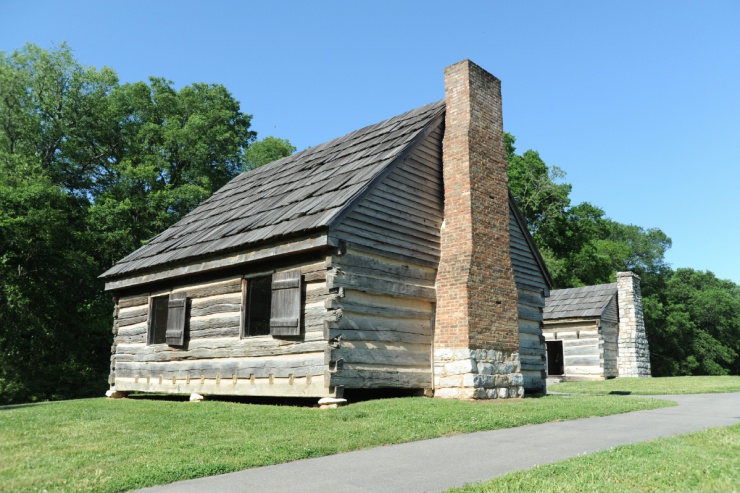
“First Hermitage,” Hermitage, Davidson County, Tennessee

Sallie Lindsley was elected Second Vice Regent of the Ladies’ Hermitage Association (1891-1899), then served as Regent18 until her death by heart failure on July 5, 1903.19   (2014)


SOURCES:

1 Her birth and death dates are inscribed on her tombstone in Mt. Olivet Cemetery.

2 Gray, Robert. The McGavock Family: A Genealogical History of James McGavock and His Descendants from 1760 to 1903. Richmond, VA: William Ellis Jones, Printer, 1903, 21.3 Gray, Robert, 20-21.

4 Gray, Robert, 14.

5 “Mrs. Lindsley Dead. Passes Away Quietly after Brief Illness.” The Nashville American, July 6, 1903, page 4.

6 “Felix Grundy.” United States Congress. Biographical Directory of the United States Congress, 1774-2005. Washington, D. C.: Government Printing Office, 2005.

7 Tennessee State Marriages, 1780-2002. Nashville: Tennessee State Library and Archives.

8 Lindsley, John Berrien. Diary, Volume 5, October 6, 1856 – January 1, 1866. Lindsley Family Papers, ca. 1812 – [1840-1940] – 1953, Box 1, Folder 23. Tennessee State Library and Archives. February 9, 1857.

9 Lindly, John M. The History of the Lindley-Lindsley-Linsley Families in America, 1639-1924, Vol. II.  Winfield, Iowa: Self-published, 1924, 19.

10 Lindsley, John Berrien. Diary, Volume 5, December 1-24, 1864.

11 Bucy, Carole Stanford. “Quiet Revolutionaries: The Grundy Women and the Beginnings of Women’s Volunteer Associations in Tennessee,” Tennessee Historical Quarterly, Vol.LIV, No. 1, Spring 1995, 45.

12 Bucy, Carole Stanford. “Ladies’ Hermitage Association.” Tennessee Encyclopedia Online. Knoxville: University of Tennessee Press, 2002-2014.

13 Dorris, Mary C. Currey. Preservation of the Hermitage, 1889-1915: Annals, History, and Stories. Smith & Lamar, 1915, 35.

14 Bucy, Carole Stanford. “Quiet Revolutionaries,” 46.

15 Bucy, Carole Stanford. “Quiet Revolutionaries,” 46.

16 The Hermitage, Home of President Andrew Jackson website. Accessed 6-23-2014. http://www.thehermitage.com/mansion-grounds/mansion/hermitage

17 The Hermitage, Home of President Andrew Jackson website. Accessed 6-23-2014.

18 Dorris, Mary C. Currey. Preservation of the Hermitage, 1889-1915, 219-220.

19 Tennessee City Death Records, Nashville, Knoxville, Chattanooga, Memphis, 1848-1907.  Nashville: Tennessee State Library and Archives.

My Hermitage Experience

A Reminiscence by Houston Seat.

My first visit to The Hermitage, at the age of five years, was with my grandfather in a borrowed Model A Ford. I had to remain in the car and be good, and I didn’t get to go into this big brick house even though I really wanted to see what was inside. Perhaps I should explain.

My grandfather, Samuel H. Seat, was a blacksmith adept at working with iron and fashioning hand-wrought objects. The quality of his work was well known and he was often occupied in some special project. It was 1935 at the time, and The Ladies’ Hermitage Association had contacted my grandfather about reproducing the latch assembly on the window shutters of the mansion since time had taken a toll on the original iron pieces. I had to remain in the Ford while he was inside meeting with the ladies in charge of the restoration. Memory brings back the wasp that came through the open car window, buzzing around me for a few moments and then flying on toward the big house with the loose, sagging shutters.

As time passed, I learned that this was the home of Andrew Jackson and his wife Rachel, who died suddenly on December 22, 1828, the year Andrew was elected President of our country. Rachel is quoted as saying, “I had rather be a doorkeeper in the house of God than to live in that palace at Washington.” Was her wish granted?

On a return visit thirty years later, I had a five-year-old with me – my son. We toured The Hermitage together. The Model A Ford is past history, along with the grandparent who let me tag along. Memories can last a lifetime and those with whom we experience special occasions live on, too.

Six Triple-Threat Town Sites

by Guy Alan Bockmon.

In his 1930 book Soil, Its Influence on the History of the United States, Archer Butler Hulbert noted that the locations of the early “ferries . . . mark the . . . points where the ancient trails descended from high ground to the fords. These were usually located on a river at the mouth of a loading tributary. The sediment of this tributary was deposited blow [sic] its mouth in the main river, making the water shallower at that point and therefore more easily forded. About such fords human habitations usually sprang up in the shape of trading cabins, villages, or forts.”

At six such sites there sprang up the first tiny villages on the Cumberland and Red Rivers in Middle Tennessee.

The village of Nashville grew up around the 1780 fort sited on a defensible bluff accessible from the river via Lick Branch. The Lick Branch shoal was augmented by that of Pond Branch, which flowed into the Cumberland from the opposite side.

A little more than a mile downstream from Nashville, and on the other side of the river, Heaton’s (or Eaton’s) Station was also established in 1780, at a location near where Well’s Mill Creek loaded into the Cumberland. The station had prospered sufficiently to be called Heatonsburg in the 1783 minutes of the Notables. Historian A. W. Putnam (1799-1869) believed the town of Waynesborough was laid out at Heaton’s Station about 1796. This new town, a rival to Nashville, was given its name in honor of General Anthony Wayne.

Clarksville, the second settlement in Middle Tennessee to survive as a town, was sited on the east bank of the Cumberland, just above the mouth of the Red River. Local historian W. P. Titus observed that Clarksville had the advantages of two rivers, good landings, and, what was then indispensable, a gushing spring of pure water.

A few miles downstream from Clarksville, Deason and Weaver Creeks had combined forces over geological time, carving a deep notch into the high limestone bluff. At that spot on the south shore, downstream from the mouth of the north shore’s Hog Branch, the village of Palmyra began to prosper in its role as the country’s international port nearest to the Gulf of Mexico. Jonathan Steele, Comptroller of the Treasury from 1796-1802, noted that the appointment of one Morgan Brown as Collector had been approved upon the information of Andrew Jackson, then a Senator from Tennessee.

About ten miles east of Clarksville, where Sulphur Fork Creek flows into the Red River, the village of Port Royal was laid out, as described by C. E. Brehm*, into 37 lots, four streets, a public square and a section of land reserved for a public warehouse.

Upstream from Nashville about six miles is the mouth of Spencer’s Spring Branch. It was later to be called, successively, Buchanan’s Spring Branch, Craighead’s Spring Branch, and Love’s Spring Branch. On its banks by 1799 was established the village of Haysborough.

Only a few fords and ferries are still in use, as are even fewer portages. The cities of Nashville and Clarksville still thrive. Palmyra still exists. The site of Port Royal is now a State Park. The historic villages of Haysborough and Waynesboro have disappeared from modern maps. The triple threat of fording place, portage, and harbor at these six sites and many others largely determined where future settlements, roads, ferries, bridges, and eventually railroads would be located. Thus did sedimentation influence settlement.


* Cloide Everett Brehm (1889-1971) was president of the University of Tennessee from 1946-1959.

A Pioneer History of Stone’s River near the Clover Bottoms

by Amelia Whitsitt Edwards.

One of the most popular features of the Donelson area is a paved greenway trail system along the banks of Stone’s River from the Percy Priest Dam to the Cumberland River. The trail winds through the Clover Bottoms, an area of prime importance to the early settlers in the Nashville area.

Scene on the greenway trail (from NHN collection)

The pioneer story began in 1766 with the exploration of the Long Hunters. The river was named in honor of one of their group, Uriah Stone. These adventurers carried the story of this bountiful, uninhabited land with them when they returned to Virginia and North Carolina. It was fourteen years, however, before the first settlers arrived.

In the spring of 1780, John Donelson, having led the flotilla of settlers to Nashborough, recognized the need to plant a corn crop immediately. He again boarded the good ship Adventure with his family, poled up the Cumberland around the great bend until he found the mouth of Stone’s River. He was looking for alluvial fields that were as fertile as the Valley of the Nile and which needed no clearing in order to plant.

The Donelson Party arrived on flatboats

A short distance from the confluence of the two rivers he found what he was looking for on the west bank of Stone’s River*, an area forever after known as the Clover Bottoms. Here he docked his boat and built half-faced shelters to house his family on the opposite bluff. This was fifteen-year-old Rachel Donelson’s first home in Tennessee.

That July heavy rains inundated the corn crop. This unhappy event, plus constant harassment from the native Indians, forced the family to move to Mansker’s Fort for protection.

By fall, word reached the settlers at Mansker’s that the flood waters had subsided and that the corn had eared. John Donelson sent a request to the men at Fort Nashborough to meet him at the Clover Bottoms to help harvest the corn. Approximately ten men from each fort built wooden sleds to drag the corn from the field to the boats moored in Stone’s River. Several days were required to load the boats.

As they left the shore, the boat from Fort Nashborough was attacked by Indians; only three settlers escaped with their lives. The Donelson party was on the north bank, harvesting the cotton planted there. They abandoned their boat loaded with corn and managed to get away on foot through the woods. Donelson’s heroic slave, Somerset, swam the Cumberland River and brought help from Mansker’s Fort to the stranded group.

Meanwhile, the boat from Fort Nashborough floated downstream, eventually reaching the bluffs with its tragic cargo of corn and slain men. The settlers there rescued the corn and buried their dead.

Some years later Andrew Jackson, who had married Rachel Donelson, operated several businesses along the Stone’s River corridor. He first opened a general store near the Clover Bottoms. In order to stock his store, he went to Philadelphia and traded land preemptions for flour, sugar, piece goods, and pocket knives. The store was a two-story building near today’s Downeymead Drive.  C. Lawrence Winn, a descendant of Jackson’s adopted son, built a house on the property in 1960.

In 1805 Jackson, with two partners, formed the Clover Bottom Jockey Club. A race track and tavern were built by the river. The story of Jackson’s duel with Charles Dickinson is well known. The unfortunate quarrel that sparked the duel started at this race track.

A story that is not so well known is that of Jackson’s boat yard on Stone’s River, near its mouth. Here he constructed five flat boats and one keel boat for former Vice President Aaron Burr who was leading a group of colonists to lands he had acquired in Louisiana. In 1812 Andrew Jackson became a military officer and began his lengthy pursuit of both a military and a political career. Thereafter his business interests on Stone’s River faded away.

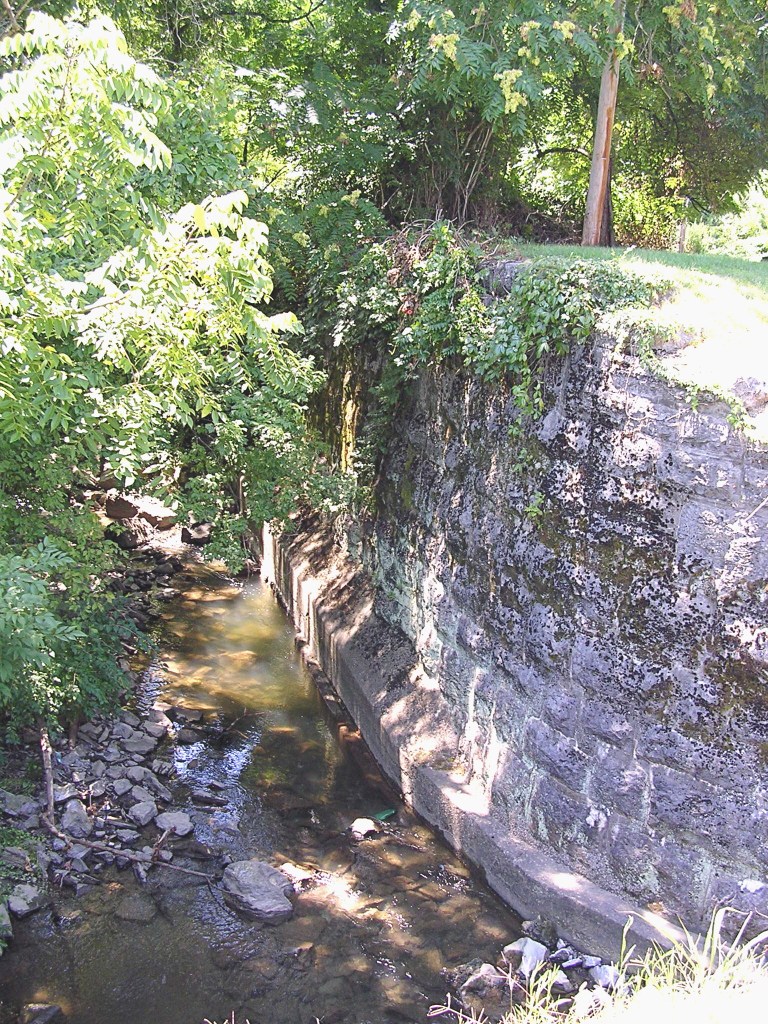
A Donelson creek (from NHN photo collection)

The large tract of land known as Clover Bottom Plantation came to be owned by Dr. James Hoggatt, who built the ante-bellum mansion on the property. The property was sold to Mr. Andrew Price in the late 19th century, and then to A.F. and R.D. Stanford in the early 20th century. After World War II it was sold to the State of Tennessee.

Although the last several years have brought considerable business development to the Clover Bottoms, much of the river bank remains untouched by man. The Greenway Project is a promise to maintain the natural beauty of this historic site and preserve it for our future generations. (2000)


* Historians surmise that John Donelson’s cornfield was located just west of the Stone’s River bridge, in the general area of today’s Jackson Downs (Target) shopping center, which was named, incidentally, for the racetrack Andrew Jackson later built slightly northeast of that location.

Ten Important Dates in Nashville History

by Mike Slate.

A short list of important dates in Nashville history must necessarily exclude many defining events. Nevertheless, we believe the effort to narrow our history into an easily memorized list is worthwhile. The listed items provide an overview of the whole and serve as guideposts between which additional events can be viewed with some perspective. Perhaps it is also motivating to realize that memorizing a list of ten important Nashville dates will result in your suddenly knowing more Nashville history than probably eighty or ninety percent of all Nashvillians!

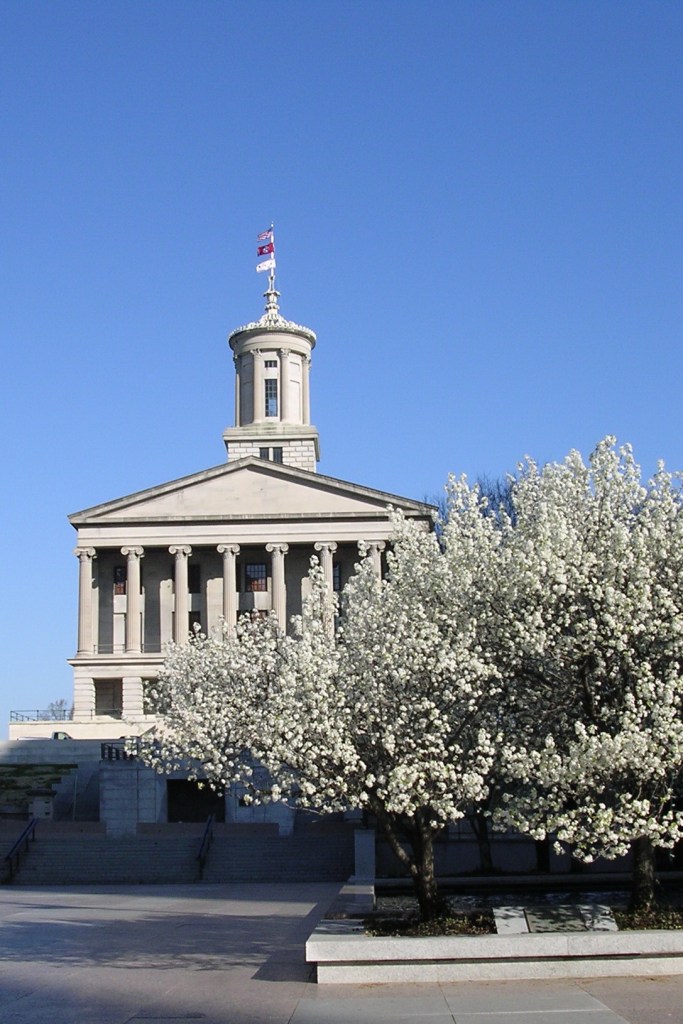
Photo of Tennessee State Capitol from NHN collection

Regrettably, in addition to Native American history, our list of dates omits Nashville’s heroic pre-settlement period, including the exploits of Timothy Demonbreun and the founding journeys to the Cumberland region led by James Robertson and John Donelson. Also omitted is the date of the formation of Davidson County (1783) as well as the dates on which Nashville was officially named (1784) and incorporated (1806). The Union occupation of Nashville (beginning February 1862) is another significant event not specified here. Several important twentieth century dates, including the rise of the huge DuPont Powder Plant complex during World War I, are not included. Finally, the modern development of Nashville, with its high-rise buildings and its various sports and entertainment venues, has been left for some future list.

No entry on the list should necessarily be construed as carrying the same historical weight as any other item on the list. For example, the 1925 beginning of the Grand Ole Opry would probably not carry the same weight as, say, the 1864 Battle of Nashville.

Expansive timelines of Nashville history can be found in other sources, including such excellent books as Henry McRaven’s Nashville: “Athens of the South.”

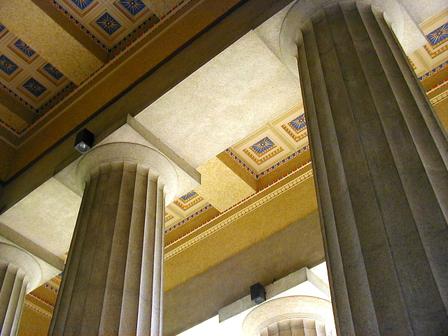
Photo of Parthenon from NHN collection

1. 1780 The signing of the Cumberland Compact.

2. 1824 The arrival of Philip Lindsley and the rise of the University of Nashville.

3. 1828 The election of Andrew Jackson as President of the United States.

4. 1843 The designation of Nashville as the capital of Tennessee.

5. 1864 The Battle of Nashville.

6. 1873 The founding of Vanderbilt University.

7. 1880 The Nashville Centennial Celebration.

8. 1897 The Tennessee Centennial Exposition.

9. 1925 The beginning of the Grand Ole Opry.

10. 1963 The formation of Metropolitan Nashville Government.

(article published in 2001)

John Berrien Lindsley, 1822-1897

by Kathy B. Lauder.

Born October 24, 1822, John Berrien Lindsley came to Nashville in 1824, when his father, Philip, became president of the University of Nashville. Young Lindsley was educated at home by his parents and a neighbor, Septima Sexta Rutledge.1 At 14 he entered the University of Nashville, earning a B.A. at 17 and an M.A. two years later.2 In 1842 he entered the University of Pennsylvania Medical School, receiving his M.D. in March 1843.3 Here Lindsley began a lifelong friendship with adventurer William Walker.4

Dr. John Berrien Lindsley

Lindsley’s next pursuit was theology: in December 1843 the Nashville Presbytery accepted him as a candidate for the ministry.5 He was licensed to preach in April 1845,6 shortly before attending to Andrew Jackson at his deathbed.7 Lindsley ministered to churches at the Hermitage and in Smyrna and, beginning in 1847, preached to slaves and the poor.8 An 1849 cholera epidemic9 kindled his interest in public health.

When Philip Lindsley left the University of Nashville in 1850, his son John Berrien became Chancellor. He proposed to rescue the faltering university by merging with the Western Military Institute of Georgetown, Kentucky,10 and by establishing the long-awaited medical school. Though apprehensive, Board members permitted the merger.  Lindsley spearheaded the development of the medical school in 1851, became its first dean, and taught there until 1873.11 [Note: the following year the University of Nashville Medical School was incorporated into Vanderbilt University, which had been founded in 1873 by virtue of a grant from Commodore Cornelius Vanderbilt. From that point on, it would be known as the Vanderbilt University School of Medicine.]

In 1857 Lindsley married Felix Grundy’s granddaughter Sarah “Sallie” McGavock, with whom he had six children. He served on the Nashville Board of Education and was secretary of the State Board of Education, administering the Peabody Education Fund and overseeing the transition of the University of Nashville into Peabody College.12 Having received a Doctorate of Sacred Theology from Princeton (1858), he lectured in the Cumberland University Theological Department in Lebanon.13

Following the capture of Fort Donelson (February 1862), Lindsley became post surgeon of Nashville hospitals. His valiant efforts to protect university property during federal occupation saved the library, laboratory equipment, and the valuable Troost mineral collection.14 

After the war, Lindsley served on the Nashville Board of Education and was superintendent of Nashville public schools. He helped establish Montgomery Bell Academy (1867) and the Tennessee College of Pharmacy (1870),15 and in 1875 presided over the State Teachers Association. Having promoted the passage of an 1877 law establishing the State Board of Health, he served as its first executive secretary.16 As Nashville Public Health Officer from 1876-1880, he supervised all health efforts in Tennessee during the 1878 yellow fever epidemic.17 He taught Sanitary Science and Preventative Medicine at the University of Tennessee from 1880-1897.18

Dr. John Berrien Lindsley in later life.

Distressed by wartime divisions within the Presbyterian Church, Lindsley became a minister in the Cumberland Presbyterian Church in 1874.19 He authored History of the Law School of Cumberland University at Lebanon, Confederate Military Annals of Tennessee, and many works on medicine and public health. He was an early member of the Tennessee Historical Society and a fellow of the American Academy of Medicine.20 His many talents led Alfred Leland Crabb to call him the “Benjamin Franklin of Nashville.”21           

John Berrien Lindsley died December 7, 1897, in Nashville. He is buried in Mt. Olivet Cemetery. (2014)


SOURCES:

1 Windrow, John Edwin. John Berrien Lindsley, Educator, Physician, Social Philosopher. Chapel Hill: University of North Carolina Press, 1938, 8.

2 Lindsley, John Berrien. Diary, Volume 4, 1849-1856.  Lindsley Family Papers, ca. 1812 – [1840-1940] – 1953, Box 1, Folder 21.  Tennessee State Library and Archives.

3 Windrow, 11.

4 Lindsley, John Berrien. Letter to Adrian Van Sinderen Lindsley, April 8, 1843. Lindsley Family Papers, ca. 1812 – [1840-1940] – 1953. Oversize folder (49). Tennessee State Library and Archives.

5 Lindsley, John Berrien. Diary, Volume 4, 1849-1856.

6 Windrow, 12.

7 Lindsley, Philip. Journal. Lindsley Family Papers, ca. 1812 – [1840-1940] – 1953, Box 2, Folder 33. Tennessee State Library and Archives.

8 Lindsley, John Berrien. Diary, Volume 4, 1849-1856. 

9 Pyle, G. F. “The Diffusion of Cholera in the United States in the Nineteenth Century,” Wiley Online Library, accessed 1-4-2014.  http://onlinelibrary.wiley.com/doi/10.1111/j.1538-4632.1969.tb00605.x/pdf

10 Conkin, Paul K. Peabody College: From a Frontier Academy to the Frontiers of Teaching and Learning. Nashville: Vanderbilt University Press, 2002, 83.

11 John Berrien Lindsley Papers, Collection No. 41. Vanderbilt University Medical Center. The Annette & Irwin Eskind Biomedical Library, Special Collections: Accessed 1-5-2014.  http://www.mc.vanderbilt.edu/diglib/sc_diglib/biopages/jlindsley.html

12 State Board of Education Records, 1815-1958. Record Group 91, Volume 55, 1875-1885. Tennessee State Library and Archives.

13 John Berrien Lindsley Papers, Vanderbilt University.

14 Crabb, Alfred Leland. The Historical Background of Peabody College. Nashville: George Peabody College for Teachers, 1941, 20-21.

15 John Berrien Lindsley Papers, Vanderbilt University.

16 Lindsley, John Berrien. Diary, Volume 5, October 6, 1856 – January 1, 1866. Lindsley Family Papers, ca. 1812 – [1840-1940] – 1953, Box 1, Folder 23. Tennessee State Library and Archives.

17 Windrow, 140-141.

18 Windrow, 159-160.

19 DeWitt, Rev. M. B. Letter, March 11, 1898, quoted in Windrow, 13-14.

20 John Berrien Lindsley Papers, Vanderbilt University.

21 Crabb, Alfred Leland. Nashville: Personality of a City. Indianapolis: Bobbs-Merrill, 1960, 95.

SUGGESTED READING:

Conkin, Paul K. Peabody College: From a Frontier Academy to the Frontiers of Teaching and Learning. Nashville: Vanderbilt University Press, 2002.

Crabb, Alfred Leland. The Historical Background of Peabody College. Nashville: George Peabody College for Teachers, 1941.

Windrow, John Edwin. John Berrien Lindsley, Educator, Physician, Social Philosopher. Chapel Hill: University of North Carolina Press, 1938.

The Historic Mud Tavern Community

by Richard R. Neil.

The Mud Tavern community grew out of two events in the early settlement of Middle Tennessee. First, sometime before 1784, Major John Buchanan built a “station,” or fortified home, on the east bank of Mill Creek just downstream from where Elm Hill Pike today crosses the creek. This is thought to be the first permanent dwelling in the Mud Tavern area.  Buchanan lived in his “station” house until his death in 1832.

Buchanan’s Station became famous in early Middle Tennessee history when, during the Chickamauga Wars, it was attacked on the evening of September 30, 1792, by a large party of Cherokee, Shawnee, and Muskogee warriors. The attack was successfully repelled by the small band of men and women who had gathered for safety at the station amid signs that the Chickamauga group was in the area. More important for this article is that the station’s defenders included James Mulherrin and Sampson Williams – two men who had migrated with Buchanan in 1780 from South Carolina to Tennessee – as well as James Todd, Samuel McMurray, and others who had received land grants in the immediate vicinity. The presence of so many neighboring settlers suggests that Buchanan station was already the civic center for a developing community of people that would come to be known as Mud Tavern. 

The second founding event is as legendary as it is historic.  Sometime near the beginning of the 19th century a tavern opened on Elm Hill Pike near what is today the intersection of the Elm Hill and McGavock Pikes. It was said to have been built of mud and cedar, hence the name “Mud Tavern.” There are no records to show who first owned the inn, but Richard Smith purchased property at this site in 1810, and court decisions in 1816 in 1832 seem to suggest that it was indeed Smith who operated a tavern there.  Although there are no ruins to mark its location or documents to prove its existence, stories of the old tavern persist. It is said that Andrew Jackson often stopped there on his way to and from Nashville and that he stayed there for two nights as he prepared for his fateful 1806 duel with Charles Dickinson. In the end, however, the best proof of the inn’s existence and its significance is that the surrounding community chose to call itself Mud Tavern, and so it appears on Davidson County maps into the 21st century.

In 1821 the Rev. Richard Dabbs came from Charlotte County, Virginia, to become founding pastor of the First Baptist Church of Nashville. He purchased 347 acres in the Mud Tavern community and built his home on hills overlooking the Mill Creek Valley. Rev. Dabbs died just two years after assuming leadership of First Baptist Church, but by that time his family had become well established in the area. In the years just before the Civil War, his grandsons expanded the original purchase to more than six hundred acres. The war and its aftermath reduced the fortunes of the Dabbs family, but they continued to play a role in the Mud Tavern community and beyond. John W. T. Dabbs, M.D., was a beloved physician in the Nashville area during the early part of the 20th century.  His son, John W.T. Dabbs Jr., Ph. D, gained an international reputation for his work at Oak Ridge National Laboratory on the nuclear ramifications of extremely low temperatures. Descendants of the Rev. Richard Dabbs were still living on his Mud Tavern farm in 1955, when the airport authority purchased the land in order to extend runways to accommodate jet air traffic.

The expansion of southern railroads after the Civil War played a major role in the area’s recovery. The community appeared on the map in 1869 when the Tennessee and Pacific Railroad established a route called the Lebanon Junction and showed Mud Tavern as one of several flag-stop stations along the way. An 1871 Davidson County map – “from actual surveys made by order of the county court” – clearly marks Mud Tavern as a separate and distinct community with the railroad running through it. 

The railroad station had a two-fold and somewhat ironic effect on Mud Tavern residents.  It provided their community with a geographic center of activity: within a fairly short time the area around the station had acquired a post office, a school, and a general store run for many years by Wallace Gleaves. The railroad also gave local citizens access to jobs, schools, and services beyond the immediate community. In 1877 the T&P was purchased by the Nashville, Chattanooga, and Saint Louis Railway, to open up travel an even larger world. Sometime in the 1920s, however, the general store acquired gasoline pumps to service the automobiles and trucks that were beginning to displace the railroads. By 1934 passenger traffic on the Lebanon Junction had declined precipitously, and the NC&SL petitioned the Interstate Commerce Commission to abandon it. The last train stopped at Mud Tavern in 1935. Among those who boarded was longtime resident Will Page, who later told an interviewer, “I took the last trip on the train about two years ago on the thirteenth of July.” It was the end of an era.

From the earliest days, Mud Tavern was primarily a rural, farming community within six or seven miles of downtown Nashville. Farmers took their produce to market by wagon, train, and truck until well into the 1950s. Some of the community’s most enduring institutions supported and influenced its agricultural way of life. Early in the 20th century, Peabody College established Knapp School of Country Life on acreage that included the old Buchanan Station. Along with other practices, the school introduced alfalfa as a hay crop among local farmers. The present-day Purity Dairies had its origins in Mud Tavern on the Miles Ezell farm. For many years Oscar L. Farris, agent for the University of Tennessee Agricultural Extension Service, lived on a hill overlooking the site of the old Mud Tavern inn. Farris and his wife Mary helped farm families of the community adapt as agricultural technology began to change rapidly during the 20th century.

In 1911 the community acquired an institution that would become emblematic of its way of life. The Davidson County Board of Education deeded to Jacob Young the old Mud Tavern school, which sat a few yards west of the crossroads where the Mud Tavern inn had been located.  Young in turn gave the clapboarded building and one acre of land to the Mud Tavern community to be used for “the good of the community,” and it was received by H. S. Allen, D. W. Thompson, James Hite, Leopold Strasser, Thomas Whitworth, and Thomas Page, who were elected trustees.  That one-room school became the meeting place of the Elm Hill Community Club. Over the years it was the site of many ice cream socials, community fairs, a free circulation library, worship services, baseball games, 4-H club and Home Demonstration meetings . . . in short, all of the activities associated with a lively rural society.       

After 1935 the urban ethos of Nashville, which was never far away, slowly but inevitably encroached upon Mud Tavern’s bucolic existence with its siren call of more lucrative jobs and public demands for new roads, commercial development, and residential subdivisions. The airport expanded in 1955, and by the early 1960s Briley Parkway and Interstate 40 had been built through the area, obliterating many of the old farms. Still, as late as 1990 the Elm Hill Community Club building could still be seen hidden in a bramble patch and surrounded by taller commercial buildings, a symbol of an earlier way of life that was gone but not forgotten. Today a group of former Mud Tavern residents meets twice a year to share stories and memories of the area.

In one of Wendell Berry’s short stories, an old man reminisces about his life on his family’s farm: “He is thinking of the membership of the fields that he has belonged to all his life, and will belong to while he breathes, and afterward.  He is thinking of the living ones of that membership – at work today in the fields that the dead were at work in before them. ‘I am blessed,’ he thinks. ‘I am blessed.’” Those whose families lived in the Mud Tavern community count themselves blessed to belong to its membership.


This article was originally published in the January 2010 edition of The Nashville Retrospect. We thank publisher Allen Forkum for his permission to republish it here.  Photograph of Mud Tavern historical marker from NHN collection.  

Thomas S. Watson Sr.: Miller, Ironmaster, and Business Partner of Andrew Jackson

by Steve Watson.

Few people who look at President Andrew Jackson’s portrait on a twenty-dollar bill think of him as a maker and purveyor of liquor, yet Jackson and his partner Thomas Watson owned two stills in 1802, producing 499.5 gallons of Tennessee corn whiskey from December 1802 through February 1803. Most of this whiskey was delivered to stores co-owned by Jackson, Watson, and John Hutchings, but Jackson kept 82.25 gallons for his personal use.

Birthplace of Andrew Jackson

This and other business relationships between Andrew Jackson and Thomas S. Watson Sr. did not last long. Although their families continued to be associated for the remainder of their lives, the two men were no longer partners after 1803. Consequently, few people know of Thomas S. Watson Sr. What follows is a brief sketch that illuminates this relatively obscure business partner and neighbor of our former President from Nashville.

Thomas S. Watson Sr., born in Virginia about 1758, was the son of John Watson and Elizabeth Ann Jones of Prince Edward County, Virginia. His father was High Sheriff and later became a magistrate of Prince Edward County; his uncle was Revolutionary War General Joseph Jones; and his wife was Sally Sanders, daughter of Thomas Sanders and Mary Mitchell. Watson and his wife moved to Davidson County after selling their Prince Edward County lands in 1796.

The first evidence of Thomas Watson in Tennessee is a 1798 indenture recorded in Davidson County, in which he signs his name as a witness to the purchase of 300 acres on Stoner’s Creek by John Watson of Prince Edward County, Virginia, from John Donelson of Davidson County, Tennessee. It was John Donelson’s sister Rachel who had married Andrew Jackson in 1791.

Before coming to Tennessee, Thomas S. Watson Sr. and his brother Augustus had built a “merchant mill” on Falling Creek in Prince Edward County, Virginia. By 1802 Thomas owned another mill, near Nashville, which was used to grind the corn for the aforementioned whiskey. He became owner of Barker’s Mill on the West Fork of the Red River in Christian County, Kentucky, by 1815, and about 1816 he also built what later became known as Peacher’s Mill in Montgomery County, Tennessee.

These milling activities notwithstanding, Thomas S. Watson’s primary business interest was iron-making, and he and his brother-in-law/business partner, Peter Guerrant Moseley, were acknowledged as ironmasters. The firm of Watson and Moseley operated the Yellow Creek Iron Works in Montgomery County, Tennessee, where the smelting furnace appears to have been in existence as early as 1802 and probably reached its zenith in the 1820s, after its purchase by Thomas S. Watson Sr. and his son-in-law. The 1820 federal census of Montgomery County shows a total of 71 persons employed at the iron works: 30 free whites, 40 slaves, and one free colored person. A smelting furnace like the Yellow Creek Furnace was undoubtedly a hot, dirty, and dangerous place in 1820. Consequently, Thomas S. Watson Sr. maintained an estate in Wilson County, Tennessee, for his wife and younger children, and in the 1820 federal census he was enumerated there as well as in Montgomery County.

Perhaps the most famous of the early Tennessee ironmasters was Montgomery Bell, after whom the renowned academy in Nashville is named. The fact that Thomas S. Watson Sr. and his son-in-law, John Hartwell Marable, acquired 2,476 acres on Yellow Creek from Montgomery Bell in 1819 suggests that Watson and Moseley’s earlier association with Yellow Creek may have developed through some type of relationship with Bell. John Hartwell Marable represented the Clarksville area of Tennessee in the United States Congress from 1825 through 1829.

Thomas S. Watson Sr. founded the Red River Forge in Montgomery County around 1816 or 1817, along with the dam and facilities later known as Peacher’s Mill. Two Montgomery County post offices were associated with these early iron works: the Red River Forge post office operated from 1826 through 1829, and the Yellow Creek Furnace post office operated from 1825 through 1866. Thomas S. Watson Sr. and Peter Moseley returned to the Nashville area before 1830, settling near the confluence of Drakes Creek and the Cumberland River, at the point where Davidson, Sumner, and Wilson Counties meet. Peter Moseley eventually moved westward and died in Yazoo, Mississippi.

At the age of 82 Thomas S. Watson Sr. was living in Sumner County, Tennessee, where he was enumerated in the 1850 federal census as a member of the household of his son Thomas S. Watson Jr. The younger Watson operated, in Saundersville, a public tavern and hotel, which was later known as the Wayside Inn, and he was a superintendent of Sumner County School District #7. The date of death and place of burial of Thomas S. Watson Sr. are not known.

A third Thomas Watson was associated with this family: Thomas Tennessee Watson was the nephew of Thomas S. Watson Sr. and a son of Sarah Branch Jones and LTC Augustus Watson. Thomas Tennessee Watson was nine years old in 1815 when his father died at Camp Carter in Albemarle County, Virginia, during the War of 1812. Thomas later came to Tennessee, assisted in founding the Tennessee Medical Society, and became a noted ironmaster himself. His tombstone stands near the remains of the Central Furnace in the Land Between the Lakes recreation area near Cadiz, Kentucky. Genealogists should be advised that some researchers have confused Thomas Tennessee Watson with his cousin, Thomas S. Watson Jr. and have erroneously concluded that Thomas Tennessee Watson was a son of Thomas S. Watson Sr.

Theodore Roosevelt’s 1907 Nashville Visit

by C. Michael Norton.

Theodore Roosevelt’s rise to the Presidency was meteoric. In 1897 he resigned from his position as Assistant Secretary of the Navy to lead the Rough Riders in the Spanish-American War. Returning from Cuba a hero, he was elected Governor of New York in 1898. In 1900 he was chosen to serve as William McKinley’s Vice President, and, when McKinley was assassinated a year later, Theodore Roosevelt became President. He was 42 years old. In 1904 he was elected President in his own right.

This dynamic man visited Nashville on October 22, 1907, and received a warm welcome. After he arrived at Union Station about 9:00 a.m. in his own rail car , a parade formed on Broadway behind the President in a horse-drawn carriage, accompanied by 25 to 30 automobiles. The escort of honor was Troop A of the Confederate Veteran Cavalry. The procession moved down Broadway to Eighth Avenue. At that corner were some 2,000 students from schools including the University of Tennessee Medical School, the Hume and Fogg Schools, Buford College, Belmont College, Radnor College, Boscobel College, and St. Cecelia Academy. The parade then wound its way through downtown, ending up at the Ryman Auditorium.

Theodore Roosevelt at Peabody College (postcard image courtesy of C. Michael Norton)

At the Ryman, Roosevelt delivered his principal address of the day. He touched on such current issues as turning the Mississippi River and its principal tributaries into navigable waterways, as well as more enduring issues, like the necessity of preventing stock manipulation (in his words, the need to “punish successful dishonesty”). Leaving the Ryman, Roosevelt changed vehicles to a 50-horsepower Peerless automobile and headed toward the Hermitage. The procession stopped at Peabody College, then located on “College Hill” at Second and Lindsley. This area also included the University of Nashville Medical College and Montgomery Bell Academy.

After a few brief remarks, Roosevelt and his entourage left again for the Hermitage.  On the trip out Lebanon Pike, the vehicles passed the site of the Clover Bottom horse racing track where Andrew Jackson had raced his horses.  Arriving at the Hermitage where a crowd of over 10,000 had gathered, Roosevelt met with officials of the Ladies’ Hermitage Association.  After a tour the President spoke to the crowd on the grounds and promised to secure federal funds to be used toward the preservation of the Hermitage.

The procession’s final stop was at the Confederate Solders’ Home, where the President also made a few remarks.  Finally, he returned to his rail car at the Hermitage Station and left Nashville a little after 1:00 p.m., heading south to Chattanooga.  During the trip he stopped and briefly spoke from his rail car at several towns, including Murfreesboro and Tullahoma.

An interesting aside concerning this visit involves the advertising campaign later developed by Maxwell House, which attributed its slogan “good to the last drop” to Roosevelt, based on a comment he allegedly made at the time.  In fact, it is unlikely that he made such a statement.  Nashville newspapers reported that, during his visit to the Hermitage, Roosevelt did ask for a cup of coffee; none of the reports, however, indicated the brand of coffee that was served to him.  The Nashville Banner reported that Roosevelt enjoyed the coffee and said, “This is the kind of stuff I like, by George, when I hunt bears.”  One can hardly imagine a successful advertising campaign based on that slogan!


Sources:
Nashville Tennessean, October 23, 1907.
Nashville Banner, October 22, 1907.
The Nashville American, October 23, 1907.
Carey, Bill. Fortunes, Fiddles, & Fried Chicken, Hillsboro Press, 2000, pp. 47-48.

Touring Elm Hill Pike

by Susan Douglas Wilson.

Elm Hill Pike is one of the most historic roads in Nashville. Few thoroughfares in our city contain so much history packed into so few miles. The road, which probably began as a buffalo or Indian trail, has been mentioned in several accounts of early Nashville history. Andrew Jackson was reported to be a frequent traveler on Elm Hill Pike on his journeys from downtown Nashville to the Hermitage. Mapmakers and old-timers have also referred to this road as “the chicken pike” and the Stones River Road.

As you turn off of Murfreesboro Pike onto Elm Hill Pike, the first historic site encountered is Mt. Ararat Cemetery on the north. Mount Ararat was founded in 1869 by local black leaders and became a burial ground for many of Nashville’s black pioneers. Over the years, the cemetery became a dumping ground and a target for vandals. In 1982 the management of Mt. Ararat was taken over by the Greenwood Cemetery’s board of directors, which voted to change the name from Mt. Ararat to Greenwood Cemetery West and to begin a comprehensive restoration project.

About a mile east of Mt. Ararat Cemetery is Greenwood Cemetery, established on thirty-seven acres in 1888 by Preston Taylor. Taylor, born a slave in Louisiana in 1849, was an influential black preacher, undertaker, and business leader. In addition to Taylor, illustrious Nashville citizens buried at Greenwood Cemetery include Z. Alexander Looby, the Rev. Kelly Miller Smith, Sr., DeFord Bailey, John Merritt, and J. C. Napier.

The gates of Mt. Ararat Cemetery (photograph from NHN Collection)

In 1906 Preston Taylor opened Greenwood Park on approximately forty acres adjoining Greenwood Cemetery. The park was established to serve the black community and included a baseball stadium, skating rink, swimming pool, theater, merry-go-round, bandstand, zoo, and many other attractions. A state-wide fair and a Boy Scout summer camp were also held at Greenwood Park. The admission to the park was ten cents on regular days and twenty-five cents on holidays. The Fairfield-Green streetcar stop was nearby and horse-drawn wagons would pick up patrons and deliver them to the park’s entrance at Lebanon Road and Spence Lane. Preston Taylor died in 1931 and his wife managed the park until its closing in 1949.

Buchanan’s Station was located about another mile east where Mill Creek crosses Elm Hill Pike. The station was established by John Buchanan in 1780. Twelve years later, an oft-recounted Indian battle ensued. On a moonlit night in 1792, a band of three hundred Creek and Cherokee, under the leadership of Chiachattalla, raided the station. The twenty-one settlers fought bravely and defeated their attackers, killing Chiachattalla. Major Buchanan lived at the station until his death in 1832. He is buried, along with his wife and other settlers, in the station’s cemetery.

John and Sally Buchanan’s gravestones in Buchanan Station Cemetery. (from NHN Collection)

Peabody College established the Seaman A. Knapp School of Rural Life in 1915 on one hundred fifty acres on Elm Hill Pike. More acreage, including the site of Buchanan’s Station, was acquired in 1922. The farm was the first institution in the United States devoted to the study of the problems of rural life. Peabody College officials believed that teachers should become acquainted with agricultural life since so many of them would be teaching in rural areas. The experimental farm became a showplace with award-winning dairy and beef cattle herds. Innovative techniques in irrigation, pasturage and field equipment were tested at the farm; and many crops were raised including a certified corn station and a contoured, 25-acre orchard. Knapp Farm provided Peabody College with all its meat, vegetables, and fruit until World War II. The importance of the farm declined after the 1920s because of state-supported agricultural research. Expensive to maintain, Knapp Farm was sold in 1965 to a contractor who developed it into an industrial park.

Though the exact location of Mud Tavern is disputed, most old-timers agree that it was near the intersection of Elm Hill Pike and McGavock Pike. The tavern, built during Nashville’s youth, was made of cedar logs with a mud and stick chimney. Andrew Jackson was a frequent patron and it is reported that he spent two days there planning strategy in his duel with the ill-fated Charles Dickinson. Years later a community named Mud Tavern grew up in the area and contained a railroad station, school, post office, and grocery store. The Mud Tavern school building was used for many years as a clubhouse by the Elm Hill Community Club.

On the far side of Donelson Pike, at the corner of Elm Hill Pike and Hurt Drive, is the James Buchanan house. This two-story log house was built circa 1809. James Buchanan and his wife are buried in the family graveyard near the house, which is now under the care of the Association for Preservation of Tennessee Antiquities.

At the present time, Elm Hill Pike ends at Bell Road. The eastern-most part of the road has been re-engineered several times. The course of the road itself may change, but the history of Elm Hill Pike will always remain as a significant part of Nashville’s heritage.  (2000)