Jonathan Jennings’ Will

Primary Source Document, transcribed by Debie Cox, author of Nashville History blog.

Editor’s Note: Historian Debie Cox discovered the Jennings will in the Metro Archives in 2001. Jennings’ tragic death soon after he drew it up gives unusual poignancy to the document. The will is historically significant because it is likely the oldest surviving document from Nashville, other than the Cumberland Compact itself.

Jonathan Jennings and his family were among the group of pioneers who journeyed with the John Donelson flotilla to the Cumberland Settlements. Donelson recorded in his journal on March 8, 1780, that Indians had attacked the flotilla, and that the Jennings family had been left behind as the settlers in the other boats made their escape.

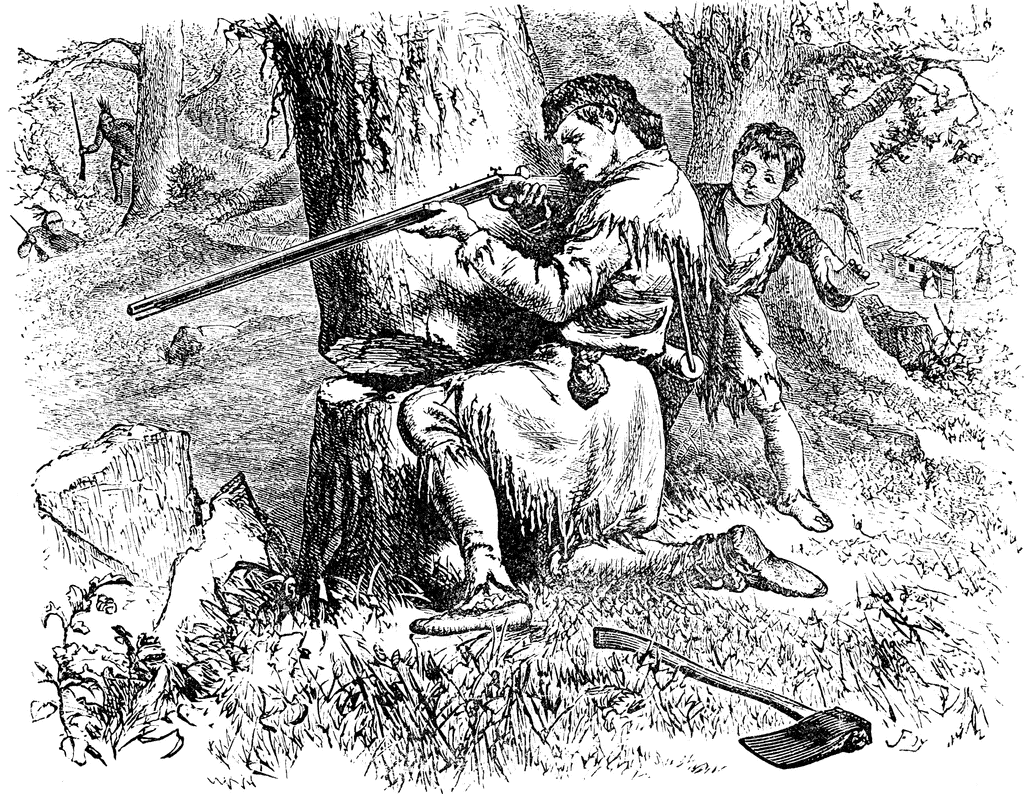
The Jennings boat had indeed survived, but not without casualties. Jennings’ daughter Elizabeth, wife of Ephraim Peyton, had given birth the day before the attack. In the confusion of the fighting, her baby was killed. Jonathan Jennings Jr., son of the elder Jennings, had jumped from the boat along with two other men. Although young Jennings, who was probably in his early teens, and one of the others made it to shore, the third man drowned. Jennings Jr. and his companion were quickly captured by the Indians, who scalped Jennings and killed the other man. Young Jennings, who had survived his injuries, was eventually rescued by a trader who agreed to pay his ransom, and he was later able to reunite with his family in the Cumberland Settlements. After the attack, the remaining members of the Jennings family had continued on their journey, arriving at Fort Nashborough on April 24, 1780.
According to J. G. M. Ramsey in his Annals of Tennessee, Jonathan Jennings Sr., was himself killed by Indians three or four months later, in July or August 1780. He left an undated will, which was presented to the Davidson County court in July 1784 and proven on the oaths of James Robertson and William Fletcher. The will had also been witnessed by Zachariah White, who had died at the Battle of the Bluffs near Fort Nashborough in April 1781. The signatures of Jennings, Robertson, and White can be verified through comparison with their signatures on the Cumberland Compact, which all three men had signed in May of 1780. The will reads as follows:

In the name of God Amen I Jonathan Jennings of North Carolina on Cumberland River having this day Received several wounds from the Indians and calling to mind the mortality of my Body do make and Ordain this to be my last will & Testament And first of all I give and recommend my soul to God that gave it and my body to be disposed of at the Discretion of my executors And as touching my Worldly affairs I dispose of them in manner following Viz

Item I give and bequeath to my    It is my Desire that my Estate be Equally divided between my Wife my sons William, Edmond, Elizabeth Haranor Mary Aggy Anne & Susannah all but such a part as shall be hereafter disposed of

Item I give and bequeath to my son Jonathan who was Scalped by Indians and rendered incapable of getting his living a Negrow girl Milla & her increase who is to remain with my beloved wife till my son comes of age Also a Choice Rifle Gun & a Horse and Saddle Item I give my beloved wife Four Choice Cows and Caves The Wards Milla and her increase and the Ward Jonathan being interlined I devise that my Loveing Wife and my son Edmond be Executrix & Executor of this my last Will & Testament
Signed Sealed & Published in Presents
of Jonathan Jenings
Zach White
Js. Robertson
William Fletcher

Six Triple-Threat Town Sites

by Guy Alan Bockmon.

In his 1930 book Soil, Its Influence on the History of the United States, Archer Butler Hulbert noted that the locations of the early “ferries . . . mark the . . . points where the ancient trails descended from high ground to the fords. These were usually located on a river at the mouth of a loading tributary. The sediment of this tributary was deposited blow [sic] its mouth in the main river, making the water shallower at that point and therefore more easily forded. About such fords human habitations usually sprang up in the shape of trading cabins, villages, or forts.”

At six such sites there sprang up the first tiny villages on the Cumberland and Red Rivers in Middle Tennessee.

The village of Nashville grew up around the 1780 fort sited on a defensible bluff accessible from the river via Lick Branch. The Lick Branch shoal was augmented by that of Pond Branch, which flowed into the Cumberland from the opposite side.

A little more than a mile downstream from Nashville, and on the other side of the river, Heaton’s (or Eaton’s) Station was also established in 1780, at a location near where Well’s Mill Creek loaded into the Cumberland. The station had prospered sufficiently to be called Heatonsburg in the 1783 minutes of the Notables. Historian A. W. Putnam (1799-1869) believed the town of Waynesborough was laid out at Heaton’s Station about 1796. This new town, a rival to Nashville, was given its name in honor of General Anthony Wayne.

Clarksville, the second settlement in Middle Tennessee to survive as a town, was sited on the east bank of the Cumberland, just above the mouth of the Red River. Local historian W. P. Titus observed that Clarksville had the advantages of two rivers, good landings, and, what was then indispensable, a gushing spring of pure water.

A few miles downstream from Clarksville, Deason and Weaver Creeks had combined forces over geological time, carving a deep notch into the high limestone bluff. At that spot on the south shore, downstream from the mouth of the north shore’s Hog Branch, the village of Palmyra began to prosper in its role as the country’s international port nearest to the Gulf of Mexico. Jonathan Steele, Comptroller of the Treasury from 1796-1802, noted that the appointment of one Morgan Brown as Collector had been approved upon the information of Andrew Jackson, then a Senator from Tennessee.

About ten miles east of Clarksville, where Sulphur Fork Creek flows into the Red River, the village of Port Royal was laid out, as described by C. E. Brehm*, into 37 lots, four streets, a public square and a section of land reserved for a public warehouse.

Upstream from Nashville about six miles is the mouth of Spencer’s Spring Branch. It was later to be called, successively, Buchanan’s Spring Branch, Craighead’s Spring Branch, and Love’s Spring Branch. On its banks by 1799 was established the village of Haysborough.

Only a few fords and ferries are still in use, as are even fewer portages. The cities of Nashville and Clarksville still thrive. Palmyra still exists. The site of Port Royal is now a State Park. The historic villages of Haysborough and Waynesboro have disappeared from modern maps. The triple threat of fording place, portage, and harbor at these six sites and many others largely determined where future settlements, roads, ferries, bridges, and eventually railroads would be located. Thus did sedimentation influence settlement.


* Cloide Everett Brehm (1889-1971) was president of the University of Tennessee from 1946-1959.

A Pioneer History of Stone’s River near the Clover Bottoms

by Amelia Whitsitt Edwards.

One of the most popular features of the Donelson area is a paved greenway trail system along the banks of Stone’s River from the Percy Priest Dam to the Cumberland River. The trail winds through the Clover Bottoms, an area of prime importance to the early settlers in the Nashville area.

Scene on the greenway trail (from NHN collection)

The pioneer story began in 1766 with the exploration of the Long Hunters. The river was named in honor of one of their group, Uriah Stone. These adventurers carried the story of this bountiful, uninhabited land with them when they returned to Virginia and North Carolina. It was fourteen years, however, before the first settlers arrived.

In the spring of 1780, John Donelson, having led the flotilla of settlers to Nashborough, recognized the need to plant a corn crop immediately. He again boarded the good ship Adventure with his family, poled up the Cumberland around the great bend until he found the mouth of Stone’s River. He was looking for alluvial fields that were as fertile as the Valley of the Nile and which needed no clearing in order to plant.

The Donelson Party arrived on flatboats

A short distance from the confluence of the two rivers he found what he was looking for on the west bank of Stone’s River*, an area forever after known as the Clover Bottoms. Here he docked his boat and built half-faced shelters to house his family on the opposite bluff. This was fifteen-year-old Rachel Donelson’s first home in Tennessee.

That July heavy rains inundated the corn crop. This unhappy event, plus constant harassment from the native Indians, forced the family to move to Mansker’s Fort for protection.

By fall, word reached the settlers at Mansker’s that the flood waters had subsided and that the corn had eared. John Donelson sent a request to the men at Fort Nashborough to meet him at the Clover Bottoms to help harvest the corn. Approximately ten men from each fort built wooden sleds to drag the corn from the field to the boats moored in Stone’s River. Several days were required to load the boats.

As they left the shore, the boat from Fort Nashborough was attacked by Indians; only three settlers escaped with their lives. The Donelson party was on the north bank, harvesting the cotton planted there. They abandoned their boat loaded with corn and managed to get away on foot through the woods. Donelson’s heroic slave, Somerset, swam the Cumberland River and brought help from Mansker’s Fort to the stranded group.

Meanwhile, the boat from Fort Nashborough floated downstream, eventually reaching the bluffs with its tragic cargo of corn and slain men. The settlers there rescued the corn and buried their dead.

Some years later Andrew Jackson, who had married Rachel Donelson, operated several businesses along the Stone’s River corridor. He first opened a general store near the Clover Bottoms. In order to stock his store, he went to Philadelphia and traded land preemptions for flour, sugar, piece goods, and pocket knives. The store was a two-story building near today’s Downeymead Drive.  C. Lawrence Winn, a descendant of Jackson’s adopted son, built a house on the property in 1960.

In 1805 Jackson, with two partners, formed the Clover Bottom Jockey Club. A race track and tavern were built by the river. The story of Jackson’s duel with Charles Dickinson is well known. The unfortunate quarrel that sparked the duel started at this race track.

A story that is not so well known is that of Jackson’s boat yard on Stone’s River, near its mouth. Here he constructed five flat boats and one keel boat for former Vice President Aaron Burr who was leading a group of colonists to lands he had acquired in Louisiana. In 1812 Andrew Jackson became a military officer and began his lengthy pursuit of both a military and a political career. Thereafter his business interests on Stone’s River faded away.

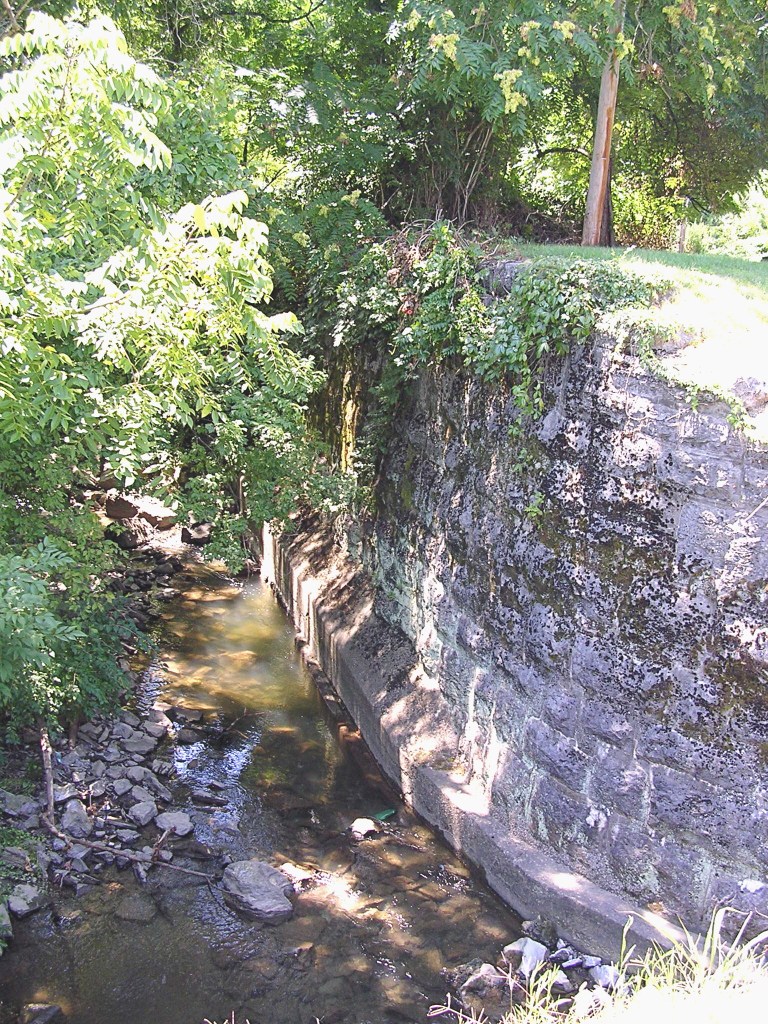
A Donelson creek (from NHN photo collection)

The large tract of land known as Clover Bottom Plantation came to be owned by Dr. James Hoggatt, who built the ante-bellum mansion on the property. The property was sold to Mr. Andrew Price in the late 19th century, and then to A.F. and R.D. Stanford in the early 20th century. After World War II it was sold to the State of Tennessee.

Although the last several years have brought considerable business development to the Clover Bottoms, much of the river bank remains untouched by man. The Greenway Project is a promise to maintain the natural beauty of this historic site and preserve it for our future generations. (2000)


* Historians surmise that John Donelson’s cornfield was located just west of the Stone’s River bridge, in the general area of today’s Jackson Downs (Target) shopping center, which was named, incidentally, for the racetrack Andrew Jackson later built slightly northeast of that location.

Francis Baily and the Flavor of the Tennessee Frontier

by Mike Slate.

On the evening of Monday, July 31, 1797, a 23-year-old English sojourner arrived at Nashville, an upstart town in the embryonic State of Tennessee. For our purposes, forget that this refined, yet daring young man would return to England and make a fortune as a stockbroker. Never mind that in the third stage of a charmed life he would become a world-class astronomer and have a moon crater named after him. For if Francis Baily had accomplished nothing else except to bequeath us his American travel journal, that alone would have secured him a place in the annals of history. First published posthumously in 1856, Baily’s Journal of a Tour in Unsettled Parts of North America in 1796-1797 is an invaluable primary source for interpreting an emerging nation.

After nearly starving and drowning on his way up the trail later called the Natchez Trace, sometimes with Indians as companions, Baily approached a ramshackle settlement on the fringes of Nashville. In a lengthy July 31st journal entry, he noted that “Nothing could exceed our joy upon this occasion: we jumped, halloed, and appeared as elated as if we had succeeded to the greatest estate imaginable.” The Natchez-to-Nashville leg of his American odyssey had taken about 27 days by horseback.

A mile and a half closer to Nashville, Baily and some fellow travelers arrived at the plantation of a “Mr. Joslin.” Perhaps this was the Joslin’s Station mentioned by later historians (e.g., Haywood, Civil and Political History of Tennessee, p. 427). Of this outpost and his meal there, Baily wrote:

“It has been formed about seven or eight years, and consisted of several acres of land tolerably well cultivated: some in corn, some in meadow, and others in grain, &c.  His house was formed of logs, built so as to command a view of the whole plantation, and consisted of only two rooms; one of which served for all the purposes of life, and the other to hold lumber, &c.  Our fare, when it came to be served up, was such as we might have expected in such a rough country as this: it consisted of nothing more than a large piece of boiled bacon, and a great dish full of French beans, together with some bread made of Indian meal. However, as it was quantity, not quality, which we stood most in need of, we made a very hardy meal, and devoured with great avidity the homely fare that was set before us.”

Continuing toward Nashville later that day, Baily and a companion named Bledsoe (perhaps a member of the important Bledsoe’s Lick community northeast of Nashville) “even met, within three or four miles of the town, two coaches, fitted up in all the style of Philadelphia or New York, besides other carriages, which plainly indicated that a spirit of refinement and luxury had made its way into this settlement.” Tantalizing tidbits to ponder are the identities and destinations of the passengers in these fine coaches.

Baily entered Nashville that evening and stayed for about two days. In his journal he left us a few precious paragraphs about the town, including this excerpt with its memorable “rude rabble” conclusion:

“This town contains about sixty or eighty families; the houses (which are chiefly of logs and frame) stand scattered over the whole site of the town, so that it appears larger than it actually is. The inhabitants (like all those in the new settled towns) are chiefly concerned in some way of business: a storekeeper is the general denomination for such persons, and under this head you may include every one who buys and sells. There are two or three taverns in this place, but the principal one is kept by Major Lewis [this was, in fact, William T. Lewis’s establishment, later known as the Nashville Inn]. There we met with good fare, but very poor accommodations for lodgings; three or four beds of the roughest construction in one room, which was open at all hours of the night for the reception of any rude rabble that had a mind to put up at the house; and if the other beds happened to be occupied, you might be surprised when you awoke in the morning to find a bedfellow by your side whom you had never seen before, and perhaps might never see again.”

Leaving Nashville in the afternoon of August 2, Baily proceeded across the Cumberland wilderness to Knoxville, a 15-day immersion in further adventures, privations, and scenery. At one point on this trek, he complimented Tennessee’s beauty by noting that “the agreeable diversity of hill and dale with which this state is favored, together with the delightful views of a fine romantic country, served to dissipate that ennui and wearisomeness which, perhaps, I might otherwise have experienced.”

The Nashville and Tennessee portion of Baily’s journal has been extracted in various historical works including Samuel Cole Williams’ Early Travels in the Tennessee Country and J. Wooldridge’s History of Nashville, Tenn. The newly formed state, however, was only one destination of Baily’s much larger American itinerary. Prior to his Natchez Trace expedition, he had visited such eastern cities as Philadelphia, New York, and Washington before crossing the Allegheny Mountains and voyaging down the Ohio and Mississippi rivers to New Orleans. His resulting journal of roughly 300 pages, one of our most engaging firsthand accounts of early American life, begs to be read in its entirety.


Rights to the 1856 edition of the Journal are in the public domain and, fortunately, Google Books offers the complete text online. In addition, used hardcopies of the 1969 Southern Illinois University Press edition can be purchased through such vendors as AbeBooks.com and Amazon.com.  Surprise after surprise awaits the reader of the full travelogue, including a description of Washington city under construction, details on building a flatboat (pertinent to John Donelson’s founding voyage to Nashville), and an almost-incredible account of meeting with none other than Daniel Boone.


This article was first published in the August 2009 issue of The Nashville Retrospect. We thank publisher Allen Forkum for his permission to republish it here.

Four Recent Answers from Two Old Documents

by Guy Alan Bockmon.

Published studies of the frontier in Middle Tennessee, Davidson County, Nashville and her urban and suburban areas tell little or nothing about the area which would become Madison, Tennessee. In them Fort Union may or may not be mentioned, but most of the published sources consulted agree that in the mid-1780s the Rev. Thomas Brown Craighead came to the frontier to establish the first church and school, that his Meetinghouse was erected near the southwest corner of Madison’s Spring Hill Cemetery, that its size was about 24 by 30 feet and that it was built of stone.

Image of a similar early stone church, from the South Carolina Department of Archives and History.

Four questions present themselves: 1) in that troubled time why settle so far from the protection of the fort at Nashville; 2) why build a structure so much larger than the courthouse; 3) why use stone instead of logs; and 4) who supplied the manpower to finish the construction in time for the Meetinghouse to be used by September 25, 1786?

After some “digging” I found an answer to the first question in a Tennessee Historical Society document, “The trustees of the church of Nashville and Springhill,” transcribed on pages 24-25 of Madison Station. There are the names of nearly sixty pioneers and the amounts they pledged in pounds, shillings, and pence to Craighead’s church in 1786. Many contributors lived at Nashville, but others were from stations scattered from Castalian Springs to Goodlettsville to White’s Creek to Mill Creek and to Robertson Road. Realizing that he was their only minister, Craighead evidently sought and found a site centrally located to all the stations. Spring Hill was accessible from the Cumberland up that historic creek near where in 1780 had stood Fort Union. The branch has been named successively for Spencer, Buchanan, Craighead, and Love. Spring Hill was also accessible from the “road” which became Gallatin Pike.

A document among the Draper papers, “Edmondson’s Defeat at Neely’s Bend-1787” yielded answers to the remaining questions. On page 23 of Madison Station is a facsimile revealing that some twenty families from Washington County, Virginia emigrated with Craighead to Spring Hill. So large a congregation required a large church and provided the necessary labor. The chosen material was stone because it fire-proofed the Meetinghouse-fort at “The Irish Station,” the existence of which had been forgotten until publication of Madison Station. (1998)


Guy A. Bockmon (1926-2005) was a professor of music with degrees from Murray State College in western Kentucky and the Eastman School of Music in Rochester, New York. He authored and/or edited several college textbooks in his field and served as director of music in Baptist, Congregationalist, Methodist, and Episcopal churches. He was the author of Madison Station, a history of Madison, Tennessee, published by Hillsboro Press in 1997.

Alice Thompson Collinsworth: Intrepid Pioneer

by Gloria Newsom Huggins.

On Christmas Day 1779 James and Elizabeth Thompson arrived at French Lick on the Cumberland River. The couple had joined James Robertson’s adventurers, looking for a new life on land where they believed they would be free. However, they had no idea what a high price they would pay for land in this territory that was to become Nashville, Tennessee.

By the time John Donelson’s party arrived on April 24, 1780, the Robertson group had already built eight stations of log cabins. A week later the men in the group gathered at the Bluff and adopted the Cumberland Compact1. Within the next two weeks they agreed on additional resolutions, and on May 13, 1780, James Thompson and his son Robert joined 254 other men in signing the completed Compact.

Signature page of the Cumberland Compact

As original settlers, the Thompsons received 640 acres on Richland Creek, near today’s Belle Meade mansion. In 1790 James began building the family’s cabin there, not realizing the dangers that lay ahead. By 1791 two of the Thompsons’ sons had lost their lives in Indian attacks. More tragedy was to follow: a narrative given to The South-Western Monthly in 1852 by John Davis, an early neighbor, described the murder of James and Elizabeth Thompson and their daughter Elizabeth by a party of Indians on February 25, 1792. Thomas E. Matthews’ book General James Robertson, Father of Tennessee, adds that the marauders enslaved the Thompson’s 31-year-old daughter Alice, along with two houseguests, a Mrs. Caffrey and her young son.

Scene in Indian village

The captives were taken to a Creek village called Kialigee, where Mrs. Caffrey’s little boy was taken from her and given to another white slave to raise. It would be two years before they were freed. Indian agent John O’Riley purchased Alice from her captors for 800 weight of dressed deerskins valued at $266 (the equivalent of almost $7,000 today). In May 1794 Alice was taken to the American Agency at Rock Island, Georgia. Before she returned to Nashville, she met with Governor Blount in Knoxville to answer his questions about other captives she had seen in the Indian camps. Governor Blount recorded these facts in a letter to the Secretary of War on October 2, 1794.

Meanwhile, in 1793, Edmund Collinsworth had arrived in Nashville to join his half-brother John Cockrill, who was married to James Robertson’s sister Ann. Edmund was a veteran of the Revolutionary War, having enlisted in the First Virginia Regiment in 1777 and served until April 1780. According to family stories, it was “love at first sight” when Alice met Edmund upon her return to Nashville in late fall 1794. They were married on December 17, 1795.

The couple built their home on land that had belonged to Alice’s brother John, who had died in the 1791 Indian attack. It is believed that both Alice and Edmund were eventually buried in unmarked graves on this home place, which is located in today’s Antioch/ Mount View area southeast of Nashville.

Edmund died in March of 1816, leaving Alice with seven children ranging in age from seven to eighteen. As she always seemed to do, Alice took the bad with the good and persevered, bringing up the children on her own. Her son James carried his Tennessee fortitude to the young Republic of Texas where he served as aide-de-camp to Sam Houston during the Battle of San Jacinto. He was a signer of the Texas Declaration of Independence and was Chief Justice of the Texas Supreme court at the time of his death. Another of Alice’s sons, John, graduated from the U.S. Military Academy at West Point. Daughter Susan married Mark Robertson Cockrill, who owned a 5.600-acre farm where he bred award-winning Merino sheep, their wool acclaimed as the finest in the world.

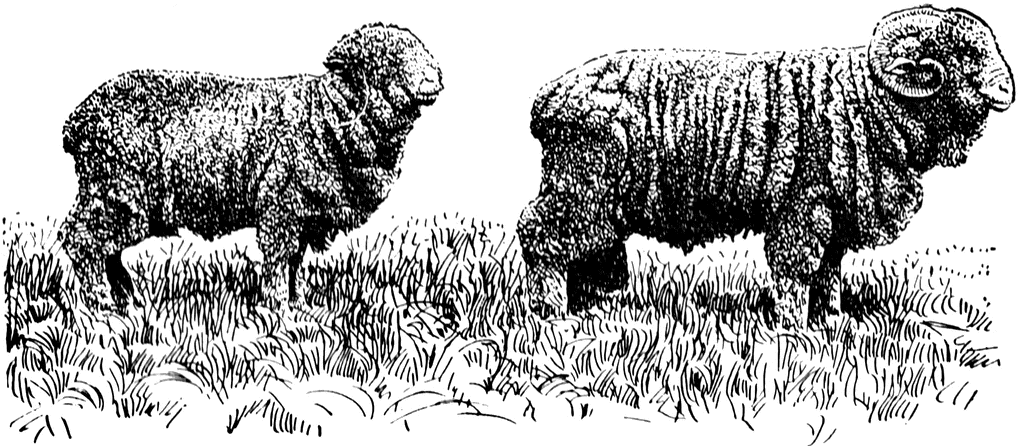
Merino sheep

Alice died in February 1828 at her home, which she shared by then with her daughter Parmelia Ann Davis and her family. The old house is long gone, but in December 1864 it was the place where Parmelia Ann had a touching encounter with a Union officer . . . but that’s another story2.


1 The Cumberland Compact, adopted in Nashville in 1780, was essentially a constitution for the frontier settlement, setting rules for governing the colony (including salaries, which were to be paid in animal skins) and for making and enforcing laws. It was signed by 256 colonists. (ed.)

2 Widowed in 1848, Parmelia watched the railroad industry change the face of middle Tennessee. During the Civil War, Nathan Bedford Forrest and others took great pride in sabotaging the tracks to impede the advance of Union troops. In early December 1864 Parmelia heard the thunderous crash of a train accident near her property and rushed toward the flaming wreckage to see what had happened. The Union officer in charge was gathering the bodies of 24 soldiers killed in the accident, planning to bury them all together in an embankment near the tracks. Parmelia intervened, insisting that the dead soldiers be buried on her plantation, each individual grave to be marked with a stone from her fields. Touched by her kind gesture, the Union officer posted a “special guard” to protect Parmelia and her land from attack for the remainder of the war. After the war the remains of the 24 Union soldiers were reportedly moved to the Stones River National Cemetery in Murfreesboro.  (ed.)

A Woman Challenged: The Life of Granny White

by Doris Boyce.

Born in 1743, Lucinda Wilson became the second wife of Zachariah White about 1760 and helped raise his children, along with a brood of her own. Zachariah wanted land badly enough to risk his scalp. He joined James Robertson and headed overland to North Carolina’s Cumberland territory to help establish the settlement of French Lick, where the city of Nashville now stands.

Granny White Grave Marker (from The Historical Marker Database; photo by Michael Manning)

Zachariah was a militiaman, a farmer, and a part-time teacher. He opened the first school at French Lick in the spring of 1781, but he was killed at the Battle of the Bluffs later that year, leaving Lucinda, called Lucy, and his heirs so poor they could not afford the surveyor’s fee required for eligibility to receive the 640-acre grant North Carolina awarded to families of men killed defending the settlement.

Seventeen years later, in 1801, 58-year-old Lucy was informed by the courts of Surrey County in the Tidewater district of North Carolina that she was too old and too poor to take on the responsibility of her two orphaned grandsons, Thomas and Willis, ages 8 and 9. The judge, who would not have granted custody to a woman in any case, ruled that the boys must be bound over to a tradesman in order to keep them out of the poorhouse.

But Lucy would not be told “No” again, certainly not by North Carolina! She loaded her spinning wheel and household goods onto an oxcart pulled by a yellow longhorn steer and left in the middle of the night, along with Thomas, Willis, and an elderly slave called Uncle Zachary. Traveling only about three miles a day, they walked 800-900 miles through Indian territory and the rugged Carolina mountains, leading the oxcart toward the Cumberland settlements where Lucy had three adult children and a number of step-children. Along the way they made several stopovers, staying long enough in each place to make a little money and become more self-sufficient. In Roane County, Tennessee, at a place called Meredith, she put up a ginger cake stand where she sold baked goods to travelers.

The small, white-haired Lucy was 60 years old when she arrived in Nashville in 1803. She set up another ginger cake stand, along with a tar pit or kiln for greasing wagon axles. With the money she made from her various enterprises, she purchased 50 acres that consisted of the facing slopes of a pair of adjoining hills. Her land was located along an old buffalo path that had been the first road built going south from Nashville to Franklin. One of Lucy’s hillsides had to be dug away to create space to build a log house. The other hill was planted in grapevines, fruit trees, and vegetable gardens. The land was so steep that apples rolled downhill into the fence and pumpkins had to be staked to the hillside.

By 1812 Lucy had opened an inn that attracted travelers from the Natchez Trace, four miles to the west. She soon became known for her excellent cooking and the whiskey that she made herself. Guests of the inn praised her for the finest brandy and applejack, the best pancakes, and the cleanest beds. She charged 12 1/2 cents a night for a room and 50 cents a night to board horses. Lucy was innkeeper, housekeeper, and cook, and somehow found time to weave the bed linens and the family’s wearing apparel. When more guest rooms became necessary, she added new wings, a room at a time.

Lucy’s grandsons called her “Granny,” and soon the customers did, too. Still remembered today as Granny White, she was 73 years old when she died in 1816, possessed of considerable wealth, along with slaves, horses, and cattle. Grandson Thomas had died in an accident as a youth, so Willis inherited the property, but the tavern was not open to paying guests after Granny’s death. Willis and his wife Winifred moved to Nashville so their ten children could go to school, but the couple returned to the inn in their old age, after the children were gone.

The inn was half-rotted by late 1864, when the Battle of Nashville took place all around it. Everett Beasley acquired the lands in 1930 and in 1942 replicated the log tavern at the same location with logs from a frontier inn in Dickson County. After 30 years, however, the old logs began to sag just as Granny’s originals had. In 1983 Robert Neil and Vander Linder conveyed the logs to Cheatham County, where they constructed a log house that still stands today.

One hundred sixty-five years after Granny’s death the property was developed into 43 residences called The Inns of Granny White. Her fenced gravesite is near the entrance. To get there from Nashville, you will take the same route the buffalo did, along the street toward Franklin, now named Granny White Pike.

Granny did not accept the social wisdom of her day. She did not let being a woman, being old, or being poor defeat her. After an apparently hopeless beginning, she became a self-reliant individual, an entrepreneur. She ignored the hurdles in her path by flaunting the law, engaging in commerce, making and selling liquor, and taking strangers into her home. She accepted the challenge of frontier life and did what she had to do.

John Dillahunty and Baptist Origins in Nashville

by Robert Lyle Williams.

 The first Baptist church south of the Cumberland River, the Richland Creek Church, was founded by John Dillahunty, a Maryland-born Baptist preacher. His father is recognized as having been a Huguenot, but John was raised as a Catholic, in his mother’s religion. His “De La Hunte” paternal grandparents reportedly fled from France to the Netherlands in 1685 and then to Ireland in 1695. No primary-source documentation has been located regarding Dillahunty’s grandparents, their ancestry, or the definitive spelling of their surname.

After John married Quaker Hannah Neal in 1747, their respective churches excommunicated them. Around 1751 they relocated to North Carolina where John became the first sheriff of Craven County. He received a colonial land agent commission which spelled his name “Dillahunty,” a spelling he and his Tennessee descendants continued to use.

Dillahunty heard the celebrated George Whitefield preach in 1755 and was later converted by the preaching of Shubal Stearns and baptized by Philip Mulkey, both Baptists. He became a deacon and licensed preacher prior to the Revolutionary War, during which he served as a chaplain.

John led a group of families to Davidson County in 1795. The following year he founded Richland Creek Church. The church building was a log structure sited on the south bank of Richland Creek. A 1925 eyewitness account placed the location across from the Belle Meade golf course, about 300 yards west of the clubhouse.

John Dillahunty died February 8, 1816, in his 88th year. Hannah died soon thereafter, on May 5, 1816. Their 67-year marriage had produced nine children, all of whom lived into adulthood. John and Hannah were buried together in a small cemetery next to the Richland Creek Church, the stone foundation of which survived into the 20th century, along with the cemetery. A 1931 Colonial Dames survey documented seven tombstone inscriptions, including those of John and Hannah Dillahunty.

Local historian and General Harding descendant Ridley Wills II recalls playing among the Dillahunty graveyard tombstones on Nichol Lane near Richland Creek. In early 2003 the Davidson County Cemetery Survey located the likely cemetery site on Nichol Lane. In March 2003, employing a probe, Tennessee State Archaeologist Nick Fielder verified the presence of two graves at this location.

The Dillahunty tombstones were moved to a memorial chapel at Baptist Hospital sometime after World War II. The hospital has since been unable to determine their disposition; their present location is a mystery awaiting resolution.

Elder Joel Anderson succeeded John Dillahunty as pastor of Richland Creek Church. Anderson moved the church one or two miles west from its original location and changed the name to Providence Church. He was succeeded by Elder John Little, then by the Rev. Jesse Cox, who served the church for 42 years. It is no longer extant.

In his 85th year Jesse Cox wrote, “I heard Elder Dillahunty preach regularly once a month for about eight years; he was a man of small stature, and was, being old, quite feeble. He was not an orator, but sound in the faith, of unblemished character and commanded large congregations. Some of his members were among the best citizens of Nashville.”

Garner McConnico, a Virginia Baptist minister, came to Tennessee around 1798. He had personal doubts about continuing his ministry but was inspired by John Dillahunty to found, in 1800, the Harpeth Baptist Church, which he led as pastor until his death in 1833. McConnico was instrumental in the 1803 organization of the Cumberland Association; he was its first Moderator and served in that capacity until his death.

John Dillahunty was also involved with the Mill Creek Church, the second Baptist church south of the Cumberland (founded in 1797). In 1806 the Mill Creek Church met in conference and chose “Brother Dillahunty” as Moderator. Mill Creek’s first and long-time pastor, James Whitsitt, served as an executor of Dillahunty’s will.

Postcard image of First Baptist Church from NHN collection

There was no Baptist church in Nashville until James Whitsitt aided Jeremiah Vardeman in establishing the first one in 1820. Its initial membership was comprised of transfers from Mill Creek. The new church adopted the name First Baptist Church of Nashville in 1830.

The Hodge House in Percy Warner Park

by Gale Wilkes Ford.

Hundreds of motorists rush past the intersection of Old Hickory Boulevard and Chickering Road every day without realizing they have just glimpsed a bit of early Tennessee history. Nearby, on the property of Percy Warner Park, stands an old two-story log house with white siding, its three limestone chimneys now cold.

The Hodge House early in its period of renovation (photo from NHN collection)

This is the Hodge House, built circa 1795 by Francis Hodge, an early pioneer settler who signed the 1780 Cumberland Compact and later received a land preemption of 640 acres. As Indian attacks diminished, many of the settlers ventured out from Fort Nashborough to settle on their own land. In the area of today’s Carden Road, Francis Hodge and his family built a log house which they called Hodge’s Station. It became a gathering place where many early Tennesseans, including James and Charlotte Robertson, came to study Methodism. Hodge later sold that tract of land to Joseph Ewing and built a cabin three or four miles south, on the plot where it now stands — land that had previously belonged to James Robertson.

This second Hodge house, originally a single pen log cabin (as has been determined by Metropolitan Historical Commission staff), stands today in the southeastern corner of Percy Warner Park. Francis Hodge and his two oldest sons, James and George, constructed the two-story dwelling of white ash logs. Over the years, the family added several more rooms, white clapboard siding, and a tin roof. To accommodate the family slaves, they built additional cabins, one of which survived into the late 1950s.

Within a few years the property was purchased by Mary and Samuel Northern, James Hodge’s daughter and son-in-law. The Northerns, whose descendants would live on this land for nearly one hundred years, dedicated an acre northeast of the house for use as a family cemetery. When James Hodge died in 1817, he was the first of the family to be buried in this graveyard, near what is now the Harpeth Hills Golf Course.

Pioneer Francis Hodge died in 1828. His will, written in his own hand, shows the excellent penmanship characteristic of an educated man. The will identifies his sons as John, James, Robert, and George; and his daughters as Elizabeth (Betsy) Armstrong, Sarah Slaughter, and Priscilla Carruthers. No surviving record indicates where Francis is buried. His son George died in 1833, willing the land, the house, and fourteen slaves to his wife Elizabeth. George’s 1829 will also stipulated that after Elizabeth’s death several nieces and nephews should inherit the property. One of the nephews named was Francis Hodge Asbury Slaughter, who, with Sterling Clack Robertson, was part of the first Texas colony.

Members of the Hodge family married into other local families whose names are still well known in the area: Betts, Becton, Harding, Northern, Osborne, Page, Reams, Sawyer, Slaughter, and Wilkes. The old house saw the Civil War come and go, with both Union and Confederate soldiers marching past on the historic Indian trail in front of the property. Hodge descendants occupied the home until its sale in 1895. In 1927 the property became part of the Warner Parks and is now listed on and protected by the National Register of Historic Places. According to the Warner Parks website, it is the “only early rural farmhouse of its type under public ownership in the county.”

The house served for many years as a residence for Parks Department employees and their families. In the early 1990s it was boarded up because of its deteriorated condition and was left vacant until a group of Hodge descendants began lobbying for protection and restoration of the property. Renewed interest in the site led to a survey of the old Hodge-Northern cemetery, during which sixteen unmarked graves, including several burial sites of children, were discovered. Moreover, as part of this year’s [2002] celebration of the 75th anniversary of the Warner Parks, the Hodge House has been designated for renovation, in order to make it a more valuable, hands-on local history resource. The Friends of the Warner Parks (FWP) has been working side-by-side with the Nashville Metropolitan Board of Parks and Recreation to acquire funding for the project. Their first objective is to restore the original white ash log cabin. FWP Director Eleanor Willis, who has spearheaded the project, describes the logs now visible in the attic area as “beautifully preserved.” Work on the foundation and the limestone chimneys is already underway. Visitors will soon be able to view the historic Hodge House as it appeared two centuries ago to the early settlers of Middle Tennessee. (2002)

Post-renovation photograph of Hodge House

Touring Elm Hill Pike

by Susan Douglas Wilson.

Elm Hill Pike is one of the most historic roads in Nashville. Few thoroughfares in our city contain so much history packed into so few miles. The road, which probably began as a buffalo or Indian trail, has been mentioned in several accounts of early Nashville history. Andrew Jackson was reported to be a frequent traveler on Elm Hill Pike on his journeys from downtown Nashville to the Hermitage. Mapmakers and old-timers have also referred to this road as “the chicken pike” and the Stones River Road.

As you turn off of Murfreesboro Pike onto Elm Hill Pike, the first historic site encountered is Mt. Ararat Cemetery on the north. Mount Ararat was founded in 1869 by local black leaders and became a burial ground for many of Nashville’s black pioneers. Over the years, the cemetery became a dumping ground and a target for vandals. In 1982 the management of Mt. Ararat was taken over by the Greenwood Cemetery’s board of directors, which voted to change the name from Mt. Ararat to Greenwood Cemetery West and to begin a comprehensive restoration project.

About a mile east of Mt. Ararat Cemetery is Greenwood Cemetery, established on thirty-seven acres in 1888 by Preston Taylor. Taylor, born a slave in Louisiana in 1849, was an influential black preacher, undertaker, and business leader. In addition to Taylor, illustrious Nashville citizens buried at Greenwood Cemetery include Z. Alexander Looby, the Rev. Kelly Miller Smith, Sr., DeFord Bailey, John Merritt, and J. C. Napier.

The gates of Mt. Ararat Cemetery (photograph from NHN Collection)

In 1906 Preston Taylor opened Greenwood Park on approximately forty acres adjoining Greenwood Cemetery. The park was established to serve the black community and included a baseball stadium, skating rink, swimming pool, theater, merry-go-round, bandstand, zoo, and many other attractions. A state-wide fair and a Boy Scout summer camp were also held at Greenwood Park. The admission to the park was ten cents on regular days and twenty-five cents on holidays. The Fairfield-Green streetcar stop was nearby and horse-drawn wagons would pick up patrons and deliver them to the park’s entrance at Lebanon Road and Spence Lane. Preston Taylor died in 1931 and his wife managed the park until its closing in 1949.

Buchanan’s Station was located about another mile east where Mill Creek crosses Elm Hill Pike. The station was established by John Buchanan in 1780. Twelve years later, an oft-recounted Indian battle ensued. On a moonlit night in 1792, a band of three hundred Creek and Cherokee, under the leadership of Chiachattalla, raided the station. The twenty-one settlers fought bravely and defeated their attackers, killing Chiachattalla. Major Buchanan lived at the station until his death in 1832. He is buried, along with his wife and other settlers, in the station’s cemetery.

John and Sally Buchanan’s gravestones in Buchanan Station Cemetery. (from NHN Collection)

Peabody College established the Seaman A. Knapp School of Rural Life in 1915 on one hundred fifty acres on Elm Hill Pike. More acreage, including the site of Buchanan’s Station, was acquired in 1922. The farm was the first institution in the United States devoted to the study of the problems of rural life. Peabody College officials believed that teachers should become acquainted with agricultural life since so many of them would be teaching in rural areas. The experimental farm became a showplace with award-winning dairy and beef cattle herds. Innovative techniques in irrigation, pasturage and field equipment were tested at the farm; and many crops were raised including a certified corn station and a contoured, 25-acre orchard. Knapp Farm provided Peabody College with all its meat, vegetables, and fruit until World War II. The importance of the farm declined after the 1920s because of state-supported agricultural research. Expensive to maintain, Knapp Farm was sold in 1965 to a contractor who developed it into an industrial park.

Though the exact location of Mud Tavern is disputed, most old-timers agree that it was near the intersection of Elm Hill Pike and McGavock Pike. The tavern, built during Nashville’s youth, was made of cedar logs with a mud and stick chimney. Andrew Jackson was a frequent patron and it is reported that he spent two days there planning strategy in his duel with the ill-fated Charles Dickinson. Years later a community named Mud Tavern grew up in the area and contained a railroad station, school, post office, and grocery store. The Mud Tavern school building was used for many years as a clubhouse by the Elm Hill Community Club.

On the far side of Donelson Pike, at the corner of Elm Hill Pike and Hurt Drive, is the James Buchanan house. This two-story log house was built circa 1809. James Buchanan and his wife are buried in the family graveyard near the house, which is now under the care of the Association for Preservation of Tennessee Antiquities.

At the present time, Elm Hill Pike ends at Bell Road. The eastern-most part of the road has been re-engineered several times. The course of the road itself may change, but the history of Elm Hill Pike will always remain as a significant part of Nashville’s heritage.  (2000)