Cohn High School 50th Reunion of the Class of 1954: Remembrances of Things Past

by Edwin S. Gleaves, State Librarian and Archivist of Tennessee: Speech delivered on October 2, 2004.

Here we are together again after 50 years, one full half century since some of us last saw each other when we graduated from Cohn High School in 1954, on what was once the city’s western border. Had we been born a few centuries earlier, those intervening fifty years would have been years of little change. The truth is that for thousands of years most of the world’s population lived just as their parents lived, worked just as their parents worked, and died where their ancestors had been laid to rest. The idea of progress, even of change itself, was not only foreign, it was simply unknown, unthinkable.

Not with us. Little did we know, back in the tranquil years of the 1950s, that ahead of us lay a world of change – local, national, international. Experts are now telling us that at the current rate of technological growth, the 21st century will be equivalent to 20,000 years at today’s rate of progress. Whatever that means, that’s too fast for me. As one young student of history said, “I wouldn’t mind studying current events if there weren’t so many of them.”

Tonight, I would like for us to leave high-speed technology and current events behind while we journey backward briefly to the Nashville we once knew, the Nashville and West Nashville of the fifties.

Bing Crosby and Danny Kaye in White Christmas

Do you remember when downtown Nashville was the place to go – the only place to go – for many things in our lives? Back then, before the days of videos, DVDs, and multiplex suburban theaters, we went to downtown Nashville to see first-run movies such as The Caine Mutiny, On the WaterfrontRear Window, and White Christmas – all hits of 1954 – at the Loews Vendome Theater, the Knickerbocker, the Paramount, or the Tennessee. Now those grand old theaters are gone, all gone.

Marlon Brando and Eva Marie Saint in On the Waterfront

If we wanted to shop, we also went downtown – to Harvey’s, where I saw my first escalator; to Loveman’s Department Store; to the “new” Cain-Sloan building on 5th and Church; and to Castner-Knott on 7th and Church. They too are gone, all gone.

Nashville also had first-rate bookstores downtown in the 1950s: Mills, Zibart’s, Stokes & Stockell. Gone, all gone.

And there were a surprising number of restaurants downtown as well: Cross Keys, the B&W Cafeteria, three Krystals, two Orange Bars, two Zagers, and Satsuma, among others. All gone? Not quite. Satsuma is still serving down on Union Street. Go there while you can; it has already closed once but reopened by popular demand.

1954 Chevrolet Bel Air

By the way, for most of our school years, we rode the bus downtown. How many of you owned your own cars in high school? Most of us borrowed our family cars when we could. Need I mention how different that is from today’s high school kids? Today’s high school parking lots are bigger than their football fields!

Closer to home, West Nashville had its own downtown on Charlotte Avenue, roughly between 42nd and 51st Avenues. I’m sure that you remember it well. I do – the Dari-Delite on 43rd and Charlotte where my dog Vicki and I savored our first soft-serve ice cream; Allen and Bean Appliance Store, down near 51st, where I saw my first television set; my grandfather’s drug store next door where I was treated special because of my name (but still had to pay full price for a cherry Coke); and the Sanitary Barber Shop near 46th and Charlotte where Doc Martin nearly cut my ears off. I bet that you remember Lovell’s Pharmacy, later Dorris’s, next door to that barber shop, and Thomerson’s Drugs a couple of blocks down Charlotte Avenue. If the potions and purgatives that we bought in the drug stores didn’t work, there were no less than three funeral homes ready to serve us: Burkitt & Bracey, Pettus & Owen, and Wood Funeral Home, later Pettus, Owen, & Wood.

In West Nashville we had several places to shop, such as Kuhn’s and Katz’s and Kroger’s, and quite a few little places to eat – if we could afford to eat out. And best of all, we had our own elite movie theater, fondly and reverently called the E-lite Theater, where we could see third-run movies at bargain prices and, once upon a time, cowboy movies on Saturdays, starring Hopalong Cassidy, Roy Rogers, and Lash LaRue, for the princely price of 12 cents.

Lash LaRue (r) in Song of Old Wyoming

Those of us who could get a car would sometimes venture out Charlotte Avenue to Gable’s Ice Cream and Sandwich Shop, a popular drive-in restaurant, where we could hear Doris Day singing sweetly of her “Secret Love,” Kitty Callen reminding us that “Little Things Mean a Lot,” and Frank Sinatra crooning “Three Coins in a Fountain” – all interspersed with a new sound to the words, “Shake, Rattle, and Roll,” by Bill Haley and the Comets. It was in 1954, by the way, that a shakin’ young fellow from Memphis by the name of Elvis cut his first record – and the rest was history.

Bill Haley & the Comets

Another drive-in, the Belle-Aire Drive-In Theater, was just up the road. It was there that some of us watched movies from our cars, while others of us, shall we say, continued our education. I distinguished myself by driving off with the speaker three times. Mr. Cool I wasn’t.

Need I say that our old neighborhood has changed over the years, along with nearly every other aspect of our lives? And need I mention that Cohn itself has changed? The building we knew has not served as a neighborhood high school since 1983, but it now serves our community in other ways through its Senior Renaissance Center, the Cohn Community Education Program, and the Cohn Adult High School. Those of us here tonight remember it, as noted on the Cohn High Alumni Association webpage, as “a place of learning and inspiration, . . . a place where lifelong friendships are formed.”

Yes, we are still here but we too have changed. In 1954 we left the security of the school that many of us had known for six years to go out into the sunlight and shadow, the triumphs and tragedies, of the real world. We either went into the job market or into military service or to college or got married – or all of the above. We knew the joys of good marriages and the pain of failed ones, but through it all we did our best to be good parents and to raise our children in the way that they should go. Then we watched our grandchildren come into a world as different from that of their parents as our children’s was from ours. Sometimes we have dared tell our children how they should raise theirs, knowing all along that we didn’t have to raise them ourselves. We learned quickly that child-rearing is for the young, and we aren’t that young anymore.

I started out by noting how different life was a few centuries ago. But consider this: had we been born only fifty years earlier, the chances of our being around at our current age would have been minimal. Life expectancy in our country in the early years of the twentieth century was only 47 years. Surely it is by the grace of God that some of us, but not all of us, have lived long enough to share this night together, to recall our formative years at Cohn High School and to share with each other a little of what we have experienced since that day in 1954 when we blithely and confidently took hold of our diplomas and set out, as we sang in our alma mater, to conquer and prevail.

Okay, so we didn’t always conquer, but we did prevail, and we are here tonight to prove it. I am confident that what we learned at Cohn, along with the friendships we shared, prepared us for the half century that followed, and I am thankful, as I’m sure you are, that tonight we can share this common milestone in our lives and say together, Hail to thee, our alma mater, Cohn High, all hail!

Nashville Founding Factors

by Mike Slate.

It’s difficult to imagine when Nashville wasn’t here—when Davidson County was a game-rich but otherwise uninhabited wilderness. Yet that’s the way it was 250 years ago. Who started all this civilization that we now take for granted and call our home? The traditional view is that Nashville was founded by pioneers James Robertson and John Donelson, who journeyed here in 1779-80 with a few hundred others, built a fort on the bluff above the Cumberland River, and persevered through much danger and hardship. The arrival of Robertson and Donelson was certainly the pinnacle of an uphill process, yet other founding factors are worthy of more emphasis than they sometimes receive.

For example, we should not forget the buffalo. The huge hump-backed beasts flourished here near the river and made paths to a salubrious spot in the vicinity of Sulphur Dell ballpark and the Bicentennial Mall. That spot was a salt lick on a creek called Lick Branch, long since smothered by modern infrastructure. So many bison and deer were here that reports from early hunters and explorers made our area attractive to adventurous colonials back east. Yes, our metropolis rides atop buffalo humps: without the bison there may never have been a Nashville, a circumstance that illustrates the interdependence of geographical, natural, and human history.

Painting from NHN collection

Despite 200 years of study the next factor remains mysterious and fraught with theory. Generally, we know that over the eons distinctly different cities were often built one on top of another. Nashville has risen upon a Mississippian-era culture commonly known as the Mound Builders, Indians so ancient that even the more modern Native Americans didn’t know where they came from or where they went. When early woodsmen arrived at our salt lick they found an old earthen mound close by, obviously man-made and apparently ceremonial in function. Ralph Earl, Andrew Jackson’s portrait artist, excavated the mound in 1821 and found the round base to be about thirty yards in diameter and the height about ten feet. Situated generally from the mound eastward to the Cumberland, an ancient burial ground held interments enough to indicate that a large population thrived here. These remains of a surprisingly sophisticated society were a few to several centuries old. In addition to Davidson County finds, other such sites were discovered in surrounding counties and across Tennessee—all a part of a nexus that extended throughout much of the Ohio River Valley and beyond. Was the existence of a previous society an encouragement to later pioneers? Did early Nashvillians assume, consciously or not, that since another culture had flourished here, so could they?

Photo by Paul Pierce

After the era of the Mound Builders, the Shawnee Indians also had villages along the Cumberland. In fact, an early name for the Cumberland River was the “Shawanoe,” an English derivative of the French “Chaouanon.”   The Shawnee were a rather nomadic tribe, but for a time they had a village near our salt lick, until driven north in about 1714 by Cherokee and Chickasaw tribes who sought to reserve Middle Tennessee for hunting only. Thus for many years before the Euro-American settlers arrived, our Middle Tennessee area was a kind of sacred game preserve. No wonder the Indians were enraged when the white man came. However, the settlers, knowing good land when they saw it, determined to have it regardless of the price they had to pay. That price was paid in blood, as Indian wars raged for the first fifteen years of white settlement. Evidently, no real estate is more desirable than that which someone else also desires!

During and after the Shawnee period, French hunters and traders headquartered at our salt lick. Around the year 1710 a young apprentice, Jean du Charleville, worked here for an old Frenchman whose name is lost to history.  Their trading post was located directly on top of our Indian mound. Arriving in the 1760s, another hunter-trader bore an auspicious name: Jacques Timothe Boucher de Montbrun. More commonly known as Timothy Demonbreun, he returned in later years to settle in Nashville, and today’s Demonbreun Street is named for him. Because of the intermittent presence of such French entrepreneurs, our locale became known as the French Lick, a name familiar to researchers of the American frontier. A remnant of French influence survives today in the word “Nashville,” the suffix -ville being French for town or village.

On the heels of the French traders came the Long Hunters, so called because of the lengthy time they spent in the woods. Notable hunters and explorers in our region during the 1760s and 70s include Thomas Hutchins, Henry Scaggs, Uriah Stone, Michael Stoner, Kasper Mansker, Isaac Bledsoe, Thomas “Bigfoot” Spencer, James Smith, John Rains, Daniel Boone, and John Montgomery. History knows a fair amount about these trailblazers, and their romantic era is fittingly memorialized in the name of today’s Long Hunter State Park along Percy Priest Lake. Serving as the vanguard of colonial civilization, the Long Hunters laid the foundation necessary for permanent settlement.

The Long Hunters gave rave reviews of the western wilds to a North Carolina judge, Richard Henderson, who was interested in land speculation. Together with like-minded partners, Henderson established a land company, the Transylvania Company; and in 1775 he negotiated with the powerful Cherokee Indians to gain tentative control of much of today’s Kentucky and upper Middle Tennessee territory, including the French Lick. He then organized emigrant groups to settle both the Kentucky and Cumberland regions, with Daniel Boone the head of the Kentucky contingent and James Robertson the Tennessee leader. Robertson, a North Carolinian, teamed with Virginian John Donelson and devised a plan to conduct a few hundred pioneers from northeastern Tennessee to the French Lick, Robertson by land and Donelson by river. Robertson’s group arrived here in December 1779 and built the fortification overlooking the Cumberland, and Donelson’s voyagers arrived the following April. A number of the newcomers established other stations nearby. Close behind the settlers came Henderson, who then penned our first organizational document—the famous Cumberland Compact—in which he referred to our compound as “Nashborough,” in honor of General Francis Nash who had recently died in the Revolutionary War. Some 256 men signed the Compact, and the primitive village was up and running, along with its sister stations.

But Nashborough had no real legitimacy. It was only a speck of civilization separated by hundreds of rugged miles from its territorial mother, the State of North Carolina. Finally, in 1783-84, the North Carolina legislature recognized it, upgrading the outpost to the status of a town in the new county of Davidson and changing its name to Nashville, an apparent attempt to disavow the English with whom the Revolutionary War was just ending.      

Of our Nashville founding factors—buffalo, Mound Builders, Shawnee, French hunters-traders, Long Hunters, Henderson, Robertson and Donelson, North Carolina legislature—perhaps the most under-appreciated is frontier opportunist Richard Henderson. So instrumental was his role in our beginnings that if someone were to claim him as our founding father it would be difficult to argue the point. While it is Robertson who is proudly and justifiably known as the “Father of Middle Tennessee,” Henderson was the CEO behind the initial enterprise. He didn’t do the heroic grunt work or Indian fighting necessary for our permanence, but he was our prime mover.

Like the trees that obscure the forest, hidden within the “how” of our founding is the “why.” Why did the founders come to this particular place? Nashville’s founding factors provide a fundamental answer: the colonial settlers were drawn to this location because it already had a magnetic history.


Helpful sources: Haywood’s The Natural and Aboriginal History of Tennessee, 1823; Goodspeed’s History of Tennessee, 1887; Thruston’s Antiquities of Tennessee, 1890; Williams’s Dawn of Tennessee Valley and Tennessee History, 1937; Arnow’s Seedtime on the Cumberland, 1960; Crutchfield’s Early Times in the Cumberland Valley, 1976; Satz’s Tennessee’s Indian Peoples, 1979; Hinton’s A Long Path, 1997; Finger’s Tennessee Frontiers, 2001.


This article was originally published in the September 2009 issue of The Nashville Retrospect. We thank publisher Allen Forkum for his permission to republish it here.

The Stieglitz Collection at Fisk University

by C. Michael Norton.*

Georgia O’Keeffe received word in 1946 in New Mexico that her husband, Alfred Stieglitz, had suffered a serious stroke in New York. Catching the next airplane from Albuquerque, she was by his side when he died on July 13. No one at Fisk University in Nashville knew then that Stieglitz’s death had put into motion a chain of events which would lead to Fisk’s receiving, in 1949, an art collection considered “the finest of its type anywhere in the South.”

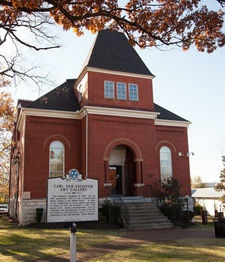
The Carl Van Vechten Art Gallery on the Fisk University campus

Stieglitz, one of the greatest photographers in the history of the medium, is credited with transforming photography from a method of documentation into an art form. As a premier collector and gallery owner of his time, Stieglitz encouraged and acquired art work by many young American artists, including Arthur Dove, Marsden Hartley, Georgia O’Keeffe, Charles Demuth, and John Marin. He is also credited with mounting the first exhibition of African sculpture in the United States. O’Keeffe, generally considered the most important female artist in 20th century America (a description that would have irritated her), had both a business and personal relationship with the much older Stieglitz. They married in 1924, despite the 23-year difference in their ages.

Along with his own photographs, Stieglitz amassed a substantial collection of paintings, but he failed to do anything with the collection during his lifetime, leaving that particular burden to O’Keeffe after his death. His will granted O’Keeffe the right to select the recipients of the art, provided it went to “one or more” non-profit corporations “under such arrangements as will assure to the public, under reasonable regulations, access thereto to promote the study of art.”

1918 Alfred Stieglitz photograph of Georgia O’Keeffe (public domain)

O’Keeffe undertook the difficult task of organizing and giving away over 1,000 pieces of art. She eventually divided the works among six institutions. The first five were logical choices: the Library of Congress, the National Gallery of Art in Washington, the Metropolitan Museum of Art in New York, the Art Institute of Chicago and the Philadelphia Museum of Art. The sixth choice was a surprise: Fisk University.

Founded in 1866 to educate newly freed slaves, Fisk is one of Nashville’s oldest universities. Outside the black community, Fisk was at that time probably best known for its choir, the Fisk Jubilee Singers, who have performed throughout this country and others since 1871. Fisk was also respected for offering a solid academic program: in 1930 it became the first African-American institution to earn accreditation by the Southern Association of Colleges and Schools. The obvious question, however, is why Fisk was selected to receive 101 pieces of art from the collection, when neither Stieglitz nor O’Keeffe had ever visited this small, historically black college in the South, where rigid segregation was the order of the day.

Enter Carl Van Vechten, New York writer/photographer and friend of both Stieglitz and O’Keeffe. A patron of the Harlem Renaissance with a consuming interest in black culture, he was also a friend of Fisk President Charles Spurgeon Johnson. Van Vechten informed O’Keeffe of his intention to leave many of his photographs and other materials to the school and introduced her to President Johnson. A sociologist by training, Dr. Johnson had come to Fisk in 1928 after spending several years in New York as director of research for the National Urban League and as a supporter of the arts. Elected president of Fisk in 1946, Johnson was the first black to occupy that position.

Later O’Keeffe explained that she picked Fisk because it would have made Stieglitz happy. Since she had given portions of the collections to institutions in the Northeast and the Midwest, she thought it logical that some of the collection go to another part of the country.

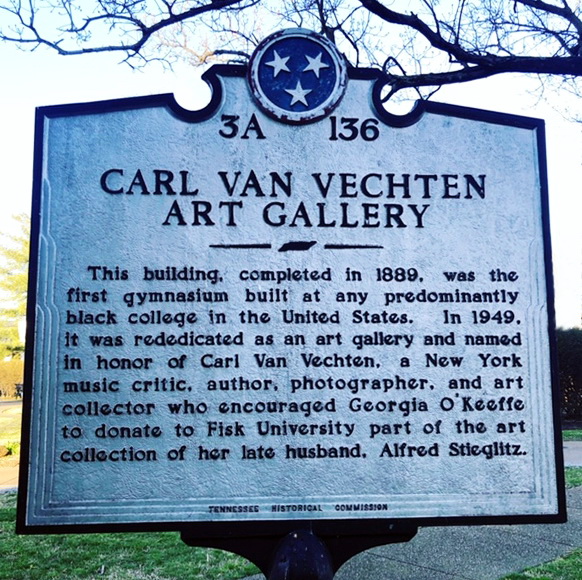
Whatever her reasons, the choice was not without problems. In late October 1949, O’Keeffe and her assistant drove to Nashville from New Mexico to inspect the gallery (to be named in honor of Van Vechten) and to assist with the hanging of the art. Fisk had gone to considerable effort and expense to convert its old gymnasium into an art gallery, hiring a New York architect to design the space. When O’Keeffe saw the gallery for the first time, she hated it. She and her assistant began conforming the space to her wishes, coming in at 7:00 each morning to meet with the workmen. For at least a week she made changes: replacing the lighting, removing molding, painting walls, changing the color of cabinets, and more. Still unhappy with the lights, she flew in a lighting expert on the morning of the opening to make a few final changes.

The opening ceremonies took place on the afternoon of November 4, 1949, in Memorial Chapel, filled to capacity with more than 900 present. President Johnson introduced O’Keeffe, who declined to approach the rostrum, speaking instead from her chair: “Dr. Johnson wrote and asked me to speak and I did not answer. I had and have no intention of speaking. These paintings and sculptures are a gift from Stieglitz. They are for the students. I hope you will go back and look at them more than once.” Van Vechten also spoke briefly, concluding that the gallery was “not equaled by any in New York City.” The dean of education at New York’s Metropolitan Museum of Art delivered the major address.

The Stieglitz Collection consists of 101 art works: five pieces of African tribal art, nineteen Stieglitz photographs, two paintings by O’Keeffe, prints by Cezanne and Renoir, and a number of paintings by Marsden Hartley, Arthur Dove, Charles Demuth, and John Marin.


*Editor’s note: A seven-year legal battle, which took place during a period of severe financial hardship for Fisk, ended in a partnership between Fisk University and the Crystal Bridges Museum of American Art in Bentonville, Arkansas. According to the terms of the final $30 million agreement, the two institutions, each now owning half of the relevant art pieces, agree to share the Stieglitz Collection, passing it back and forth on a two-year rotation. (Author Mike Norton was part of the legal team that fashioned this agreement.) The collection returned to Fisk University in April 2020, but the coronavirus pandemic has forced it to be closed to the public much of the time since its return. This short film from NPT provides a useful introduction to the museum and its collection: https://www.youtube.com/watch?v=_5NcJhqZjEM

Nashville Coaches Who Made a Difference

by Kathy B. Lauder.

“A good coach can change a game. A great coach can change a life.” John Wooden

Dr. Walter Strother Davis

WALTER STROTHER DAVIS (August 9, 1905 – October 17, 1979) was born in Canton, Mississippi. After receiving a B.S. from Tennessee A&I (now Tennessee State University), he earned his M.S. (1933) and Ph.D. (1941) from Cornell University. Before completing his doctorate, Davis was employed by TSU in 1933 as head football coach and professor of agriculture. Within ten years he had earned his Ph.D. and was elected the school’s second president, serving in that role for twenty-five years (1943-1968). Under his leadership, university enrollment grew from 1,000-6,000 students. During that same period the school gained university status (1951), constructed 24 new buildings, and established six new schools: Arts & Sciences, Education, Engineering, Agriculture, Home Economics, and a graduate school. In 1958 TSU achieved land-grant status and was also awarded accreditation by the Southern Association of Colleges and Schools. Davis proved his commitment to athletic excellence by hiring superior football coaches like John Merritt and Joe Gilliam Sr., along with other great leaders. Davis retired in 1968 and was named to the TSU Hall of Fame in 1983.

Coach Ed Temple

Another notable achiever Walter S. Davis brought to Tennessee State University was legendary track coach ED TEMPLE, whose talents attracted dozens of stellar athletes to the school. Temple headed the TSU women’s track and field program for 44 years, during which time his Tigerbelles won 23 Olympic medals. Among the 40 Olympic athletes Temple trained were gold medalists Wilma Rudolph (1960 – a former polio patient who became the first American woman to win three gold medals in the same Olympics), Wyomia Tyus (1964 & 1968 – the first person, male or female, to retain the Olympic 100-meter title), and Ralph Boston (1960 – the first man to top 27 feet in the long jump). In addition to their international successes, Ed Temple’s athletes held over 30 national titles. The U.S. Olympic Committee called him “the most prolific women’s track and field coach in the history of the sport.”

Coach John A. Merritt

JOHN AYERS MERRITT (January 26, 1926 – December 15, 1983) was a Kentucky native who moved in with an aunt in order to play football at Louisville’s Central High School. After graduation he enlisted in the U.S. Navy, but when he returned, he won a football scholarship to Kentucky State College. He graduated in 1950 and went on to graduate school at the University of Kentucky, earning his M.A. in 1952. Merritt spent ten years coaching football at Mississippi’s Jackson State University (1952-1962) before Walter S. Davis hired him to be head football coach at Tennessee State University. He moved to Nashville in 1963, bringing along his talented assistants, Joe Gilliam Sr. and Alvin Coleman. Merritt’s career included thirty straight winning seasons, four undefeated seasons, and an NCAA 1-AA playoff victory in 1982. By the time ill health led to his retirement at the end of the 1982-1983 season, he had amassed a cumulative coaching record of 233-67-11. During his long career he coached 23 future NFL players, including six who played on Super Bowl teams. He died less than a year after retiring and in 1994 was inducted posthumously into the College Football Hall of Fame. In 1995 Merritt received the American Football Coaches Association’s Amos Alonzo Stagg Award, presented annually to an “individual, group, or institution whose services have been outstanding in the advancement of the best interests of football.”

Coach Joseph W. Gilliam Sr.

John Merritt’s able assistant, JOSEPH W. “COACH” GILLIAM SR. (March 26, 1927 – November 14, 2012) had been an All-American quarterback at West Virginia State University. After graduation he coached football and basketball at Oliver High School in Winchester, Kentucky (1952-1954), leading them to a state football championship in 1954 and winning the title of Kentucky High School Football Association Coach of the Year. The following year he joined John A. Merritt’s coaching staff at Jackson State in Mississippi, where the team won a national championship. Gilliam left Mississippi in 1957 to become head coach at Kentucky State, but, having compiled a fairly unimpressive record there, he soon followed Merritt to Tennessee State (1963) as defensive coordinator. During the next 20 years the Merritt-Gilliam combo led the Tigers to four undefeated seasons and seven national titles. Gilliam himself served as head coach at TSU from 1989-1992 and was named Ohio Valley Conference Coach of the Year in 1990. He was inducted into the Tennessee Sports Hall of Fame in 2007. His son, “Jefferson Street Joe” Gilliam (1950-2000) was the starting quarterback at Pearl High School during Nashville’s first season of integrated football. He developed into a football standout at Tennessee State University, was drafted by the Pittsburgh Steelers in 1972, and, after taking the field as starting quarterback in the first six games of the 1974 season, gained recognition as one of the first black quarterbacks ever to start an NFL game.

“Jefferson Street Joe” Gilliam

RONALD R. “Scat” LAWSON SR. (April 26, 1941 – February 6, 2002) was the son of James R. Lawson, Fisk University president from 1967 to 1975, and Lillian Arceneaux Lawson. Young Ronnie attended Father Ryan High School his freshman year (1956-57), but, because its athletic teams were not yet integrated, transferred to Pearl High School in 1957 in order to play basketball under Coach William Gupton. The Pearl Tigers won the Black National High School Championship Lawson’s junior and senior years. Offered basketball scholarships to several universities, Lawson chose UCLA in order to play for Coach John Wooden. The youngster set freshman scoring and rebounding records that stood for six years (until they were broken by freshman Lou Alcindor, better known as Kareem Abdul-Jabbar), and he was named Honorable Mention All-American his sophomore year. In 1962 he transferred to Fisk, earning his B.A in 1963 and his M.A. in 1966. Lawson was hired as head coach of Cameron High School in 1964, while its student body was still entirely African American. He led the school to state championships in 1970 and 1971, with a 61-1 two-season record. After Cameron closed in 1971 and its students were sent to McGavock High School in Donelson, Lawson served as head coach of the Fisk men’s basketball program. He was a 2004 selection of the TSSAA Hall of Fame. 

Ronald R. Lawson Sr.

 JELANI KHALIB OVERTON (December 11, 1980 – November 15, 2008) first appeared in local sports pages (1994) as one of Joelton’s eighth-grade football “players to watch” By 1998 he had earned area-wide recognition as an All-Region Football offensive lineman. Graduating from Whites Creek High School (1999), he enrolled at Tennessee State University, where he played football, earned both bachelor’s and master’s degrees, and even taught a few courses himself. His first job working for Metro Schools was to teach physical education at Napier Elementary School. A short time later he began coaching football, first at Stratford High School and then at Hillwood, where he became a beloved member of the school community. Other Nashvillians got to know the generous and supportive young man through his part-time job at the Northwest YMCA. In March 2008 Jelani’s students and friends were horrified to learn that he had been diagnosed with cancer. The disease took him quickly: only 27 years old, he died eight months after his diagnosis. Hillwood High School, devastated by his loss, named its annual senior athletic retreat in his honor. But even more gratifying were the memorial tributes from his players, whose lives he had clearly touched very deeply: “You were the greatest coach, mentor, and friend I could ever ask for” . . . “I’m doing my best to make you proud” . . . “I thought about what you said and I didn’t drop out I stayd in school” . . . “Im gon keep you alive by doin the right thing.”    

Coach Jelani Khalib Overton

           Adapted from essays in the Greenwood Project.

Tennessee Politics 2002: A Year of Historic Change

by Pat Nolan.

Gov. Phil Bredesen

The recently concluded 2002 elections and their aftermath certainly left a historic mark on our state. The winds of change blew strongly, and much of it involved Nashvillians. We have a new governor, Phil Bredesen, a former mayor of our city and the first big city mayor to hold the state’s highest office. We have a new U.S. Senator, Lamar Alexander, who is a former governor and who has lived most of his adult life in Nashville. Finally, Bill Frist, our senior Senator, and a Nashville native, has been elevated to Majority Leader of the Senate, a position that arguably makes him one of the most powerful persons in the country, if not the world!

Dr. William H. Frist

The bruising and prolonged fight over a state income tax and a wave of state legislative retirements were also major political developments that led to change in 2002. The summer and fall elections brought the largest class of new lawmakers ever to our incoming General Assembly. But the single biggest factor in all the political change in Tennessee in 2002 came from the decision of Fred Thompson not to seek re-election to the U.S. Senate. That resulted in a fruit basket turnover of those holding office on the federal, state, and local levels. In fact, there is an almost direct link from Thompson’s decision to the election this past fall of Howard Gentry by Metro Nashville voters as the city’s first popularly elected black Vice Mayor. That’s because it was Thompson’s decision that led Bob Clement to vacate his Nashville congressional post and run (unsuccessfully) for the Senate. That, in turn, led Vice Mayor Ronnie Steine to run for Congress. During the campaign, Steine was implicated in a shoplifting scandal, which led to his resignation and the election of Gentry.

Howard Gentry Jr.

Furthermore, because of the changes on the senatorial and gubernatorial levels, there were very historic and interesting changes in our congressional delegation in Washington. For the first time in our memory, three of the four congressional districts which encompass the Greater Nashville and Middle Tennessee area (the 4th, 5th, 6th and 7th Districts) have new people now holding those seats. Yet despite all that change, some things remain the same. There has not been an incumbent Tennessee congressman defeated for re-election since 1974. That’s almost 30 years and counting!

Sen. Lamar Alexander (r) with Pres. George W. Bush

One other historic development came out of the last election about which there has been little public comment. A review of the records indicates that Lamar Alexander is the first person in the history of Tennessee to be popularly elected both Governor and U.S. Senator. Now that doesn’t mean we haven’t had people serve as both Governor and Senator. It’s happened several times. But all those occurred before the popular election of U.S. Senators. Back before 1912 and an amendment to the U.S Constitution, it was the state legislature, not the voters, who selected our Senators. Former Governor Frank Clement tried to make it to the Senate, but he was defeated by Howard Baker back in 1966.

This is not the first time Alexander has made statewide electoral history. He was also the first governor elected to two four-year terms. That was made possible again by a constitutional change (this time the Tennessee constitution). Governor Ray Blanton was the first governor to have the option to run again, but he declined.

Tennessee will have no statewide elections for almost four years (except for the 2004 Presidential election). So after a very active period of change, the election trail will be much quieter for a while. But as any student of politics, especially Tennessee politics, knows, it won’t ever be quiet politically around here for long.  (2002)


Author Pat Nolan

Editor’s note: Nashvillians know author Pat Nolan from his years of insightful election-night comments on WTVF television, where he also hosted “Inside Politics” and “Capitol View.” A graduate of Father Ryan High School and Vanderbilt University (where he was elected to the Student Media Hall of Fame for his distinguished career), Nolan later became Senior Vice President of DVL Seigenthaler Public Relations. We were extremely grateful to him for sharing this article with us after the momentous election of 2002.

At the Stone-Stoner Confluence

Musings by Mike Slate.

About half a mile south of the Stone’s River bridge on Lebanon Road, along the new greenway trail, you can peer across the river at the place where Stoner’s Creek empties into Stone’s River. If you know your history, you will stop dead in your tracks for a few moments, knowing that you have arrived at a historic location. The confluences of streams were landmarks for the pioneers and early historians . . . and no doubt for the Indians before them. Whereas we might say today that Central Pike is just past the Stone’s River bridge, the pioneers would more likely have said that a trail was just past the point where Stoner’s Creek flows into the Stone’s River.

Painting by Fred Hetzel (from NHN collection)

Standing on that special spot and watching the Stoner rushing into the Stone awakens the realization that stream confluences are also confluences of lives: hundreds, maybe thousands, of folks have stood in this same area long before the greenway made it accessible to us greenhorn pathfinders. Uriah Stone, for whom Stone’s River was named, probably stood there. Michael Stoner, after whom Stoner’s Creek was named, surely scouted around that spot. I wish I could tell you that these two “long hunters,” so called because they explored and hunted for extended periods of time, met each other at that place and marveled together about the similarity of their surnames. That discussion may well have taken place, but probably not there. Both Stone and Stoner might have hunted in the Wellen party in the early 1760s, but that group did not follow the Cumberland as far west as its confluence with Stone’s River. It appears that the two pioneers explored our area at separate times in the late 1760s, about a dozen years before Nashville (or “Nashborough,” as it was first called) was founded.

Nashville co-founder John Donelson would probably also have stood on that spot. He planted corn in the adjoining bottom land, called “Clover Bottom,” and the Donelson family eventually lived nearby. No less an international dignitary than Andrew Jackson may very well have strolled that area himself, perhaps while his horses were warming up on the Clover Bottom race track. Another intriguing possibility is that Daniel Boone might have stood there. Boone and Stoner were not only compatriots but also close friends. Though I know of no record of a Boone visit to the Stone’s River, he could have come with Stoner at some point in time.

Photo by Paul Pierce

Nineteenth-century historians mention the existence of a Stoner’s Lick, located at some unspecified point on the creek. This would have been a salt lick, an area where salt or a salt rock outcrop rose to the surface. Such places were not just landmarks; they, like the French Lick around which Nashville was founded, were quite valuable in other ways. Buffalo and other game congregated at the licks, assuring easy access to meat and fur for the Indians, explorers, and settlers. Stoner’s Creek winds much farther east than it appears to on some maps [Stoner Creek Elementary School in Mt. Juliet, destroyed by the March 2020 tornado, is currently being rebuilt (2021)], so the lick could have been anywhere along several winding miles. For example, since buffalo trails often became roads for the settlers, the lick could have been approximately at the intersection of today’s Central Pike and Stoner’s Creek. Perhaps the driveway to the emissions inspection station is astride the lick! At least we still have the confluence, since the lick is probably lost forever.

I will conclude these musings with a linguistic grumble: Stone’s River and Stoner’s Creek do not exist on modern maps. Oh, the streams are there, all right, but the names have changed. Although most nineteenth-century historians wrote both names in the possessive form, somewhere along the way the apostrophes dropped off. Considered acceptable now are “Stones River” and “Stoners Creek,” despite the fact that the long hunters’ names were Stone and Stoner. I will hazard a guess that the corruption occurred first on maps, for lack of space or accuracy, and then continued on into texts. However it happened, if you drive out Lebanon Road and cross the Stone’s River bridge today, you will see a sign that reads “Stones River.” Feel free to smile at that sign, realizing that you know better.


Note: In 2011 a reader informed us that his ancestor Thomas Wilson bought this land from James Rucker in 1805. Wilson died in 1811, but his sons lived there until the 1830s and then migrated to Memphis. One of his daughters married William Creel, and another married Timothy Dodson.

My Hermitage Experience

A Reminiscence by Houston Seat.

My first visit to The Hermitage, at the age of five years, was with my grandfather in a borrowed Model A Ford. I had to remain in the car and be good, and I didn’t get to go into this big brick house even though I really wanted to see what was inside. Perhaps I should explain.

My grandfather, Samuel H. Seat, was a blacksmith adept at working with iron and fashioning hand-wrought objects. The quality of his work was well known and he was often occupied in some special project. It was 1935 at the time, and The Ladies’ Hermitage Association had contacted my grandfather about reproducing the latch assembly on the window shutters of the mansion since time had taken a toll on the original iron pieces. I had to remain in the Ford while he was inside meeting with the ladies in charge of the restoration. Memory brings back the wasp that came through the open car window, buzzing around me for a few moments and then flying on toward the big house with the loose, sagging shutters.

As time passed, I learned that this was the home of Andrew Jackson and his wife Rachel, who died suddenly on December 22, 1828, the year Andrew was elected President of our country. Rachel is quoted as saying, “I had rather be a doorkeeper in the house of God than to live in that palace at Washington.” Was her wish granted?

On a return visit thirty years later, I had a five-year-old with me – my son. We toured The Hermitage together. The Model A Ford is past history, along with the grandparent who let me tag along. Memories can last a lifetime and those with whom we experience special occasions live on, too.

Walker, Taylor, and Carr: The Men behind Nashville’s African American Parks and Cemeteries

by Kathy B. Lauder.

Although City Cemetery, Nashville’s first public burial ground (1822) accepted people of all races from the beginning, the rise of the “Jim Crow” South after the Civil War compelled African Americans to look elsewhere for a final resting place. In 1869 black businessman Nelson Walker and the Colored Benevolent Society bought land for Mt. Ararat Cemetery near the Elm Hill-Murfreesboro Pike intersection, directly behind today’s Purity Dairy plant. Walker (1825-1875), a barber at the Maxwell House, became an important figure in African American politics after the Civil War. Elected president of the first State Colored Men’s Convention (August 1865), he was active in the Masonic Order, the Sons of Relief, and the State Colored Emigration Board. Largely self-educated, he became a practicing attorney and later a Davidson County magistrate. An outspoken supporter of the public schools, Walker encouraged his seven children to become well educated – his daughter Virginia was a member of Fisk University’s first graduating class in 1875.

·         The Maxwell House Hotel, built between 1859 and 1869, was partially completed in 1862, when the occupying Federal forces used it as a hospital, a prison, and barracks for Union soldiers. (In 1863 over 100 Confederate soldiers fell five stories when a staircase collapsed, killing up to 45 men and injuring many more.) Maxwell House coffee, introduced by Nashville’s Cheek family, was served in the hotel dining room. The building was destroyed by fire on Christmas night 1961.

When Mt. Ararat burial plots went on sale in May 1869, church leaders urged their parishioners to purchase them. Mt. Ararat received considerable media attention in 1890 when Reverend Nelson Merry’s remains were reinterred there from City Cemetery, and again in 1892, after three heroic African American firemen lost their lives fighting a devastating fire in downtown Nashville. The day of their burial was declared a city-wide day of mourning, and the procession leading from their funeral ceremony at the Capitol to the cemetery was said to be over a mile long. Mt. Ararat (now Greenwood West) became part of the Greenwood Cemetery complex in 1982.

Another key figure in Nashville history was the Reverend Preston Taylor (1849-1931). Born into slavery, he served as a Union Army drummer boy when he was a young teenager. While still in his 20s he founded a Mt. Sterling, Kentucky, church, attracting the largest congregation in the state during his fifteen years there, while also working as a contractor to build several sections of the Big Sandy Railroad. After moving to Nashville, he preached at the Gay Street Christian church and also joined the Masons and the IOOF, holding state offices in both organizations.

Rev. Preston Taylor

As the 19th century ended, Preston Taylor committed himself to improving the social and economic condition of Nashville’s black community. Already well known as a local religious leader and businessman, he opened the city’s first African American mortuary, the Taylor Funeral Company, in 1888, the same year he and three others came together to purchase land for a “first class burial space . . . available at cost” for African American families. After his partners backed out of the project, Taylor alone funded the purchase of a 37-acre site on Elm Hill Pike and Spence Lane, near Buttermilk Ridge (so-called because of the scattering of dairy farms along the big S-curve on Lebanon Road east of Spence). Greenwood Cemetery, still in operation today, opened in 1888. Preston Taylor’s will deeded the cemetery to the Disciples of Christ religious organization, who continue to operate the facility (now merged with Mt. Ararat/ Greenwood West) as a non-profit enterprise. Preston Taylor is buried beneath a striking monument near the entrance to Greenwood. He was also involved in establishing the Lea Avenue Christian Church, the National Colored Christian Missionary Convention, the One Cent Bank (now Citizens Savings & Trust), and Tennessee State A&I Normal School (now Tennessee State University).

Preston Taylor’s monument in Greenwood Cemetery. (photo from NHN collection)

Jim Crow laws barred African Americans not only from cemeteries but also from many entertainment venues. However, in 1905 Preston Taylor responded to these restrictions by opening Greenwood Park north of the cemetery on the large unused portion of his original 37-acre land purchase. The park’s entrance stood just west of the intersection of Lebanon Road and Spence Lane. The first recreational park for Nashville’s black community, its attractions included a merry-go-round, a roller coaster, a shooting gallery, and a skating rink. Visitors could attend events at a baseball park, a bandstand, or a theatre, and if they were hungry, they could eat at a barbecue stand, a lunchroom, or a well-maintained picnic area. The area was spacious enough to include a Boy Scout camp, a racetrack, and a zoo, and it was home to the Colored State Fair, as well as other popular annual celebrations on Labor Day and July 4th. The Barbers’ Union, Masonic Lodges, and USCT veterans scheduled special events in the park. Taylor, who actually lived on the grounds, banned fighting, drinking, or cursing by Greenwood visitors and required them to dress appropriately. When white neighbors complained about Greenwood and its attendant congestion, only Ben Carr’s last-minute appeal to Governor Patterson rescued the park from ruinous legislation. In 1910 a suspicious fire destroyed Greenwood’s large grandstand, but no one was ever charged with the crime. Preston Taylor died in 1931, but the park survived until 1949, superintended by Taylor’s widow.

The Taylor home in Greenwood Park. (photo courtesy of Peggy Dillard)

Benjamin J. Carr (1875-1935) was another remarkable Tennessean, whose concern for his fellow black citizens resulted in the creation of both a second park and a notable educational institution. Born into poverty, Carr grew up working on farms in Trousdale County, Tennessee. He carefully set aside most of his meager earnings (50¢ per day) to purchase his own farm. In time, the frugal young man was able to pay off his mortgage with income from his tobacco crop. Shortly before 1900 Carr came to Nashville, where he was elected porter for the state Supreme Court and became an unexpected friend and ally of Governor Malcolm Patterson (1907-1911), who sent Carr on a lecture tour throughout Middle Tennessee to educate and inspire black farmers. Carr headed the citizens’ organization that brought the Tennessee Agricultural & Industrial State Normal School (Tennessee A&I, known today as Tennessee State University) to Nashville, and he was the school’s first agriculture teacher. He was also the driving force behind the city’s purchase of 34 acres near the college for use as a municipal park. When Mayor Hilary Howse dedicated Nashville’s Hadley Park in 1912, it became the first public park for African Americans in the entire nation.

Ben Carr (TSLA photo from Calvert Collection)

The name given to Hadley Park is still a matter of some dispute. When Major Eugene C. Lewis (chairman of the Nashville, Chattanooga, & St. Louis Railway and director-general of the 1897 Tennessee Centennial Exposition) named the park, many assumed the title was a tribute to John L. Hadley, a white slave owner whose home plantation became the site of Tennessee State University. However, Lewis may have intended instead to honor Dr. W. A. Hadley (1850-1901), a physician-educator with whom he had worked closely during the Centennial Exposition, and for whom the Hadley School was named. A graduate of Meharry Medical College, Dr. Hadley had taught briefly in Davidson County schools before opening his medical practice. In 1880 he was elected secretary of the newly formed State Medical Association, and in 1883 he was chosen as a delegate to the National Convention of Colored Men at Louisville. He founded the Independent Order of the Immaculates and served on the executive committee (with Major E. C. Lewis) of the 1897 Centennial. After practicing medicine for several years, Hadley returned to teaching. At the time of his death, he was principal of Carter Public School in Nashville.


Adapted from the Greenwood Project.

Nashville Memories: The Man Who Shot Buses

by Carter G. Baker.

Nashville was a very different place when I worked downtown during the early 1970s. There were some real characters on the streets. These weren’t your low-grade panhandlers. No, the misfits and down-and-outers of those years when law enforcement and mental health services were a little less mindful really knew how to get your attention.

There was Shorty, sometimes known as Scooter, who had somehow lost both legs and had to push himself around on a little cart that looked like a skateboard. He could generally be found around Church Street and Seventh Avenue. Shorty had a drinking problem and would sometimes be found tipped over in the gutter where he’d run off the sidewalk; the steep hill on Seventh was his nemesis.

A more malevolent stalker of the downtown streets was the well-known and dangerous Foot Stomper.  His predilection for stomping women’s feet with his size 12 brogans as they walked down the sidewalk was infamous. Many an unsuspecting woman had her foot broken by him and was no doubt crippled for life. He’d be taken to jail but after his release would go right back to his ruthless habit. He just couldn’t seem to stop himself.

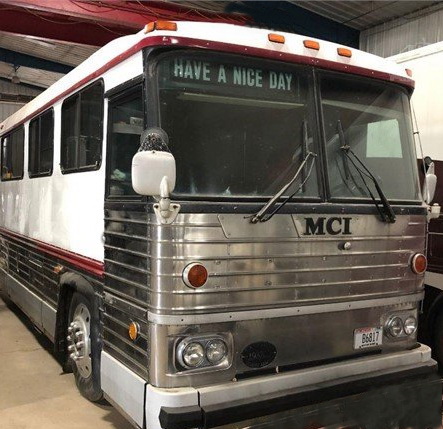
But my favorite of all the downtown denizens was the Shooter, a heavy-set guy who hung around the bus stop at Union and Fourth Avenue North. His favorite time to come out was rush hour, when there was a steady stream of buses heading up Union and he could perform his magic. He’d stand in front of a bus and pretend he was shooting the driver. Holding his hands in front of him like a kid playing at shooting a pistol and making bang-bang sounds, he would dance around until a bus started moving toward him. Then he’d quickly scamper to the sidewalk and wait for the next one.

There was one bus driver who just couldn’t stand him. This driver was a very tall man – at least six feet, six inches. I’d known him since childhood, as I rode the bus all over Nashville in the ‘50s. I was most surprised when we moved over on Richland Avenue to discover that he lived just a block away on Central. 

One warm afternoon, the tall driver had finally had enough of the Shooter jumping away from his bus at the last second. He arranged for a supervisor to be there with a policeman, and when the shooter performed his act, the officer arrested him.  Much to my sorrow, I never saw him again.

The driver told me this story one afternoon as we cruised out West End toward my stop. Whatever happened to him, I wanted to know. The story was that some relatives from down in the country came and got him. They took him somewhere that didn’t have buses to tempt him. I still sometimes wonder whether going cold turkey helped him, or whether he went completely over the edge after he was bereft of his beloved Nashville Transit Company buses. Or maybe he discovered school buses in that small town and had a happy retirement.  I hope so.

Aesop and the Wedding of Human and Natural History

Musings by Mike Slate.

Would you drive across town to visit a tree? Our busy lives and priorities seldom allow such a trek. However, whether old or young, man or woman, liberal or conservative, we share this oxygenated planet with many other interdependent life forms. Although human history is the historiographer’s normal province, other species also have important stories to tell if we would but listen.

This magnificent oak tree became part of the TN Landmark & Historic Tree Register in 1999, nominated by James Summerville. (photo by Maury Miller III)

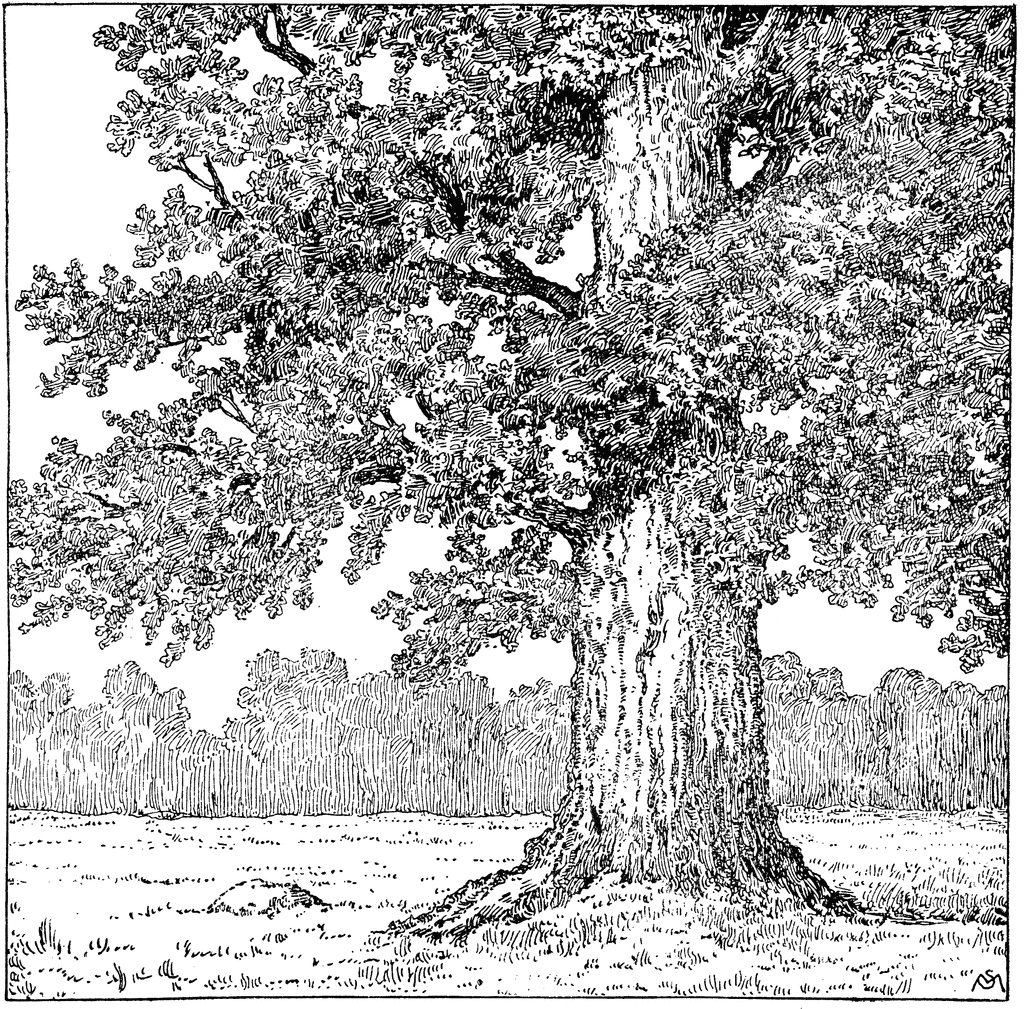
“Aesop” is the name I have given a stunning oak tree on Granny White Pike at Clifton Lane. Like his namesake, the ancient fabulist, our Aesop has contributed significantly to our lives, albeit in silence and relative obscurity. We take him for granted most of the time, but he has been honored at least twice. He was the champion chestnut oak* in the 1994 Big Old Tree Contest sponsored by the Nashville Tree Foundation, and in 1999 he was voted into the Tennessee Landmark and Historic Tree Register.

Aesop is old enough to have been present at the 1864 Battle of Nashville. Perhaps weary Union or Confederate soldiers leaned upon him, or maybe his roots absorbed the blood of the slain. Through the years frolicking children have no doubt played on and around him as their elders enjoyed his shade and admired his grandeur. He has been home to song birds, squirrels, raccoons, insects. I wonder whether a mathematician could calculate the number of liters of oxygen Aesop has provided, or the number of lungs his breath would fill.

The Battle of Nashville Monument (photo from NHN collection)

About twenty yards northwest of Aesop stands the distinguished Battle of Nashville Monument, which, in addition to the conflict it so aptly commemorates, has its own illustrious history. Thus, two archetypes stand juxtaposed in one small park – one of natural history and one of human history.

Historians are slow to combine the various divisions of their discipline. An outstanding example is the continued segregation of the histories of white and black Americans. The relatively new field of women’s studies contains still more historical material not often integrated into the general curriculum. Clearly the wedding of human and natural history is a rare occurrence, although such works as Harriette Arnow’s wonderful books, Seedtime on the Cumberland and Flowering of the Cumberland are significant exceptions.

Although you may never read about Aesop in a history book, he is well over 150 years old, perhaps demonstrating more character and majesty today than ever before. His existence has become quite personal to me–as it has to others. I know from experience that his northwest side is an effective shelter from a slow rain. I usually visit him alone, although to be alone with Aesop is to have plenty of company. Perhaps the concept of tree spirits might be more than just a primitive or romantic notion.

Like his namesake, Aesop is a teacher. He shares his woody wisdom freely, instructing us in such values as dependability and service to others. He is a visual mantra, an environmental balm, an arboreal benediction, a monumental survivor. Gather the children or grandchildren and pay him a visit: he will greet you with open arms.


* Other experts have identified this tree as a Chinquapin oak rather than a chestnut oak. These two varieties of white oak are quite similar.