Few people who look at President Andrew Jackson’s portrait on a twenty-dollar bill think of him as a maker and purveyor of liquor, yet Jackson and his partner Thomas Watson owned two stills in 1802, producing 499.5 gallons of Tennessee corn whiskey from December 1802 through February 1803. Most of this whiskey was delivered to stores co-owned by Jackson, Watson, and John Hutchings, but Jackson kept 82.25 gallons for his personal use.
Birthplace of Andrew Jackson
This and other business relationships between Andrew Jackson and Thomas S. Watson Sr. did not last long. Although their families continued to be associated for the remainder of their lives, the two men were no longer partners after 1803. Consequently, few people know of Thomas S. Watson Sr. What follows is a brief sketch that illuminates this relatively obscure business partner and neighbor of our former President from Nashville.
Thomas S. Watson Sr., born in Virginia about 1758, was the son of John Watson and Elizabeth Ann Jones of Prince Edward County, Virginia. His father was High Sheriff and later became a magistrate of Prince Edward County; his uncle was Revolutionary War General Joseph Jones; and his wife was Sally Sanders, daughter of Thomas Sanders and Mary Mitchell. Watson and his wife moved to Davidson County after selling their Prince Edward County lands in 1796.
The first evidence of Thomas Watson in Tennessee is a 1798 indenture recorded in Davidson County, in which he signs his name as a witness to the purchase of 300 acres on Stoner’s Creek by John Watson of Prince Edward County, Virginia, from John Donelson of Davidson County, Tennessee. It was John Donelson’s sister Rachel who had married Andrew Jackson in 1791.
Before coming to Tennessee, Thomas S. Watson Sr. and his brother Augustus had built a “merchant mill” on Falling Creek in Prince Edward County, Virginia. By 1802 Thomas owned another mill, near Nashville, which was used to grind the corn for the aforementioned whiskey. He became owner of Barker’s Mill on the West Fork of the Red River in Christian County, Kentucky, by 1815, and about 1816 he also built what later became known as Peacher’s Mill in Montgomery County, Tennessee.
These milling activities notwithstanding, Thomas S. Watson’s primary business interest was iron-making, and he and his brother-in-law/business partner, Peter Guerrant Moseley, were acknowledged as ironmasters. The firm of Watson and Moseley operated the Yellow Creek Iron Works in Montgomery County, Tennessee, where the smelting furnace appears to have been in existence as early as 1802 and probably reached its zenith in the 1820s, after its purchase by Thomas S. Watson Sr. and his son-in-law. The 1820 federal census of Montgomery County shows a total of 71 persons employed at the iron works: 30 free whites, 40 slaves, and one free colored person. A smelting furnace like the Yellow Creek Furnace was undoubtedly a hot, dirty, and dangerous place in 1820. Consequently, Thomas S. Watson Sr. maintained an estate in Wilson County, Tennessee, for his wife and younger children, and in the 1820 federal census he was enumerated there as well as in Montgomery County.
Perhaps the most famous of the early Tennessee ironmasters was Montgomery Bell, after whom the renowned academy in Nashville is named. The fact that Thomas S. Watson Sr. and his son-in-law, John Hartwell Marable, acquired 2,476 acres on Yellow Creek from Montgomery Bell in 1819 suggests that Watson and Moseley’s earlier association with Yellow Creek may have developed through some type of relationship with Bell. John Hartwell Marable represented the Clarksville area of Tennessee in the United States Congress from 1825 through 1829.
Thomas S. Watson Sr. founded the Red River Forge in Montgomery County around 1816 or 1817, along with the dam and facilities later known as Peacher’s Mill. Two Montgomery County post offices were associated with these early iron works: the Red River Forge post office operated from 1826 through 1829, and the Yellow Creek Furnace post office operated from 1825 through 1866. Thomas S. Watson Sr. and Peter Moseley returned to the Nashville area before 1830, settling near the confluence of Drakes Creek and the Cumberland River, at the point where Davidson, Sumner, and Wilson Counties meet. Peter Moseley eventually moved westward and died in Yazoo, Mississippi.
At the age of 82 Thomas S. Watson Sr. was living in Sumner County, Tennessee, where he was enumerated in the 1850 federal census as a member of the household of his son Thomas S. Watson Jr. The younger Watson operated, in Saundersville, a public tavern and hotel, which was later known as the Wayside Inn, and he was a superintendent of Sumner County School District #7. The date of death and place of burial of Thomas S. Watson Sr. are not known.
A third Thomas Watson was associated with this family: Thomas Tennessee Watson was the nephew of Thomas S. Watson Sr. and a son of Sarah Branch Jones and LTC Augustus Watson. Thomas Tennessee Watson was nine years old in 1815 when his father died at Camp Carter in Albemarle County, Virginia, during the War of 1812. Thomas later came to Tennessee, assisted in founding the Tennessee Medical Society, and became a noted ironmaster himself. His tombstone stands near the remains of the Central Furnace in the Land Between the Lakes recreation area near Cadiz, Kentucky. Genealogists should be advised that some researchers have confused Thomas Tennessee Watson with his cousin, Thomas S. Watson Jr. and have erroneously concluded that Thomas Tennessee Watson was a son of Thomas S. Watson Sr.
By 1853 Jesse Warren (1814-1885) and his partner Joseph Moore (1821-1871) had established a millwork machine shop on High Street (today’s 6th Avenue) in Nashville, Tennessee. The Warren & Moore company achieved local and regional prominence by 1857 when its nearly 50 employees, using steam-powered equipment — that era’s most modern — were producing massive quantities of balusters, newels, sash, doors, blinds, moldings, and dressed lumber of all kinds.
An 1863 story in the Nashville Dispatch showed Warren Brothers to have played an active role in civic affairs as early as 1855. The article listed the firm among the “very liberal” benefactors of the Nashville Protestant School of Industry for the Support and Education of Destitute Girls. The school’s all-female board of directors reads like a “Who’s Who” of Nashville’s first families, with names like Rutledge, Fogg, Kirkman, Maney, Campbell, Lindsley, Harding, and McGavock, along with Mrs. James K. Polk.
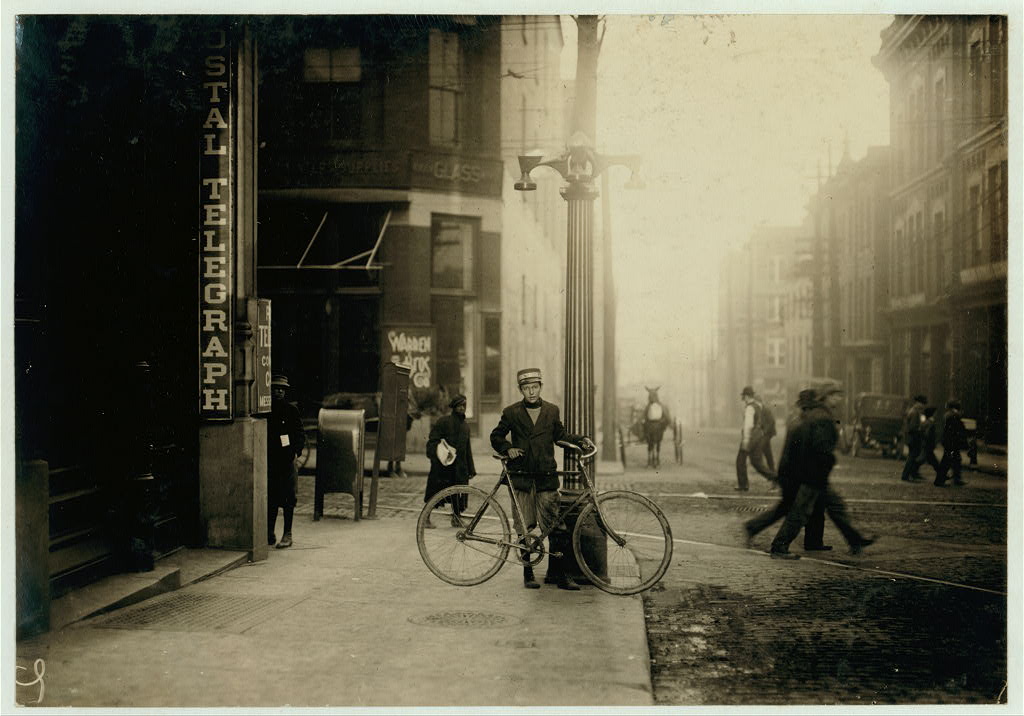
In 1874, continuing their father’s tradition, Jesse Warren Jr. (1853-1928) and his brother Joseph Moore Warren (1855-1920) established a business at 30 South Market Street (today’s 2nd Avenue) specializing in paints, oils, glass, and artists’ materials, but also offering sash, doors, blinds, and other building materials. The Warren Brothers Company operated on Market Street for about two years before moving to College Street (now 3rd Avenue North). The building on the corner of 3rd Avenue and Church Street, one block east of the famous Maxwell House Hotel, was Warren Brothers’ home for the next 50 years. Lewis Wickes Hine‘s well-known photograph of 14-year-old bicycle messenger George Christopher was taken in November 1910 near the Warren Brothers shop, which can be seen in the background, below.
Photo of bicycle messenger George Christopher by Lewis Wickes Hine, 1910. Lot 7480, v. 2, no. 1743 [P&P]. Library of Congress Prints and Photographs Division, Washington, D.C.
In addition to his partnership in Warren Brothers, Joseph Warren served from about 1892 to 1911 as the general manager of the Edgefield & Nashville Manufacturing Company. This large producer of millwork and furniture was situated just across the Cumberland River from the courthouse. Thus, Joseph manufactured millwork items on the north side of the river and sold millwork at Warren Brothers on the south side. Jesse Jr. left the company before 1910 and, according to Warren family lore, “went west.” He and his family (wife Alice, two sons, and three daughters) appear in the 1910 U.S. Census living in Portland, Oregon. A widower by the time of the 1920 Census, Jesse and his daughter Alice were still in Oregon, now living in the household of his daughter Frances Warren Tetu. He died in Portland on September 3, 1928. After Jesse’s departure, the future of the company was left predominantly to Joseph Warren and his descendants, Joseph Warren Jr. (1877-1942) and Joseph Warren III (1907-1968).
In 1909, capitalizing on Warren Brothers’ success in the paint business, Joseph Warren Jr. founded a separate firm, the Warren Paint and Color Company, which rapidly attained international distinction. The business continues to operate at 700 Wedgewood Avenue, its location since the early 1920s. In 1927 Warren Brothers relocated from 3rd and Church to 1146-1148 Broadway. About 1936 the company moved just north of the Tennessee State Capitol, at 7th Avenue and Harrison Street, where its warehouse facilities had been located for several years. The 7th and Harrison site is now part of the Tennessee Bicentennial Mall.
On May 22, 1967, the expanding Pacific Mutual Door Company, headquartered in Kansas City, Missouri, and led by Ray Lambert (1902-1986) and his son S. R. Lambert Jr., purchased Warren Brothers from the Warren family. A new plant was constructed on suburban Massman Drive, where, after nearly forty years at the 7th and Harrison location, Warren Brothers began operations in its new facility in 1975. Today Warren Brothers Sash and Door Company operates as an independent branch of its parent company. After many decades of wholesale millwork distribution to its many customers in the mid-South area, Warren Brothers is recognized as one of the oldest Nashville companies still in business. The company continues to approach the future with the same pioneering spirit that guided Jesse Warren and Joseph Moore in the 1850s. (1996)
Primary Source Document, transcribed by Mike Slate.
An Early, Official Account of the Battle of Buchanan’s Station from American State Papers: Indian Affairs, Vol. 4, pp. 294-295
Governor Blount to the Secretary of War, Knoxville, October 10th, 1792
Sir: Yesterday I received an express from General Robertson, by which I have the enclosed account of the attack upon Buchanan’s station on the 30th September: his letter was dated on the 3d instant, on the Indian Trail, four miles from Buchanan’s station, where he was encamped with three hundred men, waiting the return of the reconnoitering party. The express informs me, after he left the General, he (the express) received information of twenty-four Indians being seen on that morning at Fletcher’s Lick, eight miles southwest of Nashville, and seven on the north side of the river, about as many miles distant from the town: the first mentioned fired upon Mr. Joselin and the latter upon Mr. McRory, but neither received any wound. This is all I have yet heard of the large body of the Creeks and Cherokees that passed the Tennessee, from the 15th to the 17th September, as mentioned by the Breath, Charley, and John Boggs. Fourteen days elapsed from the passing of the Tennessee to the attack upon Buchanan’s station, when the distance between could have been marched in from four to six days. Difference in opinion, as to the mode and place of attack, at the rendezvous after they passed at the Tennessee, probably was the cause of the delay; I have no other way to account for it; and it is a rock on which large parties of Indians have generally split, especially when consisting of more than one nation.
It is to be hoped the repulsed party will return with their wounded, and it is to be feared, from the firing of the parties upon Joselin and McRory, that such small parties will continue on the frontiers, and commit depredations, but not such as were justly apprehended, when it was known so large a party had passed the Tennessee. General Robertson received my order of the 14th to discharge the militia in service, under my order of the 11th, on the 20th of September, but hesitated to execute it, because he had been previously informed by Jo. Deraque and Richard Finnelson, that the chiefs of the Lower towns would write me as they did (alluding to the letters of the Galss [sic] and the Bloody Fellow) with an intention to deceive me; the event has proved the truth of the information, and justified the General’s conduct. The express further informs me that the Cumberland people are in good spirits; and employ every hour, when they are not embodied for the common defence, in erecting block-houses and stockades, the better to ensure safety to their families. I am without information worth communicating, both from the Upper and Lower Cherokees, since that received by John Bogs [sic] and the Hanging Maw. Since the 11th of September, the day on which I received the letter from the Turkey and the other chiefs of the Upper towns, giving me notice of the determination of the five Lower for war, and of theirs to continue in peace and friendship, I have omitted no occasion of impressing the people under my government with the necessity of considering the Upper towns as much friends as if the Lower had not declared for war; and I have the pleasure to assure you that their conduct, not only in observing the treaty, but in their treatment of the friendly Indians, deserves the highest commendation; and upon the complaint of the Hanging Maw, that some of the frontier people of North Carolina at Swannano, had behaved “cross,” as he expressed it, to some of the Cherokees of the Upper towns, I thought it proper to forward an address to them on the subject, a copy of which you have enclosed. Nevertheless, I have information on which I fully depend, that several young men of the Upper have joined the Lower towns; and there is no doubt but more will; and even suppose they ultimately all should, (which I do not suspect) [no period mark] I trust it will be thought good policy in me to keep the friendship of as many as I can, until I have the honor of your orders on that head.
Only part of two companies have arrived here since the return made to your office of Major Sawyer’s battalion: but in the course of ten days I expect nearly the whole number called for by my order of the 27th September, of which I gave you information in my letter of that date by Mr. Allison.
The Captain de Mombray, of Nashville, whose name is mentioned in the information of Jo. Deraque and Richard Finnelson, is the bearer of this letter, an old resident of Kaskaskias, where he served as a Captain under General George Rogers Clark; last war, with reputation, and is now a valuable and respectable citizen.
I have the honor to be, &c.
An account of the attack, by the Creeks and Cherokees, upon Buchanan’s Station, on the 30th September, 1792
On the 30th September, about midnight, John Buchanan’s Station, four miles south of Nashville, (at which sundry families had collected, and fifteen gun-men) was attacked by a party of Creeks and Lower Cherokees, supposed to consist of three or four hundred. Their approach was suspected by the running of cattle, that had taken fright at them, and, upon examination, they were found rapidly advancing within ten yards of the gate; from this place and distance they received the first fire from the man who discovered them, (John Mc. Rory.) They immediately returned the fire, and continued a very heavy and constant firing upon the station, (blockhouses, surrounded with a stockade) for an hour, and were repulsed with considerable loss, without injuring man, woman, or child, in the station.
During the whole time of attack, the Indians were not more distant than ten yards from the blockhouse, and often in large numbers round the lower walls, attempting to put fire to it. One ascended the roof with a torch, where he was shot, and, falling to the ground, renewed his attempts to fire the bottom logs, and was killed. The Indians fired 30 balls through a port-hole of the overjutting, which lodged in the roof in the circumference of a hat, and those sticking in the walls, on the outside, were very numerous.
Upon viewing the ground next morning, it appeared that the fellow who was shot from the roof was a Cherokee half-breed of the Running Water, known by the whites by the name of Tom Tunbridge’s step-son, the son of a French woman, by an Indian, and there was much blood, and signs that many dead had been dragged off, and litters having been made to carry their wounded to their horses, which they had left a mile from the station. Near the blockhouse were found several swords, hatchets, pipes, kettles, and budgets of different Indian articles; one of the swords was a fine Spanish blade, and richly mounted in the Spanish fashion. In the morning previous to the attack, Jonathan Gee, and Clayton were sent out as spies, and on the ground, among other articles left by the Indians, were found a handkerchief and a moccason [sic], known one to belong to Gee, and the other to Clayton, hence it is supposed they are killed.
Theodore Roosevelt’s rise to the Presidency was meteoric. In 1897 he resigned from his position as Assistant Secretary of the Navy to lead the Rough Riders in the Spanish-American War. Returning from Cuba a hero, he was elected Governor of New York in 1898. In 1900 he was chosen to serve as William McKinley’s Vice President, and, when McKinley was assassinated a year later, Theodore Roosevelt became President. He was 42 years old. In 1904 he was elected President in his own right.
This dynamic man visited Nashville on October 22, 1907, and received a warm welcome. After he arrived at Union Station about 9:00 a.m. in his own rail car , a parade formed on Broadway behind the President in a horse-drawn carriage, accompanied by 25 to 30 automobiles. The escort of honor was Troop A of the Confederate Veteran Cavalry. The procession moved down Broadway to Eighth Avenue. At that corner were some 2,000 students from schools including the University of Tennessee Medical School, the Hume and Fogg Schools, Buford College, Belmont College, Radnor College, Boscobel College, and St. Cecelia Academy. The parade then wound its way through downtown, ending up at the Ryman Auditorium.
Theodore Roosevelt at Peabody College (postcard image courtesy of C. Michael Norton)
At the Ryman, Roosevelt delivered his principal address of the day. He touched on such current issues as turning the Mississippi River and its principal tributaries into navigable waterways, as well as more enduring issues, like the necessity of preventing stock manipulation (in his words, the need to “punish successful dishonesty”). Leaving the Ryman, Roosevelt changed vehicles to a 50-horsepower Peerless automobile and headed toward the Hermitage. The procession stopped at Peabody College, then located on “College Hill” at Second and Lindsley. This area also included the University of Nashville Medical College and Montgomery Bell Academy.
After a few brief remarks, Roosevelt and his entourage left again for the Hermitage. On the trip out Lebanon Pike, the vehicles passed the site of the Clover Bottom horse racing track where Andrew Jackson had raced his horses. Arriving at the Hermitage where a crowd of over 10,000 had gathered, Roosevelt met with officials of the Ladies’ Hermitage Association. After a tour the President spoke to the crowd on the grounds and promised to secure federal funds to be used toward the preservation of the Hermitage.
The procession’s final stop was at the Confederate Solders’ Home, where the President also made a few remarks. Finally, he returned to his rail car at the Hermitage Station and left Nashville a little after 1:00 p.m., heading south to Chattanooga. During the trip he stopped and briefly spoke from his rail car at several towns, including Murfreesboro and Tullahoma.
An interesting aside concerning this visit involves the advertising campaign later developed by Maxwell House, which attributed its slogan “good to the last drop” to Roosevelt, based on a comment he allegedly made at the time. In fact, it is unlikely that he made such a statement. Nashville newspapers reported that, during his visit to the Hermitage, Roosevelt did ask for a cup of coffee; none of the reports, however, indicated the brand of coffee that was served to him. The Nashville Banner reported that Roosevelt enjoyed the coffee and said, “This is the kind of stuff I like, by George, when I hunt bears.” One can hardly imagine a successful advertising campaign based on that slogan!
Sources: Nashville Tennessean, October 23, 1907. Nashville Banner, October 22, 1907. The Nashville American, October 23, 1907. Carey, Bill. Fortunes, Fiddles, & Fried Chicken, Hillsboro Press, 2000, pp. 47-48.
Back in the days when tent circuses travelled the land, there was a story told of an old showman being asked for his concept of the hereafter. He is said to have replied, “It must be like the circus lot in Nashville.”
To the generation who grew up here prior to WWII, the Centennial Park athletic field on 25th Avenue (where the Sportsplex is now situated) was the city’s principal circus lot. There a spacious, level, and grassy expanse welcomed the big tent circuses year after year.
The John Robinson Circus may have been the first to play this lot in 1910. Forepaugh-Sells Bros. was there in 1911. During the flamboyant years of the American circus, all the great railroad shows came to Centennial Park: Sells-Floto, Al G. Barnes, Hagenbeck-Wallace, and Cole Bros., to name a few. Barnum & Bailey and Ringling both played there prior to their unification in 1919; and the combined show then played the park most years through 1947, when the park board decided to close Centennial to circuses.
During that era, the flatcars would unload at Kayne Avenue, the wagons being pulled up Division Street to the top of the hill and then over to West End. The zebras, camels, llamas, performing horses, and any elephants not needed for pulling wagons were unloaded from stock cars at the north end of the yards and led out Charlotte to 23rd Avenue, thence to the show grounds, going in the back way.
As you came on the lot from 25th, you would enter the “midway” area where the sideshows (with its congress of strange people) and numerous concession stands would be raised. Beyond that was the main entrance to the circus, which took you first into a long menagerie tent where you could walk cage to cage and from pen to corral viewing animals from the corners of the earth. I saw my first gorilla (the famous “Gargantua”) here. The elephants might number from a dozen to forty, and it was not unusual to find giraffes, a rhino, and a hippo on display along with polar bears and other species not generally found in Nashville.
Working your way through the menagerie, you would find yourself in the big top, a mammoth canvas tent as long as a football field and seating several thousand. Here the actual circus performance took place, and it was always a good one. All the big circus stars played Centennial Park: Clyde Beatty (whom I still consider the greatest of the lion and tiger trainers), the Wallendas of the high wire, the Zacchinis with their mammoth cannon, the Riding Hannefords, and the famous sad-faced clown Emmett Kelly. Tom Mix was once here with Sells-Floto and Jack Dempsey came with Cole Bros.
But those days are over; dead and gone. Apparently more dead than I’d realized. We recently overheard an old timer telling a member of a younger generation about the circuses he’d seen at Centennial Park. The listener responded with, “Sir, you must be mistaken; there isn’t a building at Centennial Park big enough for a circus.” (1997)
Elm Hill Pike is one of the most historic roads in Nashville. Few thoroughfares in our city contain so much history packed into so few miles. The road, which probably began as a buffalo or Indian trail, has been mentioned in several accounts of early Nashville history. Andrew Jackson was reported to be a frequent traveler on Elm Hill Pike on his journeys from downtown Nashville to the Hermitage. Mapmakers and old-timers have also referred to this road as “the chicken pike” and the Stones River Road.
As you turn off of Murfreesboro Pike onto Elm Hill Pike, the first historic site encountered is Mt. Ararat Cemetery on the north. Mount Ararat was founded in 1869 by local black leaders and became a burial ground for many of Nashville’s black pioneers. Over the years, the cemetery became a dumping ground and a target for vandals. In 1982 the management of Mt. Ararat was taken over by the Greenwood Cemetery’s board of directors, which voted to change the name from Mt. Ararat to Greenwood Cemetery West and to begin a comprehensive restoration project.
About a mile east of Mt. Ararat Cemetery is Greenwood Cemetery, established on thirty-seven acres in 1888 by Preston Taylor. Taylor, born a slave in Louisiana in 1849, was an influential black preacher, undertaker, and business leader. In addition to Taylor, illustrious Nashville citizens buried at Greenwood Cemetery include Z. Alexander Looby, the Rev. Kelly Miller Smith, Sr., DeFord Bailey, John Merritt, and J. C. Napier.
The gates of Mt. Ararat Cemetery (photograph from NHN Collection)
In 1906 Preston Taylor opened Greenwood Park on approximately forty acres adjoining Greenwood Cemetery. The park was established to serve the black community and included a baseball stadium, skating rink, swimming pool, theater, merry-go-round, bandstand, zoo, and many other attractions. A state-wide fair and a Boy Scout summer camp were also held at Greenwood Park. The admission to the park was ten cents on regular days and twenty-five cents on holidays. The Fairfield-Green streetcar stop was nearby and horse-drawn wagons would pick up patrons and deliver them to the park’s entrance at Lebanon Road and Spence Lane. Preston Taylor died in 1931 and his wife managed the park until its closing in 1949.
Buchanan’s Station was located about another mile east where Mill Creek crosses Elm Hill Pike. The station was established by John Buchanan in 1780. Twelve years later, an oft-recounted Indian battle ensued. On a moonlit night in 1792, a band of three hundred Creek and Cherokee, under the leadership of Chiachattalla, raided the station. The twenty-one settlers fought bravely and defeated their attackers, killing Chiachattalla. Major Buchanan lived at the station until his death in 1832. He is buried, along with his wife and other settlers, in the station’s cemetery.
John and Sally Buchanan’s gravestones in Buchanan Station Cemetery. (from NHN Collection)
Peabody College established the Seaman A. Knapp School of Rural Life in 1915 on one hundred fifty acres on Elm Hill Pike. More acreage, including the site of Buchanan’s Station, was acquired in 1922. The farm was the first institution in the United States devoted to the study of the problems of rural life. Peabody College officials believed that teachers should become acquainted with agricultural life since so many of them would be teaching in rural areas. The experimental farm became a showplace with award-winning dairy and beef cattle herds. Innovative techniques in irrigation, pasturage and field equipment were tested at the farm; and many crops were raised including a certified corn station and a contoured, 25-acre orchard. Knapp Farm provided Peabody College with all its meat, vegetables, and fruit until World War II. The importance of the farm declined after the 1920s because of state-supported agricultural research. Expensive to maintain, Knapp Farm was sold in 1965 to a contractor who developed it into an industrial park.
Though the exact location of Mud Tavern is disputed, most old-timers agree that it was near the intersection of Elm Hill Pike and McGavock Pike. The tavern, built during Nashville’s youth, was made of cedar logs with a mud and stick chimney. Andrew Jackson was a frequent patron and it is reported that he spent two days there planning strategy in his duel with the ill-fated Charles Dickinson. Years later a community named Mud Tavern grew up in the area and contained a railroad station, school, post office, and grocery store. The Mud Tavern school building was used for many years as a clubhouse by the Elm Hill Community Club.
On the far side of Donelson Pike, at the corner of Elm Hill Pike and Hurt Drive, is the James Buchanan house. This two-story log house was built circa 1809. James Buchanan and his wife are buried in the family graveyard near the house, which is now under the care of the Association for Preservation of Tennessee Antiquities.
At the present time, Elm Hill Pike ends at Bell Road. The eastern-most part of the road has been re-engineered several times. The course of the road itself may change, but the history of Elm Hill Pike will always remain as a significant part of Nashville’s heritage. (2000)
Philip Lindsley was born December 21, 1786, into a cultured New Jersey family that honored education as the highest virtue. The boy was sent away early to boarding school, advancing from Robert Finley’s Academy to the junior class at Princeton (then called the College of New Jersey) at the age of fourteen.1 He graduated in 1804 and earned his MA in 1807.2 Hired as a tutor by Princeton, he remained for seventeen years as teacher-librarian, renowned as an “earnest and impressive preacher”3 and an inspiring professor of linguistics and theology.
Philip Lindsley served as Princeton’s interim president for a year but refused the presidencies of Transylvania University, Ohio University, and Dickinson College. “I infinitely preferred my peaceful classical chair at Princeton,” he wrote.4 The Trustees of Nashville’s Cumberland College pursued him for months before he finally accepted their offer. “Throughout the [Southwest] there exists not a single college,” he explained to friends. “The time has arrived when they must have the means of education at their own doors.”5 On December 24, 1824, he moved his wife and four children to Tennessee.
The Nashville area was educationally unique. Within five years of its first permanent settlement (1779-1780), as the community still faced Indian attacks, Thomas Craighead presided over Davidson Academy. The school became Cumberland College in 1806; its main campus building opened in 1808.7 Craighead was succeeded by James Priestley, who soon suspended the financially unstable school’s operations.8 Lindsley had much to overcome.
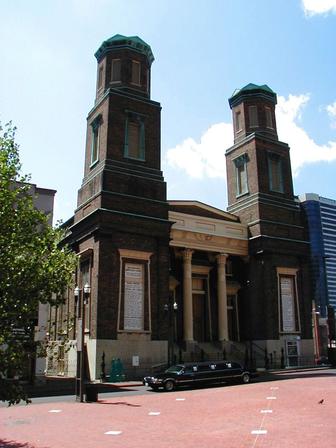
First Presbyterian Church of Nashville (photograph from NHN collection)
President Lindsley was inaugurated on January 12, 1825, at Nashville’s First Presbyterian Church.9 He revised the school’s charter in November 1826 and renamed the institution the University of Nashville. He first proposed opening a medical college in 1829. The committee he appointed in 1843 to study the prospect recommended the immediate establishment of a medical school.10
For twenty-five years Philip Lindsley taught two dozen class hours a week while also struggling with complex financial and administrative challenges. Disciplinary issues in this boisterous frontier college made harsh demands on the gentle educator. School records are full of “expulsions and midnight riots in which heads were bruised and equipment destroyed.” 11
By 1850 a series of conflicts and losses had sapped Lindsley’s energy. The deaths of his wife and nine-year-old son had devastated him.12 His faculty was aging; Professors James Hamilton and Gerard Troost had died. The university neighborhood had deteriorated, and the Board wanted to rebuild elsewhere.13 A cholera epidemic and competition from Cumberland College in Lebanon diminished enrollment, and no funds were available to build the coveted medical school that Lindsley had dreamed of.14 The Board rejected Lindsley’s 1849 offer to resign,15 but pressures and criticisms continued to grow.
In April 1849 Lindsley married Mary Ann Ayers, widow of the founder of New Albany Theological Seminary. When the Seminary Board offered him a professorship, he accepted, moving to Indiana in December 1850.16 He taught there until shortly before his death.
Philip Lindsley suffered a stroke in Nashville on May 23, 1855, and died two days later, attended by the University of Nashville Medical Faculty.17 (2014)
NOTES:
1 Lindsley, Philip. The Works of Philip Lindsley, D. D.: Volume III, Miscellaneous Discoursesand Essays. Philadelphia: J. B. Lippincott & Co., 1866, 11.
2 Lindsley, Volume III, 14.
3 Maclean, John Jr., Princeton President 1854-68, quoted in Lindsley, Volume III, 16.
4 Lindsley, Volume III, 23.
5 Lindsley, Volume III, 24.
6 Crabb, Alfred Leland. The Historical Background of Peabody College. Nashville: George Peabody College for Teachers, 1941, 9.
7 Crabb, 9.
8 Crabb, 10-11.
9 Lindsley, Volume III, 27.
10 Crabb, 18.
11 Crabb, 17.
12 Lindsley, Philip. Journal. Lindsley Family Papers, ca. 1812 – [1840-1940] – 1953, Box 2, Folder 33. Tennessee State Library and Archives.
13 Conkin, Paul K. Peabody College: From a Frontier Academy to the Frontiers of Teaching andLearning. Nashville: Vanderbilt University Press, 2002, 68.
14 Conklin, 69.
15 Crabb, 18.
16 Lindsley, Volume III, 54.
17 Lindsley, John Berrien. Diary, Volume 4, 1849-1856. Lindsley Family Papers, ca. 1812 – [1840-1940] – 1953, Box 1, Folder 21. Tennessee State Library and Archives.
The Hermitage, Andrew Jackson’s imposing home, survives today as a memorial to American history, to the old days of Tennessee, and to true love. Still standing proud and stately, it has endured poverty, the War Between the States, and the 1998 tornado. Today, perhaps more than ever before, The Hermitage serves to inspire and instruct us.
Recent archeological work at The Hermitage has uncovered some significant details of everyday 19th century slave life. Interesting finds in and near slave cabins on the property include sewing items, toys, and bits of money. The discovery of pencils and slates in every excavated cabin, indicating that Andrew Jackson’s slaves were literate, is surprising and leads us to re-examine some of our ideas about slave life. Good luck charms found at the dig sites are also fascinating, especially the Hand of Fatima which was used to ward away evil spirits. Underground “hidey holes” have also been great sources for archeologists at The Hermitage. Items stolen from the main house or passed along from a slave on a neighboring farm were commonly hid in these secret places.
Though it has become more or less expected to find them on plantation digs, the excavation of gun parts at The Hermitage is nevertheless startling. Hammers, flints, and lead shot have been found, pointing toward gun possession among the slaves. Why would Andrew Jackson allow slaves to bear arms? One plausible explanation is that the slaves used guns to hunt game which included raccoons, squirrels, turtles, and deer. By allowing slaves to hunt, plantation owners could promote self-sufficiency in the slave community.
Archeologists at The Hermitage are optimistic about what the future will teach us about the past, and their successful work reinforces the role of the great plantation as a national treasure. The many fortunate discoveries they have made tempt us to ask: Has the Hand of Fatima had something to do with it?
Ashley Layhew White was a junior at McGavock High School in Donelson, Tennessee, when she wrote this essay for the May-June 2000 newsletter. Since that time she has become a respected historian in her own right.
According to Elmer G. Sulzer’s fascinating book,Ghost Railroads of Tennessee, the grandiosely titled Tennessee and Pacific Railroad Company was chartered in 1867. It was to connect Knoxville and Jackson, Mississippi, via Nashville and Memphis.
By 1877 the T&P was serving Nashville, Mt. Olivet, Mud Tavern, Donelson, Hermitage, Green Hill, Mt. Juliet, Silver Springs, Leeville (Stringtown), Tucker’s Gap, and Lebanon. By 1888 the system had become a branch of the NC&StL.
Jere Baxter attempted to acquire the right-of-way for his Tennessee Central line. Frustrated by refusals to sell, he built new tracks nearly paralleling those of the NC&StL. Excursion trains operated by the Tennessee Central Museum still use the TC tracks. The last train ran on the T&P tracks in 1935.
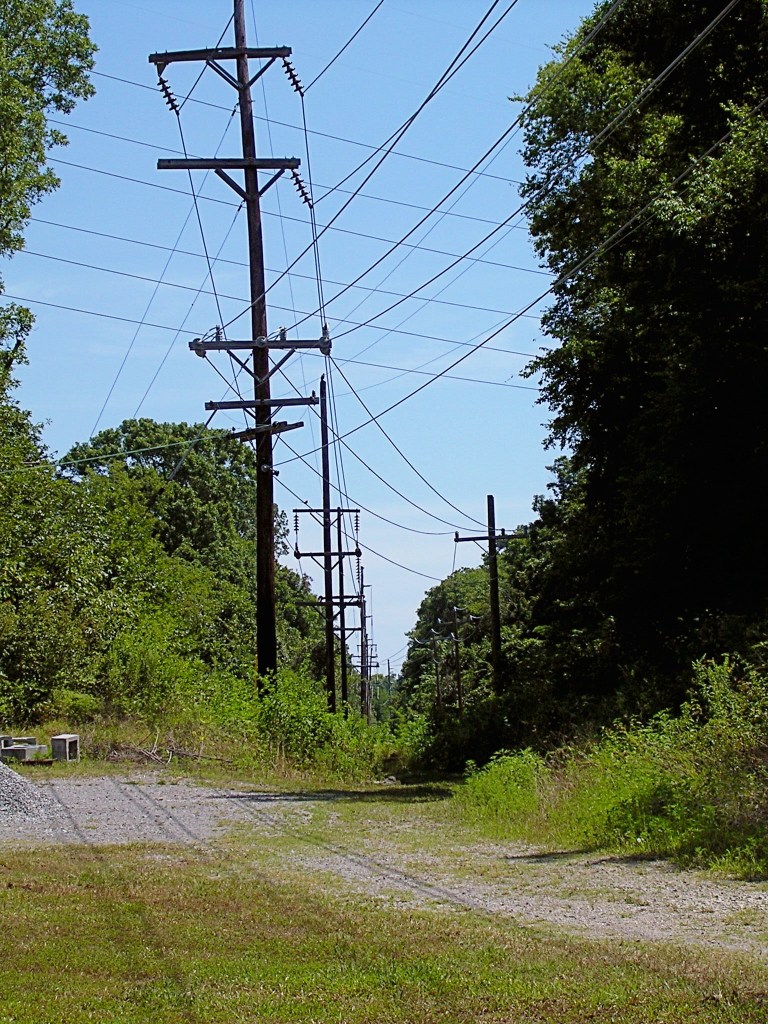
South and west of Elm Hill Pike at Mill Creek I found few remains of the T&P; but visible from both Elm Hill Pike and Massman Drive an abandoned railroad bridge is burdened with junked rail cars*. Eastward from there the former roadbed is marked by rows of power lines marching through the industrial area and across Acorn, Wanda and Sanborn Drives, and then across Briley Parkway.
Photo from NHN collection.
On the south side of Elm Hill Pike east of Ermac Drive, stone support walls of the railroad bridge which once crossed Sims Branch still exist. The right-of-way reappears on the west side of McGavock Pike north of Elm Hill Pike. The two-mile grade from Mud Tavern to Donelson Pike climbed about 100 feet. The N.E.S. poles are visible from Lakeland Drive a few yards above the Gateway Missionary Baptist Church and, farther east, from Seneca Drive.
West of the intersection of McCampbell Road and Donelson Pike, a driveway occupies the roadbed. Nearby Donelson Station changed the name of the former McWhirtersville.
Eastward from Donelson Pike, McCampbell Road runs on the right of and parallel with the procession of power poles. Before crossing Stewart’s Ferry Pike, the pair of roadbeds begin a parallel course.
The power lines terminate at the Nashville Electric Service substation on Stewart’s Ferry Pike. TSLA’s “Davidson County, ca. 1920, Map #1009” shows that the two roadbeds diverged between Stone’s River and Central Pike. The T&P roadbed then became Chandler Road from Central Pike east. At Old Lebanon Dirt Road, the Tennessee Central track and the T&P roadbed resume their side-by-side positions.
After crossing Tulip Grove Road, Chandler Road becomes West Division and then, beyond Mt. Juliet, East Division. The twin roadbeds continue into Rutland, where the tracks veer to the north. At Highway 109, the road doglegs right and left. Renamed Leeville Pike, it continues into Lebanon.
Update from NHN reader Al Grayson (11/2/2013): The cars and the bridge deck are gone by now . . .. This bridge was brought in when the Massman Drive industrial park was developed. It slopes upwards to the east as the western end of the grade was much higher. The old two-lane Elm Hill Pike passed under the approach bridge, whereas the new railroad line crossed Elm Hill at grade. All that is left of the T&P that still has track is an industrial spur off the main railroad track, which was there when the Massman Drive line was reopened in the late 1960s or early ‘70s. It ends just east of Poplar St. and is visible in some of the satellite views [such as Bing and Google maps].
April 24, 2003, marks the 223rd anniversary of the historical founding of Nashville. On that well-known date in 1780, John Donelson’s flotilla of about 30 flatboats and several pirogues completed the 1006-mile voyage via four rivers to the French Lick’s almost-completed log central station. Here the travelers joined James Robertson’s overland settlement party that had traveled into the western North Carolina frontier to cross the frozen Cumberland River on Christmas Day 1779 to establish an outpost of civilization. This two-prong settlement of Nashville was described by Theodore Roosevelt in Winning of the West as “being equal in importance to the settlement of Jamestown or the landing at Plymouth Rock.”
Not as well known is that this year also marks the 100th anniversary of the October 11, 1903, dedication of the Robertson Monument in Centennial Park. The monument’s towering 50-foot granite shaft is actually seven years older than its year of dedication, and the story of the monument’s creation in Nashville’s first public park is nearly as interesting as the Robertson pioneers it memorializes.
Photograph adapted from General James Robertson: Father of Tennessee by Thomas Edwin Matthews (Nashville: The Parthenon Press, 1934)
The monument’s existence is due to the energy, dedication, and vision of Nashville’s Major Eugene C. Lewis (1845-1917), owner of theNashville American newspaper and a consulting civil engineer. It was Lewis’ friend, local architect William C. Smith, who suggested in a late-1893 speech to Nashville’s Commercial Club that “a spectacular Tennessee Centennial be held to alleviate financial distress and to divert the attention of the people” from the long and severe depression that had engulfed America after the Panic of ’93. Before the depression, according to W. F. Creighton inBuilding of Nashville, local attorney Douglas Anderson had suggested in local newspapers that a celebration be held in Nashville to celebrate the centenary of Tennessee’s 1796 statehood. Although Anderson’s earlier suggestion had evoked favorable public response, no action was taken until Smith renewed interest in the project. The Nashville Tennessee Centennial Exposition Company was formed and by the summer of 1895 was beginning to acquire financial support for the event. John W. Thomas, president of the Nashville, Chattanooga and St. Louis Railroad, served as president of the Centennial Company and chairman of the executive committee of the Exposition, and Major E. C. Lewis was named director general. The site selected for the Exposition was the West Side Race Track and Park, located on the old fairgrounds surrounding the historic Cockrill Springs area at the end of Church Street and the terminus of the West End Avenue streetcar line. The first Tennessee State Fair had been staged on the site in 1869, with subsequent fairs held in 1873, 1879, and 1884.
The Centennial Exposition, held May 1 through October 30, 1897, was “essentially a fair on a grand scale,” wrote A. W. Crouch and H. D. Claybrook in Our Ancestors Were Engineers. Attractions included 12 large buildings featuring exhibits on the commercial, industrial, agricultural, and educational interests of the state; a “midway” including Egyptian, Cuban, and Chinese villages; a “Giant See-saw” designed by local engineer and steel fabricator Arthur J. Dyer; Venetian gondoliers on newly created Lake Watauga; a Venetian Rialto bridge designed by local architect C. A. Asmus; parades and “sham battles” by the Tennessee Militia; fireworks and other entertainment; and a 250-foot flag staff designed by E. C. Lewis. Major Lewis also had conceived the idea to create a replica of the 5th-century B. C. Athenian Parthenon to house the art exhibit, then commissioned local architect W. C. Smith to make the needed drawings. (The Parthenon, built during 1895-1897, and the city park board’s 1920 decision to have it rebuilt as a permanent structure is a story unto itself.)
Among the exhibits featured at the Exposition’s Mineral and Forestry Building was a towering, 50-foot granite shaft. The impressive monolith is attributed to the “Barry Vermont Granite Quarries” by Creighton in Building of Nashville, but Leland Johnson wrote in The Parks of Nashville that the “granite shaft was quarried at Stone Mountain, Georgia, by Venerable Brothers of Atlanta and shipped to Nashville for display during the 1897 Centennial Exposition. Oral tradition says a portion of the shaft broke off during transit to Nashville.” The shaft’s original flat-stone base remains today on the west bank of Lake Watauga and bears a metal plate commemorating the Centennial Exposition.
After the Exposition closed, all buildings except the Parthenon were torn down and removed. The success of the Exposition, as well as the progressive movement of the late 19th Century to establish public parks, planted the seed for Nashville’s park system. In 1901 Mayor James Head appointed five men, one of whom was Major E. C. Lewis, to the new Board of Park Commissioners. Negotiations were begun by the city in early 1902 with the owners of the 72-acre Centennial Park to purchase the land for a permanent city park. After months of complicated offers and counter-offers, described in The Parks of Nashville, Nashville Railway and Light Company purchased Centennial Park and its title was presented to the city park board on December 22, 1902.
On January 13, 1903, Major Lewis addressed the Tennessee Historical Society on the subject of James Robertson. He began his speech by informing the assembled members of “a fortunate circumstance that transpired only a few days ago. . . .For the first time in all its history, Nashville has park ground worthy of the Capital of Tennessee. The title to the Centennial Grounds, upon which the city has already contributed a large sum of money toward the adornment thereof, is now in the city of Nashville. The Park Commission. . .has so far determined upon but one measure, and that, the erection in Centennial Park of a monument [for] James Robertson, the founder of Nashville.” He concluded his lengthy profile of Robertson by asking, “What have we of Nashville done to honor this man’s memory? Has even the memory of all the good Robertson did been interred with his bones?. . .Are we a grateful people?”
Major Lewis had made prescient provisions to answer his own questions. When negotiations had begun to purchase the Centennial land, he purchased the 50-foot granite shaft for $200, then his fellow-commissioner Samuel A. Champion “resolved that it be erected in the park as a monument to the memory of James Robertson.” Lewis also purchased the flat-stone base for $10 in 1903 to remain beside Lake Watauga as a memorial to the Centennial Exposition. A new granite base was needed to support the heavy shaft after its relocation, but no record has yet been found of the base’s creator or its procurement. Wherever the massive base originated, Johnson described the monument’s creation in The Parks of Nashville: “With a tripod made of three large oak logs and block and tackle, Major Lewis raised the shaft into position and then constructed the foundation beneath it.” The granite shaft and its base weigh a total of 52.5 tons. Text is inscribed on a plaque on each side of the monument:
North Side Text: “James Robertson/Born in Brunswick County, Virginia, June 28, 1742. Moved to North Carolina in 1750. Came to Tennessee in 1769. Settled Nashville in 1780. Died in Tennessee Sept. 1, 1814. Reinterred in the City Cemetery at Nashville, 1825, under authority of the Tennessee Legislature.”
East Side Text: “Charlotte Reeves/Wife of James Robertson/Born in North Carolina, Jan. 2, 1751. Married to James Robertson, 1768. Died in Nashville, Jun. 11, 1843. Buried in the City Cemetery. Mother of the first male child born at Nashville. She participated in the deeds and dangers of her illustrious husband: won honors of her own and along his path of destiny cast a leading light of loyalty, intelligence, and devotion.”
South Side Text: “A worthy citizen of both Virginia and North Carolina. Pioneer, patriot, and patriarch in Tennessee. Diplomat, Indian fighter, maker of memorable history. Director of the movement of the settlers requiring that hazardous and heroic journey so successfully achieved from Watauga to the Cumberland. Founder of Nashville. Brigadier-General of the United States Army. Agent of the Government to the Chickasaw Nation. He was earnest, taciturn, self-contained, and had that quiet consciousness of power usually seen in born leaders of men. ‘He had winning ways and made no fuss.’ (Oconnostota) He had what was of value beyond price–a love of virtue, an intrepid soul, an emulous desire for honest fame. He possessed to an eminent degree the confidence, esteem, and veneration of all his contemporaries. His worth and services in peace and war are gratefully remembered. Amiable in private life, wise in council, vigilant in camp, courageous in battle, strong in adversity, generous in victory, revered in death.”
West Side Text: “James Robertson/Founder of Nashville/’We are the advance guard of civilization. Our way is across the Continent.'” Robertson—1779
The monument to James and Charlotte Reeves Robertson was presented to the city of Nashville on October 11, 1903, by Major E. C. Lewis on behalf of the Park Commission. About 100 Robertson descendants from all over the United States and one foreign country attended the ceremony in Centennial Park, according to Sarah F. Kelley in Children of Nashville. Three-year-old Dickson Wharton Robertson, descended through Dr. Peyton Robertson, was dressed in Scottish-plaid kilts and pulled the string to unveil the towering monument honoring his great-great-grandfather. Among those offering memorial tributes to Nashville’s founder were Governor James B. Frazier and Mayor James Head.
“History often repeats itself,” wrote Kelley. “On June 28, 1972, the descendants of James Robertson gathered once again in Nashville to celebrate Tennessee’s ‘James Robertson Day’ proclaimed by Governor Winfield Dunn.” Among the descendants gathered around the Robertson Monument in Centennial Park was the same Dickson Wharton Robertson who had participated in the monument’s unveiling 69 years earlier.
As the Robertson Monument approaches its centenary, the 107-year-old shaft has weathered well, as have the 100-year-old base and four bronze plaques. Attesting to the passage of a century is that the massive base appears to have sunk several feet into the earth since 1903. Without measured drawings to provide dimensions of the original base, however, a definitive conclusion cannot be made. Thus we celebrate the founding of Nashville with the hope that Centennial Park’s terra firma will continue to support the city’s monument to its founder, so that future Nashvillians may enjoy a bicentennial celebration of the Robertson Monument.
SOURCES:
Winning of the West, Volume II: From the Alleghanies to the Mississippi, 1777-1783, by Theodore Roosevelt (New York: G. P. Putnam’s Sons, 1889).
Tennessee Old and New, Sesquicentennial Edition, 1796-1946, Volumes I and II (Nashville: Tennessee Historical Commission and Tennessee Historical Society, 1946).
Seedtime on the Cumberland, by Harriette Simpson Arnow (New York: The Macmillian Company, 1960).
Building of Nashville, by Wilbur Foster Creighton; revised and enlarged by Wilbur F. Creighton, Jr., and Leland R. Johnson (Nashville: Wilbur F. Creighton, Jr., and Elizabeth Creighton Schumann, 1969).
Children of Nashville: Lineages of James Robertson, by Sarah Foster Kelley (Nashville: Blue and Gray Press, 1973).
Our Ancestors Were Engineers, by Arthur Weir Crouch and Harry Dixon Claybrook (Nashville: Nashville Section of American Society of Civil Engineers, 1976).
The Parks of Nashville: A History of the Board of Parks and Recreation, by Leland R. Johnson (Nashville: Metropolitan Nashville and Davidson County Board of Parks and Recreation, 1986).
Andrew Jackson Slept Here: A Guide to Historical Markers in Nashville and Davidson County (Nashville: Metropolitan Historical Commission of Nashville and Davidson County, 1993).






 Nashville Historical Newsletter